Summarize this article with AI
In Brief
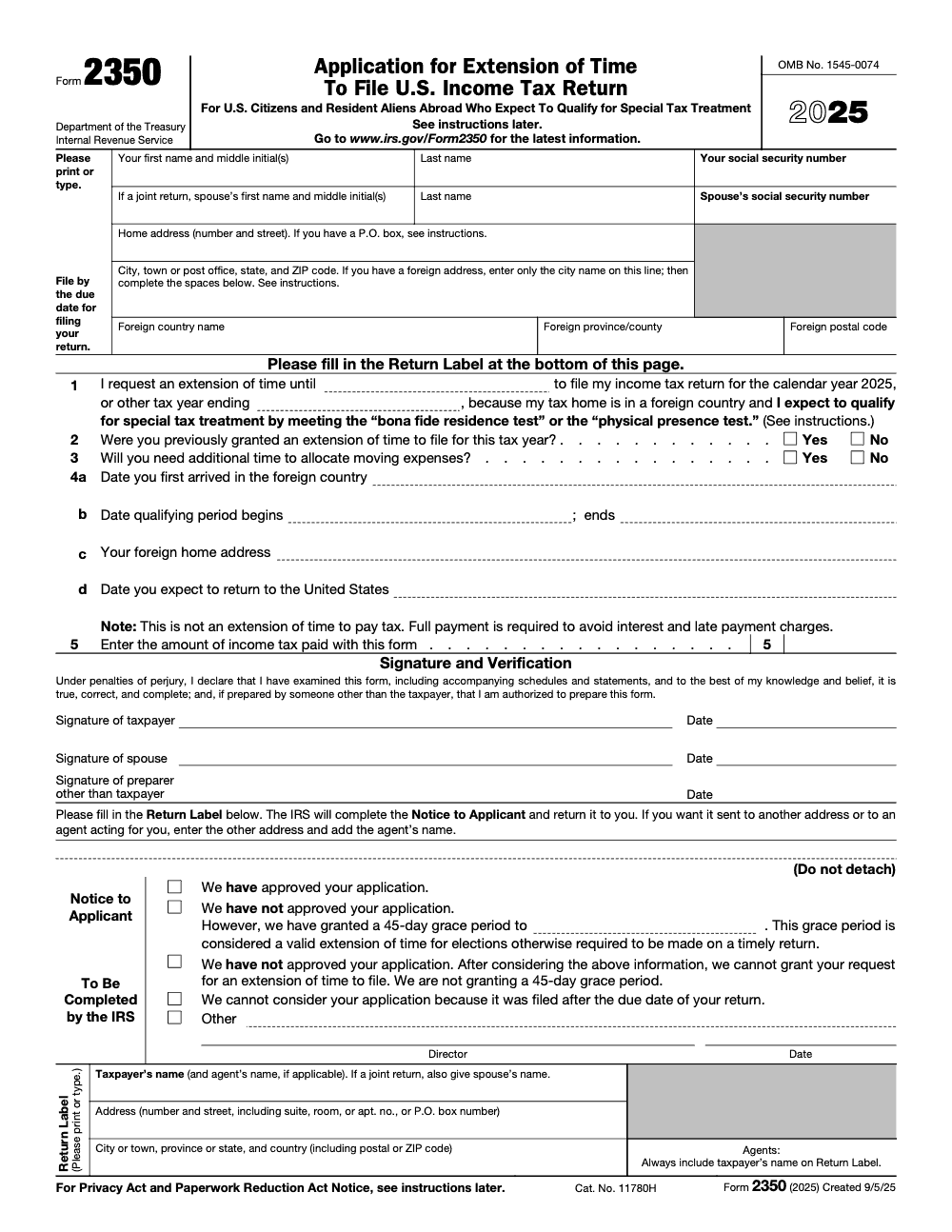
Form 2350 is the IRS extension U.S. citizens and resident aliens abroad use when they expect to qualify for the foreign earned income exclusion under IRC §911 but cannot meet the bona fide residence test or the 330-day physical presence test by the regular due date. Per the Form 2350 (2025) instructions, the application is due April 15, 2026 (or June 15, 2026 for out-of-country filers), full payment is still required by the regular due date, and the Line 5 income-tax payment carries to Schedule 3 (Form 1040), line 10 on the eventual return.
A client who moved abroad in late August emails days before her regular due date and asks whether her bona fide residence year has even started. Her tax home is clearly foreign, and she expects to meet the §911 test in the following calendar year. Form 2350 is the right tool, as long as it is filed by the regular due date.
Form 2350 is the extension U.S. citizens and resident aliens abroad use when they expect to qualify for the foreign earned income exclusion but cannot meet the bona fide residence test or the 330-day physical presence test by the regular due date. It buys time to file, not time to pay, so you still estimate and pay by the original deadline. The extension usually runs 30 days past the point you expect to qualify under the chosen test.

Key Takeaways
- Form 2350 is the IRS extension for expats who need time to meet the bona fide residence test or the 330 day physical presence test before filing with Form 2555. It is purpose built for FEIE timing, not a general extension.
- File by your original due date. If you live and work abroad on that date, you usually have an automatic 2 month filing window, for 2024 returns that was June 16, 2025 because June 15 fell on a Sunday. Interest still runs from April.
- The 2350 extension usually ends 30 days after you expect to qualify under the chosen test. In limited moving expense allocation cases, the IRS may grant up to 90 days beyond the end of the year after your move.
- This extends time to file, not time to pay. Estimate and pay by the original deadline to reduce interest and avoid penalties.
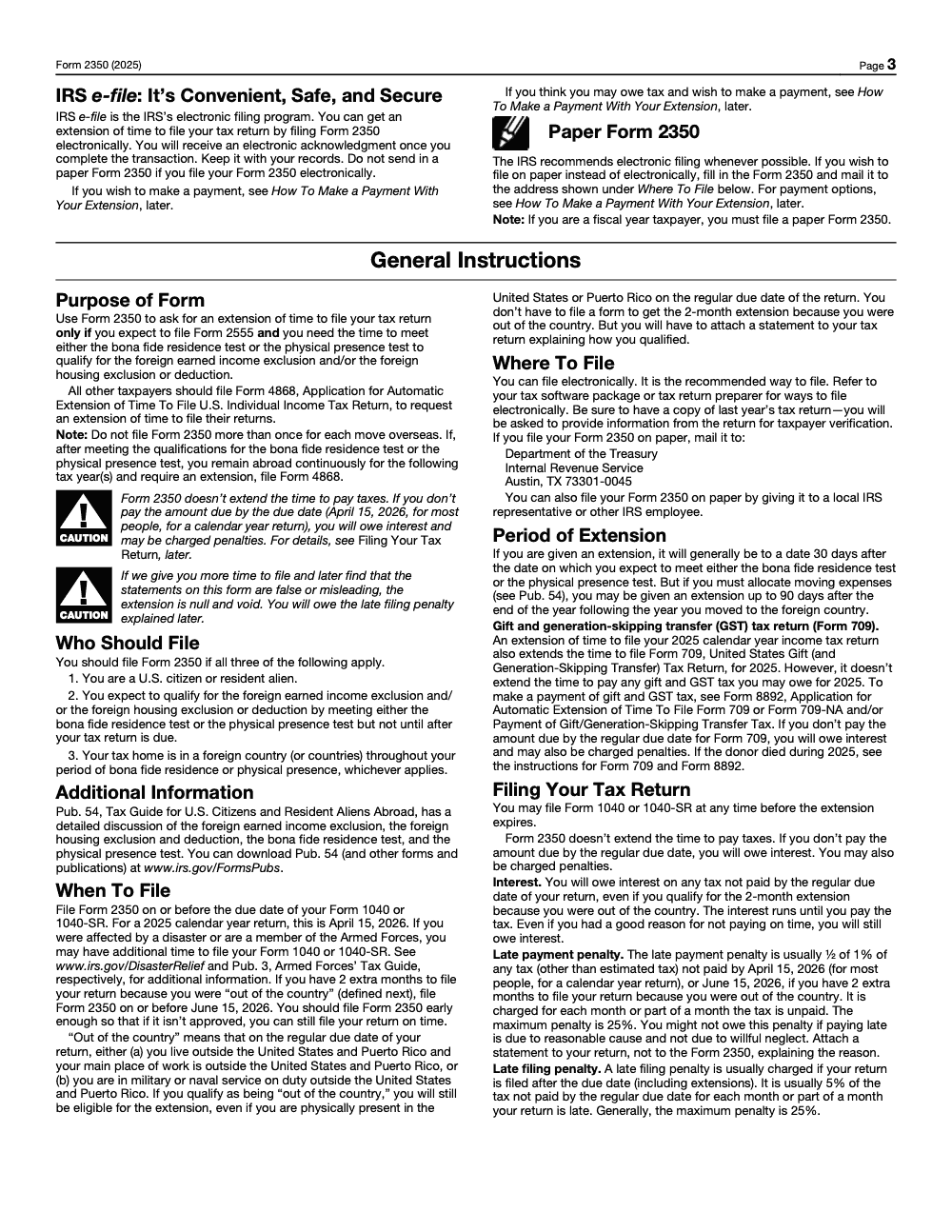
- Filing method. In 2025, authorized software can transmit Form 2350 through IRS Modernized e File, otherwise mail it to the IRS in Austin, TX. Always follow the current year instructions for the correct address.
What is IRS Form 2350 and who actually needs it
If you are a U.S. citizen or resident alien abroad, have a foreign tax home, and you expect to claim the Foreign Earned Income Exclusion on Form 2555, but you will not meet the bona fide residence test or the 330 day physical presence test by your regular filing deadline, use IRS Form 2350 to request a later filing date.
Two common paths qualify you for FEIE:
- Bona fide residence, an uninterrupted period that includes an entire tax year (open to U.S. citizens, and to resident aliens only if they are citizens or nationals of a country with a U.S. income tax treaty in effect), or
- Physical presence, at least 330 full days in one or more foreign countries during any 12 consecutive months.
For 2025 returns, the FEIE cap is 130,000 per qualifying person. For 2024 returns, it is 126,500. If both spouses qualify and each has foreign earned income, each may claim up to the cap. Your exclusion still gets prorated if you qualify for only part of the year.
How Form 2350 differs from a regular extension on Form 4868
A regular extension, Form 4868, gives most taxpayers until October 15 to file. It does not care about FEIE timing. Form 2350 exists only to let expats file after they meet FEIE eligibility, usually 30 days past the date you expect to qualify. Both are filing extensions only, not payment extensions.
| Item | Form 4868 | Form 2350 |
| Purpose | General automatic extension | FEIE focused extension to meet bona fide residence or 330 day physical presence |
| Resulting deadline | Fixed to Oct 15 for most calendar year filers | Usually 30 days after your expected qualifying date, up to 90 days in limited moving expense allocation cases |
| Who uses it | Anyone needing more time | Expats who will qualify for FEIE after the original due date |
| Filing method | Widely e filed or by mail | Can be filed through authorized software in 2025 or mailed to IRS Austin, confirm address each year |
| Payment rules | Pay by April due date | Pay by April due date, interest still runs if unpaid |
The automatic 2 month rule for Americans abroad
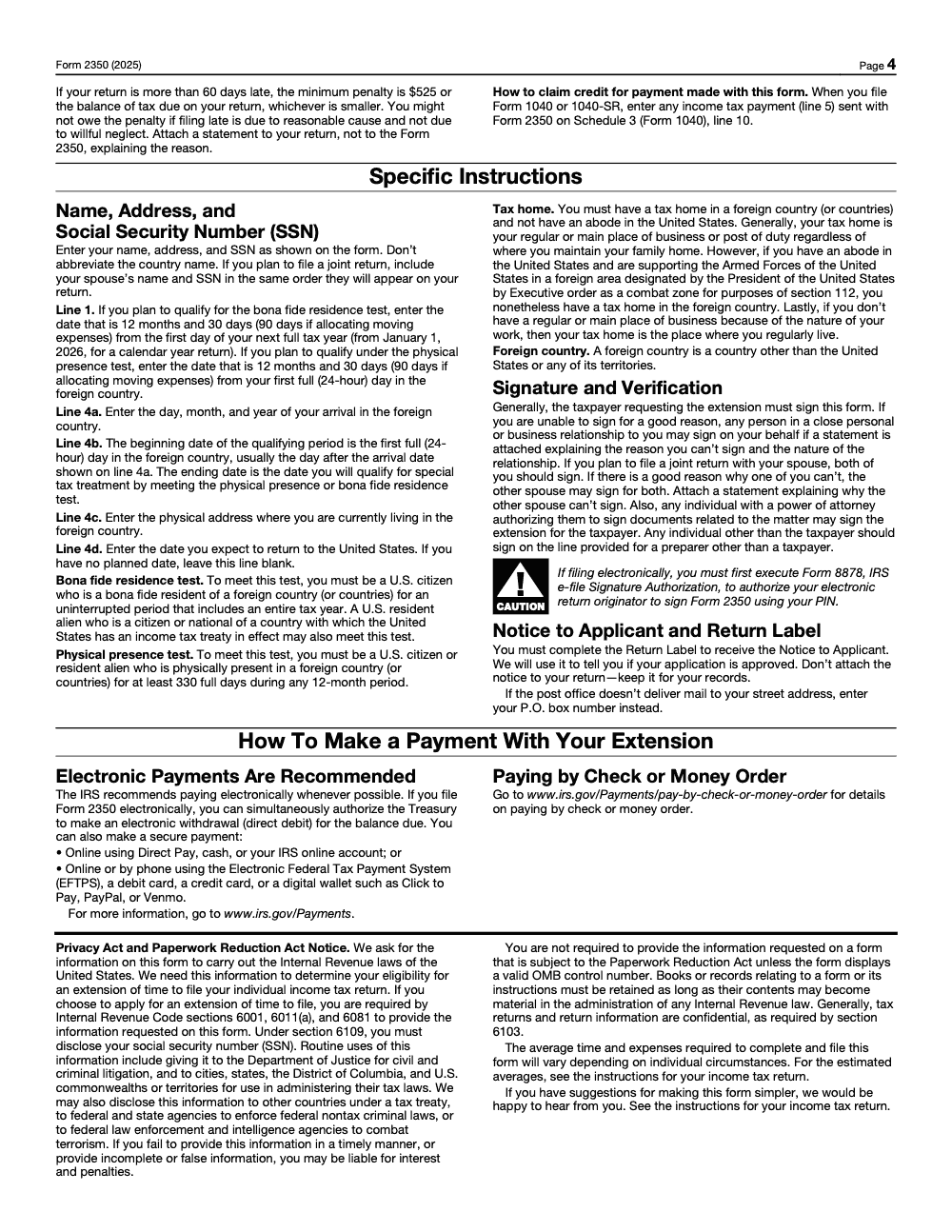
If you live and work outside the U.S. on your regular due date, you get an automatic 2 month extension – the late-payment penalty trigger shifts to June 15, but interest still accrues from April 15 on any unpaid tax. For calendar year 2024 returns, that pushed filing to Monday, June 16, 2025 because June 15 was a Sunday. You still owe interest from April on any unpaid balance. To use this, attach a short statement to your return explaining that you qualified under the out of country rule (no separate extension form is required for the automatic 2 month window; the statement on the return is enough).
When the automatic 2 months is not enough
If your 330 day period or bona fide residence year ends after that automatic window, file Form 2350 by your regular due date, including the automatic 2 month rule if it applies to you. That way, your final filing due date aligns with your expected qualification date, typically plus 30 days.
Eligibility and timing, made simple
Use Form 2350 only if all three are true:
- You are a U.S. citizen or resident alien,
- Your tax home is in a foreign country, and
- You reasonably expect to meet the bona fide residence or physical presence test after your original due date.
When to file. File Form 2350 by your original due date. If you qualify for the automatic 2 months because you are out of the country, that June date becomes your Form 2350 filing deadline for a calendar year return. Filing later will not secure the extension.
How long it lasts. The IRS usually grants 30 days beyond your expected qualifying date. In certain moving expense allocation situations, the IRS may grant up to 90 days after the end of the year following your move.
How to complete Form 2350, step by step
Follow this simple flow.
1.Confirm your test and dates
- Decide whether you will rely on the bona fide residence test or the 330 day physical presence test.
- Mark the exact date you expect to qualify, for example, your 330th full day abroad within your chosen 12 month period. A full day means 24 hours beginning at midnight.
- Fill out identification and tax period
- Enter your name, address, and SSN (per IRC §6109; the Form 2350 instructions require SSN disclosure and do not list ITIN as an alternative).
- Specify the tax year for the return that will include Form 2555.
- Pick your requested extension end date
- Request an extension that ends 30 days after your expected qualifying date. If a weekend or holiday interferes, the IRS will adjust to the next business day.
- Estimate and pay any tax by the original due date
- This is a filing extension, not an extension to pay. Use IRS Direct Pay or EFTPS to reduce interest and late payment penalties. Keep confirmations.
- Sign and send
- Sign the form. If a preparer is signing for you and the request seeks more than an October 15 date, an original signature is required under IRS processing rules.
Where and how to file in 2025
Mailing. Per the Form 2350 (2025) instructions, mail paper Form 2350 to Department of the Treasury, Internal Revenue Service, Austin, TX 73301-0045, and keep proof of mailing.
Electronic filing. In 2025, the IRS Modernized e File platform includes a schema for Form 2350, so authorized software can transmit it electronically (e-filers must first execute Form 8878, IRS e file Signature Authorization, to let the return originator sign Form 2350 with the taxpayer's PIN). If your software or preparer does not support it, mail the paper form to the Austin address in the current instructions (fiscal year taxpayers cannot e file Form 2350 at all and must always file on paper).
Private Delivery Services. If you use a designated private delivery service, make sure you use the correct street address and retain the tracking that shows the date. The IRS Where to File pages publish the current addresses and service guidance each year.
What to gather before you file
- Passport stamps and travel logs that show foreign presence days.
- Your expected qualifying date under the chosen test.
- Prior Form 2555 details if you claimed FEIE in earlier years.
- Estimates of foreign earned income and housing amounts for the return year.
- Payment method and confirmation for any tax you pay with the request.
Two clear examples you can copy
Example A, 330 day physical presence
You left the U.S. on December 1, 2024 and arrived in Portugal on December 2, 2024. Your first full day abroad is December 3, 2024. You plan to use a 12 month period December 3, 2024 to December 2, 2025. Your 330th full day lands on October 28, 2025. For your 2024 return due April 15, 2025, you file Form 2350 by the due date, including the automatic 2 month rule if you qualify, and request an extension that ends 30 days after October 28, 2025. You still pay any 2024 tax by April 15, 2025.
Example B, bona fide residence
You moved to Tokyo on August 10, 2024 and remain there through December 31, 2025. You will first meet bona fide residence for a full tax year in 2025. For the 2024 return, file Form 2350 by your due date and request an extension that ends 30 days after January 1, 2026, the point at which you can show a full year of bona fide residence. If your software cannot transmit Form 2350, mail it to the current Austin address and keep the courier receipt.
Extension length, limits, and the payment rules that trip people up
How long it lasts. Form 2350 is not fixed to October 15. The IRS usually grants an extension to a date 30 days after you expect to meet your FEIE test. The Internal Revenue Manual confirms the standard 30 day window and notes a 90 day possibility when moving expense allocations apply.
No extension to pay. Even with Form 2350, your payment deadline remains the original due date. If you qualify for the automatic 2 month rule because you are out of the country, penalties for late payment are measured from that June date, but interest still runs from April. Paying what you reasonably expect to owe reduces interest and the chance of penalties.
Common pitfalls and simple fixes
- Treating 2350 like a generic extension. It is not. Use it only when you need time to meet FEIE tests. Otherwise, file Form 4868.
- Missing the filing date. File Form 2350 by your original due date, taking into account the automatic 2 month rule if you qualify. Late requests can be denied.
- Assuming e file is impossible. In 2025, many authorized platforms can transmit Form 2350. If yours cannot, mail it. Keep dated proof.
- Forgetting to pay. This is a filing extension only. Pay by the original deadline to reduce interest and protect against a late payment penalty.
- Picking the wrong 12 month window. The physical presence test lets you choose any 12 consecutive months. Choose the period that maximizes your exclusion and cleanly supports your dates.
A quick checklist before you hit send
- Confirm your FEIE path, bona fide residence or 330 day physical presence, and write down the exact date you will qualify.
- Fill in Form 2350 completely, sign it, and request an end date 30 days after your qualifying date.
- Pay any expected tax by your April deadline, even if you will file later. Keep the payment confirmation.
- File Form 2350 by your original due date, considering the automatic 2 month rule if you qualify, and keep proof of mailing or e file acceptance.
For CPA firms and busy finance teams
When your calendar is packed with cross border moves and staggered 330 day dates, disciplined workflow can be the difference between smooth extensions and scramble. Our team at Accountably focuses on controlled offshore delivery that keeps workpapers standardized, reviews predictable, and deadlines tracked, which makes filing windows like Form 2350 easier to manage without overtime. Use what fits, then keep your process simple and documented.
Final word and a plain disclaimer
Form 2350 is a precision tool. Use it when you truly need time to meet an FEIE test, pay by the original deadline, and keep clean records of your dates. If you are unsure which window gives you the best result, a tax pro who handles expat calendars can help you choose the 12 month period and align the extension.
This article is for general information, not tax advice. Always confirm current year addresses, e file availability, and dates on IRS.gov before you file.
Common Mistakes We See Every Season
Form 2350 is small but unforgiving. The mistakes we see every season come from clients who treat it like Form 4868, miss a date on the application, or never close the loop when the eventual 1040 is filed.
Reusable Checklists
These checklists are copy-paste ready for firm SOPs. Drop them into your engagement workflow tool of choice, then customize line items per client.
Pre-2350 intake packet
- Confirm the client is a U.S. citizen or a resident alien who is a citizen or national of a treaty country.
- Document the foreign tax home: principal place of work address and qualifying period start.
- Identify the §911 qualifying test: bona fide residence or 330-day physical presence.
- Capture the expected qualifying date in writing.
- Determine whether the client qualifies for the automatic 2-month out-of-country extension to June 15, 2026.
- Confirm this is the first qualifying year. If not, route to Form 4868 per the Form 2350 (2025) instructions.
- Estimate the balance due and schedule payment via IRS Direct Pay or EFTPS for April 15, 2026.
- Pull the prior-year return for e-file taxpayer-verification information.
Line 1 target calculation
- Bona fide residence (calendar-year filer): enter 12 months and 30 days from January 1, 2026.
- Physical presence: enter 12 months and 30 days from the first full 24-hour day in the foreign country.
- Bona fide residence with moving expense allocation: enter up to 12 months and 90 days from January 1, 2026.
- Cross-check the Line 4a date (first arrival in foreign country) against the qualifying period on Line 4b.
- Confirm the foreign home address on Line 4c is spelled out in full, with no abbreviation of the country name.
- Document the expected return-to-U.S. date for Line 4d.
- Re-state the chosen qualifying test in the engagement notes so the eventual Form 2555 lines up.
Post-extension handoff to the 1040
- For e-file: execute Form 8878 first to authorize the return originator's PIN. For paper: mail Form 2350 to Department of the Treasury, Internal Revenue Service, Austin, TX 73301-0045 and keep the postmarked receipt.
- File the IRS-returned Notice to Applicant in the client's records. Do not attach it to the eventual return.
- Tag the workpaper with the Line 5 income-tax payment amount.
- When the qualifying date arrives, transfer the Line 5 amount to Schedule 3 (Form 1040), line 10.
- Attach the statement supporting the §911 qualification to the Form 2555 workpaper.
- Confirm full payment was made by April 15, 2026 to avoid late-payment penalty exposure.
- Reconcile the qualifying period actually achieved against the Line 1 target before releasing the 1040 for signature.
Keep 2350 Season From Stalling
Form 2350 sits at an awkward point in the tax calendar. A U.S. citizen or resident alien abroad needs a filing extension that stretches to a future date when she will have completed either a bona fide residence period covering an entire tax year or 330 full days of physical presence inside a 12-month window. Per the Form 2350 (2025) instructions, a calendar-year filer planning under the bona fide residence test enters a Line 1 target date that lands 12 months and 30 days from January 1, 2026, which means the engagement is open from April through the back half of the following year before the 1040 can finally close.
That long timeline is where engagements lose money. Each expat return has its own qualifying date, a separate Line 1 target, a foreign address that cannot be abbreviated, and a Line 5 income-tax payment that has to reappear on Schedule 3 (Form 1040), line 10 when the eventual 1040 or 1040-SR is filed. Per the Form 2350 (2025) instructions, the late-filing penalty runs 5 percent per month capped at 25 percent, the late-payment charge runs 1/2 of 1 percent per month also capped at 25 percent, and the minimum failure-to-file penalty for a 2025 return more than 60 days late is the smaller of $525 or the balance of tax due. Those costs compound quietly when an extension is mishandled or a single field on the application is missed.
- Distinguish the qualifying track at intake. Per IRS Publication 54, the bona fide residence test requires an uninterrupted period that includes an entire tax year, while the physical presence test requires 330 full days during any 12-month period; the Line 1 target on the application has to mirror whichever test the client is using.
- Lock the Line 1 formula in the engagement letter: 12 months and 30 days from January 1, 2026 for bona fide residence filers, 12 months and 30 days from the first full 24-hour day in the foreign country for physical presence filers, or 12 months and 90 days from January 1, 2026 if the client also needs to allocate moving expenses.
- Confirm whether the client qualifies for the automatic 2-month out-of-country extension to June 15, 2026 (live and main place of work outside the U.S. and Puerto Rico, or military duty abroad). The 2-month extension is automatic and does not require Form 2350 or Form 4868, but interest still runs from April 15, 2026 on any unpaid tax.
- Schedule the Line 5 income-tax payment with the Form 2350 filing and tag the workpaper so the eventual Form 1040 picks the payment up on Schedule 3, line 10. Without the affirmative claim on the return, the client effectively double-pays.
- Mail paper Form 2350 to Department of the Treasury, Internal Revenue Service, Austin, TX 73301-0045, do not abbreviate the foreign country name, and keep the IRS-returned Notice to Applicant in the client file rather than attaching it to the eventual 1040 or 1040-SR.
This is the kind of multi-step, deadline-stacked work where structured offshore tax delivery actually pays for itself. Our tax execution services handle Form 2350 intake, foreign address validation, Line 5 payment tracking, and the eventual 1040 close so the engagement does not slip when the bona fide residence period or 330-day physical presence window finally closes.
FAQs
It is an extension request you file when you expect to meet the FEIE tests after your regular due date. If approved, it lets you file after you qualify, usually 30 days beyond your qualifying date. It does not extend time to pay.
Form 4868 is a six month, general extension to October 15 for most calendar year filers. Form 2350 is only for expats who need time to meet the bona fide residence or 330 day physical presence test. Both extend filing only, not payment.
In 2025, the IRS maintains an e file schema for Form 2350, which means authorized software can transmit it. If your provider does not support it, mail the paper form to the current Austin address listed in IRS instructions and keep proof of mailing.
Per the Form 2350 (2025) instructions, mail paper Form 2350 to Department of the Treasury, Internal Revenue Service, Austin, TX 73301-0045, and keep your proof of mailing or private delivery tracking.
That is what Form 2350 is for. If you need to meet a test after October, request a date 30 days past your expected qualifying date, and explain your dates clearly. IRS processors are instructed on longer than six month situations and how to evaluate 2350 requests.
The maximum exclusion is 126,500 for 2024 and 130,000 for 2025, per IRS guidance. If both spouses qualify and have foreign earned income, each may claim up to the cap.
Other forms this guide names
- Form 1040: Filing Guide for 2025 Returns (AGI, Deductions, Deadlines)
- Form 4868: IRS Tax Extension 2025 Guide to Filing
- Form 2555: Foreign Earned Income Exclusion & Housing
- Form 1040-SR: Standard Deduction, Schedules, E-file Tips
- Form 8878: IRS e-file Signature Authorization for Extensions
Summarize this article with AI
About this guide
Accountably helps US CPA, EA, and accounting firms hire trained accountants and tax preparers in India.
About us Reviewed byJugal Thacker, CPAFounder and CEO at Accountably
A Washington-licensed CPA with 7+ years inside US firms – PwC, a real-estate tax practice, then a full-service firm, rising from reviewer to manager to advisory. This article was reviewed against current IRS guidance for the 2025 tax year and updated for filers preparing late returns, amendments, and 2026 estimates.
View profile →How we research, review, and update this guide
Every Accountably guide is researched against primary IRS sources, reviewed by a U.S. CPA, and refreshed as guidance evolves. Read our Editorial Guidelines to see how we source, fact-check, and update our content.