Summarize this article with AI
In Brief
Form 921-A is the IRS consent that extends the assessment statute for pass-through entities (S-corporations, partnerships, LLCs, trusts, syndicates, pools) when the Commissioner has tentatively allowed estimated future improvement costs in the basis of a real-estate contract sale (per IRS Form 921-A, Catalog No. 16976Z, January 2001 revision). The consent covers income and profits tax only; a timely-mailed deficiency notice automatically tacks on the assessment-prohibition period plus 60 days, so the statute does not end on the date written into the agreement. Used during pass-through examinations covered by our taxation services.
A revenue agent calls on a partnership examination and asks for a signed Form 921-A, and the client has no idea what it is. You have a narrow window to explain the stakes, confirm authorization, and return the consent without inadvertently waiving any rights. The pressure is real, but the form itself is more predictable than that first call makes it feel.
Form 921-A is a bilateral consent that fixes a specific date through which the IRS may assess additional income or profits tax for pass-through entities, replacing the standard three-year window. Both the taxpayer and an authorized IRS representative must sign for it to be valid. The biggest trap is signing without reading the fixed date carefully, because once both parties execute the form, that agreed date controls regardless of what the normal limitations period would have been.
Key Takeaways
- Form 921-A is a bilateral consent agreement that fixes a specific date through which the IRS may assess additional income or profits tax, replacing the standard three-year statute of limitations window.
- Both the taxpayer and an authorized IRS representative must sign for the form to be valid – an unsigned or improperly executed consent is unenforceable by either party.
- No statutory deadline exists for signing Form 921-A itself, but the IRS typically requests it when the existing statute is about to expire and an examination is still open.
- The biggest pitfall is signing without reading the fixed date carefully – once both parties execute the form, the agreed date controls regardless of what the normal limitations period would have been (with one automatic extension: a notice of deficiency mailed by certified or registered mail on or before that date tacks on the assessment-prohibition period plus 60 days).
- Quick rule you can copy into your SOP: always confirm client authorization in writing before signing any consent on behalf of a taxpayer, and calendar the fixed expiration date immediately upon execution.
- Form 921-A differs from Form 872-A (the open-ended consent that runs until terminated by Form 872-T) because Form 921-A names a hard stop date in the consent itself; Form 872 is itself a fixed-date consent, not an open-ended one.
What Form 921-A Is and When to Use It
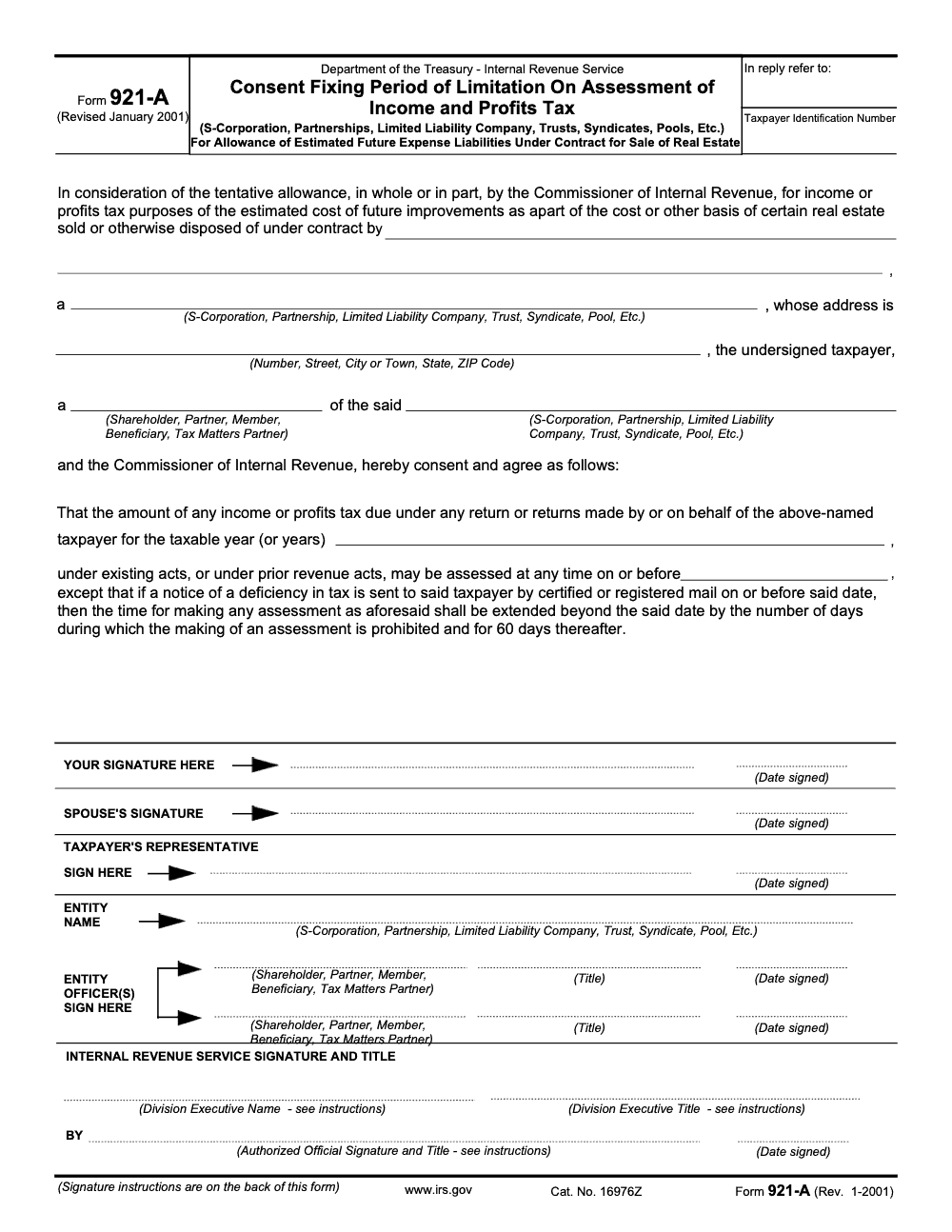
Form 921-A – officially titled Consent Fixing Period of Limitation on Assessment of Income and Profits Tax (S-Corporation, Partnerships, Limited Liability Company, Trusts, Syndicates, Pools, Etc.) – is a consent agreement between a pass-through entity taxpayer and the Internal Revenue Service that extends the normal income and profits tax assessment statute of limitations to a specific, agreed-upon date, executed in connection with the Commissioner’s tentative allowance of estimated future improvement costs in the basis of a real-estate contract sale. Unlike a standard open-ended extension, Form 921-A creates certainty for both sides by naming an exact cutoff (with one important wrinkle: if the IRS mails a notice of deficiency by certified or registered mail on or before that date, the statute is automatically extended by the days during which assessment is prohibited plus 60 more days).
The standard assessment period under IRC §6501 is three years from the date a return is filed (or the due date, whichever is later). When an examination is still active as that window approaches, the IRS may request a consent to extend. Form 921-A is the pass-through entity consent used specifically when the Commissioner has tentatively allowed estimated future improvement costs in the basis of a real-estate contract sale; it is not a generic alternative to Form 872 (which is itself a fixed-date consent) or Form 872-A (the open-ended consent).
From my side of the desk, I see this form most often in pass-through examinations – S-corporation, partnership, LLC, trust, syndicate, or pool engagements – where the IRS has tentatively allowed estimated future improvement costs on a real-estate contract sale and the limitations clock is running short. It does not apply to individual taxpayer or C-corporation returns. In both cases, the decision whether to sign – and under what conditions – is a strategic one that deserves careful analysis before ink hits paper.
Who Signs Form 921-A
On the taxpayer side, a shareholder (S-corporation), partner (partnership), member (LLC), beneficiary (trust), or tax matters partner signs on behalf of the pass-through entity, per the signature block on Form 921-A. The form does not apply to individual taxpayers (who use Form 921) or to C-corporations. A power of attorney (Form 2848) gives a representative authority to sign on the taxpayer’s behalf, but only if the POA explicitly grants that power. On the IRS side, the consent names the Division Executive for the relevant operating division (SB/SE, W&I, LB&I in place of LMSB, TE/GE, or Appeals) and is signed and dated by an authorized official within that division.
Form 921-A vs. Form 872 vs. Form 872-A
Form 872 also extends the statute, but to a specific date – making it functionally similar to 921-A. The key distinction is that Form 872-A is the open-ended version, remaining in force until terminated by either party via Form 872-T. Form 921-A is used in income and profits tax contexts where the parties prefer a hard expiration without a separate termination step (note that the “hard” expiration is itself extended if the IRS mails a notice of deficiency by certified or registered mail on or before the stated date – in that case the period runs for the days during which assessment is prohibited plus 60 days). Always confirm which form the agent is requesting and why before advising your client.
When Refusing to Sign Is a Legitimate Option
A taxpayer is never legally required to sign a consent to extend. However, refusal typically triggers an immediate notice of deficiency (a “90-day letter”) so the IRS can preserve its right to assess before the statute expires. My team always runs through the cost-benefit analysis: does signing give us more time to present favorable evidence, or does refusing force a faster IRS determination that might be more favorable than what a prolonged examination could produce? There is no universal right answer.
How to Complete Form 921-A
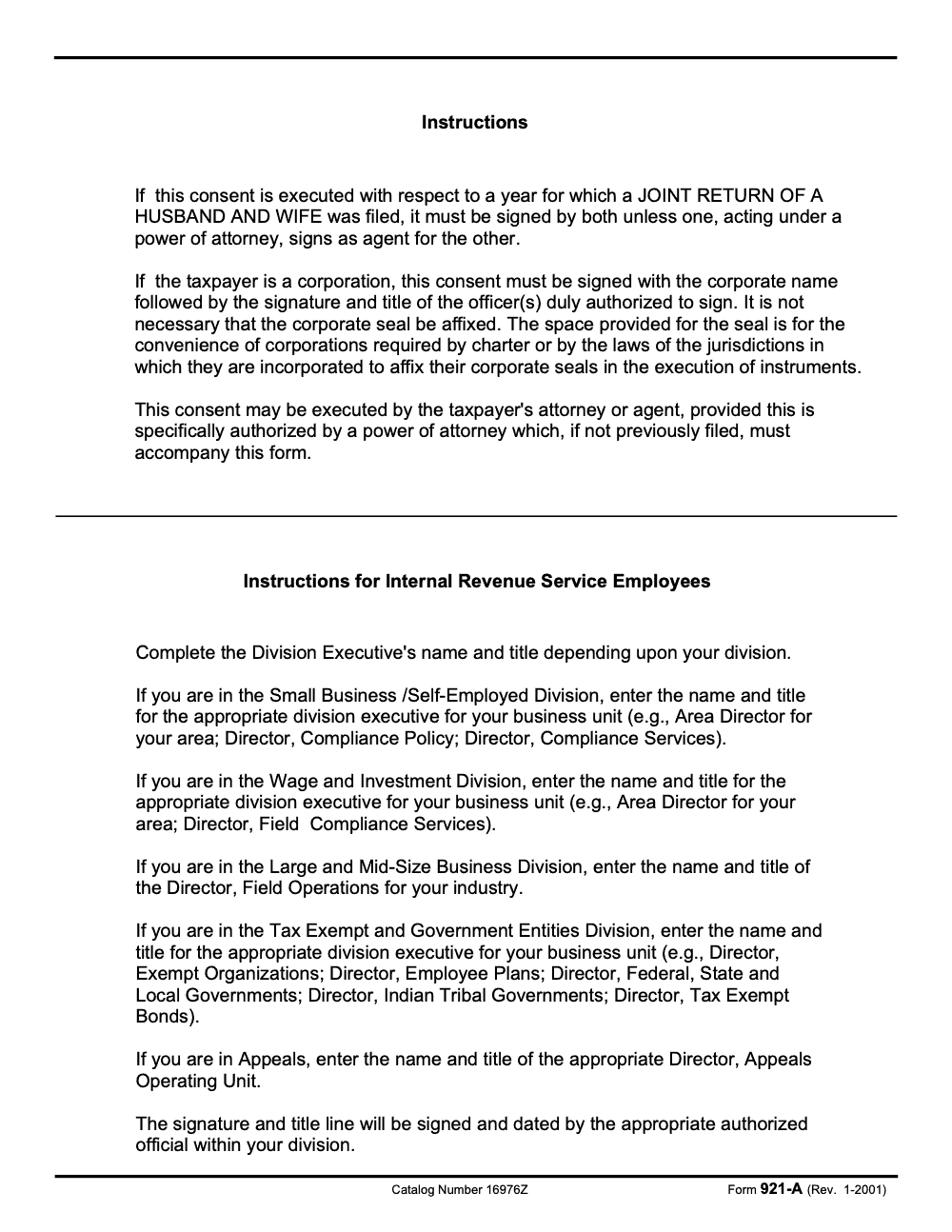
Form 921-A is a short, two-page document – a single sheet printed front and back, with the consent on page 1 and the taxpayer/IRS instructions on page 2 – but every field carries legal weight. Errors or omissions can render the consent invalid, which typically means the original statute of limitations controls – and that can hurt either the IRS or the taxpayer depending on timing.
| Field / Section | What to Enter | Practitioner Tip |
|---|---|---|
| Taxpayer Name | Full legal name exactly as it appears on the return under examination | For joint returns, both spouses must be listed; for entities, use the legal entity name, not a DBA |
| Taxpayer Identification Number | EIN for the pass-through entity (S-corporation, partnership, LLC, trust, syndicate, or pool); SSN does not apply because Form 921-A is not used for individual taxpayers | Double-check against the return – a transposed digit makes the consent unenforceable |
| Tax Year(s) Covered | Specific tax period(s) to which the consent applies (e.g., “Year ending December 31, 2022”) | If multiple years are open, each may require a separate Form 921-A or explicit listing – confirm with the agent |
| Fixed Expiration Date | The exact date through which the IRS may assess – this is the heart of the form | Negotiate this date strategically; shorter windows protect the taxpayer, longer windows give the examination more time to develop favorable facts |
| Taxpayer Signature | Taxpayer or authorized representative signature with date | Verify POA scope before signing on a client’s behalf; Form 2848 must specifically authorize statute of limitations extensions |
| IRS Signature | Division Executive name and title (SB/SE, W&I, LB&I, TE/GE, or Appeals) plus the signature and date of an authorized official within that division | The consent is not effective until both parties sign – a taxpayer-signed form held by the agent but not yet countersigned provides no protection |
Negotiating the Fixed Date
The IRS often proposes a date 12 to 18 months beyond the current statute expiration. My standard practice is to counter with a shorter period – typically six months – with the option to extend again if needed. This keeps negotiating leverage in our hands and prevents the examination from drifting indefinitely. Document every conversation about the proposed date in your engagement file.
Conditions You Can Attach
Unlike the open-ended Form 872-A, Form 921-A can include conditions limiting the IRS to specific issues. For example, a consent might specify that it applies only to the examination of a particular transaction or income item. Always discuss with your client whether a limited-scope consent serves their interests better than an unconditional one covering all issues for the year.
Deadlines, Penalties, and Filing Requirements
Form 921-A does not have a standalone filing deadline – it is executed reactively when an open examination approaches the end of the normal assessment period. The urgency is driven by the IRC §6501 limitations clock, not by a separate form-specific due date.
| Scenario | Normal SOL Period | When IRS Typically Requests Consent |
|---|---|---|
| Standard individual or corporate return | 3 years from filing date or due date (later of the two) | 60–120 days before expiration |
| Return with substantial omission (>25% of gross income) | 6 years from filing date | 60–120 days before the 6-year window closes |
| Fraudulent return or no return filed | No limitation period | Not applicable – IRS can assess at any time |
| Partnership (TEFRA or BBA/CPAR) | 3 years from the partnership return filing date (or due date) | Timing depends on the partnership’s return and any amended K-1 activity |
What Happens if the Statute Expires Without a Consent
If the assessment period lapses with no consent in place and no notice of deficiency issued, the IRS loses the right to assess additional tax for that year – with limited exceptions for fraud, failure to file, and certain listed transactions. This is generally protective for the taxpayer, but it also means any pending refund claims tied to that year may also be barred if the statutory period for refunds has expired.
Penalty and Interest Considerations
Signing Form 921-A does not itself trigger penalties or interest. However, the extended period increases the window during which the IRS may discover issues and assert penalties. Interest continues to accrue on any underpayment regardless of consent status. Clients often do not appreciate that agreeing to more time also means more time for interest to accumulate – that’s a conversation worth having explicitly before the form is signed.
Strategic Considerations Before Signing Form 921-A
Form 921-A decisions are not administrative – they are strategic. Every signature represents a choice about how much time the IRS gets to make its case, and that choice has real financial consequences for your client.
When Signing Protects the Taxpayer
There are scenarios where signing is clearly in the client’s interest. If the client has documentation that definitively disproves the IRS’s proposed adjustments but that documentation takes time to compile – think reconstructed records from a prior system or international transaction files housed overseas – buying more time with a consent can be cheaper than fighting an assessment in Tax Court. Similarly, if the taxpayer has a pending refund claim from a related year, keeping the examination open may allow netting that reduces overall liability.
When Refusing or Limiting Scope Is the Right Move
If the IRS is fishing broadly and has not identified a specific adjustment, a limited-scope consent that restricts the examination to named issues forces the agent to work efficiently or accept the existing factual record. Refusing entirely triggers the 90-day letter, which starts the Tax Court petition clock. Sometimes a fast determination – even one you intend to contest – is cheaper than an extended, resource-intensive examination.
Coordinating with Form 2848 (Power of Attorney)
Before signing Form 921-A on a client’s behalf, confirm that the POA on file expressly authorizes you to extend the statute. The standard Form 2848 grants broad authority, but some clients execute limited POAs that exclude this power. An unauthorized signature on a consent creates a legal ambiguity that neither side wants to litigate. Small errors create big cleanup.
Form 921-A in the Context of Corporate and Partnership Examinations
For S corporations (and other pass-through entities such as partnerships, LLCs, trusts, syndicates, and pools), Form 921-A covers the entity’s income and profits tax return for the period in question. A signer in one of the form’s named roles – shareholder, partner, member, beneficiary, or tax matters partner – signs in the entity name followed by signature and title; the corporate seal is optional, per the page-2 instructions. Form 921-A does not apply to C corporations; route C-corporation consents to the appropriate non-921-A consent form.
Partnership Examinations Under the BBA/CPAR Regime
Partnerships subject to the Bipartisan Budget Act (BBA) centralized audit rules use Form 921-A through the partnership representative, not the individual partners. The partnership representative has broad authority to bind all partners, including the right to extend the statute. Partners who want input into this decision should negotiate those rights in the partnership agreement – once the PR acts, it binds everyone.
Related Forms You Should Know
Form 921-A sits within a family of statute-related consent forms. Form 952 addresses a related but distinct situation – consenting to fix the limitation period for a controlled foreign corporation’s taxes. Understanding the full family of forms helps you identify which instrument applies to each client’s specific examination context.
Common Mistakes That Slow Things Down
Most rejected or contested Form 921-A consents trace back to signature-block errors and misunderstandings about how the assessment statute is actually extended. Five patterns repeat across pass-through engagements.
Practical Checklists You Can Reuse
These checklists are copy-paste ready for firm SOPs. Form 921-A workflow breaks into three handoffs: validate the request, control the signatures, and track the statute after execution.
Pre-execution review
- Confirm the taxpayer is a pass-through entity (S-corporation, partnership, LLC, trust, syndicate, or pool); do not use Form 921-A for individuals or C-corporations.
- Pull Form 921-A (Catalog No. 16976Z, January 2001 revision) and confirm no later revision has been issued.
- Verify the IRS request ties to a tentative allowance of estimated future improvement costs on a real-estate contract sale, per IRS Form 921-A purpose statement.
- List the specific taxable year or years the consent will cover; the form does not blanket-extend all open years.
- Document the income-and-profits-tax scope; route any employment, excise, gift, or estate tax extension to the correct separate consent.
- Capture the proposed expiration date and confirm it fits the engagement timeline before any signature is requested.
Signature block QA
- Confirm the signer's role matches an authorized category: shareholder (S-corp), partner, member (LLC), beneficiary (trust), or tax matters partner.
- For a corporate signer, sign in the corporate name followed by the officer signature and title; the corporate seal is optional, per IRS Form 921-A.
- If an agent or attorney is signing, attach a power of attorney that specifically authorizes execution of consents extending the statute, if it is not already on file with the IRS.
- For any joint-return year covered, obtain signatures from both spouses, or attach the specific POA naming the spouse acting as agent.
- Enter the taxpayer identification number in the upper-right block and the entity name and address (Number, Street, City or Town, State, ZIP Code) in the opening paragraph of the consent; confirm the "In reply refer to" reference matches IRS correspondence.
- Verify the IRS-side Division Executive name and title block is completed using the current division name (LB&I in place of LMSB, SB/SE, W&I, TE/GE, or Appeals).
Post-execution statute tracking
- Log the agreed expiration date in the engagement statute-tracking system, flagged to the entity and the specific taxable years.
- Add a parallel reminder for the deficiency-notice tail: the assessment-prohibition period plus an additional 60 days if a notice is mailed on or before the expiration.
- Store the executed Form 921-A and any attached POA in the engagement workpaper file with version control.
- Notify all entity signers and any joint-return spouses when the consent is executed, with a copy of the signed document.
- Calendar a 30-day status review before the expiration date for any open exam still in deficiency-notice territory.
- Reconcile the consent with the underlying real-estate contract files so the tentative-improvement-cost basis is documented for any later examination.
Keep 921-A Season From Stalling
Form 921-A workflow is exam-driven, not seasonal: the request lands during a pass-through examination tied to real-estate contract sales where the IRS has tentatively allowed estimated future improvement costs in basis, and the response window is short. Per IRS Form 921-A instructions, the consent is executed and delivered separately at the examiner's request, never as a return attachment, so the delivery challenge is coordinating multiple signers and a statute-of-limitations calendar inside an open exam, often across a tax matters partner, two or more entity officers, and (for any joint-return year) both spouses.
The fix is not adding more reviewers; it is moving the consent through a defined sequence with documented signature evidence and a parallel statute-tracking trail. Each item below maps to a specific failure point we see on Form 921-A engagements.
- Lock the taxable years and entity classification at intake; confirm the taxpayer fits the pass-through scope (S-corporation, partnership, LLC, trust, syndicate, pool) before drafting any signature block.
- Standardize the IRS Division Executive entry using the current division name (LB&I in place of LMSB, SB/SE, W&I, TE/GE, or Appeals) so the consent is not returned for stale labels.
- Use a signature checklist that names every required signer for the year covered: two entity officer lines, the three individual lines where relevant, and both spouses on any joint-return year.
- Attach the specific power of attorney authorizing consent execution to every agent-signed form when that POA has not been previously filed with the IRS; if a POA is already on file, confirm it expressly authorizes execution of consents extending the assessment statute before relying on it.
- Calendar two dates the moment the form is signed: the agreed expiration date, and the conditional tail of the assessment-prohibition period plus 60 days that activates if a deficiency notice is mailed.
This is the kind of statute-of-limitations consent workflow our taxation services team manages end to end: signer validation, division-executive labeling, statute calendaring, and exam-file documentation handled together so the executed consent holds up if examined later.
FAQs
No. Signing a consent to extend the statute of limitations is always voluntary for the taxpayer. Refusing to sign typically causes the IRS to issue a notice of deficiency before the statute expires so it can preserve its right to assess. Your attorney or CPA should analyze the cost-benefit of signing versus forcing the IRS to issue a deficiency notice in your specific situation.
Both forms extend the assessment period, but Form 872 extends to a fixed date while Form 872-A extends indefinitely until terminated by either party using Form 872-T. Form 921-A is the consent used specifically for pass-through entities (S-corporations, partnerships, LLCs, trusts, syndicates, pools) in income and profits tax matters where the Commissioner has tentatively allowed estimated future improvement costs in the basis of a real-estate contract sale. Form 921-A names a hard cutoff date and does not require a separate termination form, but that cutoff is automatically extended if the IRS mails a notice of deficiency by certified or registered mail on or before the stated date – in which case the period runs for the days during which assessment is prohibited plus 60 days.
Yes, but only if the representative holds a valid Form 2848 (Power of Attorney) that expressly authorizes signing statute of limitations consents. A general Form 2848 with broad tax-matters language is not sufficient on its own – the POA must specifically authorize execution of consents extending the statute of limitations on assessment, and if it has not been previously filed with the IRS it must accompany the executed Form 921-A. Always verify the scope of the POA before signing and retain documentation of your authorization in the engagement file.
Not necessarily. The IRS routinely requests consents when an examination is still active and approaching the normal limitations period – it does not signal that a specific deficiency has been identified. The request simply gives the agent more time to complete the review. However, if the examination has been open for an unusually long time before the request, it may be worth asking the agent about the current status of their findings.
Once the fixed expiration date in Form 921-A passes without the IRS issuing a notice of deficiency or making an assessment, the statute of limitations closes. The IRS cannot assess additional tax for the covered year after that date, with narrow exceptions for fraud and certain listed transactions. Keep a copy of the executed Form 921-A permanently in the client file as proof of the agreed-upon cutoff date.
Other forms this guide names
About this guide
Accountably helps US CPA, EA, and accounting firms hire trained accountants and tax preparers in India.
About us Reviewed byJugal Thacker, CPAFounder and CEO at Accountably
A Washington-licensed CPA with 7+ years inside US firms – PwC, a real-estate tax practice, then a full-service firm, rising from reviewer to manager to advisory. This article was reviewed against current IRS guidance for the 2025 tax year and updated for filers preparing late returns, amendments, and 2026 estimates.
View profile →How we research, review, and update this guide
Every Accountably guide is researched against primary IRS sources, reviewed by a U.S. CPA, and refreshed as guidance evolves. Read our Editorial Guidelines to see how we source, fact-check, and update our content.