Summarize this article with AI
In Brief
Form 952 is the receiving (parent) corporation’s consent to extend the IRS’s period for assessing income tax under Section 332(b), used when a complete liquidation of an 80%-owned subsidiary spans more than the subsidiary’s tax year of first distribution (per Form 952, Rev. December 2006). It replaces the default 3-year assessment period under IRC §6501(a) with a 4-year period, is filed by the due date (including extensions) of the receiving corporation’s income tax return for each year in the liquidation period, and is mailed to the IRS Ogden Submission Processing Center rather than attached to Form 1120.
When an 80%-owned subsidiary starts liquidating but does not finish distributing assets inside a single tax year, the parent has a problem the law solves with Form 952. It is the receiving corporation's consent to extend the IRS's period for assessing income tax under Section 332(b), and filing it is what keeps the Section 332 non-recognition treatment intact while the wind-down runs long.
The form replaces the default 3-year assessment period under IRC §6501(a) with a 4-year period tied to the receiving corporation's return for the third tax year after the first distribution. It is required, not optional, and any liquidation that spans more than one tax year needs a separate Form 952 for each year, each due by that year's return due date and mailed to the Ogden Submission Processing Center.
Key Takeaways
- Form 952 is a consent to extend the time to assess tax under Section 332(b) – it extends the IRS’s period for assessing all income taxes of the receiving corporation on the complete liquidation of a subsidiary under Section 332.
- The form is filed by the receiving (parent) corporation, the corporation that takes in the subsidiary’s assets, not by the liquidating subsidiary itself.
- It is required, not optional. The Form 952 instructions say it must be used when the liquidation will be completed within the 3-year period following the end of the subsidiary’s tax year of the first distribution.
- Form 952 replaces the default 3-year assessment period under IRC §6501(a) with a 4-year period tied to the receiving corporation’s return for the 3rd tax year after the first distribution.
- Quick rule you can copy into your SOP: any subsidiary liquidation that spans more than one tax year needs a separate Form 952 for each year, each due by that year’s return due date and mailed to the Ogden Submission Processing Center.
- Filing Form 952 does not save Section 332 treatment if the liquidation is not completed within the 3-year period, or if the receiving corporation stops meeting the 80% vote-and-value test under IRC §1504(a)(2); in either case gain or loss is recognized.
What Form 952 Is and When to Use It
Form 952 – Consent To Extend the Time To Assess Tax Under Section 332(b) – is the receiving corporation’s written consent to extend the period during which the IRS may assess all income taxes attributable to the complete liquidation of a subsidiary under Section 332. The consent can only lengthen, never shorten, the assessment window – if a longer period already applies under IRC §6501, such as the 6-year period for a substantial omission of income or the unlimited period in cases of fraud, that longer period continues to control.
You reach for Form 952 when an 80%-owned subsidiary is being wound up under Section 332 and the liquidation will not finish inside the subsidiary’s tax year of the first distribution. Per the Form 952 instructions, the form must be used if the liquidation will be completed within the 3-year period following the end of that tax year. Because the wind-down stretches across more than one return, the IRS needs a longer window to assess the receiving corporation’s income taxes, and Form 952 is how the parent consents to that.
The reason the stakes are high is the Section 332 benefit on the line. Gain or loss on a complete liquidation of a subsidiary is generally not recognized to the receiving corporation when the subsidiary’s assets are distributed. Missing the consent (or missing the 3-year completion deadline) can put that non-recognition treatment at risk, so I treat Form 952 as a tracked deliverable from the day the plan of liquidation is adopted.
Who Files and What the Form Protects
Form 952 is filed by the receiving (parent) corporation, not the liquidating subsidiary. The parent that takes in the assets and meets the 80% vote-and-value test of IRC §1504(a)(2) is the filer; the subsidiary is simply named on the form in its own EIN and address fields. What the consent protects is the IRS’s ability to assess the receiving corporation’s income taxes for the years the liquidation touches, replacing the default 3-year period under IRC §6501(a) with the special 4-year period described in Section 332(b).
When the Form Is Required
If all of the subsidiary’s assets are not distributed to the receiving corporation by the end of the subsidiary’s tax year in which the first distribution was made, the receiving corporation must file Form 952 for each tax year, or part of a tax year, that falls within the liquidation period. A single Form 952 does not cover a multi-year wind-down. Each consent is due by the due date, including extensions, of the receiving corporation’s income tax return for that year.
How to Complete Form 952
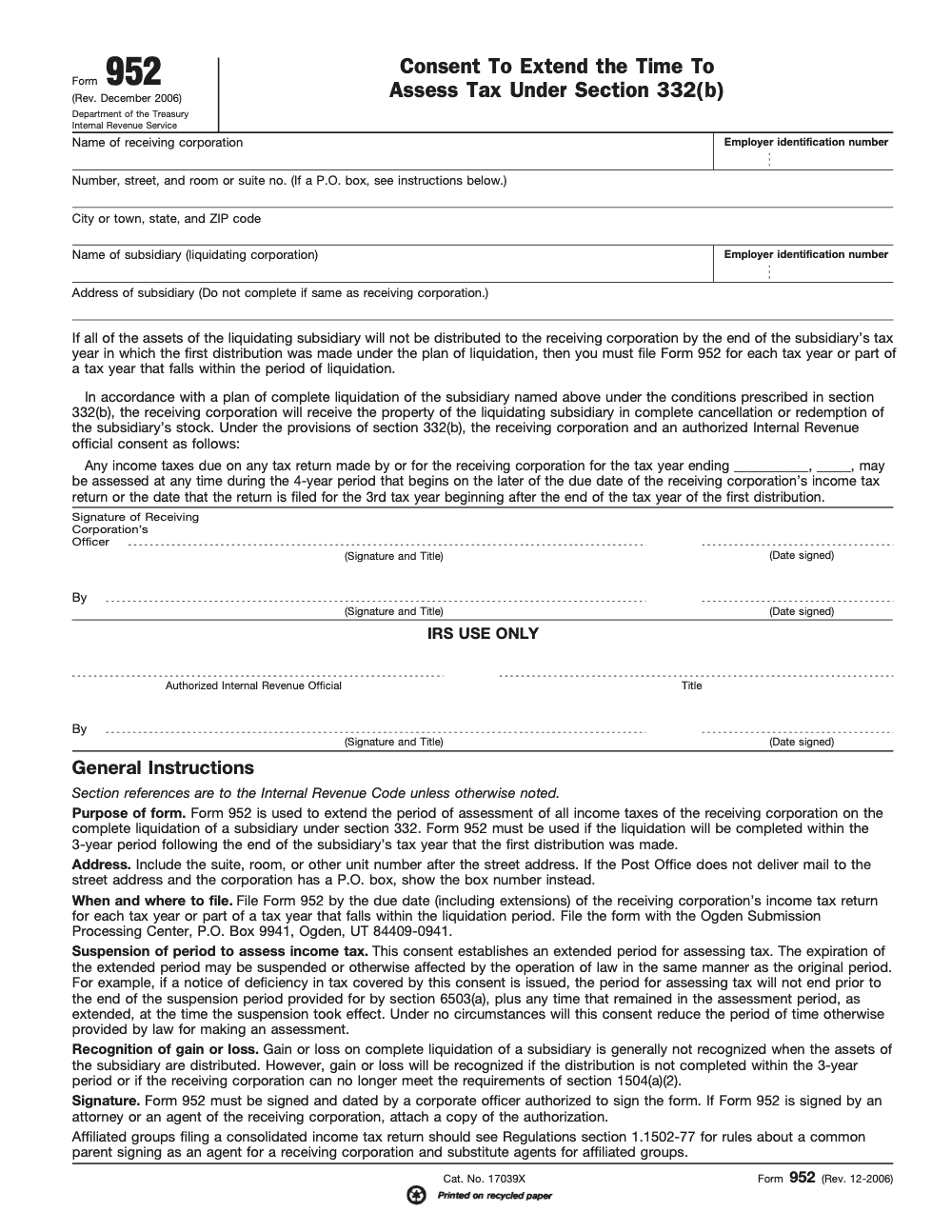
Form 952 is a concise document, but each element is legally significant. The form captures the receiving corporation’s identity, the liquidating subsidiary’s identity, the tax year ending date being extended, and the signatures that make the consent effective. Errors in any of these fields can compromise the consent’s validity.
| Field / Section | What to Provide | Practitioner Tip |
|---|---|---|
| Name of receiving corporation | Full legal name of the parent corporation receiving the subsidiary’s assets | Match exactly to the receiving corporation’s income tax return; this is the filer, not the subsidiary |
| Receiving corporation EIN | Employer identification number of the receiving corporation | Cross-check against the most recently filed return – a transposed digit can invalidate the consent |
| Name and EIN of subsidiary (liquidating corporation) | Legal name and separate EIN of the subsidiary being liquidated | Leave the subsidiary’s address blank if it is the same as the receiving corporation’s address |
| Tax year ending | The ending date of the receiving corporation’s tax year for which the assessment period is being extended | One year per form – file a separate Form 952 for each tax year, or part year, in the liquidation period |
| Address fields | Street address with suite or unit number; use the P.O. box only if the Post Office does not deliver to the street address | Follow the instructions’ address rule exactly so the consent routes correctly |
| Signature of Receiving Corporation’s Officer | Authorized corporate officer signature with date | If an attorney or agent signs rather than a corporate officer, attach a copy of the authorization. For a consolidated group, the common parent signs under Regulations section 1.1502-77, not an individual subsidiary officer |
| IRS USE ONLY block | Signature and title of the Authorized Internal Revenue Official | The consent is bilateral; it is not effective until the IRS official countersigns. Do not treat a taxpayer-only signed form as protective |
Filing the Completed Consent
Form 952 is mailed separately to the IRS Ogden Submission Processing Center, P.O. Box 9941, Ogden, UT 84409-0941. It is not attached to Form 1120 or the consolidated return, and the instructions provide no e-file option. File it by the due date, including extensions, of the receiving corporation’s income tax return for each tax year, or part of a tax year, that falls within the liquidation period.
Deadlines, Penalties, and Filing Requirements
Form 952 does have a deadline. It must be filed by the due date, including extensions, of the receiving corporation’s income tax return for each tax year, or part of a tax year, that falls within the liquidation period. For a calendar-year C corporation, that generally means April 15, or October 15 with an extension. The urgency is driven by the IRC §6501 limitations clock and by the need to keep Section 332 non-recognition treatment intact across the wind-down.
| Limitations Scenario | Applicable Period | Notes |
|---|---|---|
| Default assessment period | 3 years from filing or due date (later of the two) | Normal IRC §6501(a) period that Form 952 replaces for the years covered |
| Form 952 extended period | 4-year period | Begins on the later of the due date or filing date of the receiving corporation’s return for the 3rd tax year after the year of the first distribution |
| Omission of >25% of gross income | 6 years | A longer §6501 period; the consent cannot shorten it below this |
| Notice of deficiency issued | Suspended under IRC §6503(a) | The extended period does not end before the §6503(a) suspension period plus any time that remained on the extension |
| Fraudulent return or no return filed | No limitation | Assessment may occur at any time; the consent cannot shorten this unlimited period |
When the 4-Year Clock Starts
The most often misread point on Form 952 is when the extended period begins. It does not start on the due date of the year being extended. It begins on the later of the due date or the actual filing date of the receiving corporation’s income tax return for the 3rd tax year beginning after the end of the tax year of the first distribution. The extension is also not self-protecting once a notice of deficiency lands: under IRC §6503(a) the period is suspended, so the IRS keeps the suspension period plus whatever time remained on the consent. Small errors create big cleanup, so I anchor every statute diary to that 3rd-year return date.
Section 332 Non-Recognition and the Ownership Test
Form 952 only makes sense against the Section 332 backdrop it is built to support. Gain or loss on a complete liquidation of a subsidiary is generally not recognized to the receiving corporation when the subsidiary’s assets are distributed in cancellation or redemption of its stock. That non-recognition is the benefit the consent is designed to protect when the wind-down spans more than one tax year.
The 80% Vote-and-Value Requirement
To qualify for Section 332 treatment, the receiving corporation must own at least 80% of the total voting power and at least 80% of the total value of the subsidiary’s stock, the affiliated-group test of IRC §1504(a)(2). This is a continuing requirement, not a one-time check at plan adoption. Gain or loss will be recognized if the receiving corporation can no longer meet the requirements of §1504(a)(2) at any point during the liquidation.
The 3-Year Completion Deadline
Filing Form 952 extends the IRS’s assessment window; it does not extend the substantive deadline to finish the liquidation. The distribution must be completed within the 3-year period following the end of the subsidiary’s tax year of the first distribution. If it is not, gain or loss is recognized and Section 332 non-recognition is lost – so I track the completion deadline and the consent deadlines on the same calendar.
How Form 952 Fits the Liquidation Compliance Picture
Form 952 does not exist in isolation – it sits inside the broader compliance work of winding up a subsidiary under Section 332. Understanding where it fits helps a corporate tax team anticipate when the consent is due and keep the file clean across every year the liquidation touches.
What the Consent Does and Does Not Do
The consent extends the assessment period for all income taxes of the receiving corporation on the Section 332 liquidation; it is not issue-limited and not negotiable as to scope. It can only lengthen the assessment period, never shorten any longer period that already applies under IRC §6501. And it never substitutes for actually completing the liquidation within the 3-year window or keeping the 80% ownership test satisfied.
Consolidated Groups and Signing Authority
When the receiving corporation is part of an affiliated group filing a consolidated income tax return, signing authority follows Regulations section 1.1502-77. The common parent – or a designated substitute agent – signs Form 952 as agent for the receiving corporation, rather than an individual subsidiary officer. Confirm that authority before routing the consent for signature, and remember the form is not effective until an Authorized Internal Revenue Official countersigns the IRS USE ONLY block.
Common Mistakes That Slow Things Down
The same handful of errors show up every time a Section 332 liquidation stretches past a single tax year, and each one is avoidable with a quick check against the Form 952 instructions before the consent leaves your tax workflow.
Practical Checklists You Can Reuse
These are copy-paste ready for a firm SOP. Drop them into your engagement file alongside the rest of our IRS form guides so a Section 332 liquidation never loses its statute protection between hand-offs.
Confirm Form 952 applies
- Verify the receiving corporation owns at least 80% of the subsidiary’s vote and value under IRC §1504(a)(2).
- Confirm the transaction is a complete liquidation under Section 332, with no gain or loss recognized to the parent.
- Check that the liquidation will not finish by the end of the subsidiary’s tax year of first distribution.
- Identify every tax year (or part year) that falls within the liquidation period.
- Confirm the liquidation can still complete within the 3-year period, or Section 332 non-recognition is lost.
Complete and route the form
- Enter the receiving (parent) corporation’s name and EIN.
- Enter the liquidating subsidiary’s name and separate EIN; leave its address blank if it matches the parent’s.
- Fill in the tax year ending date for the year being extended.
- Have an authorized corporate officer sign and date the form.
- If an attorney or agent signs, attach a copy of the authorization.
- For a consolidated group, have the common parent sign under Regulations section 1.1502-77.
- Mail the form to the Ogden Submission Processing Center, P.O. Box 9941, Ogden, UT 84409-0941, by the return due date (including extensions).
Track the extended statute
- File a separate Form 952 for each tax year within the liquidation period.
- Diary the 4-year window from the later of the due date or filing date of the 3rd-year return after the first distribution.
- Confirm an Authorized Internal Revenue Official countersigned the IRS USE ONLY block.
- Note that the period can still be suspended by operation of law, such as a notice of deficiency under IRC §6503(a).
- Remember the consent can only lengthen, never shorten, any longer §6501 period that already applies.
- Retain the countersigned original in the engagement file.
Keep 952 Season From Stalling
Form 952 rarely lands on a calendar the way a quarterly or April filing does. It surfaces in the middle of a corporate wind-down, often months after the deal team has moved on, and the receiving corporation still owes a fresh consent for every tax year the liquidation touches. Under IRC §6501(a) the IRS normally has 3 years to assess, and Form 952 stretches that to a 4-year window per the Form 952 instructions (Rev. December 2006), so one missed signature can quietly expose the parent’s non-recognition position.
The fix is treating each Section 332 liquidation as a multi-year obligation with its own tracking, not a one-time filing. When the statute diary, the signature routing, and the Ogden mailing are all documented, the consent stops slipping between the people who closed the deal and the people who file the returns.
- Log every tax year (and part year) inside the liquidation period, and queue a separate Form 952 for each one.
- Tie the 4-year assessment clock to the later of the due date or filing date of the 3rd-year return after the first distribution, not the liquidation year.
- Route signatures correctly: an authorized officer of the receiving corporation, or the common parent under Regulations section 1.1502-77 for a consolidated group.
- Confirm the Authorized Internal Revenue Official countersigned the IRS USE ONLY block before closing the file.
- Mail each consent to the Ogden Submission Processing Center on its own, never stapled to Form 1120.
This is the kind of documented, multi-year follow-through our team builds into its tax execution workflow, so a long liquidation keeps its statute protection through every hand-off and review cycle.
FAQs
Form 952 is filed by the receiving (parent) corporation that takes in the subsidiary’s assets in a Section 332 complete liquidation. The liquidating subsidiary is named on the form in its own name, EIN, and address fields, but it does not file the consent. An authorized officer of the receiving corporation signs and dates the form.
No. If the subsidiary’s assets are not fully distributed by the end of its tax year of the first distribution, the receiving corporation must file a separate Form 952 for each tax year, or part of a tax year, that falls within the liquidation period. Each consent is due by the due date, including extensions, of the receiving corporation’s income tax return for that year.
The 4-year period does not start on the due date of the year being extended. It begins on the later of the due date or the actual filing date of the receiving corporation’s income tax return for the 3rd tax year beginning after the end of the tax year of the first distribution. Diary that 3rd-year return date, not the liquidation year.
No. The consent can only lengthen, never shorten, the assessment period. If a longer period already applies under IRC §6501, such as the 6-year period for a substantial omission of income or the unlimited period in cases of fraud, that longer period continues to control. Form 952 also does not extend the substantive 3-year deadline to complete the liquidation under Section 332.
No. Form 952 is mailed separately to the IRS Ogden Submission Processing Center, P.O. Box 9941, Ogden, UT 84409-0941. It is not attached to Form 1120 or the consolidated return. The consent is also bilateral: it is not effective until an Authorized Internal Revenue Official countersigns the IRS USE ONLY block. Retain the fully executed, countersigned original in the engagement file.
Other forms this guide names
- Form 1120: Corporation Tax Return Guide
About this guide
Accountably helps US CPA, EA, and accounting firms hire trained accountants and tax preparers in India.
About us Reviewed byJugal Thacker, CPAFounder and CEO at Accountably
A Washington-licensed CPA with 7+ years inside US firms – PwC, a real-estate tax practice, then a full-service firm, rising from reviewer to manager to advisory. This article was reviewed against current IRS guidance for the 2025 tax year and updated for filers preparing late returns, amendments, and 2026 estimates.
View profile →How we research, review, and update this guide
Every Accountably guide is researched against primary IRS sources, reviewed by a U.S. CPA, and refreshed as guidance evolves. Read our Editorial Guidelines to see how we source, fact-check, and update our content.