Summarize this article with AI
In Brief
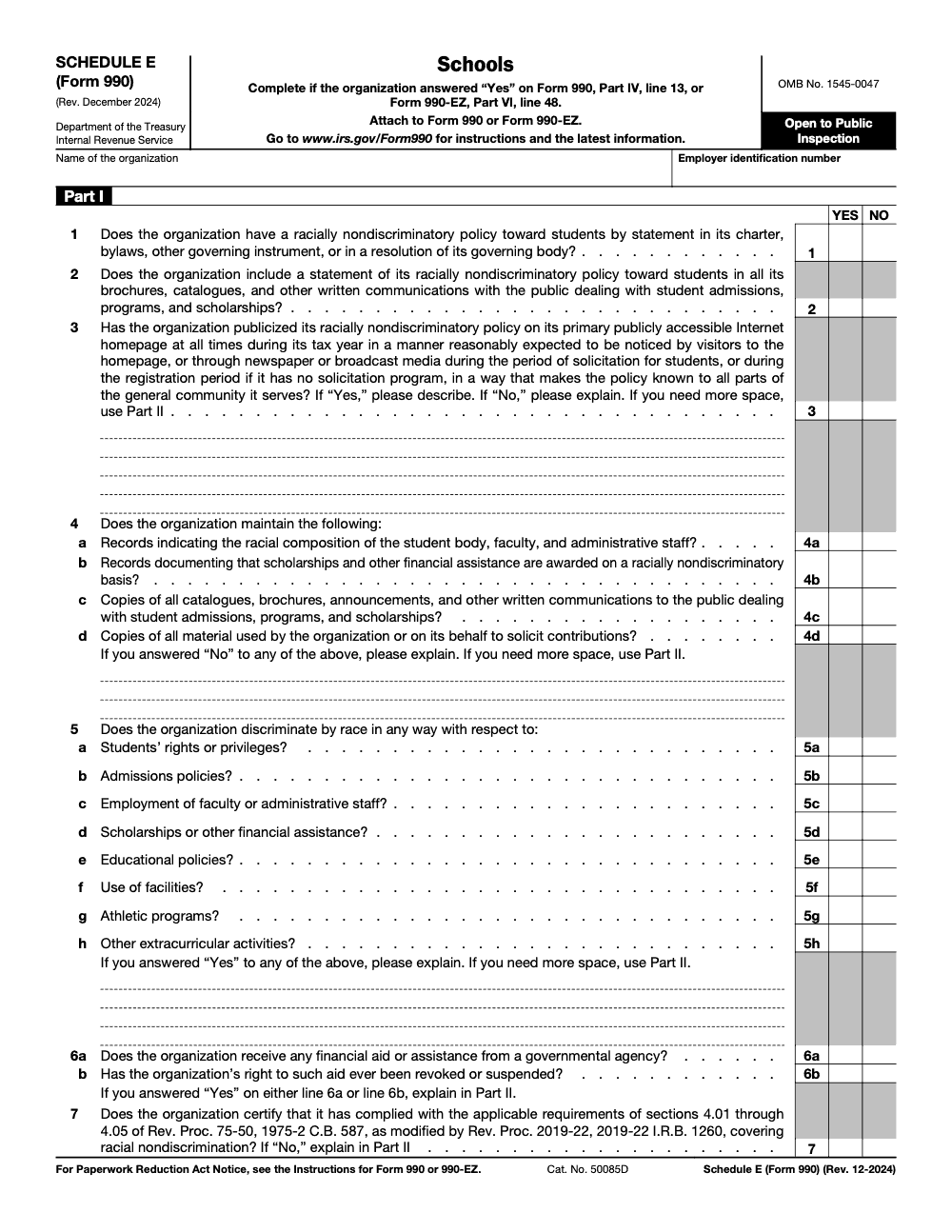
Form 990 Schedule E is the IRS attachment private schools use to certify racial nondiscrimination – required whenever an organization answers Yes on Form 990 Part IV, line 13, or Form 990-EZ Part VI, line 48 (per Schedule E (Form 990), Rev. December 2024). Calendar-year 2025 filers attach Schedule E to their Form 990 by May 15, 2026, or push the deadline six months with Form 8868.
For a private school, Schedule E comes down to one certification on line 7, signed under penalties of perjury, that the organization meets its racially nondiscriminatory policy in admissions, scholarships, programs, and employment. The schedule is required whenever the organization answers Yes on Form 990 Part IV, line 13, or Form 990-EZ Part VI, line 48.
The mistakes that cost schools the most are the quiet ones. A policy that lives only on the website instead of the governing instruments, a homepage notice that disappears in a redesign, scholarship records that were not kept for at least the 3-year retention period. By the time the IRS asks for proof, the year has closed and the binder is light, which is why the publicity rule and the records list below are worth setting up before the question ever comes.
Key Takeaways
- Schedule E is required when your organization operates a private school described in IRC §170(b)(1)(A)(ii) (not just any organization with educational activities) and answers “Yes” on Form 990 Part IV, line 13, or Form 990‑EZ Part VI, line 48.
- Schedule E confirms your written racially nondiscriminatory policy and how you apply it in admissions, scholarships, programs, and employment.
- Your governing instruments should include the policy, and your public notice method must meet IRS rules. Provide clear explanations for any “No” responses in Schedule E, Part II.
- If you file Form 990‑EZ, you generally attach Schedule A along with Schedule E, and you assemble schedules in alphabetical order for the e‑file packet.
- Keep records that support the policy and how it is applied, including student body and scholarship data, for at least 3 years after compilation.
Who Must File Schedule E
You must complete and attach Schedule E if your organization operates a private school described in IRC section 170(b)(1)(A)(ii) and you answered “Yes” on Form 990 Part IV, line 13, or on Form 990‑EZ Part VI, line 48. In other words, once you indicate school status on the core form, Schedule E is mandatory and becomes part of the annual return package.
If you are filing Form 990‑EZ and you indicate school status, you also attach Schedule A to report public charity status and support. When you assemble the return, include required schedules in alphabetical order, for example, Schedule A, Schedule E, Schedule O, as applicable.
Quick note for schools that do not file the 990 series, for example, certain church related schools. The annual certification of racial nondiscrimination may be completed on Form 5578 instead. Confirm applicability with current IRS guidance before filing.
What Schedule E Covers
Schedule E focuses on one thing, whether your school maintains and follows a racially nondiscriminatory policy. The IRS relies on long standing guidance that outlines what the policy must say, how you publicize it, how scholarships are offered, and how you certify compliance each year. Your answers in Part I and any explanations in Part II help the IRS see that your written policy matches your actual practices.
At a minimum, you confirm that,
- the policy exists and is in your charter, bylaws, or board resolution,
- you publish the policy to the community in an approved way,
- admissions, programs, and scholarships are run without racial discrimination, and
- an authorized official certifies compliance annually on Schedule E, line 7.
Filing Triggers You Should Not Miss
Think of the filing trigger as a light switch. The moment you indicate school status on Form 990 Part IV, line 13, or Form 990‑EZ Part VI, line 48, the return must include Schedule E. If you file 990‑EZ, you include Schedule A as well. This is not optional, and missing a required schedule can delay IRS processing or prompt a notice.
The Public Notice Rule, Newspaper, Broadcast, or Website
Historically, schools satisfied the publicity requirement through a newspaper notice or broadcast media. The IRS now recognizes a third option (added by Rev. Proc. 2019-22, which modifies Rev. Proc. 75-50), your primary public website, when the notice appears on the homepage throughout the year in a way visitors will see. Many schools choose the website route because it is practical and easy to verify during review.
Sample notice language, “The School admits students of any race, color, national and ethnic origin to all the rights and programs.”
If you use the website option, make sure the notice sits on the main public homepage, not behind a portal or a PDF that is hard to find. Keep a dated screenshot during the year for your records. The goal is simple, anyone in your community should be able to see your policy without hunting for it.
Why Delivery Breakdowns Create Schedule E Risk
Most schools do not stumble because they lack the policy. They stumble because no one owns the checklist, the notice is buried, or the narrative explanations are not drafted until the last minute. If your team is already stretched, even small gaps, like a missing board resolution excerpt or a stale homepage, can slow filing. Tight workpapers, clear SOPs, and early validations keep you out of that bind. When you structure the process, Schedule E becomes a quick confirm, not a scramble.
How To Complete Schedule E, Step By Step
You can get Schedule E done smoothly if you treat it like a short compliance project, not a last minute form. Here’s a simple workflow you can run before you hit e‑file.
Pre‑work, the 60‑minute file check
- Pull your governing instruments, bylaws, charter, and any board resolutions. Confirm the nondiscrimination statement appears in at least one of them. If it does not, schedule a board action and document the fix in your workpapers.
- Take a dated screenshot of your public notice. If you use your website, make sure the statement sits on your primary homepage and is easy to see without clicks or hover menus. A link to another page is not enough. Keep the screenshot in your 990 folder.
- Gather records that show admissions, scholarships, and programs are administered without racial discrimination. Keep copies of brochures and scholarship guidelines with the return binder. Retain these for at least 3 years after the year you compiled them.
Part I, what each question is really asking
Part I is a series of Yes or No checks. Read each one literally and answer based on this year’s facts.
- Policy exists and is current in your governing documents or board actions. If not, fix it and explain how and when you will update.
- You publicize the policy to the community in an approved way, for example, a clearly visible statement on your primary homepage all year, or newspaper or broadcast methods that actually reach your community.
- Admissions, programs, athletics, and scholarships are run without racial discrimination. If a policy or practice was unclear, describe what changed and when.
- An authorized official certifies the school met the requirements. This is the annual certification shown on Schedule E, line 7.
Quick tip, use short, factual sentences in your explanations. “Board approved revised policy text on March 12, 2025. Homepage notice moved to the top section on April 1, 2025.”
Part II, write concise explanations
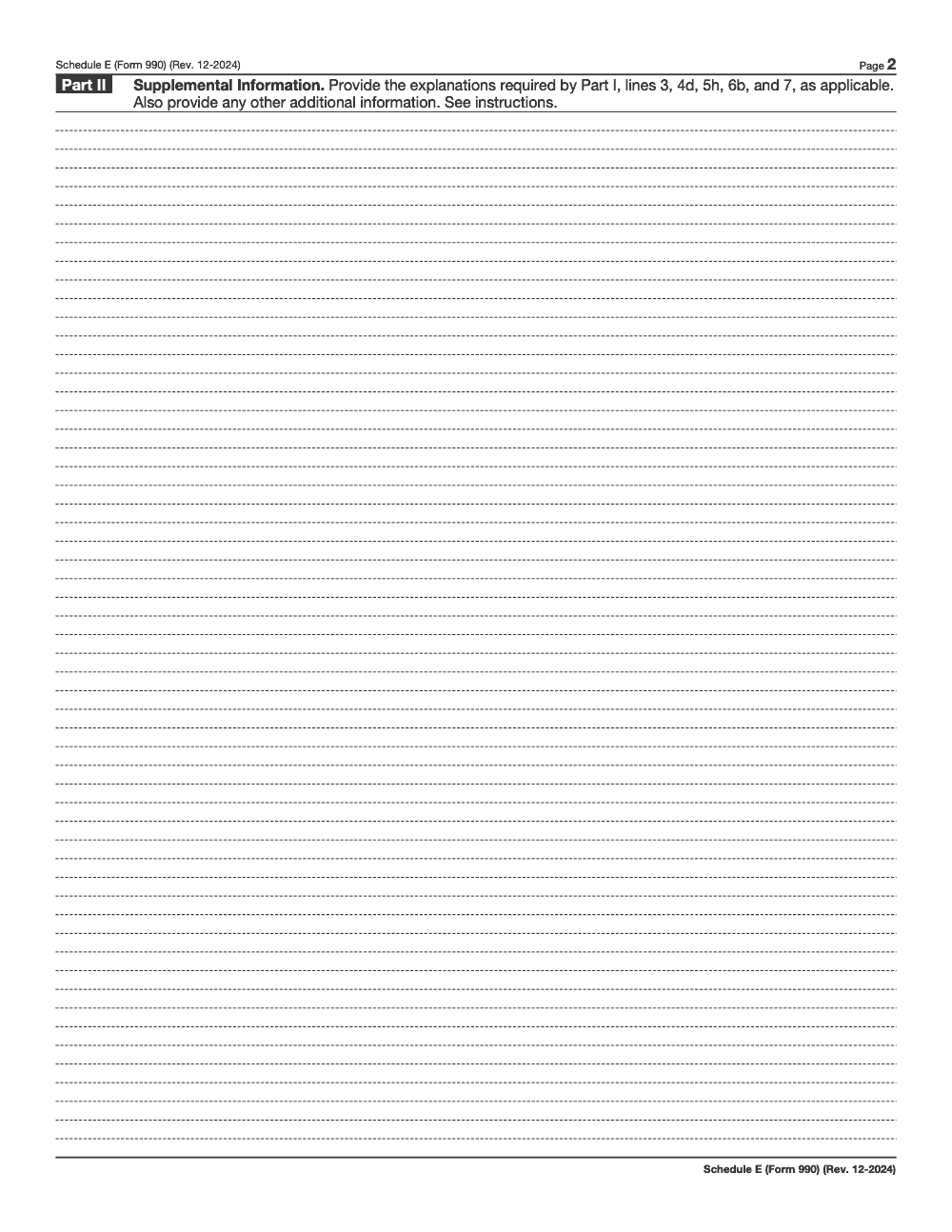
Use Part II when a question requires narrative support, for example, when you answer No on a publicity question or you updated bylaws midyear. Identify the line number you are explaining and keep it tight and verifiable. You can duplicate Part II if you need more space.
If you answered “No,” what to do next
| Item you reviewed | What the IRS expects | If you answered “No,” do this |
| Written policy | Adopted, current, accessible | Schedule a board action, add exact policy text, document meeting date |
| Governing instruments | Policy appears in bylaws, charter, or board resolution | Note where it will be inserted, include draft text and timeline |
| Public notice | Notice on primary homepage all year, or valid newspaper or broadcast method that reaches your community | Move the statement to the primary homepage, capture screenshot, describe timing; or attach documentation of newspaper/broadcast method |
| Scholarships | Offered on a nondiscriminatory basis | Update written criteria, show how the policy is communicated, include sample notice in packets |
| Certification | Authorized official certifies annually | Identify the official, confirm date of certification, include in workpapers |
Publicity Options, what counts in 2025
Schools can use newspaper, broadcast media, or their primary public homepage. If you use your website, the notice must be on the homepage throughout the tax year and must be easy to notice. A link to another page or a rotating carousel that can be missed is not acceptable. Keep dated screenshots and note where on the homepage the statement appears.
Sample policy language, keep it recognizable
“The School admits students of any race, color, national and ethnic origin to all rights and programs. It does not discriminate on the basis of race, color, national and ethnic origin in administration of its educational policies, admissions policies, scholarship and loan programs, and athletic and other school‑administered programs.”
Use wording that communicates the same items in plain language. Many schools keep this exact phrasing in their bylaws and on the homepage so reviewers and auditors recognize it quickly.
Records you should keep, the short list
- Student body, faculty, and administrative staff racial composition, which can be based on the best information you already collect. Keep notes on your method.
- Documentation that scholarships or comparable benefits are offered on a nondiscriminatory basis, and where you announce them.
- Copies of brochures, catalogs, admissions, and program materials.
- Copies of materials used to solicit contributions. Maintain these for at least 3 years after the year you created them.
E‑file software steps that prevent mistakes
- In your software, indicate that you operate a private school. This flips the Schedule E trigger and adds the schedule to your return. If you are filing Form 990‑EZ, it will also prompt you for Schedule A.
- Complete Part I, then use diagnostics to find missing explanations. Add Part II entries in line order, for example, “Line 4d” followed by your explanation.
- Attach your governing document excerpt and homepage screenshot to your internal binder. They are not filed with the IRS, but they speed reviews and answer questions if the IRS asks later.
Common pitfalls we see and how to avoid them
- The homepage shows the statement, but it appears only in a rotating banner that can be missed. Move it to a fixed, visible area.
- The bylaws reference a nondiscrimination policy but do not include the statement. Add the text or a board resolution with the full statement.
- Explanations do not identify the line number or the fix date. In Part II, always label the line and state who did what, and when.
Make Schedule E easy with tight workpapers and reviews
If your team is stretched during filing season, structure beats heroics. A light SOP and a short checklist eliminate review churn and last minute scrambles.
A 7‑point SOP you can copy
- Create a Schedule E folder with four subfolders, Policy, Public Notice, Scholarships, Certification.
- Save governing document pages showing the policy, with a bookmark.
- Capture two homepage screenshots, one early in the year and one just before filing. Label them with dates.
- Drop in scholarship criteria and a copy of how you announce them.
- Prepare a one paragraph Part II template for common explanations, for example, policy moved to bylaws on March 12, 2025.
- Assign one reviewer to verify Part I answers and the certification on line 7.
- Run software diagnostics, resolve items, and lock the binder.
Where useful, our team at Accountably can help you standardize workpapers and review flows so your staff spends less time hunting for policy text and more time confirming facts. We integrate into the tools you already use and follow your templates so control stays with you.
A short reviewer checklist you can paste into your binder
- Bylaws or charter include the nondiscrimination statement, with page bookmarks.
- Homepage shows the statement all year, screenshot saved with dates.
- Scholarship materials show nondiscriminatory availability and are publicly communicated.
- Part I answers align with documents, and any “No” has a dated fix described in Part II.
- Schedule A included if filing 990‑EZ.
- Line 7 certification complete.
Final thoughts
You do not need a big team to keep Schedule E clean. You need clear ownership, a visible homepage statement, and a tidy set of records. When you standardize the workflow, reviews take minutes, not hours, and your filing moves without stress.
If you want help building a simple SOP that your staff can run every year without reinventing the process, our team at Accountably can plug into your workflow and keep your documentation consistent. We focus on structure and review protection so you keep control, meet deadlines, and move on to the work only you can do.
Common Mistakes We See Every Season
Three checklists you can drop into your school client SOPs or your firm's review binder. Each one is sized to the part of Schedule E that quietly creates the most rework when it is skipped.
Pre-File Packet for Schedule E
- Pull the current charter, bylaws, other governing instrument, or board resolution that contains the racially nondiscriminatory policy (Schedule E line 1 will not accept a website-only statement).
- Confirm the policy statement appears in every brochure, catalog, and admissions communication issued during the tax year (line 2).
- Save the homepage screenshot, broadcast affidavit, or newspaper tear sheet that proves the publicity method used during the tax year (line 3).
- Compile racial composition records for student body, faculty, and administrative staff for the year (line 4a).
- Pull scholarship and financial-aid award documentation showing nondiscriminatory awarding (line 4b).
- Stage copies of the catalogs, brochures, announcements, and solicitation materials referenced on lines 4c and 4d.
- Confirm whether the school is required to file Form 990 or 990-EZ before defaulting to Form 5578. Schedule E and Form 5578 are not both required.
Publicity Method Verification (Line 3 and Part II)
- Pick one of the three approved methods for the tax year: newspaper of general circulation, broadcast media, or primary publicly accessible Internet homepage (per Rev. Proc. 2019-22).
- For the newspaper method, confirm at least 3 column inches, a title in 12 point bold face type, body text in at least 8 point, published at least once annually during student solicitation or the school's registration period.
- For the Internet method, confirm the notice text sits on the primary publicly accessible homepage at all times during the tax year (excluding maintenance outages), not on a deep policy sub-page.
- Draft the Part II narrative for line 3 describing which method was used and where the proof lives in the workpapers.
- For a church-related school relying on the 75% denomination exception, document the preceding 3 years of enrollment data and confirm the school did not advertise in newspapers of general circulation.
Annual Certification Handoff (Line 7)
- Walk the authorized signer through what line 7 actually certifies: compliance with sections 4.01 through 4.05 of Rev. Proc. 75-50, 1975-2 C.B. 587, as modified by Rev. Proc. 2019-22, 2019-22 I.R.B. 1260.
- Confirm Part II narratives are drafted for every triggered line: 3 (publicity), 4d (if No on solicitation records), 5h (any Yes on 5a-5h), 6b (revoked or suspended governmental aid), and 7 (if No on certification).
- Remind the school that Schedule E is Open to Public Inspection once filed – strip any personally identifiable student information from Part II before signing.
- Tie the deadline to the parent return: for calendar-year 2025 filers the Form 990 with Schedule E is due May 15, 2026, extendable 6 months via Form 8868 filed by the original due date.
- Archive the signed certification and supporting workpaper binder for the 3-year retention period, which starts the year after compilation or acquisition.
Reusable Checklists
Schedule E season does not behave like the rest of the exempt-organization calendar. The parent Form 990 moves on a predictable May 15 deadline for calendar-year filers, but Schedule E pulls evidence from across the school year that should have been gathered in real time, not assembled in April. Per Schedule E (Form 990), Rev. December 2024, an organization triggers a Schedule E filing requirement only when it answers Yes on Form 990, Part IV, line 13, which means your school client list quietly shifts each year and any new private-school engagement surfaces documentation work that was not in last year's review budget.
The fix is to treat Schedule E as a year-round documentation discipline rather than a 90-day filing sprint. Every Part I line maps to a specific artifact that either exists or it does not, and the line 7 certification (compliance with sections 4.01 through 4.05 of Rev. Proc. 75-50 as modified by Rev. Proc. 2019-22, per IRS Publication 557) is signed under penalties of perjury with the school's §501(c)(3) status on the line.
- Audit line 1 first every year. The nondiscriminatory policy must live in the charter, bylaws, other governing instrument, or a board resolution. A handbook clause or homepage statement is not enough on its own.
- Lock the publicity method before the tax year begins. There are three valid options under Rev. Proc. 2019-22 (newspaper of general circulation, broadcast media, or primary publicly accessible homepage at all times). Pick one and document monthly that the proof still exists.
- Run a Part II readiness scan. Lines 3, 4d, 5h, 6b, and 7 each require a written narrative when triggered, and blank Part II entries are one of the most common IRS follow-up triggers we see on Schedule E filings.
- Track the 3-year record retention clock correctly. It starts the year after compilation or acquisition, not the year of, so a 2025 enrollment composition file is retained through 2028.
- For 990-EZ filers, confirm the trigger line is Part VI, line 48 (not Part IV, line 13) and that Schedule A is attached alongside Schedule E.
If your school clients keep slipping on Part II narratives or the line 1 governance proof, our team at Accountably's tax outsourcing service can stand up the workpaper structure and review cadence that keeps Schedule E filings clean before they reach a senior reviewer. The goal is the same one your firm has, signed certifications you can defend without a second pass.
Keep Form 990 Schedule E Season From Stalling
Most private schools we work with hit the same May 15 wall every year. The Form 990 (with Schedule E attached) lands at the same time as fiscal year-end closes, board reporting, and audit prep, so the racial nondiscrimination evidence – governing-document language for line 1, the publicity method for line 3, and three years of composition records under line 4 – gets pulled together in the final week instead of maintained throughout the year. Under Rev. Proc. 75-50 as modified by Rev. Proc. 2019-22, the line 7 certification is signed under penalties of perjury, and an unsupported or false certification can lead to proposed revocation of §501(c)(3) status (according to the Schedule E (Form 990) instructions, Rev. December 2024).
The fix is not more hours in April and May. It is a quarterly cadence that builds the Schedule E evidence file as the year runs, so the May filing is a review pass instead of a research project.
- Lock the line 1 evidence in writing. The racially nondiscriminatory policy must live in the charter, bylaws, governing instrument, or a board resolution. A website page or handbook clause alone does not satisfy line 1, even if the school answered Yes for years on prior returns. Save the signed governance document in the Schedule E audit binder.
- Decide and document the line 3 publicity method early. Per Rev. Proc. 2019-22 there are three valid methods: newspaper of general circulation, broadcast media, or the primary publicly accessible Internet homepage displayed at all times during the tax year. The homepage method requires the same notice text used for the newspaper method on the main public-facing homepage, not a link buried on a policy sub-page.
- Run the four record categories on a 3-year rolling schedule. Racial composition of students, faculty, and administrative staff; scholarship and financial-assistance documentation; admissions, program, and scholarship brochures; and solicitation materials. The 3-year retention clock starts the year after compilation, not the year of compilation, so the rolling window is wider than most schools assume.
- Pre-draft Part II narratives before they are needed. Line 3 requires an explanation either way, line 4d requires one if No, line 5 requires one if any of 5a-5h is Yes, line 6b requires one if Yes, and line 7 requires one if No. Blank Part II entries where narrative is required is the most common IRS follow-up trigger we see on school filings.
- Confirm Schedule E vs Form 5578 before the close. Schools required to file Form 990 or 990-EZ certify on Schedule E. Schools not required to file those returns (for example, church-affiliated schools meeting the church exception) certify on Form 5578 instead. Filing both, or the wrong one, creates avoidable cleanup.
Schools that miss May 15 can request the automatic 6-month extension on Form 8868, but the extension buys filing time, not evidence time. Our team at Accountably's tax outsourcing service can stand up the quarterly Schedule E workpaper cadence so governance proof, publicity documentation, and Part II narratives are built as the year runs, and the May filing is a clean review pass rather than a scramble.
FAQs
Any organization that operates a private school described in section 170(b)(1)(A)(ii) and answers “Yes” on Form 990 Part IV, line 13, or Form 990‑EZ Part VI, line 48, must complete and attach Schedule E.
Yes. 990‑EZ filers that are schools generally attach Schedule A along with Schedule E. Your software should prompt for both.
No. Form 1040’s Schedule E reports rental and pass‑through income for individuals. Form 990’s Schedule E is for private schools to certify their racially nondiscriminatory policy and related practices. Different purpose, different audience.
No. The IRS says the statement must appear on your primary public homepage in a way visitors are reasonably expected to notice. A link or a carousel that might be missed does not meet the requirement.
At least 3 years after the year you compiled them. Keep composition data, scholarship documentation, and copies of admissions and program materials.
An authorized official who can certify, under penalties of perjury, that the school satisfied the requirements for the year. This certification appears on Schedule E, line 7.
Other forms this guide names
- Form 990: Nonprofit Tax Return Filing Guide 2025
- Form 990‑EZ: Eligibility, Deadlines, E‑File, Schedules
- Form 5578: compliance guide for private K–12 schools
- Form 1040: Filing Guide for 2025 Returns (AGI, Deductions, Deadlines)
- Form 8868: Extension for Exempt Organization Returns
About this guide
Accountably helps US CPA, EA, and accounting firms hire trained accountants and tax preparers in India.
About us Reviewed byJugal Thacker, CPAFounder and CEO at Accountably
A Washington-licensed CPA with 7+ years inside US firms – PwC, a real-estate tax practice, then a full-service firm, rising from reviewer to manager to advisory. This article was reviewed against current IRS guidance for the 2025 tax year and updated for filers preparing late returns, amendments, and 2026 estimates.
View profile →How we research, review, and update this guide
Every Accountably guide is researched against primary IRS sources, reviewed by a U.S. CPA, and refreshed as guidance evolves. Read our Editorial Guidelines to see how we source, fact-check, and update our content.