Summarize this article with AI
In Brief
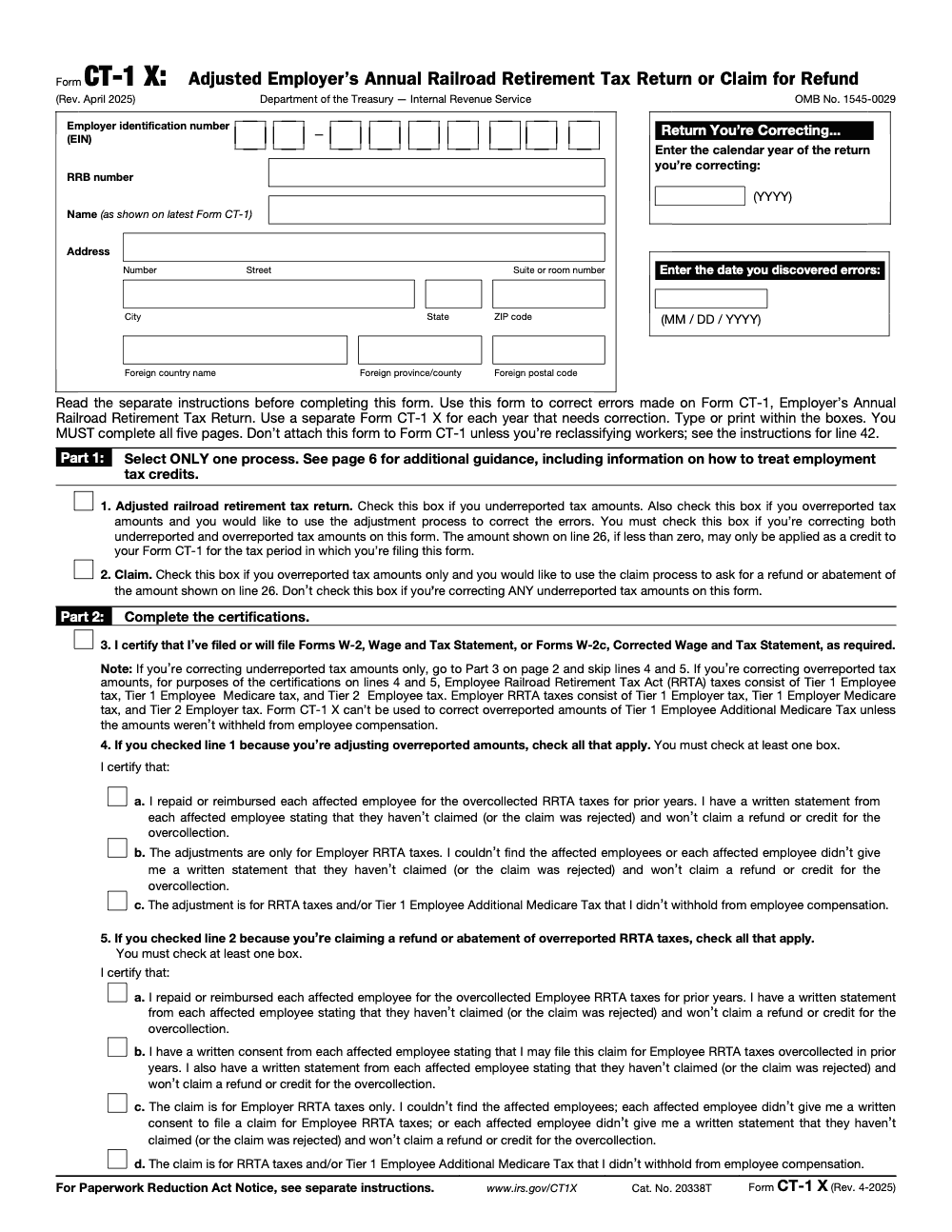
Form CT-1X is the railroad-specific correction return – railroad employers use it to fix a previously filed Form CT-1 (RRTA tax), while non-railroad employers correct social security and Medicare on Form 941-X or 944-X instead, per the IRS Instructions for Form CT-1 X (Rev. April 2025). File one CT-1X per year you are correcting, pick exactly one process in Part 1 (line 1 for an adjustment, line 2 for a claim), and read line 26 as the net result: a negative amount becomes a credit to your next CT-1 under an adjustment, or a refund or abatement under a claim.
Form CT-1X turns on one decision you make once per year. In Part 1 you pick exactly one process: line 1 for an adjusted return when a change increases tax or you have a mix, or line 2 for a claim only when every change reduces tax. Pick wrong and you set the whole correction on the wrong track, because line 26 reads as the net result and a negative total behaves differently depending on which box you chose.
Use CT-1X to fix a previously filed Form CT-1 for RRTA tax, while non-railroad employers correct social security and Medicare on Form 941-X or 944-X instead. File one CT-1X per tax year, certify your W-2 or W-2c actions in Part 2, and mail it as a paper filing; the current revision is dated April 2025 and the where-to-file page lists Cincinnati, OH for USPS mail.
Key Takeaways
- Use CT‑1X to fix prior year RRTA reporting for Tier 1 and Tier 2, plus Tier 1 Employee Additional Medicare only when that amount was not withheld from pay.
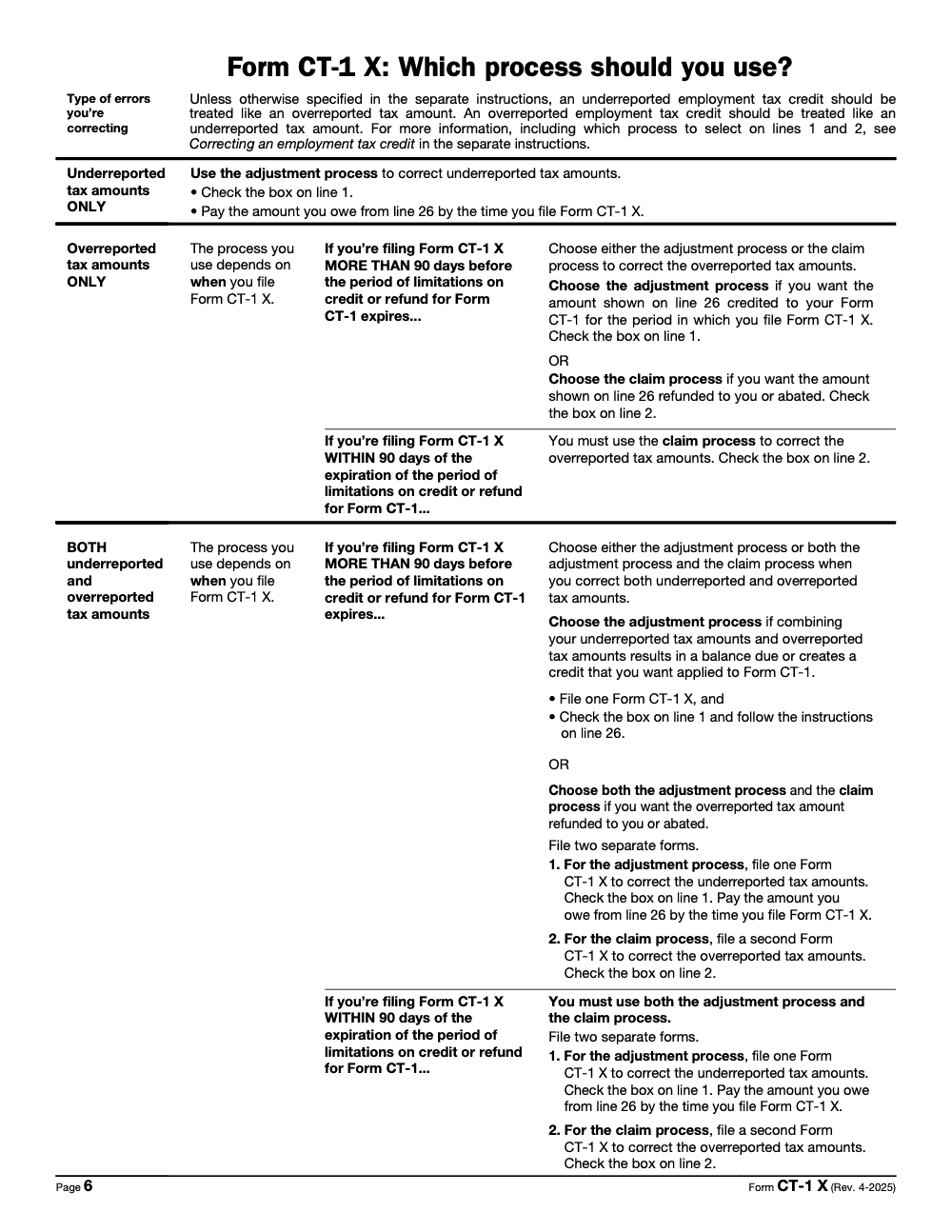
- In Part 1, pick exactly one process. Choose Adjusted return if any change increases tax or if you have a mix. Choose Claim only if every change reduces tax. A negative total on line 26 becomes a credit if you chose Adjusted return, or a refund/abatement if you chose Claim.
- You must certify W‑2 or W‑2c actions in Part 2. For employee tax decreases, either repay and collect employee statements or obtain written consents. Keep records, do not send them with the return.
- Do not use CT‑1X to fix the federal tax liability grid on CT‑1 or Form 945‑A, that has its own correction path.
- File one CT‑1X per tax year and mail it, CT‑1X is a paper filing. The current where‑to‑file page lists Cincinnati, OH for USPS mail.
Who should use Form CT‑1X and what it covers
If you are a railroad employer subject to the Railroad Retirement Tax Act, CT‑1X is your correction path when a previously filed CT‑1 needs to change. You can correct Tier 1 and Tier 2, employer and employee portions, and you can correct Tier 1 Employee Additional Medicare only if the amounts were not actually withheld from the employee. If those Additional Medicare amounts were withheld, you cannot claim them back on CT‑1X.
You will file a separate CT‑1X for each tax year that needs attention, and you will not attach CT‑1X to a current CT‑1, except for a narrow worker reclassification scenario noted in the instructions. Keep your year‑by‑year files clean, since mixed‑year packages create avoidable notices.
Adjusted return vs. Claim, a simple decision you make once per year
Part 1 forces a clean choice, which is good for reviewers and for the IRS.
- Adjusted return, pick this if any item increases tax, or if you have a mix of increases and decreases. If your final line 26 total is negative on an adjusted return, it posts as a credit to the CT‑1 for the year you file the CT‑1X, not as a refund check.
- Claim, pick this only if all items reduce tax. Here, a negative on line 26 is the refund or abatement you are asking the IRS to issue.
The 90‑day rule that trips people up
If you discover an overreport during the last 90 days before the refund statute expires for that year, you must use the Claim process, not an adjustment. If you also have underreported items, you file a separate CT‑1X for those increases. This avoids timing problems and keeps your credit or refund from getting stuck.
Why delivery breaks here, and how to fix it
Most errors are simple, the time sink is documentation. Teams get jammed preparing W‑2c files, chasing employee signatures, and deciding how to treat Additional Medicare. The cure is a small SOP, not heroics. In my work with railroad employers and firms, three things shorten reviews, a one‑page intake, a clean employee documentation tracker, and a reviewer checklist that forces a yes or no on line 26 cash handling.
Light note on help you can call in, if your team is buried during statute season, a disciplined offshore delivery team can prep standardized workpapers and handle W‑2c and consent tracking inside your systems, so your reviewers only approve. Mentioning this once is enough, use it only if capacity is your real constraint.
What, how, wow, the framework that makes CT‑1X painless
- What, CT‑1X corrects a previously filed CT‑1 for a single year, and it handles both increases and decreases.
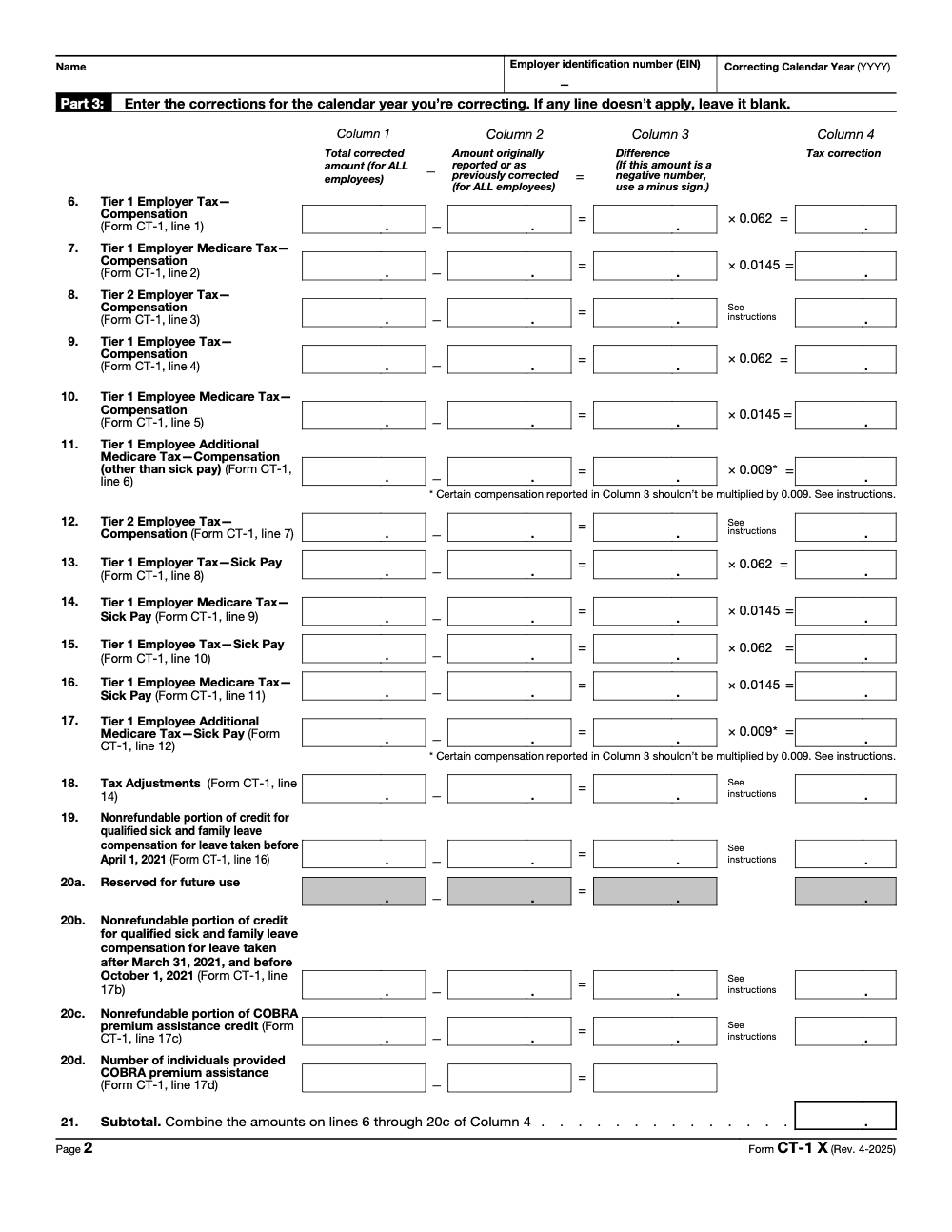
- How, pick the right process in Part 1, certify W‑2 or W‑2c and employee steps in Part 2, then complete the math in Part 3 and follow the payment or credit rules tied to line 26.
- Wow, a one‑page SOP cuts review time in half, because it prevents the two biggest mistakes, choosing the wrong process and skipping W‑2/W‑2c documentation.
A quick comparison, Adjusted return vs. Claim
| Purpose | Adjusted return | Claim |
| When to use | Any increase, or a mix of increases and decreases | Every change reduces tax |
| Line 26 negative | Treated as a credit to the CT‑1 for the year you file CT‑1X | Treated as a refund or abatement you are requesting |
| 90‑day statute window | Do not use for overreports in the last 90 days | Required for overreports in the last 90 days |
| Employee steps | Line 4, repay with statements, employer‑only where allowed, or not‑withheld Additional Medicare | Line 5, repay with statements, obtain written consents, employer‑only where allowed |
| Cash planning | No check expected on an adjustment, plan the credit | Refund processing follows claim timelines |
This table mirrors the structure in the current instructions, so your review notes align with how the IRS thinks about each path.
Part 2, the employee certification path
You certify W‑2 or W‑2c on line 3, then you certify how you handled employee tax decreases on line 4 for adjustments or line 5 for claims. Choose the boxes that match your documentation, for example, you repaid and collected written statements, you obtained written consents to file on the employee’s behalf, or you are making an employer‑only correction when an employee cannot be located. You must check at least one box on line 4 for an adjustment, or line 5 for a claim, whenever overreported amounts are involved, or the IRS will not process the correction. Keep all statements and consents in your records, do not send them with the return.
Important limit, you cannot use CT‑1X to claim a refund of Tier 1 Employee Additional Medicare Tax that was actually withheld from employees. You may correct only amounts that were not withheld, Additional Medicare Tax that was actually withheld from an employee is recovered by that employee on their own Form 1040, not refunded on this form.
A short employee notice you can adapt
We found an RRTA overcollection on your prior year pay. We will [repay/reimburse] you [amount] and correct our IRS filings. Please sign the attached statement confirming you have not, and will not, request a refund or credit for that amount. If you prefer, you may sign the consent that authorizes us to file a claim on your behalf. Note, federal law does not permit a refund of Additional Medicare that was actually withheld.
Timing, statutes, and interest‑free adjustments
- Underreported amounts, if you discover an underreport, you generally keep it interest‑free by filing CT‑1X by the due date of the CT‑1 for the year in which you discovered the error and paying when you file. IRC section 6205 and related regulations govern this treatment.
- Period of limitations, for refund or credit, it is generally 3 years from when CT‑1 is considered filed, or 2 years from when tax was paid, whichever is later. The instructions explain the practical examples and encourage filing adjustments within the first 11 months so credits post before your next CT‑1.
- Last 90 days, for overreports, use a Claim. If you also have underreported amounts, file a second CT‑1X for the increases.
Filing and payment in 2025
- Paper filing, the IRS processes CT‑1X on paper. The current where‑to‑file list shows Cincinnati, OH for USPS and lists separate addresses for private delivery services. Always check the live “Where to file” page in case addresses changed after printing.
- Paying a balance, if line 26 is positive, pay by the time you file using EFTPS or by check, and note your EIN, “Form CT‑1X,” and the corrected year on the memo line. The instructions explain how line 26 amounts flow.
The IRS “About Form CT‑1X” page shows the current revision and notes no recent developments as of July 8, 2025. Always download fresh copies before you prepare your package.
Step by step, completing the 2025 revision with fewer review loops
Step 1, prepare your intake
- Year and EIN, confirm these match the original CT‑1.
- Error type, increase, decrease, or both.
- Statute dates, write the exact expiration date and whether you are inside the last 90 days.
- Employee impact, list names, amounts, and whether you will repay or obtain consents.
This one‑page intake gives reviewers everything they need to approve Part 1 and Part 2 choices in minutes.
Step 2, choose the process in Part 1
Check only one box, Adjusted return if any item increases tax or if you have a mix, Claim if all items reduce tax. Add a short note in your file that justifies the choice, for example, “Claim only, 2023 Tier 2 overreport, no underreported items.”
Step 3, certify W‑2 or W‑2c and employee handling in Part 2
- Line 3, certify your W‑2 or W‑2c status.
- Line 4 or 5, match the boxes to your actual documentation, repay with statements, obtain consents, employer‑only when allowed, not‑withheld Additional Medicare. Keep proofs in your records.
Step 4, complete Part 3 without math surprises
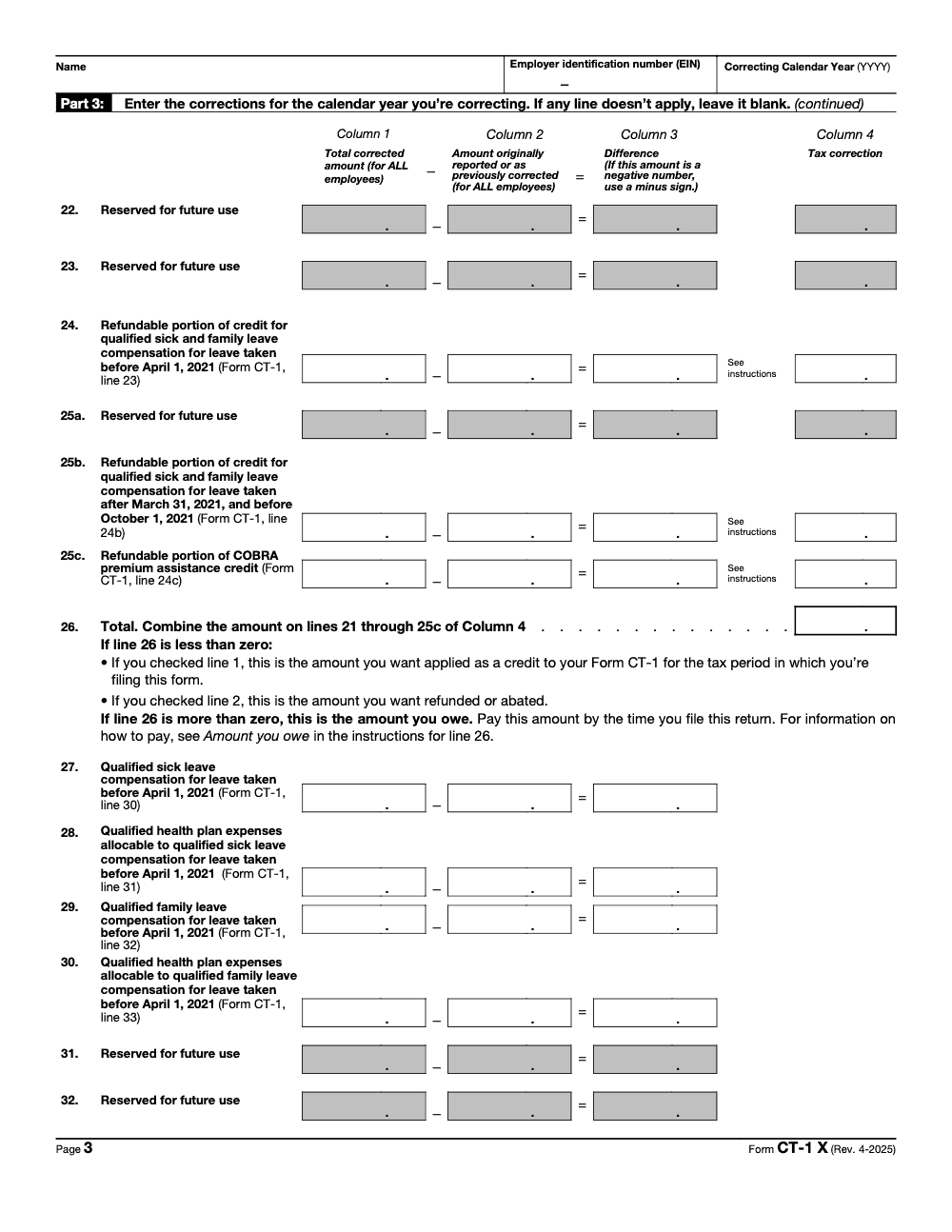
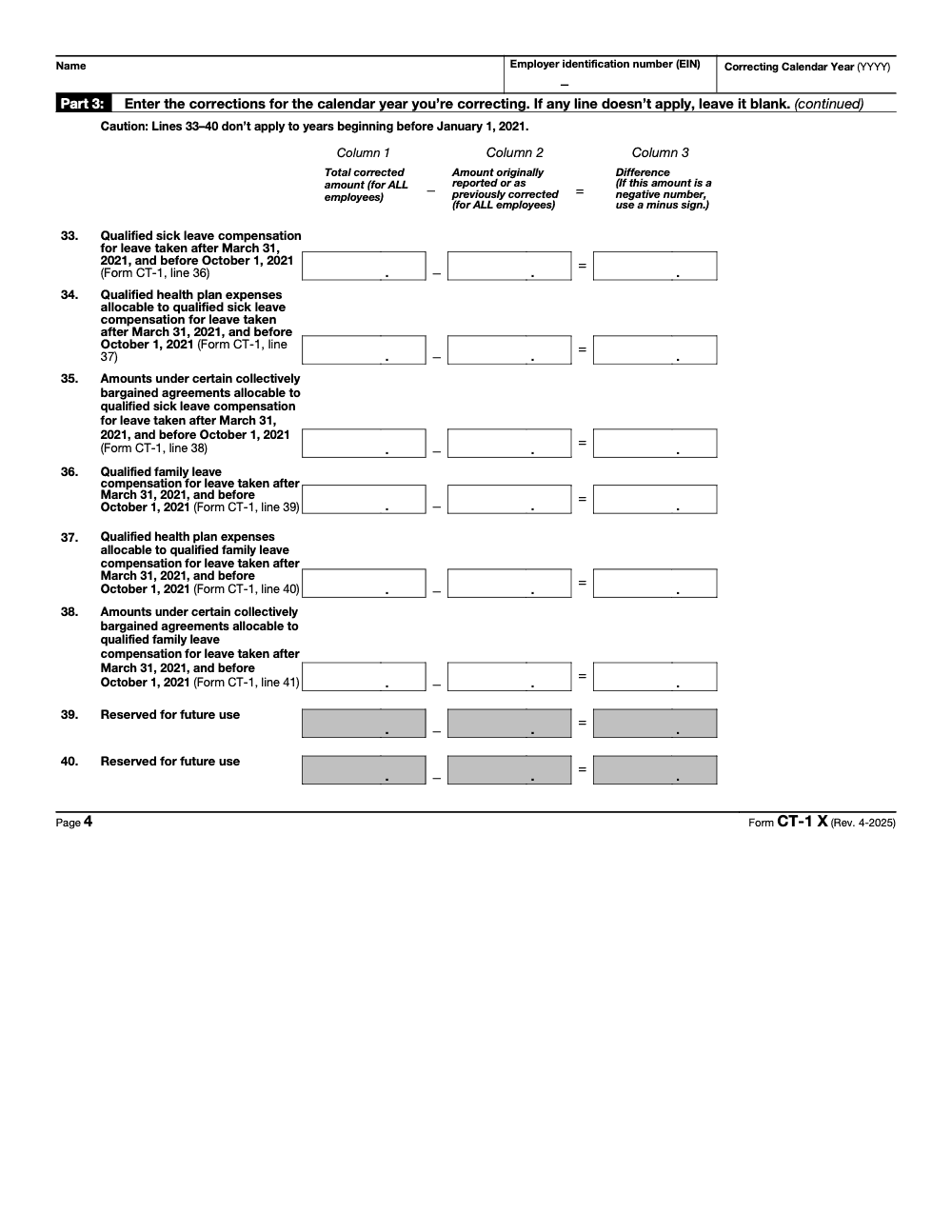
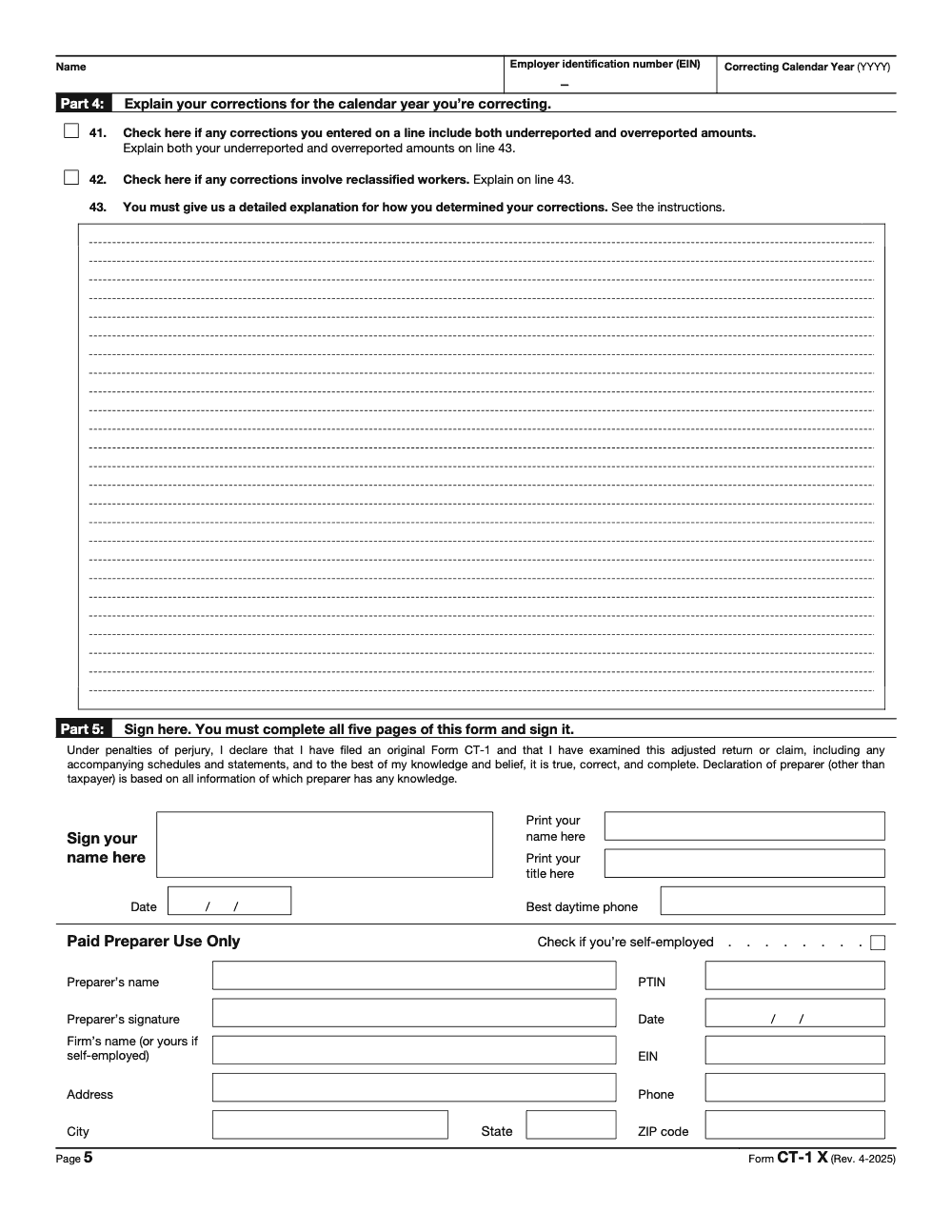
You will enter corrected totals, previously reported amounts, differences, and tax effects across Tier 1, Medicare, and Tier 2 lines, then compute the total on line 26. The instructions tell you which lines are active, which are reserved, and how to handle Additional Medicare in column entries. Finish with a clear narrative on line 43 that explains each correction, a blank or one‑line explanation is one of the most common reasons the IRS sends correspondence or delays processing.
Step 5, handle line 26 the right way
- Positive total, you owe. Pay by the time you file.
- Negative total, if you chose Adjusted return, it becomes a credit to the CT‑1 for the year you file CT‑1X, if you chose Claim, it is the refund or abatement you are requesting.
Common pitfalls and easy fixes
- Picking the wrong process, adjust versus claim, fix it by anchoring your choice to whether any item increases tax and to the 90‑day rule.
- Treating a negative line 26 like cash on an adjusted return, fix it by planning for a credit, not a refund check.
- Forgetting W‑2/W‑2c status, fix it by making line 3 a required reviewer checkpoint with SSA proof attached.
- Using CT‑1X to fix the liability grid, fix it by filing a corrected Form 945‑A for timing entries.
- Mishandling Additional Medicare, fix it by remembering you can only correct amounts not withheld.
Worked examples
Example A, pure decrease, Claim
You filed 2023 CT‑1 on February 27, 2024. In January 2026 you find a Tier 2 overcollection. There are no increases. File a 2023 CT‑1X as a Claim, repay employees and collect statements or obtain consents, check line 5, and request the refund shown as a negative on line 26. You are inside the last 90 days before the statute closes, so Claim is required.
Example B, mix of increase and decrease, Adjusted return
In May 2025 you find a 2024 Tier 1 underreport and a separate Tier 2 overreport. File 2024 CT‑1X as an Adjusted return and pay the net positive on line 26 by the time you file, or apply the net negative as a credit if the total falls below zero. Handle employee steps on line 4.
Example C, interest‑free increase
On June 20, 2025 you discover an additional 2024 RRTA amount. File CT‑1X by March 2, 2026, the due date of the 2025 CT‑1, and pay when you file to keep it interest‑free under IRC 6205.
A practical SOP your team can copy
Intake
- Year, EIN, and original CT‑1 filing date
- Error summary and whether any item increases tax
- Statute dates, include the 90‑day checkpoint
- Employee list with amounts and chosen path, repay or consent
Documentation
- W‑2c status and SSA confirmation
- Repayment proof, date, method, amount
- Employee statements or consents, filed and indexed
- Notes if using employer‑only corrections for employees you cannot locate
Review
- Part 1 choice initialed
- Line 3 W‑2/W‑2c status verified
- Line 4 or 5 selections tied to documentation
- Line 26 handling, payment or credit plan approved
- Line 43 narrative checked for clarity
Filing and follow up
- EFTPS payment confirmation if you owe
- USPS or private‑delivery address verified using the current “Where to file” page, since addresses can change after printing. For 2025, USPS mail shows Cincinnati, OH for CT‑1X.
- Calendar a status check 8 to 12 weeks after mailing
Micro‑anecdotes from the field
- The missing consent, one firm kept losing time waiting on a single traveler who never replied. They switched to employer‑only for that person, documented attempts, then closed the file. The reviewer time dropped by half.
- The “December surprise,” a payroll lead found an overreport on December 20. They waited to file until March, still inside the statute, so the credit posted before the next CT‑1. That prevented a balance due notice. The instructions recommend this timing pattern for credits.
Why this matters for delivery
CT‑1X is where production, review, and people operations meet. When you standardize intake and documentation, partners get out of reviewer loops and back to client strategy. That is how you protect margins and keep promises during peak season.
If you ever need extra hands, use outside help sparingly and only when it adds structure. A controlled offshore team that works in your systems, follows your SOP, and delivers standardized workpapers can be a relief valve without giving up quality or security. Use it when capacity, not complexity, is your blocker.
Templates and quick references
Adjusted return vs. Claim, side by side
| Topic | Adjusted return | Claim |
| Eligibility | Any underreported amount or a mix | Only overreported amounts |
| Line 26 negative | Credit to the CT‑1 for the year you file | Refund or abatement requested |
| Last 90 days | Do not use for overreports | Must use |
| Employee handling | Line 4 selections, repay with statements, employer‑only, not‑withheld Additional Medicare | Line 5 selections, consents allowed, repay with statements, employer‑only |
| Documentation kept | W‑2/W‑2c proof, statements or consents, reviewer sign‑off | Same as adjusted return |
Reference these rules directly from the 2025 instructions when you review files.
Where to mail and why to recheck the address
The IRS keeps a live “Where to file” page that lists the current addresses for CT‑1X. This page is updated more often than printed instruction booklets, so check it each time. As of September 22, 2025, USPS mail for CT‑1X goes to Cincinnati, OH 45999‑0007.
Final checklist before you file
- Confirm year and EIN on every page
- Pick the correct Part 1 path and note the 90‑day rule
- Certify W‑2 or W‑2c on line 3
- Choose the correct line 4 or 5 options and match them to real documentation
- Compute line 26 and plan payment or credit
- Add a clear line 43 explanation
- Verify the current mailing address and send the package
Light CTA, only if you truly need it
If your firm is buried in CT‑1X cleanups during statute season, you can bring in structured offshore capacity without losing control. At Accountably, we integrate trained teams into your SOP, your templates, and your systems, we standardize workpapers, and we protect reviewer time with layered QA. Use help like this only when it adds discipline and predictability, not as a band‑aid.
Sources and currency
- About Form CT‑1X, page last reviewed July 8, 2025, confirms purpose and shows no recent developments.
- Instructions for Form CT‑1X, revised April 2025, detail the Adjusted return versus Claim choice, W‑2/W‑2c and employee certifications, 90‑day rule, and line 26 handling.
- Where to file forms beginning with the letter C, updated September 22, 2025, lists current CT‑1X mailing addresses, including Cincinnati for USPS mail.
- IRM 21.7.2, Employment and Railroad Tax Returns, cites IRC 6205 interest‑free adjustments and the requirement to use the corresponding “X” form for corrections.
Common Mistakes We See Every Season
Most CT-1X problems are not math errors, they are process and documentation slips that pull a clean correction into IRS correspondence. These are the ones my team flags most often, with the fix we bake into the SOP.
Reusable Checklists
These are copy-paste ready for your firm SOP. Drop them into your CT-1X workpaper template and check off each item as you go.
Part 1 process-decision packet
- Confirm an original Form CT-1 was filed for the year you are correcting; CT-1X cannot stand in for a missed original.
- Enter the four-digit calendar year and the date you discovered the errors at the top of the form.
- Total every increase and decrease so you know whether the return is all-decrease, all-increase, or mixed.
- Pick exactly one process: line 1 for any increase or a mix, line 2 only when every change reduces tax.
- Apply the 90-day rule: within 90 days of the refund statute on an overreport, route it to the claim process.
- Confirm both the EIN and the RRB number appear on the form.
- Use the Tier 2 rate published for the year being corrected, not the current year.
Part 2 certification and W-2c tracker
- Check line 3 to certify that Forms W-2 or W-2c were or will be filed; it is never optional.
- For overreported amounts on an adjustment, check at least one box on lines 4a, 4b, or 4c.
- For an overreported claim, check at least one box on lines 5a through 5d.
- For employee tax decreases, repay or reimburse and collect employee statements, or obtain written consents.
- Correct Additional Medicare on lines 11 and 17 only where the 0.9% was not withheld.
- Keep W-2c proofs, statements, and consents in your files; do not mail them unless the IRS asks.
Pre-mail review
- Recompute Column 4 on each line as Column 3 times the correct rate for that year.
- Verify line 21 subtotals lines 6 through 20c, and line 26 totals lines 21 through 25c.
- Write a complete line 43 explanation of how every correction was determined.
- If any single line mixes increases and decreases, check line 41 and explain both directions on line 43.
- Complete and sign all five pages, even the ones left blank.
- If line 26 is positive, include payment with the return; if negative, confirm the credit-or-refund result matches your Part 1 choice.
- Mail one CT-1X per year to the current Where to File address, not an older printed address.
Keep CT1X Season From Stalling
CT-1X work does not arrive on a tidy quarterly calendar. It lands whenever a payroll error surfaces or a refund statute starts to close, and each correction is a five-page return that runs through line 43 and must reconcile back to the original CT-1, per the IRS Instructions for Form CT-1 X (Rev. April 2025). That reconstruction, not the arithmetic, is where reviewer time disappears.
The fix is a repeatable intake and review path, not extra hours. When the Part 1 process, the Part 2 certifications, and the line 26 cash treatment are settled up front, reviewers approve a file instead of investigating it.
- A one-page intake that captures the year being corrected, the discovery date, and whether the return is all-decrease, all-increase, or mixed, so the process is chosen once.
- A W-2c and consent tracker tied to the line 3 certification and the line 4 or line 5 boxes, so no overreported correction goes out uncertified.
- A line 26 rule that flags whether a negative total is a credit (adjustment) or a refund (claim) before the file reaches review.
- A Tier 2 rate reference pinned to each correction year, so lines 8 and 12 never inherit the current-year rate.
- A line 43 narrative template documenting how each correction was calculated, the single biggest driver of avoidable notices.
That is the discipline we build into client workflows at Accountably. Our tax execution teams prepare standardized CT-1X workpapers inside your systems and templates, track W-2c and consent documentation, and hand reviewers a clean file, so corrections clear without stalling your season.
FAQs
As of 2025, CT‑1X is a paper filing. Mail it to the current address listed on the live “Where to file” page, not an older printed address.
No. CT‑1X is a stand‑alone filing. The instructions note a narrow worker reclassification exception, otherwise do not attach it to CT‑1.
Generally, it is 3 years from the date CT‑1 is considered filed, or 2 years from the date tax was paid, whichever is later. The instructions include timing examples and the 90‑day claim rule.
The completed form, your line 43 explanations, and payment if you owe. Keep W‑2c proofs, statements, and consents in your files, do not send them unless asked.
No. Use a corrected Form 945‑A for liability timing. CT‑1X is for tax corrections, not liability schedule changes.
Other forms this guide names
- Form W-2c: Guide to Correcting W-2 Errors
- Form W‑2: Deadlines, E‑File Rules, Boxes, and W‑2c Corrections
- Form 945-A: Daily Liability, Next-Day Rule, Line M Guide
- Form 1040: Filing Guide for 2025 Returns (AGI, Deductions, Deadlines)
About this guide
Accountably helps US CPA, EA, and accounting firms hire trained accountants and tax preparers in India.
About us Reviewed byJugal Thacker, CPAFounder and CEO at Accountably
A Washington-licensed CPA with 7+ years inside US firms – PwC, a real-estate tax practice, then a full-service firm, rising from reviewer to manager to advisory. This article was reviewed against current IRS guidance for the 2025 tax year and updated for filers preparing late returns, amendments, and 2026 estimates.
View profile →How we research, review, and update this guide
Every Accountably guide is researched against primary IRS sources, reviewed by a U.S. CPA, and refreshed as guidance evolves. Read our Editorial Guidelines to see how we source, fact-check, and update our content.