Summarize this article with AI
In Brief
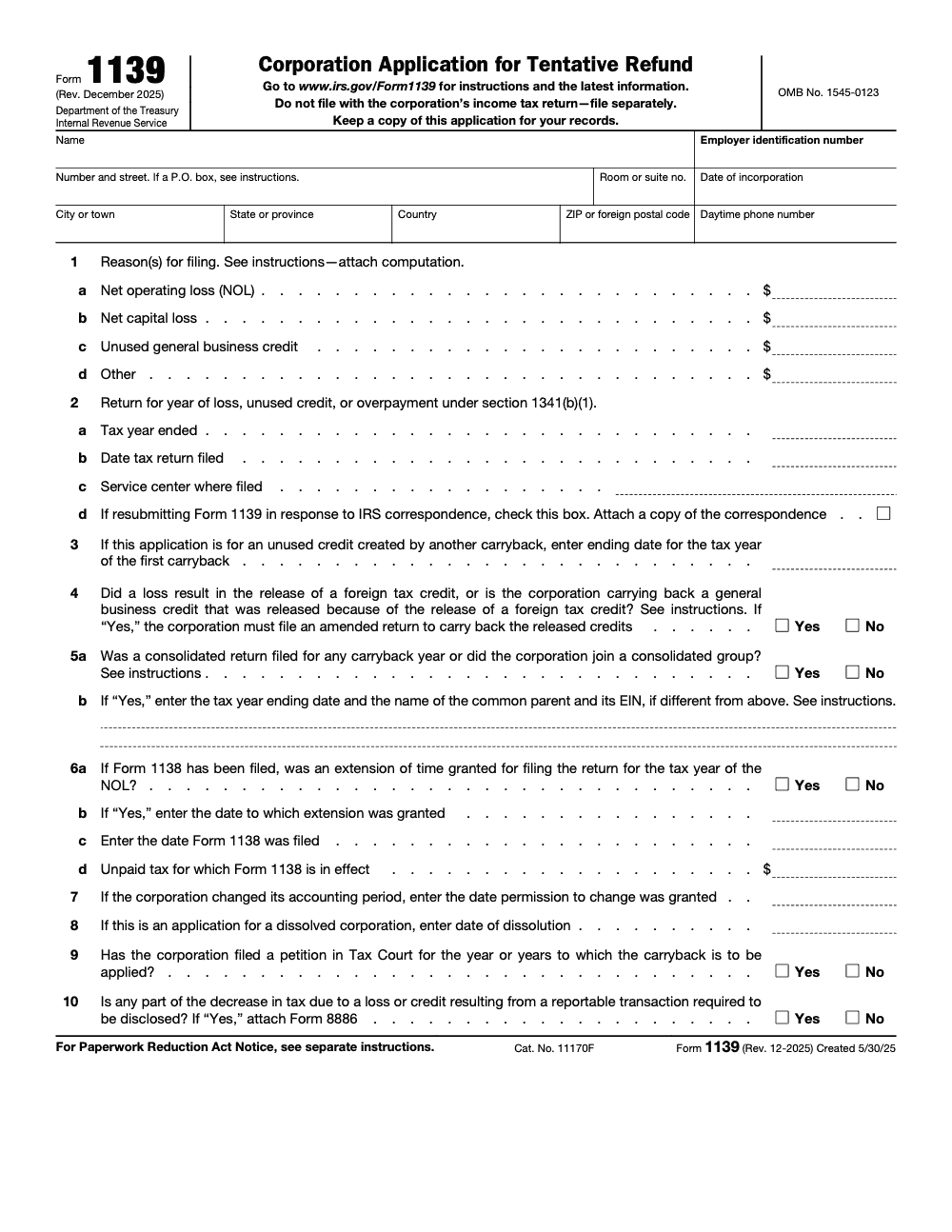
Form 1139 is the C corporation application for tentative refund for carrying back a net operating loss, net capital loss, unused general business credit, or §1341 claim-of-right adjustment (per IRC §6411). File within 12 months after the loss-year ends, mail it separately from Form 1120 to the same IRS service center, and the IRS targets action within 90 days.
The window on Form 1139 is unforgiving: file no earlier than the date you file the loss-year return and no later than 12 months after that tax year ends. Miss it and the quick tentative-refund route closes, leaving the slower Form 1120-X. Plenty of corporations discover the deadline with only a few weeks left and the loss-year Form 1120 still unfiled.
Form 1139 applies a carryback of a net operating loss, net capital loss, unused general business credit, or a section 1341 claim-of-right adjustment, and S corporations cannot use it. The rules attached to each are easy to trip on: post-2020 net operating losses generally do not carry back outside narrow categories, the 80 percent income limit applies in years beginning after 2020, net capital losses carry back 3 years and forward 5, and unused general business credits generally carry back 1 year. Mail it separately from Form 1120 to the same service center, and the IRS targets action within 90 days under section 6411.
Key Takeaways
- Form 1139 is a corporate application for a quick, tentative refund from a carryback of an NOL, net capital loss, unused general business credit, or a §1341 claim of right adjustment. S corporations do not use it.
- Timing is strict. File no earlier than the date you file the return for the loss or adjustment year, and no later than 12 months after that tax year ends. If you miss the 12‑month window, the quick‑refund route closes and you must use Form 1120X within the 3‑year refund statute instead.
- Post‑2020 NOLs generally do not carry back, except for specific categories such as farming losses and certain insurance companies, and the 80 percent income limit applies when used in years beginning after 2020.
- Net capital losses for corporations generally carry back 3 years and forward 5. Unused general business credits generally carry back 1 year.
- The IRS performs a limited review and aims to act quickly on a properly filed 1139. If it is disallowed or needs more, you can still use Form 1120X.
- File Form 1139 with the IRS service center where your corporate return is filed. Do not attach it to the return. Check current IRS instructions before you mail.
What Form 1139 Does, And Who Can Use It
Form 1139 lets a C corporation ask the IRS for a quick refund from specific carrybacks and from a §1341 claim of right adjustment. You use it to push tax attributes back to earlier profitable years, recompute those years, and pull cash forward now. The form is not for S corporations and not for individuals. Non‑corporate filers use Form 1045.
What You Can Claim On Form 1139
- Net operating loss carryback, where allowed by current law.
- Net capital loss carryback, generally 3 years, limited so it does not create or increase an NOL in the carryback year.
- Unused general business credit carryback, generally 1 year, with refigured Form 3800 for the carryback year.
- §1341 claim of right tentative refund, with the supporting computation.
Important Limits You Should Expect In 2026
- For losses in years beginning after December 31, 2020, a standard corporate NOL generally does not carry back. Certain categories still do. Your NOL deduction for years beginning after 2020 is also subject to the 80 percent income cap for post‑2017 NOLs.
- A corporate net capital loss can still carry back 3 years. Treat it as short‑term in the carryback year, and remember it cannot generate or enlarge an NOL in that year.
- Unused general business credits typically carry back 1 year. Recompute the credit on Form 3800 for the carryback year and include any released credits.
Quick Note On Consolidated Groups
Consolidated groups follow the same 12‑month timing, with a special rule for a qualified new member whose separate return year ends on the date it joins. The instructions explain how that year is treated for the timing test.
When To File, And Why The Sequence Matters
You can only file Form 1139 after you file the corporate return for the year that created the carryback or §1341 item. The deadline is 12 months after that tax year ends. Miss that window, and your quick‑refund route closes. You can still pursue a refund on Form 1120X inside the statute, but you lose the speed of the tentative refund process.
Here is a simple timeline:
- Your loss year ended December 31, 2025.
- You file the 2025 Form 1120 on March 15, 2026.
- Your Form 1139 filing window runs from March 15, 2026 up to December 31, 2026. You must file inside that 12‑month window, and only after the 2025 return is filed.
Section 1341 Claim Of Right Timing
If you had to repay income previously taxed under a claim of right, you can file a tentative refund application under §6411(d). Your window starts on the date you file the return for the year of the deduction and ends 12 months after that year’s last day.
Where To Send It
File Form 1139 with the IRS service center where the corporation files its income tax return. Do not attach it to your return. Check the Form 1139 page for the most current directions before you mail, then keep your proof of mailing.
Practical tip, especially for large refunds. If the carryback‑year refund is at least $1,000,000, include Form 8302 to request electronic deposit.
Why This Matters Operationally
You are on the clock, and you are paper‑heavy. The IRS does a limited review and aims to act quickly, but errors, gaps in attachments, or missing signatures stop the process. If you need liquidity for debt covenants or payroll runway, weeks count. The cleanest 1139 files I have seen come from teams that standardize workpapers, keep prior‑year returns and recalcs side by side, and label every schedule like they expect a stranger to review it in five minutes. The rules favor that discipline.
In places where you need extra hands to pull prior‑year recomputations, reconcile Schedule D totals, or rebuild Form 3800 for a released credit, a structured offshore team can help you hold the deadline without sacrificing review quality. At Accountably, we build that kind of delivery discipline as part of your workflow, so your Form 1139 package is complete, consistent, and on time. Use us where it truly helps, not as a shortcut.
Eligibility And What To Attach, Matched To Each Claim Type
If you want your refund quickly, give the IRS everything they expect in one, organized packet. The official instructions specify both who can file and what to attach. Here is a practical map you can follow.
Attachment Map For Form 1139
| Claim Type | Core Eligibility Notes | Must‑Have Attachments |
| Net Operating Loss carryback | Post‑2020 carryback limited to certain categories, others generally carry forward and are subject to the 80 percent cap when used in years after 2020 | Detailed NOL computation for the loss year, showing adjustments and any elections. Identify each carryback year. Include first two pages of Form 1120 for the loss year. Add any required elections |
| Net Capital Loss carryback | Corporations only. Generally a 3‑year carryback and 5‑year carryforward. Cannot create or increase an NOL in the carryback year. Treated as short‑term in the carryback year | Schedule D for the loss year, plus carryback‑year recomputations that tie to Form 1139 Line 12 and the columns for affected years |
| Unused General Business Credit carryback | Generally a 1‑year carryback. You must recompute the carryback‑year credit | Form 3800 for the carryback year and applicable component credit forms, along with the loss‑year credit schedules |
| §1341 Claim of Right tentative refund | Available when you repaid amounts previously included in income under a claim of right | The computation that compares the tax with and without the §1341 deduction and shows the overpayment |
| AMT or BEAT interactions | Pre‑2018 AMT may still be relevant in carryback years. BEAT applies to certain large corporations | Attach recomputations. Include Form 4626 for pre‑2018 AMT years or Form 8991 for BEAT as needed |
Include copies of all loss‑year forms and any carryback‑year forms that changed after your recompute, plus any reportable transaction disclosures originally attached. The instructions call these out specifically.
Deadlines In Plain English
Here is the timing rule in the simplest form I know:
- You cannot file Form 1139 before you file the corporate return for the year of the NOL, loss, unused GBC, or §1341 item.
- You must file Form 1139 within 12 months after that tax year ends.
A quick date anchor for 2026:
- If your fiscal year ended on June 30, 2025, your Form 1139 must be filed by June 30, 2026, and only after you file the 2025 return.
90‑Day IRS Action Window
The IRS targets action within 90 days of your filing, based on the tentative carryback rules. The review is intentionally limited to math and omissions, which is why clean workpapers speed things up. The 90‑day allowance is not a guarantee of finality, though – the IRS can still examine the carryback later within the statute of limitations and assess a deficiency through normal procedures.
Interest, If It Runs Long
If the IRS does not pay within normal administrative windows, interest rules under §6611 apply. This is another reason to file a complete, processible package.
Step‑By‑Step, How To Complete Form 1139
You do not need to be fancy. You need to be complete, consistent, and easy to review.
- Identify the trigger on Line 1 Select the correct box for NOL, net capital loss, unused GBC, or §1341. Confirm your original return for the loss or adjustment year has been filed. For net capital loss, verify that the prior years actually have capital gains to absorb it. For a GBC carryback, confirm the 1‑year lookback and credit recompute.
- Recompute the carryback years For each affected year, recompute taxable income, tax, AMT or BEAT if applicable, and credits. Capital loss carrybacks are short‑term. Released credits should be tracked and reconciled to Form 3800 in the carryback year.
- Assemble the attachments
- First two pages of the loss‑year return, plus the schedules that produce the carryback.
- Carryback‑year forms and schedules that changed after recompute.
- NOL schedule with adjustments and elections, or Schedule D tie‑outs, or Form 3800 recalculation, plus any §1341 workpapers.
- If applicable, Form 4626 for pre‑2018 AMT and Form 8991 for BEAT.
- Sign and file with the right IRS service center Sign the form, mail it to the service center where you file your corporate return, and keep proof of mailing. Do not attach Form 1139 to your income tax return.
- Track the 90‑day clock and respond fast If the IRS requests clarifications, respond quickly and keep the packet structure intact. If an application is disallowed for omissions or math errors, you can still file Form 1120X.
Real‑World Checklist You Can Reuse
- Confirm eligibility for the carryback you intend to claim in 2026.
- Validate the 12‑month filing deadline, measured from the end of the loss or §1341 year, and confirm your return for that year is filed.
- Verify capital loss and GBC carryback periods, and the NOL limits that apply in the carryback and carryforward years.
- Prepare tidy, labeled workpapers for every recompute, including credit releases.
- Include any required elections, especially for NOLs in special categories.
- Sign, file to the correct service center, and retain mailing proof.
Common Errors That Slow 1139 Refunds, And How To Avoid Them
Even tiny misses can stall a tentative refund. These are the issues I see most often, with quick fixes you can apply today.
- Header mismatches. Missing or mismatched EIN, tax year end, or service center. Cross‑check the header block before you print and sign. File with the same service center where you file your corporate return.
- Capital loss tie‑outs do not match. Reconcile Form 1139 Line 12 and its columns to Schedule D, and confirm the loss does not create or increase an NOL in the carryback year.
- Unattached credit recomputations. A GBC carryback needs a recomputed Form 3800 for the carryback year and the component credit forms.
- Thin NOL schedules. Include the full NOL computation for the loss year, flag whether any special elections apply, and identify carryback years clearly. If you are not in a qualifying category, do not try to carry back a post‑2020 NOL.
- §1341 claims without the required schedule. The computation must compare the tax with and without the §1341 deduction and show the overpayment.
- Missing signature. Simple, painful, and very common. Sign the form.
A tentative refund application is not a formal claim. If the IRS disallows it for omissions or math errors, you can still file a traditional claim on Form 1120X within the refund statute.
Form 1139 Or Form 1120X, Which Should You Use?
Use this quick comparison when you are deciding on speed versus finality.
| Topic | Form 1139, Tentative Refund | Form 1120X, Amended Return |
| Best use case | Quick cash from a permitted carryback or §1341 item | Final changes to a prior year, any item type |
| Action target | The IRS aims to act promptly, with a limited review | No set quick‑action target, full amended processing |
| Filing window | 12 months after the end of the loss or §1341 year, and not before filing that year’s return | Generally 3 years from when the original return was filed or 2 years from payment, whichever is later |
| What happens if denied | You can still file 1120X | You can protest or litigate per refund claim rules |
| Where to file | IRS service center where you file your corporate return, separate from the income tax return | Per 1120X instructions |
A Note On Electronic Options
Instructions direct you to file Form 1139 with your service center and not with the return. There is no general e‑file pathway described in the current instructions. Always check the Form 1139 page for the latest submission method before you send.
Worked Example, From Trigger To Refund
Let us say your corporation’s tax year ended December 31, 2025. You have a net capital loss in 2025 and prior‑year capital gains.
- File the 2025 return You file on March 15, 2026.
- Recompute carryback years You carry the 2025 net capital loss back to 2022, 2023, and 2024, limited to capital gain net income each year. You treat the loss as short‑term in each carryback year. You do not create or increase an NOL in any carryback year.
- Prepare Form 1139 Check Line 1b for net capital loss. Complete the year‑by‑year columns, and attach Schedule D for 2025 and the recomputed carryback‑year schedules. Tie your line items to the workpapers.
- File on time You file your Form 1139 on May 1, 2026, which is inside the 12‑month window that ends December 31, 2026.
- IRS action window The IRS targets prompt action after you file. You watch for correspondence and respond quickly.
How Accountably Helps, When It Actually Helps
This page is here to teach, not to pitch. That said, if you need extra capacity to hit a Form 1139 deadline, structure beats heroics. Accountably works inside your systems, aligns to your templates, and builds checklists and file naming that protect reviewer time. That is useful when you must:
- Recompute several carryback years and roll forward released credits.
- Reconcile Schedule D and Form 3800 numbers across multiple entities.
- Package a clean §1341 computation with all required statements.
Use us only where the operational lift matters. Your name goes on the signature, so control and quality come first.
Compliance Notes For 2026
- The IRS Form 1139 page shows its own review date. Always check that page for any updates before you file.
- The published instructions reflect post‑2020 NOL carryback limits and the 80 percent cap. If Congress changes anything, the IRS will post updates on the Form 1139 page.
Your Operational Playbook, From First Look To Mail Out
Think like a reviewer. Build a packet that answers questions before they get asked.
Prep Week
- Pull the loss‑year return draft and finalize it. You cannot file Form 1139 until that return is filed.
- Identify the eligible claim type. Confirm that your intended carryback is actually permitted in 2026, especially for NOLs.
- List all affected carryback years and gather the original filed returns.
Recompute Week
- For each carryback year, recompute taxable income, credits, AMT or BEAT if needed, and tax. Follow ordering rules in the instructions.
- For capital loss carrybacks, confirm there are gains to absorb the loss and that you are not creating or enlarging an NOL.
- For GBC carrybacks, rebuild Form 3800 for the carryback year and list any released credits.
Packaging Week
- Build a cover memo that states the claim type, tax years affected, refund estimate by year, and a contents list.
- Attach the first two pages of the loss‑year return, the schedules that produce the carryback, and all carryback‑year forms that changed after recompute.
- Include elections where relevant, for example any NOL carryback waivers for special categories.
- If a single carryback‑year refund is at least $1,000,000, attach Form 8302 for electronic deposit.
Filing Day
- Confirm signature, EIN, tax year end, and service center address.
- Mail the signed original to the IRS service center where you file your corporate return, separate from the income tax return. Keep proof of mailing.
QA Checklist For Reviewers
- Names, EIN, and tax year dates are consistent across the form and attachments.
- Loss‑year return is filed. If not, stop and file it first.
- Carryback period is permitted for the claim type in 2026. NOLs have special limits.
- Schedules tie. Form 1139 columns reconcile to Schedule D, Form 3800, and the recomputed returns.
- §1341 claim includes the required computation elements.
- Optional but smart. Include a one‑page timeline with the loss‑year return filing date and the 12‑month deadline date to anchor expectations.
Answers To Questions You Are Probably Getting Internally
- Why not just file 1120X? Because 1139 is faster when you have a permitted carryback or a §1341 situation. If your 12‑month window has closed or your changes are outside 1139’s scope, use 1120X.
- Does 1139 lock us in forever? No. It is a tentative refund. The IRS can still adjust on exam. If your application is disallowed, you can pursue a regular claim.
- Can we e‑file 1139? The instructions direct you to file with the service center and not with the return. There is no standard e‑file path described. Always check the Form 1139 page for current submission options.
Micro‑Anecdotes, Because The Details Matter
- The “released credit” miss. A client once carried back an NOL that zeroed out a prior‑year GBC, which freed up a credit. The 1139 packet forgot to carry that released credit back one year on Form 3800. We fixed it on follow‑up, but it cost a month.
- The capital loss that created a loss. A preparer treated a capital loss carryback like a floating plug and ended up creating an NOL in the carryback year. That is not allowed.
- The unsigned form. It sat. Then it came back. Sign the form.
Quick Reference Tables
Carryback Periods You Will Ask About Most
| Attribute | Carryback Rule (corporations) | Key Caveats |
| NOL in years beginning after 2020 | Generally no carryback, except certain categories | Post‑2017 NOLs used in years beginning after 2020 are limited to 80 percent of taxable income |
| Net capital loss | Carry back 3 years, forward 5 years | Treated as short‑term in carryback year, and cannot create or increase an NOL |
| Unused general business credit | Carry back 1 year, forward up to 20 years (unless a special rule applies) | Must recompute the carryback‑year Form 3800 and track released credits |
| §1341 claim of right | Tentative refund available via §6411(d) | File in the 12 months after the year ends and after filing that year’s return |
Common Mistakes We See Every Season
The mistakes that cost a Form 1139 refund are rarely about the math. They are about sequence, packaging, and one or two regime rules that quietly changed under TCJA and have not fully landed in every firm's SOP yet.
Reusable Checklists
The following lists are copy-paste ready for a firm SOP or engagement workpaper. Each step maps to a specific line, attachment, or deadline on Form 1139 so a senior reviewer can verify completion without re-reading the form.
Pre-file eligibility triage
- Confirm the corporation is a C corporation; Form 1139 does not apply to individuals, estates, or trusts (those use Form 1045).
- Confirm the loss-year Form 1120 is filed; 1139 cannot be mailed before it.
- Identify the line 1 reason: 1a NOL, 1b net capital loss, 1c unused general business credit, or 1d §1341 claim of right.
- For NOLs, confirm the carryback eligibility category (farming under §172(b)(1)(B) or qualifying non-life insurance under §172(b)(1)(C)); general post-2017 NOL carrybacks are disallowed.
- Check that no Tax Court petition is pending for any carryback year (line 9 disqualifier).
- Verify the 12-month deadline under IRC §6411(a) has not passed; if within 30 days of cutoff, escalate the routing decision (1139 vs Form 1120-X).
- Confirm no released foreign tax credits or FTC-released GBC components are riding in the same package; those must split off to Form 1120-X.
Carryback computation packet
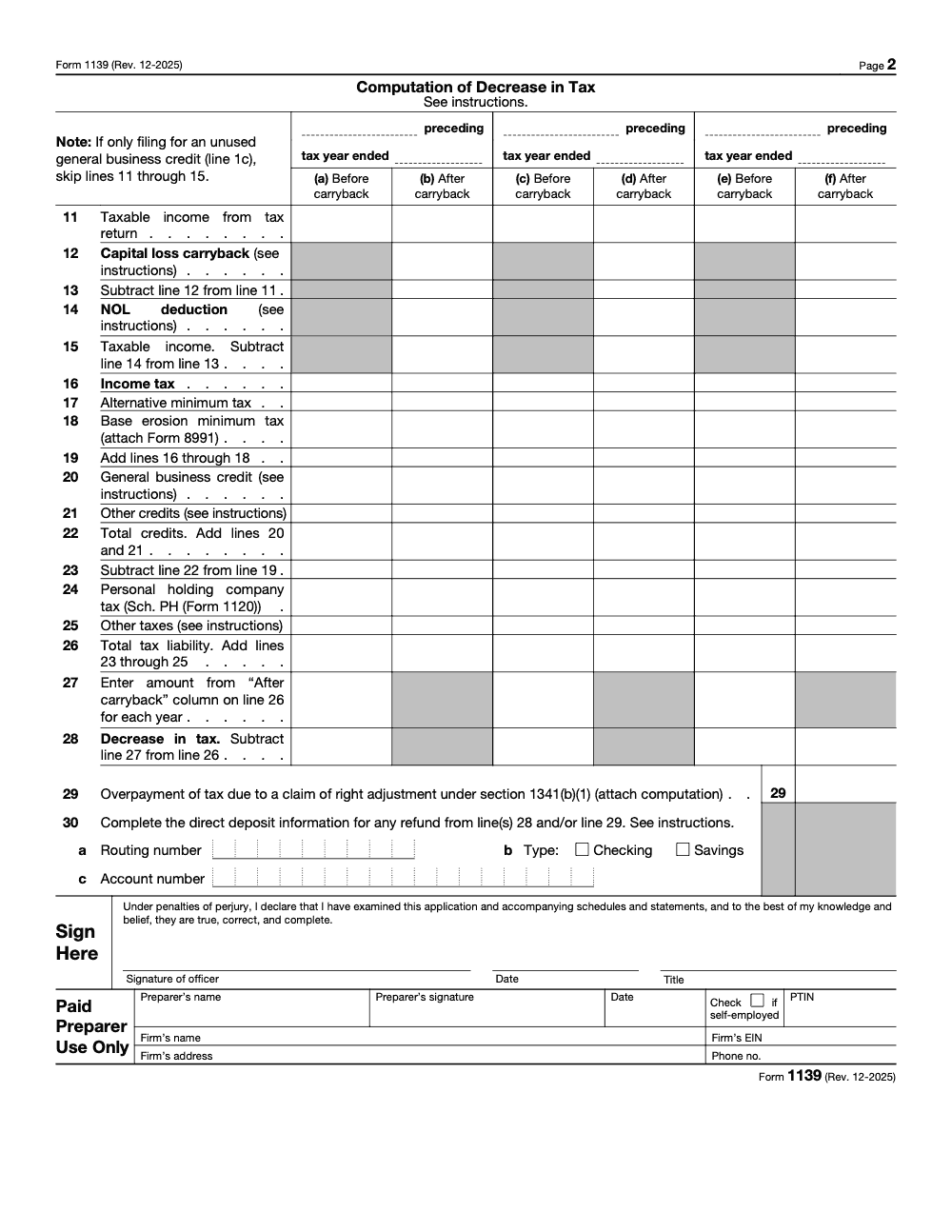
- Pull the three preceding tax years' Forms 1120 and supporting workpapers; page 2 of Form 1139 provides columns for three carryback years.
- Populate line 11 (taxable income from return) for each carryback year from the as-filed 1120.
- Apply the capital loss carryback on line 12 as short-term in each carryback year, per IRC §1212(a)(1)(A).
- Apply the NOL deduction on line 14 subject to the 80% pre-NOL taxable income cap for post-2017 NOLs (IRC §172(a)(2)).
- Recompute lines 16 through 19 using the flat 21% corporate rate, plus corporate AMT on line 17 if AFSI crosses the $1 billion CAMT threshold, plus BEAT on line 18 with Form 8991 if applicable.
- Rebuild credits on lines 20 through 22 from the carryback-year Form 3800 and supporting credit forms.
- Confirm line 28 (decrease in tax) ties to the supporting computation; attach the computation to the 1139 package per the Form 1139 instructions.
- If filing only for an unused general business credit (line 1c), leave lines 11 through 15 blank rather than zeroing them out.
Mail-out and reviewer QA
- Officer signature under penalties of perjury in place; paid-preparer PTIN, firm name, EIN, address, and phone completed.
- Computation packet, Form 8886 (if line 10 yes), Form 8991 (if line 18 BEAT), and Schedule PH (Form 1120) attachments included where applicable.
- Direct deposit on line 30 either fully populated (30a routing, 30b account type, 30c account number) or fully blank; partial data delays the refund.
- If resubmitting in response to IRS correspondence, line 2d box checked and a copy of the correspondence attached.
- Consolidated return information on line 5b complete with common parent name and EIN if any carryback year was a consolidated return.
- Confirm Form 1138 information on line 6 if the corporation obtained an extension of time to pay tax on the year preceding the NOL year.
- Mail to the same IRS service center where the loss-year Form 1120 was filed (Line 2c address); no e-file path exists for Form 1139.
- Retain a stamped or certified-mail copy in the engagement file.
Keep 1139 Season From Stalling
Form 1139 work has a brutally compressed cycle. The 12-month filing window under IRC §6411(a) starts the moment the loss-year closes, and the loss-year Form 1120 has to be on file before the application is mailed, which means the real working window for the carryback recomputation, the attached computation packet, and the mail-out is usually four to six weeks once year-end close and the federal return are layered on top of each other.
The fix is to treat 1139 as a packaged workflow rather than a one-off form. Each line 1 reason has its own attachment map, its own carryback period under a different Code section, and its own recomputation path through page 2's six before-and-after columns. Sequencing is what saves the refund.
- Lock the line 1 reason and the carryback periods up front: §172 NOLs (narrowly available for farming or qualifying non-life insurance only), §1212 net capital losses (3-year carryback, 5-year carryforward), §39 unused general business credit (1-year carryback, 20-year carryforward), or §1341 claim of right on line 29.
- Build one supporting computation packet per line 1 reason and key every figure to lines 11 through 28 of page 2; this is the document the IRS reviewer reads and the document your own QA reviewer signs off against.
- Run carryback-year tax at the flat 21% corporate rate under TCJA, and re-check whether Schedule PH personal holding company tax on line 24, BEAT on Form 8991 for line 18, or reportable transaction disclosure on Form 8886 for line 10 flips on in any carryback year.
- Calendar the 12-month IRC §6411(a) cutoff and the 90-day IRS action window on the same engagement timeline, so the team knows when a deficiency conversation, rather than a refund, becomes the realistic outcome.
- Mail the application separately to the IRS service center where the loss-year Form 1120 was filed (line 2c), with the officer signature under penalties of perjury and a stamped or certified-mail copy retained.
Accountably's corporate tax preparation team runs Form 1139 packages on this sequence, with documented review against Form 1120 line items, the attached computation packet, and the 12-month clock, so the application clears the 90-day IRS action window without the avoidable rework that drags a tentative refund into a deficiency review.
FAQs
It is a corporate application for a quick, tentative refund when you carry back a qualifying NOL, a net capital loss, an unused general business credit, or when you claim a §1341 refund. It is not a formal refund claim, and the IRS targets fast action on properly filed applications.
Form 1139 is about speed on specific carrybacks and §1341. Form 1120X is the standard amended return for making final changes, with longer processing and full claim rights. Many teams use 1139 for cash and then file 1120X later for unrelated changes.
You must file it within 12 months after the end of the year that generated the NOL, capital loss, unused GBC, or §1341 item. You also must file the loss‑year return before or on the same date you file Form 1139. If you miss the 12‑month window, you lose the quick‑refund route and must use Form 1120X within the 3‑year refund statute (no 90‑day tentative treatment).
Mail it to the IRS service center where you file your corporate return. Do not attach it to the income tax return. Verify the current instructions on the IRS Form 1139 page before mailing.
Generally no, unless it is a qualifying category such as a farming loss or specific insurance company losses. Otherwise, it carries forward and is subject to the 80 percent limitation when used in years beginning after 2020.
The IRS targets action within about 90 days after you file, under the tentative carryback rules. The review is limited, but incomplete applications can be disallowed, which adds time. A paid 1139 refund is also tentative, not final – the IRS retains the right to later examine the carryback and assess a deficiency within the statute of limitations.
Consolidated groups follow the same 12‑month window. A special timing rule applies for a qualified new member’s separate return year that ends on the date it joins the group.
Other forms this guide names
- Form 1120: Corporation Tax Return Guide
- Form 3800: How to Claim the General Business Credit in 2025
- Form 1120-X: Amend a Corporate Return, Deadlines, Refunds
- Form 172: NOL Carryforward, Carryback, How to File
- Form 1045: Quick Refund Guide for Carrybacks and Form 172
- Form 4626: CAMT AFSI Safe Harbor Guide & Filing Steps
Summarize this article with AI
About this guide
Accountably helps US CPA, EA, and accounting firms hire trained accountants and tax preparers in India.
About us Reviewed byJugal Thacker, CPAFounder and CEO at Accountably
A Washington-licensed CPA with 7+ years inside US firms – PwC, a real-estate tax practice, then a full-service firm, rising from reviewer to manager to advisory. This article was reviewed against current IRS guidance for the 2025 tax year and updated for filers preparing late returns, amendments, and 2026 estimates.
View profile →How we research, review, and update this guide
Every Accountably guide is researched against primary IRS sources, reviewed by a U.S. CPA, and refreshed as guidance evolves. Read our Editorial Guidelines to see how we source, fact-check, and update our content.