Summarize this article with AI
In Brief
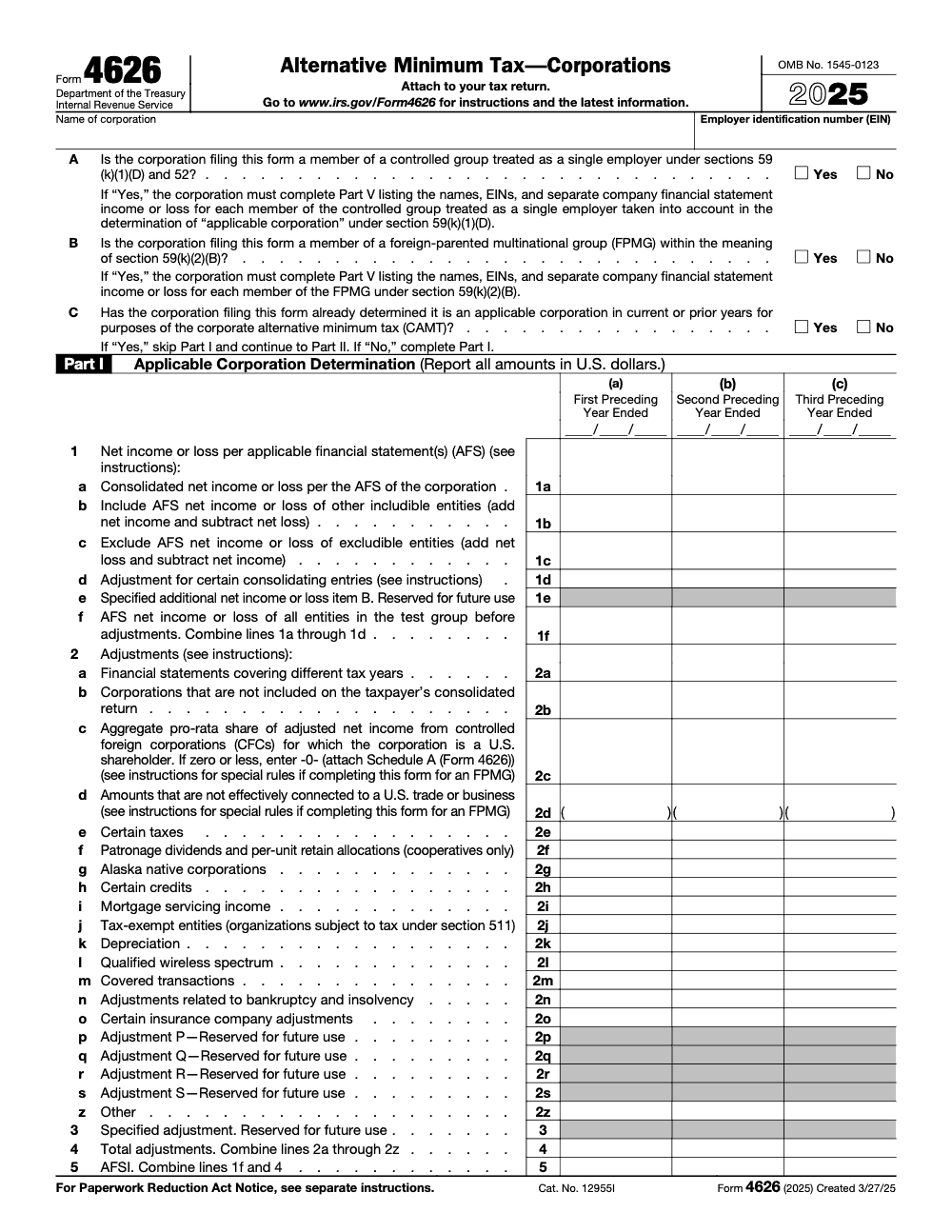
Form 4626 computes the 15% Corporate Alternative Minimum Tax (CAMT) for applicable corporations – generally those whose three-year average annual adjusted financial statement income (AFSI) exceeds $1 billion, or $100 million for certain U.S. members of a foreign-parented group (per IRC section 59(k) and the 2025 Form 4626 instructions). You apply the 15% rate on Part II, line 7, subtract the CAMT foreign tax credit, compare the result to regular tax plus BEAT on line 12, and carry the final CAMT from Part II, line 13 to Form 1120, Schedule J, line 3.
Many small corporations reported CAMT on Form 4626 in 2023 by mistake, so the first question is whether the corporation is an applicable corporation at all. Form 4626 computes the 15% Corporate Alternative Minimum Tax, and applicable status generally means a three-year average adjusted financial statement income above $1 billion, or above $100 million for certain U.S. members of foreign-parented groups.
For 2025 the IRS added an interim simplified method that lets some filers skip the form by testing against reduced thresholds of $800 million and $80 million when conditions are met, elected on Form 1120, Schedule K, Question 29(c). Filers apply the 15% rate on Part II, line 7, subtract the CAMT foreign tax credit, and compare the result to regular tax plus BEAT on line 12.
Key Takeaways
- Form 4626 calculates the 15 percent Corporate Alternative Minimum Tax using Adjusted Financial Statement Income, then compares that result to regular tax plus BEAT. You owe CAMT only if 15 percent of AFSI, after the CAMT foreign tax credit, exceeds regular tax plus BEAT.
- You file if you are an applicable corporation. That generally means a three‑year average AFSI above 1 billion in the general test, or above 100 million for certain U.S. members of foreign‑parented groups. Filing exclusions apply to S corps, RICs, and REITs, and some tax‑exempts with no unrelated business income.
- The IRS added an interim simplified method in 2025. It lets some filers avoid Form 4626 by testing against reduced thresholds of 800 million and 80 million for foreign‑parented groups when certain conditions are met. Elect it on Form 1120, Schedule K, Question 29(c).
- Expect new schedules. Form 4626 now includes Part VI and a separate Schedule A to capture CFC pro‑rata items, with tie‑ins to Form 5471 Schedule H‑1. Get those data feeds right or reviews will stall.
- Many small corporations reported CAMT in 2023 by mistake. If that happened, revisit your applicable corporation analysis before repeating the error.
What Form 4626 is, and who must file
Form 4626, Alternative Minimum Tax, Corporations, is the IRS form that determines two things in one workflow. First, are you an applicable corporation under section 59(k). Second, if you are applicable, how much CAMT you owe under section 55. For consolidated groups, you compute on a consolidated basis.
Who files in practice
- You complete Form 4626 unless a filing exclusion applies or you qualify for a safe harbor election that lets you bypass the form.
- You are generally in scope if your three‑year average AFSI exceeds 1 billion, or if you are in a foreign‑parented multinational group and meet the special two‑part test that includes the $100 million U.S. member threshold.
Who usually does not file
- S corporations, RICs, REITs, and tax‑exempts with no unrelated business income are generally excluded from filing. That said, tax‑exempts can still have CAMT exposure if they have unrelated business AFSI.
Pro tip, do the applicability test before you model credits or draft memos. If you are not applicable, your CAMT for the year is zero and your time is better spent on planning and documentation.
A quick caution on 2023 filings
The IRS has noted that some small corporations reported CAMT for tax year 2023 when they may not have been subject to the tax. If you see a positive amount on Form 1120 Schedule J, line 3 from last year, revisit your applicable corporation determination and consider whether a safe harbor applied.
CAMT at a glance, the clean mental model
Here is the working model I share with reviewers. Start with financial statement net income, apply the section 56A adjustments to compute AFSI, then compute 15 percent of that number. Reduce the result by the CAMT foreign tax credit. That gives you tentative minimum tax. Compare tentative minimum tax to your regular tax plus BEAT. If tentative is higher, the excess is your CAMT for the year. All of this runs through Form 4626.
Three steps you can run on repeat
- Confirm applicability using the three‑year average AFSI tests, including the special rules for foreign‑parented groups.
- Build AFSI with the required 56A adjustments and CFC inclusions, now reported on Part VI and Schedule A with cross‑references to Form 5471 Schedule H‑1.
- Compute tentative minimum tax and compare it to regular tax plus BEAT, then document the positions and schedules you relied on.
Where reviews go off the rails
AFSI is multi‑year, multi‑entity, and adjustment heavy. Missing a single add‑back, dropping a CFC negative adjustment, or using last year’s spreadsheet logic can swing the result. Build versioned workpapers, map each 56A adjustment to an authority, and keep a running “statement of rules applied” in the file. Your reviewers will thank you.
Understanding Adjusted Financial Statement Income, without the headaches
AFSI starts with net income or loss on your applicable financial statement, then applies a defined set of statutory adjustments. Some common patterns, add back tax‑exempt interest, exclude federal income tax expense, reflect specific section 56A items, and coordinate CFC data. For consolidated filers, compute on the consolidated AFS, then add in includible entities that are outside the AFS but inside the tax group.
What to assemble before you touch the form
- Audited or otherwise permitted financial statements for the three‑year window.
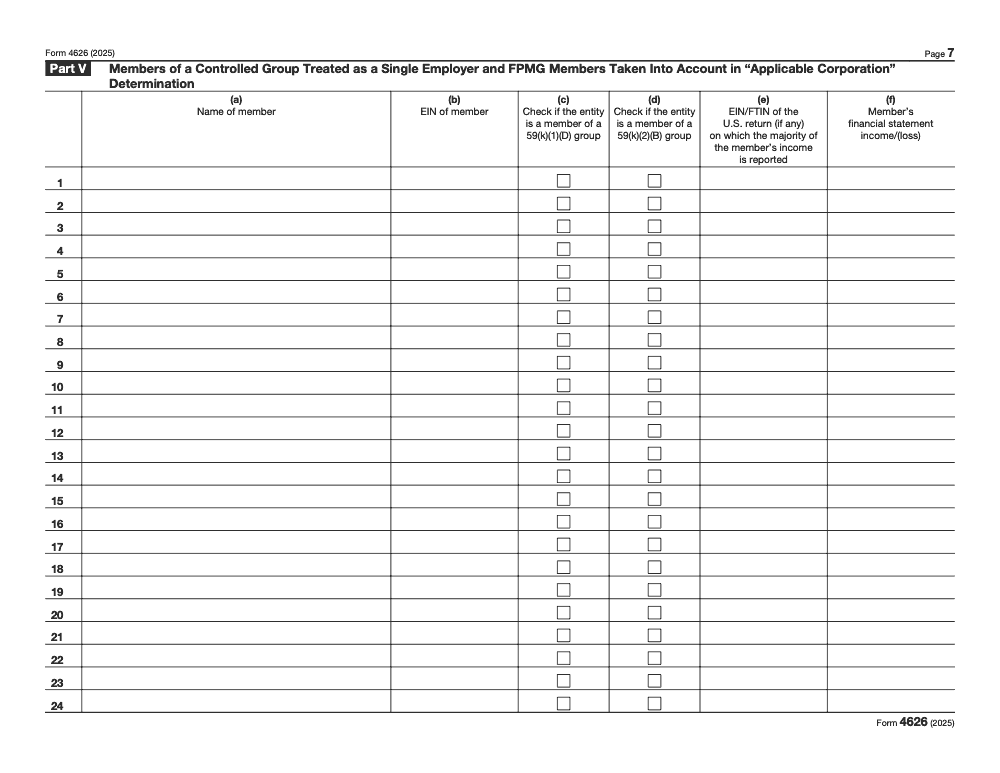
- An entity list that flags foreign‑parent status, controlled groups under section 52, and any changes in ownership (members of a controlled group treated as a single employer under sections 59(k)(1)(D) and 52 aggregate their AFSI for the threshold test rather than testing it separately).
- A mapping from GAAP accounts to 56A categories, with sign conventions baked in.
- CFC pro‑rata items from Form 5471 Schedule H‑1, tied out to Part VI and the new Schedule A for prior years.
How FSNOL fits AFSI can be reduced by financial statement net operating losses, but only up to 80 percent of AFSI and subject to carry rules for years ending after 2019, and once that reduction is applied AFSI is floored at zero on Part II, line 6, so an FSNOL can never drive AFSI below zero. Do not use FSNOL when testing three‑year average AFSI for applicability. That reduction is off limits for the test.
Think of AFSI like a clean water line feeding CAMT. If you pull that water from multiple sources, filter it the same way every time, label every pipe, and log the flow. That is your control.
Computing tentative minimum tax on Form 4626
Once AFSI is set, the math stays simple. Multiply current‑year AFSI by 15 percent, then reduce the result by the CAMT foreign tax credit to arrive at tentative minimum tax. Now compare tentative minimum tax to regular tax plus BEAT. The excess, if any, is CAMT. Keep your credit ordering and CFC tie‑outs clean, since the CAMT foreign tax credit uses amounts taken into account on the AFS and pro‑rata CFC items, and the CFC portion of that credit is capped at the lesser of the actual CFC foreign taxes or 15 percent of the aggregate pro-rata share of CFC adjusted net income.
A quick worked example
- Current‑year AFSI, 1,250,
- 15 percent of AFSI, 187.5,
- CAMT foreign tax credit, 40,
- Tentative minimum tax, 147.5,
- Regular tax plus BEAT, 130,
- CAMT liability, 17.5.
This is not a planning example, it is a control check. Reviewers often run this math on a separate sheet to validate the form’s totals.
Safe harbor, the simplified method, and when it lets you skip the form
When you evaluate CAMT scope, start with the simplified method. If you qualify, you can determine that you are not an applicable corporation using a trimmed AFSI test, then you can skip Form 4626 for that year. It is fast, it uses reduced thresholds, and it avoids most section 56A adjustments that slow teams down.
What you actually do
- Compute a three year average AFSI using near book numbers permitted under the simplified method.
- Compare the average to the reduced thresholds, generally 500 million for the broad test, and 50 million for certain U.S. members in foreign parented groups.
- If you are below the relevant threshold, make the election on Form 1120, Schedule K, question 29c, then keep your support with the return.
Keep a single workpaper that shows your three year averages, source statements, excluded adjustments, and the date you checked the Schedule K box. Reviewers need one page they can trust.
Reduced thresholds and what changes in the calculation
The simplified method narrows the AFSI build for applicability testing. You rely on permitted near book inputs, not a full section 56A rebuild. That saves time, and for many filers, it reduces the average. If you pass the simplified test, you are not an applicable corporation for the year, and you can set Form 4626 aside. You still retain your calculations and a copy of the election.
| Item | Statutory test | Simplified method safe harbor |
| Thresholds | 1B general, 100M for certain U.S. members of foreign parented groups | 500M general, 50M for certain U.S. members of foreign parented groups |
| Period | Three year average | Three year average |
| Inputs | Full section 56A AFSI adjustments | Near book items with limited adjustments |
| Evidence | Complete AFSI workpapers | Safe harbor workpaper, Schedule K, Q29c checked |
| Outcome | If above threshold, Form 4626 required | If below threshold, Form 4626 can be skipped |
Note, safe harbor tests must be re‑done each year, and aggregation or ownership changes can move a group in or out. Keep a quick annual tickler so this step is never missed.
Procedural steps when you use the safe harbor
You can keep this down to three steps and one checklist.
- Run the simplified AFSI average across the prior three years. Use permitted near book data, do not fold in the section 56A adjustments you would otherwise use for a full AFSI.
- If the average sits below your threshold, check Schedule K, question 29c on Form 1120 and capture a PDF or e‑file proof that the box is checked.
- Store contemporaneous records. That includes the financial statements, the entity list used for aggregation, and a one page memo citing the authority you relied on for the safe harbor.
A short internal checklist that prevents rework
- Entity list updated for the year, including foreign parented status checks.
- Three year financial statements obtained, reconciled, and tied out.
- Simplified method spreadsheet saved with formulas exposed.
- Form 1120 Schedule K Q29c checkbox verified in the draft and in the final.
- Annual reminder to re‑test safe harbor at the start of the next year.
AFSI, from book to tax in a straight line
If you do not qualify for the safe harbor, you will compute AFSI under section 56A. Start with financial statement net income, then apply required add backs and exclusions. Common adjustments include adding back tax exempt interest and related items, removing federal income taxes, and integrating controlled foreign corporation results on a pro rata basis. Tie CFC data to the current year schedules and carry forward any prior year items that affect your three year average.
Practical tips
- Map GAAP line items to section 56A categories once, then reuse the map.
- Note sign conventions in bold next to each adjustment to avoid silent reversals.
- Build references to your sources inside the spreadsheet cells so reviewers see the trail without opening another file.
- For consolidated groups, track which entities are inside the AFS and which are added for tax, then show the bridge.
The fastest reviews happen when a senior can read your AFSI map top to bottom without asking where a number came from.
Computing tentative minimum tax, cleanly and consistently
Once AFSI is set, apply the 15 percent rate and reduce by the CAMT foreign tax credit to arrive at tentative minimum tax. Then compare tentative minimum tax to regular tax plus BEAT. If tentative is higher, the excess is your CAMT. Keep a dedicated page in your workpapers that shows credit ordering and any foreign tax credit interactions that feed CAMT. That page becomes your audit ready summary.
A reviewer’s quick math
- Current year AFSI multiplied by 0.15 equals preliminary amount.
- Subtract CAMT foreign tax credit equals tentative minimum tax.
- Compare to regular tax plus BEAT.
- If tentative is greater, the difference is CAMT on Form 4626.
Step by step filing workflow for Form 4626
Here is the path my team follows so nothing slips.
- Confirm applicability first. Run the three year AFSI test under the statute or the simplified method. If you are not applicable, document the result and stop the form (note that once a corporation has been determined an applicable corporation in a prior year, that status persists, so it skips Part I and proceeds directly to the CAMT computation rather than re-testing out).
- If applicable, build AFSI under section 56A. Add backs, exclusions, and CFC inclusions should be listed with sources next to each line.
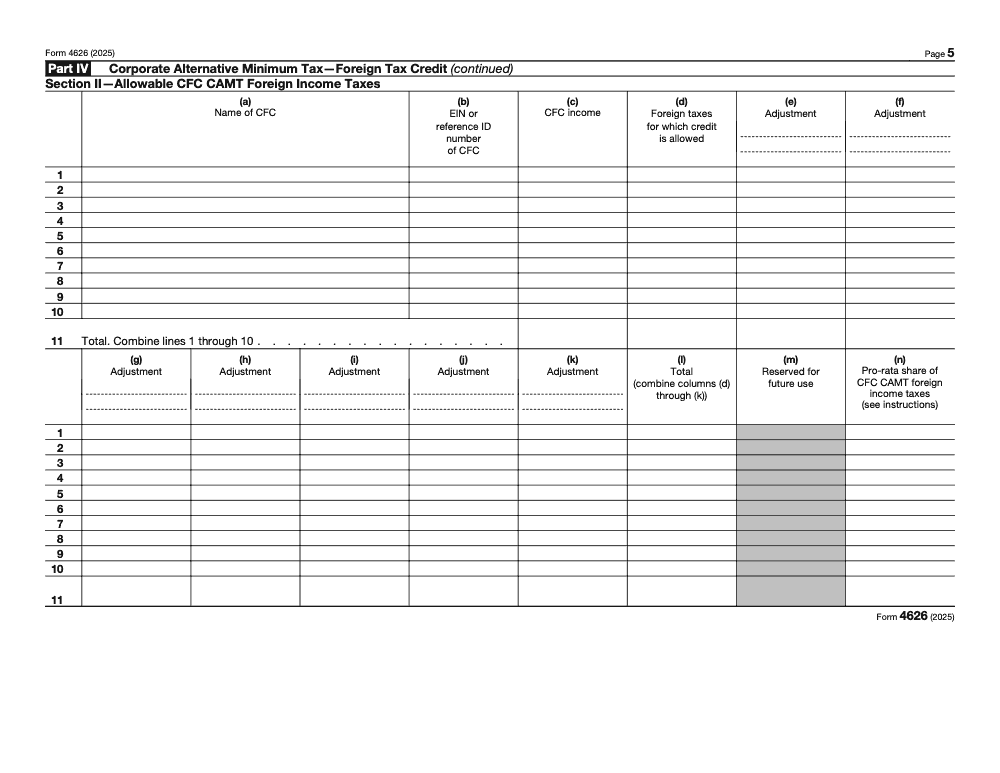
- Complete Form 4626 Part I and any required schedules. Make sure Schedule A and CFC schedules tie to Forms 5471 where relevant.
- Compute the tentative minimum tax. Apply the 15 percent rate and CAMT foreign tax credit.
- Compare to regular tax plus BEAT and determine CAMT liability.
- Attach a short statement of rules you relied on. Keep it factual, with dates, and save it with your workpapers.
- Lock the file, record version history, and route for review with a clear request date so deadlines are visible.
Document once, reuse often
If you support multiple entities, store a standard AFSI map, a safe harbor memo template, and a one page “CAMT summary” that shows threshold status, AFSI bridge, and final computation. A consistent set of templates will shorten reviews and reduce questions from partners.
Common pitfalls and how to avoid them
Manual CAMT work can be risky because the calculation crosses years, entities, and schedules. Here are the errors we see the most and how to prevent them.
- Using the wrong three year window after a change in year end, especially after an acquisition. Solve this with a timeline taped to the workpaper and a clear label for each year.
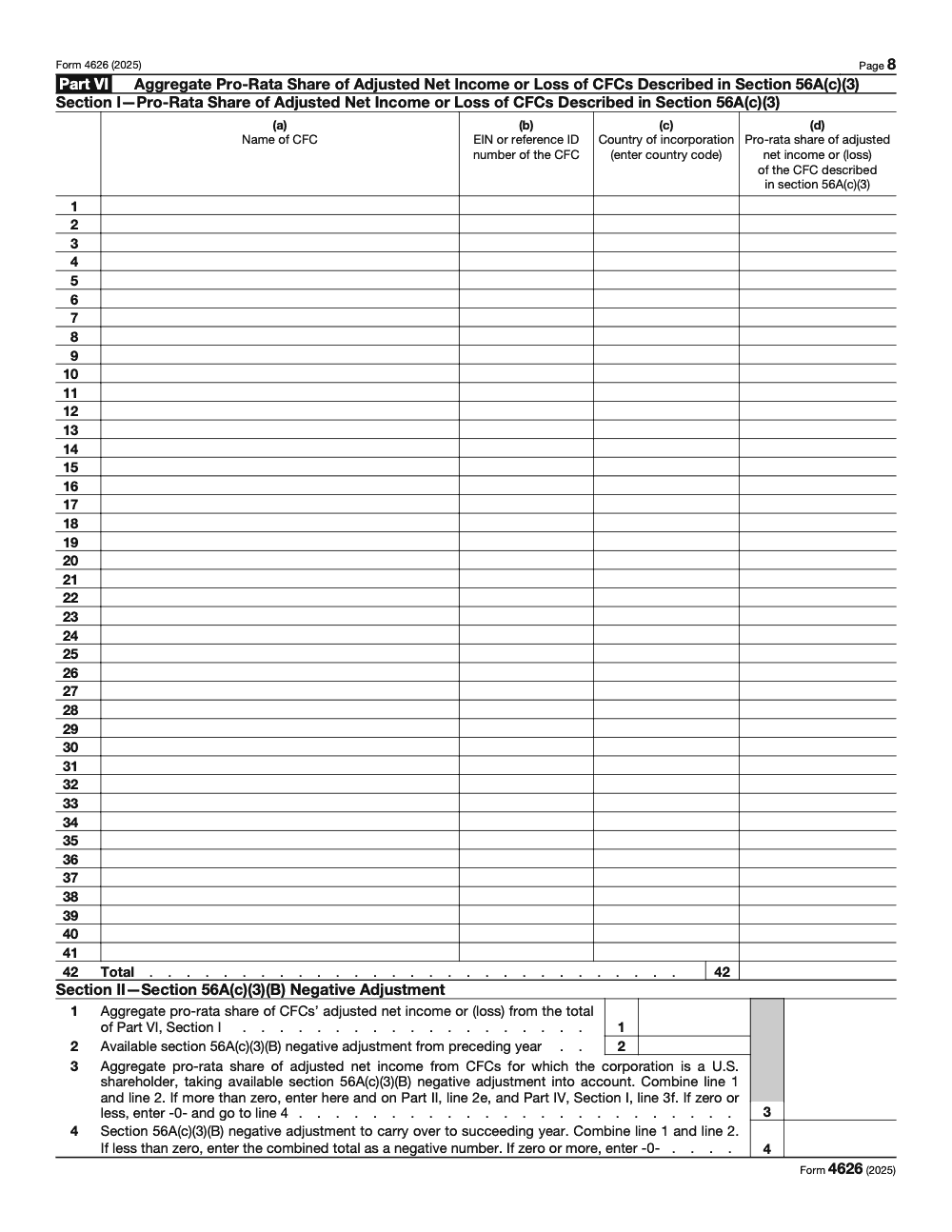
- Dropping a negative CFC adjustment that should reduce AFSI (and remember a net negative aggregate pro-rata share of CFC adjusted net income does not reduce current-year AFSI below zero; it carries forward as a section 56A(c)(3)(B) negative adjustment against future CFC income). Fix this by adding a CFC tie out section that lists positive and negative items separately.
- Carrying forward a prior year threshold conclusion without re‑testing the safe harbor. Build an annual tickler to re‑run the test.
- Misapplying sign conventions on tax exempt interest. Put signs in bold inside the formula cells to keep them visible.
- Missing the Schedule K election when the simplified method is used. Add a final form review step that checks the box and saves an e‑file proof.
If something can be missed in busy season, assume it will be. Create one control per risk and build it into your checklist.
Tools and templates that actually help
Standardize on a CAMT workpaper set that encodes section 56A adjustments and the 15 percent rate so you are not rebuilding logic each year.
- AFSI builder, three tabs for three years, with a clear bridge from GAAP lines to 56A categories.
- Safe harbor tester, a one page calculator that also prints to PDF for your file.
- CFC schedule tie out, links to Form 5471 data and lists each pro rata item.
- Credit ordering page, shows how the CAMT foreign tax credit flows and reconciles to the form.
- Statement of rules template, a short memo with dates and citations, saved as a PDF with the return.
Standardize CAMT with purpose built templates that link authority, automate AFSI adjustments, and keep reviewers focused on risk, not arithmetic.
Where Accountably fits. If your team is buried in production, Form 4626 work often waits until late in the cycle. Accountably can plug in a disciplined offshore delivery layer that builds the same AFSI maps, safe harbor tests, and tie outs every single time, inside your systems and templates. You keep control, and your reviewers get consistent workpapers that cut review time. Use this only if you need capacity with structure, not resumes.
Offshore delivery for CAMT, only if you need control with capacity
Some firms try offshore to handle peak season, then get burned by inconsistent workpapers and unclear reviews. That is not a staffing issue, it is a process issue. If you add people without structure, you add chaos. If you add a delivery system that uses your templates, your checklists, and your deadlines, you add stability.
How Accountably structures CAMT work
- SOP driven execution across bookkeeping, tax, and month end so AFSI inputs arrive ready for review.
- Structured workpapers with standard naming, version control, and a clean AFSI map.
- A multi layer review path, preparer to senior to quality to final, that protects partner time.
- Turnaround SLAs and live workflow visibility that keep owners informed.
- Continuity plans so nothing stops if a team member is out.
Security and compliance you should expect
- Role based access, no local storage, encrypted file exchange, and audit logs.
- Training on U.S. GAAP, IRS workflows, and the exact communication style your reviewers prefer.
- Work performed inside your systems and templates so control stays with you.
Use this model if you want production stability, review efficiency, and on time delivery without burning out your core team.
Conclusion, steady work that scales
Form 4626 is not hard math, it is careful plumbing. Confirm applicability first, use the safe harbor when you qualify, then build AFSI with the same map every time. Keep your tie outs to CFC schedules clean, apply the 15 percent rate, and compare to regular tax plus BEAT. Store a one page statement of rules and a simple control checklist. When your delivery system is tight, reviews move fast, partners get their time back, and deadlines stop feeling like a cliff.
If you are buried in production and need structured help, our team at Accountably can plug in trained offshore capacity that follows your process, inside your systems, with the controls you expect. Ask us for a sample AFSI map and the safe harbor checklist, then decide if the model fits your firm.
Common Mistakes We See Every Season
Form 4626 punishes assumptions more than arithmetic. The same handful of errors show up every season, and almost all of them trace back to skipping the scope test or pulling a number from the wrong regime.
Reusable Checklists
These are copy-paste ready for a firm SOP. Lift them into your workpaper index and adjust the line references only if the IRS revises the 2025 form.
Applicable-corporation scope test
- Confirm the entity type and remove S corp, RIC, and REIT income at Part I, line 1c.
- Build AFS net income or loss for the test group on Part I, lines 1a through 1f.
- Apply the Part I, line 2 adjustments (a through z) to reach AFSI on line 5.
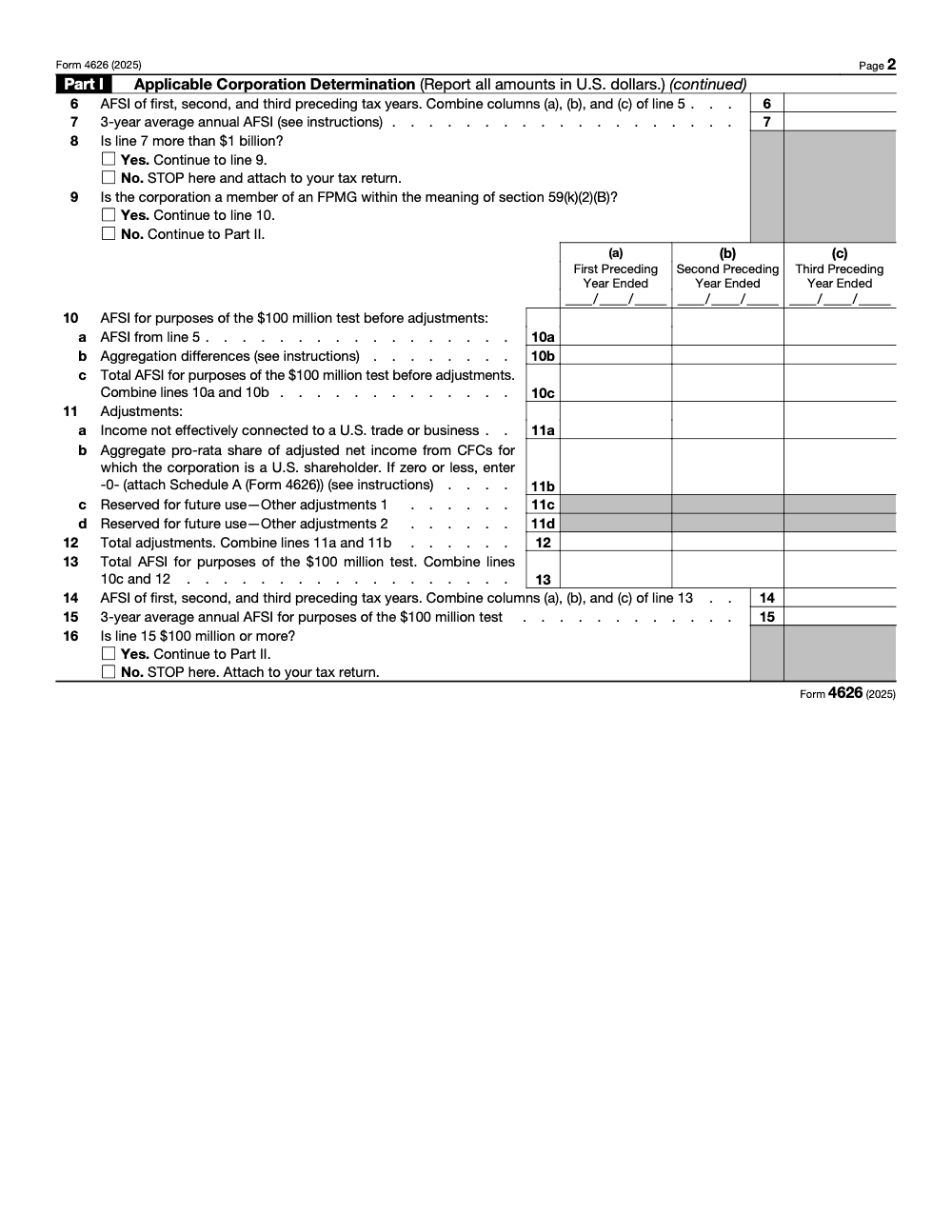
- Pull AFSI for the current and three preceding years and compute the three-year average on line 7.
- Test line 7 against $1 billion on line 8.
- If you are a foreign-parented multinational group, run the separate $100 million test on lines 10 through 16.
- If applicable status was set in a prior year, skip Part I and note it in the permanent file.
AFSI to CAMT computation
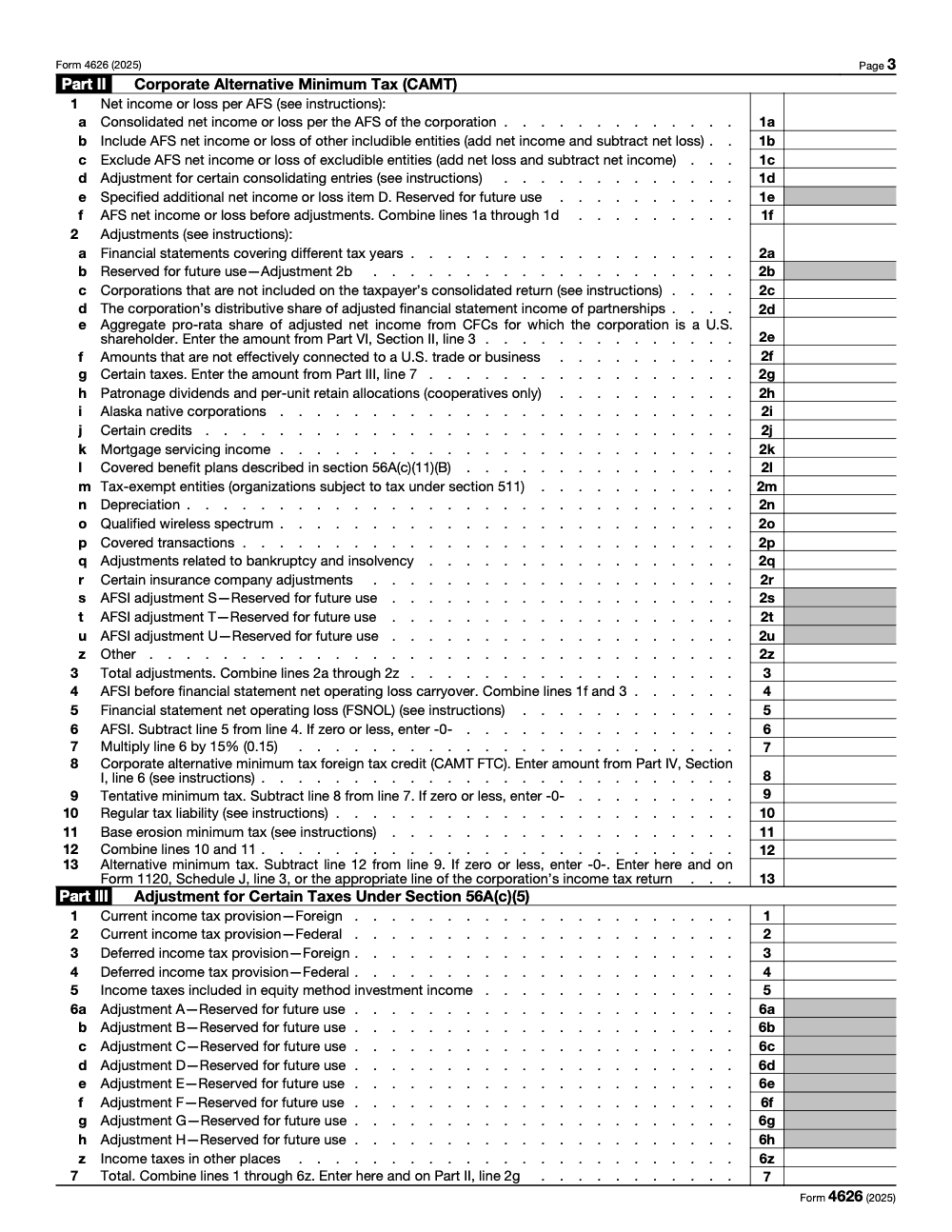
- Start from AFS net income or loss on Part II, line 1f.
- Layer in the section 56A adjustments on line 2, including the Part III taxes add-back that carries to line 2g.
- Carry the CFC pro-rata inclusion from Part VI, Section II, line 3 to line 2e.
- Subtract the financial statement net operating loss on line 5 and floor AFSI at zero on line 6.
- Multiply line 6 by 15% on line 7.
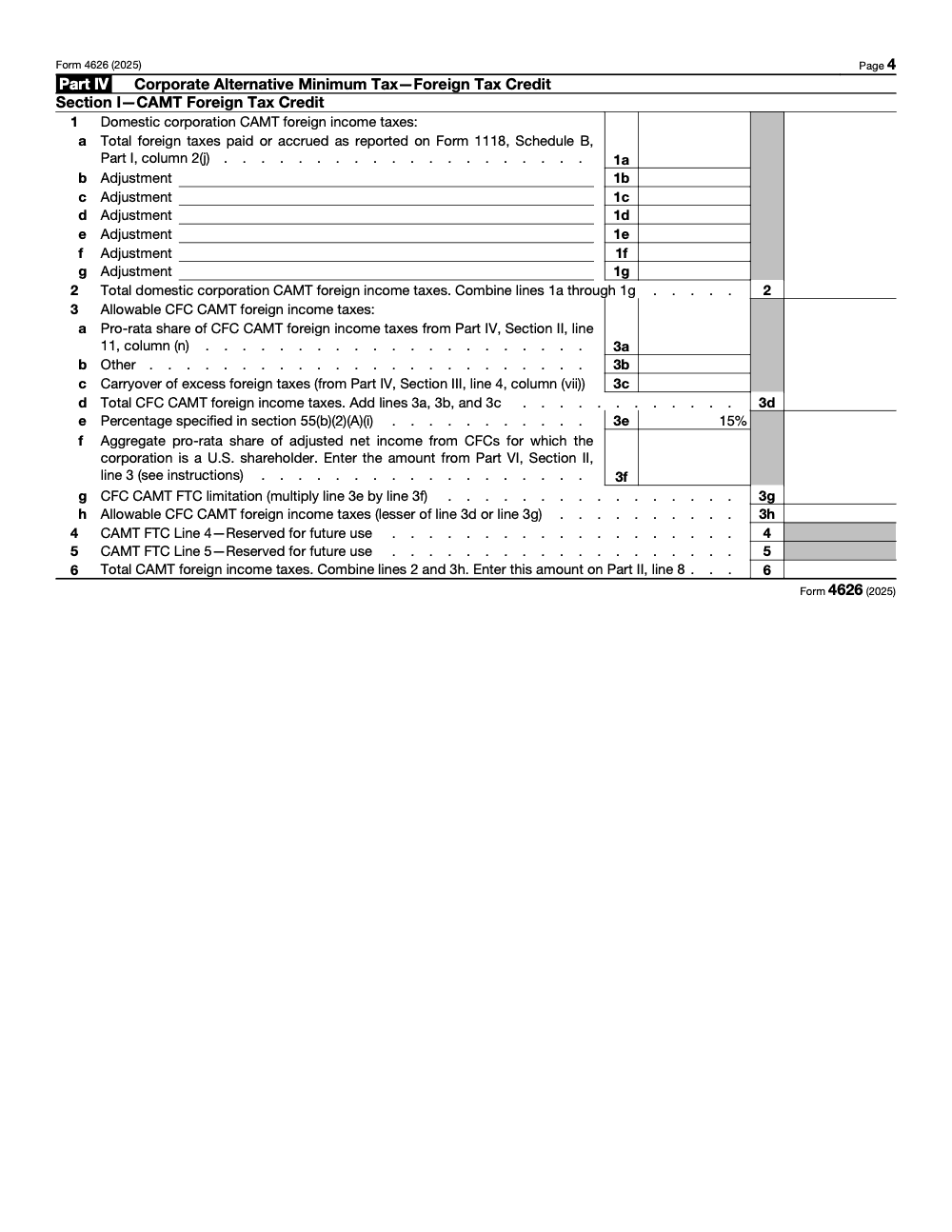
- Subtract the CAMT foreign tax credit from Part IV, Section I, line 6 on line 8 to reach tentative minimum tax on line 9.
- Combine regular tax and BEAT on line 12, subtract from line 9, and report CAMT on line 13.
- Carry the line 13 amount to Form 1120, Schedule J, line 3 and attach Form 4626.
Reviewer handoff packet
- One-line threshold status and which test you used.
- An AFSI bridge with every section 56A adjustment labeled by line.
- The Schedule A and Part VI CFC tie-out with year-over-year movement.
- The 15% math on line 7 shown next to the regular tax plus BEAT comparison on line 12.
- Sign conventions called out in bold next to any negative-adjustment line.
- Confirmation that all amounts are reported in U.S. dollars.
- A note on whether the simplified-method safe harbor was tested for the year.
Keep 4626 Season From Stalling
Form 4626 is still a young filing, and the data feeding it moves every year. CAMT was enacted by the Inflation Reduction Act of 2022 and applies to tax years beginning after December 31, 2022, and the 2025 form, revised 3/27/2025, now runs to six Parts with a separate Schedule A for CFC items. That is a lot of moving data for a calculation most teams only touch a handful of times a year, which is exactly when delivery becomes the bottleneck.
The way to keep the season moving is to treat CAMT as a repeatable process rather than a once-a-year scramble. Standardize where each number comes from, fix the review order, and the form stops being the thing that stalls the close.
- Map every Part II, line 2 adjustment back to a named source in the AFS so the section 56A bridge reconciles on the first pass.
- Keep one CFC tie-out that links Schedule A, Part VI, and the line 2e inclusion, updated for year-over-year movement.
- Pre-build the line 12 comparison so regular tax plus BEAT sits next to the 15% tentative tax before review starts.
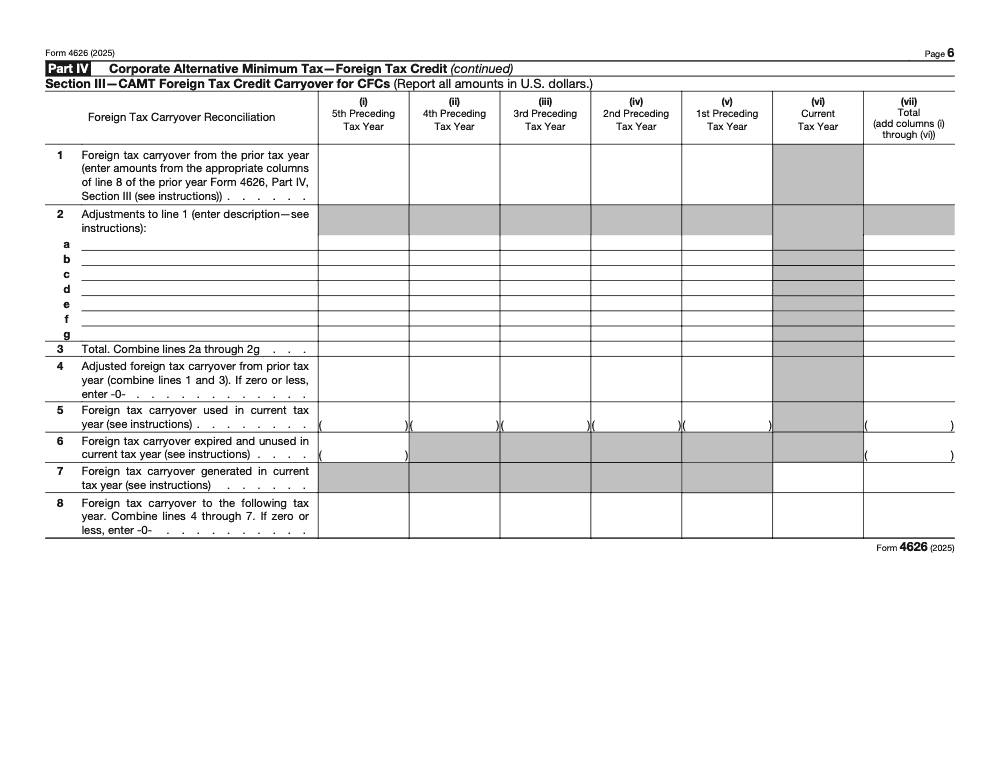
- Track the CAMT foreign tax credit limitation and the five-year carryover in Part IV on a standing schedule, not a one-off worksheet.
- Flag applicable-corporation status in the permanent file so next year's preparer skips Part I when the determination already holds.
That structure is what we install when corporate tax teams hand CAMT work to our tax delivery team: documented sources, a fixed review order, and tie-outs that hold up under scrutiny, so the 15% calculation gets done without burning senior hours.
FAQs
Form 4626 computes corporate alternative minimum tax. You build Adjusted Financial Statement Income, apply the 15 percent rate, reduce by the CAMT foreign tax credit, then compare to regular tax plus BEAT. If the tentative amount is higher, the excess is CAMT for the year.
You file if you are an applicable corporation under the three year AFSI tests. The general threshold is 1 billion for the group, with a $100 million test for certain U.S. members of foreign parented groups. S corps, RICs, and REITs are generally excluded, and some tax‑exempts are only in scope if they have unrelated business AFSI.
Run the simplified method safe harbor. If your three year average AFSI, computed using permitted near book inputs, is below the reduced threshold, check Schedule K, question 29c on Form 1120 and keep your support. You will not be an applicable corporation for that year.
CFC pro rata items often create delays, especially when Schedule A, Part VI, and Form 5471 Schedule H‑1 do not match. Build a single tie out that reconciles these schedules and shows the movement year over year.
Give them a one page CAMT summary. First, threshold status and which test you used. Second, an AFSI bridge with all section 56A adjustments labeled. Third, the 15 percent math and the regular tax plus BEAT comparison. Add sign conventions in bold next to any sensitive lines.
Revisit the three year AFSI test and the safe harbor for that year. If your facts show you were not in scope, talk to your advisor about options, then update your internal process so the mistake does not repeat.
Form 4626 family
- Form 4626 Schedule A: CAMT guide for CFC AFSI
Other forms this guide names
Summarize this article with AI
About this guide
Accountably helps US CPA, EA, and accounting firms hire trained accountants and tax preparers in India.
About us Reviewed byJugal Thacker, CPAFounder and CEO at Accountably
A Washington-licensed CPA with 7+ years inside US firms – PwC, a real-estate tax practice, then a full-service firm, rising from reviewer to manager to advisory. This article was reviewed against current IRS guidance for the 2025 tax year and updated for filers preparing late returns, amendments, and 2026 estimates.
View profile →How we research, review, and update this guide
Every Accountably guide is researched against primary IRS sources, reviewed by a U.S. CPA, and refreshed as guidance evolves. Read our Editorial Guidelines to see how we source, fact-check, and update our content.