Summarize this article with AI
In Brief
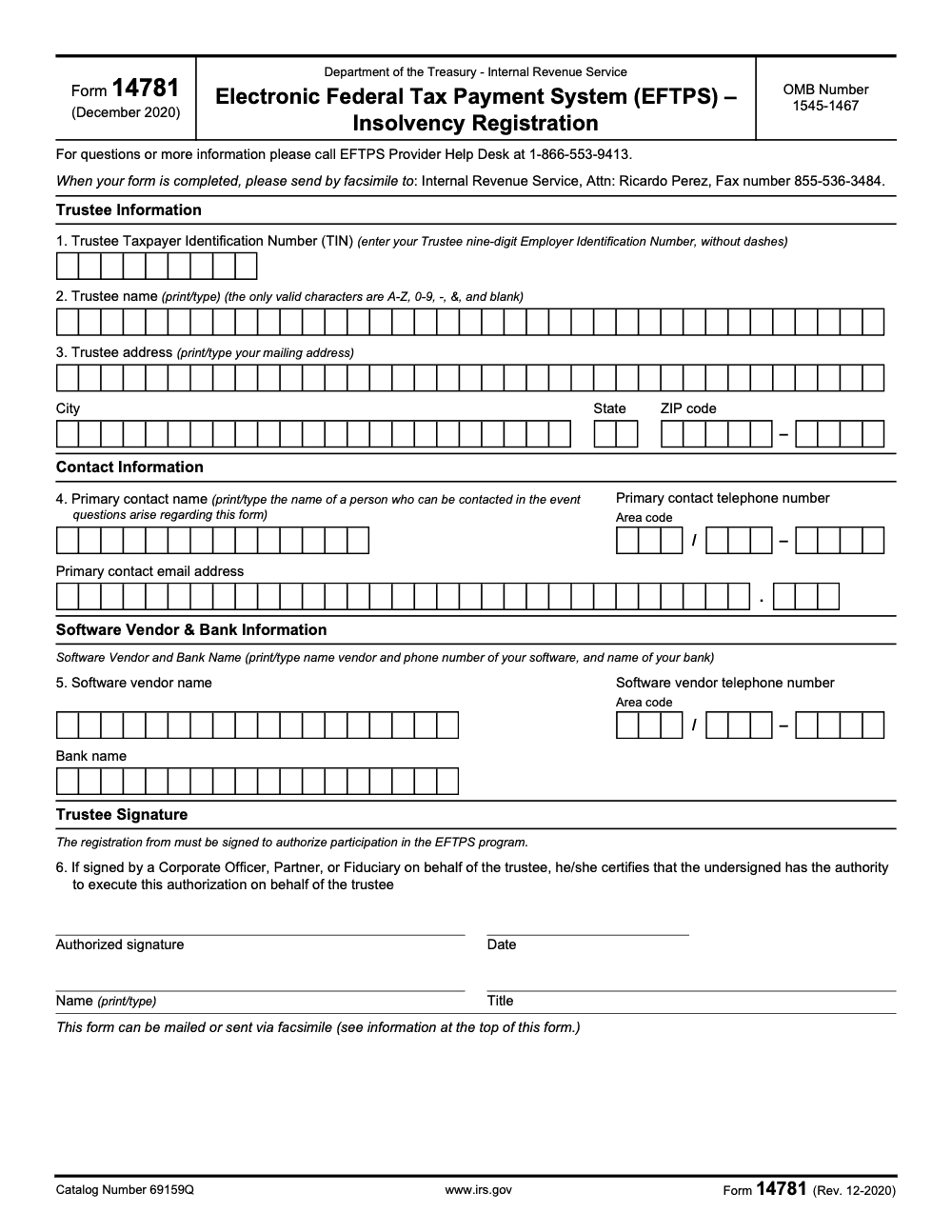
Form 14781 (Rev. 12-2020) is the EFTPS Insolvency Registration – the one-page IRS form trustees in insolvency proceedings use to enroll in the Electronic Federal Tax Payment System so they can make federal tax payments for debtor entities. Line 1 requires a nine-digit trustee EIN with no dashes; submit by mail or fax to 855-536-3484, Attn: Ricardo Perez (per the Form 14781 instructions, IRS catalog 69159Q, OMB 1545-1467). Questions go to the EFTPS Provider Help Desk at 1-866-553-9413.
A trustee takes over an insolvency case and discovers the first federal tax deposit for the debtor is due in days, with no way to pay it electronically yet. Form 14781 is the one-page EFTPS Insolvency Registration that fixes that, enrolling the trustee in the Electronic Federal Tax Payment System so deposits for debtor entities can actually move.
The form is short, but the timing has no give. Line 1 needs a nine-digit trustee EIN with no dashes, submission goes by mail or fax to 855-536-3484, and a first-time enrollment includes a PIN letter that usually takes 5 to 7 business days to arrive. Payments themselves must be scheduled by 8:00 p.m. ET the day before the due date to post on time, so the buffers you build now keep that first deposit from slipping.
Key Takeaways
- Form 14781 is the IRS EFTPS Insolvency Registration form, used so insolvency trustees can enroll and make federal tax payments through EFTPS on behalf of debtors, under OMB control number 1545‑1467.
- EFTPS payments must be scheduled by 8:00 p.m. ET the calendar day before the due date to post on time, and first‑time enrollments include a PIN letter that typically arrives in 5–7 business days.
- As of November 5, 2025, the IRS notes no new EFTPS enrollments for individual taxpayers. Businesses and existing individual users can continue using EFTPS, and trustees use Form 14781 for insolvency workflows.
- Official help lines you will actually use, PPS 866‑860‑4259, EFTPS Customer Service 800‑555‑4477, Business & Specialty Tax Line 800‑829‑4933, and Taxpayer Advocate 877‑777‑4778.
- Security is layered. EFTPS now requires multifactor authentication via Login.gov or ID.me. Keep confirmations for reconciliation and audit trails.
What Form 14781 Actually Is
Form 14781 is not a generic consent for any disclosure or a broad EFTPS change form. The IRS and Treasury list it with Forms 9779 and 9783 under OMB control number 1545‑1467, and the current supporting statement describes Form 14781 as EFTPS, Insolvency Registration. In plain English, trustees use it so they can enroll and submit payments for insolvent taxpayers through EFTPS. That is its lane.
If you work inside a CPA or EA firm, you will mostly see 14781 when your client is in bankruptcy and a trustee needs EFTPS access tied to that case. For everything else, businesses enroll online or with Form 9779 and, historically, individuals used Form 9783. The OMB listing keeps all three together because they are part of the same EFTPS information collection.
Bottom line, use 14781 for insolvency trustee registration, not as a blanket replacement for transcripts, consents, or standard banking updates.
How Form 14781 Fits With EFTPS Today
You still run payments through the Electronic Federal Tax Payment System. EFTPS is the Treasury platform that debits via ACH, tracks confirmations, and enforces the timing rule you and I care about, the 8:00 p.m. Eastern cutoff the calendar day before the due date. That rule applies whether you schedule via the site or the voice system, and it is the most common reason firms miss a deposit.
There is an important 2025 change. The IRS page last reviewed on November 5, 2025 states that individual taxpayers can no longer create new EFTPS accounts. Existing individual users keep access, businesses keep using EFTPS for required deposits, and trustees use 14781 for insolvency. If your internal wiki still tells staff to enroll every new 1040 client in EFTPS, update that playbook.
Security stepped up as well. EFTPS requires multifactor authentication with Login.gov or ID.me, which means first‑time sign in and recovery workflows feel different than they did a few seasons ago. Budget a few extra minutes for staff who are switching browsers or resetting credentials.
Who Should Use Form 14781
Insolvency Trustees and Their Teams
If you are a Chapter 7 or Chapter 13 trustee or work on a trustee team, Form 14781 is your registration path to use EFTPS for the debtor’s federal tax payments. The supporting statement from OMB names this explicitly, which helps when you need to explain the form to counsel, a controller, or the court.
When Your Firm Is Advising a Debtor or the Trustee
If you are the debtor’s tax advisor, expect to coordinate with the trustee on timing, designations, and documentation, then reconcile to IRS accounts after payments post. Use PPS for account resolution and transcripts, and route operational EFTPS questions to EFTPS Customer Service. Keep your authorizations current, for example Form 2848, because PPS will check them.
Who Should Not Use 14781
Do not use 14781 for ordinary banking changes, batch provider setup, or general business enrollment. Those live in EFTPS enrollment and profile tools and in Form 9779. If an individual wants to start using EFTPS fresh, note the IRS restriction on new individual enrollments and consider IRS Direct Pay or Online Account for one‑off payments.
The Practical EFTPS Timeline You Can Trust
- Enroll online or, for insolvency cases, submit the trustee registration with 14781.
- Wait for the PIN letter at the IRS address of record, commonly 5–7 business days after online enrollment.
- Activate, add users, and schedule payments. Remember, the cutoff is 8:00 p.m. ET, the calendar day before the due date.
EFTPS also publishes helplines and hours. The customer service line at 800‑555‑4477 covers enrollment and login questions. The voice payment system at 800‑555‑3453 runs 24,7, which is useful during peak season when the site is busy. International callers use 1‑303‑967‑5916. Save these in your team’s internal SOP.
Purpose, Scope, and Where Form 14781 Fits
Form 14781 exists for a very specific job. It is the IRS Electronic Federal Tax Payment System, EFTPS, Insolvency Registration. Trustees use it to register so they can make federal tax payments through EFTPS on behalf of debtors in bankruptcy. It is part of the same information collection as Forms 9779 and 9783 under OMB control number 1545‑1467.
If you advise a debtor or you work on a trustee team, this form bridges the gap between the court process and Treasury’s payment rails. In simple terms, 14781 is the on‑ramp that lets a trustee schedule and track federal tax deposits for the case inside EFTPS. The IRS and Treasury describe the collection as the way EFTPS enrolls taxpayers, validates data, initiates ACH debits, and transmits payment details to IRS accounts.
Quick reminder. 14781 is not a generic disclosure consent and it is not a catch‑all for ordinary banking changes. It is the insolvency registration path for EFTPS. Businesses enroll through EFTPS or Form 9779, and individuals historically used EFTPS enrollment as well.
Enrollment Steps That Work In Busy Seasons
You can get predictable results by following a simple, firm‑friendly process.
- Confirm authority and case details
- Verify trustee appointment and the tax ID that will appear in EFTPS.
- Collect the mailing address of record, this is where the EFTPS PIN letter will go.
- File the right enrollment
- For insolvency, complete Form 14781 per IRS instructions (submit by mail or fax to 855‑536‑3484, Attn: Ricardo Perez – Form 14781 cannot be filed through the EFTPS.gov portal).
- For business enrollment outside insolvency, use EFTPS online or Form 9779.
- Plan for the PIN letter
- Expect a PIN by U.S. Mail in roughly five to seven business days at the address of record. Do not wait to build your payment calendar. Draft dates now and leave buffer.
- Activate and add users
- Activate the account when the letter arrives, then set up users with the least access they need. If your firm helps the trustee, document who can schedule, who can approve, and who only views.
- Schedule with the cutoffs in mind
- The core rule is simple. Schedule by 8:00 p.m. Eastern time the calendar day before the due date or it will settle on the next business day. Build a one day buffer in peak weeks.
What to Gather Before You Start
| Field | Why it matters | Tips |
| Debtor name and TIN | Exact match to IRS records | Use recent IRS notice to verify formatting |
| Trustee EIN and contact | EFTPS identity and communication | Keep a direct phone and email on file |
| Mailing address of record | Where the PIN letter is sent | Confirm before submission to avoid resends |
| Bank routing and account | ACH debit source | Validate with a $0.00 prenote if your bank supports it |
| Authorized users | Access control | Assign preparer, approver, and viewer roles separately |
A Firm SOP You Can Hand to Your Team
- Build a calendar that flags every deposit at least two business days ahead, then set an internal cutoff at 5:00 p.m. local time, earlier if your team works across time zones.
- Require a screenshot or PDF of every EFTPS confirmation number in the workpapers. Tie confirmations to the GL and to any 941, 943, 944, 945, 940, or income tax account they affect.
- Use a two‑person rule for first payments under a new enrollment. One person schedules, one person reviews the settlement date and amount.
- Keep a same‑day fallback ready. If you miss the 8:00 p.m. ET window, have your bank’s Fedwire template for the Federal Tax Collection Service, FTCS, tested ahead of time.
Where this helps your firm, Accountably can slot into your workflow with structured checklists, versioned workpapers, and review protection that keeps these steps consistent week after week. Use us when you need capacity without giving up control.
Eligibility, Appropriate Users, and Common Edge Cases
If you are a bankruptcy trustee or support a trustee team, Form 14781 is your lane. The IRS confirms that Form 14781 is the Electronic Federal Tax Payment System, EFTPS, Insolvency Registration, used so trustees can enroll and make federal tax payments for insolvent taxpayers. It sits in the same information collection as Forms 9779, business enrollment, and 9783, historical individual enrollment, under OMB control number 1545‑1467.
- Use 14781 when a trustee needs EFTPS access to schedule and confirm federal tax payments tied to a bankruptcy case. The IRS supporting statement names Form 14781 and describes its use for trustees. Keep the completed form, proof of authority, and enrollment confirmations in the case file.
- Do not use 14781 for routine business enrollment or banking updates. Businesses enroll online through EFTPS or by using Form 9779.
- As of November 5, 2025, new individual enrollments are not available. Existing individual users keep access, businesses continue as usual, and trustees use 14781 for insolvency tasks. If an individual cannot enroll, steer them to IRS Online Account or Direct Pay for one‑off payments.
Quick checkpoint. If your internal wiki still tells staff to enroll every new 1040 client in EFTPS, update the page and train the team this week. The IRS page dated November 5, 2025 makes the change clear.
Who qualifies in practice
- Chapter 7 and Chapter 13 trustees who must pay federal taxes from the bankruptcy estate.
- Controllers and tax leads who coordinate with trustees, often providing schedules, designations, and supporting records.
- CPA and EA firms helping trustees, where your Form 2848 or other authority is current for IRS calls and transcript work. Use Practitioner Priority Service for account‑level issues.
Enrollment Steps for EFTPS, With Insolvency Notes
Here is a simple set of steps your team can follow during busy season.
- Confirm authority and identity
- Verify trustee appointment and the tax ID entries you will use in EFTPS.
- Confirm the address of record in IRS systems, since enrollment processing ties to it.
- Submit the correct enrollment
- For insolvency, file Form 14781 (mail or fax to 855‑536‑3484, Attn: Ricardo Perez – it is not submitted through the EFTPS.gov portal).
- For businesses outside insolvency, enroll online or use Form 9779. The Federal Register notice and the OMB statement group these forms under 1545‑1467.
- Plan the timing
- New EFTPS enrollments can take up to five business days to process. Build a buffer before your first scheduled debit.
- Activate and add users
- After enrollment, activate access and assign roles. Keep to least‑privilege access, one preparer, one approver, and a viewer. EFTPS support and e‑help lines can guide you on e‑products, not account adjustments.
- Schedule with the cutoffs in mind
- For an EFTPS deposit to be on time, schedule by 8:00 p.m. Eastern time the calendar day before the due date. That single rule prevents most penalties. The IRS repeats this rule in multiple places, including Pub. 15, Topic 757, and the business tax calendars.
What to gather before you start
| Item | Why it matters | Practical tip |
| Debtor name and TIN | Must match IRS records | Pull the latest IRS notice to verify the exact formatting |
| Trustee EIN and contact | EFTPS identity and outreach | Keep a direct email and phone ready for support calls |
| Address of record | Where enrollment ties and notices route | Verify before submission to avoid delays |
| Bank routing and account | ACH debit source | Validate with your bank and document sign‑off |
| Authorized users | Access control and continuity | Separate preparer, approver, and viewer roles |
Managing Existing EFTPS Accounts Without Stress
Once access is live, you will spend most of your time keeping users, bank details, and payments current and verified.
- Update routing and account numbers inside EFTPS, then capture the confirmation in your workpapers.
- Add or remove users promptly when staff or vendor roles change.
- If you need a hand, call EFTPS Customer Service at 800‑555‑4477. For filings and deposits guidance, Instructions to Forms 941 and Pub. 15 point you to EFTPS and also restate the scheduling rule.
Field note. I ask staff to paste the EFTPS confirmation number and the selected settlement date straight into the review note, then attach the PDF. That tiny habit saves a surprising number of review loops.
Same‑day fallback if you miss the window
If you miss the 8:00 p.m. Eastern scheduling deadline for a required deposit, you still have a same‑day option through the Federal Tax Collection Service, FTCS, same‑day wire. You must prepare this with your bank in advance. Expect fees and bank cutoffs that are earlier in the day, often around 3:00 p.m. Eastern. The IRS instructions discuss the same‑day wire method and link to the detailed setup steps.
How Accountably Helps, Briefly
You may not need more people. You probably need structure. Accountably plugs in where firms get stuck, scheduling and reconciling payments inside your systems, keeping standardized workpapers, and meeting the 8:00 p.m. ET rule without drama. We bring SOPs, layered review, and clear owners, so trustees, controllers, and partners stop firefighting and get back to advisory work. We do this quietly, with your templates, and we measure turnarounds so the work stays predictable. Use us when you need capacity, control, and audit‑clean files, not resumes or band‑aids.
Required Information and Documentation
Accuracy is everything with 14781 and EFTPS. Gather these items and lock in a clean record.
- Legal name and TIN exactly as the IRS has it – note that Form 14781 Line 1 requires the trustee's nine‑digit EIN with no dashes (an SSN is not accepted), and the Line 2 trustee name field accepts only A‑Z, 0‑9, hyphen, ampersand, and blank, so strip periods, commas, apostrophes, or slashes before submission.
- Address of record, trustee authority documents, and contact details.
- Precise tax periods, form numbers, and designations for each scheduled payment.
- Supporting documents that explain amounts and timing, notices, GL tie‑outs, and bank confirmations.
- For practitioner calls, a current Form 2848 on file and your CAF info, since PPS verifies authority.
Simple documentation table you can reuse
| Item | Required? | Examples |
| Identity | Yes | Government ID, IRS notice with name and TIN |
| Account details | Yes | Tax period end, form type, deposit rules reference |
| Evidence | Yes | Payment confirmations, notices, reconciliations |
| Authority | Conditional | Trustee appointment, Form 2848 for practitioner calls |
Pro tip. Name files so reviewers can scan quickly. I like YYYY‑MM‑DD_EFTPS_Amount_Form_Period_ConfirmationNumber.pdf. It makes future audits painless.
Privacy, PII, and Records You Must Keep
The IRS treats tax data as confidential under IRC 6103, and the EFTPS collection includes a Privacy Act statement in the enrollment materials. The OMB supporting statement confirms that these forms are part of a federal information collection, and it notes the Privacy Act statement inclusion. Keep personally identifiable information, PII, limited to what you need, protect access, and document your retention policy.
- Retain confirmations, bank proofs, and reconciliations for the period your firm policy requires, commonly three to seven years depending on the return type and your engagement letter.
- Restrict access with least privilege, encrypt at rest where possible, and log who touched what.
- If you use a third party platform, verify their security and make sure you can export records on request.
Timing, Deadlines, and Real‑World Scheduling
Here is the operating truth your calendar should reflect.
- For deposits to be on time, schedule by 8:00 p.m. Eastern the calendar day before the due date. This rule appears in Pub. 15, Topic 757, and IRS business calendars.
- New EFTPS enrollments can take up to five business days to process. Do not plan your first payment for the same week you enroll.
- If you miss the cutoff, use same‑day wire through FTCS if your bank is set up. Expect earlier cutoffs than EFTPS.
Cutoff quick reference
| Requirement | What it means | Action that keeps you safe |
| EFTPS deadline | Submit by 8:00 p.m. ET the day before due date | Build a one day buffer on your internal calendar |
| Future dated debit | The date you pick is the settlement date | Double‑check banking days and holidays |
| Missed cutoff | You can still pay same day by wire via FTCS | Keep bank templates tested and handy |
Story time. A payroll deposit was due Tuesday. We booked it Monday morning and still reviewed it again at 4:00 p.m. local time. That second look found a digit flip in the amount. The 8:00 p.m. ET rule gives you room, your checklist gives you the save.
Security and Authentication You Will See
Security changed in recent seasons, and your staff will notice.
- EFTPS uses multifactor authentication and works with Login.gov or ID.me. Plan a few extra minutes during first sign in or recovery. The site points users to MFA login help and provides the phone numbers you will actually use.
- Keep session security tight. Rotate passwords on your schedule, document who approves changes to bank accounts, and require re‑authentication before any banking edit.
- Save audit trails. EFTPS produces confirmation numbers, and Pub. 15 reminds employers to keep a trace number as a receipt. Tie those to your GL and workpapers.
Common Errors And How To Avoid Them
Small mistakes trigger avoidable penalties and rework. Here is the short list we train on.
- Scheduling after the cutoff
- The most common miss is booking a payment after 8:00 p.m. ET for a due date the next day. Lock an earlier internal cutoff and use an automated reminder one hour before.
- Wrong tax period or form designation
- Match the form and period to your return, 941 versus 944, quarter end dates, or income tax forms. Tie the confirmation back to the right schedule in your file.
- Missing confirmations
- If it is not in the workpapers, it did not happen. Require a confirmation number or PDF attached to the task and labeled clearly.
- Access sprawl
- Old users with live access create both risk and confusion. Remove unused profiles monthly, document role changes, and audit access quarterly.
- No same‑day fallback
- If you or the trustee miss the EFTPS cutoff, the same‑day wire through FTCS can be a lifesaver. Only if your bank template exists and your staff knows how to use it. Test it now, not at 4,30 p.m. on a due date.
Simple mantra. Schedule early, label clearly, save the receipt. Your future self will thank you.
Contact Information And Support Channels You Will Actually Use
When you hit a snag, go to the right place the first time.
- EFTPS Customer Service for enrollment and platform help, 800‑555‑4477. Voice payment system, 800‑555‑3453. The 941 instructions and EFTPS site list these numbers.
- Practitioner Priority Service, PPS, for account issues with authority on file, 866‑860‑4259. Hours are generally weekdays, 7:00 a.m. to 7:00 p.m. local time, with Puerto Rico using 8:00 a.m. to 8:00 p.m. The IRS PPS page and IRM confirm the line and scope.
- E‑help Desk for e‑products like e‑Services and EFTPS technical support, 866‑255‑0654. Not for account adjustments.
- Taxpayer Advocate Service guidance on payment options and timelines, helpful articles and reminders to plan at least five days for enrollment.
Keep these in your SOP. Train the team on who to call for what, then track resolutions in your case file.
Recent OMB Actions And Why They Matter
The EFTPS forms package, including Forms 9779, 9783, and 14781, is governed by OMB control number 1545‑1467. In 2025, the IRS requested an extension without change. The Federal Register notice on April 25, 2025 lists the control number and confirms no change in burden. The 2025 Supporting Statement lists Form 14781 explicitly as the insolvency registration and provides burden estimates. That is your compliance anchor if someone on the case asks, why this form, why now.
Translation. The rules around EFTPS enrollment stayed stable in 2025. Your focus should be execution quality, not chasing moving targets.
Businesses Versus Individuals, Practical Impact
- Businesses continue using EFTPS for payroll and income tax deposits. The scheduling rules and recordkeeping expectations are the same.
- Individuals who already have EFTPS accounts can keep using them. New individual enrollments are closed as of November 5, 2025, which means you should route first‑time individual payments through Online Account or Direct Pay.
- Insolvency situations are different. The trustee uses Form 14781 to register so payments can be made through EFTPS from the estate or as directed by the court. Keep communication tight between the trustee, the debtor’s advisors, and any payroll provider.
A Simple, Repeatable Workflow You Can Copy
- Enroll the right way, 14781 for insolvency, EFTPS online or 9779 for business.
- Assign roles, preparer, approver, viewer, and train on the 8:00 p.m. ET rule.
- Schedule early, attach confirmations to workpapers, and reconcile to GL and returns.
- Keep a tested same‑day wire template for true emergencies.
- Review access monthly, then archive closed period files with clear names.
Where Accountably Fits, When It Matters
If your firm is drowning in production, deliveries slip because the work lacks structure. Accountably places trained offshore accountants and tax preparers inside your firm, ramped on your software and SOPs, to run SOP‑driven EFTPS tasks inside your stack, QuickBooks, Thomson Reuters, CCH Axcess, or your case tools, with multi‑layer review and real‑time tracking. You keep control, we keep schedule discipline, and your partners stop losing nights to preventable cutoffs. Proof before your name is on the line: not a fit in 45 days, we replace them free. Don't trust us. Test us.
Compliance Note And Resources
This article is educational, not tax or legal advice. Confirm details against IRS and Treasury sources before you act. Start with these pages and phone numbers that your team will actually use.
- EFTPS overview and current enrollment notes, including individual enrollment status.
- Pub. 15 and 941 instructions for the 8:00 p.m. ET rule and depositing guidance.
- Practitioner Priority Service and the IRM section describing PPS.
- Same‑day wire guidance referenced in IRS instructions and topics.
Common Mistakes We See Every Season
Form 14781 looks short, but trustees in insolvency cases trip on the same six fields every time. The mistakes below come from the engagements we see flow through our review queue.
Reusable Checklists
These checklists are copy-paste ready for insolvency engagement SOPs. Use them as-is or adapt the wording to match your firm's file-naming conventions.
Trustee data packet (pre-fill)
- Confirm the trustee's nine-digit EIN from the IRS confirmation letter; do not accept an SSN.
- Capture the legal trustee name and pre-clean it (remove periods, commas, apostrophes, and slashes).
- Record the trustee mailing address: street, city, state, ZIP, and the four-digit ZIP extension.
- Identify the primary contact: name, direct phone with area code, and email address.
- Note the software vendor's name and phone, plus the bank from which EFTPS debits will originate.
- Confirm the authorized signer role: Corporate Officer, Partner, or Fiduciary with authority to bind the trustee.
Line-by-line review (pre-submission)
- Line 1: EIN entered as nine consecutive digits, no dashes.
- Line 2: Trustee name uses only A-Z, 0-9, hyphen, ampersand, and blank spaces.
- Line 3: Full mailing address printed or typed (not handwritten), ZIP+4 present.
- Line 4: Primary contact name, telephone, and email all populated.
- Line 5: Software vendor name and phone, plus bank name, all completed.
- Line 6: Signature, date, printed or typed name, and title all present and dated the same day.
- Footer confirms "Rev. 12-2020" – the only current revision through tax year 2025.
Submission and EFTPS activation watch
- Submit by mail or by fax to 855-536-3484, Attention Ricardo Perez – never through the EFTPS.gov portal.
- Log the submission date and method in the trustee engagement file the same day.
- Calendar a follow-up to call the EFTPS Provider Help Desk at 1-866-553-9413 if no confirmation arrives within your standard review window.
- Schedule the trustee's first EFTPS deposit at least one business day before the deadline so any system delay does not push the payment past the IRS deposit date.
- Store the signed form and the submission cover sheet in the trustee record retention folder per your firm's retention policy.
Keep 14781 Season From Stalling
Insolvency engagements stack court deadlines, debtor payment obligations, and IRS coordination into one shared calendar – and EFTPS enrollment is the single chokepoint that can stall everything downstream. Form 14781 has only six numbered lines on a single page (per the Form 14781 instructions, Rev. 12-2020, OMB control number 1545-1467), but the registration must clear the IRS before the trustee can settle a single federal tax liability electronically.
The fix is to treat the trustee data packet, the line-level review, and the post-submission activation watch as one operational sequence rather than three separate tasks. When the packet is pre-cleaned and the review is documented, the form goes out correctly on the first attempt and the trustee enters EFTPS without losing the buffer before the first scheduled deposit.
- Lock the EIN early: pull the nine-digit number from the IRS confirmation letter for Line 1 and verify it before any other field is typed.
- Pre-clean the trustee name on Line 2: strip periods, commas, apostrophes, and slashes so the IRS file load succeeds on the first pass.
- Pair the right roles to the right lines: a Corporate Officer, Partner, or Fiduciary on Line 6 for authorization, the operations lead on Line 4 for IRS communications.
- Route submissions to fax 855-536-3484, Attention Ricardo Perez, and log the send date the same day so the deposit calendar starts on a known anchor.
- Keep the EFTPS Provider Help Desk number (1-866-553-9413) on a shared engagement contact card so anyone on the team can chase activation without rehunting the number.
This is the kind of structured, low-glamour delivery work where a documented SOP and a second set of eyes save the engagement. Our tax delivery support teams run the trustee packet, the line-level review, and the activation watch as one workflow so the enrollment never becomes the bottleneck.
FAQs
It is the EFTPS Insolvency Registration that lets trustees enroll so they can make federal tax payments on behalf of insolvent taxpayers.
Schedule by 8:00 p.m. Eastern time the calendar day before the due date or it will post the next business day. Build an internal buffer.
No. As of November 5, 2025, the IRS says individual taxpayers can no longer create new EFTPS accounts. Existing individual users can continue for now.
If it is a required deposit, consider a same‑day wire through FTCS. You must set this up with your bank in advance and meet the bank’s earlier cutoff time.
The IRS notes new enrollments can take up to five business days to process, so enroll early, then activate and add users before your first due date.
Call PPS 866‑860‑4259 for IRS account issues with authority on file, and EFTPS Customer Service 800‑555‑4477 for enrollment or platform help.
Other forms this guide names
About this guide
Accountably helps US CPA, EA, and accounting firms hire trained accountants and tax preparers in India.
About us Reviewed byJugal Thacker, CPAFounder and CEO at Accountably
A Washington-licensed CPA with 7+ years inside US firms – PwC, a real-estate tax practice, then a full-service firm, rising from reviewer to manager to advisory. This article was reviewed against current IRS guidance for the 2025 tax year and updated for filers preparing late returns, amendments, and 2026 estimates.
View profile →How we research, review, and update this guide
Every Accountably guide is researched against primary IRS sources, reviewed by a U.S. CPA, and refreshed as guidance evolves. Read our Editorial Guidelines to see how we source, fact-check, and update our content.