Summarize this article with AI
In Brief
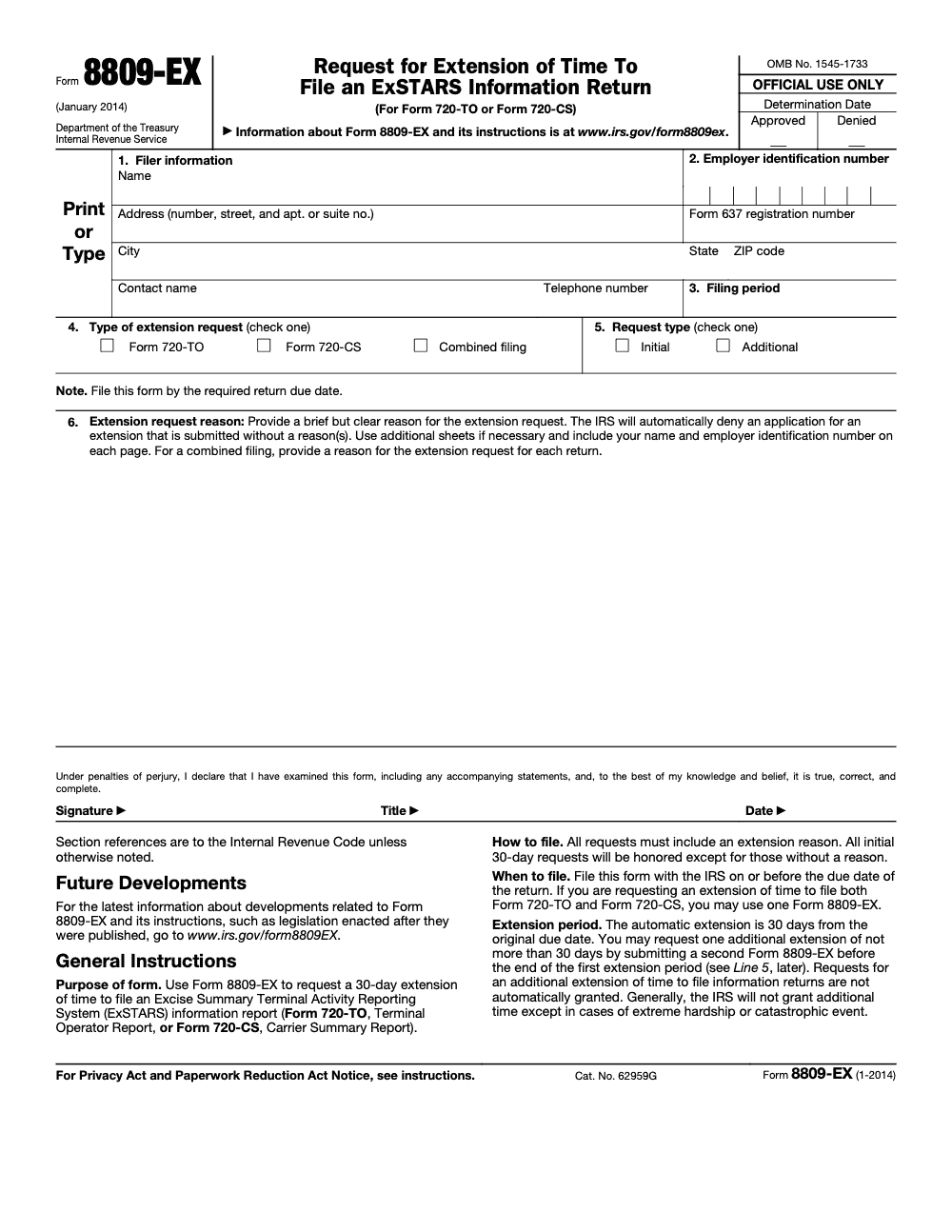
Form 8809-EX is the one-time, 30-day paper extension request for ExSTARS information returns – Form 720-TO (Terminal Operator Report) and Form 720-CS (Carrier Summary Report) – filed by Form 637-registered terminal operators (activity letter S) and bulk carriers (activity letter Y). It must reach the IRS Cincinnati service center on or before the original due date of the underlying return (per the Form 8809-EX instructions, OMB 1545-1832); miss the extended window and the §6721 information-return penalty is $340 per return for 2025, capped at $4,098,500 calendar-year for large filers (per Rev. Proc. 2024-40, IRS.gov). See Form 8809 for non-ExSTARS extension requests, or Accountably's tax delivery practice for offshore excise-reporting support.
A terminal operator called one January, sure they were covered: the standard Form 8809 had gone in weeks earlier. The catch was that Form 8809 does not extend ExSTARS returns at all. The extension for Form 720-TO and Form 720-CS lives on a separate form, and missing that distinction turned into a penalty notice the client had to fight to abate.
Form 8809-EX is the one-time, 30-day paper extension request for ExSTARS information returns, filed by Form 637-registered terminal operators (activity letter S) and bulk carriers (activity letter Y). Unlike the automatic relief Form 8809 often grants, this one requires IRS review and approval, so it is not guaranteed. It must reach the Cincinnati service center by the original due date, because a late request is denied and the underlying return is then treated as not timely filed.
Key Takeaways
- Form 8809-EX is the specific extension request form for ExSTARS (Excise Summary Terminal Activity Reporting System) information returns – it is separate from Form 8809, which covers most other information returns.
- Terminal operators (filing Form 720-TO, Form 637 activity letter S) and bulk transport carriers (filing Form 720-CS, activity letter Y) required to file ExSTARS reports under IRC Section 4101 use this form when additional filing time is needed.
- Unlike Form 8809 (which often grants an automatic 30-day extension), Form 8809-EX requires IRS review and approval – the extension is not guaranteed.
- The form must be submitted by the due date of the underlying ExSTARS return; a late extension request is denied and the underlying ExSTARS return is then treated as not timely filed for Section 6721 penalty purposes.
- Penalties for late ExSTARS returns run under IRC Section 6721 and can be substantial for large filers – up to $4,098,500 per year for large filers in 2025 (per Rev. Proc. 2024-40).
- Quick SOP rule: calendar ExSTARS due dates separately from other information return due dates, and track Form 8809-EX submission as its own line item.
What Form 8809-EX Is
Form 8809-EX is the IRS form for requesting an extension of time to file ExSTARS information returns. ExSTARS is the IRS’s electronic system for collecting detailed fuel terminal transaction data from terminal operators and position holders in the motor fuel supply chain. The reporting obligation flows from IRC Section 4101, which grants the IRS authority to require registration and reporting from fuel terminals.
The “EX” in the form name refers specifically to ExSTARS – this is not a general-purpose extension form. Practitioners who see “8809” in the name and assume it functions like the standard Form 8809 (which handles W-2 and 1099 extensions) are setting up a miss. The two forms are administered differently, have different approval processes, and carry different consequences if misapplied.
From my side of the desk, ExSTARS work tends to sit at the intersection of excise tax compliance and information return compliance – a combination that many tax practices handle in entirely separate groups. Making sure both groups are coordinating on deadline management is the first thing I verify when onboarding a fuel terminal client.
What ExSTARS Is and Who Files It
ExSTARS (Excise Summary Terminal Activity Reporting System) is the IRS’s electronic filing system for excise tax information returns related to fuel terminal operations. The system captures data on every fuel transaction entering and leaving a terminal – product type, volume, movement date, and the parties involved.
Mandatory Filers
- Terminal operators – operators of bulk liquid storage terminals subject to IRS registration under IRC Section 4101
- Bulk transport carriers – pipeline and vessel operators registered under Form 637 activity letter Y who file Form 720-CS (Carrier Summary Report)
- Pipeline operators – in some cases, operators who move taxable fuel through pipeline systems connected to registered terminals
The underlying information returns are filed electronically through the ExSTARS system, which is separate from the IRS FIRE (Filing Information Returns Electronically) system used for most 1099 and W-2 returns. This separate infrastructure is part of why the extension process is also on a different form.
The Reporting Period
ExSTARS returns are filed monthly – Form 720-TO and Form 720-CS each cover one calendar month, due by the last day of the following month. This is different from most information returns, which have an annual filing cycle. The higher frequency means more opportunities for a deadline to be missed – and more opportunities for Form 8809-EX to become relevant.
Form 8809-EX vs. Form 8809
| Feature | Form 8809 | Form 8809-EX |
|---|---|---|
| Applies to | W-2, 1099 series, 1098, 5498, W-2G, and most other information returns | ExSTARS information returns only |
| Extension length | 30 days (automatic in most cases) | 30 days (requires approval) |
| Automatic grant? | Yes, for most filers | No – IRS must approve |
| Filing method | Electronic (FIRE system) or paper | Paper only (mail to Cincinnati IRS service center; no fax option) |
| Can be used for ExSTARS? | No | Yes – required |
| Second extension available? | Yes, under certain circumstances | No – the 30-day grant is one-time only per reporting period |
The critical practical distinction: if a terminal operator files Form 8809 believing it covers their ExSTARS returns, they have not filed Form 8809-EX. The ExSTARS return remains due on its original date, and any filing after that date is late regardless of what Form 8809 says.
Approval Criteria and Reasonable Cause
Because Form 8809-EX does not carry an automatic approval, the IRS evaluates the request before granting extra time. The standard applied is similar to reasonable cause for penalty abatement – the filer must demonstrate that the failure to file timely was due to circumstances outside their reasonable control.
Commonly Accepted Grounds for Approval
- System failures at the IRS or the terminal operator’s IT infrastructure that prevented timely data compilation
- Personnel transitions or unexpected staff changes affecting the compliance function
- Natural disasters or other force majeure events affecting operations
- Significant regulatory changes requiring reprocessing of reporting data
- Mergers or acquisitions that disrupted reporting systems during the filing period
“We need more time” on its own is not enough. The form asks for the reason for the extension request, and that reason needs to be specific and credible. Vague requests are more likely to be denied. I always advise clients to document the specific operational issue before submitting, not after.
FATCA and International Filing Dimensions
People sometimes ask whether an ExSTARS extension touches their FATCA reporting, so it is worth clarifying the relationship: ExSTARS itself is a domestic excise reporting system focused on fuel terminal activity. FATCA (Foreign Account Tax Compliance Act) involves different information returns under Chapter 4 of the Code. The two are not directly linked.
However, some large fuel distribution companies operating internationally may simultaneously have FATCA reporting obligations under Forms 8938, 1042-S, or FFI Agreement requirements. In those organizations, the compliance calendar can appear to overlap when FATCA extension requests (generally handled through Form 8809 or FFI Agreement procedures) land in the same window as ExSTARS deadlines. The two extension processes are entirely separate and must be managed independently.
If you serve multinational fuel distribution clients, map out both the ExSTARS and FATCA compliance calendars at the start of each engagement year and confirm which extensions apply to which filings. Small errors here create large penalty exposures.
Penalty Framework for Late ExSTARS Returns
Penalties for failing to timely file information returns are governed by IRC Section 6721 (filing failures). ExSTARS returns are filed with the IRS only and have no payee-statement requirement, so Section 6721 is the relevant statute. The penalty structure for tax year 2025 (per Rev. Proc. 2024-40) is:
| Filing Timing | Penalty Per Return | Annual Cap (Large Filer) |
|---|---|---|
| Filed within 30 days of due date | $60 | $683,000 |
| Filed after 30 days but by August 1, 2026 | $130 | $2,049,000 |
| Filed after August 1, 2026 or not filed | $340 | $4,098,500 |
| Intentional disregard | Greater of $680 or 10% of aggregate amount required to be reported | No cap |
For terminal operators filing hundreds of transactions per month, the “per return” calculation can compound quickly. “Large filer” status (gross receipts over $5 million) applies different annual caps than “small filer” status. Confirm the client’s classification before estimating penalty exposure.
How to Complete Form 8809-EX
The form is relatively short, but each field carries weight because the IRS uses the information to evaluate whether to approve the request.
Part I – Filer Information
Enter the filer’s name, EIN, mailing address, and Form 637 registration number (activity letter S for terminal operators, Y for bulk transport carriers). The name, EIN, and Form 637 registration number must match the records on file with the IRS for the terminal operator or bulk carrier. Mismatches between the form and the ExSTARS registration can delay processing or result in the request being routed to the wrong review unit.
Part II – Return Information
Identify the specific ExSTARS return(s) for which the extension is being requested. Include the reporting period (the calendar month being reported – ExSTARS returns are filed monthly only), the original due date, and the extended due date being requested. The maximum extension is 30 days from the original due date.
Part III – Reason for Extension
Provide a clear and specific explanation of why the extension is needed. Reference the specific operational issue, the date the problem was identified, and what steps are being taken to resolve it. This section carries the most weight in the approval decision. A generic statement like “additional time needed to compile data” is insufficient. Describe the specific data gap, system failure, or personnel issue that caused the delay.
Signature and Dating
The form must be signed by an authorized officer or agent of the filer. Unsigned forms are not processed. If a third-party representative is signing, confirm they have a valid Power of Attorney on file with the IRS for this purpose.
Deadlines and Submission Method
| Item | Requirement |
|---|---|
| When to file | By the original due date of the ExSTARS return |
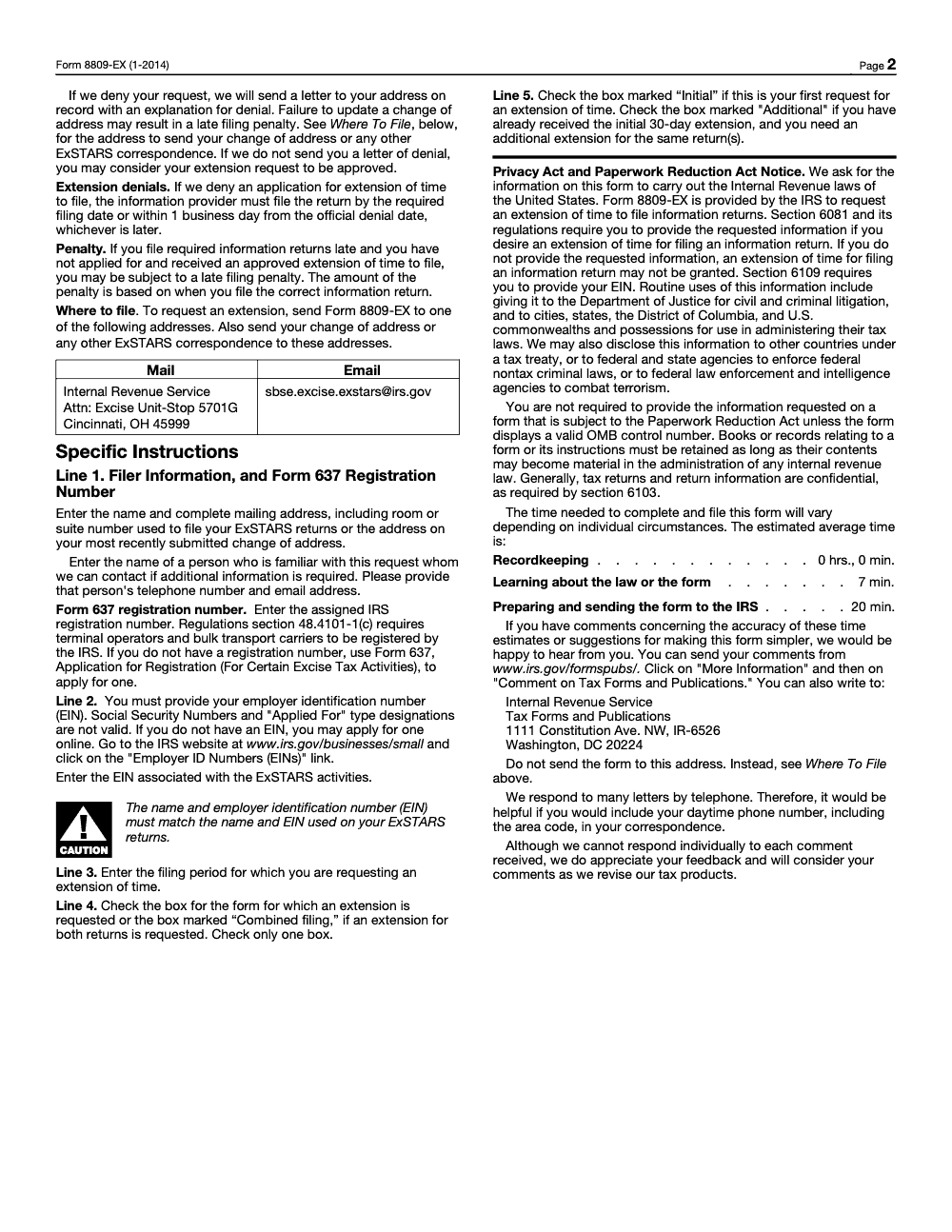
| Submission method | Mail only to Department of the Treasury, Internal Revenue Service, Cincinnati, OH 45999 (no fax option) |
| Electronic filing | Not available for Form 8809-EX as of 2025 |
| Extension length | Maximum 30 days from original due date |
| Second extension | Not available – the 30-day grant is one-time only per reporting period |
| IRS response | Written denial only if denied; no approval letter is issued – silence within a reasonable time means approval |
Always send the form by a method that creates a delivery record – certified mail with return receipt is the standard route since Form 8809-EX is paper-only and must reach the Cincinnati service center. If the IRS later questions whether the form was timely submitted, your delivery record is your evidence. Keep it in the client file for at least three years after the ExSTARS return is ultimately filed.
What Happens After You File
The IRS reviews Form 8809-EX but issues no approval letter – only denials are communicated. Silence within a reasonable time means the request was approved; the engagement team should treat the absence of a denial as approval and file the underlying return by the 30-day extended due date. If a denial notice arrives, file the underlying ExSTARS return as quickly as possible to limit the §6721 penalty tier.
If the extension is approved (signaled by IRS silence within a reasonable time), the ExSTARS return must be filed by the 30-day extended due date measured from the original due date. Filing beyond the extended due date means the return is still late, even with an approved Form 8809-EX on file – an approved extension shifts the Section 6721 penalty start by 30 days, it is not a penalty waiver. If the extension is denied, file the ExSTARS return as soon as possible to minimize the penalty amount – the earlier the late filing, the lower the per-return penalty tier.
Common Mistakes That Slow Things Down
A handful of patterns drive nearly every Form 8809-EX denial or downstream §6721 penalty we see across terminal operator and bulk-carrier engagements. Each one is avoidable inside a simple monthly close SOP.
Practical Checklists You Can Reuse
These three checklists sit in our offshore SOP library for ExSTARS engagements. Paste them straight into your firm's monthly playbook or workpaper template – they map to the actual Form 8809-EX, 720-TO, and 720-CS filing rhythm.
Pre-extension packet (run 7 business days before the original due date)
- Confirm the filer's Form 637 activity letter is active (S for terminal operators, Y for bulk carriers) and registration matches the EIN on the extension request.
- Pull the underlying Form 720-TO or 720-CS reporting month and verify the original due date – the last day of the month following the reporting month, rolling forward per IRC §7503 if it lands on a weekend or holiday.
- Draft the specific reason for the extension – name the system failure, late carrier data feed, or audit reconciliation; avoid generic "more time needed" language.
- Capture the Terminal Control Number (TCN) for 720-TO requests and confirm it matches the IRS ExSTARS database record.
- Have an authorized officer sign Form 8809-EX under penalties of perjury – an unsigned form is treated as not filed (per the Form 8809-EX instructions).
- Mail to Department of the Treasury, Internal Revenue Service, Cincinnati, OH 45999 by tracked postage; log the certified mail receipt in the engagement file.
Post-filing watch (run from filing through the 30-day extended window)
- Diary the 30-day extended due date from the original due date – the IRS issues no approval letter for Form 8809-EX, only denials.
- Open the engagement's IRS correspondence log and route any denial notice to the engagement manager within one business day.
- Track preparation progress against the extended due date weekly; flag at the 50% and 75% checkpoints.
- Confirm the §6721 correction-window deadlines run from the EXTENDED due date, not the original due date.
- If the return is unlikely to land by the extended due date, prepare a late-filing penalty memo for the client with the 2025 §6721 tiers.
§6721 penalty exposure scan (run if the ExSTARS return slips past the extended due date)
- Compute per-return exposure at the correct tier: $60 within 30 days of the extended due date, $130 by August 1, 2026, $340 thereafter (per Rev. Proc. 2024-40, IRS.gov).
- Apply the calendar-year cap – $4,098,500 for large filers, $1,366,000 for small filers (average gross receipts of $5M or less).
- Document the reason for delay in the workpaper to support reasonable-cause abatement under IRC §6724.
- Confirm whether intentional disregard applies (greater of $680 or 10% of items required to be reported, with no calendar-year cap).
- File the underlying 720-TO or 720-CS as soon as possible to lock in the lowest available penalty tier; later filings drift to the next band.
Keep 8809-EX Season From Stalling
ExSTARS reporting runs on a monthly cadence, with Form 720-TO and Form 720-CS due on the last day of the month following the reporting month. That rhythm leaves zero slack when a terminal data system goes down mid-close or a carrier feeds gallon-level data late, and the single 30-day Form 8809-EX window is the only buffer the IRS will grant per reporting period (per the Form 8809-EX instructions, OMB 1545-1832).
The teams that protect their monthly close treat the extension as a planned safety valve, not a last-minute scramble. The fix is procedural: pre-stage the request, monitor the silent-approval window, and feed every late-month signal into the same workflow so nothing surprises the controller at the end of the next reporting month.
- Lock the Form 637 activity-letter check (S for terminal operators, Y for bulk carriers) into the new-month opening checklist so registration mismatches are caught before extension day.
- Standardize the "specific reason" language by ExSTARS scenario – terminal data system outage, refiner late-disbursement reporting, audit-driven gallon reconciliation – so every Form 8809-EX has a defensible reason on file.
- Build a TCN-to-EIN crosswalk in the workpaper template so a 720-TO extension request never carries the wrong Terminal Control Number into the filing envelope.
- Track the §6721 correction windows from the EXTENDED due date ($60 within 30 days, $130 by August 1, 2026, $340 thereafter for 2025 per Rev. Proc. 2024-40) so a slipped return still lands in the cheapest available band.
- Diary the silent-approval window – the IRS communicates only denials – so the engagement manager owns the calendar reminder to confirm filing before the 30-day extended due date burns.
Accountably's offshore tax bench runs this exact monthly cadence inside client systems – from Form 637 registration verification through Form 720-TO and 720-CS preparation and the Form 8809-EX safety valve – with U.S.-led review and SOC-2-aligned controls. See our tax delivery practice for how the workflow plugs into a firm or in-house excise team.
FAQs
Form 8809-EX is used to request an extension of time to file ExSTARS (Excise Summary Terminal Activity Reporting System) information returns. It is separate from Form 8809, which handles extension requests for most other information returns. ExSTARS filers cannot use standard Form 8809 to extend their ExSTARS due dates.
Terminal operators (filing Form 720-TO, Form 637 activity letter S) and bulk transport carriers (filing Form 720-CS, activity letter Y) required to file ExSTARS information returns under IRC Section 4101 and related regulations must file Form 8809-EX when they need additional time beyond the standard due date. Form 720-TO and Form 720-CS are filed monthly only.
No. Unlike Form 8809 for most other information returns, Form 8809-EX requires IRS review and approval. The extension is not automatic. The IRS issues no approval letter for Form 8809-EX – only denials are communicated. Silence within a reasonable time means the request was approved, so file early enough to absorb a possible denial before the original due date.
Form 8809-EX must be submitted by the original due date of the ExSTARS return for which the extension is requested. A request submitted after the original due date will be denied. The maximum extension granted is 30 days from the original due date.
Late filing of information returns triggers penalties under IRC Section 6721. For 2025, the per-return penalty ranges from $60 (filed within 30 days of the due date) to $130 (after 30 days but by August 1, 2026) to $340 (after August 1, 2026 or not filed at all), with an annual cap of $4,098,500 for large filers ($1,366,000 for small filers with average gross receipts of $5M or less, per Rev. Proc. 2024-40). Intentional disregard carries the greater of $680 or 10% of items required to be reported, with no cap.
Form 8809 is the general extension request for W-2, 1099 series, and most other information returns – and grants an automatic 30-day extension for many filers. Form 8809-EX applies only to ExSTARS returns, is not electronically filed, and is not automatically granted. Using Form 8809 when Form 8809-EX is required leaves the ExSTARS return with no valid extension.
Other forms this guide names
- Form 8809: Information Return Extension Guide
- Form 720-TO: Terminal Operator Fuel Report Guide
- Form 637: Registration Guide for Fuel Exporters
- Form W‑2: Deadlines, E‑File Rules, Boxes, and W‑2c Corrections
About this guide
Accountably helps US CPA, EA, and accounting firms hire trained accountants and tax preparers in India.
About us Reviewed byJugal Thacker, CPAFounder and CEO at Accountably
A Washington-licensed CPA with 7+ years inside US firms – PwC, a real-estate tax practice, then a full-service firm, rising from reviewer to manager to advisory. This article was reviewed against current IRS guidance for the 2025 tax year and updated for filers preparing late returns, amendments, and 2026 estimates.
View profile →How we research, review, and update this guide
Every Accountably guide is researched against primary IRS sources, reviewed by a U.S. CPA, and refreshed as guidance evolves. Read our Editorial Guidelines to see how we source, fact-check, and update our content.