Summarize this article with AI
In Brief
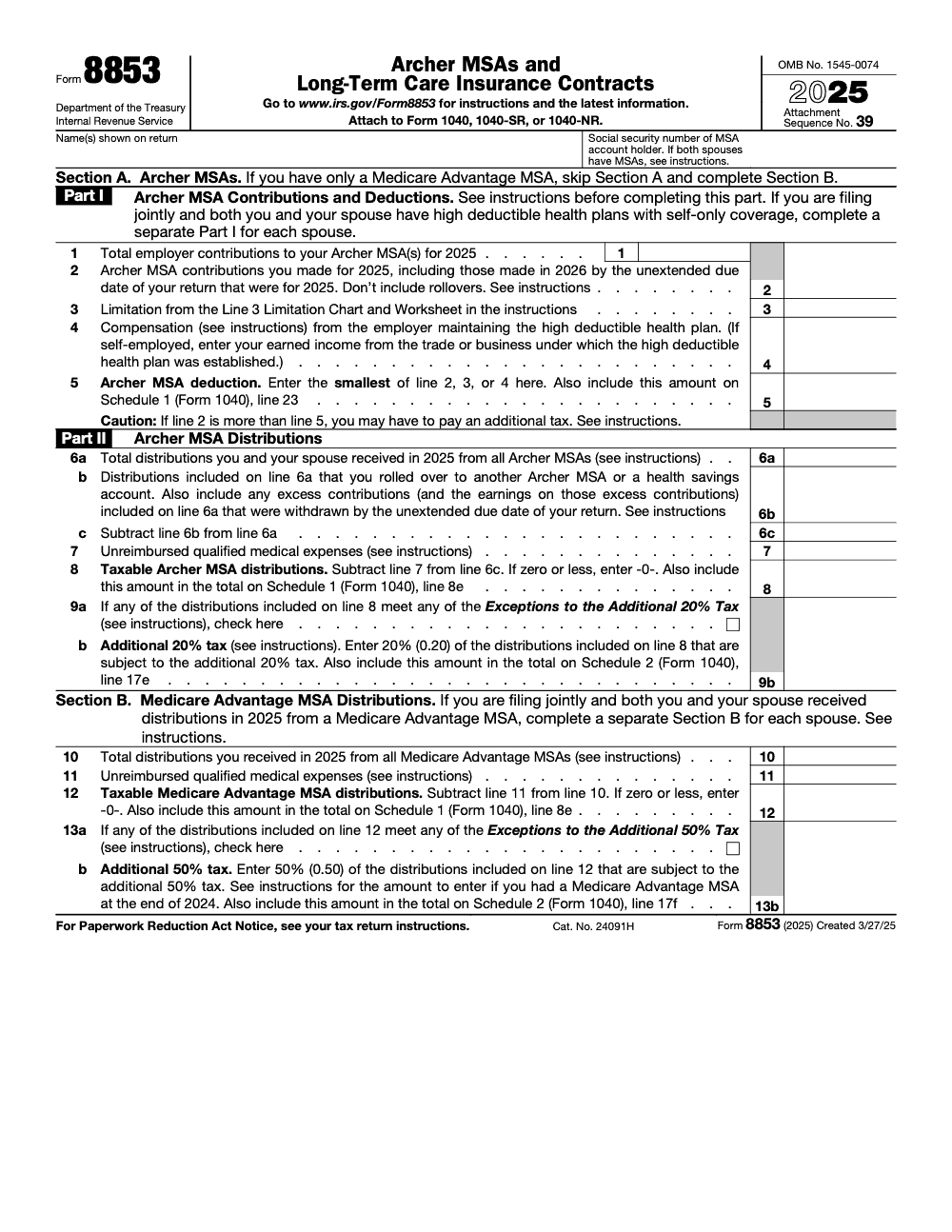
Form 8853 reports Archer MSA contributions and deductions, Medicare Advantage MSA distributions, and taxable payments from qualified long-term care contracts and accelerated death benefits, attached to Form 1040, 1040-SR, or Form 1040-NR under IRC §220, §138, and §7702B. For tax year 2025, the LTC per diem limit is $420 per day (per Rev. Proc. 2024-40), non-qualified Archer MSA distributions face a 20% additional tax on line 9b flowing to Schedule 2 (Form 1040) line 17e, and non-qualified MA MSA distributions face a 50% additional tax on line 13b flowing to Schedule 2 line 17f.
Form 8853 puts two additional taxes side by side, 20% on a non-qualified Archer MSA distribution on line 9b, flowing to Schedule 2 (Form 1040) line 17e, and 50% on a non-qualified Medicare Advantage MSA distribution on line 13b, flowing to Schedule 2 line 17f.
The form reports Archer MSA contributions and deductions, Archer MSA and Medicare Advantage MSA distributions, and taxable long-term care insurance and accelerated death benefits, attached to Form 1040, 1040-SR, or 1040-NR. Employer contributions shown on Form W-2, Box 12, code R reduce or eliminate the deduction, and for 2025 the long-term care per-diem limit is $420 per day under Rev. Proc. 2024-40.
Key Takeaways
- Form 8853 reports Archer MSA contributions and deductions, Archer MSA and Medicare Advantage MSA distributions, plus taxable long‑term care insurance and accelerated death benefits. Attach it to your Form 1040, 1040‑SR, or 1040‑NR for the year of the activity.
- If you or your spouse contributed to an Archer MSA, received Archer MSA or Medicare Advantage MSA distributions, acquired an MSA due to death, or received LTC or accelerated death benefits, you must file Form 8853. Joint filers may need separate statements for each spouse.
- Employer Archer MSA contributions appear on Form W‑2, Box 12, code R. Those amounts reduce or eliminate your deduction. You cannot deduct employer amounts.
- Nonqualified Archer MSA distributions are taxable and generally face a 20 percent additional tax. Nonqualified Medicare Advantage MSA distributions are taxable and generally face a 50 percent additional tax. Exceptions apply for death, disability, and, for Archer MSAs, age 65.
- For 2025, the long‑term care per‑diem limit is 420 per day. Amounts above the limit can become taxable unless supported by actual qualified LTC costs.
- You will reconcile Forms 1099‑SA and 5498‑SA for MSA activity and 1099‑LTC for long‑term care payments. These information returns drive the lines you enter on Form 8853.
What Form 8853 Does, in Plain English
Form 8853 performs four jobs.
- It calculates your Archer MSA deduction after applying monthly eligibility, HDHP rules, and compensation limits, then it offsets any employer funding that shows up with code R on your W‑2.
- It reports Archer MSA distributions and applies the 20 percent additional tax when a withdrawal did not pay a qualified medical expense and no exception applies.
- It reports Medicare Advantage MSA distributions and, when not qualified, applies the 50 percent additional tax.
- It computes any taxable portion of long‑term care insurance or accelerated death benefits, using the current per‑diem cap and reimbursements.
If you received an MSA distribution at any point in the year, you must attach Form 8853 to your return, even if none of the distribution is taxable. That rule surprises people. It is strict, and it is stated in the official instructions.
Who Must File Form 8853
You must file if any of the following happened this year.
- You or your employer made Archer MSA contributions.
- You or your spouse received Archer MSA or Medicare Advantage MSA distributions.
- You or your spouse became an MSA owner due to the death of the original account holder.
- You received taxable long‑term care insurance payments or accelerated death benefits.
Attach Form 8853 to your Form 1040 series return. If both spouses received Medicare Advantage MSA distributions, prepare separate Section B statements and combine totals on the main Form 8853.
Quick Document Checklist
- Form W‑2 with code R for employer Archer MSA contributions
- Form 1099‑SA for distributions from Archer MSA or Medicare Advantage MSA
- Form 5498‑SA for contributions and rollovers reported by the trustee
- Form 1099‑LTC for long‑term care benefits
- Receipts for qualified medical expenses that you did not also claim on Schedule A
What Changed for 2025
Two items matter for this year’s filings.
- The long‑term care per‑diem limit for 2025 is 420 per day.
- The age‑based caps for deductible LTC premiums for 2025 are 480, 900, 1,800, 4,810, and 6,020, depending on age band. You will see these in many software worksheets and in Revenue Procedure 2024‑40.
Note, Archer MSAs remain a closed, legacy arrangement for most people. New contributions are generally allowed only if you were already an active Archer MSA participant before 2008 or you became one through a participating small‑employer HDHP arrangement after that date. That long‑standing rule still appears in the current instructions.
Section A, Archer MSA Contributions and Deductions, How To Work Lines 1–5
Here is the sequence I use with clients and in reviews.
- Line 1, employer contributions. Enter the total shown on your W‑2, Box 12, code R. If the employer funded your Archer MSA, your own deduction may be zero. That is by design.
- Line 2, your contributions. Include what you paid during the tax year and also what you paid by the April deadline for that tax year. Do not include rollovers. The trustee will separately report rollovers.
- Line 3, annual limit. Use the Line 3 worksheet and mark each month you were eligible under a qualifying HDHP. Add the monthly values, then divide by 12 to annualize.
- Line 4, compensation limit. This caps the deduction at your compensation from the employer maintaining the HDHP, or your net self‑employment income when that applies.
- Line 5, your deduction. Take the smallest of Line 2, Line 3, and Line 4. Report it on Schedule 1. If employer funding blocked the deduction, you will enter zero here, and you may need to address any excess contributions separately.
Eligibility Rules That Trip People Up
- The small‑employer rule is real. Archer MSAs tie to self‑employed individuals or employees of small employers that averaged 50 or fewer employees in either of the prior two calendar years.
- You must have a qualifying HDHP, be eligible on the first day of a month to deduct for that month, have no disqualifying coverage, not be enrolled in Medicare, and not be someone else’s dependent.
- Employer Archer MSA contributions can eliminate your ability to deduct your own amounts in the same year.
Pro tip, if you discovered an excess contribution, ask the trustee about a return of excess with earnings by the due date. That correction prevents additional tax (excess Archer MSA contributions left in the account trigger a 6 percent excise tax under IRC section 4973 each year until removed, so the carryover-only assumption is wrong). The instructions outline how excesses work for both employee and employer amounts.
A Simple Example
You contributed 1,200, your Line 3 limit is 1,800, and your compensation cap is 1,000. Your allowable deduction is 1,000. If your W‑2 shows code R for 500, that employer funding does not become your deduction. It simply reduces the amount you can deduct to the smallest permitted number.
Section A, Archer MSA Distributions, Lines 6a–9
Work this part with your 1099‑SA in hand.
- Line 6a, enter total Archer MSA distributions, which should match Box 1 of your 1099‑SA.
- Line 6b, subtract any rollovers to another Archer MSA or to an HSA.
- Line 6c, this is your net distribution.
- Line 7, enter unreimbursed qualified medical expenses you paid for yourself, your spouse, and dependents. Do not also claim these on Schedule A.
- Line 8, if 6c is more than 7, that excess is taxable and flows to Schedule 1.
- Line 9, compute the 20 percent additional tax on any nonqualified amount unless an exception applies for death, disability, or age 65. That additional tax appears on Schedule 2.
Small check, rollovers are not taxable and the trustee reports them separately on Form 5498‑SA. Keep your rollover confirmations with your return file, since the IRS will match the 1099‑SA to your Form 8853.
Review Notes I Leave For Teams
- Tie Line 6a to 1099‑SA Box 1.
- Confirm no double counting of medical expenses on Schedule A.
- For beneficiaries after the account holder’s death, follow the instructions carefully. Spouse beneficiaries are treated differently than non‑spouse beneficiaries for income inclusion and penalties.
What About Archer MSA Availability Today
Archer MSAs are a legacy option. After December 31, 2007, you generally cannot start new contributions unless you were already a participant or became one through a qualifying participating small employer’s HDHP arrangement. Existing accounts still operate, and distributions still require Form 8853 when they occur.
If you have an old Archer MSA and an HSA, remember that rollovers from an Archer MSA can go to an HSA, but not the other way. Keep trustee confirmations for both accounts.
Section B, Medicare Advantage MSA Distributions, Lines 10–13b
This section is similar in shape to Archer MSAs, but the penalty rate is very different.
- Line 10, enter total distributions from 1099‑SA, Box 1.
- Line 11, enter unreimbursed qualified medical expenses for the account holder. Do not also claim them on Schedule A.
- Line 12, the difference is taxable and goes to Schedule 1.
- Line 13b, compute the additional 50 percent tax on any taxable, nonqualified amount, unless the death or disability exception applies. That additional tax appears on Schedule 2.
If both spouses received Medicare Advantage MSA distributions, prepare a separate Section B for each spouse with name and SSN, then combine totals on one Form 8853 for e‑file or attach statements for paper filing, as the instructions describe.
Quick Feel‑to‑Reality Check
| Feeling | Reality |
| Relief | Accurate Line 11 entries reduce Line 12, which reduces the penalty exposure on Line 13b. |
| Urgency | Your 1099‑SA controls Line 10 totals. Reconcile every distribution. |
| Control | Keep a running ledger of qualified expenses so you can prove tax‑free treatment quickly. |
A One‑Minute Example
You withdrew 2,000 from a Medicare Advantage MSA. You have 1,600 of qualified expenses not claimed on Schedule A. Line 12 is 400, which is taxable. The additional tax on Line 13b is generally 200. If a death or disability exception applies, the additional tax may be zero, but the 400 is still income.
Section C, Long‑Term Care Insurance and Accelerated Death Benefits
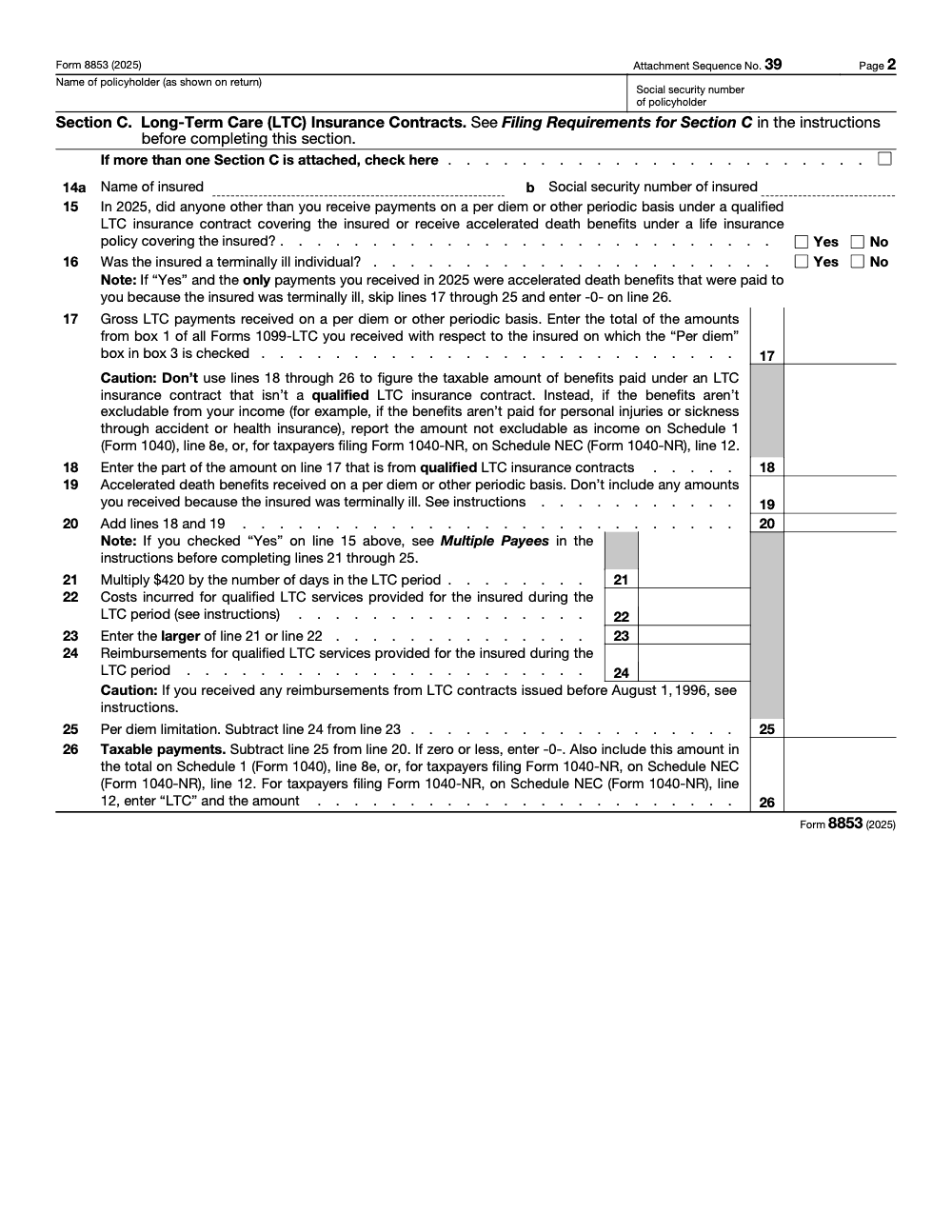
Form 8853 also handles taxable portions of LTC insurance benefits and accelerated death benefits (Section C is for per‑diem or periodic payments only – reimbursement‑basis LTC benefits, where Box 3 of Form 1099‑LTC shows 'Reimbursed amount,' are not reported on Section C). Start by entering the insured’s name and SSN, then follow the Section C flow. Pull totals from Form 1099‑LTC. If Box 3 on the 1099‑LTC shows per‑diem or periodic benefits, you must apply the per‑diem cap for the year. For 2025, the per‑diem limit is 420 per day. Amounts above the cap can be taxable unless your actual qualified LTC costs exceed the combined benefits (per diem benefits are not unconditionally tax free – the exclusion is capped at the greater of the per‑diem limit times days or actual qualified LTC costs, reduced by reimbursements).
- Lines 17–20, enter per‑diem or periodic amounts, identify qualified contracts, and add accelerated death benefits for a chronically ill individual if applicable.
- Lines 21–25, compute the excludable amount using the per‑diem limit times days, or actual qualified LTC costs if higher, then subtract reimbursements.
- Line 26, any excess is taxable and flows to Schedule 1 line 8e for Form 1040 and 1040‑SR filers, or to Schedule NEC line 12 with the label 'LTC' for Form 1040‑NR filers (the 1040 path does not apply to nonresident returns). If the insured is terminally ill and the only 2025 payments were accelerated death benefits paid because of the terminal illness, skip lines 17 through 25 and enter zero on line 26 (those benefits are fully excludable under IRC section 101(g), not partially taxable per diem).
2025 Age‑Based Limits for Deductible LTC Premiums
These are the Section 213(d)(10) annual caps that software uses when you itemize medical expenses. They are not Form 8853 lines, but they matter in planning.
| Age at year end | 2025 deductible limit |
| 40 or less | 480 |
| 41–50 | 900 |
| 51–60 | 1,800 |
| 61–70 | 4,810 |
| Over 70 | 6,020 |
Common Section C Pitfalls I See
- Treating per‑diem benefits as fully tax‑free without checking the current year cap.
- Forgetting to net reimbursements before testing for any taxable excess.
- Reporting the same expense for both LTC tax‑free treatment and Schedule A, which the instructions forbid. Bring the receipts that tie to the benefits.
Keep every 1099‑LTC and a simple worksheet that shows days, per‑diem, reimbursements, and actual costs. It turns a messy pile of bills into a clean Line 26 answer.
Archer MSA Eligibility, The Details You Should Verify Each Year
- You are self‑employed or you work for a small employer that averaged 50 or fewer employees in either of the prior two years.
- You have qualifying HDHP coverage, you are not enrolled in Medicare, and you are not someone else’s dependent.
- You must be eligible on the first day of a month to deduct for that month.
- Employer Archer MSA contributions shown with W‑2 code R can prevent you from making a deductible contribution in the same year.
Additional Taxes, Penalties, and the Exceptions
- Archer MSA, nonqualified distributions are taxable and generally face a 20 percent additional tax, unless the exception for death, disability, or age 65 applies (this is the Archer rate under IRC section 220, not the 10 percent HSA penalty under section 223).
- Medicare Advantage MSA, nonqualified distributions are taxable and generally face a 50 percent additional tax, with exceptions for death or disability.
- Long‑term care, test per‑diem benefits against the annual cap of $420 per day for 2025, or use actual qualified costs if higher. Any excess is income on Schedule 1.
When excess contributions or penalty adjustments apply, follow the instructions and, when required, use Form 5329 to compute or adjust certain additional taxes. Your software will guide you, but you are responsible for the entries and the backup.
How To Report Contributions and Distributions Without Rework
- Archer MSA Part I, enter W‑2 code R on Line 1, your contributions on Line 2, your annual limit on Line 3, your compensation cap on Line 4, and your deduction, the smallest number, on Line 5.
- Archer MSA Part II, use 1099‑SA to complete Lines 6a–9, subtract rollovers, list qualified expenses, compute any taxable amount, and then apply the additional 20 percent tax if needed.
- Medicare Advantage MSA Section B, use 1099‑SA to complete Lines 10–13b, and compute any additional 50 percent tax.
- Section C, use 1099‑LTC and the 2025 per‑diem limit, then compute any taxable amount on Line 26.
- Reconcile 5498‑SA for contributions and rollovers reported by your trustee. The IRS matches these forms to your return.
Related Forms and Federal References
- Instructions for Form 8853, the primary authority for who must file, line‑by‑line rules, and penalties.
- About Form 8853, quick status and links to current revision.
- Publication 969, definitions and examples for MSAs and related plans.
- About Forms 1099‑SA and 5498‑SA, information returns for distributions and contributions.
- Revenue Procedure 2024‑40 in IRB 2024‑45, 2025 inflation numbers for per‑diem limits and LTC premium caps.
- About Form 1099‑LTC, general guidance for LTC reporting.
If You Run a Firm, Where Accountably Fits
If you are a partner or ops lead, your real bottleneck is rarely finding clients. It is consistent delivery at scale during peak season. For Form 8853 work, that means documenting SOPs for 1099‑SA and 5498‑SA tie‑outs, per‑diem testing workflows for Section C, review notes that protect Lines 8, 9, 12, and 13b, and audit‑ready workpapers. Accountably plugs into that delivery layer with trained offshore teams who work inside your systems and templates, with turnaround SLAs and multi‑layer reviews that reduce partner time in review. This is not resume farming, it is controlled execution for firms that need capacity without losing quality or security. Use us when your in‑house team is buried in production and you want advisory time back.
Final Notes and Next Steps
- Keep receipts for every qualified medical expense you claim against MSA distributions.
- Verify monthly eligibility before you compute any Archer MSA deduction.
- Use the 2025 per‑diem and age‑based limits when testing LTC benefits and premiums.
- When in doubt, read the current instructions and, for complex fact patterns, ask a tax professional to review the file.
Freshness check, our team reviewed IRS Instructions for Form 8853 and Revenue Procedure 2024‑40 on November 17, 2025. At that time, the IRS “About Form 8853” page showed no recent developments and the 2025 LTC per‑diem remained 420 per day.
Disclaimer, this article is for general information. It is not tax advice. For your return, follow the IRS instructions that apply to your tax year and your facts.
Common Mistakes We See Every Season
Form 8853 mistakes don't come from the easy returns. They come from spouses with split coverage, rollovers that look like contributions, and LTC payors who report on the wrong basis. Here are the patterns we catch most often before review.
Reusable Checklists
These checklists are copy-paste ready for firm SOPs. Drop them into Karbon, TaxDome, or whatever workflow tool the engagement runs through, and tie each step back to the source documents in your intake.
Section A: Archer MSA contribution and deduction close packet
- Pull Form W-2 box 12 code R for every Archer MSA participant and post the amount to line 1.
- Tie self-paid 2025 contributions to Form 5498-SA box 2 and confirm payments landed by the unextended due date before posting line 2.
- Confirm HDHP eligibility month-by-month; partial-year participants use the Line 3 Limitation Chart and Worksheet in the Form 8853 instructions.
- Set line 4 from compensation tied to the HDHP-maintaining employer, or net earned income for self-employed filers.
- Set line 5 to the smallest of line 2, line 3, and line 4 (per IRC §220), and roll it into Schedule 1 (Form 1040) line 23.
- For married filing jointly with self-only coverage on both spouses, complete a separate Part I per spouse.
- Post the 1099-SA distribution to line 6a and rollovers or excess withdrawn by due date to line 6b before computing line 6c.
- Tie qualified medical expense receipts to line 7 and confirm line 8 floors at zero before reviewing line 9a or computing the 20% line 9b.
Section B: Medicare Advantage MSA distribution review
- Confirm the MA MSA distribution amount from the plan statement and Form 1099-SA, and post to line 10.
- Verify no taxpayer contributions were entered anywhere on Form 8853; MA MSAs are Medicare-funded.
- Tie qualified medical expenses for the insured to line 11 with receipts attached to the workpaper.
- Evaluate the line 13a exception (death or disability) before charging the 50% additional tax on line 13b.
- For joint returns where both spouses received MA MSA distributions, attach a separate Section B per spouse.
- If the taxpayer had an MA MSA at the end of 2024, follow the instructions for the prior-year balance adjustment on the 50% tax line.
- Cross-foot line 13b to Schedule 2 (Form 1040) line 17f before locking the return.
Section C: Qualified LTC and 1099-LTC tie-out
- Confirm the Form 1099-LTC box 3 "Per diem" indicator is checked; reimbursement-basis benefits do not go through Section C.
- Confirm the contract is qualified under IRC §7702B before posting gross per diem to line 17; pre-August 1, 1996 contracts get grandfathered treatment.
- Compute line 21 as $420 multiplied by the days in the LTC period (per Revenue Procedure 2024-40 for 2025); do not pull a prior-year cap from older templates.
- Set line 23 to the larger of line 21 or actual qualified LTC costs on line 22, then reduce by reimbursements on line 24 to land line 25.
- If the insured is terminally ill and 2025 payments were only accelerated death benefits, skip lines 17-25 and enter -0- on line 26.
- Answer line 15 carefully; multiple-payee fact patterns require allocating the per diem limit before line 25.
- If more than one Section C is attached, check the multiple-section box at the top of page 2 of Form 8853.
- For Form 1040-NR filers, route the taxable LTC amount on line 26 to Schedule NEC (Form 1040-NR) line 12 with the label "LTC" instead of Schedule 1 line 8e.
Keep 8853 Season From Stalling
Form 8853 does not move return volume the way Form 1040 or Form 941 does, but the mistakes are expensive. The 20% additional tax on Archer MSA line 9b and the 50% rate on Medicare Advantage MSA line 13b mean a single misallocated distribution turns into a five-figure adjustment. According to IRS Publication 1304, the IRS processes roughly 161 million individual returns each year, and the small subset that touch Form 8853 carry penalty exposure most production teams underestimate.
The fix is not more headcount. It is a workflow that catches the predictable misses before review: rollovers stuck on line 2, an outdated per diem on line 21, a non-qualified LTC contract routed through lines 18-26, or two spouse MA MSAs squeezed into one Section B. Once the workpaper template enforces the routing, review time drops and the penalty-math risk falls with it.
- Lock the 2025 per diem of $420 (per Revenue Procedure 2024-40) into the Section C template before tax season opens, so line 21 never carries a prior-year cap.
- Build an intake tag that splits Form 1099-LTC forms into per-diem versus reimbursement basis; reimbursement amounts stay off Section C entirely.
- Standardize the line 5 calculation as "smallest of line 2, line 3, or line 4" inside the workpaper formula so preparers cannot default to line 2 alone.
- For joint returns, require a separate Section B per spouse whenever both received Medicare Advantage MSA distributions, and a separate Part I when both have self-only HDHPs.
- Map line 9b to Schedule 2 (Form 1040) line 17e and line 13b to Schedule 2 (Form 1040) line 17f in the e-file diagnostics so a missing entry blocks the lock.
That is the layer Accountably builds into the engagement: trained reviewers, documented SOPs for Archer MSA, MA MSA, and qualified LTC reporting, and turnaround SLAs that let production scale without the penalty-math errors riding to review. U.S. taxation delivery stays inside your systems and templates while the structure does the catching.
FAQs
Yes. If you received an Archer MSA or Medicare Advantage MSA distribution, you must file Form 8853 with your return for that year, even when the distribution is not taxable.
Employer amounts appear on Form W‑2, Box 12, code R. You do not deduct employer contributions, and those amounts can block a personal deduction for the same year.
It is $420 per day for payments received in 2025 from qualified LTC contracts or certain life insurance policies paying accelerated death benefits for a chronically ill individual.
For 2025 the limits are 480, 900, 1,800, 4,810, and 6,020 based on age bands from 40 or less to over 70. These come from Revenue Procedure 2024‑40.
Form 8853 covers Archer MSAs, Medicare Advantage MSAs, and LTC or accelerated death benefits. Form 8889 covers HSAs. Distributions from HSAs are not reported on Form 8853, and distributions from Archer MSAs or MA MSAs are not reported on Form 8889.
Use 1099‑SA for distributions, 5498‑SA for contributions and rollovers, and 1099‑LTC for long‑term care benefits. Keep these forms with your records and tie them to the lines you enter.
Other forms this guide names
- Form 1099-SA: HSA Distributions, Codes, Penalties & Filing
- Form 1040: Filing Guide for 2025 Returns (AGI, Deductions, Deadlines)
- Form 1099-LTC: 2025 Guide to Taxability, Per Diem Limits & Reporting
- Form W‑2: Deadlines, E‑File Rules, Boxes, and W‑2c Corrections
- Form 5498-SA: HSA & Archer MSA Contribution Reporting
- Form 1040‑NR: Filing 2025, Nonresident Taxes Made Simple
Summarize this article with AI
About this guide
Accountably helps US CPA, EA, and accounting firms hire trained accountants and tax preparers in India.
About us Reviewed byJugal Thacker, CPAFounder and CEO at Accountably
A Washington-licensed CPA with 7+ years inside US firms – PwC, a real-estate tax practice, then a full-service firm, rising from reviewer to manager to advisory. This article was reviewed against current IRS guidance for the 2025 tax year and updated for filers preparing late returns, amendments, and 2026 estimates.
View profile →How we research, review, and update this guide
Every Accountably guide is researched against primary IRS sources, reviewed by a U.S. CPA, and refreshed as guidance evolves. Read our Editorial Guidelines to see how we source, fact-check, and update our content.