Summarize this article with AI
In Brief
Schedule G (Form 1120) is the corporate-ownership disclosure attached to Form 1120 that lists every entity owning 20% or more of voting stock directly, or 50% or more directly or indirectly, measured at the end of the tax year (per the Schedule G instructions, Rev. December 2011). Part I captures entity owners triggered by Schedule K, Question 4a; Part II captures individuals and estates triggered by Schedule K, Question 4b.
A Form 1120 comes back from the IRS with a question about Schedule G, the engagement partner is certain it was filed, and the truth turns up after digging through folders: the schedule was simply omitted because no one realized it was triggered. That oversight costs weeks of correspondence, and it starts with a threshold most teams skim past.
Schedule G (Form 1120) lists every entity owning 20% or more of voting stock directly, or 50% or more directly or indirectly, measured at the end of the tax year. Part I captures entity owners triggered by Schedule K, Question 4a; Part II captures individuals and estates triggered by Question 4b. It is due with the Form 1120 return on April 15 for calendar‑year corporations, with a 6‑month extension via Form 7004, and constructive ownership rules can push a single owner over the line through family attribution.
Key Takeaways
- Schedule G is an ownership disclosure form attached to Form 1120 that identifies any person or entity owning 20% or more of the corporation’s total voting stock.
- The 20% direct threshold applies to individuals, partnerships, corporations, estates, and trusts. A separate 50% direct-or-indirect voting-power test applies to the same set of owners; either threshold alone triggers reporting.
- Schedule G is due with the Form 1120 return – the 15th day of the fourth month after the tax year ends (April 15 for calendar-year corporations), with a 6-month extension available via Form 7004.
- Omitting Schedule G when required makes the return incomplete, which can trigger IRS inquiry and expose the corporation to failure-to-file penalty risk.
- Constructive ownership rules apply. Stock owned by family members (spouse, brothers, sisters, ancestors, lineal descendants) and related entities can be attributed to a single owner, pushing them above the threshold even if their direct ownership is lower. Note: under the Schedule G instructions, family attribution under §267(c)(2) only applies when the person receiving the attribution already owns a direct or entity-routed (corporation, partnership, or trust) interest in the corporation.
- Quick rule you can copy into your SOP: pull the corporation’s cap table at the start of every corporate engagement and check whether any single entry reaches 20% voting stock before you open the tax software.
What Schedule G Is and When to Use It
Schedule G (Form 1120) is a required disclosure schedule attached to the U.S. Corporation Income Tax Return when certain ownership thresholds are met. Its formal title is “Information on Certain Persons Owning the Corporation’s Voting Stock.” The IRS uses it to maintain ownership transparency for domestic corporations and to identify related-party relationships that may affect income allocation, transfer pricing, or consolidated return eligibility.
The schedule must be attached whenever any individual, partnership, corporation, estate, or trust owns, at the end of the tax year, directly 20% or more of the total voting power of all classes of stock of the corporation entitled to vote (the IRS uses a year-end snapshot, so mid-year holders who fall below the threshold by the last day of the tax year are not listed). It is also required when any such owner owns, directly or indirectly, 50% or more of that same voting power. These are two separate tests, and either one independently triggers the filing obligation.
From my side of the desk, the hardest part isn’t completing the form itself – the schedule is one page and straightforward once you have the cap table. The hard part is knowing when it’s required. New preparers often skip it because it doesn’t appear prominently in most tax software checklists. Build the question into your engagement kickoff process so you never have to backtrack.
Who Must File
Any domestic corporation filing Form 1120 must attach Schedule G if the ownership thresholds are met (both domestic and foreign owners count toward the thresholds; the filing trigger is not limited to corporations with foreign owners). S corporations, which file Form 1120-S, do not use this schedule. Foreign corporations filing Form 1120-F have separate disclosure requirements. Tax-exempt organizations filing Form 990 are also not subject to Schedule G under this framework, though they have their own Schedule L for related party transactions.
What “Voting Stock” Means Here
The 20% threshold applies specifically to voting stock – shares entitled to vote for directors or management decisions. Non-voting preferred stock does not count toward the 20% test. The 50% direct-or-indirect test also measures voting power across all classes of stock entitled to vote, not total value or non-voting classes. When a corporation has multiple classes of stock with different voting rights, you need to carefully map each voting class to determine whether any holder crosses the voting threshold.
Indirect and Constructive Ownership
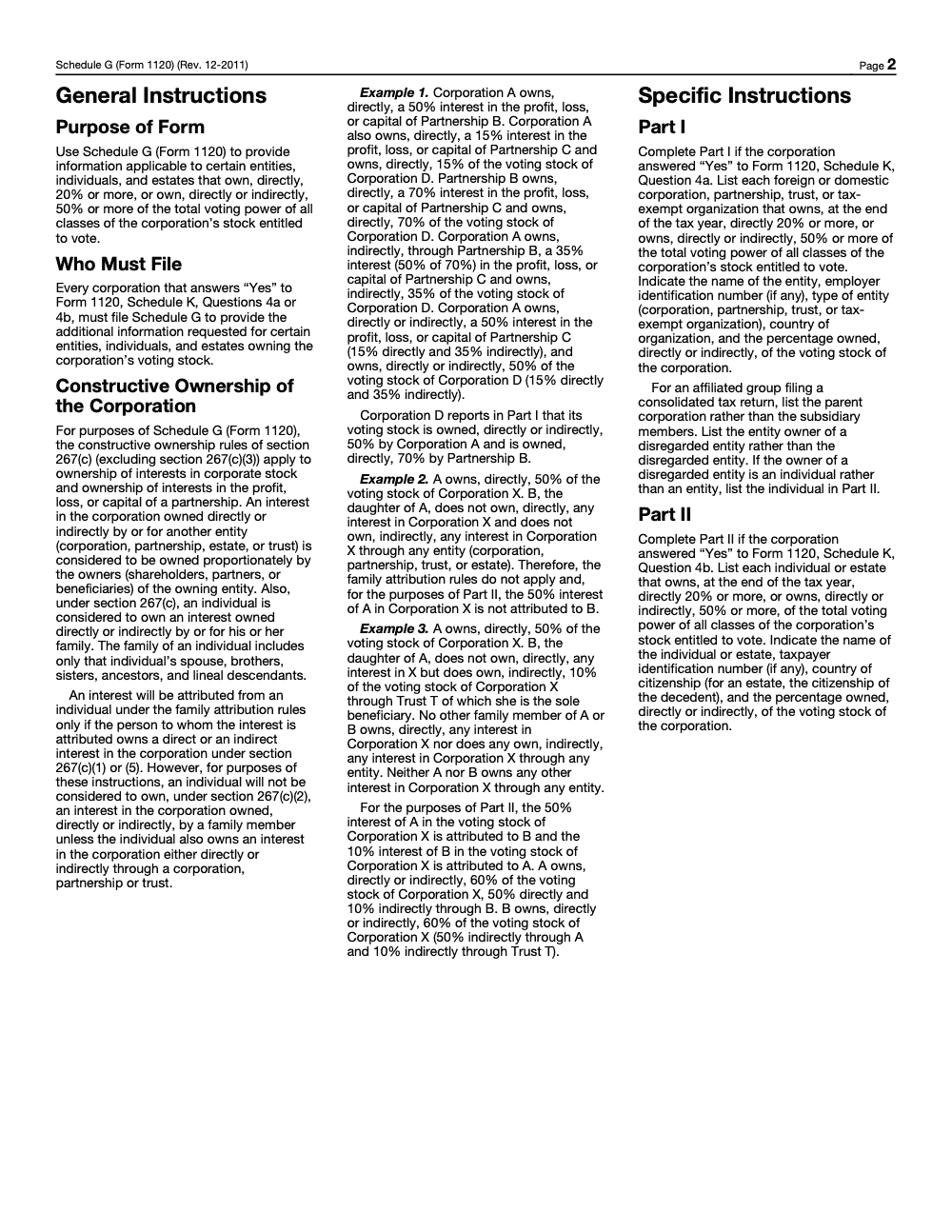
The constructive ownership rules under IRC §267(c), excluding §267(c)(3), apply when determining ownership percentages for Schedule G (not the §318 rules that govern many other corporate provisions). This means stock owned by a spouse, brothers, sisters, ancestors, or lineal descendants can be attributed to the taxpayer, provided the taxpayer already owns a direct or entity-routed interest in the corporation. Stock owned by a partnership, estate, or corporation can also be attributed to its partners, beneficiaries, or shareholders. Ignoring constructive ownership is one of the most common reasons firms miss the Schedule G filing requirement for clients who appear, on the surface, to have no dominant single owner.
The 20% and 50% Ownership Thresholds Explained
Schedule G has two columns in Part I and a separate Part II. Understanding which threshold applies to each row is critical for accurate completion.
| Test | Threshold | Applies To | Reported In |
|---|---|---|---|
| Direct Voting Stock (Entities) | 20% or more direct | Corporations, partnerships, trusts, tax-exempt orgs | Part I |
| Direct or Indirect Voting Power (Entities) | 50% or more direct or indirect | Corporations, partnerships, trusts, tax-exempt orgs | Part I |
| Direct Voting Stock (Individuals & Estates) | 20% or more direct | Individuals, estates | Part II |
| Direct or Indirect Voting Power (Individuals & Estates) | 50% or more direct or indirect | Individuals, estates | Part II |
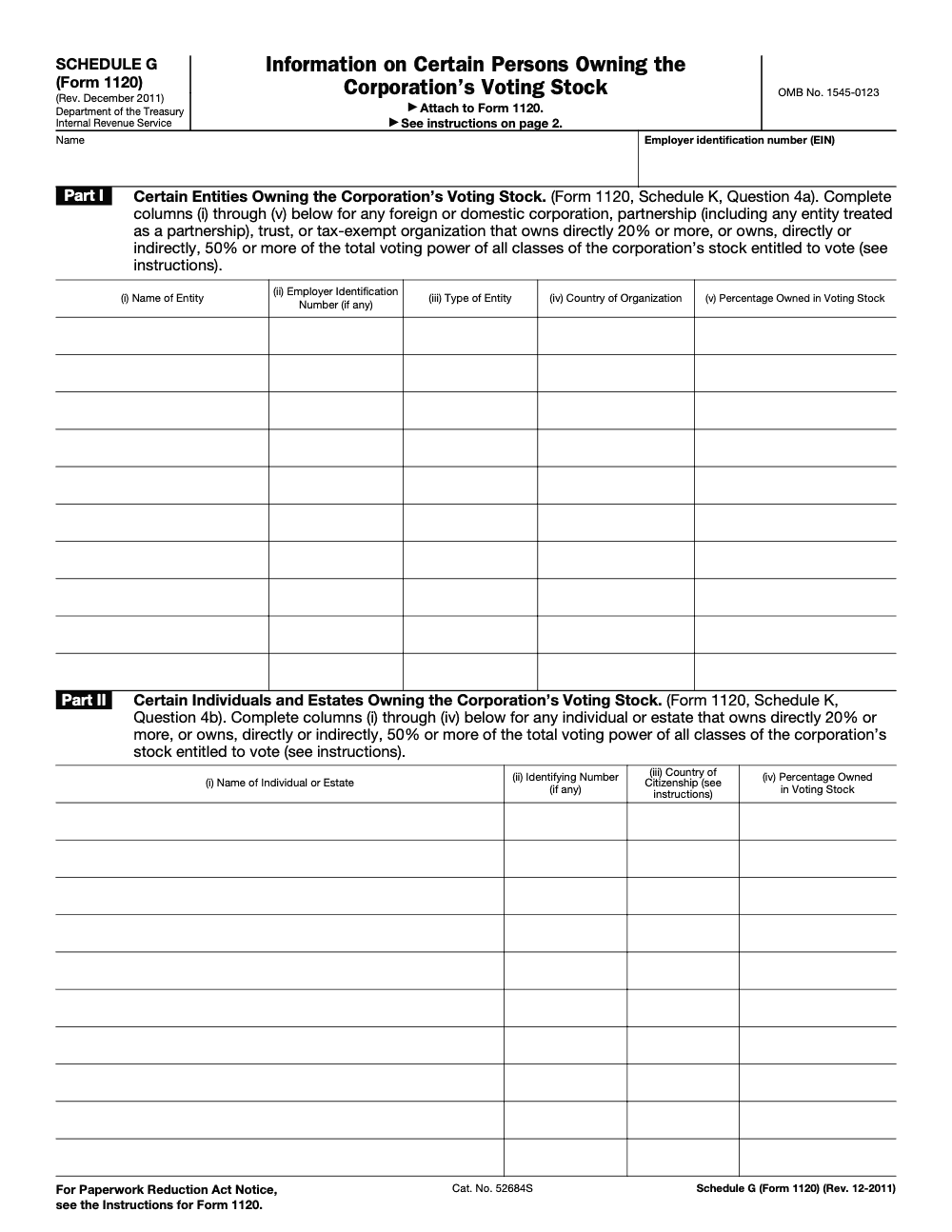
Part I asks you to list each foreign or domestic corporation, partnership, trust, or tax-exempt organization owning directly 20% or more, or directly or indirectly 50% or more, of total voting power, along with the EIN (if any), type of entity, country of organization, and percentage of voting stock owned. When both a direct holder and a higher-tier indirect owner each independently meet a threshold, both must appear separately on Schedule G; reporting only the immediate direct shareholder and omitting the upper-tier indirect owner is incomplete. If there is no single owner at or above 20%, Part I is left blank and Schedule G does not need to be filed.
Part II requires disclosure of each individual or estate that owns directly 20% or more, or directly or indirectly 50% or more, of the total voting power of all classes of the corporation’s stock entitled to vote. Entities (corporations, partnerships, trusts, tax-exempt organizations) are reported in Part I, never in Part II. There is no separate 50% “value” test – both Schedule G thresholds measure voting power only. For an estate listed in Part II, report the country of citizenship of the decedent (not the fiduciary).
How to Complete Schedule G
Part I – Persons Owning 20% or More of Voting Stock
| Column | What to Enter | Practitioner Tip |
|---|---|---|
| (i) Name of Entity | Legal name of the entity as it appears on its tax return or formation documents | Part I lists entities only; individuals and estates go in Part II |
| (ii) Employer Identification Number (if any) | EIN of the entity, if one exists; foreign entities without a U.S. EIN may have none to report | For foreign entities without an EIN, country of organization in column (iv) does the identification work |
| (iii) Type of Entity | Corporation, partnership, trust, or tax-exempt organization | Look through disregarded entities to the tax owner before classifying |
| (iv) Country of Organization | Country where the entity was formed | Use ISO country codes for clarity; “US” for U.S. domestic entities |
| (v) Percentage Owned in Voting Stock | Direct and indirect voting-stock percentage, including constructive ownership under §267(c) | Round to two decimal places; show calculation in workpapers |
Part II – Individuals and Estates Owning 20% Direct or 50% Direct-or-Indirect Voting Power
Part II uses four columns – (i) Name of Individual or Estate, (ii) Identifying Number (if any), (iii) Country of Citizenship, and (iv) Percentage Owned in Voting Stock – and lists only individuals or estates that own directly 20% or more, or directly or indirectly 50% or more, of the total voting power. Entities (corporations, partnerships, trusts, tax-exempt organizations) are reported in Part I, not Part II. For an estate, record the country of citizenship of the decedent, not the fiduciary.
Attaching Schedule G to Form 1120
Schedule G is attached after Form 1120 is completed. In tax software, most programs automatically prompt for Schedule G when you enter ownership information in the entity setup. However, do not rely solely on software prompts – run an independent check against the cap table. Software prompts are only as accurate as the data entered in the ownership fields.
Deadlines, Penalties, and Filing Requirements
| Item | Detail |
|---|---|
| Standard due date (calendar year) | April 15 (15th day of 4th month after year-end) |
| Standard due date (fiscal year) | 15th day of 4th month after fiscal year-end |
| Extension form | Form 7004 – grants automatic 6-month extension |
| Extended due date (calendar year) | October 15 |
| Failure to file penalty | 5% of unpaid tax per month, up to 25% (applies to the Form 1120 return as a whole) |
| Incomplete return risk | Missing Schedule G when required can render the return incomplete |
| E-file requirement | Corporations with assets of $10 million+ and 250+ returns must e-file Form 1120 |
Schedule G has no separate penalty of its own – it rides with the Form 1120. But an incomplete return is a real risk: the IRS can reject or flag a return that omits required schedules, which opens the door to penalties on the underlying tax and interest accrual. More practically, it creates IRS correspondence that consumes partner time and delays client file closure.
Extension Mechanics
Form 7004 extends the time to file the Form 1120 return, which includes all attached schedules. The extension is automatic upon timely filing of Form 7004 – no IRS approval required. The extension does not extend time to pay any tax due. If the corporation has a balance due, estimate and pay it by the original due date to avoid the late payment penalty of 0.5% per month.
Attribution Rules and Constructive Ownership
The constructive ownership rules under IRC §267(c), excluding §267(c)(3), are the most technical aspect of Schedule G compliance (Schedule G does not use the §318 attribution rules that apply elsewhere in subchapter C). They exist to prevent ownership dispersal strategies that would otherwise circumvent related-party disclosures. My team runs through attribution analysis on every new corporate client before finalizing the Schedule G determination.
Family Attribution
Under §267(c)(2), an individual is treated as owning stock held by their spouse, brothers, sisters, ancestors (parents, grandparents), and lineal descendants (children, grandchildren). Brothers and sisters ARE included for Schedule G purposes (a key difference from §318). Aunts, uncles, cousins, nieces, nephews, and in-laws are not family for this rule. Per the Schedule G instructions, family attribution only kicks in once the recipient already owns a direct or entity-routed interest. For a closely held family business where Mom owns 15% directly and Dad owns 10% directly, Mom’s 15% is attributed to Dad – making his constructive ownership 25%, which triggers Part II (individuals are reported in Part II, not Part I).
Entity-to-Owner Attribution
Stock owned by a corporation, partnership, estate, or trust is attributed proportionately to its shareholders, partners, or beneficiaries (Schedule G applies §267(c)(1), not the 50%-shareholder threshold of §318). These rules can create surprising chains: a trust that owns 30% of Corporation A, where Corporation B is a 60% beneficiary, means Corporation B is attributed 18% of Corporation A through the trust (30% × 60% = 18%, applying the multiplication rule for indirect ownership).
Owner-to-Entity Attribution Does Not Apply Here
Upward attribution – partner-to-partnership or shareholder-to-corporation – is a §318 concept and is NOT part of the §267(c) framework Schedule G uses. §267(c)(3) (partner-to-partner attribution through a partnership) is also expressly excluded from Schedule G. For this schedule, only downward proportional attribution from an entity to its owners, and the narrow family attribution under §267(c)(2), are in scope.
Practical Documentation Approach
Build a simple ownership matrix in your workpapers. List all shareholders down one axis and all stock classes across the top. Apply direct ownership first, then run attribution tests. Flag any row or column that approaches 20% after attribution. Keep this matrix in the permanent file – it speeds up next year’s analysis and protects you in any audit.
Foreign Owners and Additional Disclosure Requirements
When a foreign person or entity owns 25% or more of the U.S. corporation’s stock (by vote or value), Form 5472 becomes a separate and independent filing requirement. Schedule G and Form 5472 are not substitutes for each other – they serve different purposes and can both be required on the same return.
Form 5472 Overlap
Form 5472 requires disclosure of reportable transactions between the U.S. corporation and its 25%+ foreign shareholders or related parties. The penalty for a missing or incomplete Form 5472 is $25,000 per required form per year, with additional $25,000 penalties for continuing failures after IRS notice. That is a far more severe penalty regime than Schedule G carries, which is why flagging foreign ownership early in the engagement is non-negotiable in my practice.
FBAR and FATCA Considerations
If the corporation itself holds foreign financial accounts exceeding $10,000 at any point during the year, FinCEN Form 114 (FBAR) may also be required. Foreign corporations that are owners listed on Schedule G may trigger additional disclosure under FATCA reporting requirements. Coordinate with any international tax specialists on your team before completing disclosures for multi-jurisdictional structures.
Schedule G vs. Other Ownership Disclosure Forms
Corporations have multiple overlapping ownership disclosure obligations. Knowing which form covers what prevents both under-reporting and duplicative entries.
| Form | Purpose | Trigger |
|---|---|---|
| Schedule G (Form 1120) | Disclose owners of 20%+ voting stock direct, or 50%+ voting power direct or indirect | Ownership thresholds met |
| Form 5472 | Reportable transactions with 25%+ foreign shareholders | 25%+ foreign ownership + reportable transactions |
| Form 1120 Schedule K | Other information about the corporation | Filed with every Form 1120 |
| Form 851 (Affiliations Schedule) | Consolidated group member affiliations | Consolidated return filers |
| Schedule PH (Form 1120) | Personal Holding Company tax computation | PHC income and ownership tests met |
If a corporation is part of a consolidated return group, Schedule G is still completed for each subsidiary on its pro-forma return, reflecting that subsidiary’s own ownership structure. The parent’s consolidated return consolidates these but does not eliminate individual disclosure obligations.
Practical Tips for Multi-Layer Corporate Structures
Multi-entity corporate structures are where Schedule G gets genuinely complex. I have seen tiered holding company arrangements where the same beneficial owner appears in Schedule G filings for five different entities in the same tax year – each with a slightly different ownership percentage due to attribution flow-through.
Map the Full Ownership Chain Before Filing Season
For clients with complex structures, pull the organizational chart in October or November, before the filing season rush. Verify that all intercompany ownership percentages are current – ownership changes during the year affect which entities trigger Schedule G requirements. Any equity transactions (new investors, buyouts, dilution events) during the tax year should immediately trigger a Schedule G review.
Sync with the Client on Cap Table Changes
Corporate clients do not always understand that selling 10% of stock to a new investor can change their disclosure obligations. Build a client communication touchpoint around equity events: any transfer, issuance, or repurchase of voting stock should prompt your firm to review the Schedule G status for that year.
Prepare One Workpaper That Travels Through All Entities
Quick rule you can copy into your SOP: for any client with three or more related entities, maintain a single ownership matrix workpaper that lists all entities and their cross-ownership percentages. Update it annually during the entity setup phase. This one workpaper will save your team hours of cross-referencing during busy season.
Common Mistakes That Slow Things Down
Schedule G errors cluster around three blind spots: measuring ownership the wrong way, picking the wrong moment in time, and applying the wrong slice of IRC §267(c). The form has not been substantively revised since December 2011, so the instructions sit at the back of the practitioner's mind during a busy 1120 review.
Practical Checklists You Can Reuse
Two checklists you can paste straight into your firm SOP. Both are built for the corporate review week, when Schedule G typically gets pulled in late.
Year-End Voting-Stock Snapshot
- Pull the cap table as of the last day of the tax year, not a period average.
- Separate voting from non-voting classes and build the denominator from voting power only.
- Identify every entity holder at 20% direct or 50% direct-plus-indirect for Part I.
- Identify every individual or estate at the same thresholds for Part II.
- Document mid-year transfers in the workpaper but exclude them from the reportable list.
- Flag every disregarded entity and replace it with its tax owner.
- Name the affiliated group parent when a consolidated group holds stock, not the subsidiaries.
Constructive Ownership Walk
- List every entity in the ownership chain with its direct percentage.
- Multiply through each chain to compute indirect ownership for upper tiers.
- Apply IRC §267(c)(1), (2), (4), and (5) only; do not apply §267(c)(3).
- Confirm any recipient of family attribution already owns a direct or entity-routed interest before adding the relative's stake.
- Limit 'family' to spouse, brothers, sisters, ancestors, and lineal descendants.
- For estates in Part II, record the decedent's citizenship, not the fiduciary's.
- Reconcile every reportable owner back to the cap table and the attribution worksheet.
Pre-Attach Review
- Confirm Schedule K Question 4a and 4b answers match the Schedule G parts populated.
- Verify identifying numbers are present, or marked 'if any' where none exists.
- Verify country of organization for Part I entities and country of citizenship for Part II individuals and estates.
- Reconcile every percentage back to the year-end voting-stock register.
- Confirm Schedule G is physically attached to Form 1120 before the engagement partner signs off.
- Save the year-end ownership matrix and attribution walk in the workpaper folder for next year's roll-forward.
Keep 1120 Schedule G Season From Stalling
Schedule G stalls when the corporate review week collides with the engagement partner's calendar block. The form has not been substantively revised since December 2011 (per the Schedule G instructions, Rev. December 2011), so it sits low in the review queue and gets pulled in only when a reviewer happens to remember to check it.
The fix is to lift Schedule G out of the partner's queue and into a preparer-level workpaper that is built during the cap-table refresh, not at signoff. A standing ownership matrix keyed to the year-end voting register removes the late-stage scramble and gives the reviewer a single page to check instead of three folders to reconstruct.
- Pull the year-end voting-stock register on the same workpaper page as the constructive ownership walk, so the analysis travels as one document.
- Build the denominator from voting power across all voting classes (Schedule G column (v) for Part I, column (iv) for Part II), never from total outstanding shares.
- Tag every disregarded entity in the ownership chain so the preparer reports the tax owner and not the disregarded LLC.
- Flag affiliated-group parents and consolidated filers separately so subsidiaries do not get listed twice in Part I.
- Reconcile Schedule K Questions 4a and 4b answers to Schedule G Parts I and II before the file leaves the preparer.
This is the kind of corporate-return discipline our team builds into the tax production workflow for every 1120 engagement. The ownership matrix runs once at cap-table refresh, rolls forward each year, and removes Schedule G from the partner's busy-season queue.
FAQs
Schedule G identifies persons and entities that own, directly, 20% or more of the voting stock of a corporation filing Form 1120, or own, directly or indirectly, 50% or more of the total voting power of all classes of stock entitled to vote. The IRS uses this information to track ownership transparency and related-party relationships for domestic corporations.
Any domestic C corporation filing Form 1120 must complete Schedule G when any individual, partnership, corporation, estate, or trust owns directly 20% or more, or directly or indirectly 50% or more, of the total voting power of all classes of stock entitled to vote (constructive ownership under IRC §267(c), excluding §267(c)(3), counts toward the test). If no owner meets that threshold, Schedule G is not required. S corporations use Form 1120-S and do not attach this schedule.
No. If no person or entity owns directly 20% or more of voting stock, or directly or indirectly 50% or more of the total voting power, Schedule G is not required. However, document your analysis in the workpapers. Attribution rules can push ownership above the threshold in ways that are not obvious from the cap table alone, so always run the constructive ownership calculation before concluding the schedule is not needed.
Part I collects the entity name, EIN (if any), type of entity, country of organization, and percentage of voting stock owned for each foreign or domestic corporation, partnership, trust, or tax-exempt organization meeting the thresholds. Part II collects the name of the individual or estate, identifying number (if any), country of citizenship (for an estate, the decedent’s citizenship), and percentage of voting stock owned. All ownership percentages must reflect both direct and constructive ownership under IRC §267(c), excluding §267(c)(3).
Schedule G is attached to Form 1120 and has no independent penalty. However, omitting a required schedule can cause the IRS to treat the return as incomplete, which can trigger the failure-to-file penalty applicable to Form 1120 – 5% of unpaid tax per month, up to 25%. IRS correspondence to resolve the incomplete return also disrupts client service and consumes staff time.
Yes, if the foreign owner holds 25% or more of the corporation’s stock (by vote or value), Form 5472 is also required to disclose reportable transactions between the corporation and that foreign-related party. The penalty for a missing Form 5472 is $25,000 per required form, so this is not a disclosure to overlook when foreign ownership appears on Schedule G.
Other forms this guide names
- Form 1120: Corporation Tax Return Guide
- Form 5472: Filing Rules, Reportable Transactions, Deadlines
- Form 7004: Business Tax Extension Guide, Deadlines & E‑File
- Form 1120-S: Guide for S‑Corp Filing, K‑1, K‑2/K‑3, Deadlines
Summarize this article with AI
About this guide
Accountably helps US CPA, EA, and accounting firms hire trained accountants and tax preparers in India.
About us Reviewed byJugal Thacker, CPAFounder and CEO at Accountably
A US-licensed CPA with 7+ years inside US firms – PwC, a real-estate tax practice, then a full-service firm, rising from reviewer to manager to advisory. This article was reviewed against current IRS guidance for the 2025 tax year and updated for filers preparing late returns, amendments, and 2026 estimates.
View profile →How we research, review, and update this guide
Every Accountably guide is researched against primary IRS sources, reviewed by a U.S. CPA, and refreshed as guidance evolves. Read our Editorial Guidelines to see how we source, fact-check, and update our content.