Summarize this article with AI
In Brief
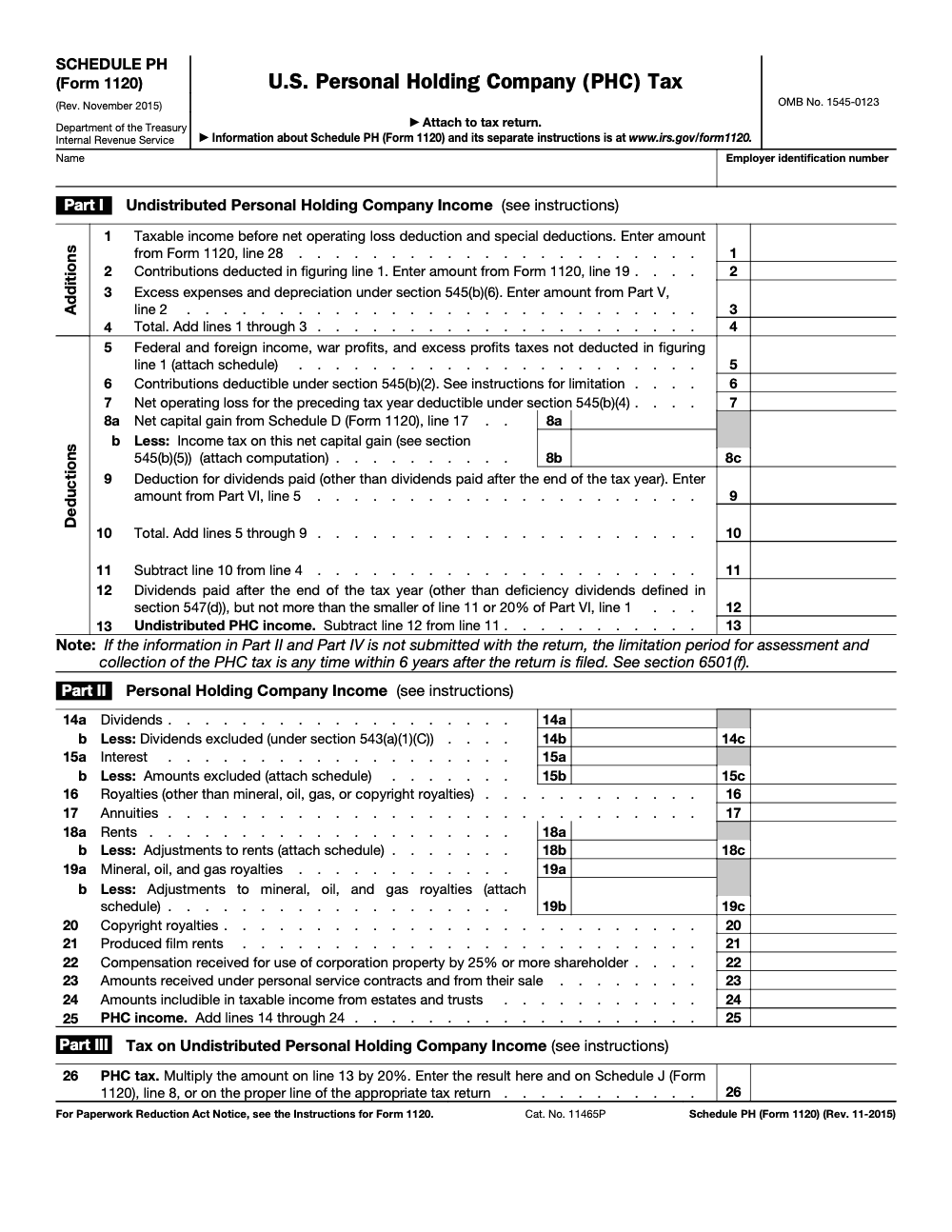
Schedule PH (Form 1120) computes the 20% Personal Holding Company tax on a closely held C corporation’s undistributed PHC income (line 13), which carries to Schedule J (Form 1120), line 8. A corporation is a PHC only when both tests are met: 5 or fewer individuals own more than 50% of stock by value during the last half of the tax year, and at least 60% of adjusted ordinary gross income is PHC income (per IRC Sections 542 and 543). The schedule attaches to Form 1120 rather than filing on its own; calendar-year 2025 returns are due April 15, 2026, and Form 7004 extends filing – not payment – to October 15, 2026.
I once picked up a three-shareholder holding company with a portfolio of dividend-paying stocks and a consulting contract on the side. Within minutes of reading the income statement, the Personal Holding Company problem was obvious, and nobody had run the tests in years of prior filings. The accumulated 20% penalty exposure was real, and it was avoidable.
PHC status requires both tests to be met: 5 or fewer individuals own more than 50% of the stock by value during the last half of the year, and at least 60% of adjusted ordinary gross income is PHC income. When both land, Schedule PH computes a 20% tax on undistributed PHC income that carries to Schedule J. Distributions before year-end can reduce or eliminate it, and consent or deficiency dividends offer a path even after the year closes.
Key Takeaways
- Schedule PH computes the Personal Holding Company (PHC) penalty tax of 20% on undistributed PHC income for corporations that meet both the ownership and income tests under IRC Sections 541–547.
- Two independent tests must both be met for PHC status: the Ownership Test (five or fewer individuals own more than 50% of stock, by value, in the last half of the year) and the Income Test (at least 60% of adjusted ordinary gross income is PHC income).
- The PHC tax is in addition to regular corporate income tax – it is a penalty on passive income hoarded inside a closely held corporation rather than distributed to shareholders.
- Distributions to shareholders before year-end can eliminate or reduce the PHC tax. Consent dividends and deficiency dividends offer additional remedies even after the tax year closes.
- Schedule PH is filed with the Form 1120 return – due April 15 for calendar-year corporations, with a 6-month extension available via Form 7004 (the Form 7004 extension covers filing only, not payment; the tax is still due April 15, and interest accrues on any unpaid balance from that date).
- Quick rule you can copy into your SOP: run the PHC ownership and income tests at engagement setup for every closely held C corporation that holds significant investments, royalties, or passive rental income.
What Schedule PH Is and When to Use It
Schedule PH (Form 1120) is the computation schedule for the Personal Holding Company tax under IRC §541. The PHC tax was enacted to prevent what Congress called “incorporated pocketbooks” – wealthy individuals who would transfer investment assets to a closely held corporation, accumulate dividend and interest income at the corporate rate, and never distribute it to avoid paying individual income tax rates on passive income. Schedule PH calculates the undistributed PHC income subject to the 20% penalty tax.
The schedule is not filed by every C corporation – only those that meet the PHC definition. But the determination must be made every year, because a corporation can move in and out of PHC status as its income composition and ownership structure change. A corporation that acquired a new investor (diluting concentration below the 50% threshold) or shifted to more active service income (reducing PHC income below 60%) may no longer be a PHC even if it was one in prior years.
Who Files Schedule PH
Any domestic C corporation that qualifies as a Personal Holding Company must attach Schedule PH to its Form 1120, unless it falls within one of the statutory exclusions under IRC §542(c) – including banks, life insurance companies, surety companies, certain lending or finance companies, and licensed small business investment companies – which should be confirmed before running the PHC analysis. Foreign corporations are subject to a different provision (Section 552, the Foreign Personal Holding Company rules), which are now largely obsolete following legislative changes. S corporations are not subject to PHC rules and do not file Schedule PH. Tax-exempt organizations do not file Form 1120 and are not subject to PHC rules through this mechanism.
The Legislative Purpose
The PHC rules were designed in the early 20th century, when the individual income tax rates were significantly higher than corporate rates, making it tempting to shelter passive investment income inside a corporation. Even after the TCJA reduced corporate rates to 21%, the PHC rules remain in force because the 20% qualified dividend rate for individuals is often lower than the combined 21% corporate rate plus 20% PHC penalty, making the rules still meaningful for corporations with significant undistributed passive income.
The Two-Part PHC Test
The Ownership Test
A corporation meets the ownership test if more than 50% of the value of its outstanding stock is owned, directly or indirectly, by five or fewer individuals at any time during the last half of the tax year. Constructive ownership rules under IRC §544 apply – stock owned by a family member, partner, or trust beneficiary can be attributed to an individual. This test catches closely held corporations where a small number of people control the investment income accumulation.
The ownership test looks at any point during the last six months of the tax year. If the five-or-fewer concentration existed even briefly during that window, the test is met. This matters for corporations that underwent ownership changes during the year – selling 10% to a new investor in November may not be enough to break the concentration if the original five-or-fewer owned more than 50% through October.
The Income Test
The income test is met when at least 60% of the corporation’s adjusted ordinary gross income (AOGI) consists of personal holding company income. AOGI is ordinary gross income reduced by certain deductions (primarily depreciation, property taxes, interest, and rent paid to unrelated parties on income-producing property). PHC income includes dividends, interest, royalties, annuities, and certain rents and personal service income. The income test is recalculated every year, so a change in business operations can break PHC status even if ownership remains concentrated.
What Counts as PHC Income
| Income Type | PHC Income? | Key Exception |
|---|---|---|
| Dividends | Yes | No general exception; generally counts, though dividends excluded under IRC §543(a)(1)(C) are subtracted on line 14b |
| Interest | Yes | Interest from active money-lending business may be excluded |
| Royalties | Yes (generally) | Active mineral royalties may qualify for exclusion from PHC income |
| Rents | Conditional | Excluded if rents are 50%+ of AOGI and certain dividends paid; active rental operations may qualify |
| Personal service contracts | Yes | Only if a specific individual is designated to perform the service by the customer and that individual owns 25% or more of the stock by value |
| Annuities | Yes | No general exception |
| Active business income (sales, manufacturing) | No | Ordinary business operations excluded from PHC income definition |
The rent exception deserves special attention. Rents are excluded from PHC income if adjusted income from rents constitutes 50% or more of AOGI and the corporation distributes as dividends an amount at least equal to the excess of non-rent PHC income over 10% of ordinary gross income. This is a common escape route for real estate-heavy corporations that meet the ownership test.
How to Complete Schedule PH
Part I – Undistributed Personal Holding Company Income
| Section | What to Calculate | Practitioner Note |
|---|---|---|
| Lines 1–10 | Taxable income from Form 1120, line 28, adjusted by the Section 545 additions (contributions, excess expenses and depreciation) and deductions (federal and foreign taxes, recomputed contributions, NOL, net capital gain net of tax, and the dividends-paid deduction) | Part I converts taxable income into the PHC base – the PHC income categories themselves are reported in Part II (lines 14–25), not here |
| Lines 11–13 | Additions less deductions (line 11), the after-year-end throwback dividend limit (line 12), and undistributed PHC income (line 13) | Line 13 is the base for the 20% PHC tax; the dividends-paid deduction on line 9 comes from Part VI, line 5 |
Part II – Personal Holding Company Income
Part II lists personal holding company income by category on lines 14 through 24 – dividends, interest, royalties, annuities, rents, mineral/oil/gas and copyright royalties, produced film rents, compensation for use of corporation property by a 25%-or-more shareholder, personal service contract amounts, and amounts from estates and trusts – then totals them as PHC income on line 25. Attaching Part II is also what holds the statute of limitations at 3 years rather than 6.
Part III – PHC Tax Computation
Part III is a single line: it multiplies the undistributed PHC income figured in Part I (line 13) by 20% to arrive at the PHC tax on line 26. The undistributed-income computation, including the dividends-paid and consent-dividend deductions, happens in Part I; deficiency dividends under Section 547 are excluded from it and follow their own refund mechanism on Form 976. The line 26 result carries to Schedule J (Form 1120), line 8.
Deadlines, Penalties, and Filing Requirements
| Item | Detail |
|---|---|
| Due date (calendar year) | April 15 – filed with Form 1120 |
| Extension (Form 7004) | Automatic 6-month extension to October 15 |
| PHC penalty tax rate | 20% of undistributed PHC income |
| Regular corporate tax | 21% flat rate (applies separately from PHC tax) |
| Deficiency dividend filing | Form 976 filed within 120 days of IRS determination of PHC liability |
| Consent dividend | Form 972 filed by each consenting shareholder; Form 973 by the corporation |
| Estimated tax | PHC tax is included in corporate estimated tax obligations under IRC §6655 |
Avoiding the PHC Tax Through Distributions
The most direct way to eliminate PHC tax liability is to distribute personal holding company income to shareholders before the end of the tax year. Dividends paid during the year reduce undistributed PHC income dollar for dollar. If the corporation distributes all of its PHC income before December 31, the undistributed PHC income is zero and no PHC tax is owed.
Dividend Timing Strategy
Plan dividend distributions by the third quarter of the year. Once the fourth quarter income picture becomes clear, top up the distribution to cover any additional PHC income generated during Q4. Do not wait until December 31 – payroll and distribution processing delays can push payments into January, which means they count for the following tax year, not the current year.
The Dividends-Paid Deduction
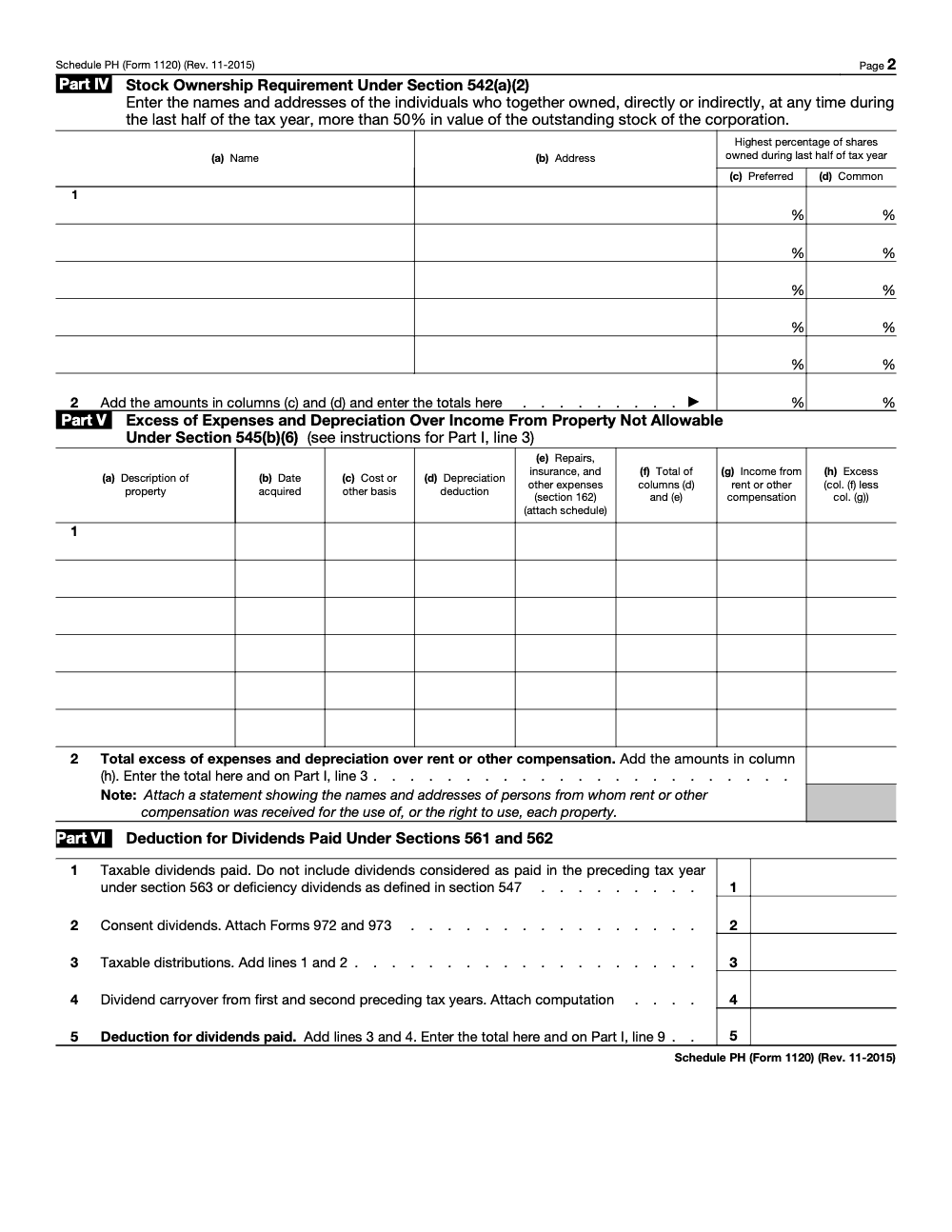
Under IRC §561, corporations can deduct dividends paid during the tax year when computing undistributed PHC income. This includes regular cash dividends, consent dividends, and dividends paid within 2.5 months after year-end (the “throwback” dividend rule). The 2.5-month throwback allows a corporation to make a dividend payment after year-end that still applies against the prior-year PHC income, provided the payment is made by March 15 for calendar-year corporations. The amount thrown back on Schedule PH line 12 is capped at the smaller of line 11 or 20% of the taxable dividends paid during the tax year (Part VI, line 1) – both limits apply and the smaller one controls; deficiency dividends under Section 547 do not qualify for this line.
Consent Dividends and Deficiency Dividends
Consent Dividends (Section 565)
A consent dividend is a hypothetical dividend – shareholders agree to be taxed as if they received a dividend, even though no cash was actually distributed. The corporation gets a dividends-paid deduction equal to the consent amount, which reduces undistributed PHC income. Consent dividends must be documented on Form 972 (filed by each consenting shareholder) and Form 973 (filed by the corporation with the Form 1120 return); without both forms attached to Schedule PH, the IRS can disallow the consent dividend deduction and recompute the PHC tax base without it. The shareholder’s basis in the corporation increases by the amount of the consent dividend, as if they received cash and immediately contributed it back.
Deficiency Dividends (Section 547)
If the IRS determines a PHC deficiency after the tax year has closed, Section 547 sets two separate clocks. First, the corporation must pay the deficiency dividend to its shareholders within 90 days of the determination. Second, it then files Form 976 to claim the deficiency-dividend deduction within 120 days of that same determination. While this reduces the PHC tax, it does not eliminate interest and the Section 6601 penalty, so deficiency dividends are a damage-control tool, not a planning tool. Use them when the initial assessment is unavoidable, not as a substitute for pre-year-end planning.
PHC Status and Entity Planning Considerations
When a closely held C corporation begins accumulating significant passive investment income, the PHC analysis should prompt a broader entity structure review. S corporation election, conversion to a partnership or LLC taxed as a partnership, or restructuring income streams to reduce the PHC income percentage may all be worth evaluating. These are multi-year planning discussions, not quick fixes.
S Corporation Election as an Exit Strategy
A C corporation that converts to S corporation status terminates its exposure to PHC rules going forward. However, the built-in gains tax under IRC §1374 applies to gains on assets that were appreciated when the S election was made, for a period of five years post-election. PHC income accumulated in C corporation years does not follow into the S corporation period. Plan the timing of any S election carefully in coordination with the corporation’s asset mix and capital gain exposure.
Increasing Active Income to Break the Income Test
If passive income is just above the 60% AOGI threshold, adding active business operations or service revenue can push the ratio below 60% and eliminate PHC status without any ownership restructuring. This requires genuine operational change, not just income reclassification. Document the business purpose of any new activities in case the IRS scrutinizes the shift.
Common Mistakes That Slow Things Down
Most PHC errors I see are not arithmetic – they come from running the wrong test, on the wrong base, or skipping a disclosure that quietly extends the IRS lookback. Here are the patterns that stall a Schedule PH the most.
Practical Checklists You Can Reuse
These checklists are copy-paste ready for your firm SOPs – drop them into your workpaper template and adapt the line references to the engagement.
PHC status screen
- Confirm the entity is a C corporation; S corporations, partnerships, and disregarded entities are outside the PHC rules.
- Check the IRC Section 542(c) exclusion list (banks, life insurance companies, surety companies, qualified lending or finance companies, licensed SBICs) before running the tests.
- Build the Part IV ownership schedule by value and apply Section 544 constructive ownership; confirm whether 5 or fewer individuals held more than 50% during the last half of the tax year.
- Classify each income source as PHC or non-PHC income and compute adjusted ordinary gross income.
- Determine whether PHC income is at least 60% of AOGI; flag the engagement as a PHC only if both tests are met.
- Document the conclusion in the file even when the corporation is not a PHC, with the tested figures.
Schedule PH preparation
- Start Part I at taxable income from Form 1120, line 28, then apply the Section 545 additions and deductions.
- Add back contributions from Form 1120, line 19 on line 2 and recompute the Section 545(b)(2) contributions deduction on line 6.
- Net the capital gain from Schedule D (Form 1120), line 17 against the income tax on that gain across lines 8a through 8c.
- Carry the dividends-paid deduction from Part VI, line 5 to Part I, line 9.
- Confirm line 26 equals undistributed PHC income (line 13) multiplied by 20%.
- Carry the PHC tax from line 26 to Schedule J (Form 1120), line 8.
- Attach Parts II and IV to keep the statute of limitations at 3 years.
Distribution and remedy planning
- Project PHC income by the third quarter and schedule dividends before year-end to reduce undistributed PHC income.
- If cash is tight, document consent dividends with Form 972 and Form 973 attached to Schedule PH.
- Limit any after-year-end throwback dividend on line 12 to the smaller of line 11 or 20% of Part VI, line 1.
- Track dividend carryover from the first and second preceding tax years on Part VI, line 4 with the computation attached.
- If the IRS asserts a deficiency, evaluate a deficiency dividend on Form 976, knowing it does not stop interest.
Keep Schedule PH Season From Stalling
Schedule PH is not a volume form – the real delivery risk is that it gets missed entirely. The 20% Personal Holding Company tax has applied to undistributed PHC income since 2013 (per IRC Section 541, as amended by the American Taxpayer Relief Act of 2012), and the schedule itself has not been revised since November 2015, so it rarely lands on a preparer’s radar until a closely held C corporation has accumulated years of passive income. By then the exposure is layered across multiple returns.
The fix is structural: bake the PHC test into the intake workflow rather than treating it as a year-end afterthought. Once the test is a standing step, the Schedule PH computation becomes routine instead of a fire drill in April.
- Run the ownership test (more than 50% by value, 5 or fewer individuals, last half of the year) and the 60% AOGI income test at engagement setup, not at filing.
- Maintain a Part IV stock-ownership schedule with Section 544 attribution so concentration is documented before the return is opened.
- Reconcile Part II PHC income classifications against the trial balance each quarter, so dividend timing decisions happen before December 31.
- Carry undistributed PHC income from line 13 to line 26 at 20%, then to Schedule J (Form 1120), line 8, and confirm Parts II and IV are attached to hold the statute at 3 years.
That is the kind of standing review discipline our tax preparation services are built around – structured workpapers, a documented review path, and turnaround SLAs that keep low-frequency, high-exposure schedules like this one from slipping through. Accountably places trained offshore accountants and tax preparers inside your firm in under 3 weeks, ramped on your software and SOPs, with a preparer-to-senior-to-quality review process so a missed PHC test never reaches your signature. Not a fit in the first 45 days? We replace them free. Prove the work before your name is on the line.
FAQs
The PHC tax is a 20% penalty tax on a C corporation’s undistributed personal holding company income under IRC §541. It applies when a closely held corporation – with five or fewer individuals owning more than 50% of stock – accumulates passive investment income (dividends, interest, royalties, and certain other income) without distributing it to shareholders. The PHC tax is separate from, and in addition to, the regular 21% corporate income tax.
The Ownership Test requires that more than 50% of the outstanding stock (by value) is owned by five or fewer individuals at any time during the last half of the tax year, with constructive ownership under IRC §544 applied. The Income Test requires that at least 60% of the corporation’s adjusted ordinary gross income is personal holding company income. Both tests must be met for PHC status to apply.
Distribute personal holding company income as dividends to shareholders before December 31 of the tax year. The dividends-paid deduction reduces undistributed PHC income dollar for dollar. Consent dividends (Section 565) can be used when cash distribution is not feasible. A throwback dividend paid by March 15 of the following year also counts against the prior year’s PHC income. Deficiency dividends (Section 547) can reduce an assessed PHC deficiency after the fact but do not eliminate interest charges.
PHC income includes dividends, interest, royalties, annuities, rents (excluded from PHC income only when adjusted rental income is 50% or more of AOGI and the corporation distributes dividends covering the excess of non-rent PHC income over 10% of ordinary gross income), and personal service contract income where a specific named individual must perform the service and that individual owns 25% or more of the stock by value. Active business income from sales, manufacturing, or general services does not count. The classification of income as PHC or non-PHC is the most judgment-intensive part of the Schedule PH analysis.
The PHC penalty tax rate is 20% of undistributed personal holding company income. This applies on top of the regular 21% corporate income tax. A corporation that is a PHC and fails to distribute its passive income can face a combined effective rate of 41% on that income before any individual shareholder-level tax, making the PHC rules a significant planning consideration for investment-holding corporations.
Other forms this guide names
Summarize this article with AI
About this guide
Accountably helps US CPA, EA, and accounting firms hire trained accountants and tax preparers in India.
About us Reviewed byJugal Thacker, CPAFounder and CEO at Accountably
A US-licensed CPA with 7+ years inside US firms – PwC, a real-estate tax practice, then a full-service firm, rising from reviewer to manager to advisory. This article was reviewed against current IRS guidance for the 2025 tax year and updated for filers preparing late returns, amendments, and 2026 estimates.
View profile →How we research, review, and update this guide
Every Accountably guide is researched against primary IRS sources, reviewed by a U.S. CPA, and refreshed as guidance evolves. Read our Editorial Guidelines to see how we source, fact-check, and update our content.