Summarize this article with AI
In Brief
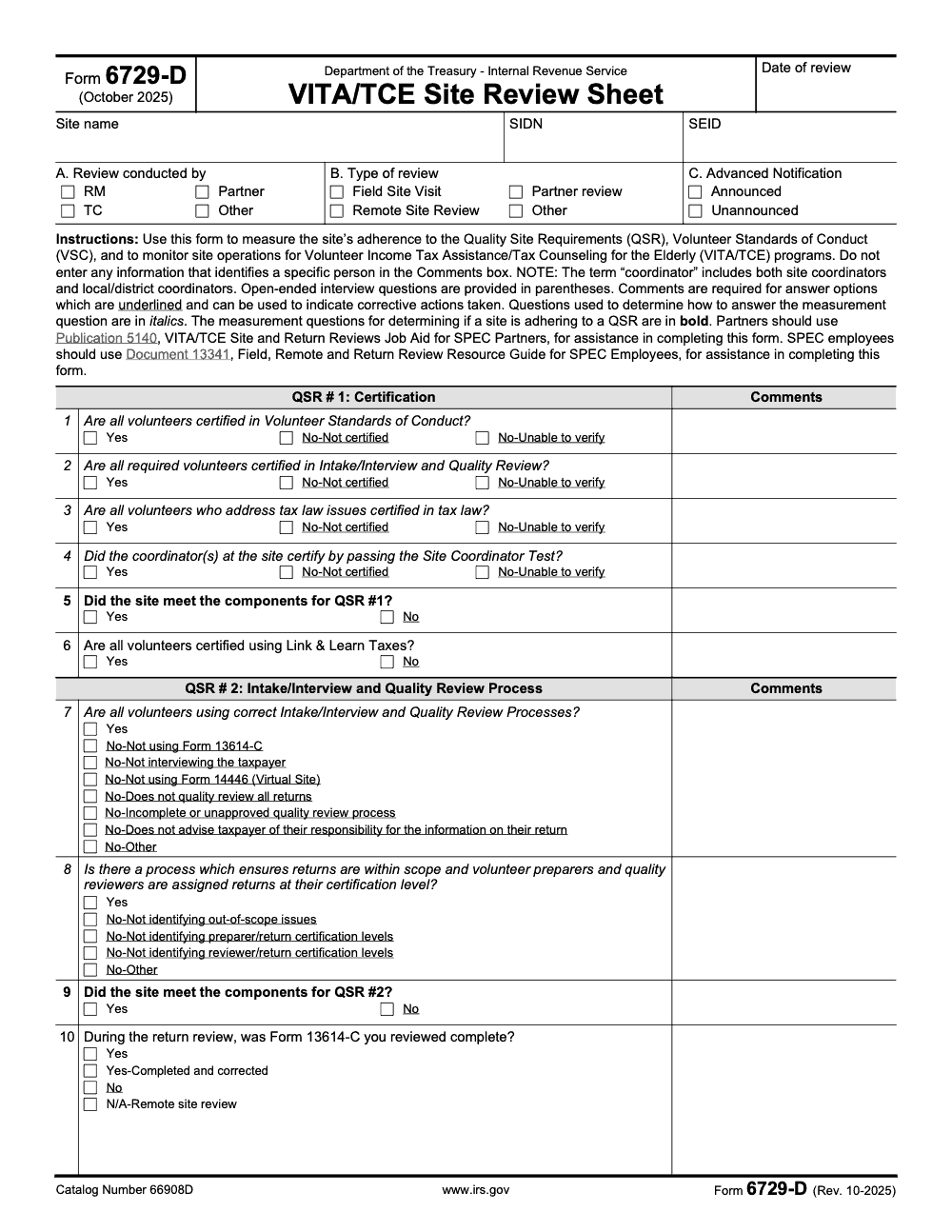
Form 6729-D is the IRS VITA/TCE Site Review Sheet (Catalog Number 66908D, Rev. October 2025) used by SPEC personnel and Partners to measure a site's adherence to the 10 Quality Site Requirements and 6 Volunteer Standards of Conduct. The adherence rating on Question 30 is calculated from 10 measurement questions (5, 9, 11, 12, 16, 18, 19, 20, 21, and 26) at 10 points each, for a maximum score of 100 (per Form 6729-D, October 2025 revision). SPEC Partners reference Publication 5140; SPEC employees reference Document 13341. For broader U.S. tax workflow support, see our taxation services.
Form 6729-D looks at the site, not the individual return. Where a return-review sheet checks one preparer's work, this one measures whether the whole site holds to the 10 Quality Site Requirements and the 6 Volunteer Standards of Conduct. SPEC personnel and Partners use it, and it never gets filed with the IRS by a taxpayer.
The October 2025 revision scores a fixed set: walk the 10 measurement questions, numbers 5, 9, 11, 12, 16, 18, 19, 20, 21, and 26, and award 10 points for each Yes, for a maximum adherence score of 100 recorded on Question 30. Comments are required on every underlined response option, and they must never name a specific person. Sites with weak quality records can lose grant funding or IRS support, so the documentation here carries real weight.
Key Takeaways
- Form 6729-D is the IRS Site Review Sheet for Volunteer Income Tax Assistance (VITA) and Tax Counseling for the Elderly (TCE) programs – used internally by site reviewers, not filed with the IRS by taxpayers.
- Form 6729-D measures site-level adherence to the 10 Quality Site Requirements and 6 Volunteer Standards of Conduct. It is the standardized site-review instrument used by SPEC personnel and Partners; the per-return quality-review process is captured on a different form.
- Reviewers walk the 10 measurement questions (5, 9, 11, 12, 16, 18, 19, 20, 21, and 26) and award 10 points for each Yes, for a maximum adherence score of 100 recorded on Question 30 (per Form 6729-D, October 2025 revision).
- Comments are required on every underlined response option and may also be used to document corrective actions taken by the site; reviewers must not enter any information that identifies a specific person in the Comments boxes (per Form 6729-D instructions).
- IRS monitors VITA/TCE sites and reviews site quality records, including Form 6729-D documentation, during site visits. Sites with poor quality review records may lose grant funding or IRS support.
- Quick rule you can copy into your SOP: work the 10 measurement questions (5, 9, 11, 12, 16, 18, 19, 20, 21, and 26) in a fixed order each review, then reconcile the 10-point-per-Yes tally against the rating entered on Question 30 before signing.
What Form 6729-D Is and When to Use It
Form 6729-D, VITA/TCE Site Review Sheet (Catalog Number 66908D, Rev. October 2025), is an IRS internal site-review instrument used within the VITA and TCE volunteer tax preparation programs. It is not a tax return, not a disclosure form, and not transmitted to the IRS as part of any filing. It is a site-level oversight tool – completed by a SPEC employee or Partner during a Field Site Visit, Remote Site Review, Partner review, or Other type of review to measure the site's adherence to the 10 Quality Site Requirements and 6 Volunteer Standards of Conduct, not a per-session per-return checklist.
The form exists because VITA and TCE sites prepare hundreds of thousands of free tax returns each filing season. Without a standardized review process, the quality of preparation would vary widely across sites and across individual volunteers. Form 6729-D creates a consistent framework: each site is measured against the same 10 Quality Site Requirements and 6 Volunteer Standards of Conduct, and each site review is documented in the same way.
The Broader VITA and TCE Framework
The Volunteer Income Tax Assistance program provides free tax preparation services to low- and moderate-income individuals (generally those earning $67,000 or less, though IRS updates this threshold annually), people with disabilities, and limited-English-speaking taxpayers. The Tax Counseling for the Elderly program focuses specifically on taxpayers aged 60 and older. Both programs operate through IRS partnerships with community organizations, non-profits, and government agencies that host volunteer sites.
Who Completes Form 6729-D
Form 6729-D is completed by the reviewer designated in Section A of the form header – RM, TC, Partner, or Other. In practice that is a SPEC employee or a SPEC Partner conducting the site review, not a site volunteer. Section B records whether the review is a Field Site Visit, Remote Site Review, Partner review, or Other; Section C records whether the review was Announced or Unannounced. SPEC Partners reference Publication 5140 to complete the form; SPEC employees reference Document 13341.
The VITA and TCE Programs Explained
VITA sites are typically located in community centers, libraries, schools, shopping malls, and other accessible community locations. Volunteers are trained and certified by the IRS each year through Link & Learn Taxes (L<), the IRS’s free online training and certification platform. Certification is required before any volunteer can prepare returns at an IRS-sponsored site.
Certification Levels
VITA volunteers can certify at different levels – Basic, Advanced, Military, International, and Foreign Student – each covering progressively more complex tax situations. Reviewers must hold at least the same certification level as the return they are reviewing. A reviewer certified only at the Basic level cannot review a return that involves Advanced-level issues (such as business income, rental income, or certain education credits).
Site Coordinator Responsibilities
Each VITA/TCE site has a site coordinator who oversees operations, manages volunteers, tracks quality metrics, and maintains documentation including Form 6729-D records. The site coordinator is responsible for ensuring that quality reviews are completed for every return and that review documentation is retained as required by IRS program guidelines.
TCE Program Distinctions
The TCE program, often administered through AARP Foundation Tax-Aide, focuses on seniors and specifically covers pension and retirement income issues that are particularly relevant to older taxpayers. TCE volunteers receive specialized training on issues like Social Security taxation, pension distributions, and retirement account withdrawals. The Form 6729-D quality review process applies equally to TCE sites.
Quality Review Standards at VITA/TCE Sites
The IRS requires a quality review of 100% of returns prepared at VITA and TCE sites. There are no sampling exceptions or minimum volume thresholds. Every return – regardless of complexity – must be reviewed before filing. This is a non-negotiable program requirement, and IRS monitors verify compliance during site evaluation visits.
The Purpose of 100% Review
Unlike commercial tax preparation firms where internal review processes may cover a sample of returns, VITA and TCE programs serve populations that often cannot easily correct mistakes after filing. An error on a low-income taxpayer’s return may mean a delayed refund, an unexpected balance due, or an incorrect credit amount that creates downstream compliance issues. The 100% review requirement reflects the program’s commitment to protecting its taxpayer population.
Quality Review vs. Preparer Oversight
The quality review is not a supervisory check on the preparer – it is an independent verification of accuracy. The reviewer approaches the return fresh, with the source documents, and confirms each entry independently before the preparer’s work is used. This distinction matters for training: reviewers should not simply ask the preparer “did you check this?” – they should verify it themselves.
How to Complete Form 6729-D
Header Information
| Field | What to Enter |
|---|---|
| Site Number (SIDN) | The site’s IRS-assigned Site Identification Number |
| SEID | The reviewer's Standard Employee Identifier (for SPEC employees) |
| A. Review conducted by | RM, TC, Partner, or Other |
| B. Type of review | Field Site Visit, Remote Site Review, Partner review, or Other |
| C. Advanced Notification | Announced or Unannounced |
Review Sections
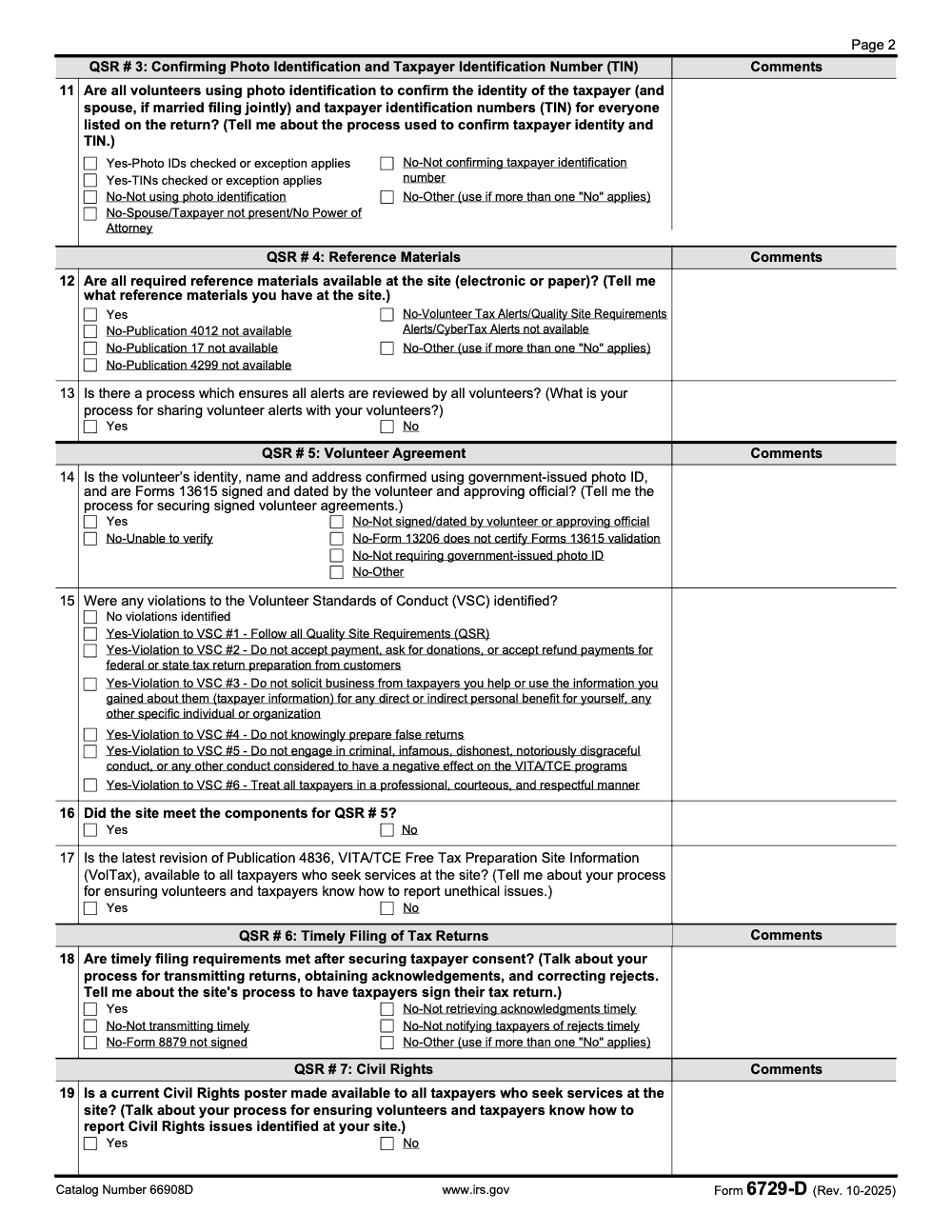
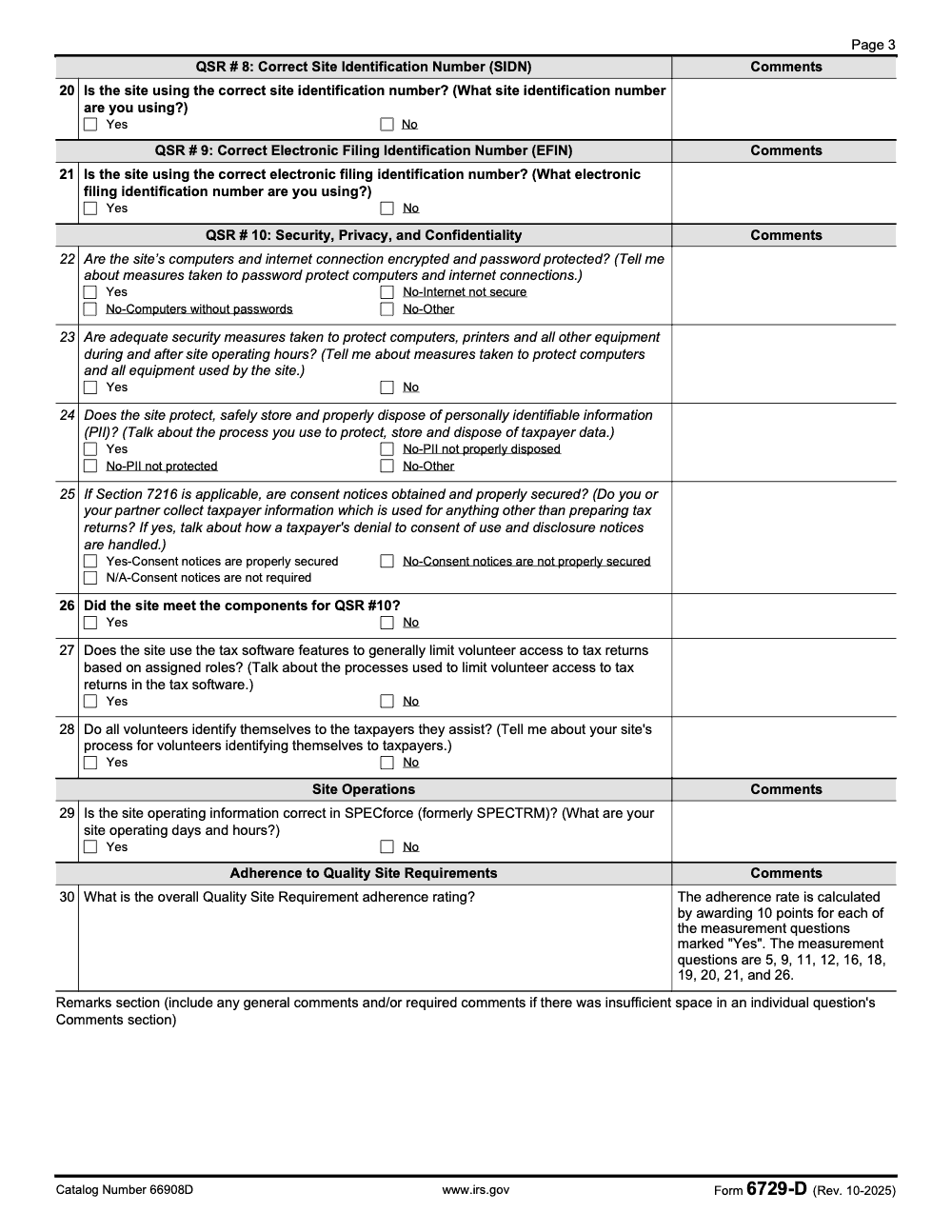
The body of Form 6729-D contains 30 numbered questions grouped under the 10 Quality Site Requirements: Certification (QSR #1, Q1–6), Intake/Interview and Quality Review Process (QSR #2, Q7–10), Confirming Photo Identification and TIN (QSR #3, Q11), Reference Materials (QSR #4, Q12–13), Volunteer Agreement (QSR #5, Q14–17), Timely Filing of Tax Returns (QSR #6, Q18), Civil Rights (QSR #7, Q19), Correct SIDN (QSR #8, Q20), Correct EFIN (QSR #9, Q21), and Security, Privacy, and Confidentiality (QSR #10, Q22–28), plus a standalone Site Operations question (Q29) and the overall adherence rating (Q30). The reviewer answers each question Yes, No, or N/A as applicable, with Comments required on every underlined response. The form ends with Question 30, the overall Quality Site Requirement adherence rating – 10 points for each of the 10 measurement questions (5, 9, 11, 12, 16, 18, 19, 20, 21, and 26) marked Yes, for a maximum of 100.
Retention of Completed Forms
Completed Form 6729-D sheets are retained at the site for the duration of the filing season and for any subsequent IRS monitoring review period. IRS program guidelines specify minimum retention periods – typically three years from the end of the filing season in which the return was prepared. Site coordinators should store forms in a secure, organized manner that allows retrieval by return date or site reference number.
What Reviewers Look For
Form 6729-D measures site-level adherence to the 10 Quality Site Requirements and the 6 Volunteer Standards of Conduct. The reviewer is not adjudicating individual tax positions on a prepared return – that is a per-return quality review captured on a different form. On 6729-D, the reviewer assesses whether the site as a whole is meeting the QSR and VSC standards.
Quality Site Requirements (QSRs)
The form covers all 10 QSRs: Certification (QSR #1), Intake/Interview and Quality Review Process (QSR #2), Confirming Photo Identification and TIN (QSR #3), Reference Materials (QSR #4), Volunteer Agreement (QSR #5), Timely Filing of Tax Returns (QSR #6), Civil Rights (QSR #7), Correct SIDN (QSR #8), Correct EFIN (QSR #9), and Security, Privacy, and Confidentiality (QSR #10). Each QSR has at least one designated measurement question whose Yes/No answer drives the adherence score.
Volunteer Standards of Conduct (VSCs)
Question 15 captures whether any of the 6 VSC standards were violated. Response options include “No violations identified” plus one option per VSC (VSC #1 through VSC #6). There are 6 VSCs, not 7 – Q15 simply offers a 7-option response set because “No violations identified” sits alongside the six specific violation options (per Form 6729-D instructions).
Site Operations and Adherence Rating
Question 29 records whether site operating information is correct in SPECforce (formerly SPECTRM). Question 30 records the overall Quality Site Requirement adherence rating, calculated by awarding 10 points for each of the 10 measurement questions (5, 9, 11, 12, 16, 18, 19, 20, 21, and 26) marked Yes – for a maximum of 100 (per Form 6729-D, October 2025 revision).
IRS Monitoring and Site Evaluation
The IRS conducts regular monitoring visits to VITA and TCE sites throughout the filing season. During these visits, IRS representatives may observe ongoing return preparation sessions, review Form 6729-D documentation, and assess whether quality review procedures are being followed. Sites that demonstrate strong quality review practices are more likely to receive favorable IRS assessments and continued program support.
What 6729-D Captures
Form 6729-D documents the site-level review by the SPEC employee or Partner: which Quality Site Requirements the site met, which it missed, any Volunteer Standards of Conduct violations recorded on Q15, the SIDN/EFIN/SPECforce checks (Q20, Q21, Q29), and the overall adherence rating on Q30. It is not a per-return preparer-vs-reviewer log; the preparer/reviewer separation that QSR #2 requires inside the site's own quality-review process is a different artifact.
Grant Funding Implications
VITA sites that receive IRS SPEC (Stakeholder Partnerships, Education, and Communication) grant funding are subject to additional monitoring and reporting requirements. Sites with documented quality review failures may face grant restrictions or require corrective action plans as a condition of continued funding. The Form 6729-D documentation is directly relevant to grant compliance reviews.
Volunteer Certification Requirements
All volunteers at IRS-sponsored VITA and TCE sites must be certified annually through the Link & Learn Taxes platform before preparing or reviewing returns. Certification involves completing online training modules and passing certification exams at the appropriate level.
| Certification Level | Covers | Who Needs It |
|---|---|---|
| Basic | Simple returns: wages, unemployment, basic credits | All preparers and reviewers at minimum |
| Advanced | Schedule C (simple), rental income, education credits, retirement income | Preparers and reviewers handling complex returns |
| Military | Military-specific issues: combat pay, PCS moves, state tax issues | Sites serving military personnel |
| Foreign Student | Nonresident alien returns, treaty benefits, Form 1040-NR | Sites near universities serving international students |
| Health Savings Account | HSA contributions and distributions | Sites handling returns with HSA activity |
When QSR or VSC Gaps Are Found During the Review
When the SPEC reviewer or Partner finds that a site has missed a Quality Site Requirement component, the form's underlined No options identify what specifically failed (e.g., Form 13614-C not used, Publication 4012 not available, Form 8879 not signed). Comments are required on each underlined response and may also be used to document corrective actions taken by the site (per Form 6729-D instructions). Reviewers must not enter information that identifies a specific person in the Comments boxes.
Documenting VSC Violations
If any of the 6 Volunteer Standards of Conduct were violated, Question 15 records which VSC was involved (VSC #1 through VSC #6). Where the violation is described in Comments, document it generically (e.g., “a volunteer accepted a donation from a taxpayer”) rather than naming the individual.
Reconciling the Adherence Rating
Before signing the form, the reviewer should reconcile the tally of Yes responses on the 10 measurement questions (5, 9, 11, 12, 16, 18, 19, 20, 21, and 26) against the rating entered on Question 30. Overflow comments that don't fit a single Comments box go in the Remarks section at the end.
Common Mistakes That Slow Things Down
After many seasons reviewing VITA/TCE quality documentation, the same patterns surface across sites. Most are not knowledge gaps; they are shortcuts that quietly erode the form's audit trail.
Practical Checklists You Can Reuse
Site coordinators and SPEC reviewers can paste these checklists directly into their own SOPs. Each one maps to a real choke point in the Form 6729-D review cycle and pulls from the rules printed on the October 2025 revision of the form.
Pre-review readiness
- Confirm SIDN and EFIN against the site's current SPECforce record before walking in.
- Verify the latest revision of Publication 4836 (VolTax) is posted and accessible to taxpayers at the site.
- Spot-check that Publication 4012, Publication 17, and Publication 4299 are available in electronic or paper form.
- Pull a sample of Forms 13615 signed by volunteers and validated on Form 13206.
- Confirm a current Civil Rights poster is visible in the taxpayer waiting area.
- Identify which alerts (Volunteer Tax Alerts, Quality Site Requirements Alerts, CyberTax Alerts) volunteers have reviewed this season.
Measurement-question walkthrough (Q5, Q9, Q11, Q12, Q16, Q18, Q19, Q20, Q21, Q26)
- Q5: Confirm certification components for QSR #1 are met across all volunteers and the coordinator.
- Q9: Confirm the Intake/Interview and Quality Review Process (QSR #2) is followed on every return.
- Q11: Verify photo ID and TIN checks for the taxpayer, spouse if MFJ, and everyone listed on the return, or document the exception.
- Q12: Walk the reference shelf and confirm all required reference materials are present.
- Q16: Confirm Volunteer Agreement components (QSR #5), including Form 13206 validation of Forms 13615.
- Q18: Confirm timely-filing components after securing taxpayer consent (Form 8879 signed, acknowledgments retrieved, rejects communicated).
- Q19: Confirm the current Civil Rights poster is available to all taxpayers seeking services.
- Q20 and Q21: Confirm the correct SIDN and EFIN are being used on transmitted returns.
- Q26: Confirm encryption, equipment security, PII protection, and Section 7216 consent where applicable.
- Tally 10 points per Yes and reconcile against the rating entered on Question 30.
Post-review documentation
- Re-read every underlined response and confirm the matching Comments box has content.
- Scrub every Comments box for taxpayer or volunteer names; use generic language only.
- Move overflow comments to the Remarks section when a single Comments box runs short.
- Verify the math on Question 30 matches the 10 measurement responses.
- File the completed form per site retention policy; do not transmit it with the taxpayer's return.
- Log any pattern errors (same preparer, same mistake type) for the coordinator's training plan.
Keep 6729-D Season From Stalling
VITA and TCE sites operate under a compressed delivery window – the bulk of returns are filed January through April, and SPEC site visits get scheduled across that same window. Form 6729-D is what makes the quality review defensible, but the form is dense: 30 questions, 10 measurement questions, six Volunteer Standards of Conduct, and a Comments discipline that easily slips. Publication 5140 is the SPEC Partner reference for completing the form, and Document 13341 is the SPEC employee equivalent; both assume the reviewer is fresh, which is rarely true by mid-March.
The fix is not more training in the abstract. It is a tighter checklist and a shorter feedback loop between the reviewer, the site coordinator, and the volunteer who prepared the return. Most stalls come from the same five places, and once they're tracked, they get cheap to close.
- Pre-populate the form header (SIDN, SEID, review type, advance notification) before the site visit so reviewer attention goes to the QSR content, not the admin block.
- Walk the 10 measurement questions (5, 9, 11, 12, 16, 18, 19, 20, 21, 26) in a fixed order every time so reviewers stop hunting across the form for the bold items.
- Treat every underlined response as a flag that the Comments box is mandatory and capture corrective actions in the same box, not in scratch notes.
- Pull Forms 13615 and confirm Form 13206 validation before the review begins, not after – this is where most QSR #5 No responses originate.
- Cross-check SIDN and EFIN against SPECforce on the day of the review, not from a printout that may be a season old.
This is the same structured delivery discipline applied across U.S. accounting and tax outsourcing work at Accountably. The teams behind our taxation services run SOPs, structured workpapers, and multi-layer review on every engagement – the same posture a well-run VITA/TCE site needs across its compressed review season.
FAQs
Form 6729-D, VITA/TCE Site Review Sheet, is used by SPEC personnel and Partners to measure a VITA/TCE site's adherence to the 10 Quality Site Requirements and 6 Volunteer Standards of Conduct. It is a site-level review instrument completed during a Field Site Visit, Remote Site Review, Partner review, or Other type of review – not a per-return quality-review checklist. It is not submitted to the IRS with any taxpayer's return.
Form 6729-D is completed by the reviewer designated in Section A of the form header – RM, TC, Partner, or Other. In practice that is a SPEC employee or a SPEC Partner conducting the site review, not a site volunteer. SPEC Partners reference Publication 5140 to complete the form; SPEC employees reference Document 13341.
No. Form 6729-D is retained at the VITA or TCE site as an internal quality control document. It is not transmitted with the taxpayer’s tax return. However, IRS monitors may review Form 6729-D records during site evaluations to verify that quality review procedures are being followed consistently.
Form 6729-D covers the 10 Quality Site Requirements – Certification, Intake/Interview and Quality Review Process, Photo ID and TIN confirmation, Reference Materials, Volunteer Agreement, Timely Filing of Tax Returns, Civil Rights, Correct SIDN, Correct EFIN, and Security, Privacy, and Confidentiality – plus the 6 Volunteer Standards of Conduct on Question 15, site operations on Q29, and the overall adherence rating on Q30. It does not adjudicate per-return positions like filing status or EITC eligibility; those belong to the site's own per-return quality review.
When the reviewer finds that a site missed a Quality Site Requirement component, the form's underlined No options identify what failed (e.g., Form 13614-C not used, Publication 4012 not available, Form 8879 not signed). Comments are required on every underlined response and may also be used to document corrective actions taken by the site. Reviewers must not enter information that identifies a specific person in the Comments boxes (per Form 6729-D instructions).
Other forms this guide names
- Form 8879: IRS e-file Signature Authorization Explained
- Form 13206: VITA/TCE Summary Report Guide 2025
- Form 13615: IRS VITA/TCE Volunteer Standards & Requirements
About this guide
Accountably helps US CPA, EA, and accounting firms hire trained accountants and tax preparers in India.
About us Reviewed byJugal Thacker, CPAFounder and CEO at Accountably
A Washington-licensed CPA with 7+ years inside US firms – PwC, a real-estate tax practice, then a full-service firm, rising from reviewer to manager to advisory. This article was reviewed against current IRS guidance for the 2025 tax year and updated for filers preparing late returns, amendments, and 2026 estimates.
View profile →How we research, review, and update this guide
Every Accountably guide is researched against primary IRS sources, reviewed by a U.S. CPA, and refreshed as guidance evolves. Read our Editorial Guidelines to see how we source, fact-check, and update our content.