Summarize this article with AI
In Brief
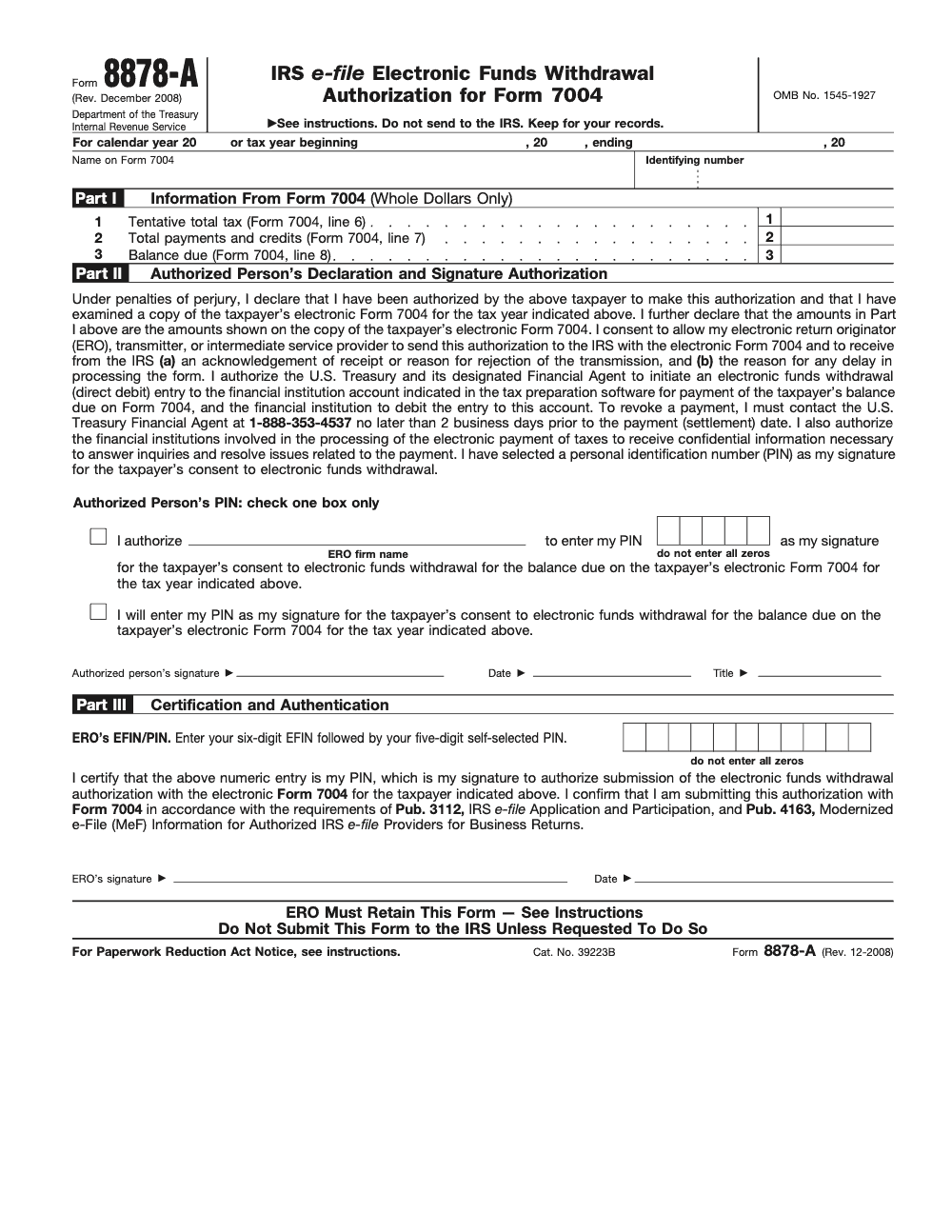
Form 8878-A authorizes an Electronic Funds Withdrawal (EFW) for the balance due on an e-filed Form 7004 business extension – it does not grant the extension itself, which the 7004 does. Part I carries three whole-dollar figures from Form 7004 (line 6 to line 1, line 7 to line 2, line 8 to line 3), the authorized person signs Part II with a five-digit PIN that serves as the signature, and the ERO keeps the form for three years instead of mailing it to the IRS (Form 8878-A, Rev. December 2008, OMB No. 1545-1927).
The calls that come in on a 7004 deadline are rarely about the extension itself. They are about a balance due that someone tried to pay by Electronic Funds Withdrawal without a signed Form 8878-A in hand. One March a controller approved the numbers by email late at night and assumed we could transmit; we could not, because the authorization had not yet been signed and returned.
Form 8878-A authorizes an Electronic Funds Withdrawal for the balance due on an e-filed Form 7004 business extension. It does not grant the extension itself, which the 7004 does. Part I carries three whole-dollar figures from Form 7004, the authorized person signs Part II with a five-digit PIN, and the ERO keeps the form for three years instead of mailing it. The EFW record must match the 7004 down to the routing and account numbers.
Key Takeaways
- Form 8878-A authorizes an Electronic Funds Withdrawal when you e-file Form 7004 for business extensions like 1120, 1120-S, 1065, and 1041.
- You need it only when an electronic payment is included with the 7004. If no EFW is attached, the signature form is not required.
- An authorized officer and the Electronic Return Originator (ERO) must sign before transmission.
- The EFW record must match Form 7004, including amount, routing and account numbers, account type, and requested withdrawal date.
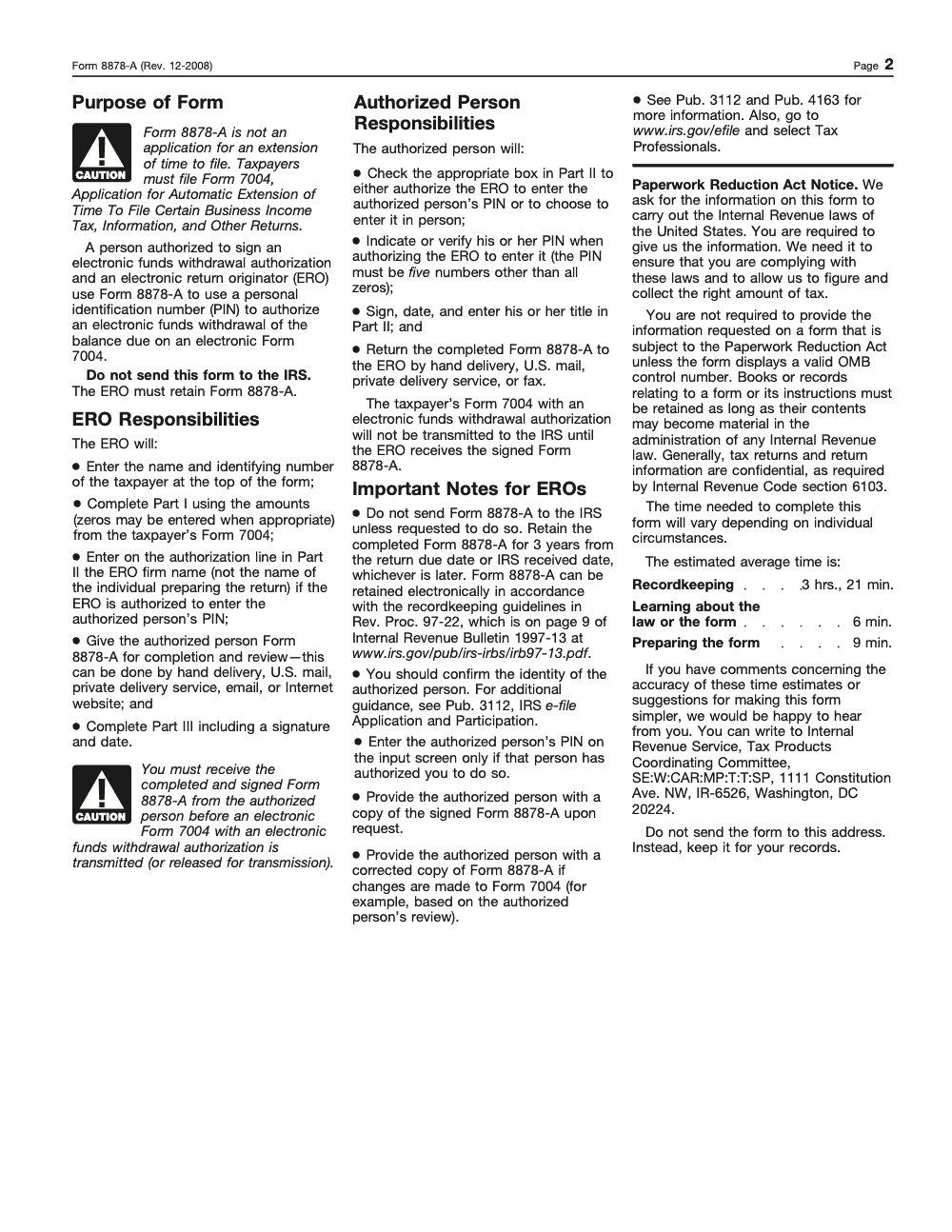
- Do not file Form 8878-A with the IRS. The ERO keeps it, generally for three years from the return due date or IRS received date, whichever is later.
What Is Form 8878-A?
Form 8878-A is the IRS e-file Electronic Funds Withdrawal Authorization tied specifically to Form 7004. It gives the IRS permission to debit your business bank account for the extension payment and documents the officer’s PIN authorization that the ERO relies on when sending the e-file package. The form itself shows OMB No. 1545-1927, confirms its purpose, and instructs EROs to retain the signed copy.
Two points matter for compliance. First, the form is not the extension, it is only the payment authorization. Second, the signed authorization must exist before the ERO pushes the 7004 with the EFW record, otherwise the payment cannot be initiated and you may miss the due date for paying.
Do You Need Form 8878-A?
You need Form 8878-A when you e-file Form 7004 and choose to pay the extension amount by Electronic Funds Withdrawal through your software. If you pay with EFTPS or do not include a payment with the 7004, you do not need this authorization form. The IRS explicitly notes that 7004 filers can pay by EFW and refers you to Form 8878-A for that option.
Most modern tax platforms create 8878-A as soon as you designate the extension as electronic and enter an EFW amount. That convenience does not change the rule, you still must capture the officer’s signature and the ERO’s certification before transmission.
Who Can Sign, And Why It Matters
Two signatures drive a valid 8878-A:
- The taxpayer’s signer, an authorized corporate officer, partner, member, or fiduciary, gives consent to the exact payment and approves the PIN authorization.
- The ERO signs, certifying that the EFW will be sent with the e-filed 7004 and that IRS e-file procedures were followed.
This dual-signature structure protects both sides. It ties the bank debit to the precise 7004 figures and gives your firm a defensible record if there is a dispute about amount, date, or bank details later. The IRS form text and ERO instructions highlight both responsibilities and retention.
Signature Timing, The Non‑Negotiable Rule
Get the officer’s signature before the e-file leaves your queue. If you transmit a 7004 with an EFW record and do not yet have a signed 8878-A, you have no written consent for the debit. This is an avoidable control failure during peak season. The IRS guidance on EFW and MeF processing underscores the need for signed EFW consent and accurate payment records.
The Compliance Backbone, EFW Records And What Must Match
An EFW payment attached to Form 7004 must match the balance due and include all required fields: routing number, account number, account type, payment amount, requested payment date, and a daytime phone number. If any element is wrong, the payment can fail even when the extension is accepted. Publication 4163, updated for Processing Year 2026, spells out these fields and scheduling rules in detail.
Note on cancellation, if you must revoke an EFW, you generally need to call the U.S. Treasury Financial Agent at 1‑888‑353‑4537 no later than two business days before the scheduled date, by 11:59 p.m. Eastern. Build that cutoff into your internal deadline calendar.
When Exactly Does Form 8878-A Apply?
Use it when you are e-filing Form 7004 for entities like C corps, S corps, partnerships, and trusts, and you want the IRS to debit the extension amount from a designated bank account. The IRS “About Form 8878-A” page plainly states that an authorized person and the ERO use this form with a PIN to authorize an EFW for the balance due on an electronic 7004. If there is no EFW, there is no 8878-A requirement.
The separate “Instructions for Form 7004” page also confirms that EFW is an available payment method when filing the extension electronically, and it points you back to Form 8878-A for that authorization. This cross reference is your signal that the 8878-A is the right vehicle for the withdrawal.
Roles And Responsibilities, Officer And ERO
Authorized Officer, What You Attest To
You, as the officer or authorized representative, are authorizing a specific ACH debit for a specific extension. You confirm the amount that matches line 8 of Form 7004, the bank details, and the requested date. You also select or consent to a five‑digit PIN that functions as your signature for the EFW authorization (the PIN must be five numbers other than all zeros). The form states that without your signed authorization, the ERO cannot transmit a 7004 that includes an EFW record.
ERO, What You Certify
As the ERO, you complete the 8878-A blocks from the taxpayer’s 7004, confirm the identity of the signer per IRS rules, apply your EFIN plus five‑digit PIN, and retain the signed form for the required period. You also ensure the IRSPayment record is attached to the electronic extension and that figures match. You are responsible for keeping the signed authorization before sending the e-file.
Retention, How Long You Keep 8878-A
Do not send 8878-A to the IRS. Keep it in your file. The form instructs EROs to retain the completed authorization for three years from the return due date or the IRS received date, whichever is later. Electronic retention is allowed under IRS recordkeeping guidelines. Treat this the same way you treat other e-file signature authorizations and ensure it is retrievable on request.
Practical note, some firms extend retention for high‑risk situations or when statutes may be extended. That is a policy choice, but the baseline IRS language on the form is three years, with electronic storage permitted.
Information You Need To Complete Form 8878-A
You will collect two sets of data.
- Signer details, printed name, title, daytime phone, signature, and date. The signer must have authority for the entity.
- EFW details, routing number, account number, account type, exact 7004 balance due amount, and the requested withdrawal date. Software sends that IRSPayment record with the e-file, so the routing and account numbers live in the tax software rather than on Form 8878-A itself.
Pro tip, tighten your checklist so the EFW amount always equals the 7004 balance due, and schedule the debit on or before the original due date. That small control prevents a lot of rejects and interest.
How To Generate 8878-A In Common Software
Most platforms create the form when you mark the 7004 as electronic and enter an EFW payment. You usually find it under the extension workflow, then verify and print or e‑sign for officer approval. If electronic payment access is not enabled, the form will not appear. Confirm these settings during your extension prep sprint. Support notes from several vendors mirror this workflow.
Shortcut reminder: mark 7004 as electronic, enter the EFW amount, then open View Results or the forms list to review 8878-A for signature.
Scheduling And Processing, What Happens After You Transmit
Once accepted, the IRS schedules a single ACH debit on your requested date, typically the original due date or earlier. If the e-file is rejected, the withdrawal does not occur. For business extensions, payments do not get the same “perfection period” treatment that returns get, so if a 7004 is rejected on the due date, switch to another payment method rather than assuming the debit will go through later. Publication 4163 explains EFW allowed uses, required fields, scheduling, and the cancellation window.
If the debit bounces, tax, penalties, and interest still apply. Follow the payment inquiry channel if you must revoke or reschedule, and document every step in your engagement file.
Step‑By‑Step, Completing Form 8878-A Without Rework
1) Validate Entity And Return Data
- Confirm EIN, legal name, and tax period in the 7004 match your records and the IRS name control. A mismatch can trigger rejects, so check before the signer touches the page.
2) Lock Down The EFW Numbers
- Collect the routing number, account number, account type, amount, and requested date. Align the amount with Form 7004, line 8. If you change the amount after the officer signs, issue a corrected 8878-A and obtain a new signature.
3) Capture Signatures In The Right Order
- Have the officer review the populated 8878-A, select or consent to the five‑digit PIN, then sign, date, and enter their title.
- The ERO completes the EFIN plus PIN block as one continuous 11-digit entry (six-digit EFIN followed by the five-digit PIN, not all zeros) and signs. Retain the form. Do not transmit the 7004 with an EFW record until both signatures are in place.
4) Transmit And Monitor
- Transmit the 7004 with the IRSPayment record attached. Watch for the IRS acknowledgment. If the submission is rejected, correct the return quickly, and, if same‑day payment is at risk, use a different payment channel rather than assuming the EFW will settle later.
Common Errors That Create Headaches
- Missing officer signature before transmission, the ERO had no written consent for the debit.
- EIN or name control mismatch between 8878-A and 7004, which can cascade into rejects.
- Amount on the EFW record does not equal the 7004 balance due, causing payment failures.
- Wrong or incomplete bank data, routing or account number transposed.
- Relying on the 10‑day return perfection logic for a payment, payments do not share that window.
How To Fix Payment Or PIN Issues Fast
- Re‑verify bank details from a voided check or bank letter, then correct and get a refreshed 8878-A signed if any amount or date changed.
- If a PIN mismatch occurs, reissue the form, obtain a corrected signature, and retransmit the 7004 with the updated IRSPayment record.
- If you must cancel an EFW, call 1‑888‑353‑4537 by 11:59 p.m. Eastern, two business days before the scheduled debit. Document the cancellation confirmation.
- If a 7004 is rejected on the due date, send the payment via EFTPS or another approved method that same day, then fix and re‑e‑file the extension. Publication 4163 explains why you should not count on the EFW after a reject.
Recordkeeping, The Practical Checklist
- Keep the signed 8878-A for three years from the return due date or IRS received date, whichever is later. Electronic storage is acceptable.
- Tie the form to the exact e-file submission ID, payment confirmation, and bank proof in your workpapers.
- If an agent signs for the officer, keep the power of attorney or corporate authorization with the form.
Field note from our team, we run a quick “EFW match” review, a one‑minute check that the IRSPayment record, 7004 line 8, and the 8878-A all mirror each other. It has saved more than one late‑night phone call.
2025–2026 Status Check, Still Current And In Use
The IRS “About Form 8878-A” page was last reviewed on January 21, 2025, and continues to host the form. The PDF shows OMB No. 1545‑1927 and a revision date of December 2008, which is common for certain e-file authorization forms that remain valid across years. Always confirm the OMB number displayed on the form you download.
The Form 7004 instructions dated December 2025 still point filers to EFW as a valid payment method when e-filing, with Form 8878-A as the authorization. Publication 4163, revised December 2025 for Processing Year 2026, provides the definitive EFW scheduling and cancellation rules.
Form 8878-A vs. Forms 8878 And 8879, Know The Difference
It is easy to mix up the signature forms. Here is the short version you can share with your team.
| Form | What it authorizes | When you use it | Who signs | File or retain? |
| 8878-A | PIN authorization for an Electronic Funds Withdrawal with an e-filed Form 7004 business extension | When paying a business extension by EFW | Authorized officer or fiduciary, plus ERO | Do not file, retain for 3 years |
| 8878 | Signature authorization for individual extensions, and for EFW on Form 4868 or 2350 | When an individual extension needs a signature or EFW | Taxpayer, plus ERO | Do not file, retain per IRS rules |
| 8879 | PIN authorization to sign an electronically filed individual return | When e-filing a 1040-series return using the Practitioner PIN method | Taxpayer, plus ERO | Do not file, retain per IRS rules |
Sources, IRS pages for 8878-A and IRM guidance on 8878 and 8879 retention for e-file authorizations.
Real-World Controls That Keep Teams Out Of Trouble
A one‑page extension SOP
- Name control and EIN check
- Populate 7004, compute amount due
- Populate EFW fields
- Generate and obtain 8878-A signatures
- Transmit, confirm acceptance, and archive the signed authorization
The “EFW match” mini‑audit
- Compare 7004 line 8 to the EFW amount
- Confirm routing and account numbers against the bank record
- Check the requested date against the filing calendar
- Reprint the 8878-A if any edits were made after signature
Cancellation backup plan
- If a filing is in danger, switch to EFTPS
- If you must cancel, use the U.S. Treasury Financial Agent at 1-888-353-4537 and log the call details
- Notify the client in writing of the change in payment method and any timing impacts
If your firm battles peak‑season bottlenecks, a disciplined delivery setup helps. Accountably integrates trained offshore teams into your tax workflow, uses SOP‑driven workpapers, and protects review time, which is especially useful when hundreds of 7004s and 8878‑As hit at once. Use it only if you want stable capacity with full control of quality and timing.
Compliance Notes, OMB And Source Of Truth
The form PDF displays OMB No. 1545‑1927. Some public OMB listing pages still show older expiration dates, which can be confusing. The IRS routinely renews approvals and does not always print expiration dates on forms to avoid the impression that a form is “expired.” Your best check is the current IRS form PDF and the About Form 8878-A page.
For payment mechanics, scheduling windows, cancellation rules, and required EFW fields, default to Publication 4163 for Processing Year 2026. For 7004 due dates and what payments are permitted with the extension, use the Instructions for Form 7004 updated December 2025.
Editorial Checklist You Can Paste Into Your Playbook
- Officer is authorized, title verified, phone captured
- ERO identity confirmed, EFIN plus five‑digit PIN ready
- 7004 amount on line 8 equals EFW amount
- Routing, account, and account type validated from bank documentation
- Requested date aligns with the original due date
- Signed 8878-A on file before transmission
- E-file accepted, EFW posted as scheduled
- Retain the signed 8878-A for at least three years, store securely and retrievably
Example, A Clean 15‑Minute 7004 + 8878‑A Flow
- Prep 7004 and compute the extension amount.
- Enter the EFW details, amount equals line 8.
- Generate 8878-A, send to the officer to PIN‑authorize and sign.
- ERO signs and retains.
- Transmit and monitor acknowledgments.
- File the signed form, payment confirmation, and acceptance notice together.
Glossary, Terms You Will See
- EFW, Electronic Funds Withdrawal, an ACH debit authorized in your e-file package.
- ERO, Electronic Return Originator, the firm authorized to originate e-file submissions.
- IRSPayment record, the data element inside MeF that carries your EFW fields with the 7004 submission.
- Practitioner PIN, the PIN method that allows the ERO and taxpayer to sign electronically.
Conclusion
You now have a complete, practical playbook for Form 8878-A. When you pair it with a clean 7004, verify the amount, bank details, and payment date, capture both signatures, and retain the authorization for the required period. Treat payment rejections and cancellations with care, follow the timing rules, and reference the IRS sources linked here for the latest specifics. With these controls in place, your extension season will feel calmer, and your clients will feel taken care of.
Common Mistakes We See Every Season
Form 8878-A is short, but the same handful of errors resurface on every 7004 deadline. Here are the ones my team flags most often, with the fix we paste straight into our SOP.
Reusable Checklists
These are copy-paste ready for your firm SOP. Drop them into your engagement workflow so every Form 7004 with an EFW clears the same gates.
Pre-transmission packet
- Confirm an EFW is actually attached to the Form 7004; if no electronic payment is included, Form 8878-A is not required.
- Enter the taxpayer name and identifying number at the top of the form.
- Copy Form 7004 line 6 to Part I line 1, line 7 to line 2, and line 8 to line 3, in whole dollars.
- Verify the Part I amounts match the taxpayer's electronic Form 7004 exactly.
- Confirm the bank routing number, account number, account type, and withdrawal date in the software match the authorization.
Signature and PIN review
- Authorized person checks exactly one Part II box: ERO enters the PIN, or the signer enters it in person.
- Capture the authorized person's signature, date, and title in Part II.
- Confirm the authorized person's PIN is five digits and not all zeros.
- Confirm the Part II authorization line shows the ERO firm name, not the individual preparer's name.
- ERO completes Part III with its six-digit EFIN plus five-digit PIN, then signs and dates.
- Confirm the signed form is in hand before releasing the 7004 for transmission.
Retention and post-file
- File the signed Form 8878-A in your records; do not send it to the IRS unless requested.
- Retain for three years from the return due date or IRS received date, whichever is later.
- Store electronically per Rev. Proc. 97-22 if you are going paperless.
- Provide the authorized person a copy on request.
- If Form 7004 amounts change, reissue a corrected Form 8878-A and re-sign before transmission.
- Log the revocation contact (U.S. Treasury Financial Agent, 1-888-353-4537, two business days before settlement) in the client file.
Keep 8878-A Season From Stalling
Form 8878-A volume clusters around the business extension deadlines, when one office is racing to e-file Form 7004 for several entities and attach an Electronic Funds Withdrawal for each balance due. The form looks trivial, yet the Paperwork Reduction Act notice on Form 8878-A estimates recordkeeping alone at 3 hrs., 21 min. once you account for the controls around it, and the form has not been revised since December 2008, so the surrounding procedures rarely get a fresh look.
The risk is not the typing; it is the sequencing. When a signed authorization lands late, or Part I does not match the 7004, the payment cannot go out on time and the client absorbs penalties and interest. A disciplined intake-to-transmission process removes that scramble.
- Lock Part I to its source: pull line 1 from Form 7004 line 6, line 2 from line 7, and line 3 from line 8, in whole dollars, every time.
- Verify the EFW details (routing number, account number, account type, and withdrawal date) against the software before anyone signs.
- Gate transmission on a signed Part II and a completed Part III, so no 7004 with an EFW is released without both.
- Standardize the return channel for signed forms (fax or secure portal) and log the date received.
- Calendar the three-year retention period and the two-business-day revocation window for every authorization.
This is the kind of repeatable, low-drama execution our tax preparation and review teams are built to run. We standardize the workpapers, hold the signature gate, and keep the retention clock, so extension season stays predictable from the first 7004 to the last.
FAQs
No. If you do not include an Electronic Funds Withdrawal with the e-filed Form 7004, Form 8878-A is not required.
For a 7004 EFW, the payment should match the balance due that you report. Publication 4163 notes that extension payments are submitted using the IRSPayment record and must align with the transmitted figures.
Call 1‑888‑353‑4537 to cancel, no later than two business days before the scheduled settlement, by 11:59 p.m. Eastern. Have the EIN, exact amount, and account number ready.
Fix the reject and retransmit the extension, but do not rely on the original EFW. Use another payment method the same day to avoid penalties and interest.
Check the IRS “About Form 8878-A” page and open the current PDF. As of this writing, the page shows a last review on January 21, 2025, and the PDF displays OMB No. 1545‑1927.
Other forms this guide names
Summarize this article with AI
About this guide
Accountably helps US CPA, EA, and accounting firms hire trained accountants and tax preparers in India.
About us Reviewed byJugal Thacker, CPAFounder and CEO at Accountably
A Washington-licensed CPA with 7+ years inside US firms – PwC, a real-estate tax practice, then a full-service firm, rising from reviewer to manager to advisory. This article was reviewed against current IRS guidance for the 2025 tax year and updated for filers preparing late returns, amendments, and 2026 estimates.
View profile →How we research, review, and update this guide
Every Accountably guide is researched against primary IRS sources, reviewed by a U.S. CPA, and refreshed as guidance evolves. Read our Editorial Guidelines to see how we source, fact-check, and update our content.