Summarize this article with AI
In Brief
Form W-8ECI certifies that a foreign person’s U.S.-source income is effectively connected with a U.S. trade or business, so the payer stops the default 30% Chapter 3 FDAP withholding (per the October 2021 revision of Form W-8ECI). A U.S. TIN is required on line 7, each item of effectively connected income is itemized on line 11, and the certificate goes to the withholding agent, not the IRS. Providing it does not end the filer’s duty to report that income on an annual U.S. return – Form 1040-NR for individuals or Form 1120-F for corporations – at graduated rates, with a replacement form due within 30 days of any change (per IRS Publication 515).
Skip this certificate and the cost shows up months later as a pile of over-withholding to unwind. A foreign-owned U.S. operation that never handed its withholding agent a W-8ECI watches 30% come off every payment, and reversing that means amended returns and a slow refund process. One certificate, provided on time, would have stopped the whole thing.
Form W-8ECI certifies that a foreign person's U.S.-source income is effectively connected with a U.S. trade or business, so the payer drops the default 30% Chapter 3 FDAP withholding. A U.S. TIN goes on line 7, each item of effectively connected income is itemized on line 11, and the form goes to the withholding agent, not the IRS. It does not end the duty to report that income on an annual U.S. return such as Form 1040-NR, and a new form is due within 30 days of any change.
Key Takeaways
- What it does: Form W-8ECI certifies that a foreign person’s U.S.-source income is effectively connected with a U.S. trade or business, exempting it from standard 30% Chapter 3 FDAP withholding. It only stops withholding at the source, though – the foreign person must still file an annual U.S. return (Form 1040-NR for individuals, Form 1120-F for corporations) to report the income and pay tax at graduated rates.
- Who files it: Foreign individuals, corporations, partnerships, trusts, and estates that receive U.S.-source income attributable to a U.S. trade or business they actively conduct.
- Key deadline: The form must be provided to the withholding agent before the first payment is made; it is not filed with the IRS directly by the foreign person.
- Validity: Unlike Form W-8BEN, the form carries no fixed calendar expiration – it stays valid as long as its certifications remain true, with a new form due to the withholding agent within 30 days of any change. Track each one anyway, since many withholding agents request a periodic refresh as a control measure.
- Main pitfall: Listing income types too broadly or failing to name the specific U.S. trade or business gives the withholding agent grounds to reject the certificate and revert to 30% withholding.
- SOP tip: Create a W-8 expiration calendar for every foreign client or payee; build in a 60-day renewal reminder so updated forms arrive before the withholding agent’s deadline.
What Form W-8ECI Is and When to Use It
Form W-8ECI – the Certificate of Foreign Person’s Claim That Income Is Effectively Connected With the Conduct of a Trade or Business in the United States – sits at the intersection of two major IRS withholding regimes: Chapter 3 (FDAP withholding on nonresident aliens and foreign corporations) and the regular graduated U.S. tax system that applies to income effectively connected with a U.S. business (ECI).
The core logic is straightforward. When a foreign person earns income that is NOT connected to a U.S. business – think a dividend from a U.S. corporation paid to a Canadian investor – the payer withholds 30% at source (or a reduced treaty rate). But when that income IS effectively connected to a U.S. trade or business the foreign person conducts, the income belongs on a U.S. tax return, taxed at regular graduated rates. Withholding at 30% on top of that would be double-counting the tax burden. The W-8ECI tells the withholding agent: “Stop the 30% withholding – I’m reporting this on a U.S. return.”
Who Needs to Provide This Form
Any foreign person – individual nonresident alien, foreign corporation, foreign partnership, foreign trust, or foreign estate – that receives U.S.-source income attributable to a U.S. trade or business must give a completed W-8ECI to the withholding agent or payer before the first payment. Common scenarios my team sees:
- A foreign corporation with a U.S. branch receiving interest, rents, or royalties from U.S. customers that the branch generates
- A nonresident alien operating a sole proprietorship or LLC in the U.S. and receiving business income payments
- A foreign partner in a U.S. partnership where the partner’s distributive share of income is ECI (though note: partnerships also use Schedule K-1 of Form 1065 to report this)
- A foreign person receiving payments for services performed through a U.S. fixed base of operations
ECI vs. FDAP: The Distinction That Drives Everything
Effectively Connected Income (ECI) is income that is directly generated by, or closely linked to, a U.S. trade or business. The IRS applies two tests – the asset-use test and the business-activities test – to determine connectivity. FDAP income (Fixed, Determinable, Annual, or Periodic) that fails those tests stays in Chapter 3 withholding territory and belongs on a W-8BEN or W-8BEN-E instead.
From my side of the desk, the most common confusion I see is a foreign person providing a W-8BEN when they should be filing a W-8ECI. The result: treaty rates that don’t fully apply because the income is ECI, not FDAP, and a withholding agent who starts asking hard questions at year-end.
When W-8ECI Does Not Apply
The W-8ECI is not appropriate for treaty-based reductions on FDAP income (that’s W-8BEN territory), for foreign governments claiming sovereign immunity (Form W-8EXP applies), or for foreign intermediaries passing through payments on behalf of others (Form W-8IMY handles that layer). Choosing the wrong W-8 form is the fastest way to create a withholding dispute.
How to Complete Form W-8ECI, Section by Section
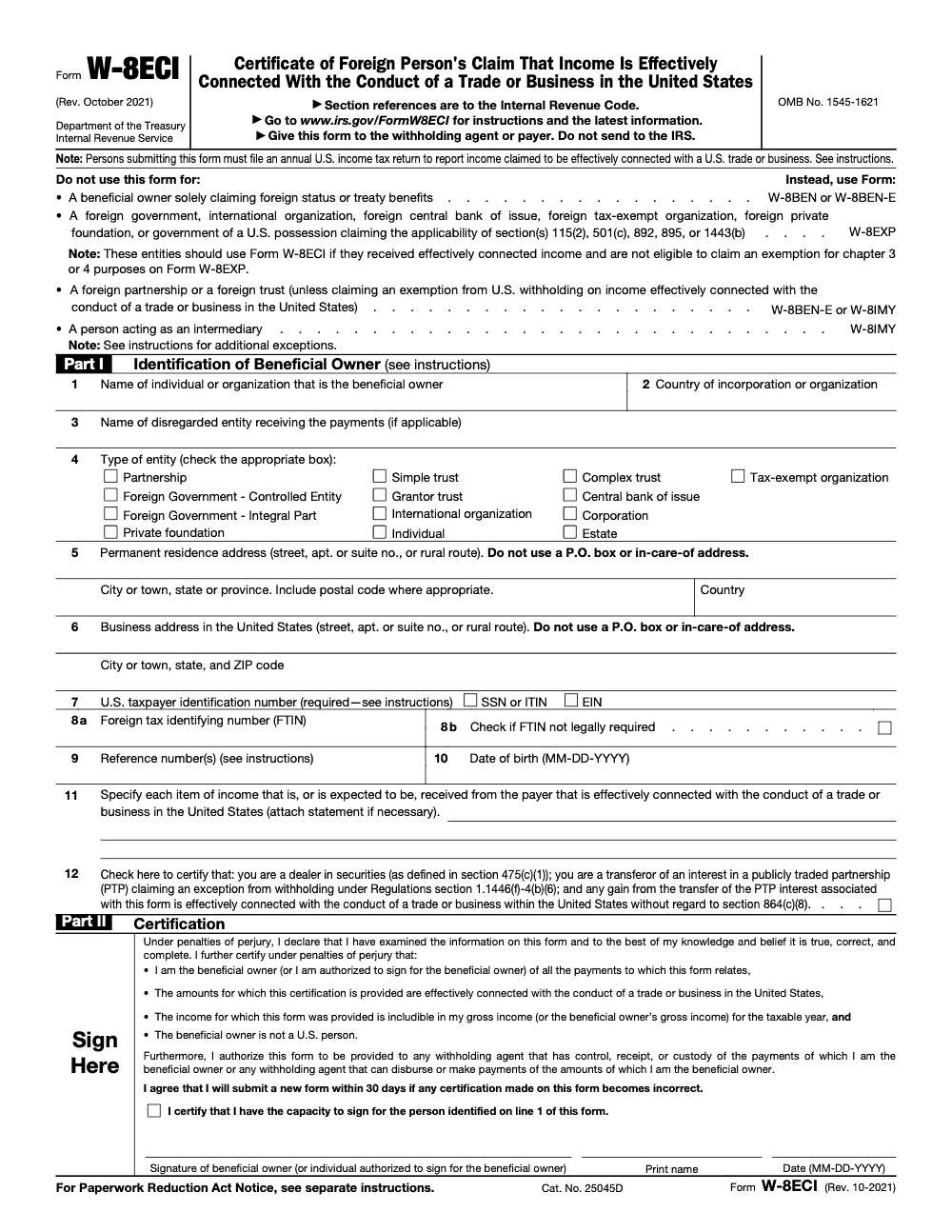
The current revision of Form W-8ECI is relatively compact – one page with 12 numbered lines – but each line carries real withholding consequences if completed incorrectly. Here is a practical walkthrough.
| Line / Field | What to Enter | Practitioner Notes |
|---|---|---|
| Line 1 – Name | Full legal name of the foreign individual or entity | For entities, use the exact name on the formation documents – not a trade name or DBA. |
| Line 2 – Country of incorporation / citizenship | Country where the individual is a citizen or where the entity was formed | This determines whether a tax treaty exists with the U.S., even though ECI claims don’t typically rely on treaty rates. |
| Line 4 – Type of entity | Check: Individual, Corporation, Partnership, Simple trust, Grantor trust, Complex trust, Estate, Government, Central bank, Tax-exempt organization, Private foundation, International organization | Foreign partnerships should generally use W-8IMY unless the income allocable to the partner level is ECI and each partner certifies separately. |
| Line 5 – Permanent residence address | Complete street address in the country of residence | A U.S. address here will prompt the withholding agent to ask for a U.S. TIN or additional documentation. A P.O. box or in-care-of address is not permitted at all – the form requires a street address (apartment, suite, or rural route), not a mail-handling proxy. |
| Line 7 – U.S. taxpayer identification number (TIN) | EIN (for entities) or ITIN/SSN (for individuals) | A valid U.S. TIN is required on W-8ECI. Without it, the withholding agent cannot apply the ECI exemption and must withhold at 30%. |
| Line 8a – Foreign tax identifying number (FTIN) | Tax identification number issued by the foreign country | Required unless the line 8b box is checked indicating an FTIN is not legally required in the country of residence; supplying it also helps withholding agents satisfy FATCA due diligence and reduces information requests later. Provide the foreign tax identifying number on line 8a, or check the line 8b box if an FTIN is not legally required in the country of residence. |
| Line 9 – Reference number(s) | Internal account or broker reference numbers if applicable | Used by withholding agents to tie the certificate to specific accounts. Leave blank if not applicable. |
| Line 11 – Description of effectively connected income & U.S. trade or business | Describe each type of income being claimed as ECI and identify the specific U.S. trade or business that generates it | This is the most important field. Be specific: “Rental income from commercial property located at [address], operated as a U.S. real property trade or business” is better than “rental income.” Vague descriptions give withholding agents grounds to reject the form. |
Certification and Signature Requirements
The form must be signed by the beneficial owner (the foreign person) or an authorized representative. Electronic signatures are acceptable in many cases, but the withholding agent’s policies govern. The signer certifies under penalties of perjury that the information is accurate and that the income is genuinely ECI from a U.S. trade or business the foreign person conducts.
Quick rule you can copy into your SOP: never accept an unsigned or undated W-8ECI. An unsigned form has no legal effect and leaves the withholding agent exposed.
When a U.S. TIN Is Mandatory
Unlike W-8BEN where a foreign TIN may substitute for a U.S. TIN in some cases, W-8ECI always requires a U.S. taxpayer identification number. If the foreign person does not yet have an EIN or ITIN, they must apply before or simultaneously with providing the W-8ECI. Filing Form W-9 is for U.S. persons – direct foreign clients to Form SS-4 (for EINs) or Form W-7 (for ITINs) as needed.
Deadlines, Penalties, and Filing Requirements
The W-8ECI is not filed with the IRS on a specific due date the way a tax return is. Instead, it is a certificate provided to a withholding agent before payments begin. However, there are important timing rules and compliance consequences.
| Event | Deadline / Rule | Consequence if Missed |
|---|---|---|
| Providing W-8ECI to withholding agent | Before the first payment or credit | Withholding agent must apply 30% FDAP withholding rate on all covered payments |
| Form validity expiration | No fixed calendar expiration; the form stays valid while its certifications remain accurate (unlike W-8BEN, which lapses after three years). Many withholding agents still request a periodic refresh as a control measure | Withholding agent must revert to 30% withholding until a new form is received |
| Change in circumstances | Must notify withholding agent within 30 days of any change that affects the form’s accuracy | Continued use of an invalid certificate can create penalties and back-withholding liability |
| Withholding agent record retention | Must retain W-8ECI for 3 years after the last payment to which it relates, per Reg. §1.1441-1(e)(4)(iii) | IRS audit exposure if forms cannot be produced |
| Refund of over-withheld amounts | Claim on Form 1040-NR or 1120-F; generally by the extended due date of the return | Refund forfeited if return is not filed timely |
How the Foreign Person Recovers Over-Withheld Tax
If withholding occurred before a valid W-8ECI was in place – or if the form lapsed – the foreign person can claim credit for amounts withheld against their actual U.S. tax liability. Nonresident aliens use Form 1040-NR; foreign corporations use Form 1120-F. The difference between amounts withheld and actual tax owed becomes a refund.
Small errors create big cleanup. A lapsed form for even one quarter can mean thousands in over-withholding, plus the administrative cost of amended returns and correspondence with the IRS.
Withholding Agent Obligations
U.S. withholding agents – anyone who pays U.S.-source income to a foreign person, including partnerships, corporations, and financial institutions – bear primary responsibility for collecting and validating W-8 forms. They must report payments and any withholding on Form 1042-S and file the annual Form 1042. An agent who relies on an invalid or expired W-8ECI bears personal liability for under-withholding, even if the foreign person is ultimately compliant on their own return.
Effectively Connected Income: The Legal Framework
Understanding what qualifies as ECI is not optional – it is the foundation of every W-8ECI claim. The IRS uses two primary tests under IRC §864(c).
The Asset-Use Test
Under the asset-use test, income is ECI if the asset that produces the income is used in, or held for use in, the U.S. trade or business. A piece of equipment deployed in a U.S. branch operation, for example, generates rental or depreciation-related income that passes this test. Portfolio securities held for investment by a foreign corporation with a U.S. branch do not automatically pass this test unless the securities are actively managed by the branch.
The Business-Activities Test
Under the business-activities test, income is ECI if the activities of the U.S. trade or business were a material factor in the realization of that income. This test catches income types like fees for services where the U.S. office actually performed the work, even if the client is offshore. My team flags this test often for foreign tech and consulting firms that route payments through foreign entities but whose engineers and developers are actually based in U.S. offices.
Special Rules for FDAP Income
Certain categories of FDAP income – dividends, interest, rents, royalties, and gains – are treated as ECI only if they pass one of the two tests above. However, Section 864(c)(6) and (7) contain additional rules for income from the sale of certain U.S. assets. A W-8ECI claim on dividend or interest income requires strong documentation that the income genuinely passes the asset-use or business-activities test. Withholding agents will scrutinize these claims more closely than claims on operating income.
How W-8ECI Interacts With FATCA and Chapter 4
FATCA (the Foreign Account Tax Compliance Act) added Chapter 4 withholding on top of the existing Chapter 3 framework. W-8ECI addresses Chapter 3 withholding, but withholding agents also need to assess the payee’s FATCA status under Chapter 4.
FATCA Status on W-8ECI
In the current version of the W-8ECI instructions, foreign entities providing the form may also need to establish their Chapter 4 (FATCA) status. For a foreign corporation claiming ECI, the corporation must be either a participating FFI, a deemed-compliant FFI, an exempt beneficial owner, or otherwise FATCA-exempt. Failure to address FATCA status can result in Chapter 4 withholding being applied even when Chapter 3 withholding is waived by the W-8ECI.
W-8ECI and FATCA Withholding Interactions
From a practical standpoint, if a foreign entity is an FFI that has signed an FFI Agreement with the IRS, the withholding agent still needs to confirm that status before applying the W-8ECI’s Chapter 3 exemption. The simpler cases are non-financial foreign entities (NFFEs) – a foreign manufacturing company with a U.S. factory, for example – which are generally exempt from FATCA withholding on ECI without additional documentation.
The instructions to the form and the Treasury Regulations (especially Reg. §1.1441-4) are the authoritative sources. My standard practice is to review the entity’s FATCA classification before collecting any W-8 form so the right box gets checked the first time.
Branch Profits Tax and W-8ECI: What Foreign Corporations Need to Know
A foreign corporation with a U.S. branch that files W-8ECI for its ECI does not escape the branch profits tax under IRC §884. The branch profits tax is a second-level tax on the after-tax earnings of a U.S. branch that are deemed to be repatriated to the foreign parent, roughly analogous to the dividend withholding tax that would apply if the branch were a U.S. subsidiary paying dividends.
How the Branch Profits Tax Works
The branch profits tax rate is 30% (or a reduced treaty rate) applied to the “dividend equivalent amount” – essentially, the U.S. ECI net of tax that is not reinvested in U.S. assets. The withholding agent does not handle this tax; it is reported and paid by the foreign corporation directly on Form 1120-F. But knowing this exists matters when advising foreign corporate clients about their total U.S. tax cost for operating through a branch rather than a subsidiary.
Treaty Reductions on Branch Profits Tax
Many U.S. income tax treaties reduce the branch profits tax rate below 30%, and some eliminate it entirely for certain qualifying entities. If your foreign corporate client is from a treaty country, always check whether the treaty contains a branch profits article before assuming the full 30% rate applies. This is a savings opportunity that gets missed more often than I’d like.
Common Mistakes That Slow Things Down
Most W-8ECI problems trace back to misunderstanding what the certificate does and does not do, not to the mechanics of any single line. Here are the patterns my team corrects most often.
Practical Checklists You Can Reuse
These checklists are copy-paste ready for your firm SOPs – one for intake, one for the withholding agent’s control file, and one for the annual reconciliation. Adapt the items to your client mix, then drop them into your engagement workflow.
W-8ECI Intake and Validation
- Confirm the payee is a foreign person and the income is U.S.-source.
- Run the asset-use and business-activities tests to confirm the income is effectively connected.
- Collect a valid U.S. TIN for line 7 (SSN or ITIN for individuals, EIN for entities).
- Verify lines 5 and 6 use street addresses, not P.O. boxes or in-care-of addresses.
- List each item of effectively connected income on line 11, naming the specific U.S. trade or business.
- Check line 12 only if the filer is a section 475(c)(1) securities dealer or a qualifying PTP transferor.
- Confirm Part II is signed and dated under penalties of perjury.
- Record the FATCA (Chapter 4) status so the right exemption is documented.
Withholding Agent Control File
- Confirm the certificate is complete, signed, and dated before the first payment.
- Verify the line 7 U.S. TIN is present; without it, apply the default 30% rate.
- Check that the line 11 income description is specific enough to rely on.
- Diary a 30-day trigger to collect a replacement form after any change in circumstances.
- Report payments and any withholding to the foreign person on Form 1042-S.
- File the annual Form 1042 summarizing the year’s payments and withholding.
- Retain the W-8ECI in the payee file for audit support.
Annual Return and Withholding Reconciliation
- Confirm the foreign person files Form 1040-NR (individual) or Form 1120-F (corporation) reporting the ECI.
- Reconcile the income itemized on line 11 to the amounts reported on the return.
- Credit amounts shown on Form 1042-S against the actual U.S. tax owed.
- For foreign partners, reconcile section 1446 withholding shown on Form 8805 and any Form 8804-C reductions.
- Track estimated tax installments (April 15, June 15, September 15, and January 15) where the filer expects to owe $1,000 or more.
Keep W8ECI Season From Stalling
Form W-8ECI rarely arrives on a tidy April calendar. It surfaces whenever a foreign payee signs a new contract, a U.S. branch turns on, or a partnership admits a foreign partner – and the clock starts before the first payment, not at a year-end deadline. Miss the window and the payer must apply the default 30% Chapter 3 withholding (per IRS Publication 515), after which everyone spends the next quarter chasing refunds.
The work that stalls is the tracking, not the form itself. A foreign partner’s share of effectively connected income can carry section 1446 withholding at the 37% top rate, FATCA status has to be confirmed before the Chapter 3 exemption applies, and any change in circumstances opens a 30-day replacement window. None of that is hard in isolation; it falls apart when no one owns the calendar.
- Build a W-8ECI register that captures the line 7 U.S. TIN, the line 11 income description, and the signature date for every foreign payee.
- Set a 30-day change-monitoring trigger so a replacement form reaches the withholding agent before any certification goes stale.
- Confirm each payee’s FATCA (Chapter 4) status at intake, so the Chapter 3 exemption is not held up by a missing classification.
- Tie every certificate to its annual follow-through on Form 1040-NR or Form 1120-F, and reconcile the reported ECI to amounts on Form 1042-S.
- For foreign partners, track section 1446 withholding on Form 8805 and any Form 8804-C deduction reductions alongside the certificate.
That is the kind of structured, repeatable execution our teams run every day. When cross-border withholding and the annual ECI follow-through stretch your bandwidth, Accountably’s tax delivery teams handle the tracking, review, and reconciliation inside your workflow, so the certificates and the returns stay in sync.
FAQs
Form W-8ECI is used by foreign individuals and entities to certify that income they receive from U.S. sources is effectively connected with a U.S. trade or business they conduct. By providing this certificate to a withholding agent, the foreign person claims exemption from Chapter 3 FDAP withholding at 30% because the income will instead be reported on a U.S. tax return and taxed at regular graduated rates.
Any foreign individual, corporation, partnership, trust, or estate that receives income from U.S. sources that is effectively connected with the conduct of a U.S. trade or business must provide Form W-8ECI to the U.S. withholding agent or payer. Common filers include foreign companies with U.S. branch operations, foreign partners in U.S. partnerships where their share of income is ECI, and nonresident aliens operating U.S. businesses.
Unlike Form W-8BEN, Form W-8ECI does not carry a fixed three-year expiration. It stays valid as long as the certifications on it remain true. It becomes invalid upon any change in circumstances that makes information on the form incorrect, and the foreign person must give the withholding agent a new form within 30 days of such a change. Many withholding agents do request a periodic refresh as a control measure, but that is an agent policy rather than a calendar expiration set by the form.
Form W-8BEN (or W-8BEN-E for entities) is used by foreign persons to claim reduced withholding under a tax treaty for FDAP income that is not effectively connected with a U.S. business. Form W-8ECI is used when the income is effectively connected with a U.S. trade or business, making treaty rates irrelevant because the income is taxed on a U.S. return at graduated rates rather than being subject to FDAP withholding.
W-8ECI exempts only the specific income items listed on the form from Chapter 3 FDAP withholding. Any income not listed, or income that does not qualify as effectively connected under the asset-use or business-activities tests, remains subject to standard 30% withholding. Filers must list each income type and the relevant U.S. business with enough specificity to satisfy the withholding agent.
Yes. A foreign corporation operating through a U.S. branch that conducts a U.S. trade or business can use W-8ECI to certify that payments received are effectively connected income attributable to that branch. The corporation still reports and pays U.S. corporate tax on that ECI on Form 1120-F and may also be subject to the branch profits tax under IRC §884 – W-8ECI does not eliminate that second-level tax.
Other forms this guide names
- Form W-8BEN: Foreign Status Certificate Guide 2025
- Form 1120‑F: Guide, Filing, Deadlines, Protective Return
- Form 1120-F: Schedule Q, QDD Filing Guide
- Form 1040‑NR: Filing 2025, Nonresident Taxes Made Simple
- Form W-8BEN-E: Treaty Benefits and Withholding Basics
- Form W-7: ITIN Application Guide, Requirements & Documents
Summarize this article with AI
About this guide
Accountably helps US CPA, EA, and accounting firms hire trained accountants and tax preparers in India.
About us Reviewed byJugal Thacker, CPAFounder and CEO at Accountably
A US-licensed CPA with 7+ years inside US firms – PwC, a real-estate tax practice, then a full-service firm, rising from reviewer to manager to advisory. This article was reviewed against current IRS guidance for the 2025 tax year and updated for filers preparing late returns, amendments, and 2026 estimates.
View profile →How we research, review, and update this guide
Every Accountably guide is researched against primary IRS sources, reviewed by a U.S. CPA, and refreshed as guidance evolves. Read our Editorial Guidelines to see how we source, fact-check, and update our content.