Summarize this article with AI
In Brief
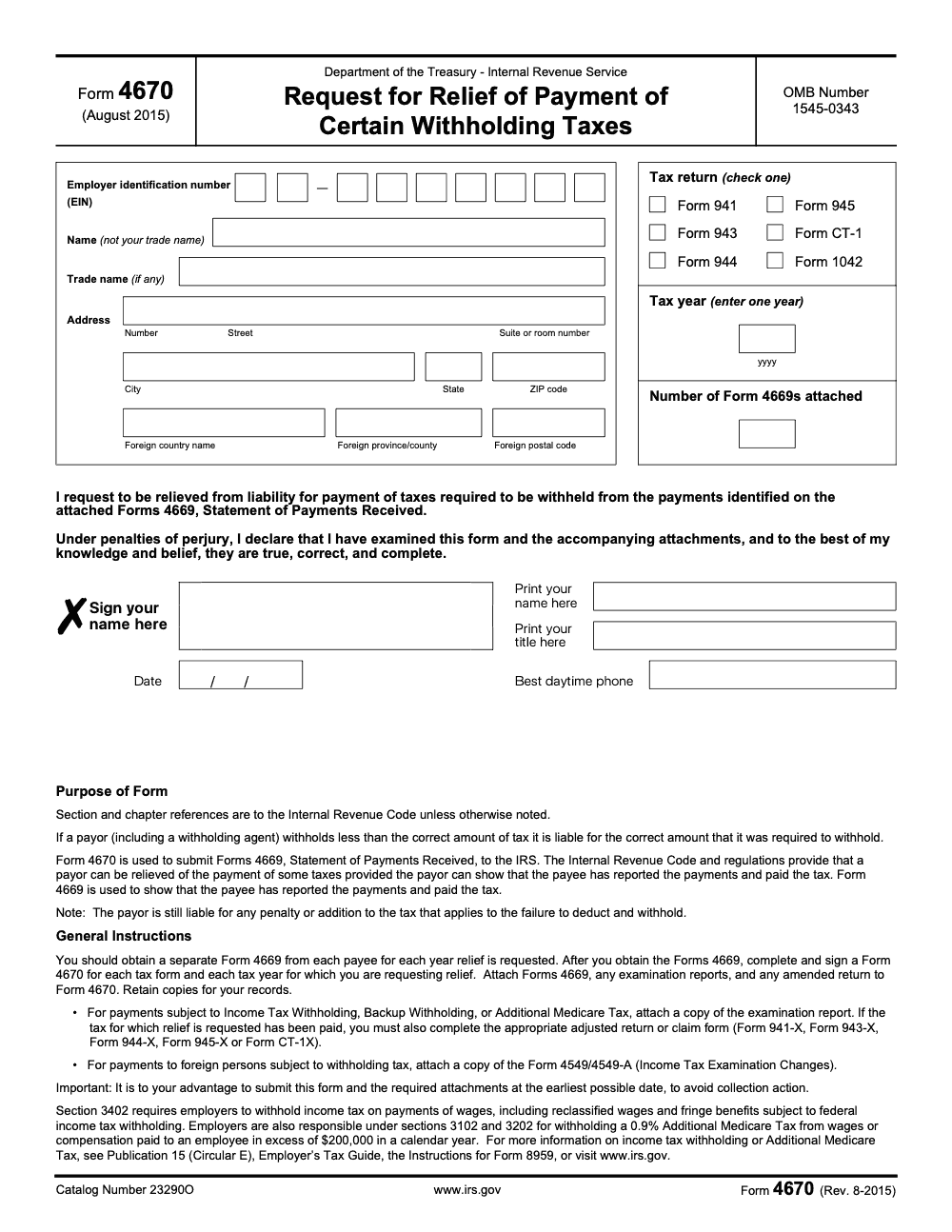
Form 4670 transmits Forms 4669 to the IRS so a payor can be relieved of income tax it failed to withhold when the payee already reported the income and paid the tax (per the August 2015 revision of Form 4670, still current for tax year 2025, operating under Subtitle C of the Internal Revenue Code together with IRC §3406 backup withholding and chapters 3 and 4 foreign-person withholding). File one Form 4670 per tax form type per tax year across the six covered returns (Forms 941, 943, 944, 945, CT-1, and 1042); the failure-to-deduct-and-withhold penalty stays with the payor even when relief is granted.
A payroll examination turns up payments where income tax should have been withheld but was not, and the agent moves to assess the payer for the missing amount. Form 4670 is the request that can take that assessment off the table, but only when the payees already reported the income and paid the tax themselves. You cannot file it alone: every Form 4670 has to carry signed Form 4669 statements from each affected payee, and the two forms are inseparable.
Relief reaches across six withholding-tax returns, including Forms 941, 943, 944, and 945, under Subtitle C plus the §3406 backup withholding and chapters 3 and 4 foreign-person rules. There is no annual deadline here. The form is filed during an examination or against a specific assessment, the IRS independently cross-checks each payee's TIN against filed returns, and the relief stands or falls on that verification. Because payee response time is the slow part, the request and the outreach should go out the same day the exam opens.
Key Takeaways
- Form 4670 is the payer’s relief request. When a payer failed to withhold income tax from wages or other payments, they file Form 4670 to ask the IRS to waive the assessment because the payee already paid the tax.
- Form 4669 must accompany every Form 4670. The payer cannot obtain relief without signed statements from each affected payee. The two forms are inseparable.
- Relief covers six withholding-tax returns. Form 4670 operates under Subtitle C (employment taxes) plus IRC §3406 backup withholding and chapters 3 and 4 foreign-person withholding – covering Forms 941, 943, 944, 945, CT-1, and 1042. FUTA tax (Form 940), information return penalties, and the failure-to-deduct-and-withhold penalty itself are not covered.
- No fixed calendar deadline. Form 4670 is filed during an examination or in response to a specific IRS assessment, not on an annual schedule. The examination timeline governs.
- The IRS verifies the payee independently. After receiving Form 4670, the IRS will cross-check the payee’s TIN against filed returns to confirm the income was reported and the tax paid. Relief depends on that verification succeeding.
- SOP tip: When a withholding examination opens, issue the payee outreach letter and Form 4669 request on the same day you receive the IDR. Do not wait until you have reviewed all the records. Payee response time is your longest lead item.
What Form 4670 Is and When to Use It
Form 4670, Request for Relief of Payment of Certain Withholding Taxes, is filed by an employer or payor who did not deduct and withhold the required income tax from wages or other payments. Under IRC §3403, the payer is personally liable for any tax that should have been withheld but was not. Form 4670 is the mechanism for obtaining relief from that underlying tax liability when specific conditions are met (the IRS instructions explicitly note that the payer remains liable for any penalty or addition to tax for the failure to deduct and withhold, even if relief from the tax itself is granted).
The form is used almost exclusively in an examination context. A payroll audit or compliance review identifies unwithheld income tax – on bonus payments, non-cash compensation, commissions, or miscellaneous vendor payments – and the examiner proposes an assessment against the payer. At that point, the payer’s option is to either pay the assessment or demonstrate that the payees already reported and paid the underlying tax through their own federal income tax returns.
The legal mechanism sits in Subtitle C of the Internal Revenue Code together with IRC §3406 (backup withholding) and chapters 3 and 4 (foreign-person withholding), and in each setting the principle is the same: a payor can be relieved of paying the under-withheld tax when the payee has already reported the payments and paid the tax. Form 4670 is the formal request, and the package of Form 4669 statements from each payee is the evidentiary basis. Without both, the relief is not available.
When Form 4670 Is Not the Right Tool
Form 4670 covers withholding-tax liability on six specific returns: Forms 941, 943, 944, 945, CT-1, and 1042. That sweeps in income tax withholding under IRC §3402 on wages, the 0.9% Additional Medicare Tax withholding under IRC §§3102 and 3202, backup withholding under IRC §3406 (reported on Form 945), and chapter 3 and chapter 4 foreign-person withholding (reported on Form 1042). Form 4670 does not cover FUTA tax (Form 940) or the failure-to-deduct-and-withhold penalty itself. Using Form 4670 for a return outside the six listed will result in the submission being rejected without credit toward the assessment.
How to Complete Form 4670
Form 4670 is a relatively compact form, but every field matters because the IRS will review it against both the examination records and the Form 4669 attachments.
Part I – Payer Information
| Field | What to Enter | Practitioner Note |
|---|---|---|
| Name of payer | Legal name of the employer or payor entity | Must match EIN registration; disregarded entity rules may require the owner’s name |
| EIN | Payer’s federal employer identification number – an SSN or ITIN is not permitted on Form 4670 | Must match the EIN used on the related 941/W-2 or 1099 filings |
| Address | Current business address of the payer | If address differs from the examination notice, include an explanation |
| Tax period(s) | Calendar year(s) for which relief is requested | Match exactly to the tax periods listed in the examination report; file a separate Form 4670 for each tax year AND each form type if needed – the IRS instructions prohibit entering more than one form type or tax year on a single Form 4670 |
Tax-Return and Tax-Year Selection
Check exactly one of the six covered returns (Form 941, 943, 944, 945, CT-1, or 1042) and enter exactly one tax year in YYYY format. The Form 4670 instructions are explicit that a single Form 4670 cannot mix form types or tax years – each form-type and tax-year combination needs its own Form 4670, its own matching Forms 4669, and its own attachments.
Enter the count of Forms 4669 attached in the “Number of Form 4669s attached” field, and reference any exhibit numbers from your Form 4669 package in your cover letter so the examiner can cross-reference quickly.
Signature Block
The payer or an authorized representative signs under penalties of perjury, certifying that the information is true and that they have obtained Form 4669 statements from the payees listed. If a representative signs on behalf of the payer, a valid Form 2848 power of attorney must already be on file with the IRS – merely holding the executed POA or enclosing it with the submission is not enough. No signature means no filing – the IRS will not process an unsigned Form 4670.
Deadlines, Penalties, and Filing Requirements
| Item | Details |
|---|---|
| Form 4670 due date | No fixed annual deadline. Filed during an IRS examination, in response to a proposed assessment, or within the timeframe set by the examining agent. The IRS instructions explicitly note it is to the payer’s advantage to submit Form 4670 and the required attachments at the earliest possible date to avoid collection action. |
| Form 4669 requirement | Must be attached for each payee. Partial packages covering only some payees will result in partial relief at best. |
| Underlying payer liability | IRC §3403: payer is personally liable for unwithheld income tax. Interest accrues from the original due date of the tax until the assessment date or relief is granted. |
| What is NOT relieved | The failure-to-deduct-and-withhold penalty itself, information return penalties (IRC §§6721–6722), and FUTA tax on Form 940. FICA tax (Form 941) and backup withholding tax (Form 945) are within Form 4670 scope; only the related penalties stay with the payor. |
| Statute of limitations | The IRS generally has three years from the return due date to assess employment taxes. Failure to file a 941 can extend the period to indefinite under IRC §6501(c)(3). Know your open years before filing. |
| Interest on assessment | If relief is granted, the underlying income tax assessment is removed but interest accrued through the examination period may still apply. Confirm interest treatment with the examiner. |
Withholding-Tax Relief – The Legal Framework
Form 4670 operates under Subtitle C (Employment Taxes) of the Internal Revenue Code, together with IRC §3406 (backup withholding) and chapters 3 and 4 (foreign-person withholding). In each setting, the principle is the same: once the payee has reported the income and paid the tax, collecting it again from the payor would produce a windfall for the Treasury – something the statutes were written to prevent. Form 4670 is the request that asks the IRS to recognize that payee payment and release the payor from the underlying tax liability, though the failure-to-deduct-and-withhold penalty still stays with the payor.
The operative phrase is “thereafter the taxes are paid.” The IRS interprets this to require that the payee actually filed and paid, not merely that the payee had income for the year. This matters in cases where the payee received a refund overall, had offsetting losses, or was on an installment agreement that has not been completed. Each situation requires individual analysis, and blanket reliance on Form 4669 without transcript verification creates examination risk.
The Three Conditions the IRS Looks For
- The payee filed a federal income tax return for the tax year(s) in question.
- The payment in question was included in the payee’s reported gross income for that year.
- The payee paid the resulting tax – either through withholding from other sources, estimated payments, or payment with the return or extension.
If any of these three conditions is not met for a given payee, the IRS will deny relief for that payee’s payments. The payer remains liable. The only path forward at that point is the normal assessment and collection process, or a penalty abatement request based on reasonable cause.
What “Employer” Means for Purposes of Form 4670
Form 4670 uses the term “employer,” but the form applies broadly to any payor who makes payments subject to withholding – not just traditional employment relationships, and not just income tax withholding. A business that paid directors’ fees, commission-only sales agents classified as employees, supplemental wages to contractors later reclassified as employees, FICA or Additional Medicare-eligible wages, backup-withholdable reportable payments, or chapter 3 / chapter 4 foreign-person payments can all be in scope through the matching covered return (941, 943, 944, 945, CT-1, or 1042). The key is whether the payments were subject to a withholding requirement at the time they were made and whether the relevant return is one of the six listed on Form 4670.
What Relief Does and Does Not Cover
From my side of the desk, the most common client misunderstanding is that Form 4670 approval means all withholding-related issues are resolved. It does not. The relief is narrow and precisely defined.
| Assessment Type | Covered by Form 4670? | Alternative Relief Path |
|---|---|---|
| Income tax withholding (IRC §3402) | Yes – primary purpose of the form | N/A – this is the form |
| Employee FICA / 0.9% Additional Medicare (IRC §§3102, 3202) | Yes – via the matching Form 941, 943, 944, or CT-1 | FICA and Additional Medicare Tax withholding are within Form 4670 scope when the payee has reported and paid; the employer share of FICA remains the payor’s liability |
| Backup withholding tax (IRC §3406) vs. related penalties | Tax: Yes via Form 945 · Related penalties: No | Form 4670 can relieve the under-withheld backup tax on Form 945 when the payee has reported and paid; the related penalties require reasonable-cause abatement |
| Failure-to-file 1099 penalties (IRC §6721) | No | Reasonable cause or first-time penalty abatement |
| Failure-to-furnish payee statement (IRC §6722) | No | Reasonable cause or first-time penalty abatement |
| FUTA tax | No | No equivalent payee-paid relief; employer liability is absolute |
When presenting the relief request outcome to a client, document in writing exactly what was and was not resolved. A Form 4670 approval does not mean a clean bill of health from the examination – it means one category of the assessment has been addressed.
Common Mistakes That Slow Things Down
Over the years I have watched the same handful of stumbles drag a clean Form 4670 package into a six-month back-and-forth with an examiner. The form itself is two pages, but most of the friction sits in how the attachments are assembled and where the package is finally mailed.
Practical Checklists You Can Reuse
These three checklists are formatted to drop straight into a firm SOP or a client engagement memo. Each step maps to a document or decision the IRS expects to see when it pulls the file.
Pre-submission packet checklist
- Confirm the single tax form type (941, 943, 944, 945, CT-1, or 1042) and the single tax year (YYYY) covered by this Form 4670.
- Collect one signed Form 4669 from each affected payee for that tax year.
- Enter the exact count of attached Forms 4669 in the "Number of Form 4669s attached" field.
- Attach the IRS examination report covering the under-withholding finding.
- If the tax has already been paid, attach the matching X-series adjusted return (Form 941-X, 943-X, 944-X, 945-X, or CT-1X).
- For payments to foreign persons subject to chapter 3 or chapter 4 withholding, attach Form 4549 or Form 4549-A (Income Tax Examination Changes).
- Retain a full copy of the package, including every attachment, in the payor's records before mailing.
Routing decision checklist
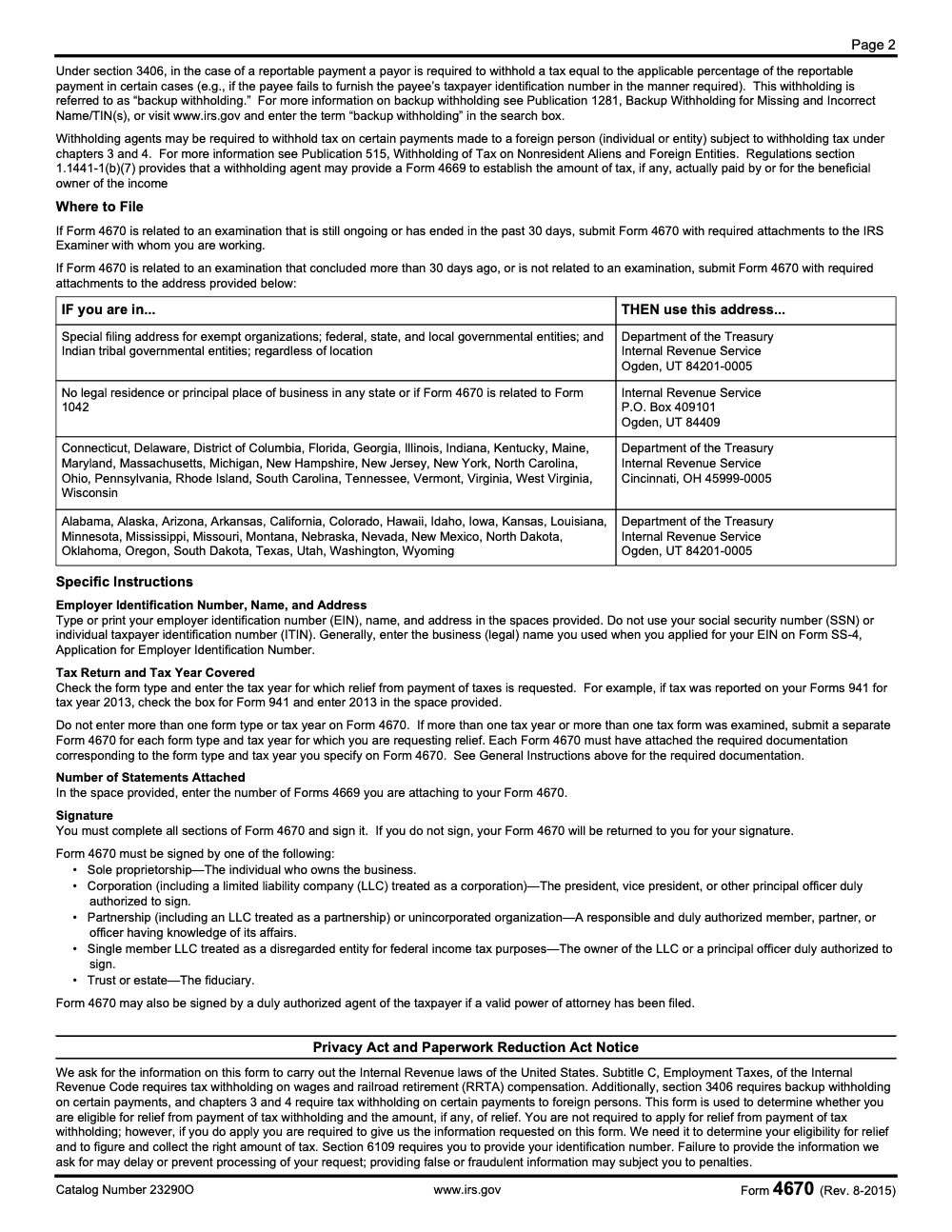
- If an examination is open, or closed within the past 30 days, route the package to the assigned IRS Examiner – not to a service center.
- If the package relates to Form 1042, route to Internal Revenue Service, P.O. Box 409101, Ogden, UT 84409, regardless of the filer's state.
- If the filer is an exempt organization, or a federal, state, local, or Indian tribal governmental entity, route to Department of the Treasury, Internal Revenue Service, Ogden, UT 84201-0005, regardless of geography.
- If the filer is principally located in CT, DE, DC, FL, GA, IL, IN, KY, ME, MD, MA, MI, NH, NJ, NY, NC, OH, PA, RI, SC, TN, VT, VA, WV, or WI, route to Cincinnati, OH 45999-0005.
- If the filer is principally located in AL, AK, AZ, AR, CA, CO, HI, ID, IA, KS, LA, MN, MS, MO, MT, NE, NV, NM, ND, OK, OR, SD, TX, UT, WA, or WY, route to Ogden, UT 84201-0005.
- If the filer has no legal residence or principal place of business in any state, route to P.O. Box 409101, Ogden, UT 84409.
Filer-and-signer verification checklist
- EIN entered in the header in XX-XXXXXXX format – never an SSN or ITIN.
- Legal name on Form 4670 matches the name used on the original Form SS-4 application.
- Trade name (DBA) is placed on the "Trade name (if any)" line only, never on the legal-name line.
- Signer authority matches the entity type: owner for a sole proprietorship, president or principal officer for a corporation, partner or member for a partnership or LLC, fiduciary for a trust or estate.
- If a representative is signing, the matching power of attorney (Form 2848 or equivalent) is already on file with the IRS.
- Signature, printed name, printed title, date, and best daytime phone are all complete before the package is sealed.
Keep 4670 Season From Stalling
Form 4670 work is reactive, not seasonal. Packages show up after an IRS examiner has flagged under-withholding, and the volume comes in clusters: a single audit can spawn six or eight separate Form 4670 packages because each form-type and tax-year combination needs its own filing, per the Form 4670 instructions (Rev. August 2015). Add in the requirement under Treas. Reg. §1.1441-1(b)(7) and the form instructions for one signed Form 4669 per affected payee per year, and a mid-sized payor with three open years of payroll exposure can be looking at 200+ payee statements to chase down before anything is mailed.
The work itself is not complex on a single package. The stall happens when packages are assembled one-at-a-time with no template, no payee tracker, and no routing checklist – senior reviewers end up re-reading the same examination report on every file to remember which X-series return belongs with it.
- Build one master tracker keyed to (form type, tax year, assigned examiner, payee count) and clone the same packet template for every row.
- Pre-populate the EIN, legal name, and trade name from the original Form SS-4 record so every package opens with verified header data and no DBA leakage.
- Standardize attachment order on every package: Form 4670, count-confirmed Forms 4669, examination report, matching X-series adjusted return if the tax has been paid, and Form 4549 or 4549-A for any foreign-person payments.
- Lock the routing decision before assembly starts – Examiner during open audit, P.O. Box 409101 Ogden for any Form 1042 file, Ogden 84201-0005 for exempt and governmental entities, then state-based for everything else.
- Run a signature-and-perjury verification on the day of mailing, since an unsigned Form 4670 is returned unprocessed and resets the timeline back to zero.
This is exactly the kind of structured production work that benefits from a documented SOP and a layered review queue rather than an ad-hoc partner-driven push. Our tax outsourcing and offshoring service can absorb Form 4670 relief packages alongside the broader payroll and withholding workload, with preparer, senior, and quality-review checkpoints built in before any package leaves the office.
FAQs
Form 4670 is filed by a payer (employer or payor) who failed to withhold income tax from wages or other payments. Under IRC §3402(d), if the payees subsequently filed returns and paid the income tax themselves, the payer can request that the IRS relieve them of the withholding assessment. The form must be accompanied by Form 4669 statements from each affected payee, and the IRS independently verifies payee compliance before granting relief.
Form 4669 is completed by the payee – the person who received the payments – certifying that those amounts were included in their gross income. Form 4670 is filed by the payer to request relief from the withholding assessment. Form 4669 is the evidence; Form 4670 is the request. The IRS requires both. Filing one without the other accomplishes nothing in the relief process.
The penalty itself is never relieved – even when Form 4670 is granted, the payor remains liable for any penalty or addition to tax for the failure to deduct and withhold. Form 4670 can, however, relieve the underlying backup-withholding TAX reported on Form 945 (alongside FICA and Additional Medicare on Form 941, 943, 944, or CT-1, and chapter 3 / chapter 4 withholding on Form 1042) when the payee has already reported the payments and paid the tax. FUTA tax on Form 940 and information-return penalties under IRC §§6721–6722 sit outside Form 4670 and require separate procedures. After a Form 4670 is approved, confirm with the examiner which portions of the assessment remain open.
The routing depends on exam status. If an examination is still ongoing or ended within the past 30 days, Form 4670 goes directly to the assigned IRS Examiner with a cover letter listing the case number and exhibits – not to a service center. Otherwise the Form 4670 instructions provide a specific address table: exempt organizations and federal, state, local, or Indian tribal governmental entities file at Ogden, UT 84201-0005 regardless of location; any Form 4670 related to Form 1042 (or a filer with no legal residence or principal place of business in any state) files at Internal Revenue Service, P.O. Box 409101, Ogden, UT 84409; eastern-state filers (CT, DE, DC, FL, GA, IL, IN, KY, ME, MD, MA, MI, NH, NJ, NY, NC, OH, PA, RI, SC, TN, VT, VA, WV, WI) file at Cincinnati, OH 45999-0005; and western-state filers (AL, AK, AZ, AR, CA, CO, HI, ID, IA, KS, LA, MN, MS, MO, MT, NE, NV, NM, ND, OK, OR, SD, TX, UT, WA, WY) file at Ogden, UT 84201-0005.
If a payee declines to sign or cannot be located, the payer cannot obtain relief for that payee’s payments. The assessment for those specific amounts remains enforceable, and the payer owes the unwithheld income tax. In that situation, the payer’s options are limited to paying the assessment, negotiating an installment agreement, or seeking penalty abatement on reasonable cause grounds for any associated failure-to-deposit penalties. The refusal of a third party to cooperate does not, on its own, constitute reasonable cause for the original withholding failure.
Other forms this guide names
- Form 4669: Statement of Payments Received Guide
- Form 1042: Annual Withholding Tax Return for Foreign Persons 2025
- Form 941: Employer's Quarterly Tax Return Guide 2025
- Form 945: Backup Withholding, Deadlines, and Deposits
- Form 943: Agricultural Employer Guide, Deadlines, Filing Steps
- Form 944: Eligibility & Due Dates
About this guide
Accountably helps US CPA, EA, and accounting firms hire trained accountants and tax preparers in India.
About us Reviewed byJugal Thacker, CPAFounder and CEO at Accountably
A Washington-licensed CPA with 7+ years inside US firms – PwC, a real-estate tax practice, then a full-service firm, rising from reviewer to manager to advisory. This article was reviewed against current IRS guidance for the 2025 tax year and updated for filers preparing late returns, amendments, and 2026 estimates.
View profile →How we research, review, and update this guide
Every Accountably guide is researched against primary IRS sources, reviewed by a U.S. CPA, and refreshed as guidance evolves. Read our Editorial Guidelines to see how we source, fact-check, and update our content.