Summarize this article with AI
In Brief
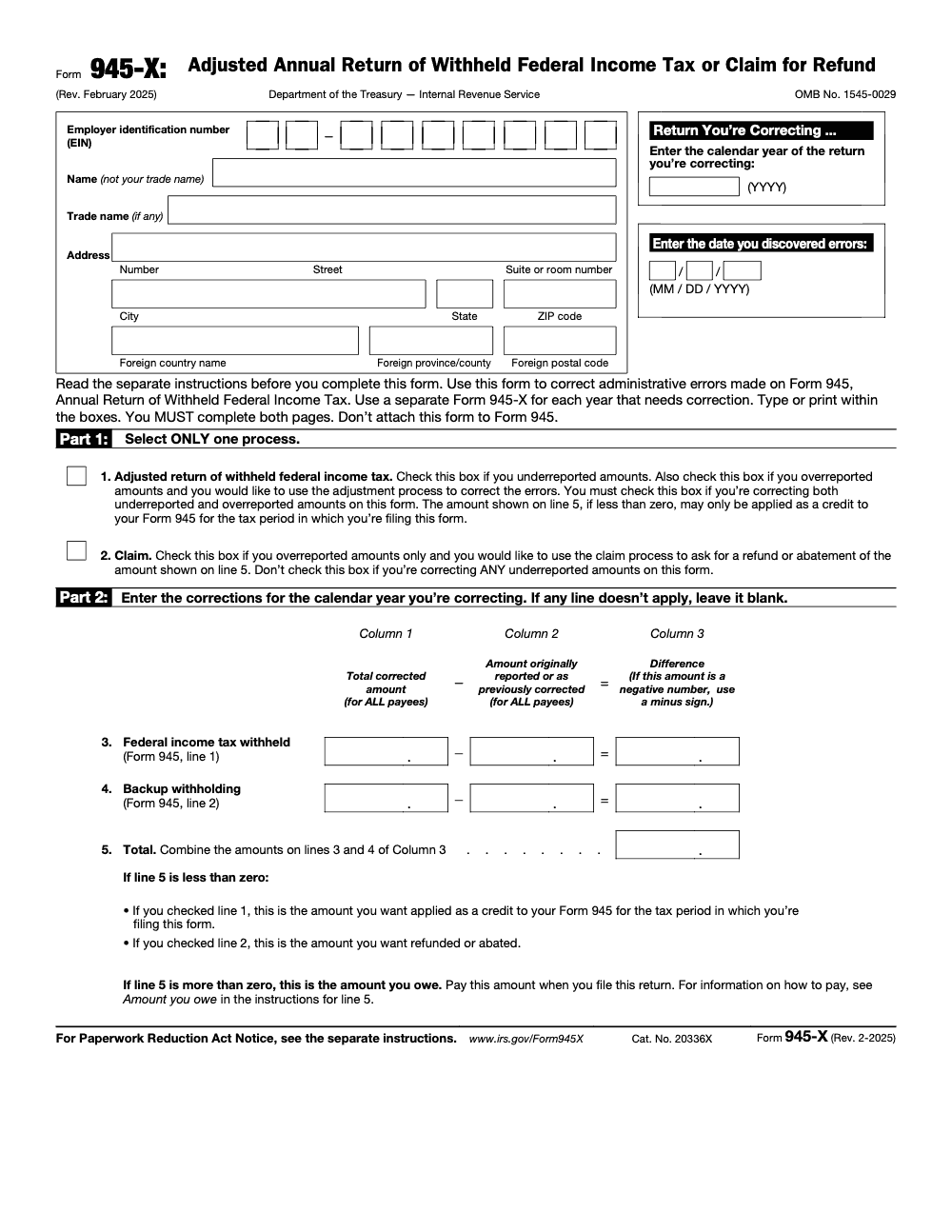
Form 945-X (Rev. February 2025) is the adjusted return used to correct administrative errors on a previously filed Form 945, the annual return of withheld federal income tax on pensions, annuities, IRAs, gambling winnings, and 24% backup withholding (per the IRS Instructions for Form 945-X). Check line 1 for the adjustment process or line 2 for the claim process, report each correction in the three columns of Part 2, explain it on line 7, file one form per calendar year, and pay any balance shown on line 5 when you file.
When a prior Form 945 reported the wrong federal income tax withheld, or a backup withholding run got transposed, Form 945-X is the adjusted return that corrects those administrative errors. Form 945 covers withheld federal income tax on pensions, annuities, IRAs, gambling winnings, and 24% backup withholding.
Check line 1 for the adjustment process or line 2 for the claim process, report each correction across the three columns of Part 2, explain it on line 7, and file one form per calendar year. For overreported tax you have the 3-year or 2-year statute to work in, and if you are within the last 90 days, you must use the claim process; for underreported tax, pay any balance shown on line 5 when you file.
Key Takeaways
- File a separate Form 945‑X for each calendar year, include your EIN, the year corrected, the earliest discovery date, and a clear line 7 explanation with attachments.
- For underreported tax, file by the due date of Form 945 for the year you discovered the error, generally around late January, and pay when you file to stay interest free.
- For overreported tax, choose either the adjustment process, a credit, or the claim process, refund or abatement, within the 3‑year or 2‑year statute. If you are within the last 90 days, you must use the claim process.
- You can e‑file Form 945‑X through the IRS Modernized e‑File system and receive acknowledgements quickly, which eliminates the guesswork of paper filings.
- If deposit timing changes or you are filing late on an underreported correction, attach an amended Form 945‑A so you do not trigger averaged deposit penalties.
What Form 945‑X is, and when to use it
Form 945‑X is the adjusted return you file when your prior Form 945 has an administrative reporting error, for example a math mistake, a transposition, or a misreported backup withholding amount. You correct the year that is wrong, and you explain exactly what changed, when you discovered it, and how you calculated the corrected numbers. You must use the “X” form that matches the original return type, so 945‑X is only for 945.
In Part 1 you choose one path. For underreported amounts you use the adjustment path and pay with the filing. For overreported amounts you either use the adjustment path to take a credit on a future Form 945, or you use the claim path to request a refund or abatement. Your line 7 narrative should read like a clean audit trail, dates, amounts, lines affected, and a simple cause.
What this form cannot do
- It does not correct 941, 943, 944, or CT‑1, each has its own “X.”
- It does not abate penalties or interest. Use Form 843 for that.
Timing that keeps you out of trouble
If you underreported tax, file Form 945‑X by the due date of the Form 945 for the year you discovered the error and pay when you file. Do that, include the earliest discovery date, and explain the correction, and the IRS generally does not charge interest or failure‑to‑deposit or failure‑to‑pay penalties. If you are late, attach an amended Form 945‑A so you do not get hit with an averaged deposit penalty.
For overreported tax, the period of limitations is usually 3 years from when the original Form 945 is considered filed or 2 years from when you paid the tax, whichever is later. In the last 90 days of that window, the claim process is mandatory, not the adjustment process.
Quick date anchor you can use, the 2025 Form 945 itself is due February 2, 2026, or February 10, 2026 if all deposits were on time and in full. This helps you plan your 945‑X underpayment timing for errors discovered in 2025.
Why e‑filing 945‑X should be your default
Electronic filing through IRS MeF gives you fast acknowledgements, clearer error messages, and fewer preventable rejections. That matters when you are up against deadlines. Paper offers no real‑time status and can sit in queues for weeks.
If you owe a balance on line 5, pay when you file. Use electronic payment methods that create a clean record. If you take a credit using the adjustment process, remember that the IRS treats it as a tax deposit on the first day of the year you file the 945‑X, and it may be reduced if the IRS offsets it or adjusts your claim.
Exactly what you can correct with Form 945‑X
Form 945‑X fixes administrative errors on a previously filed Form 945 for the same calendar year. That includes math errors, transposed digits, and errors in federal income tax withheld, including backup withholding, that changed what you reported. For a prior year, it can only fix an administrative reporting error; it cannot retroactively change the amount you actually withheld from a payee. Its scope is narrow on purpose, so your correction is easy to follow and easy to post.
Do not use 945‑X to correct other employment returns or to ask for penalty or interest relief. Use the correct “X” form for each return type, and use Form 843 for abatements.
Adjustment versus claim, side by side
| Option | When to choose | Part 1 selection | Where the money goes | Timing traps |
| Adjustment, credit | You want the overreported amount applied to the year you file 945‑X, or you are paying an underreported amount | Line 1 | Credit is treated as a deposit on the first day of the year you file 945‑X | You cannot use this in the final 90 days of the limitations period |
| Claim, refund or abatement | You want a refund or abatement of overreported amounts and are not correcting underreported amounts on the same form | Line 2 | Refund or abatement after IRS processing | Required in the final 90 days of the limitations period |
How to keep underreported corrections interest free
Three items protect you. File by the due date of the return for the year you discovered the error, pay any balance with the filing, and disclose the earliest discovery date with a clear explanation. If you are late, include an amended 945‑A so the IRS does not average your deposits and assess a penalty.
Paper versus e‑file, how to decide
E‑file is faster, gives you acknowledgements, and reduces preventable rejections with business‑rule checks. Paper requires correct mailing addresses and patience. If you must mail, Cincinnati handles a set of states, Ogden handles another, and there are special addresses for certain entities. Always confirm current addresses in the instructions before you ship.
Pro tip, MeF has planned maintenance near year end, then reopens in January. If you are filing late December or early January, check the current MeF status page and plan your submission window so acknowledgements return on time.
Step by step, how to complete Form 945‑X
You will prepare one Form 945‑X per year, plus your line 7 narrative and any supporting schedules. Label every page with your name, EIN, “Form 945‑X,” and the calendar year you are correcting.
Step 1, gather filer details
- Employer legal name, EIN, current address.
- The calendar year you are correcting, enter it at the top of both pages and on attachments.
- The earliest date you discovered the error. If you found several at different times, use the earliest date here and list the others in your explanation.
- A simple narrative that shows cause, dates, and math for each correction.
Step 2, complete Part 1, choose one process only
Check one box. Use line 1 for the adjustment process, including when you are paying an underreported amount or taking a credit. Use line 2 only for a refund or abatement of overreported amounts when you are not correcting underreported amounts on the same form. If you are within the last 90 days of the limitations period, the claim route is mandatory.
Step 3, enter Part 2 corrections with three‑column precision
Use the three columns exactly as the IRS expects. Column 1 is the corrected amount, column 2 is what you originally reported, and column 3 is the difference. Use a minus sign for reductions, include cents, and leave non‑applicable lines blank (do not enter zeros, since the IRS reads a zero as a correction to zero rather than a line that does not apply). When you finish, compute line 5. If line 5 is positive, you owe tax and should pay with the filing. If line 5 is negative and you chose adjustment, the IRS treats that amount as a deposit on the first day of the year you file the 945‑X, not a cash refund; if you want money back, you must use the claim process on line 2 instead.
Quick tie‑out, if you are late on an underreporting correction, attach an amended 945‑A that shows corrected liability timing by day or month, and make sure its totals match your corrected 945 and the 945‑X net change on line 5.
Step 4, write a line 7 explanation that speeds processing
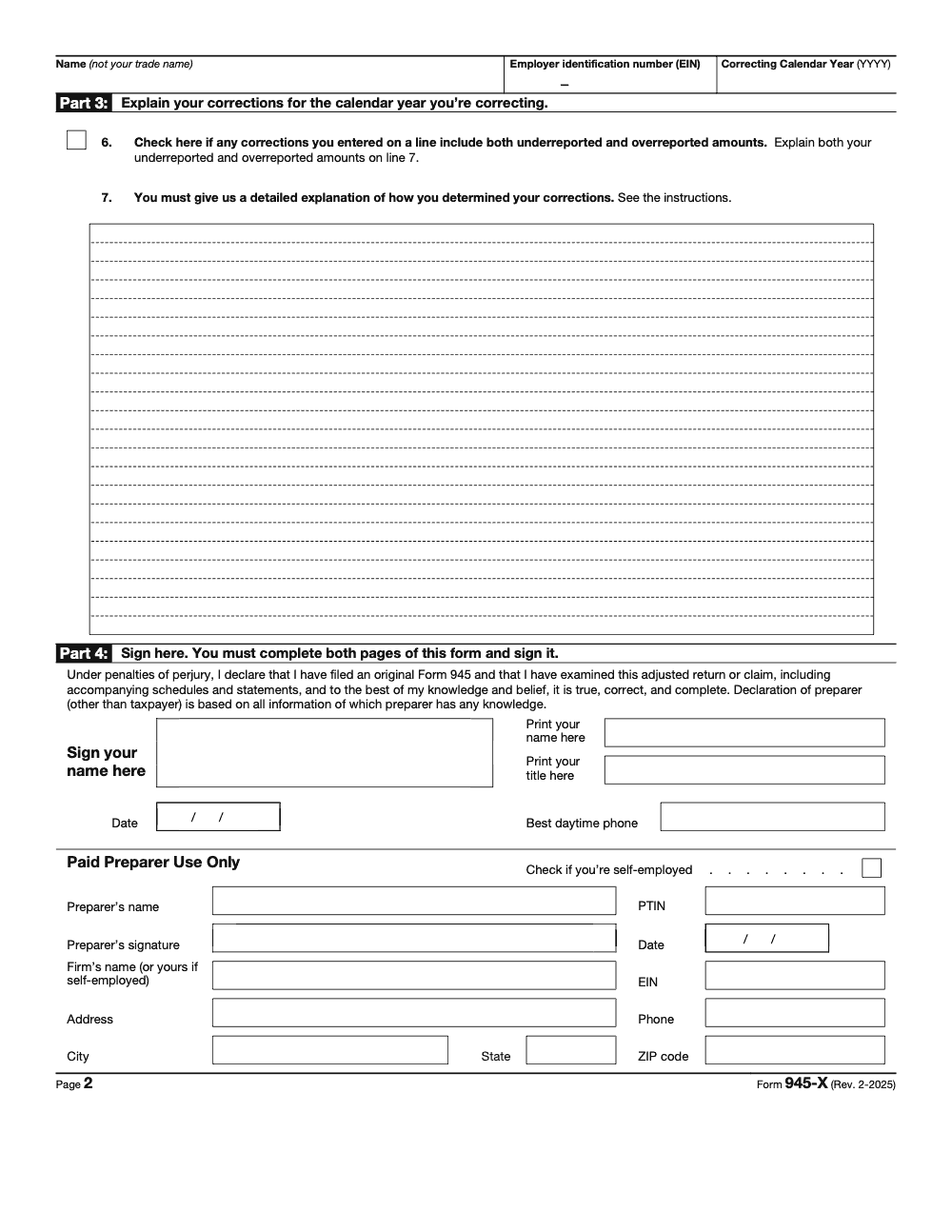
Tell the story a reviewer needs. For each change, give the cause, the dates, the Form 945 line affected, the original amount, the corrected amount, and the difference. If a net number combines increases and decreases for different payees, list both sides so the math is transparent. Specific beats vague here.
Step 5, sign, file, and pay
Sign page 2. If you owe on line 5, pay when you file. Use electronic payment to keep clean records and avoid mail delays. If you are taking a credit under the adjustment process, plan cash flow with the deposit‑on‑January‑1 treatment and the possibility of offsets during processing.
Quick reference table
| Section | Action | Notes |
| Header | Enter year, EIN, address | Include the earliest discovery date |
| Part 1 | Choose only one box | Adjustment on line 1 or claim on line 2 |
| Part 2 | Corrected, original, difference | Use minus signs and include cents |
| Line 5 | Compute net change | Pay if positive, credit if negative and using adjustment |
| Part 3, line 7 | Explain each correction | Dates, causes, lines affected, amounts |
Required documentation that prevents rework
Before you transmit or mail, confirm you have the identifiers and proof the IRS expects. That means the legal name, EIN, address, the corrected year, the earliest discovery date, and a narrative that matches Part 2. If your deposit schedule changed or you are late on an underreporting correction, attach an amended Form 945‑A. Label every attachment clearly.
Payments, penalties, and interest, how to avoid surprises
When 945‑X shows tax due on line 5, pay with the filing. If you file by the due date for the year you discovered the error, pay on time, enter the discovery date, and explain the correction, the IRS generally does not charge interest or failure‑to‑deposit or failure‑to‑pay penalties for underreported amounts. This interest-free treatment is not available, however, if the failure relates to an issue the IRS already raised in an examination of a prior return, or if you knowingly underreported the tax; in those cases interest runs from the original due date. If you are late, the IRS may average your deposits unless you include an amended 945‑A.
If you take a credit under the adjustment process, the IRS applies it as a deposit on the first day of the year you file 945‑X. That credit can be reduced if you owe other taxes or the IRS changes your claim during processing, so do not plan cash that depends on the full amount until you see it posted.
Common mistakes that slow you down
Most 945-X rework I see is not a math problem, it is a process problem. These are the patterns that send a correction back into the queue, and how to keep yours moving.
Field‑tested filing checklist
- Confirm you actually need 945‑X, not a different “X” form or Form 843.
- Gather EIN, legal name, address, the year corrected, earliest discovery date.
- Choose your Part 1 path, adjustment credit or claim.
- Complete Part 2 with cents and correct signs, reconcile to workpapers.
- Compute line 5, pay if positive, document credit handling if negative.
- Draft a detailed line 7 explanation tied to each changed line.
- If late for an underreporting correction, attach amended 945‑A.
- E‑file through an IRS‑authorized provider for faster acknowledgements.
- Save acknowledgements, payment proof, and a clean copy set.
Why firms end up filing 945‑X so often
Busy seasons create capacity spikes. Partners get trapped in review loops, hiring delays leave gaps, and documentation suffers. That is when transposed digits and misclassified withholding sneak into the Form 945 totals. You can keep fixing with 945‑X, or you can reduce the errors by building delivery discipline, standardized workpapers, layered reviews, and clear SOPs that hold up when workload jumps.
If 945‑X filings recur every January, you do not have a sales problem, you have a delivery system problem. Clean workpapers and structured reviews shrink error rates and protect partner time.
A brief, optional note on help
If you need trained capacity without losing control, a U.S.‑led offshore delivery model can work when it is built like operations, not resume farming. Teams work in your systems, follow your templates and SOPs, and use layered quality checks. That is the difference between fewer January corrections and a repeat of last year. Accountably offers that kind of disciplined offshore delivery for firms that want stable production, workflow discipline, and review protection.
Example scenarios you can model
Underreported math error discovered the next year
On June 20, 2025 you discovered an additional 10,000 of withheld tax on your 2024 Form 945. File 945‑X by February 2, 2026, because January 31, 2026 falls on a Saturday, and pay the balance when you file. With the discovery date and a clear explanation, this correction is generally interest free.
Overreported transposition error using the adjustment credit
You filed 2024’s 945 on January 31, 2025. On May 1, 2025 you found a 3,000 overstatement in backup withholding. You filed 945‑X in June 2025 and checked line 1. The IRS treats that credit as a deposit on January 1, 2025, and you include it in total deposits on your 2025 Form 945.
Inside the last 90 days of the period of limitations
If you are within the final 90 days of the limitations period, you must use the claim process for the overreported portion. If you also have underreported amounts, file a second 945‑X using the adjustment process and pay with the filing.
Where to file and how to confirm posting
Paper filings route by state, typically to Cincinnati or Ogden, and certain entities always use Ogden. Private delivery services cannot deliver to P.O. boxes, so follow the instruction list if you use a carrier. Or skip the mail, e‑file through MeF and keep the acknowledgements as proof of receipt.
Ready‑to‑use wording for line 7
“On 2025‑03‑14 we discovered a transposition error in the 2024 backup withholding roll‑up reported on 2024 Form 945, line 2. Corrected amount for all payees is 9,000.00, previously reported 6,000.00, difference 3,000.00 increase. See attached Schedule A for payee‑level changes and reconciliation to deposits.”
Pair that with a schedule that lists payees adjusted, ties to deposit history, and reconciles original to corrected totals.
Final checklist, then file
- The form shows the correct year and the earliest discovery date.
- Part 1 has only one box checked.
- Part 2 shows corrected, original, difference, with minus signs and cents.
- Line 5 positive, you paid, line 5 negative and adjustment, you will treat it as a deposit on the first day of the filing year.
- If late for an underreporting correction, an amended 945‑A is attached and ties out.
- You e‑filed and saved acknowledgements, or you mailed to the current address in the instructions.
Reusable Checklists
These checklists are copy-paste ready for your firm SOP folder. Drop them into your workpaper template so every Form 945-X follows the same path.
Before you start a 945-X
- Confirm an original Form 945 was filed for the year you are correcting.
- Confirm the issue is an administrative reporting error, not a different return type, and not a penalty or interest matter (use Form 843 for those).
- Pull the original Form 945, the deposit history, and payee-level records for the corrected year.
- Record the earliest discovery date in MM/DD/YYYY format.
- Decide the Part 1 path: line 1 adjustment, or line 2 claim for overreported-only corrections.
- If any underreported amount exists on the form, default to the adjustment process on line 1.
Completing Part 2 and line 7
- Enter the corrected year on both pages of the form.
- Use line 3 to correct Form 945 line 1 (federal income tax withheld).
- Use line 4 to correct Form 945 line 2 (backup withholding at 24%).
- Populate Column 1 (corrected total for all payees), Column 2 (originally reported), and Column 3 (difference) for every changed line.
- Use a minus sign for negative differences, and leave non-applicable lines blank rather than entering zero.
- Combine the amounts on lines 3 and 4 of Column 3 onto line 5.
- Check line 6 if any single line nets both under- and overreported amounts, and explain both directions on line 7.
- Write a detailed line 7 explanation: discovery date, lines affected, per-payee impact, and how you derived the figures.
Filing and payment
- If line 5 is positive, pay the balance when you file the form.
- If line 5 is negative under the adjustment process, plan for a credit on your next Form 945, not a refund.
- If line 5 is negative under the claim process, expect a refund or abatement after IRS processing.
- E-file through the IRS e-file program for faster acknowledgements, or mail to the address in the separate Instructions for Form 945-X.
- Sign Part 4 under penalties of perjury.
- Save the acknowledgement, payment proof, and a complete copy set.
Keep 945-X Season From Stalling
Form 945-X work clusters in a tight window. Most corrections surface right after the annual Form 945 is filed, which for the 2025 tax year was due January 31, 2026, or February 10, 2026 if every deposit was made on time (per the IRS Instructions for Form 945). That is the same stretch when teams are buried in year-end reconciliations, so the transposed digit or misclassified backup withholding that triggers a 945-X tends to be caught late and corrected in a rush.
The fix is not heroics in January, it is a delivery system that catches the error before the original Form 945 goes out, and that handles the correction cleanly when one is needed. Structured workpapers and layered review shrink the error rate, and a documented 945-X SOP keeps the rare correction from stalling.
- Reconcile Form 945 line 1 (federal income tax withheld) and line 2 (24% backup withholding) to payee records before the annual return is transmitted.
- Keep a standing 945-X workpaper that captures the earliest discovery date, the lines affected, and the Part 2 three-column math.
- Pre-draft line 7 wording so the written explanation is detailed and quantified, never a one-word reason.
- Flag in advance which corrections need the adjustment process on line 1 versus the claim process on line 2, since mixed under- and overreported amounts must use line 1.
- File one Form 945-X per year, and route any positive line 5 balance to payment at the time of filing.
When corrections recur every January, the bottleneck is delivery capacity, not demand. Accountably builds that capacity with trained, U.S.-led offshore teams that work inside your systems and SOPs, with multi-layer review built in. See how our tax execution services keep withholding corrections from piling up.
FAQs
You can correct administrative errors on a previously filed Form 945 for the same calendar year, including federal income tax withheld and backup withholding. You cannot use 945‑X to abate penalties or interest, use Form 843, and you cannot use 945‑X to correct other employment tax returns.
No. File one 945‑X per year, and label all attachments with the name, EIN, “Form 945‑X,” and the year.
Generally, 3 years from the date the original 945 is considered filed, or 2 years from the date you paid the tax, whichever is later. Within the final 90 days you must use the claim process.
Yes. The IRS accepts 945‑X through MeF, which returns acknowledgements quickly and provides clear error feedback if something needs correction.
Pay when you file. Filing by the due date for the year you discovered the error, paying on time, and providing the earliest discovery date and a clear explanation generally keeps the correction interest free.
Attach an amended 945‑A if liability timing changed or you are late on an underreporting correction. This prevents the IRS from averaging deposits and assessing a penalty.
Other forms this guide names
- Form 945: Backup Withholding, Deadlines, and Deposits
- Form 945-A: Daily Liability, Next-Day Rule, Line M Guide
Summarize this article with AI
About this guide
Accountably helps US CPA, EA, and accounting firms hire trained accountants and tax preparers in India.
About us Reviewed byJugal Thacker, CPAFounder and CEO at Accountably
A Washington-licensed CPA with 7+ years inside US firms – PwC, a real-estate tax practice, then a full-service firm, rising from reviewer to manager to advisory. This article was reviewed against current IRS guidance for the 2025 tax year and updated for filers preparing late returns, amendments, and 2026 estimates.
View profile →How we research, review, and update this guide
Every Accountably guide is researched against primary IRS sources, reviewed by a U.S. CPA, and refreshed as guidance evolves. Read our Editorial Guidelines to see how we source, fact-check, and update our content.