Scale Your CPA Firm Without Adding Headcount
Build your offshore team that works your way, trained, compliant, and white-labeled under your firm.
???? Book a Discovery CallTable of Contents
- Scale Your CPA Firm Without Adding Headcount
- Key Takeaways
- What Form 1040 Is and Why It Matters
- Hundreds of Firms Have Already Used This Framework.
- Who Needs to File
- Deadlines and Filing Options
- Improve Margins Without Compromising Quality
- Choosing Between the Standard Deduction and Itemizing
- Understanding Adjusted Gross Income, AGI
- Key Lines You Will Actually Use
- Estimated Tax Safe Harbor, A Quick Guardrail
- Schedules You May Need To Attach
- Recent Changes and Corrections You Should Apply This Season
- Key Deliverables for Paper Filers
- Refunds, Payments, and Extensions
- Variations of the Form, 1040, 1040‑SR, 1040‑NR, 1040‑X
- Real‑World Examples You Can Use
- For Firm Owners and Ops Leads, Keep 1040 Season From Stalling
- FAQs
- Closing Notes
- Simplify Delivery, Improve Margins, Stay in Control.
If you have ever felt that sigh of “this should be simple,” you are not alone. The solution is not more speed, it is clearer structure. In this guide, I walk you through Form 1040 in plain language, with the exact lines, schedules, and choices that keep returns moving and errors out of your hair.
The goal is simple, you file accurately, on time, and with fewer surprises, so you can focus on real planning instead of rework.
Key Takeaways
- Form 1040 reports your income, deductions, credits, tax, and payments to determine your refund or balance due. Key lines, wages on line 1, total income on line 8, AGI on line 11, deductions on line 16, total tax on line 24, and payments on lines 25a–25c.
- File your 2024 return by Tuesday, April 15, 2025, or request an extension to October 15 with Form 4868, pay any tax due by April 15 to limit penalties and interest.
- Standard deduction for 2024, Single or MFS 14,600, MFJ or Qualifying surviving spouse 29,200, Head of household 21,900. Itemize on Schedule A only if your totals beat those amounts.
- Most e‑filed refunds with direct deposit arrive in less than 21 days, refunds with EITC or ACTC cannot be issued before mid‑February by law.
- If you are self‑employed with net earnings of 400 or more, you must file Schedule SE and pay self‑employment tax.
What Form 1040 Is and Why It Matters
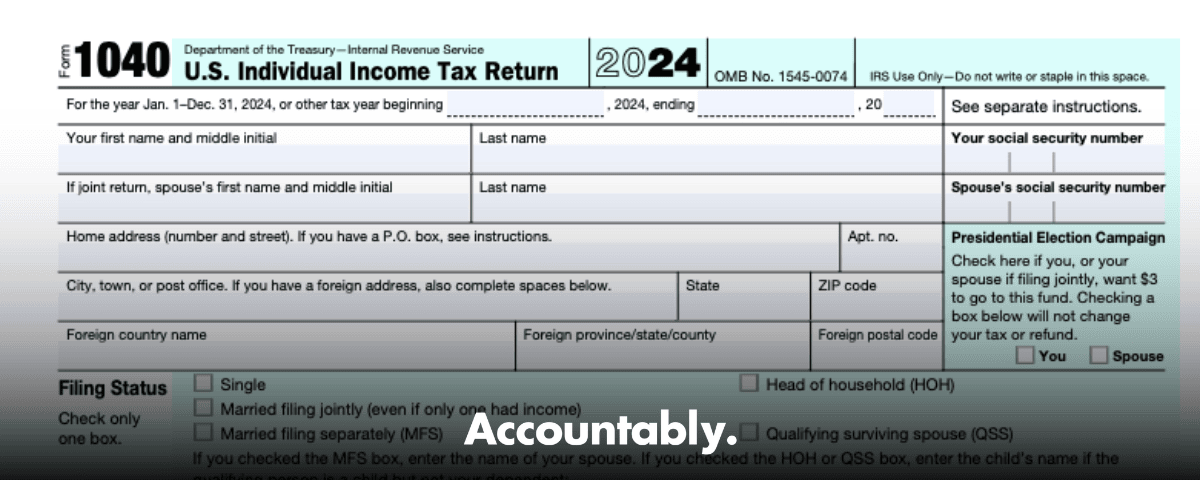
Form 1040 is the annual U.S. individual income tax return. Everyone can file Form 1040, and filers age 65 or older can choose Form 1040‑SR, which uses the same schedules and instructions as the standard 1040. The form centralizes totals and pushes detail to attached schedules. You enter filing status and dependents, summarize your income, apply adjustments, take either the standard deduction or Schedule A itemized deductions, then compute total tax, credits, and payments.
Line 11, Adjusted Gross Income, is the control knob for your return. It is total income minus “above‑the‑line” adjustments from Schedule 1, Part II, such as student loan interest, deductible half of self‑employment tax, and certain retirement or HSA contributions. Many credits and deductions rise or phase out based on AGI, so small adjustments can change your eligibility.
Hundreds of Firms Have Already Used This Framework.
Join the growing list of CPA and accounting firms using Accountably’s Offshore Playbook to scale faster.
???? Get Your FREE Playbook
???? Visit Jugal Thacker’s LinkedIn
Send him a connection request and message “Playbook” to get your copy.
Remember, AGI drives eligibility. If you want to qualify for a credit or keep itemized deductions meaningful, focus on the adjustments that lower AGI first.
You will rely on Schedules 1–3 to move data to the main form, Schedule 1 for additional income and adjustments, Schedule 2 for additional taxes, and Schedule 3 for credits and other payments. These totals flow to Form 1040 and determine your bottom line.
Who Needs to File
You must file Form 1040 when your gross income meets or exceeds the IRS filing threshold for your status and age for the year. If you have net earnings from self‑employment of 400 or more, you must file and complete Schedule SE to figure self‑employment tax. You also must file if you owe additional taxes, for example AMT, household employment tax, or excess Advance Premium Tax Credit repayment. Many people who fall below filing thresholds still file to claim refunds or refundable credits. Check the current instructions to confirm your status and any special rules.
If you are age 65 or older, you can file Form 1040‑SR instead of Form 1040. It is the same return with larger print and an embedded standard deduction chart for easy reference. If you are a nonresident alien with U.S. source income, you must use Form 1040‑NR, which has different rules, including limited access to the standard deduction. If you need to correct a previously filed return, use Form 1040‑X within the time limits.
Deadlines and Filing Options
Your 2024 Form 1040 is due on April 15, 2025. Not ready to file? Submit Form 4868 by that date to extend the filing deadline to October 15, 2025. An extension gives you more time to file, not more time to pay, so estimate your tax and pay by April 15 to limit penalties and interest. E‑file with direct deposit is usually the fastest path to a refund.
Improve Margins Without Compromising Quality
Offshore staffing helps firms deliver more, scale faster, and stay compliant, without adding local headcount.
???? Book a Discovery CallIf you live and work outside the United States on the regular due date, you generally receive an automatic 2‑month extension to file, typically to mid‑June, interest still accrues on any unpaid tax after April 15. Disaster‑area taxpayers may have different automatic deadlines based on FEMA designations, always confirm your county’s current date.
Choosing Between the Standard Deduction and Itemizing
The standard deduction simplifies your return. For the 2024 tax year, the standard deduction amounts are:
| Filing status | Standard deduction (2024) |
| Single or Married filing separately | 14,600 |
| Married filing jointly or Qualifying surviving spouse | 29,200 |
| Head of household | 21,900 |
Use the standard deduction unless your allowable itemized deductions on Schedule A are higher.
When itemizing, focus on four big buckets that meaningfully move the needle:
- Medical and dental expenses, only the amount over 7.5% of AGI is deductible.
- State and local taxes, SALT, limited to 10,000 per return, 5,000 if MFS.
- Home mortgage interest, generally deductible on acquisition debt up to 750,000 total, 375,000 if MFS, with a higher 1,000,000 limit for older debt.
- Charitable contributions, keep proper receipts and acknowledgments for gifts of 250 or more.
Practical tip, if you bought a home, made significant charitable gifts, or had large out‑of‑pocket medical bills, run both options in software. If itemized totals do not exceed the standard deduction, take the standard deduction and keep your records on file.
Understanding Adjusted Gross Income, AGI
AGI lives on line 11 of Form 1040. You reach it by adding up all income, then subtracting allowable above‑the‑line adjustments from Schedule 1, Part II, for example student loan interest, deductible half of self‑employment tax, HSA and IRA contributions, and certain educator expenses. Many credits and deductions start or phase out based on AGI, not taxable income, so AGI planning matters.
Here is a simple workflow you can use before you finalize:
- Gather W‑2s, 1099s, K‑1s, and brokerage statements to compute total income.
- Enter Schedule 1 adjustments to lower AGI where eligible, then confirm line 11.
- Compare the standard deduction to itemized totals on Schedule A.
- If self‑employed, complete Schedule C and Schedule SE, then revisit AGI and credits.
If a rule refers to Modified AGI, MAGI, it means your AGI plus specific add‑backs that vary by credit or deduction, for example tax‑exempt interest for some IRA rules. Check the instructions for the specific credit you claim.
Key Lines You Will Actually Use
Here are the lines most filers should verify:
- Line 1, Wages, confirm against Form W‑2 box 1.
- Line 8, Total income, baseline before adjustments.
- Line 11, AGI, after Schedule 1 adjustments.
- Line 16, Standard deduction or itemized deductions.
- Line 24, Total tax, after credits.
- Lines 25a–25c, Withholding and other payments, used to determine refund or balance due.
If you track these six spots and the schedules that feed them, you will catch most issues before filing.
Estimated Tax Safe Harbor, A Quick Guardrail
To reduce or avoid underpayment penalties, aim for one of these safe harbors through withholding and estimated tax:
- Pay at least 90% of the current‑year total tax, or
- Pay 100% of last year’s total tax,
- Or, if last year’s AGI was over 150,000, pay 110% of last year’s tax.
Farmers and fishers follow different percentages. These rules are spelled out each year in IRS Publication 505, which also lists the quarterly due dates.
Many of us sleep better using the prior‑year tax safe harbor, especially when income is lumpy. Update estimates each quarter if your year changes.
Schedules You May Need To Attach
You do not attach every schedule, only the ones your facts require. Think of Schedules 1–3 as the bridge between your details and the 1040 totals.
- Schedule 1, additional income such as unemployment, prizes, gambling, business or rental, and adjustments like educator expenses, student loan interest, deductible half of SE tax, IRA or HSA contributions.
- Schedule 2, additional taxes such as self‑employment tax, AMT, household employment tax, excess APTC repayment.
- Schedule 3, credits and other payments, for example foreign tax credit, education credits, residential energy credits, clean vehicle credits, and any amount you paid with an extension.
If you itemize, attach Schedule A. If you run a business as a sole proprietor or single‑member LLC, attach Schedule C, and if your net self‑employment earnings are 400 or more, attach Schedule SE. Investment sales use Schedule D, with Form 8949 if required.
Self‑Employment Basics, The Three Forms That Matter
- Schedule C, report revenue and ordinary and necessary business expenses.
- Schedule SE, compute self‑employment tax at 15.3% on net earnings, then claim the deduction for one‑half of SE tax on Schedule 1.
- Estimated tax, if your SE tax and income tax together create a balance at filing, set up quarterly estimates to protect yourself from penalties. For 2024 returns, the SE filing trigger is 400 of net earnings.
If your business qualifies, consider whether the Qualified Business Income, QBI, deduction applies. Use Form 8995 or 8995‑A depending on your taxable income and facts, and attach the form to your return. The 1040 instructions explain the thresholds and forms to use.
Recent Changes and Corrections You Should Apply This Season
Two IRS corrections affect 2024 returns filed in 2025:
- On January 8, 2025, the IRS corrected the 2024 tax rate schedules in the 1040 instructions.
- On January 21, 2025, the IRS corrected Schedule 2, line 21.
Make sure your software or PDF package reflects these changes before you compute tax or additional taxes. The IRS maintains an official “post‑release changes” page you can check anytime.
There is also an earlier correction that still matters when amending older returns, a June 7, 2024 clarification to Schedule 3, line 5b in the 2023 Instructions for Form 1040. The “About Form 1040” page summarizes these corrections with dates. If you used the original instructions for a 2023 filing, review whether you need a 1040‑X.
Keep a note in your workpapers with the exact IRS revision dates you used. It saves time if a notice arrives later.
Key Deliverables for Paper Filers
If you still mail your return, pull the current‑year Form 1040, schedules, and instructions from IRS.gov. Assemble W‑2s showing federal withholding, required 1099s, and any statements the instructions require. The 1040 instructions include signature guidance, assembly order, and reminders to use the correct “Where to File” address for your state and whether a payment is enclosed. Use Certified Mail or another trackable service and keep a complete copy.
Refunds, Payments, and Extensions
Getting Your Refund
Most e‑filed returns with direct deposit are paid in less than 21 days. The IRS updates Where’s My Refund once per day, usually overnight. By law, refunds that include the Earned Income Tax Credit or Additional Child Tax Credit cannot be issued before mid‑February, and for early EITC or ACTC filers, status typically updates by February 22 with funds often available by early March if there are no issues.
Best practice, e‑file, choose direct deposit, triple‑check routing and account numbers, and use Where’s My Refund for status instead of calling.
Making Tax Payments
If you owe a balance, pay by April 15 to limit penalties and interest. The fastest no‑fee option is IRS Direct Pay from your bank account. You can also use a card with a service fee, electronic funds withdrawal when you e‑file, or your IRS Online Account. EFTPS remains available, with the IRS encouraging individual taxpayers to transition toward Direct Pay and Online Account over time.
If you expect to owe this year, set up or adjust quarterly estimated payments. To avoid penalties, meet the safe harbor, pay at least 90% of current‑year tax, 100% of last year’s tax, or 110% if your prior‑year AGI was over 150,000. Publication 505 explains the rules and lists the quarterly due dates, including the mid‑June shift when the 15th lands on a weekend.
Filing an Extension
Need more time to file? Submit Form 4868 by April 15 for an automatic extension to October 15. This extends the paperwork, not the payment, so estimate and pay what you owe with the extension to reduce penalties and interest. The IRS confirms the extension deadline every year near Tax Day.
Variations of the Form, 1040, 1040‑SR, 1040‑NR, 1040‑X
- Form 1040, the standard form for U.S. residents.
- Form 1040‑SR, an optional version for filers age 65 or older. Same lines, larger print.
- Form 1040‑NR, for nonresident aliens with U.S. source income. Filing dates and standard deduction rules differ for many 1040‑NR filers.
- Form 1040‑X, to amend a prior return, often e‑filed now, with a typical processing window of several weeks.
Real‑World Examples You Can Use
- You bought a home in 2024. Check Form 1098 for mortgage interest, then confirm your loan date and balances against Publication 936’s limits. If you have post‑2017 acquisition debt, the total limit is generally 750,000 across your main and second home.
- Your medical bills were high. Add all unreimbursed qualified expenses, subtract 7.5% of AGI, and see if itemizing now beats the standard deduction.
- You changed jobs and received unemployment plus a 1099 from contracting. You will likely use Schedule 1 for unemployment, Schedule C and SE for your contracting income, then revisit AGI and the safe harbor for estimates.
Tip for checklists, write the line number next to each document in your folder. It speeds review and helps you catch a missing 1099 or W‑2 before filing.
For Firm Owners and Ops Leads, Keep 1040 Season From Stalling
If you lead a CPA, EA, or accounting firm, you already know the real choke point is delivery, not demand. Returns slip when workpapers are inconsistent, reviews bounce, or capacity spikes hit in March and mid‑April. A few practical fixes you can apply now:
- Standardize names and version control for workpapers so reviewers spend time on judgment, not hunting.
- Use a two, then three‑layer review for high‑risk returns, preparer to senior to quality, and cut partner review to true exceptions.
- Track turnaround with SLAs by engagement type, for example, clean W‑2 only, rental plus capital gains, Schedule C with SE tax.
- Build continuity plans, so a single absence does not derail a deadline week.
When offshore capacity makes sense, treat it like operations, not staffing. Integrate teams into your systems and SOPs, enforce documentation rules, and measure delivery with clear KPIs. That is the only way offshore adds stability instead of noise. When a firm needs a disciplined offshore delivery system during 1040 season, Accountably can help implement structure, trained teams, and review protection inside your workflow, without over‑taking the page here.
FAQs
What is Form 1040 used for?
You use it to report income, claim deductions and credits, and reconcile your total tax with payments and withholding to determine your refund or amount due. Key lines to confirm, wages on line 1, AGI on line 11, deductions on line 16, total tax on line 24, and payments on lines 25a–25c.
Is Form 1040 the same as a W‑2?
No. Your employer issues a W‑2 that reports wages and withholding. You use those figures to complete your Form 1040. The W‑2 feeds the return, it is not the return.
How do I get a blank Form 1040?
Download the current Form 1040, schedules, and instructions from IRS.gov. The instructions include assembly order, signature rules, and mailing addresses if you file on paper.
Who must file if self‑employed?
If your net earnings from self‑employment are 400 or more, you must file and complete Schedule SE to calculate self‑employment tax, and you will likely make or adjust estimated payments.
When will I get my refund?
Most e‑filed refunds with direct deposit arrive in less than 21 days. Refunds with the Earned Income Credit or Additional Child Tax Credit cannot be released before mid‑February by law. Use Where’s My Refund for status.
What if I need to fix a return I already filed?
File Form 1040‑X with the corrected forms and schedules. Many amended returns can be e‑filed now, and you generally have three years from the filing date or two years from the date you paid the tax, whichever is later, to claim a refund.
Closing Notes
You have everything you need to get Form 1040 right, line numbers to check, schedules to attach, and dates to hit. Focus on AGI, choose the deduction method that actually lowers taxable income, confirm safe harbor coverage if you owe, and file early with direct deposit for a faster refund. If you run a firm, put structure around workpapers and reviews, so your team keeps momentum when March volume hits.
Compliance first, clarity always, and fewer surprises at the end.
Compliance and sourcing notes, figures and deadlines reflect IRS guidance for 2024 returns filed in 2025, including standard deduction amounts, safe harbor rules, and January 2025 corrections. Always confirm the latest instructions on IRS.gov before filing.
Simplify Delivery, Improve Margins, Stay in Control.
Offshore support that works exactly like your in-house team.
???? Let’s Talk