Summarize this article with AI
In Brief
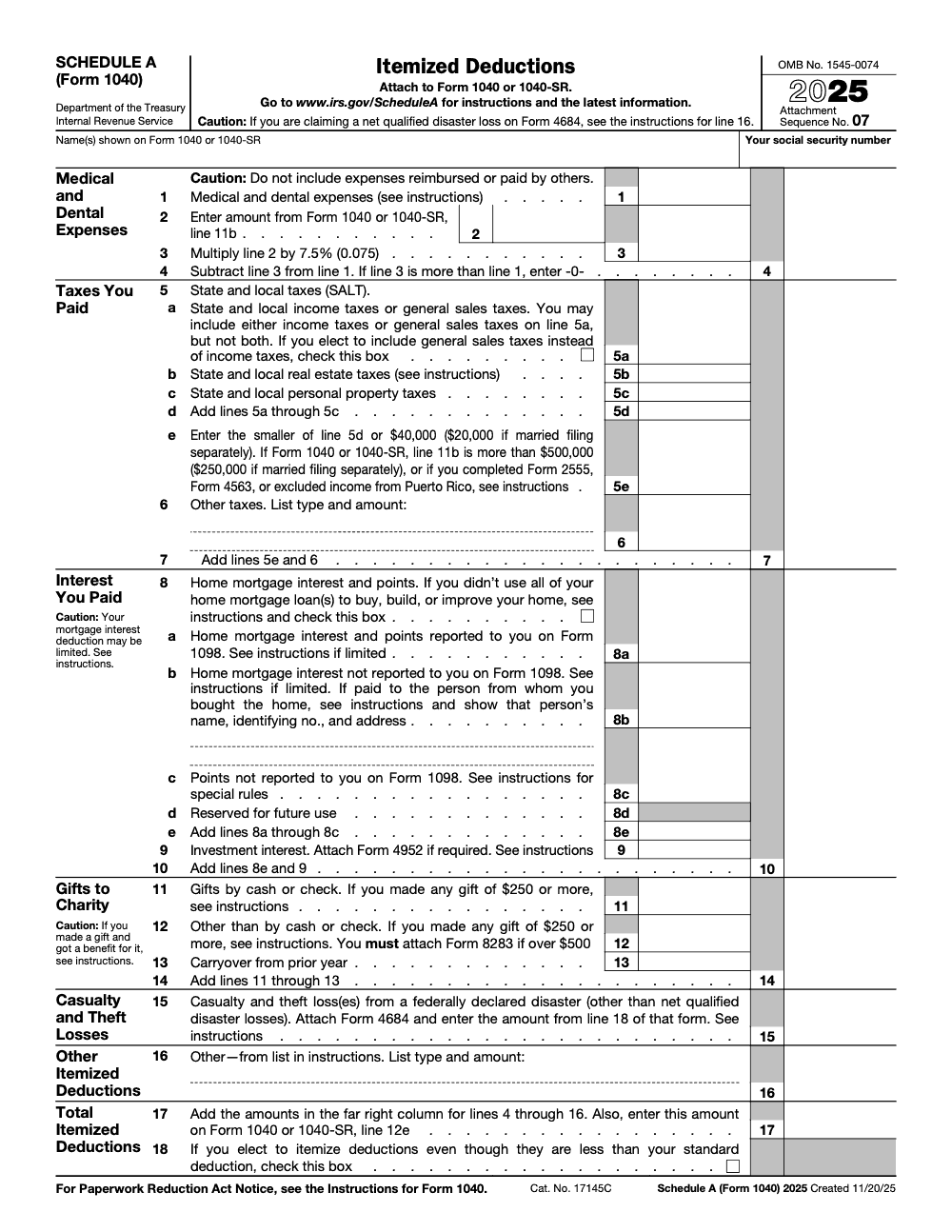
Schedule A (Form 1040) is where you claim itemized deductions in place of the standard deduction. For 2025 it covers medical costs above 7.5% of AGI (line 4), the state and local tax deduction capped at $40,000 on line 5e ($20,000 if married filing separately), home mortgage interest, and charitable gifts; the line 17 total flows to Form 1040 line 12e, and 2025 returns are due April 15, 2026 (per the IRS 2025 Schedule A instructions).
Schedule A comes down to one comparison you have to make honestly before you fill in a single line. Your itemized total has to beat the standard deduction, which for 2025 is $15,750 single or married filing separately, $23,625 head of household, and $31,500 married filing jointly. If your medical, tax, mortgage, and charity numbers do not clear that bar, the schedule is wasted effort and the standard deduction wins.
The pieces that change the math most are the ones with their own thresholds. Medical only counts above 7.5% of AGI, the SALT deduction is capped at $40,000 on line 5e with half that for married filing separately, and mortgage interest follows different limits depending on whether the loan came before or after December 15, 2017.
Key Takeaways
- Schedule A lets you itemize deductions instead of taking the standard deduction on Form 1040. You choose whichever is larger (one exception: if you file married filing separately and your spouse itemizes, you must itemize too, even when the standard deduction would be larger).
- Medical and dental expenses are deductible only above 7.5% of your AGI, and only the unreimbursed portion counts (exclude anything paid or repaid by insurance, an HSA, or an FSA). Keep bills, EOBs, and mileage logs for medical travel.
- For 2025, the standard deduction is generally higher than prior years. It is $15,750 single or MFS, $23,625 head of household, and $31,500 married filing jointly. Compare your itemized total to these amounts.
- For 2025, Congress raised the SALT cap to as much as $40,000 with an income-based phaseout above $500,000 MAGI, with MFS at half those amounts. Itemizers in high-tax states may benefit, so model both paths.
- Mortgage interest on acquisition debt is typically deductible up to $750,000 of principal, with older pre‑12/16/2017 debt under prior $1 million limits. Home equity interest must fund buying, building, or substantially improving the home.
- Casualty and theft losses are deductible only for federally declared disasters, generally on Form 4684 flowing to Schedule A, and only after you reduce each loss by $100 and your total personal-use losses by 10% of AGI.
What Schedule A Is and When to Use It
Schedule A is the form you use to list itemized deductions by category, then carry the total to Form 1040. You should itemize if, and only if, your allowed deductions exceed your standard deduction. That comparison is the entire game. The IRS instructions spell out what counts, what does not, and what documentation to keep.
Here are the standard deduction amounts for tax year 2025 so you can make a quick comparison before you spend time totaling receipts.
2025 Standard Deduction Amounts
| Filing status | 2025 standard deduction |
| Single | $15,750 |
| Married filing separately | $15,750 |
| Head of household | $23,625 |
| Married filing jointly, Surviving spouse | $31,500 |
Numbers reflect IRS inflation updates for 2025 after midyear legislation.
A smart first pass:
- If your mortgage interest plus property taxes already approach your standard deduction, add in state income or sales tax, charitable gifts, and any medical expenses above the 7.5% threshold. If the total beats your standard deduction, itemize.
- If you are close, run both scenarios in software. A small change, like bunching donations in one year, can flip the result.
Itemize when the total of your allowed categories exceeds your standard deduction. Run both paths and pick the larger deduction.
Schedule A, At A Glance
The main categories you can claim
- Medical and dental expenses, but only the portion above 7.5% of AGI.
- State and local taxes, subject to the 2025 cap and phaseout rules.
- Home mortgage interest and points within the acquisition debt limits.
- Gifts to charity with proper receipts or acknowledgements.
- Casualty and theft losses in federally declared disasters, reported on Form 4684.
- Gambling losses, but only up to the amount of your reported winnings.
A quick example to ground the decision
Say your 2025 filing status is married filing jointly. Your standard deduction is $31,500. Your totals look like this:
- Mortgage interest from Form 1098, $17,800
- Property taxes, $9,200
- State income tax withheld, $11,500
- Charitable gifts with receipts, $3,000
- Medical expenses paid, $6,000, with AGI of $120,000 so only the portion above $9,000 counts, which is $0 this year
Your projected Schedule A subtotal before SALT limits is $41,500. In 2025, SALT is capped at up to $40,000, subject to income phaseout above $500,000 MAGI, so your combined state income and property taxes are limited accordingly. With typical incomes below the phaseout, you would likely beat the $31,500 standard deduction and itemize. Always run the precise cap and any phaseout in software.
A note for firms and reviewers
If you manage a tax team, most Schedule A headaches are not technical, they are operational. Clear workpaper naming, a standard SALT worksheet with the 2025 cap logic, and a simple medical-threshold calculator reduce review time. That structure is what prevents rework and missed caps during busy season.
In the next section, we will break down each Schedule A category, what counts, the limits to watch, and the records to keep so your return, or your client files, survive review without last minute scrambles.
Categories of Itemized Deductions You Can Claim
Quick rule of thumb, itemize only when the total of your allowed categories beats your standard deduction for 2025, which is $15,750 single or MFS, $23,625 head of household, and $31,500 married filing jointly.
Medical and Dental Expenses
You can deduct only the part of your medical and dental costs that is more than 7.5% of your AGI. Typical eligible costs include insurance premiums you pay out of pocket, copays, prescriptions, medically necessary dental work, and medical travel at the IRS rate, plus parking and tolls. Track these by person, date, and purpose, and reduce for reimbursements. If you are close to the threshold, consider bunching elective procedures in one calendar year.
What to keep:
- Explanation of benefits, pharmacy logs, invoices, and canceled checks.
- A simple mileage log for medical travel with dates and destinations.
State and Local Taxes, SALT
For 2025, the SALT deduction can be as high as $40,000, $20,000 if you file married filing separately. The cap is reduced for taxpayers with modified AGI above $500,000, $250,000 MFS. If you live in a high tax state, model this number carefully and watch the phaseout. You may deduct either state income tax or general sales tax, plus real estate and personal property taxes, but you cannot deduct both income and sales tax in the same year.
Pro tips:
- If you take the sales tax route, use the IRS tables in your software and add big ticket receipts like a car.
- Prepaying property taxes counts only if the tax was assessed, not just estimated.
Mortgage Interest and Points
Mortgage interest is generally deductible on acquisition debt up to $750,000 in principal, or up to $1 million for older, grandfathered mortgages. Points may be deductible in the year paid if strict tests are met, otherwise they are amortized. Interest on home equity loans is deductible only when the funds are used to buy, build, or substantially improve the home that secures the loan. Keep your Form 1098 and any supporting settlement statements, especially for refinances and points.
Reviewer note for firms:
- Build a short worksheet to trace use of proceeds for home equity debt and to flag debt above the qualified loan limit. It saves back‑and‑forth during review.
Charitable Contributions
You can deduct cash gifts to qualified charities if you have bank records or receipts. Gifts of property require additional documentation, with appraisals for larger amounts. If you received goods or services in return, deduct only the net amount. Year end letters must include the “no goods or services” statement for cash gifts of 250 or more. Keep donation dates tight around December to avoid cutoff issues.
Casualty and Theft Losses
Personal casualty and theft losses are deductible only when attributable to a federally declared disaster. Most filers complete Form 4684 and carry the result to Schedule A. Special disaster rules may allow a deduction without itemizing in certain years and locations, and some thresholds change for qualified disaster losses. Check the disaster declaration dates and keep insurance correspondence and photos.
Gambling Losses
You can deduct gambling losses only if you itemize, and only up to the amount of your gambling winnings reported as income. Keep a diary of sessions with dates, venues, and amounts, and retain W‑2G forms and tickets. Do not net wins and losses on the income line, report full winnings and take losses on Schedule A.
Other Deductions That Still Show Up
A few items, such as amortizable bond premium and estate tax on income in respect of a decedent, remain on Schedule A. The old 2 percent miscellaneous deductions are generally still suspended, so do not expect a deduction for unreimbursed employee expenses in 2025 unless a specific exception applies. Always check the current year instructions.
How to Prepare Schedule A Step by Step
Step 1, Gather the Right Proof
- Form 1098 for mortgage interest, mortgage insurance, and points.
- Property tax bills and proof of payment dates.
- State income tax withheld from your W‑2s, plus any quarterly estimates, or sales tax receipts if you are using that method.
- Medical totals by person with EOBs and a mileage log.
- Donation receipts and year end acknowledgements.
- Disaster documentation for Form 4684 if applicable.
Step 2, Run the Medical Threshold
Total eligible medical costs, subtract 7.5 percent of AGI, and only the excess moves to Schedule A. If you have an HSA or MSA distribution, coordinate first so you do not double count.
Step 3, Compute SALT With the 2025 Cap
Add your state income tax, or sales tax, plus real estate and personal property taxes, then apply the 2025 SALT cap and any phaseout if your income is high. Software handles this well, but verify the inputs and watch for double counting of withholdings and estimates.
Step 4, Enter Mortgage Interest and Points
Use Form 1098 entries, apply the acquisition debt limits, and limit home equity interest to qualifying improvements. For points, confirm the year‑paid deduction tests, or amortize. Keep refinance closing statements in the workpapers.
Step 5, Add Charitable Gifts, Casualty Losses, and Other Items
Record cash gifts, property gifts with fair market value and appraisals when needed, disaster losses per Form 4684, and any remaining permitted “other itemized deductions.”
Aim for clean, named workpapers that mirror Schedule A lines. Clear naming shortens review time and protects you if questions come later.
Comparing Itemizing To The Standard Deduction
Here is the fast way to decide. First, total your allowed Schedule A categories. Next, compare that total to your 2025 standard deduction. For 2025, the standard deduction is $31,500 for married filing jointly, $23,625 for head of household, and $15,750 for single or married filing separately. Choose the larger number, since you cannot claim both.
Quick example, you file jointly and your 2025 itemized totals are $17,800 mortgage interest, $12,000 combined state and local taxes, and $3,000 charitable gifts. Your subtotal is $32,800, which beats the $31,500 standard deduction for 2025, so you would itemize. If your income is high, make sure any SALT phaseout does not pull you back under the standard deduction.
Rule of thumb, if mortgage interest plus property taxes gets you close to your standard deduction, add state income or sales tax, charitable gifts, and medical costs above the threshold. Then run both paths in software and pick the larger deduction.
Limits And Special Rules You Must Apply
Medical And Dental Expenses, The 7.5% Threshold
Only the part of your medical and dental costs that is more than 7.5% of AGI goes on Schedule A. Track insurance premiums you pay out of pocket, copays, prescriptions, and medically necessary dental work. Add mileage and parking for medical travel at the IRS rate. Keep EOBs, invoices, and a simple mileage log.
State And Local Taxes, 2025 Cap And Phaseout
For tax year 2025, individuals who itemize can deduct state and local taxes up to $40,000 in total, $20,000 if married filing separately. This higher cap is reduced for taxpayers with modified AGI above $500,000, $250,000 if married filing separately. You may deduct either state income tax or general sales tax, plus real estate and personal property taxes. Model this carefully if you live in a high tax state.
Mortgage Interest And Points
Mortgage interest is generally deductible on acquisition debt up to $750,000 of principal, with older pre‑12/16/2017 debt possibly under the prior $1 million cap. Interest on home equity loans is deductible only when the funds are used to buy, build, or substantially improve the home that secures the loan. Points may be deductible in the year paid if specific tests are met, otherwise they are amortized. Use your Form 1098 and keep closing statements for refinances.
Charitable Gifts
Cash gifts require bank records or receipts. Property gifts need additional substantiation and, for larger gifts, a qualified appraisal. If you received goods or services, deduct only the net amount. Save year end acknowledgements with the “no goods or services” statement for any single gift of 250 or more. See the Schedule A instructions for documentation language.
Casualty And Theft Losses
Personal casualty and theft losses are deductible only when tied to a federally declared disaster, generally via Form 4684 that flows to Schedule A. Some qualified disaster rules change the usual $100 reduction and 10% of AGI threshold. Confirm your disaster declaration dates and keep photos, adjuster letters, and insurance paperwork.
Gambling Losses
You must report all gambling winnings as income. If you itemize, you can deduct losses only up to your reported winnings, and you need a diary and supporting tickets or statements. Do not net wins and losses on the income line. Enter the full winnings as income, then take losses on Schedule A under Other Itemized Deductions.
Other Line‑Items That Still Appear
A few items remain on Schedule A as “Other Itemized Deductions,” for example amortizable bond premium or federal estate tax on income in respect of a decedent. The Schedule A instructions list what still qualifies. Most former “2 percent” miscellaneous deductions remain suspended.
How To Prepare Schedule A, Step By Step
Step 1, Assemble Proof
- Form 1098 for mortgage interest, mortgage insurance, and points.
- Property tax bills and proof of payment.
- State income tax withheld and estimates or, if using sales tax, your receipts for big ticket items.
- Medical totals by person with EOBs and a mileage log.
- Donation receipts and year end acknowledgements.
- Disaster documentation for Form 4684.
Step 2, Apply The Medical Threshold
Total eligible medical costs, subtract 7.5% of AGI, and only the excess goes on Schedule A. Coordinate with any HSA or MSA distributions to avoid double counting.
Step 3, Compute SALT With The 2025 Cap
Add state income tax, or general sales tax, plus real estate and personal property taxes. Apply the $40,000 cap, $20,000 MFS, and check for the high income phaseout. Software handles this well, but verify inputs and avoid double counting withholdings and estimates.
Step 4, Enter Mortgage Interest And Points
Use Form 1098, apply the acquisition debt limits, and restrict home equity interest to qualified improvements. For points, confirm if they are fully deductible this year or must be amortized. Keep refinance closing statements.
Step 5, Add Charitable Gifts, Casualty Losses, And Other Items
Record cash and property gifts with the right substantiation, disaster losses per Form 4684, and remaining allowed “other itemized deductions.” Keep a clean set of named workpapers that mirror the exact lines on Schedule A.
If you lead a firm, standardized workpaper naming and a single SALT calculator for 2025 prevent rework and speed reviews. That structure is how teams stay accurate during peak season.
Tools, Support, And Filing Options
You can complete Schedule A by hand, yet reputable tax software makes it easier to apply the 7.5% medical threshold, the 2025 SALT cap, and the mortgage interest limits, then carries your total to Form 1040. Upload or enter the documents that support each line so your return stands up to review. If your situation includes disaster losses or complex equity debt tracing, consider a preparer.
Recordkeeping matters. In general, keep records for at least three years after you file, longer in special cases such as bad debt or worthless securities. Save property basis records until after you dispose of the property. Digital copies are fine if they are legible and backed up.
If you run a firm and want smoother reviews, build a short checklist that matches the lines on Schedule A, include a medical threshold calculator, a SALT cap sheet with the 2025 amounts, and a home equity tracing memo. If you need extra capacity without losing control of workflow or quality, it can help to partner with a team that works inside your systems and templates, with clear SLAs and layered review. That is the model we use at Accountably when firms ask for disciplined, U.S.‑led offshore support on seasonal Schedule A work. Keep it light, focus on documentation, and protect review time.
Common Mistakes To Avoid
Schedule A errors cluster around thresholds and substantiation, the two places where a small miss creates big cleanup. These are the ones my team flags most often.
Conclusion
If you take one thing from this guide, make it this. Add up the allowed categories with the right limits, then compare to your 2025 standard deduction, and pick the larger deduction. In 2025 that standard deduction is $31,500 for joint filers, $23,625 for heads of household, and $15,750 for single or married filing separately. That single comparison decides whether you itemize. Use software or a preparer for the medical threshold, the SALT cap, mortgage interest limits, and disaster rules. Keep receipts for three years or more where required. When you do those simple things, you file a clean, defensible return and you can stop second guessing your choice.
Note on accuracy and timing, numbers and rules in this article reflect IRS guidance for tax year 2025 as of November 26, 2025. Always check the current IRS instructions for Schedule A before you file.
Editorial note, this article was prepared by our editorial team and reviewed against current IRS sources. We use automation to help with formatting and checklists, and a human reviewer validates every tax figure and citation.
Reusable Checklists
These checklists are copy-paste ready for your firm SOPs or your own filing folder. Lift them into your Schedule A workpaper and tick each line as you go, against the 2025 IRS Schedule A instructions.
Schedule A intake packet
- Forms 1098 for every mortgage, with the outstanding balance and the acquisition date.
- Year-end medical and dental receipts, net of insurance, HSA, and FSA reimbursements.
- State and local income (or general sales) tax records, real estate tax bills, and personal property tax notices.
- Written acknowledgment letters for every charitable gift of $250 or more.
- Non-cash donation records and a Form 8283 draft when those gifts exceed $500 in total.
- FEMA disaster number and Form 4684 figures for any casualty loss.
- Prior-year Schedule A and any charitable carryover still inside the 5-year window.
2025 limit and cap review
- Pull AGI from Form 1040 line 11b before applying any floor or cap.
- Apply the 7.5% medical floor on line 3 and confirm line 4 is not below zero.
- Cap state and local taxes at $40,000 on line 5e ($20,000 MFS) and run the phaseout above $500,000 AGI ($250,000 MFS).
- Confirm acquisition debt stays within $750,000 ($375,000 MFS) for post-December 15, 2017 mortgages.
- Limit cash gifts to public charities to 60% of AGI and apply the lower limits to non-cash and capital gain property.
- Total line 17 and carry it to Form 1040 line 12e.
Itemize versus standard sign-off
- Compare line 17 against the 2025 standard deduction: $15,750 single or MFS, $31,500 MFJ or qualifying surviving spouse, $23,625 head of household.
- Confirm both spouses use the same method when filing separately, since one itemizing forces the other to itemize.
- Use the line 18 election when a smaller itemized total is still required.
- Check the state return, because itemizing federally can change the state outcome.
- Document the larger-deduction decision in the workpaper.
Keep 1040 Schedule A Season From Stalling
Schedule A turns the March and April crunch into a documentation marathon. Every itemized return carries receipts, Forms 1098, acknowledgment letters, and tax bills that all have to be totaled, floored, and capped before line 17 is trustworthy. The 2025 changes raise the stakes: the SALT cap on line 5e moved from $10,000 to $40,000 with a high-income phaseout, and the standard deduction climbed to $31,500 for joint filers, so the itemize-versus-standard call has to be re-run on more returns than last season (per the 2025 IRS Schedule A instructions).
The bottleneck is rarely the math. It is the review time lost to inconsistent workpapers, missing substantiation, and last-minute tracing of home equity debt. A repeatable structure fixes most of that before a senior ever opens the file.
- Standardize the workpaper around the line order: medical on lines 1 to 4, SALT on lines 5a to 5e, interest on lines 8a to 10, and charity on lines 11 to 14.
- Build a SALT cap sheet that pulls AGI from line 11b and applies the $40,000 cap and phaseout automatically, so high-income returns are never capped by hand.
- Require a written acknowledgment for every gift of $250 or more and a Form 8283 trigger at $500 of non-cash gifts before the file moves to review.
- Add a home equity tracing memo to confirm acquisition debt and the line 8 checkbox, the most common source of late-stage rework on itemized returns.
- Run the itemize-versus-standard comparison against the 2025 standard deduction inside the same workpaper, not in a separate spreadsheet.
That is the discipline we bring to seasonal Schedule A work at Accountably. Our trained, U.S.-led offshore teams plug into your software and templates with documented SOPs and layered review, so itemized returns clear faster without adding headcount. See how our tax preparation support keeps review time down while quality holds.
FAQs
They can reduce state taxable income, but every state is different. Confirm whether your state conforms to federal itemized rules, whether it has its own SALT limitations, and how it treats mortgage interest and charitable gifts. Your software can run a state comparison, then you can decide whether itemizing federally still makes sense. Check your state instructions each year.
No. If you file separately, you cannot combine itemized deductions. Many states follow similar rules and some require both spouses to itemize if one spouse itemizes. Because separate returns often reduce deductions or credits, compare the joint and separate scenarios before you decide.
Usually you handle it in the year you receive the refund. The tax benefit rule applies. Include the taxable portion of the refund in your income only if the earlier year’s itemized deduction lowered your tax, and only up to that benefit. See Publication 525 for the worksheet and details.
Keep receipts, Forms 1098, acknowledgements, and tax notices at least three years after you file. Keep property basis records until after you sell and the limitation period closes on that year. If you claim losses from worthless securities or bad debts, hold those records for seven years. Digitize and back up files.
Yes, for 2025 you can deduct gambling losses up to the amount of your reported winnings if you itemize, and you must keep a diary with tickets or statements. Report full winnings as income first, then claim losses on Schedule A.
Other forms this guide names
Summarize this article with AI
About this guide
Accountably helps US CPA, EA, and accounting firms hire trained accountants and tax preparers in India.
About us Reviewed byJugal Thacker, CPAFounder and CEO at Accountably
A Washington-licensed CPA with 7+ years inside US firms – PwC, a real-estate tax practice, then a full-service firm, rising from reviewer to manager to advisory. This article was reviewed against current IRS guidance for the 2025 tax year and updated for filers preparing late returns, amendments, and 2026 estimates.
View profile →How we research, review, and update this guide
Every Accountably guide is researched against primary IRS sources, reviewed by a U.S. CPA, and refreshed as guidance evolves. Read our Editorial Guidelines to see how we source, fact-check, and update our content.