Summarize this article with AI
In Brief
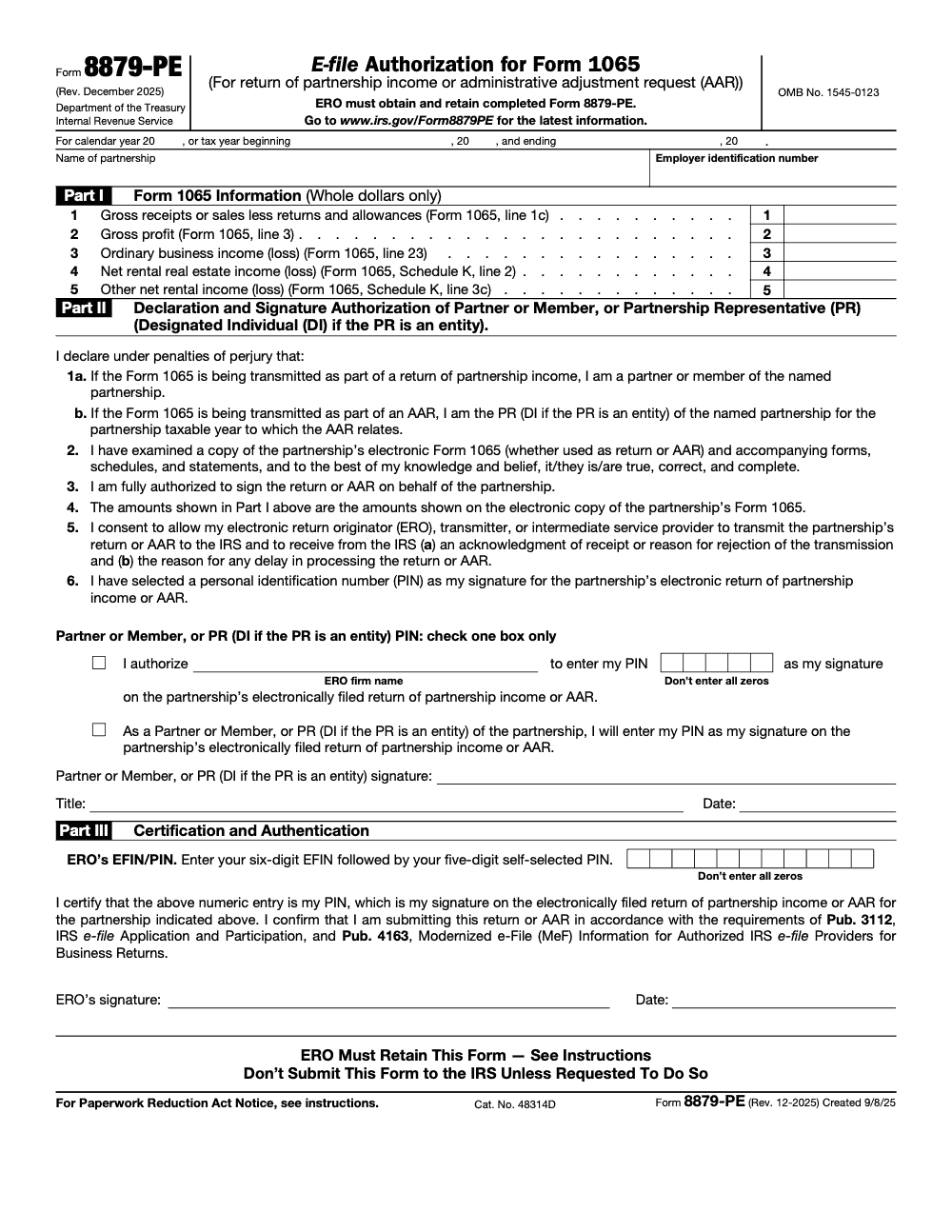
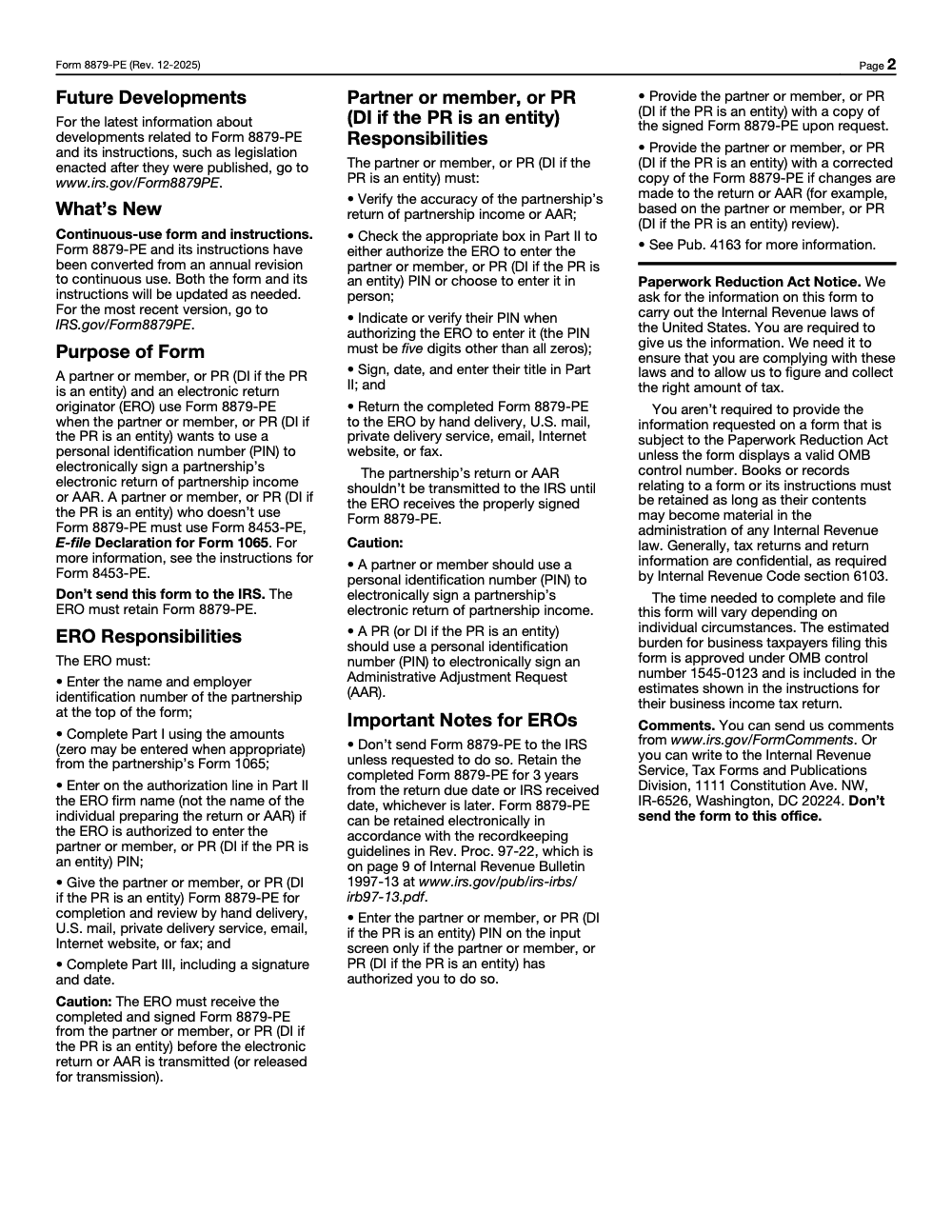
Form 8879-PE is the IRS e-file signature authorization for a partnership’s Form 1065. A partner, member, or Partnership Representative uses a five-digit PIN to electronically sign the return, and the ERO retains the signed form for 3 years from the later of the return due date or the IRS received date (according to the Form 8879-PE instructions, Rev. December 2025). You keep it on file rather than mailing it to the IRS; for end-to-end Form 1065 preparation and review, see our tax services.
When a partnership return stalls, it is usually not because the 1065 was hard. It stalls because the signature step has no system behind it. Form 8879-PE is where a partner, member, or Partnership Representative uses a five digit PIN to sign the return electronically, and because it can be signed electronically, you can build a clean, trackable checkpoint into your workflow instead of chasing paper at the deadline.
Timing is the thing to plan backward from. For calendar-year 2024 returns the 1065 was due Monday, March 17, 2025, because the 15th fell on a weekend, and extensions run on Form 7004. The ERO keeps the signed form for three years from the later of the return due date or IRS received date rather than mailing it to the IRS, so set up your capacity and signature checkpoints around those dates.
Key Takeaways
- You are not short on demand. You are short on a delivery system that holds up under growth.
- Form 8879-PE authorizes an ERO to use a PIN to e-file Form 1065, and it can be signed electronically, which means you can build a clean, trackable signature workflow into your tax process.
- For calendar-year 1065 returns for 2024, the due date fell on Monday, March 17, 2025, because the 15th landed on a weekend. Extensions require Form 7004. Build your capacity, SOPs, and signature checkpoints backward from those dates.
- Offshore capacity fails without structure. Standardized workpapers, clear review tiers, and turnaround SLAs matter more than headcount.
- A disciplined model gives you production stability, shorter reviews, and happy clients, which opens the door for advisory work again.
Why Firms Hit a Delivery Ceiling
You can sell. The roadblock appears when workload spikes and your system bends. Here is where most firms feel the pinch, in plain language.
Capacity Crunch During Peaks
You get buried in March and September. Work arrives in waves, not in neat weekly batches. Without a plan for leveling work, or a way to expand capacity inside a consistent process, teams default to heroics and overtime. That buys a week, not a solution.
Partners Trapped in Review
When workpapers are rushed or inconsistent, reviewers spend time fixing basic items instead of coaching or doing client strategy. Partners wander into file triage because quality gates are unclear. Reviewer time becomes the new bottleneck.
Constant Resourcing Gaps
Hiring takes longer than the workload will wait. Turnover, training, and salary pressure make it hard to add stable capacity on short notice. You end up shuffling jobs to whoever is free, which magnifies rework.
Quality Swings and Missed Deadlines
Different preparers use different file structures. You see version chaos, missing schedules, and unexplained adjustments. Deadlines start slipping, clients start calling, and trust gets dented.
Low Visibility, High Anxiety
If you cannot see what is in prep, in review, waiting on client, or ready to e-file, you cannot lead. The team is busy, yet no one can answer the simple question, “What will be done on Friday?”
Compliance Fatigue
Rules change. States change. IRS updates keep coming. Without a shared playbook and checklists, your team spends energy remembering steps that should have been embedded in the process.
Advisory Buried Under Production
When the system wobbles, smart people get pulled into cleanup. Advisory plans sit on the shelf because everyone is chasing signatures, PDFs, and corrections. That is opportunity cost you can measure.
Why Most Offshore Attempts Struggle
Plenty of firms try offshore help and come back disappointed. The cause is simple. Offshore is not a labor shortcut. It is operations. When treated like staffing, the effort breaks.
- No SOPs, so the same job looks different every time.
- Workpapers are unstructured, so reviews slow down and rework climbs.
- Review cycles are unclear, so reviewers fix what preparers should have caught.
- Documentation discipline is weak, so schedules and support go missing.
- No KPIs or SLAs, so turnaround feels random.
- Vendors send resumes, not accountable teams with a quality layer.
- Teams are not trained to U.S. GAAP and IRS standards, so reviewers babysit files.
- Communication is reactive, not driven by the workflow or ticket.
- Security is loose, which raises real risk with client data.
- Dependency on freelancers means no continuity next season.
Offshore without structure multiplies your chaos. Offshore with structure multiplies your capacity.
Where Form 8879-PE Fits in a Reliable Tax Workflow
Let’s connect this to a specific pinch you can fix right now. Form 8879-PE is the IRS e-file Signature Authorization for Form 1065. A general partner or LLC member manager signs it to authorize the ERO to use a PIN and file the partnership return electronically (when the filing is an Administrative Adjustment Request rather than a Form 1065 return, the Partnership Representative, or the Designated Individual if the PR is an entity, signs instead of a partner). The IRS allows electronic signatures on the 8879 series, which means you can collect, verify, and file without the back-and-forth that derails timelines in March. Build a standard, audited process for 8879-PE, store it with the workpapers, and make its status visible in your tracker.
A Clean, Repeatable SOP for Form 8879-PE
Form 8879-PE is simple on paper, yet it is the small hinge that swings big deadlines. It authorizes your ERO to apply a PIN and e-file the 1065. It must be signed by a general partner or LLC member manager, and you keep it on file, you do not mail it with the return. That means you can lock it into your workflow, collect it electronically, and keep production moving without last‑minute scrambles.
Two Signature Paths, One Decision
You have two compliant ways to handle the e-file signature for partnerships:
- Practitioner PIN method with Form 8879-PE, signed and retained by the ERO, not sent to the IRS.
- Scanned declaration method with Form 8453-PE, transmitted as a PDF with the e-filed return when required.
Here is a quick comparison.
| Method | Form | Who signs | Send to IRS? | Best use case |
| Practitioner PIN | 8879-PE | General partner or LLC member manager | No, retain for your records | Fast, paperless approval, standard for most 1065 e-files |
| Scanned declaration | 8453-PE | Authorized signer | Yes, transmit PDF with return when needed | When attachments or specific circumstances require the 8453 route |
Sources for definitions and usage live on the IRS pages for each form.
Retention, Timing, and Practical Rules
- Retain the signed 8879-PE for at least three years from the return due date or IRS received date, whichever is later. This mirrors the ERO retention rule for 8879 series forms across IRS guidance.
- Collect the completed 8879-PE after the taxpayer has reviewed the prepared return, and before you transmit. Do not wait until the day you plan to file. If the return changes after the partner signs, for example based on that review, provide a corrected Form 8879-PE before you transmit.
- For calendar‑year 1065 returns, the statutory due date is March 15, which moved to Monday, March 17, 2025 for tax year 2024 because the 15th fell on a Saturday. An on‑time Form 7004 extends filing to September 15, 2025. Plan your checkpoints backward from these dates.
Pro tip, treat 8879-PE like a gate on your Kanban board. No signature, no transmission. That one rule cuts down the Friday 6 p.m. chaos.
Your 8879-PE Workflow, Step by Step
1) Pre‑prep setup
- Confirm the signing authority for each partnership at onboarding. Capture the name and title of the general partner or member manager in your CRM, and tag the preferred e-sign identity method.
- Add a client‑facing explainer that shows what 8879-PE is, who signs it, and why you need it. Link the explainer in every 1065 engagement letter.
2) Prep stage
- Populate Part I numbers on 8879-PE from your software once the draft return is complete.
- Queue the 8879-PE for signature with your e-sign tool, or deliver the PDF if your client prefers a wet signature. Either way, track status in your workflow system.
3) Review stage
- Senior reviewer runs a short checklist: workpapers complete, notes cleared, 8879-PE sent, signer verified, deadline in range.
- If your reviewer sees 8879-PE unsigned with less than five business days to file, escalate. Do not let a clean return sit because one form has not been signed.
4) E-file stage
- Receive the signed 8879-PE and validate the signer’s role. Transmit only after the form is back.
- If you are using the 8453-PE route for a specific case, include the PDF in the e-file package per software prompts.
5) After filing
- Store the signed 8879-PE in the client’s permanent e-file folder. Mark it immutable.
- Retain for three years from due date or IRS received date, whichever is later, consistent with IRS retention guidance for 8879 forms. Keep an electronic image that is legible and readable at print size.
Make It Visible With SLAs and Status Tags
Build three simple SLAs around 8879-PE so your team knows what “on time” means:
- Send 8879-PE within 24 hours of internal approval.
- Follow up with the signer within 48 hours if no action.
- Escalate to partner or client ops if unsigned on day 3.
Use status tags that anyone can read at a glance, for example Sent, Reminded, Escalated, Signed. This is where a structured delivery model pays off. When your board shows 50 returns “ready to file” and 46 of them say “Awaiting 8879-PE,” you know your next move without a meeting.
8879-PE and Amended 1065s
If you file an amended 1065, the IRS says you include all changed forms and schedules, attach an Amended Return Statement, and you use either a signed 8453-PE or the Practitioner PIN method with 8879-PE to authenticate the e-file. Build this into your amended return SOP so you do not re‑invent the process in July.
Don’t Forget Security Basics
Your 8879-PE process must respect e-file provider rules and data safeguards. Align with IRS guidance for e-file providers and the safeguarding playbook that the IRS publishes for tax professionals. That means controlled access, audit trails, incident response, and a secure way to move signature documents.
If you use an offshore team, restrict role‑based access, avoid local storage, and capture audit logs on signature workflows. Publications and IRS pages for e-file and data protection give you the guardrails, your delivery system makes them real.
Up next, we will show the broader delivery model that keeps every job moving, how a disciplined review ladder cuts partner time, and the engagement options firms use when they want capacity without chaos.
Delivery Structure Built For Control, Not Chaos
When work hits, you need a system that holds steady. Below is the structure I have seen keep firms calm in March and September, without partners babysitting files.
SOP-Driven Execution
- Write the steps for each engagement type, then make the SOP the default inside your workflow tool.
- Keep checklists short, under 20 items, and stack them by role, preparer list, reviewer list, e-file list.
- Tie SOP steps to status tags, for example Trial Balance posted, Ties to prior year, K‑1s generated, 8879‑PE sent, 8879‑PE signed, E-file accepted.
Consistency is a kindness to your future self. When every job looks the same under the hood, your reviewers fly.
Structured Workpapers That Speed Review
- Use a naming convention that tells the story, for example “01‑TB‑2024.xlsx,” “02‑BankRec‑Operating‑JanToDec.pdf,” “03‑FixedAssets‑Rollforward.xlsx.”
- Group PBC items and support schedules by section, and include a readme that explains unusual items or judgement calls.
- Version control matters. Archive drafts in a dated folder, and keep a single “Current” folder that mirrors the reviewer’s path through the file.
A Multi-Layer Review That Protects Partner Time
- Preparer checks completeness against the internal list before routing.
- Senior review clears tie outs, confirms documentation, and writes clear notes.
- Quality layer samples high‑risk areas, for example revenue, basis, multi‑state, and the final reviewer focuses on conclusions.
- Partner sees a clean summary, exceptions only, and time is spent on client impact, not file cleanup.
Turnaround SLAs, So Everyone Knows “When”
- Set windows by engagement, for example “1040, 3 business days prep, 2 days review,” “1065, 5 days prep, 3 days review.”
- Publish the rule, if the SLA slips, escalate before it becomes a missed date.
- Tie SLAs to capacity planning, and do not overpromise in peak weeks.
Visibility You Can Lead With
- Use a dashboard that shows counts by stage, in prep, in review, waiting on client, ready to e‑file.
- Make blockers visible, missing 8879‑PE, waiting on bank statement, pending SALT clarification.
- Review this board in a 15‑minute daily standup, and solve for flow, not personalities.
Escalation That Prevents Friday Night Surprises
- Give preparers a simple rule, if a task sits more than 24 hours due to a blocker, raise a ticket.
- Define owner by blocker type, signer unresponsive goes to client success, unclear tax position goes to technical lead, system access goes to IT.
- Keep the escalation ladder short, and celebrate people who call issues early.
Capacity Planning That Matches Work To People
- Forecast by entity count, form type, and complexity, not just hours.
- Load balance weekly. If seniors are at 95 percent and preparers at 60 percent, you will stall in review.
- Create continuity plans for key roles, and document handoffs so an unexpected absence does not halt a job.
How Accountably Fits, Only Where It Helps
You can run this system with your team, or you can add controlled offshore capacity where it actually helps flow. Accountably integrates trained offshore professionals into your tools and templates, then runs work through a disciplined model with SOPs, structured workpapers, and clear review tiers. Every professional is trained on U.S. accounting and IRS workflows, onboarded through a 3‑week delivery readiness framework, and works inside your systems, not a vendor portal. You keep workflow control. We bring the steady hands.
We support the software you already use, QuickBooks, Xero, UltraTax, CCH Axcess, ProConnect, Lacerte, Drake, Thomson Reuters, Canopy, Karbon, TaxDome, Suralink, JetPack, and more. The goal is simple, give you capacity without chaos, and protect review time so partners get back to client strategy.
The 8879‑PE Checkpoints Inside That System
- At prep complete, your software fills Part I figures on the 8879‑PE.
- At senior review start, status changes to “8879‑PE sent,” with automatic reminders on day 2.
- At quality layer, reviewer confirms signer authority and file storage path.
- At final review, no signature means no transmission, and the job cannot move to e‑file stage until the form is signed and retained.
- After filing, the signed form is locked in the permanent e‑file folder, and retention rules are set so nothing is misplaced.
This is how you turn a recurring pain point into a quiet non‑event. It is not glamorous, it is dependable.
Signs Your Delivery System Is Working
- Review notes shrink, and the same issues do not repeat.
- You stop moving jobs by gut feel, and start moving them by plan.
- Your team answers “what will be done Friday” without a meeting.
- Clients stop chasing you, because you stop missing dates.
- Partners spend time on advisory, planning, pricing, and recruiting, not file rescue.
When your system steadies, growth stops feeling scary. It feels earned.
Engagement Models That Scale With You
Pick what fits your stage. If you grow, the model grows with you.
| Model | Best For | What You Get | Why It Works |
| Dedicated Offshore Talent | Firms that need steady production capacity | Full‑time accountants or tax staff working in your workflow, aligned to your SOPs and calendars | Stable teammates who learn your preferences and get faster every month |
| White‑Label Delivery Teams | Firms with seasonal spikes or compliance surges | An end‑to‑end team with a manager and reviewers that plugs into your pipeline | You get throughput and quality control without building a whole layer |
| Build–Operate–Transfer Offshore Unit | Firms ready for long‑term control | Your own offshore center with exclusive staff and management, operated to your standards, then transferred | You keep the wins, the know‑how, and the team continuity over years |
No band‑aids, no resume farming. The focus is repeatable execution you can count on.
Security, Compliance, And Work Integrity
You cannot risk client data or compliance exposure. Your delivery model should enforce that.
- SOC 2 aligned controls, NDA‑backed confidentiality.
- Role‑based access, secure VPN, server protection, and audit logs.
- Zero local storage and encrypted file exchange.
- Background‑verified staff and U.S. client data standards.
And the work itself follows U.S. rules:
- U.S. GAAP aligned accounting.
- IRS and state tax standards for partnerships and pass‑throughs.
- Multi‑state payroll familiarity.
- Sales tax automation workflows.
- Documentation that stands up to audit.
Work We Support Today
Accounting Execution
- Month‑end close and reconciliations.
- AP, AR, and cleanup.
- Financial reporting packages and multi‑entity consolidation.
- Fixed assets and depreciation.
- GL reviews, adjustments, and cash flow support.
Tax Execution
- 1040, 1120, 1120S, 1065, and 990 preparation.
- State and local tax, plus cleanup and review support.
- Workpaper preparation that makes reviews faster.
CAS And Payroll Support
- Monthly financial packages.
- Payroll review and T&E allocations.
- Client onboarding, cleanup, and year‑end processing.
Built For Firms Serious About Scale
When the system is right, you feel it.
- Production stability, no more capacity panic.
- Delivery efficiency, faster approvals and fewer reworks.
- Operational maturity, less dependency on individual heroes.
- Review protection, smart workpapers cut review time.
- Client trust, dates met, fewer excuses.
- Margin durability, lower cost per file without losing quality.
- Growth freedom, partners back in advisory and expansion.
This is not generic, plug-and-play outsourcing. This is structured offshore and outsourced staffing, used only where it adds control.
Next Step
If you want to keep your team sane and your clients happy, start with the delivery system and the 8879‑PE workflow. If you want help, we can plug in a trained offshore team that runs inside your tools and templates, follows your SOPs, and protects your review time.
Common Mistakes We See Every Season
Over many partnership seasons, the same handful of 8879-PE slips show up, and each one can stall a clean Form 1065 e-file on filing week. Here are the ones we catch most often, with the fix we bake into the SOP.
Reusable Checklists
Copy these into your firm SOP or e-sign template so every 1065 e-file moves the same way. The steps reflect the Form 8879-PE instructions.
Pre-transmission 8879-PE gate
- The partner, member, or PR has reviewed the prepared return for accuracy.
- Correct signer confirmed: a partner or member for a Form 1065, the PR or Designated Individual for an AAR.
- Exactly one Part II PIN-entry method is checked, never both and never neither.
- The five-digit partner, member, or PR PIN is entered and is not all zeros.
- The Part I amounts on the form match the five amounts on the e-filed Form 1065.
- The signed form arrived through one of the six permitted delivery channels.
- The six-digit EFIN and five-digit ERO PIN are entered in Part III, and the ERO firm name is on the Part II authorization line, not in Part III.
ERO completion sequence
- Enter the partnership name and EIN at the top of the form.
- Complete the five Part I lines from Form 1065 in whole dollars, including any zeros.
- Enter the ERO firm name on the Part II authorization line if authorized to enter the partner PIN.
- Deliver the form to the signer for review and signature.
- Sign and date Part III after the signer returns the form.
- Transmit only after the signed form is in hand.
Retention and corrected-copy log
- File the signed 8879-PE in the permanent e-file folder, marked read-only.
- Keep it for 3 years from the later of the return due date or IRS received date.
- If stored electronically, confirm the image is legible and meets the Rev. Proc. 97-22 storage guidelines.
- Provide the signer a copy of the signed form on request.
- Issue a corrected 8879-PE if the return or AAR changed after signing.
- Never mail the form to the IRS unless it is specifically requested.
Keep 8879-PE Season From Stalling
Partnership season has a quiet bottleneck that has nothing to do with the return itself. Every 1065 e-file waits on one signed Form 8879-PE arriving before you can transmit, and the Form 8879-PE instructions require the ERO to hold that signed form for 3 years from the later of the return due date or IRS received date. When dozens of partnerships stack up in the same window, a single missing signature can hold an otherwise finished return.
The fix is not more reminders, it is a structured workflow where the authorization is treated as a tracked deliverable rather than an afterthought. When the 8879-PE has an owner, a status, and a deadline, the signature stops being the thing that surprises you on filing week.
- Pull the five Part I amounts from Form 1065 lines 1c, 3, and 23 and Schedule K lines 2 and 3c the moment the draft return is final, so the form is ready to send.
- Route a partner or member to sign a Form 1065, but route the Partnership Representative, or the Designated Individual if the PR is an entity, for an Administrative Adjustment Request.
- Offer the signer any of the six permitted delivery channels, from secure email to fax, so the signature is never blocked by one missing option.
- Trigger a corrected 8879-PE automatically whenever a post-signature change touches the Part I amounts.
- Gate transmission on the signed form so no return moves to the IRS without the authorization on file.
This is the kind of repeatable execution we build into every engagement. If partnership filings keep outgrowing the hours you have, a trained offshore team can run the 8879-PE workflow inside your tools and SOPs through structured tax preparation and review, so signatures, retention, and transmission stay on schedule.
FAQs
A general partner or LLC member manager with authority to sign the return on a Form 1065. For an Administrative Adjustment Request (AAR), the Partnership Representative, or the Designated Individual if the PR is an entity, signs instead. Capture this at onboarding and verify during review so you do not stall on filing week.
No, unless the IRS specifically requests it. You keep the signed form in your records as the ERO. Store it with the e‑file workpapers and make it read‑only after filing.
Keep it for at least three years from the due date or the IRS received date, whichever is later. A clear retention rule saves you from painful retrievals later.
Yes, the IRS permits electronic signatures for the 8879 series. Use a secure e‑sign tool and record the audit trail.
8879‑PE supports the Practitioner PIN method and is retained by you. 8453‑PE is a scanned declaration that is transmitted with the return in specific cases. Most firms standardize on 8879‑PE.
Update your CRM and engagement letter, verify authority, and resend the 8879‑PE. Do not transmit until the correct signer authorizes.
Do not file. Escalate, call the signer, and use a same‑day e‑sign option. Build this rule into your workflow so no one clicks transmit without the authorization on file.
Other forms this guide names
- Form 1065: Guide, Deadlines, K‑1, K‑2/K‑3, E‑File
- Form 1065: Schedule K-2 and K-3 Guide 2025, one month date rules
- Form 8453-PE: What It Is, How to File, vs 8879-PE
- Form 8879: IRS e-file Signature Authorization Explained
- Form 1040: Filing Guide for 2025 Returns (AGI, Deductions, Deadlines)
- Form 7004: Business Tax Extension Guide, Deadlines & E‑File
About this guide
Accountably helps US CPA, EA, and accounting firms hire trained accountants and tax preparers in India.
About us Reviewed byJugal Thacker, CPAFounder and CEO at Accountably
A Washington-licensed CPA with 7+ years inside US firms – PwC, a real-estate tax practice, then a full-service firm, rising from reviewer to manager to advisory. This article was reviewed against current IRS guidance for the 2025 tax year and updated for filers preparing late returns, amendments, and 2026 estimates.
View profile →How we research, review, and update this guide
Every Accountably guide is researched against primary IRS sources, reviewed by a U.S. CPA, and refreshed as guidance evolves. Read our Editorial Guidelines to see how we source, fact-check, and update our content.