Summarize this article with AI
In Brief
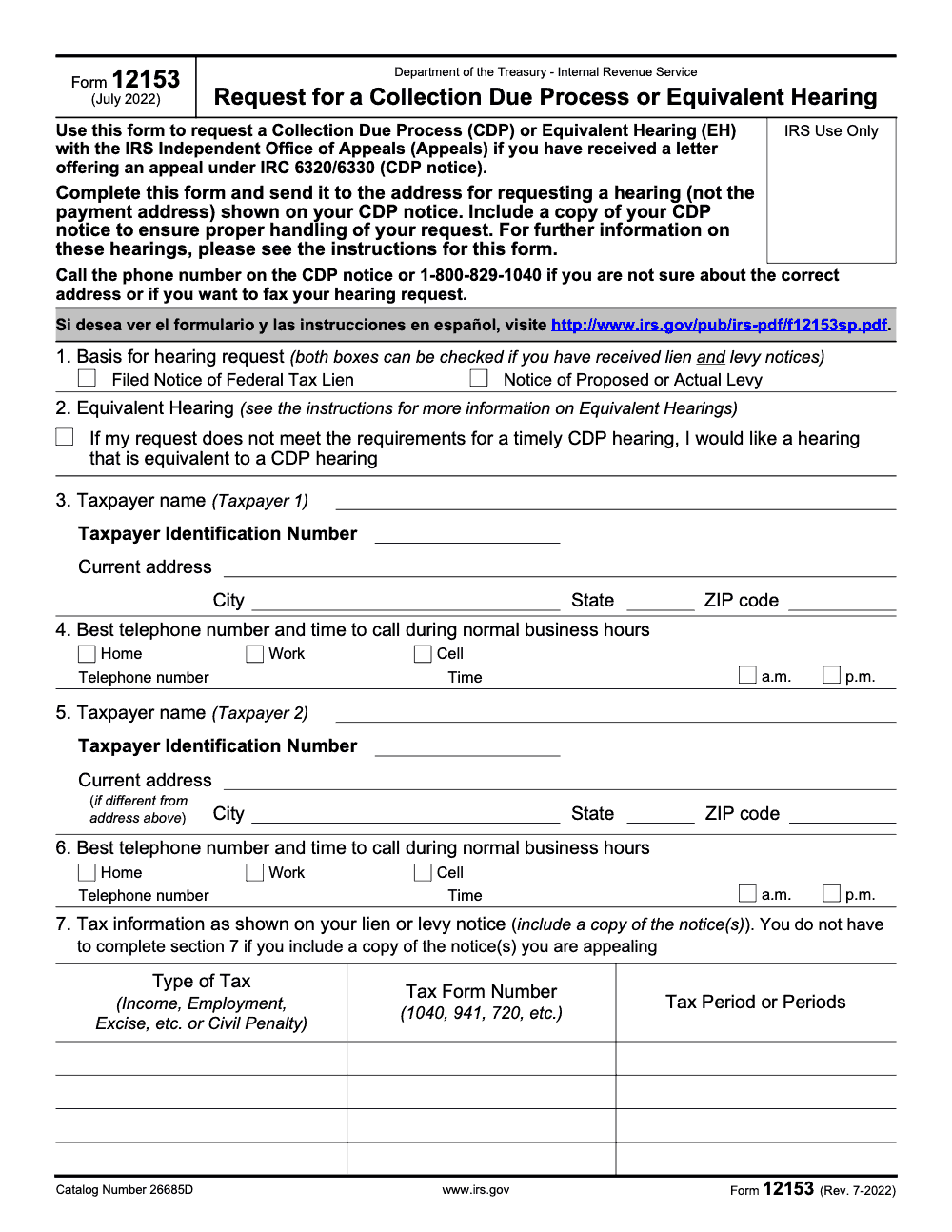
Form 12153 requests a Collection Due Process (CDP) hearing or Equivalent Hearing with the IRS Independent Office of Appeals after a Notice of Federal Tax Lien under IRC §6320 or a proposed or actual levy under IRC §6330. A timely CDP filing prohibits most levy action and suspends the 10-year collection statute under IRC §6502; the Equivalent Hearing backup (one year from the levy notice, or one year plus five business days from the NFTL filing date) gives Appeals review only, with no levy stop, no statute suspension, and no judicial review. Mail the form to the hearing address on your CDP notice (not the payment address) and route Section 9 collection alternatives through a structured tax delivery process.
After a Notice of Federal Tax Lien under section 6320 or a proposed or actual levy under section 6330, Form 12153 is the request that can actually stop collection. A timely Collection Due Process filing prohibits most levy action and suspends the 10-year collection statute under section 6502 while Appeals reviews the case. Miss the CDP window and the Equivalent Hearing backup gives you Appeals review only, with no levy stop, within one year of the levy notice or one year plus five business days from the lien filing date.
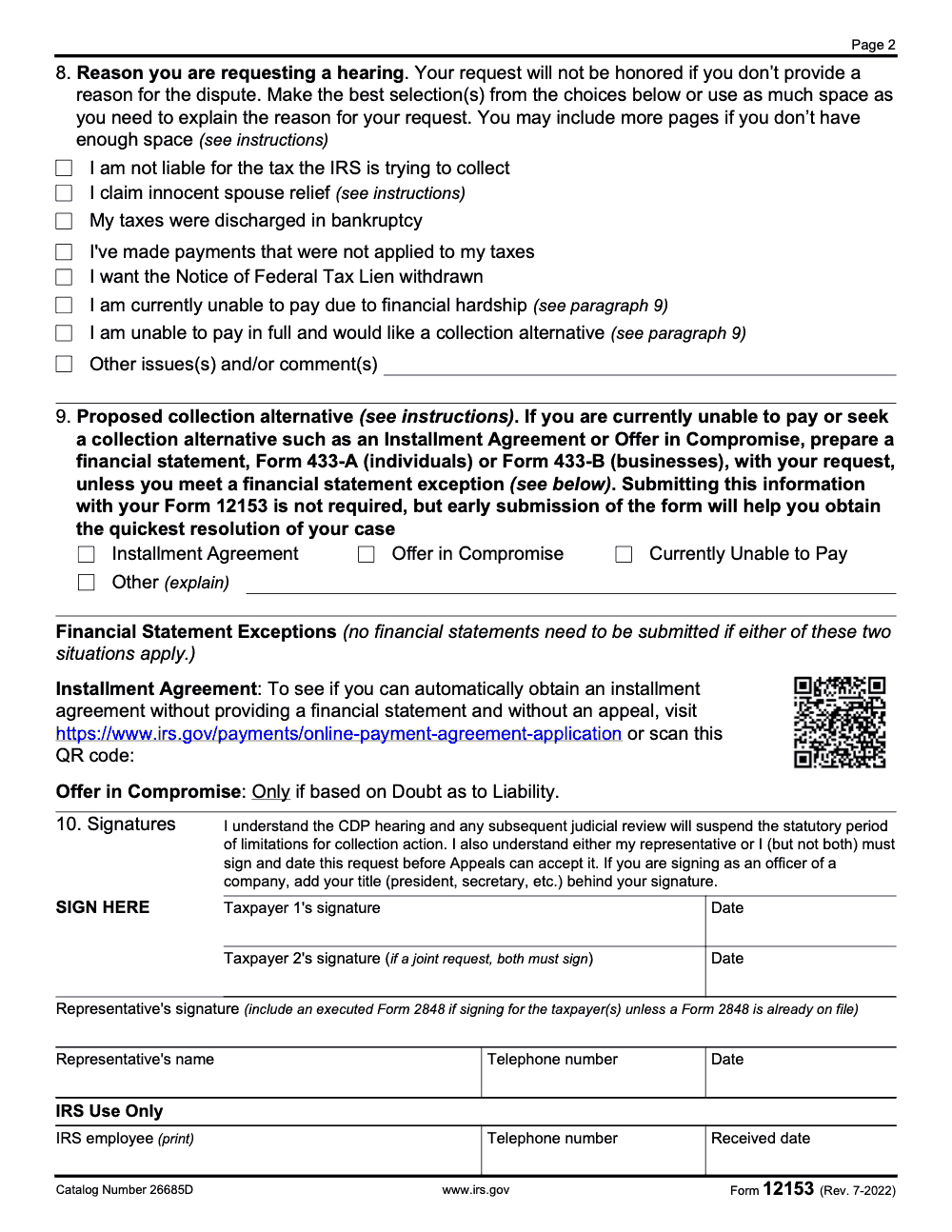
Three spots on the form quietly decide whether the protections hold. Section 8 states the reason for the hearing, and checking the innocent spouse box alone is not enough, because Form 8857 has to be completed and attached. Section 9 proposes a collection alternative and generally needs Form 433-A for individuals or Form 433-B for businesses. Section 10 must be signed by the taxpayer or the representative but not both, and a representative needs an executed Form 2848. Mail it to the hearing-request address on the notice, not the payment address, and keep proof of the send date.
Key Takeaways
- Form 12153 requests a Collection Due Process (CDP) hearing or Equivalent Hearing with the IRS Independent Office of Appeals after a Notice of Federal Tax Lien under IRC §6320 or a proposed or actual levy under IRC §6330.
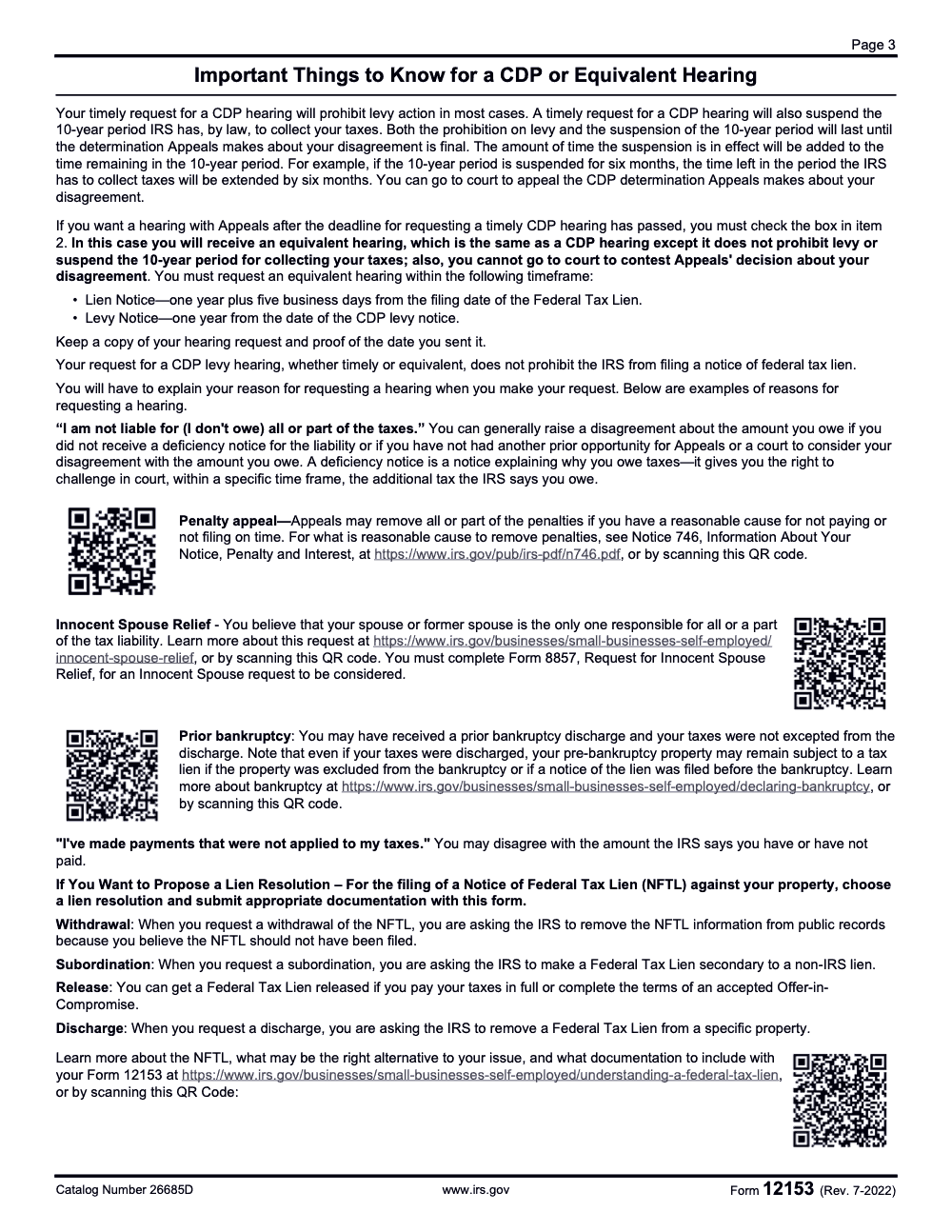
- A timely CDP request prohibits levy action in most cases and suspends the 10-year collection statute under IRC §6502 until the Appeals determination (and any subsequent judicial review) becomes final; the suspension time is added back to the remaining collection period.
- If the CDP window is missed, an Equivalent Hearing must be requested within one year of the CDP levy notice (for levy notices) or within one year plus five business days from the filing date of the Notice of Federal Tax Lien (for lien notices). Equivalent Hearings do not prohibit levy, do not suspend the 10-year statute, and are not subject to judicial review.
- Mail Form 12153 to the hearing-request address shown on the CDP notice (not the payment address) and include a copy of the CDP notice; keep proof of the send date.
- Section 8 lists the reason for the hearing; checking the innocent spouse box alone is not enough – Form 8857 must also be completed and attached.
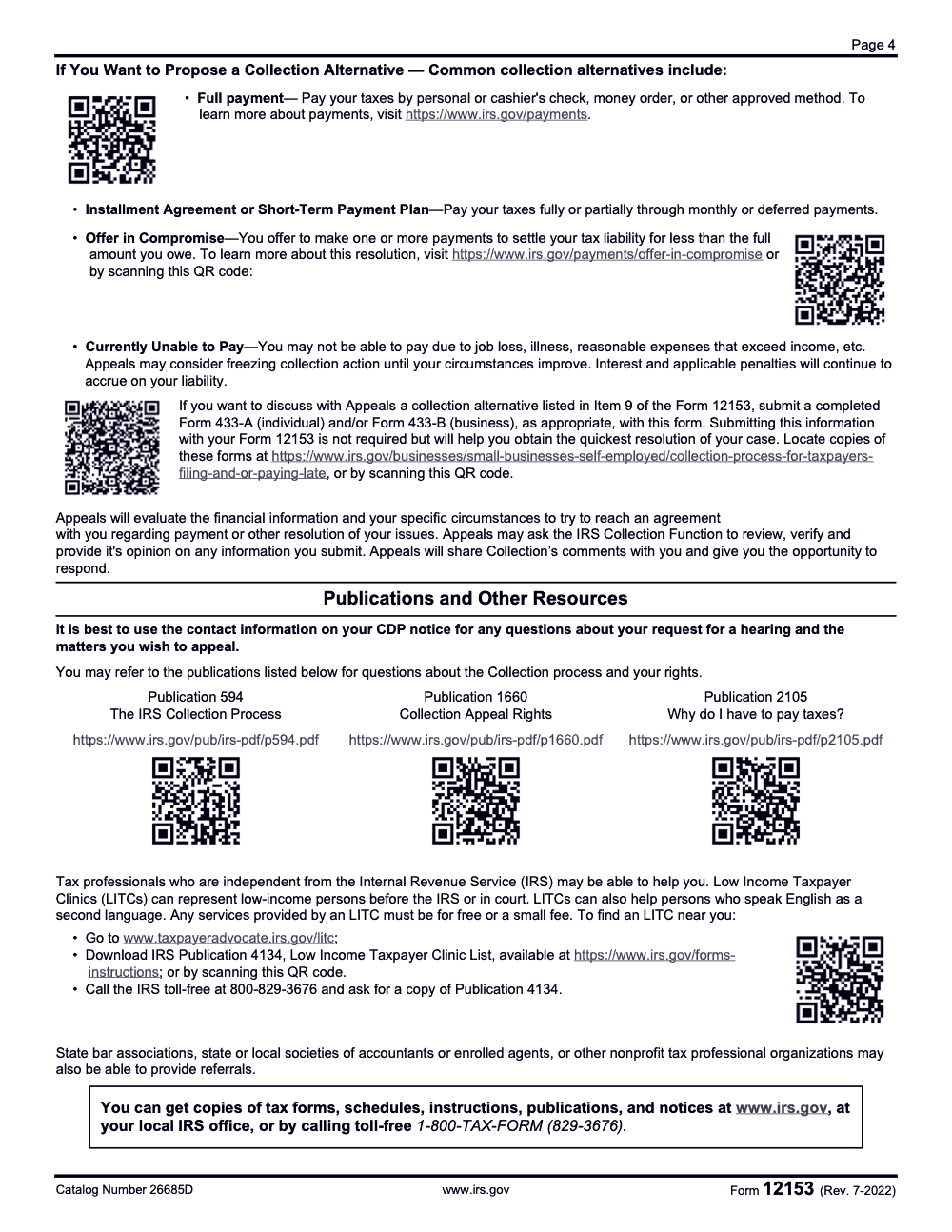
- Section 9 proposes a collection alternative (Installment Agreement, Offer in Compromise, Currently Unable to Pay, or Other); Form 433-A (individuals) or Form 433-B (businesses) is required unless the OIC is based on Doubt as to Liability.
- Either the taxpayer or the representative – but not both – must sign Section 10; for a joint request, both spouses must sign as taxpayers, and a representative needs an executed Form 2848.
2025 Deadlines You Cannot Miss
CDP Timing After Levy or Lien
- Levy notices, LT11 or Letter 1058, you have 30 days from the notice date to send a signed hearing request. A timely request generally suspends levies on the tax periods in the notice while Appeals decides the case.
- Lien notices, Letter 3172, you have 30 days after the first five business days following the filing of the NFTL to submit a CDP request. Levy suspension works differently in lien cases, however taxpayers typically still get protection from levy on the periods in a timely levy-based CDP, and Appeals works the lien issues during the hearing.
If you miss those windows, you can still ask for an Equivalent Hearing within one year of the CDP levy notice, or within one year plus five business days from the filing date of the Notice of Federal Tax Lien in lien situations. Equivalent Hearings do not stop levies by statute and you usually cannot petition Tax Court if you disagree.
What Actually Pauses, And For How Long
A timely CDP request suspends levy activity that is the subject of the hearing, and it tolls the collection statute until you withdraw the request or the Appeals Notice of Determination (and any subsequent judicial review) becomes final. Equivalent Hearings do not toll the statute and do not automatically stop levies.
There are exceptions, for example jeopardy, certain state refund levies, specific employment tax scenarios, or a court order allowing levy during litigation. These carve outs are rare, but they exist.
Who Can Request, And The Signature Rules That Trip People Up
- The taxpayer named on the notice may request the hearing. A representative can sign only if a valid Form 2848 is on file or attached.
- If a representative signs without a proper 2848, the IRS treats the request as unprocessable until fixed, which can cost you the CDP window. If you correct missing pieces later, the original timely, processable request date is preserved, but signatures are not something Appeals can assume, so sign it right the first time.
Keep the notice together with your Form 12153, list the exact tax periods and forms, for example 1040 2022, and make your issues clear in Sections 8 and 9. If you want alternatives, include Form 433‑A or 433‑B and the documents those forms require, pay stubs, bank statements, housing and medical bills. This reduces back‑and‑forth and gets you to a decision faster.
How To Complete Form 12153, Step By Step
Before You Start
- Pull your notice and confirm the deadline and submission method. Some notices now include the IRS Document Upload Tool with a one‑time access code, others list a fax or a specific mailing address. Do not use a general IRS address.
- Use the latest Form 12153 included with your notice or from IRS resources, then make sure the taxpayer or an authorized representative signs.
Line‑By‑Line Priorities
- Taxpayer info, copy the name, address, and TIN from the notice to avoid mismatches.
- Tax type and periods, enter the exact form number and period years on your letter.
- Check CDP or Equivalent Hearing, choose CDP if you are within the 30‑day window, if late, check Equivalent Hearing and send it within one year of the CDP levy notice (or within one year plus five business days from the NFTL filing date for lien notices).
- Explain your issues in Sections 8 and 9, for example inability to pay, request for installment agreement, lien withdrawal, innocent spouse if eligible (checking the Section 8 box is not enough on its own, you must also complete and attach Form 8857, Request for Innocent Spouse Relief, for the request to be considered), or, when permitted, questions about the underlying liability. Support that with documents.
- Attach financials if you want alternatives, Form 433‑A or Form 433‑B, with the documents those forms require.
- Sign and date, attach Form 2848 if a representative is signing. Incomplete signature authority can block processing.
Tip, send by certified mail or other trackable delivery, or use the upload option shown on the notice. Keep the receipt with a copy of your form. If you mail on day 30, the postmark counts.
Where, When, And How To File
- Mail or fax to the exact address for requesting a hearing shown on your notice, which is different from the payment address, or, if offered, upload through the IRS Document Upload Tool using the access code on the letter.
- For levy notices, get a postmark within 30 days of the notice date. For lien notices, get a postmark within 30 days after the first five business days following the filing of the lien.
- If you are outside the CDP window, check Equivalent Hearing and submit within one year of the CDP levy notice (or within one year plus five business days from the NFTL filing date for lien notices) to preserve an administrative review, understanding that collection can continue.
CDP vs. Equivalent Hearing, Side‑By‑Side
| Item | CDP Hearing, timely Form 12153 | Equivalent Hearing, late but within one year |
| Filing window | 30 days after levy notice, or 30 days after the first 5 business days following lien filing | Within 1 year of the CDP levy notice (levy), or 1 year plus 5 business days from the filing date of the Notice of Federal Tax Lien (lien) |
| Levy suspension | Generally suspended for periods in the CDP while Appeals and any court review are pending, subject to limited exceptions | Not required to be suspended, policy holds may apply in some cases |
| Statute of limitations | Collection statute is tolled during the hearing and court review | Not tolled |
| Court review | 30 days to petition U.S. Tax Court after a Notice of Determination | No Tax Court, except narrow issues like innocent spouse or interest abatement |
| What to use | Form 12153, check CDP | Form 12153, check Equivalent Hearing |
Sources, IRS CDP FAQs, IRM 5.1.9 and 5.19.8, and Treasury regulations 301.6320‑1 and 301.6330‑1.
What Happens After You File
Timeline And What To Expect
- A timely CDP request usually shifts your file to Appeals. An Appeals Settlement Officer, who was not involved in your case before, will schedule a conference, most often by phone. Expect first contact in about a few weeks to a couple of months, then a request for documents if you are proposing payment options.
- During a timely levy‑based CDP, most levy action on the periods in the notice is paused. Lien filings on other periods can still occur and the IRS may take certain non‑levy actions. Exceptions like jeopardy and state refund levies exist.
- The collection statute is paused during a timely CDP from the date the IRS receives your request until the determination becomes final. After Appeals issues a Notice of Determination, you have 30 days to petition Tax Court.
How To Prepare For Appeals
Bring complete, recent financials. Include Form 433‑A or 433‑B with pay stubs, bank statements, rent or mortgage, utilities, medical costs, and any special circumstances. The better your packet, the faster Appeals can decide on an installment agreement, Currently Not Collectible, or an Offer in Compromise.
“Use as much detail as possible to state your issues,” the IRS advises in its CDP FAQ. That advice saves time and reduces repeated requests.
Collection Alternatives You Can Propose With Form 12153
Installment Agreement
If you can pay over time, propose a monthly amount you can sustain and support it with Form 433‑A or Form 433‑B. Appeals will review income, necessary expenses, and equity to see what fits. If a prior installment agreement was rejected or terminated, remember you also have separate CAP appeal rights on that action with specific 30 day timing.
Currently Not Collectible, CNC
If your verified expenses leave little or no ability to pay, ask for CNC. Provide detailed proof of income and required living expenses. Appeals can place your account in hardship status when the numbers support it. CNC pauses active collection like levies and garnishments, however interest and applicable penalties continue to accrue on the unpaid balance.
Offer in Compromise
If the balance is more than you can pay before the statute expires, you can pursue an Offer in Compromise. You may note your intent on Form 12153, however Appeals often needs the full OIC forms and supporting statements to evaluate ability to pay and any doubt as to liability.
Lien Actions
Ask for lien withdrawal, release, subordination, or discharge when you have legal or factual grounds, for example a paid balance that did not update, a refinance that benefits collection, or to sell property free of the lien with proceeds to the IRS. Appeals will weigh the facts with Collection Advisory. For office contacts, see Publication 4235.
If You Disagree With Appeals
- Timely CDP case, you will receive a Notice of Determination. If you disagree, you have 30 days to file a petition in U.S. Tax Court. Calendar that date immediately.
- Equivalent Hearing, you will receive a Decision Letter. There is generally no Tax Court review except for narrow issues such as spousal relief or interest abatement, or when timeliness itself is at issue.
Missed the petition deadline, consider audit reconsideration, refund claims, or help from the Taxpayer Advocate Service or a Low Income Taxpayer Clinic.
Fast Administrative Relief, When To Use CAP Instead
When speed matters or you need an administrative check on a levy, lien filing, seizure, or an installment agreement rejection or termination, use the Collection Appeal Program, CAP. You start with the employee and then a group manager review. If still unresolved, submit Form 9423 within the short windows shown on your notice. CAP decisions are final inside the IRS and usually cannot be taken to Tax Court.
CAP, The Practical Flow
| Step | Action | Key Document |
| 1 | Speak with the employee on the notice | Collection notice |
| 2 | Request a conference with the group manager within 2 business days | Internal memo or email |
| 3 | If unresolved, file the appeal within the notice window | Form 9423 |
| 4 | Provide financials if you want payment options | Forms 433‑A or 433‑B |
| 5 | Appeals reviews and issues a decision | Appeals letter |
Timeframes are tight. The IRM explains that, after a manager conference, Form 9423 generally must be received or postmarked within three business days to keep collection on hold in most situations. For rejected or terminated installment agreements, a 30 day CAP window applies.
Real‑World Pitfalls To Avoid
- Waiting until day 30 to start. Mail delays happen, use certified mail or upload when available. Keep proof.
- Sending an unsigned form. Appeals cannot process a hearing request without a valid signature, and a representative needs a proper 2848.
- Listing the wrong tax periods. Copy exactly from the notice so the right modules get protected.
- Skipping financials when you need relief. If you want an installment plan, CNC, or an offer, include the 433 and support up front to speed a decision.
Where To Get Help And Official Resources
- Download Form 12153 and read the CDP FAQs. They cover what Appeals can consider, what to submit, and how to speed things up with a complete packet.
- Read Publication 594 for the collection process and Publication 1660 for appeal rights under CDP and CAP.
- If you qualify, a Low Income Taxpayer Clinic can help at little or no cost. For urgent hardship or delays, contact the Taxpayer Advocate Service.
If your notice includes a document upload link or code, you can submit your Form 12153 and attachments electronically. Follow the notice, then save the confirmation.
How Accountably Supports CDP Work For Firms
If you run a CPA, EA, or accounting firm, you want your clients protected quickly without clogging your partner time in review loops. Our teams are trained on U.S. procedures and work inside your systems to standardize workpapers, track CDP deadlines, assemble 433 packages with support, and keep submissions clean, complete, and on time. This means fewer revisions, faster Appeals responses, and better client outcomes, all inside your firm’s workflow and templates. Use us when you need disciplined execution across peak season or when staff capacity is stretched.
Accountably integrates with tools firms use daily, QuickBooks, Xero, UltraTax, CCH Axcess, ProConnect, Karbon, Canopy, TaxDome, and more, so your CDP pipeline stays visible, documented, and on schedule. This is infrastructure, not resume farming.
Conclusion
If a levy or lien notice just landed, you have a narrow window to breathe, organize, and act. A complete, timely Form 12153 preserves your rights, usually pauses most levies on the listed periods, and gives Appeals what it needs to consider payment plans, hardship, or a settlement you can live with. Match your filing to the notice address or upload portal, sign it properly, attach the right financials, and keep your proof. That is how you protect options and move toward a durable resolution.
Common Mistakes We See Every Season
The mistakes below repeat every CDP cycle, almost always because the notice clock runs faster than a busy intake process. Each one converts a winnable CDP into an Equivalent Hearing, or worse, into an unprocessable filing that loses the window entirely.
Reusable Checklists
These checklists are copy-paste ready for firm SOPs. Drop them into the engagement workspace and run them as the gating quality check before any Form 12153 packet leaves the office.
CDP Pre-Flight
- Pull the CDP notice and capture three dates: the notice date (for levy), the NFTL filing date (for lien), and the postmark cutoff for the 30-day CDP window.
- Confirm the hearing-request address, fax destination, or IRS Document Upload Tool access code from the notice. Do not use the payment address.
- Copy taxpayer name, address, and TIN from the notice into Section 3 (and Section 5 for a joint request) rather than retyping from prior returns, to avoid mismatches.
- Complete Section 7 with the exact Type of Tax (Income, Employment, Excise, Civil Penalty) and Tax Form Number (1040, 941, 720), or attach a copy of the CDP notice in lieu of Section 7.
- Mark Section 1 boxes for the notice type at issue, lien or levy or both, and check Section 2 only if the CDP window has already passed and the file is an Equivalent Hearing.
- Write the reason for the hearing in Section 8 in plain language and attach additional pages if the listed checkboxes do not cover the dispute.
- Confirm Section 10 signatures: taxpayer chain or representative chain (never both), both spouses on a joint request, and an executed Form 2848 attached if a representative is signing.
- Ship by certified mail or the IRS Document Upload Tool, keep proof of the send date, and file a copy of the full packet in the engagement workspace.
Section 9 Collection Alternative Packet
- Identify the proposed alternative on Section 9: Installment Agreement, Offer in Compromise, Currently Unable to Pay, or Other.
- For Installment Agreement, Offer in Compromise (other than Doubt as to Liability), or Currently Unable to Pay, prepare Form 433-A for individuals or Form 433-B for businesses.
- Attach the supporting documents the financial statement requires: recent pay stubs, three months of bank statements, mortgage or rent, utilities, medical bills, and verification of any special circumstances.
- If the OIC basis is Doubt as to Liability, document the basis in writing and skip Form 433-A or 433-B per the Form 12153 instructions.
- For a Currently Unable to Pay request, note in the file that interest and applicable penalties continue to accrue on the unpaid liability while the account sits in hardship status.
- For Innocent Spouse Relief, attach a completed Form 8857 and identify the relief years on the same cover page.
- Stamp the packet with a single version-control number and store the final under the CDP file rather than the general client folder.
Equivalent Hearing Deadline Math
- Confirm the CDP window has lapsed before defaulting to an Equivalent Hearing, since late but processable CDPs still preserve full protections.
- For a levy-based Equivalent Hearing, calendar one year from the date of the CDP levy notice as the EH filing deadline.
- For a lien-based Equivalent Hearing, calendar one year plus five business days from the filing date of the Notice of Federal Tax Lien, not from the date of the CDP lien notice.
- Check the Section 2 Equivalent Hearing box, otherwise Appeals may treat the late filing as unprocessable rather than as an EH election.
- Tell the taxpayer in writing that an Equivalent Hearing does not prohibit levy, does not suspend the 10-year collection statute under IRC §6502, and is not subject to judicial review.
- If the taxpayer needs any of those three protections, evaluate whether a CAP appeal or other administrative path applies instead.
Keep 12153 Season From Stalling
CDP work is not seasonal the way 1040 or 941 cycles are, but it is brutally deadline-driven. Every CDP notice starts a 30-day clock (measured from the levy notice date, or from five business days after the NFTL filing date for lien notices) that, if missed, collapses the file into an Equivalent Hearing and strips three protections at once: the levy prohibition, the suspension of the 10-year collection statute under IRC §6502, and the right to petition Tax Court. Publication 594 frames CDP rights as a core taxpayer protection, and Publication 1660 details the appeals path, yet the most common reason taxpayers lose those rights is process drift inside the firm, not the law.
The fix is not more heroics on day 28. It is a structured intake-to-mail workflow that treats every CDP notice as a deadline event the moment it lands, with the right base dates captured, the right Section attachments staged, and the right signer chain validated before the packet leaves.
- Calendar Section 1 dates separately at intake, the levy notice date for the 30-day CDP window and the NFTL filing date for the lien-based Equivalent Hearing math (one year plus five business days).
- Pre-stage Form 433-A or Form 433-B whenever Section 9 proposes Installment Agreement, Offer in Compromise (other than Doubt as to Liability), or Currently Unable to Pay, so Appeals does not have to chase financials after the hearing is scheduled.
- Run a Section 10 signature check on every packet: taxpayer chain or representative chain (never both), both spouses on a joint request, and an executed Form 2848 attached if a representative is signing.
- Default the send method to certified mail or the IRS Document Upload Tool with a saved access code, and file the postmark or upload receipt next to the packet copy.
- Track each CDP file through Appeals contact, conference, and Notice of Determination, with a separate 30-day Tax Court petition deadline calendared the moment the Notice of Determination is issued.
This is the disciplined production layer that converts a high-stakes IRS notice into a managed file rather than a fire drill. Accountably's structured tax delivery integrates trained U.S.-led offshore teams into existing CDP and Appeals workflows, with documented SOPs for intake, signature validation, Section 9 packet build, and Appeals follow-through, so the deadline is the calendar's problem and not the partner's.
FAQs
Form 12153 is the request for a Collection Due Process hearing or an Equivalent Hearing after a levy or lien notice. A timely request routes your case to Appeals and usually pauses levy action for the periods listed while the hearing is pending. It does not, however, prohibit the IRS from filing a Notice of Federal Tax Lien.
You meet, often by phone, with an independent Appeals Settlement Officer. The officer verifies legal steps, considers issues you properly raised, and evaluates options like an installment agreement, CNC, or an offer using your Form 433 data and documents. Afterward you receive a Notice of Determination.
Use the exact address, fax, or upload link on your notice. The IRS instructs taxpayers to rely on the notice itself for the correct destination and many notices now include the Document Upload Tool with an access code. Keep dated proof.
You can still file within one year of the CDP levy notice (or within one year plus five business days from the NFTL filing date for lien notices) for an Equivalent Hearing. Collection does not have to stop, the 10-year collection statute is not suspended, and there is generally no Tax Court review of the decision. If you need fast administrative intervention, consider CAP with Form 9423.
Sometimes, but not always. Appeals can consider liability only in limited circumstances, for example if you did not previously receive a statutory notice of deficiency or you did not have a prior chance to dispute the liability. The CDP FAQs explain your other routes, refund claim, audit reconsideration, or an Offer in Compromise, doubt as to liability.
Other forms this guide names
- Form 433-A: IRS Collection Information Statement Guide
- Form 433-B: Business IRS Guide, Requirements & How to File
- Form 2848: Guide to Line 3, Filing, and Rules
- Form 8857: Innocent Spouse Relief Guide, Deadlines, Filing
- Form 9423: CAP Guide to Stop Levies, Liens, Seizures
- Form 1040: Filing Guide for 2025 Returns (AGI, Deductions, Deadlines)
About this guide
Accountably helps US CPA, EA, and accounting firms hire trained accountants and tax preparers in India.
About us Reviewed byJugal Thacker, CPAFounder and CEO at Accountably
A Washington-licensed CPA with 7+ years inside US firms – PwC, a real-estate tax practice, then a full-service firm, rising from reviewer to manager to advisory. This article was reviewed against current IRS guidance for the 2025 tax year and updated for filers preparing late returns, amendments, and 2026 estimates.
View profile →How we research, review, and update this guide
Every Accountably guide is researched against primary IRS sources, reviewed by a U.S. CPA, and refreshed as guidance evolves. Read our Editorial Guidelines to see how we source, fact-check, and update our content.