Summarize this article with AI
In Brief
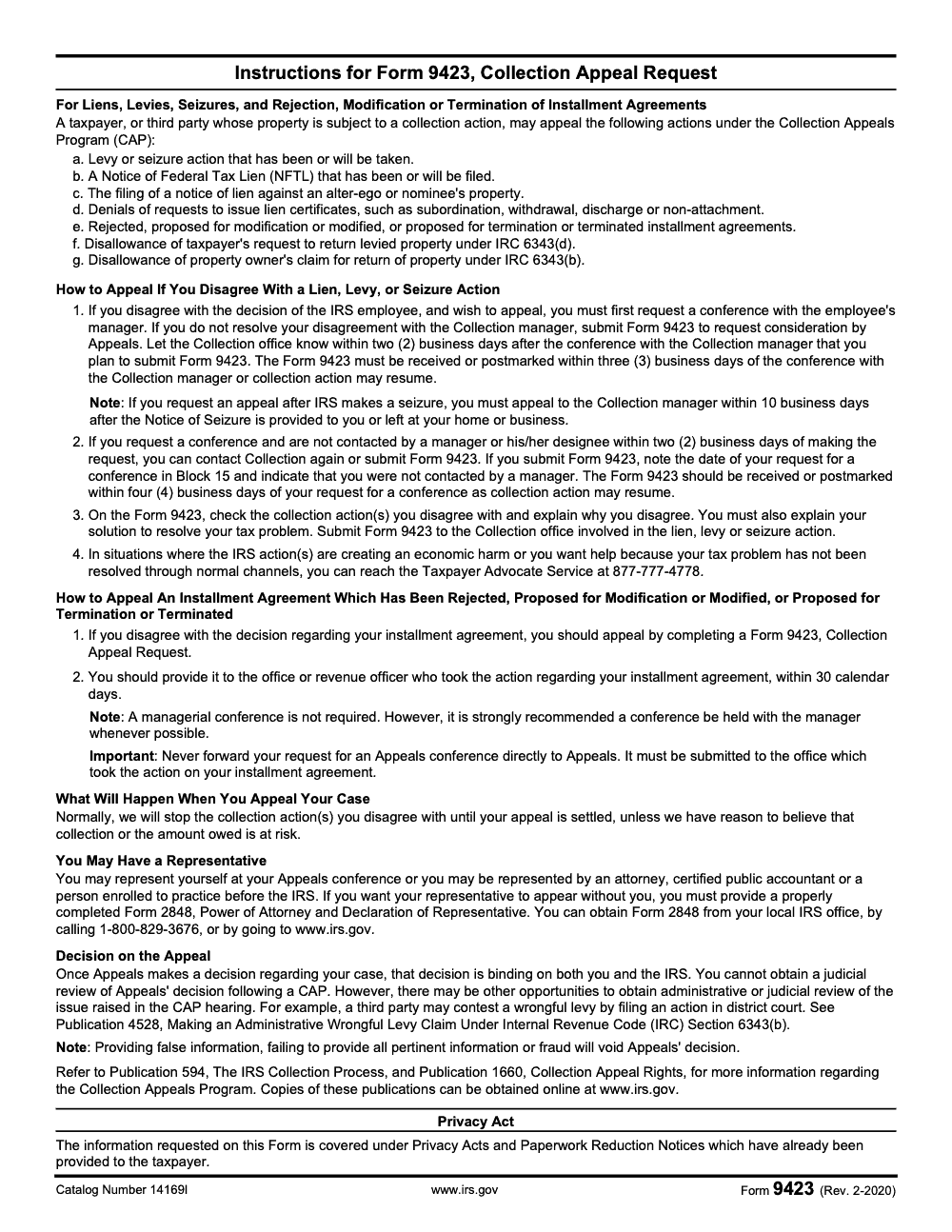
Form 9423 is the Collection Appeal Request used under the IRS Collection Appeals Program (CAP) to challenge a lien, levy, seizure, denied lien certificate, or installment agreement decision (per the IRS Form 9423 instructions, Rev. February 2020). For most lien, levy, or seizure actions you first hold a manager conference, notify Collection of your intent within 2 business days, then get the form received or postmarked within 3 business days; installment agreement appeals run on a 30 calendar day window. File it with the Collection office on your notice, never directly to Appeals, and line up professional tax representation if a wage levy or seizure is already in motion.
A bank levy notice arrives late on a Thursday and the instinct is to deal with it next week. That instinct loses the case. By Friday morning the clock on a Form 9423 appeal is already running, and one wasted day can let a levy clear an operating account before anyone files a thing.
Form 9423 is the Collection Appeal Request under the IRS Collection Appeals Program, used to challenge a lien, levy, seizure, or installment agreement decision. For most lien, levy, or seizure actions you hold a manager conference first, tell Collection within 2 business days that you intend to appeal, then get the form received or postmarked within 3 business days. Seizures give you 10 business days from the Notice of Seizure, and installment agreement appeals run on a 30 day window. CAP is final and not court reviewable, so when you need Tax Court left open, Form 12153 and CDP is the other road.
Key Takeaways
- Use Form 9423 to appeal a lien, levy, seizure, or an installment agreement decision under the Collection Appeals Program, then expect a faster, focused review.
- After a required manager conference for most actions, tell Collection within 2 business days that you will submit Form 9423, and get it received or postmarked within 3 business days. This timing preserves the pause on enforcement.
- For seizures, you have 10 business days from the Notice of Seizure to appeal through CAP.
- For rejected, modified, proposed for modification, proposed for termination, or terminated installment agreements, you generally have 30 days to appeal, and levy action is restricted by statute during that window and while a timely appeal is pending.
- CAP is final and not court reviewable. If you need the option to go to Tax Court or to contest the underlying tax, consider CDP via Form 12153 instead.
Who This Guide Is For
You lead or support a U.S. accounting firm, CPA or EA practice, or a tax controversy team that handles IRS collections for business and individual clients. You know the code and the forms, your constraint is time, organization, and clear next steps that your staff can execute without drama. This guide gives you a field-tested playbook, including timelines, evidence checklists, and submission tips your team can follow today.
What Is Form 9423 and How CAP Works
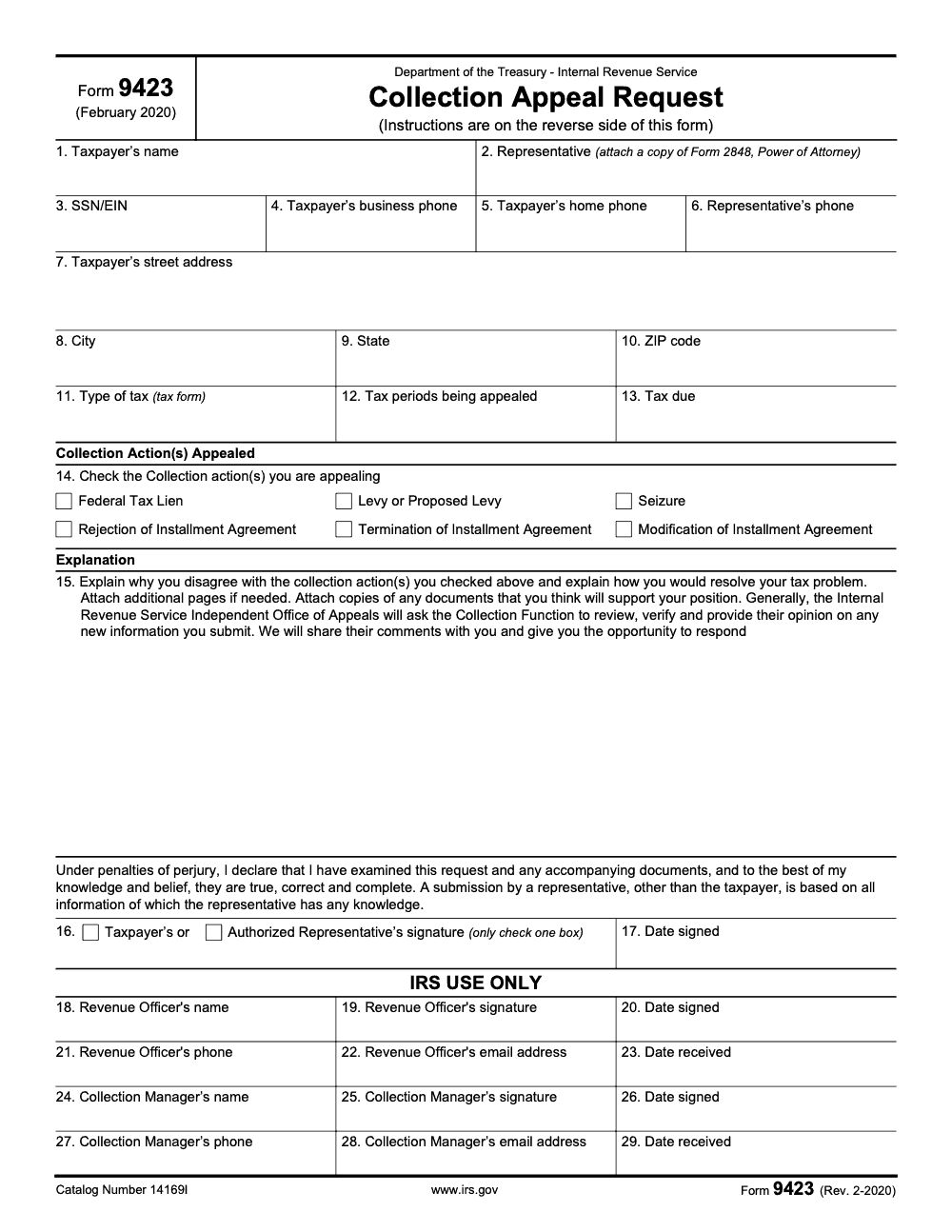
Form 9423 is your request for a Collection Appeals Program review. You use it when the IRS has taken or plans to take a collection action you believe is wrong, premature, or disproportionate. CAP looks at whether the IRS followed procedure and whether the action fits the facts, and it moves quickly. In most cases, once you submit a timely CAP request to the Collection office that issued the action, collection is paused until Appeals decides, unless collection is in jeopardy. Decisions are binding on both sides, and there is no judicial review of a CAP determination, though the underlying issue may still have other administrative or judicial review options (for example, a third party may contest a wrongful levy in district court).
When to Use Form 9423
File Form 9423 when you face or anticipate any of the following, and you want fast scrutiny and a potential hold on enforcement:
- Federal tax lien, filed or proposed
- Levy or proposed levy, including bank or wage levy
- Seizure already made
- Installment agreement, rejected, modified, proposed for modification, proposed for termination, or terminated
- Denial of a request to return levied property These are all squarely within CAP’s scope.
The One Thing That Trips Up Firms
Routing. Do not send Form 9423 to Appeals. Mail, fax, or deliver it to the address or contact on the triggering notice, typically the revenue officer or local Collection office. Submitting to Appeals first can delay or derail routing, and timing is everything in CAP.
CAP vs. CDP, Choosing the Right Path
Both CAP and CDP can halt enforcement once you file properly, yet they serve different goals. Use CAP when speed and procedural review are paramount. Use CDP when you need broader rights, including Tax Court review and, when allowed, a chance to dispute the underlying liability.
CAP vs. CDP At A Glance
| Item | CAP, Form 9423 | CDP, Form 12153 |
| What it reviews | Collection action propriety and procedure | Collection action, and in some cases underlying liability |
| Typical speed | Days to weeks | Weeks to months |
| Court review | Not available | Available if you file timely |
| Manager conference | Required for most non‑IA issues | Not required |
| Installment agreement timing | 30 days to appeal, levy restricted by statute during that window and pending appeal | CDP clock runs off specific lien or levy notices, generally 30 days |
| Where to file | Collection office on your notice | Address on your CDP notice |
| Primary use case | Fast relief from a levy, lien, or seizure, or IA decisions | Preserve court rights, consider underlying tax |
| Citations, CAP file to Collection and is fast, no court review. CDP, timely 30 days, court review preserved if timely. |
Deadlines You Must Calendar
- Manager conference window, notify intent within 2 business days, then file within 3 business days after that conference for most non‑IA issues.
- Seizure, 10 business days from the Notice of Seizure to request CAP.
- Installment agreements, 30 days to appeal rejections, modifications, proposed terminations, and terminations.
Steps To Take Before You File Form 9423
Preparation is half the win. Two moves set up a clean, fast review, the manager conference, then a complete evidence packet.
Request a Manager Conference
Call the revenue officer or the number on the notice, then ask to speak with the Collection manager. State exactly what you disagree with and what you want, for example levy release, lien withdrawal, or IA reinstatement. If you cannot resolve it, tell the manager you intend to file Form 9423. Note the date, time, and the manager’s name. Then, meet the CAP timing, tell Collection within 2 business days that you plan to file, and get the form received or postmarked within 3 business days after the conference. If the manager does not respond within 2 business days, you may submit Form 9423 and note that on the form, in which case the postmark target is within 4 business days of your conference request.
Gather Supporting Documents
Build a labeled evidence packet so Appeals can verify facts quickly:
- IRS notices that triggered the action, include notice numbers, dates, and the office or officer name
- Identity and tax period details, SSN or EIN, return copies for the period in dispute, and a signed Form 2848 if represented
- Financials, recent pay stubs, three months of bank statements, P&L or ledger, monthly expense summary, and if relevant a current Form 433
- Action‑specific documents, prior payments, canceled checks, IA terms and payment history, property valuations, seizure receipts
- A one‑page chronology with the relief you want, for example, release, withdrawal, modification These materials allow Appeals to review substance, not guesswork.
How To Complete Form 9423
Taxpayer Information, Keep It Exact
Match IRS records to prevent delays. Use the legal name on file, the correct SSN or EIN, the full mailing address, and a reachable phone number. If a representative will act for you, attach Form 2848 with precise taxpayer, tax types, periods, and the Collection office or case ID. Sign under penalty of perjury, or have your authorized representative sign within the scope of their 2848.
Identify The Collection Action You Are Appealing
Specify the action, lien filed or proposed, levy or proposed levy, seizure, or an IA decision. Include the notice or letter number, the date on the notice, the IRS office or revenue officer’s name, tax type and period, and the total assessed amount. Note whether the action is proposed or already executed. If there are multiple actions, list each with its identifiers. Precision speeds intake and routing.
Write A Tight, Evidence‑Driven Explanation
Use numbered facts with dates, figures, and cross‑references to exhibits:
- Open with the action and outcome you seek, for example, “Appeal of Notice of Intent to Levy dated 08/12/2025, requesting levy release.”
- Tie each assertion to a labeled exhibit, for example, “1) Three months of bank statements show net monthly loss, Exhibit A. 2) Approved direct‑debit IA on 05/15/2025, confirmation ID ####, Exhibit B.”
- If claiming hardship, summarize net income, allowable expenses, and disposable income, with references to your ledger or Form 433 and exhibits.
- Close with a concrete proposal, for example IA terms, lien withdrawal after payment, levy release, or a short enforcement hold to complete documentation. This structure mirrors how Appeals reads the file, and it cuts the back‑and‑forth.
Where and How To Submit Form 9423
Send Form 9423 to the IRS Collection contact on the notice, the local Collection office, or the assigned revenue officer, not to Appeals. Use certified mail with return receipt or a fax with a transmission confirmation, and keep a full copy of everything you send. If you met with a manager, preserve the 3‑business‑day filing window after that conference, and notify the officer or manager within 2 business days that you will submit.
Proof Of Submission, Do Not Skip This
Your best defense is a clear paper trail. Keep the certified mail receipt or fax confirmation with your copy of Form 9423, Form 2848, and all exhibits. If you filed after a manager conference, your proof shows you hit the 2‑day intent notice and the 3‑business‑day postmark. For a seizure, track the 10‑business‑day appeal window from the Notice of Seizure date.
What Happens After You File
Once the Collection office receives your CAP request, it forwards the case to the IRS Independent Office of Appeals. Appeals acknowledges the case, may ask Collection to review any new information, then schedules an informal conference by phone, video, mail, or in person. Many matters resolve within days to a few weeks. During a timely CAP, collection normally stops unless the IRS believes collection is at risk. The decision is binding on you and the IRS, though providing false information or failing to disclose all pertinent facts can void it.
Practical Tips For The Appeals Conference
- Have your packet open to the same exhibit list you sent, so you can cite tab and page.
- Lead with the remedy you want, then the facts, then the exhibits, in that order.
- Be ready to answer questions about ability to pay, alternative remedies, and timelines.
- If you need a short hold to complete a payment or to upload missing proof, ask for it directly, with a specific date.
CAP vs. CDP, How To Decide In Real Life
Choose CAP when you need speed to pause a levy or to address a lien filing that just hit a financing deal. Choose CDP when you need the right to petition Tax Court if you disagree with Appeals, or when you need to raise the underlying liability in a qualifying case. File CDP on Form 12153, generally within 30 days of the qualifying notice. Send it to the address on that notice, not to Appeals. A timely CDP request preserves the right to Tax Court review if you still disagree after Appeals.
Installment Agreements, Special Rules You Must Know
Installment agreement issues run on their own clock. You have 30 calendar days (not business days) to appeal a rejection, a modification, a proposed modification, a proposed termination, or a termination. During that 30‑day window, and while a timely CAP appeal is pending, levy action is restricted by statute. A manager conference is not required for IA CAP appeals, though a discussion can still help clarify facts.
After A Seizure, Time Is Tighter
If a seizure already happened, you must appeal to the Collection manager within 10 business days of the Notice of Seizure. Move quickly, assemble proof of hardship or resolution, and request prompt Appeals review.
Common Reasons CAP Works
- The IRS used stale financial data that no longer reflects ability to pay
- A levy hit despite a pending, viable IA
- A lien filing would materially harm a refinancing that would pay the balance
- A seizure ignored new hardship facts or available alternatives These are exactly the issues CAP was designed to surface quickly.
For Firm Leaders, Keep Delivery Ready
If you run a busy tax team, the win is not only knowing the rules, it is being able to respond in hours with clean workpapers and evidence. That is where disciplined workflow matters. In our experience helping firms standardize client files, the teams that keep consistent naming, labeled exhibits, and a tight chronology shave days off CAP turnarounds. When firms need structured capacity to prepare packets in peak season, Accountably’s U.S. led offshore delivery integrates into your systems and templates so managers spend more time on strategy, less time hunting for documents. Use it when you need stable production without giving up control of standards or review.
Step By Step, A Reusable CAP Checklist
- Confirm the action type and deadline, lien, levy, seizure, IA decision, and calendar the exact due date.
- Request the manager conference where required, document the date and names, and note your intent to file within 2 business days.
- Assemble the packet, notice, identity, Form 2848 if represented, financials, action‑specific proof, and a one‑page chronology.
- Complete Form 9423, identify the action, write a numbered, evidence‑tied explanation, and propose a clear resolution.
- Submit to the Collection office or revenue officer on the notice, not to Appeals, and use certified mail or fax with confirmation.
- Track receipt, then prepare for an Appeals call within days or weeks, with exhibits ready to reference. During a timely CAP, collection normally stops unless collection is at risk.
Conclusion
If a lien, levy, or seizure threatens your client or your own business, Form 9423 under CAP gives you a fast, structured way to pause enforcement, present facts, and get an independent decision. Calendar the exact deadline, complete a manager conference where required, and submit to the Collection office on the notice, not to Appeals. In most timely cases, collection stops while Appeals reviews your file, and you will have an answer in days to weeks. For rights to petition Tax Court or to raise the underlying liability where allowed, consider CDP instead. Updated for December 20, 2025, based on current IRS sources.
Sources
- IRS, Form 9423, Collection Appeal Request, including deadlines, pause on action, manager conference, filing location, and finality of CAP.
- IRS, Preparing a Request for Appeals, CAP procedures, where to submit, CDP basics and court review.
- IRS IRM 8.24.1.3.5, CAP field cases, 2‑day intent, 3‑business‑day filing, and stay implications.
- IRS IRM 5.10.3, Conducting the Seizure, 10‑business‑day CAP deadline after Notice of Seizure.
- IRS IRM 8.24.1 and IRM 5.1.9, Installment agreement CAP timelines and levy restrictions during timely appeals.
About Accountably, For Firms That Need Capacity With Control
When your team is buried in production, even clean CAP cases can slip. Accountably integrates trained offshore teams into your workflow so CAP packets, exhibits, and timelines get handled with discipline. We work inside your systems and templates, maintain documentation standards, and support your reviewers so partners spend more time on client strategy, not chasing workpapers. Use this when you want stable capacity without losing control of quality, security, or process.
Common Mistakes We See Every Season
Most failed CAP requests we clean up share the same root cause, a procedural misstep that hands the IRS a reason to resume collection. The fixes are simple once they live in a documented intake routine, the kind that keeps tax controversy work moving in peak weeks.
Reusable Checklists
These checklists are copy paste ready for your firm SOPs. Drop them into your engagement templates so any preparer can run a clean CAP file the same way every time.
CAP intake and deadline triage
- Identify the collection action, lien, levy, seizure, or installment agreement decision.
- Pull the triggering notice and record its date, number, and the revenue officer or Collection office named.
- Calendar the exact deadline, 3 business days after the manager conference, 4 business days if no manager makes contact, 10 business days after a Notice of Seizure, or 30 calendar days for an installment agreement.
- Confirm whether a manager conference is required, yes for lien, levy, and seizure, recommended for installment agreement appeals.
- Verify a signed Form 2848 is on file if a representative will appear without the taxpayer.
Evidence packet assembly
- Copies of the IRS notices that triggered the action, with numbers and dates.
- Identity and period details, SSN or EIN, return copies, and the type of tax and tax periods for Lines 11 and 12.
- Financials, recent pay stubs, three months of bank statements, a P&L or ledger, and a current Form 433 if relevant.
- Action specific proof, payment history, IA terms, property valuations, or seizure receipts.
- A one page chronology stating the relief you will propose on Line 15.
Form 9423 completion and submission
- Enter taxpayer name, SSN or EIN, and contact details on Lines 1 through 10 exactly as the IRS has them.
- Check the correct action on Line 14, one of six boxes, Federal Tax Lien, Levy or Proposed Levy, Seizure, Rejection, Termination, or Modification of an installment agreement.
- Write the Line 15 explanation with your disagreement and a specific proposed resolution.
- Select only one signature box on Line 16, sign Line 16, date Line 17, and leave Lines 18 through 29 blank.
- Submit to the Collection office on the notice by certified mail or fax, keep proof, and never send it directly to Appeals.
Keep 9423 Season From Stalling
Form 9423 does not run on a tidy annual calendar, it runs on a stopwatch. Per the IRS Form 9423 instructions, a lien, levy, or seizure appeal can come down to a 3 business day filing window after the manager conference, or just 10 business days after a Notice of Seizure. When a levy notice lands mid week and your team is already buried, those business day clocks are exactly where good cases get lost.
The fix is not heroics, it is a repeatable production routine that turns a scramble into a checklist. When intake, evidence, and completion follow the same path every time, a CAP file moves from notice to submission in hours, not days.
- Pre stage a CAP intake sheet that captures the action type and calculates the 2, 3, 4, 10, or 30 day deadline from the correct trigger, the manager conference or conference request for the 2, 3, and 4 business day clocks, the Notice of Seizure for the 10 business day clock, and the installment agreement action for the 30 calendar day clock.
- Keep a labeled evidence packet template ready, notices, identity, Form 2848, financials, and a one page chronology for Line 15.
- Standardize the Line 14 action selection and the Line 15 explanation so every preparer drafts the same structure.
- Lock a submission step that routes the form to the Collection office on the notice with certified mail or fax proof, never to Appeals.
That discipline is what we build into structured tax delivery, trained U.S. led teams working inside your systems and templates so a time sensitive CAP request never waits on capacity. When the clock starts, your file is already moving.
FAQs
Often, yes, when your CAP request is timely and accepted, collection normally stops while Appeals reviews the case, unless the IRS believes collection is at risk. The faster you meet the 2‑day intent and 3‑business‑day filing targets after a manager conference, the safer your position.
Send it to the Collection contact on your notice, usually the revenue officer or local Collection office. Do not send it directly to Appeals or you risk delay. Use certified mail or fax and keep proof.
You can still request CAP, but you must appeal to the Collection manager within 10 business days of the Notice of Seizure. Move fast and support hardship or alternative collection options.
No. CAP reviews the collection action, not the underlying liability, and its decision is final and not court reviewable. If you need court rights or to contest liability in a qualifying situation, consider CDP with Form 12153 within the notice’s 30‑day window.
You generally have 30 days to appeal rejected, modified, proposed for modification, proposed for termination, or terminated installment agreements. A manager conference is not required for IA appeals.
Other forms this guide names
- Form 2848: Guide to Line 3, Filing, and Rules
- Form 12153: CDP Hearing, How to Stop an IRS Levy
About this guide
Accountably helps US CPA, EA, and accounting firms hire trained accountants and tax preparers in India.
About us Reviewed byJugal Thacker, CPAFounder and CEO at Accountably
A Washington-licensed CPA with 7+ years inside US firms – PwC, a real-estate tax practice, then a full-service firm, rising from reviewer to manager to advisory. This article was reviewed against current IRS guidance for the 2025 tax year and updated for filers preparing late returns, amendments, and 2026 estimates.
View profile →How we research, review, and update this guide
Every Accountably guide is researched against primary IRS sources, reviewed by a U.S. CPA, and refreshed as guidance evolves. Read our Editorial Guidelines to see how we source, fact-check, and update our content.