Summarize this article with AI
In Brief
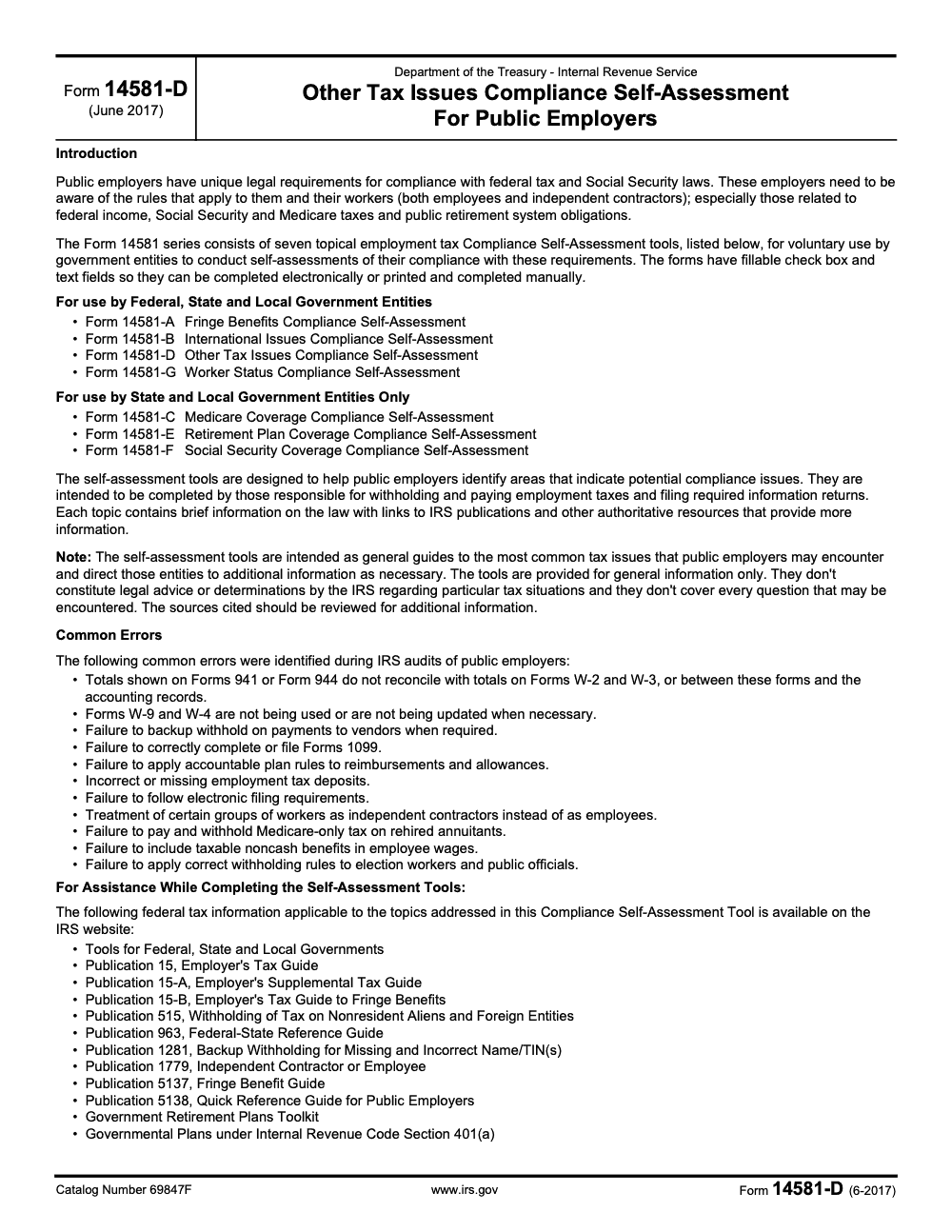
Form 14581-D is the IRS Other Tax Issues Compliance Self-Assessment for Public Employers (Rev. June 2017, Catalog Number 69847F) – a voluntary 3-page checklist a public employer keeps on file, not a return you submit to the IRS. Its five sections cover employment tax returns, Form W-4 handling, 14 information returns, independent contractor reporting, and backup withholding; watch the $600 Form 1099 threshold, the February 15 deadline for renewing exempt Forms W-4, and the $10,000 Form 8300 cash-reporting trigger (per IRS Publication 15). For help running the review, see our tax compliance services.
I first worked through Form 14581-D with a county government client tightening up its payroll and information-return controls. Walking each section surfaced a stack of unreconciled Form 941-to-W-3 differences long before the IRS ever would have. It is the IRS Other Tax Issues Compliance Self-Assessment for Public Employers (Rev. June 2017, Catalog Number 69847F), a voluntary checklist a public employer keeps on file, not a return you submit.
Its five sections cover employment tax returns on Forms 941, 944, and 945, Form W-4 handling, the 14 information returns in Section 3, independent contractor reporting, and backup withholding. The thresholds worth flagging early are the $600 Form 1099 reporting trigger, the February 15 deadline for renewing exempt Forms W-4, and the $10,000 Form 8300 cash threshold.
Key Takeaways
- Form 14581-D is the IRS Other Tax Issues Compliance Self-Assessment for Public Employers (Rev. June 2017, Catalog Number 69847F) – a voluntary tool government entities use to self-check compliance on employment tax returns, Forms W-4, information returns, contractor reporting, and backup withholding.
- Who completes it: Those responsible for withholding and paying employment taxes and filing information returns at a public employer (federal, state, or local government entity). It is completed internally and kept on file, not received from the IRS.
- Voluntary, not filed: Form 14581-D is one of seven Form 14581 series self-assessment tools for voluntary use by government entities; it is retained internally, not submitted to the IRS, and carries no required response or escalation.
- Main focus areas: Five sections covering employment tax returns (Forms 941, 944, and 945), Form W-4 handling, the 14 information returns in Section 3, independent contractor reporting, and backup withholding.
- SOP tip: Keep your employment tax returns, year-end Forms W-2 and W-3, all Forms 1099, and the W-9 and W-4 files together – these are the records you will reconcile as you work through Form 14581-D’s five sections.
What Form 14581-D Is and When to Use It
Form 14581-D is part of the Form 14581 series, which consists of seven topical employment tax Compliance Self-Assessment tools for voluntary use by government entities. The “D” variant – Other Tax Issues – covers employment tax returns, Form W-4 handling, the information returns in Section 3, independent contractor reporting, and backup withholding for public employers.
It is important to be clear about what this form is not. Form 14581-D is not sent by the IRS, and it is not a return you submit. It is a voluntary self-assessment a public employer completes and retains to review its own employment tax and information-return compliance. As the form itself notes, the tools are provided for general information only and do not constitute legal advice or IRS determinations.
Who Should Use It
Form 14581-D is one of four tools in the series available to Federal, State and Local Government Entities, alongside 14581-A (Fringe Benefits), 14581-B (International Issues), and 14581-G (Worker Status). The remaining three forms in the series – 14581-C, 14581-E, and 14581-F – are restricted to State and Local Government Entities only. It is meant to be completed by those responsible for withholding and paying employment taxes and filing the required information returns.
What the Five Sections Cover
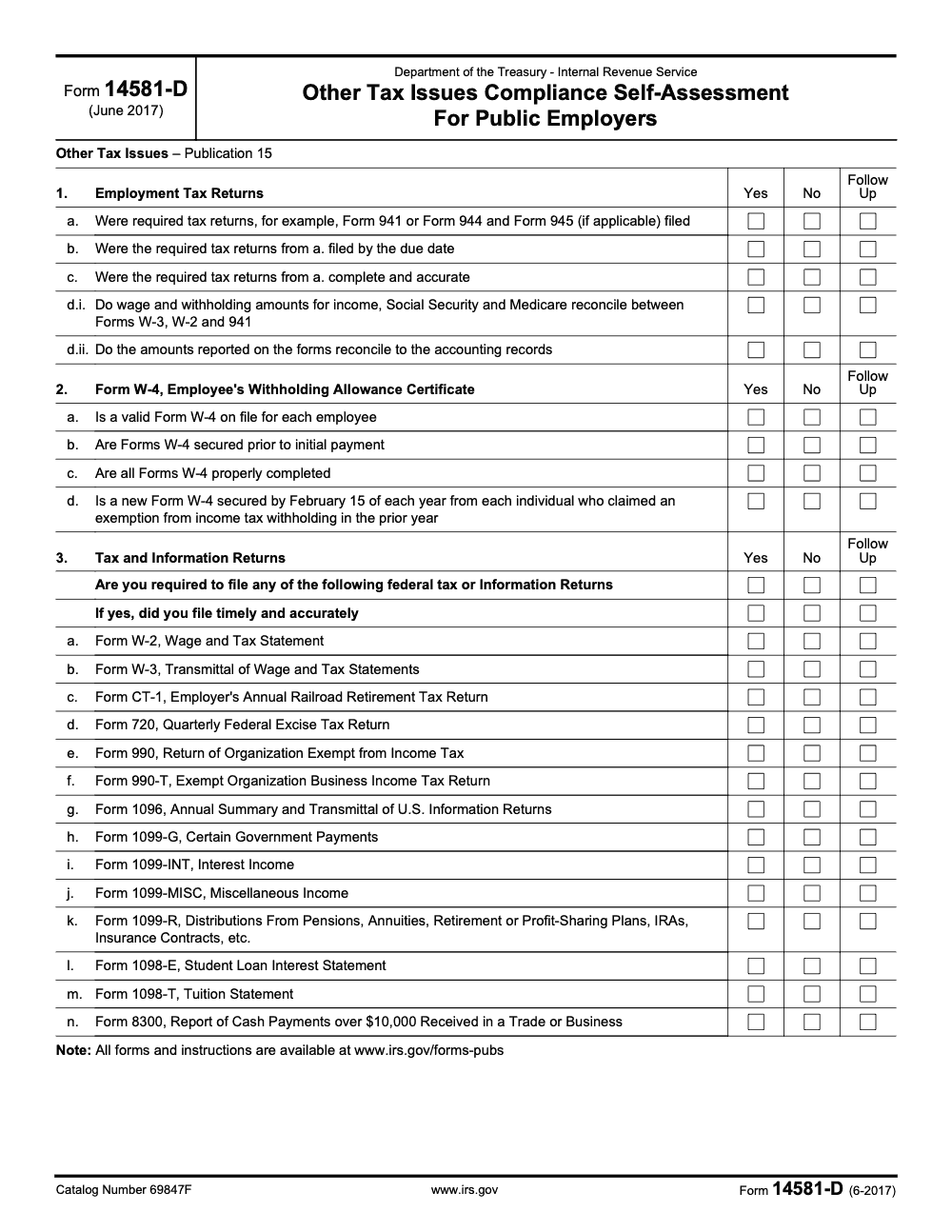
Form 14581-D is self-administered, so the entity itself works through its five sections: whether required employment tax returns (Forms 941, 944, and 945) were filed timely and accurately, whether wage and withholding totals reconcile across Forms W-3, W-2, and 941, whether valid Forms W-4 are on file, whether contractor payments and Forms 1099 are handled correctly, and whether backup withholding is reported on Form 945. Each question offers three responses – Yes, No, and Follow Up – with the Follow Up column used to flag items needing further internal review.
How to Complete Form 14581-D
Form 14581-D presents Yes, No, and Follow Up questions across five sections covering employment tax returns, Forms W-4, information returns, contractor reporting, and backup withholding. Have whoever is responsible for withholding and paying employment taxes and filing information returns complete it, pulling payroll records, Form W-2 and W-3 totals, the 1099 files, and the W-9 and W-4 documentation before starting.
| Section / Topic | Information Required | Practitioner Notes |
|---|---|---|
| Entity Identification | Government entity name, EIN, tax year, and the person responsible for completing the self-assessment | Confirm the EIN matches what is on file with the IRS; assign a named owner so the review is documented and repeatable |
| Section 1 – Employment Tax Returns | Whether Forms 941 or 944 and Form 945 (if applicable) were filed by the due date, complete and accurate | Reconcile wage and withholding totals for income, Social Security, and Medicare across Forms W-3, W-2, and 941, and tie them back to the accounting records |
| Section 2 – Form W-4 | Whether a valid Form W-4 is on file for every employee and secured before the initial wage payment | Re-collect a new Form W-4 by February 15 from anyone who claimed exemption from withholding in the prior year |
| Section 3 – Tax and Information Returns | Which of the 14 listed returns apply, including Forms W-2, W-3, 1096, 1099-G, 1099-MISC, 1099-R, 1098-T, and 8300 | For each return that applies, confirm it was filed timely and accurately |
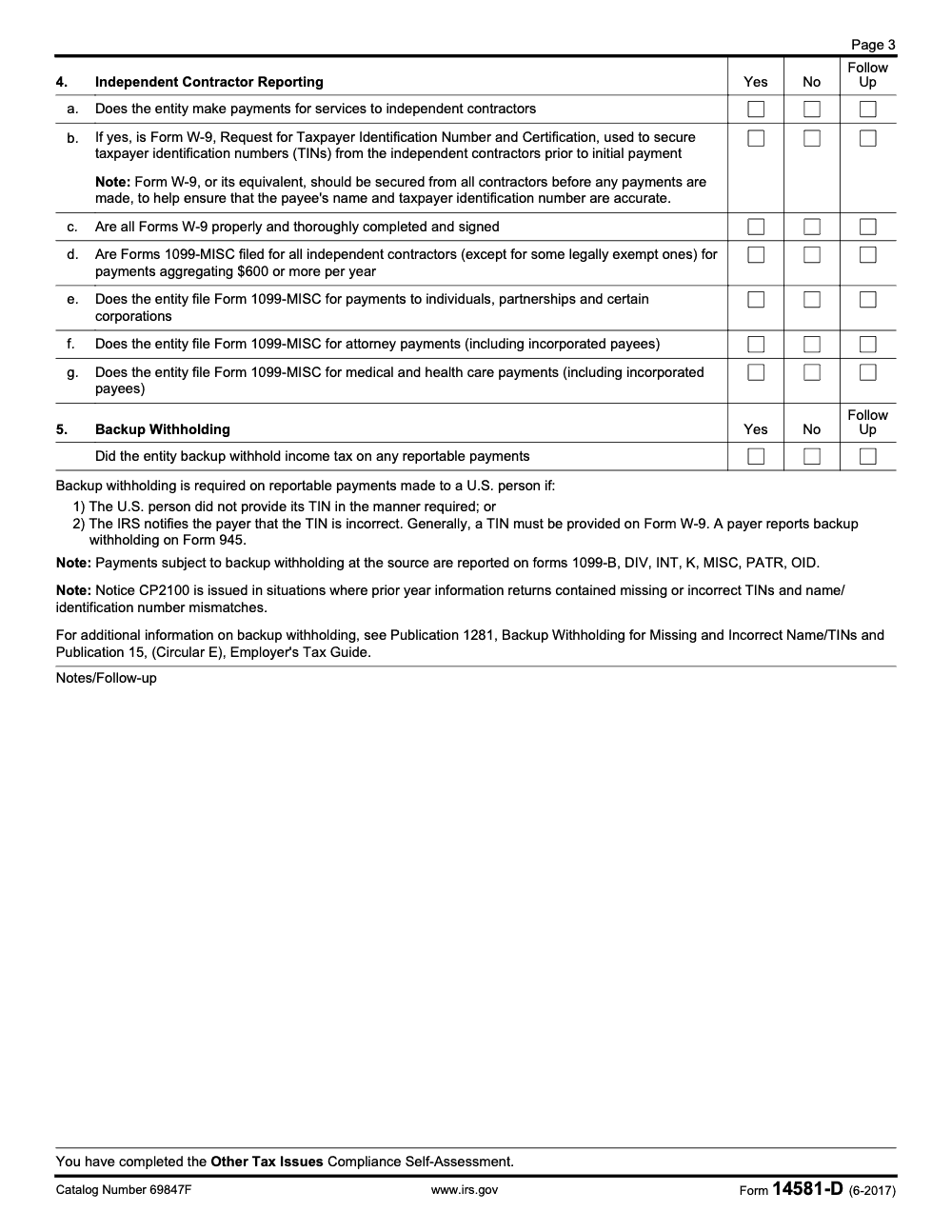
| Section 4 – Independent Contractor Reporting | Whether Form W-9 is secured before payment and Forms 1099-MISC are filed for payments aggregating $600 or more per year | The corporate exemption does not apply to attorney or medical and health-care payments; report them even when the payee is incorporated |
| Section 5 – Backup Withholding | Whether backup withholding was applied when a payee failed to furnish a TIN or the IRS issued a CP2100 notice | Report backup withholding on Form 945, not Form 941; a TIN is generally provided on Form W-9 |
Deadlines, Penalties, and Filing Requirements
| Action | Deadline | Consequence of Missing |
|---|---|---|
| Complete the Form 14581-D self-assessment | No IRS deadline – voluntary, on the entity’s own schedule | None; the form is retained internally and is not filed with the IRS |
| Renew exempt Forms W-4 (Section 2) | By February 15 each year | Miss it and you must begin withholding under the current default rules until a new W-4 is received |
| File Section 3 information returns that apply (Forms W-2 and W-3, the 1099 series, Form 8300, and others) | Per each return’s own due date | For each return that applies, the form asks whether you filed timely and accurately; late or inaccurate filings are a common IRS audit finding |
| Report and deposit backup withholding (Section 5) | On Form 945, per the Form 945 deposit and filing schedule | Backup withholding belongs on Form 945, not Form 941; failure to backup withhold when required is a listed common error |
Backup Withholding and Information Returns: What Practitioners Need to Know
Sections 3, 4, and 5 of Form 14581-D are where public employers most often find gaps, because vendor payments and information returns tend to be handled outside the core payroll team. Backup withholding is required on reportable payments to a U.S. person in two situations: when the payee does not provide its TIN in the manner required, or when the IRS notifies the payer that the TIN is incorrect. A TIN is generally provided on Form W-9, which is why securing a W-9 before any payment is the single best safeguard.
Where Backup Withholding Is Reported
This is the detail that trips up the most teams: a payer reports backup withholding on Form 945, not on Form 941. Form 941 is for employee wage withholding; Form 945 is for nonpayroll withholding, including backup withholding. When the IRS issues a CP2100 notice flagging missing or incorrect TINs and name/identification-number mismatches on prior-year information returns, work each one promptly to cure the mismatch and start backup withholding where required. Payments subject to backup withholding at the source are reported on Forms 1099-B, 1099-DIV, 1099-INT, 1099-K, 1099-MISC, 1099-PATR, and 1099-OID.
Section 3 Information Returns and the Form 8300 Trigger
Section 3 lists 14 federal tax and information returns a public employer may need to file, including Forms W-2, W-3, CT-1, 720, 990, 990-T, 1096, 1099-G, 1099-INT, 1099-MISC, 1099-R, 1098-E, 1098-T, and 8300. For each one that applies, the form asks a single question: did you file it timely and accurately. Do not overlook Form 8300, which must be filed for cash payments over $10,000 received in a trade or business; government entities receiving such cash payments are subject to the same reporting requirement as private businesses.
Common Mistakes That Slow Things Down
Across the public-employer reviews we run, the same gaps surface again and again. Form 14581-D itself lists 11 errors IRS examiners flag most often, and these five drive most of the cleanup we see.
Practical Checklists You Can Reuse
These are built to paste straight into a firm or in-house SOP. Work them as you move through Form 14581-D's five sections so the Yes, No, and Follow Up columns reflect a real review, not a guess.
Form 14581-D self-assessment packet
- Confirm Form 14581-D fits your entity type (it is one of four tools in the series open to all federal, state, and local government employers).
- Decide whether to complete it electronically with the fillable fields or print and complete it manually.
- Pull the employment tax returns in scope: Forms 941 or 944, plus Form 945 if you have nonpayroll withholding.
- Gather year-end Forms W-2 and W-3, all Forms 1099, and the W-9 and W-4 files.
- Assign each of the five sections to a named owner and a due date.
- Use the Follow Up column to flag anything needing further internal review.
Employment tax and W-4 review
- Reconcile income, Social Security, and Medicare totals across Forms 941 or 944, W-2, and W-3.
- Tie those totals back to the general ledger and document the match.
- Confirm all required employment tax deposits were made on time and in full.
- Verify a valid Form W-4 is on file for every employee before the first wage payment.
- Re-collect a new Form W-4 by February 15 from anyone who claimed exempt last year.
- Check that taxable noncash benefits, such as gift cards and personal vehicle use, are included in wages (per IRS Publication 15-B).
Contractor and backup withholding review
- Secure a Form W-9 from every contractor before the first payment.
- Apply the $600 aggregate threshold to identify reportable payees.
- Flag attorney and medical payments for 1099 reporting even when the payee is incorporated.
- Start backup withholding when a TIN is missing or a CP2100 notice arrives, and report it on Form 945.
- File Form 8300 for any cash payment over $10,000 received in a trade or business.
- Confirm each Section 3 information return that applies was filed timely and accurately.
Keep 14581-D Season From Stalling
Form 14581-D rarely sits alone on the calendar. Public employers usually reach for it at year-end, the same stretch when Forms W-2 and W-3 have to reconcile to four quarters of Form 941, every Form 1099 has to go out, and any exempt Form W-4 has to be renewed by February 15. The self-assessment flags 11 errors IRS examiners see most often and walks through 14 separate information returns in Section 3 alone (per IRS Form 14581-D), so a quick pass can surface a lot of cleanup at the worst possible time.
The teams that stay calm treat the questionnaire as a standing internal control, not a once-a-year scramble. They map each of its five sections to a named owner and a due date, then run the checks on a schedule that lines up with the deposit and reporting cycle rather than after the books close.
- Reconcile Forms 941 or 944 to Forms W-2, W-3, and the general ledger every quarter so Section 1 mismatches never compound.
- Tie the Section 2 review to a February 15 reminder to re-collect exempt Forms W-4 before default withholding kicks in.
- Run the Section 4 contractor check before any payment goes out, confirming a Form W-9 is on file and flagging attorney and medical payees who need a 1099 even when incorporated.
- Route any Section 5 backup withholding to Form 945, and respond to every CP2100 notice promptly (per IRS Publication 1281).
- Track the Section 3 information returns and the $10,000 Form 8300 cash trigger in one log so nothing slips between owners.
That structure is exactly what we build for clients. Accountably integrates trained, U.S.-led teams into your workflow with documented SOPs and a preparer, senior, and quality review on every return, so the 14581-D checks get done on time without burning out your own staff. See our tax services for how that fits a public-employer compliance calendar.
FAQs
Form 14581-D is the IRS Other Tax Issues Compliance Self-Assessment for Public Employers – a voluntary self-assessment tool a government entity completes and keeps on file, not a form the IRS sends out. Its five sections review employment tax returns, Form W-4 handling, the information returns in Section 3, independent contractor reporting, and backup withholding. It is not a tax return; it is an internal compliance checklist and is not filed with the IRS.
No. Form 14581-D is one of the seven Form 14581 series tools that government entities use voluntarily to self-assess their compliance. It is completed internally and kept on file, not submitted to the IRS. There is no required response and no escalation for not completing it; it works as a documented internal control you keep on hand.
Form 14581-D is one of four tools in the series available to Federal, State and Local Government Entities, alongside Form 14581-A (Fringe Benefits), Form 14581-B (International Issues), and Form 14581-G (Worker Status). The other three forms in the series – 14581-C, 14581-E, and 14581-F – are for State and Local Government Entities only. It is intended to be completed by those responsible for withholding and paying employment taxes and filing the required information returns.
Backup withholding is required on reportable payments to a U.S. person when the payee does not provide its TIN in the manner required, or when the IRS notifies the payer that the TIN is incorrect (typically through a CP2100 notice). A payer reports backup withholding on Form 945, not Form 941. A TIN is generally provided on Form W-9, which should be secured from every contractor before any payment is made.
Other forms this guide names
- Form W-4: Step-by-Step Guide to Accurate Withholding
- Form 941: Employer's Quarterly Tax Return Guide 2025
- Form 945: Backup Withholding, Deadlines, and Deposits
- Form W‑2: Deadlines, E‑File Rules, Boxes, and W‑2c Corrections
- Form W-3: What It Is, Filing Deadline, W-3c Corrections
- Form W-9: Guide & Instructions
About this guide
Accountably helps US CPA, EA, and accounting firms hire trained accountants and tax preparers in India.
About us Reviewed byJugal Thacker, CPAFounder and CEO at Accountably
A Washington-licensed CPA with 7+ years inside US firms – PwC, a real-estate tax practice, then a full-service firm, rising from reviewer to manager to advisory. This article was reviewed against current IRS guidance for the 2025 tax year and updated for filers preparing late returns, amendments, and 2026 estimates.
View profile →How we research, review, and update this guide
Every Accountably guide is researched against primary IRS sources, reviewed by a U.S. CPA, and refreshed as guidance evolves. Read our Editorial Guidelines to see how we source, fact-check, and update our content.