Summarize this article with AI
In Brief
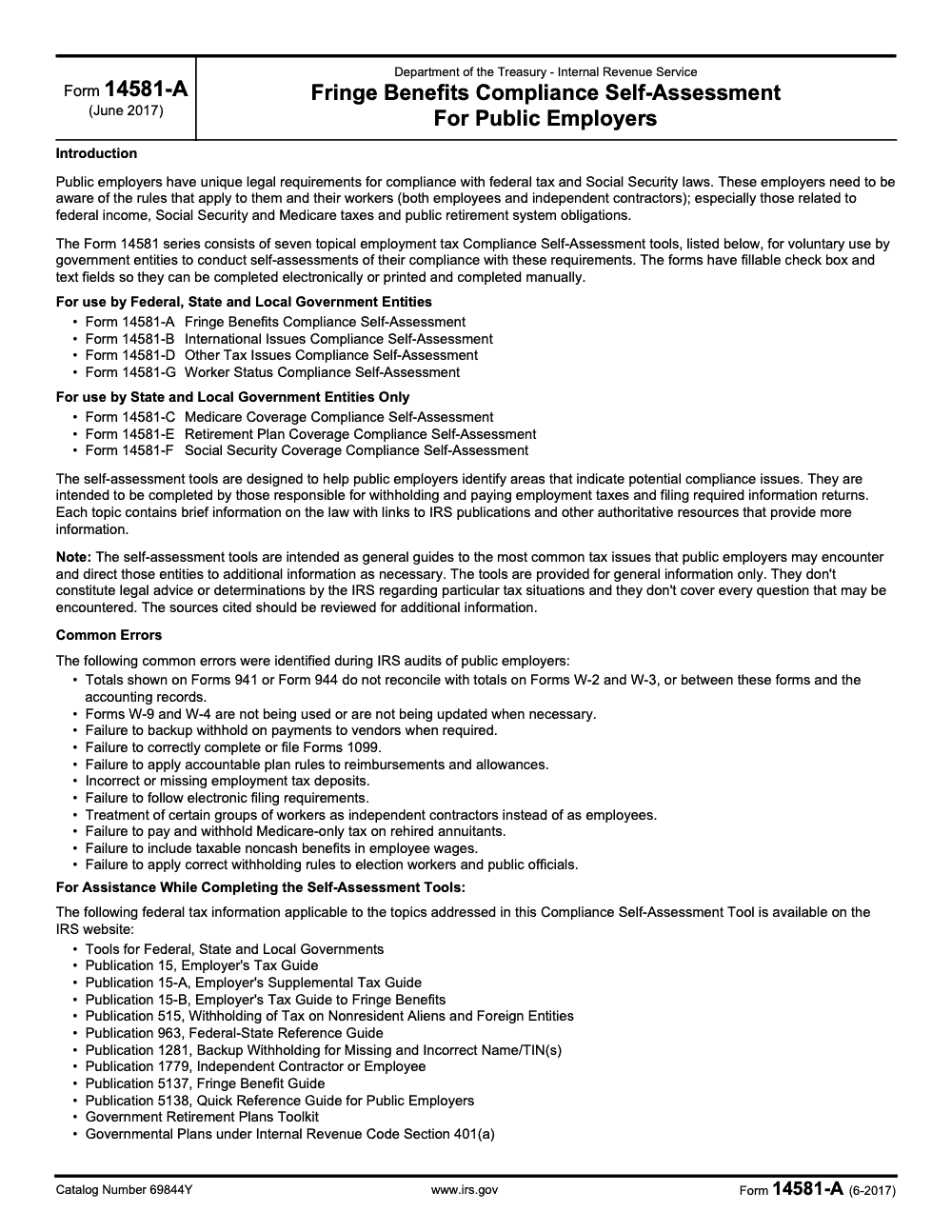
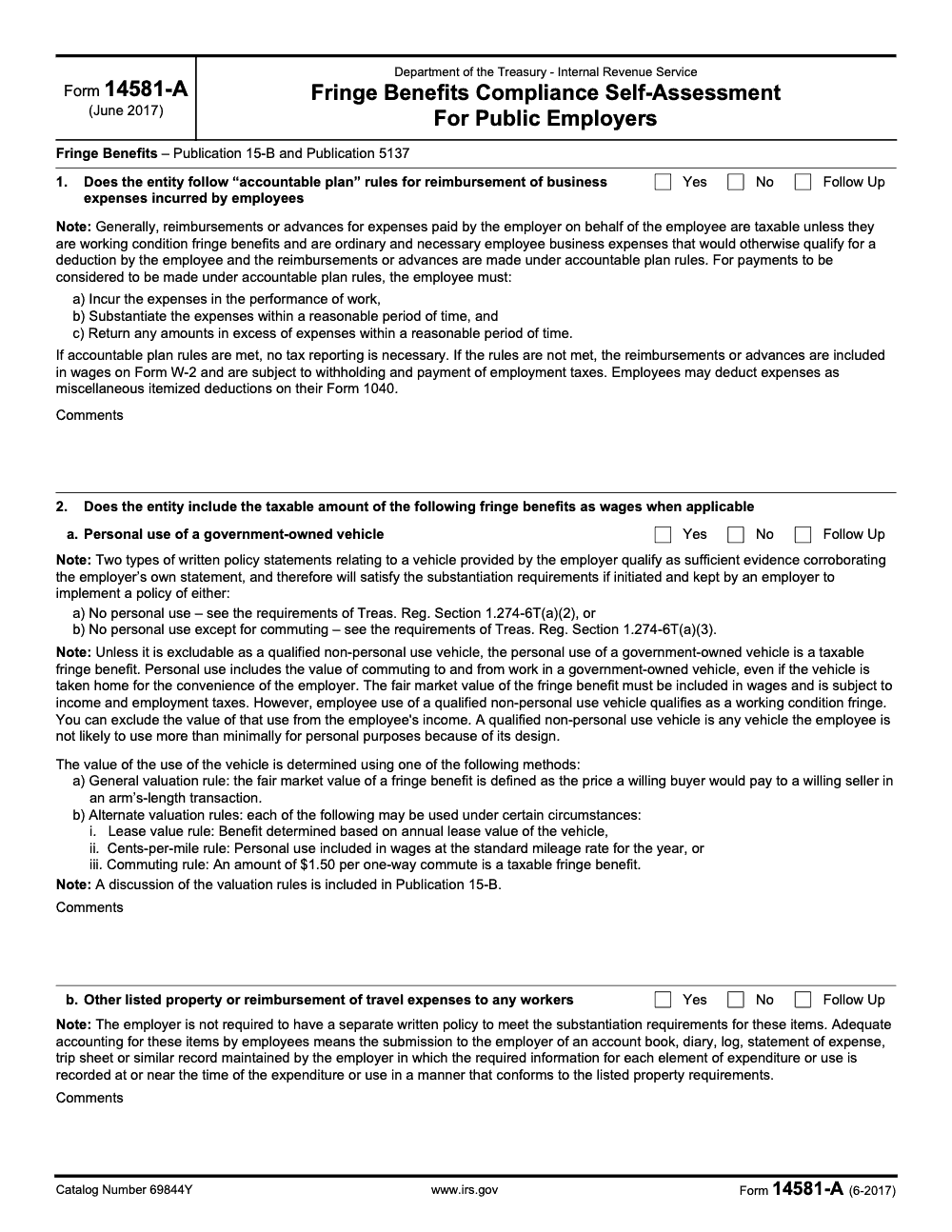
Form 14581-A is the IRS Fringe Benefits Compliance Self-Assessment for Public Employers – a four-page voluntary checklist (catalog number 69844Y, revised June 2017) and one of seven tools in the Form 14581 series, completed and kept internally by federal, state, and local government entities rather than filed with the IRS. It steps payroll teams through accountable-plan rules and ten taxable fringe benefit categories, including personal use of vehicles and group-term life over $50,000, where the excess stays in Social Security and Medicare wages even though no income tax is withheld on it (per IRS Publication 15-B).
A county payroll office runs take-home trucks, tuition reimbursement, and a drawer of holiday gift cards, and none of it has been valued or tied to anyone's W-2. That is the gap Form 14581-A is built to close. It is the IRS Fringe Benefits Compliance Self-Assessment for Public Employers, a voluntary four-page checklist that federal, state, and local entities complete and keep internally rather than file.
The form walks payroll teams through accountable-plan rules and ten taxable fringe categories, from personal use of vehicles to group-term life over $50,000. The work that actually trips people up is reconciliation: the IRS flags gaps between Forms 941 or 944, the W-2 and W-3, and the ledger as a routine audit finding, so the values you assign here need to match what payroll already reported.
Key Takeaways
- Form 14581‑A is a voluntary IRS self‑assessment for public employers, it is a four‑page fillable checklist you keep internally, not a return you file.
- It focuses on fringe benefits like vehicles, group‑term life, meals, lodging, education, awards, moving expenses, and gift certificates, and it links out to IRS publications for the rules.
- The 2026 monthly exclusion for qualified parking and for commuter highway vehicles or transit passes is $340 each, set in Publication 15‑B.
- Expect to reconcile values to payroll and W‑2s, the IRS flags reconciliation gaps between Forms 941 or 944, W‑2/W‑3, and your ledger as a common audit finding.
- There is no universal due date for Form 14581‑A, schedule it around year‑end payroll and W‑2 prep, then retain your workpapers.
What Is Form 14581‑A, and Who Actually Needs It?
Form 14581‑A, Fringe Benefits Compliance Self‑Assessment for Public Employers, is an IRS checklist built for federal, state, and local government employers. You use it to verify how you value fringe benefits, which items are excluded, what becomes taxable wages, and whether those amounts flowed into payroll and employee Forms W‑2. The form is fillable, so you can complete it on screen or print it, then keep it in your compliance binder. There is no routine submission to the IRS.
If you manage payroll, finance, or HR for a city, county, district, or agency, this tool is for you. It is especially helpful if you provide transportation subsidies, assign vehicles, offer group‑term life, pay for lodging or meals in limited cases, cover education, or give awards. The checklist points you to the right valuation approaches and to Publication 15‑B for the underlying rules.
Why it matters in 2026
Fringe benefits come with moving targets. For 2026, the qualified transportation exclusions are $340 per month for transit or commuter highway vehicles and $340 for qualified parking, so anything above those amounts is taxable and must be captured in wages. Align your valuation, payroll coding, and employee communications with these limits.
What the Form Covers, In Practice
Here is what you will validate with Form 14581‑A, in plain terms:
- Accountable plan rules, when reimbursements are excluded, and when they must be treated as wages.
- Personal use of government vehicles, plus how you value it, annual lease value, cents‑per‑mile, or commuting valuation.
- Listed property and travel reimbursements, what logs and receipts you actually need.
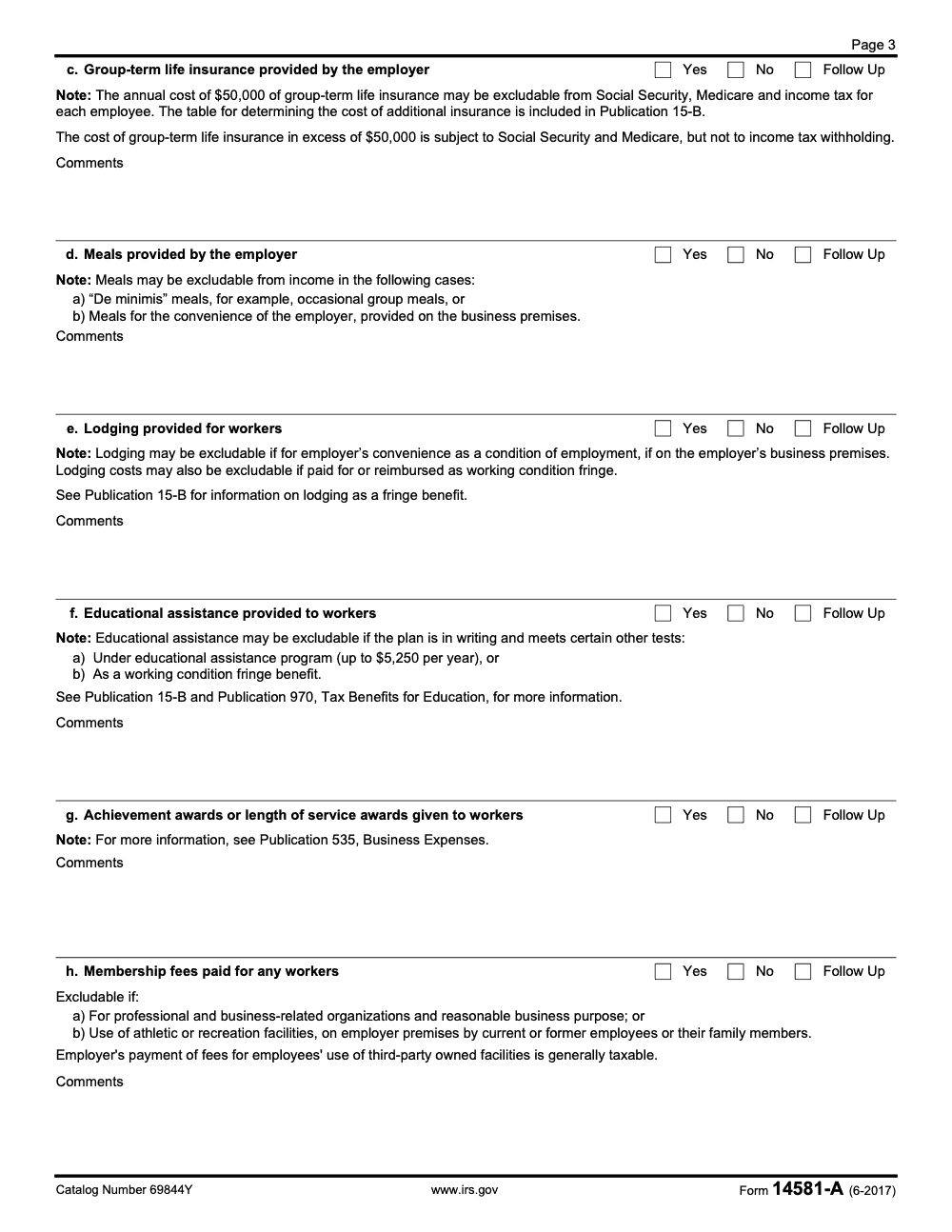
- Group‑term life over 50,000, where to include it on the W‑2, and how Social Security and Medicare apply.
- Meals and lodging, when limited exclusions apply.
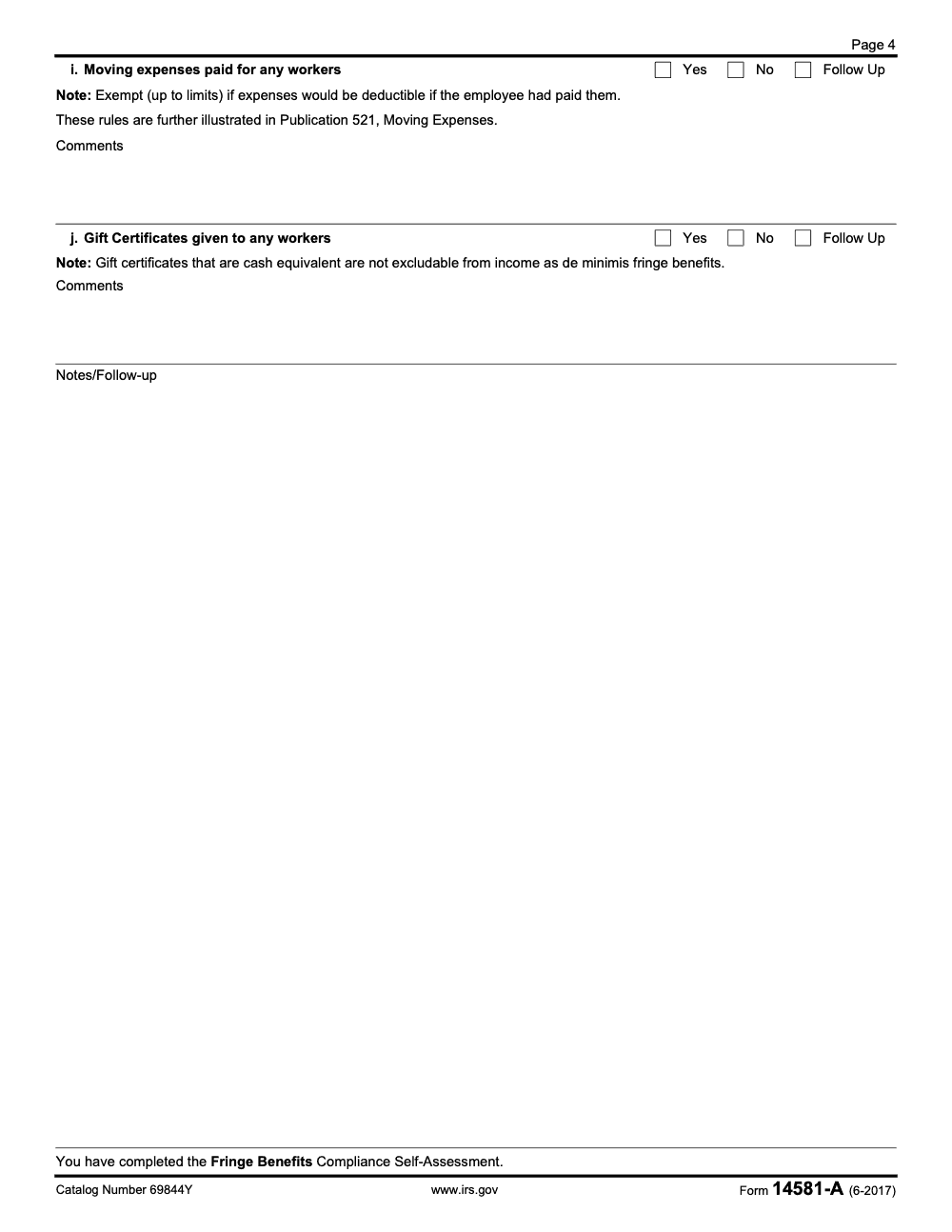
- Education assistance, awards, and gift certificates, including when a gift card is taxable because it is cash equivalent.
Quick win, keep a one‑page note beside each benefit explaining the chosen valuation method, the data source, and who reviewed it. That single page often answers 90 percent of examiner questions.
How To Use Form 14581‑A Without Rework
- Build your benefit inventory List every fringe benefit you provide, even those you believe are excluded, for example parking, transit, vehicles, meals, lodging, education, awards, moving reimbursements, mobile phone stipends. Add the number of recipients and total value by category, then park the logs, invoices, and policies in one folder.
- Pick valuation methods and write them down Choose the rule that fits each benefit and apply it consistently for the year. Publication 15‑B explains the general fair market value rule and special methods for vehicles. Note why you chose the method and where your numbers came from.
- Confirm exclusions, then reconcile to payroll and W‑2s Mark items that qualify for exclusions, for example up to $340 per month for parking and $340 for transit in 2026, then push the taxable remainder into payroll. Reconcile to Forms 941 or 944 and to W‑2 totals, since mismatches are a classic audit issue.
- Capture reviewer notes and sign‑off Add short reviewer notes in your workpapers, for example why a vehicle qualifies as a non‑personal use vehicle (the test is the vehicle’s design, not how it is assigned), or how you applied commuting valuation at 1.50 per one‑way commute. Date the sign‑off.
Valuation methods at a glance
| Method | When it fits | What to keep |
| Fair market value, general rule | When no special rule applies | Evidence of FMV, policy, usage logs |
| Annual lease value | Valuing personal use of an employer vehicle | ALV table, assignment memo, mileage logs |
| Cents‑per‑mile rule | If the vehicle meets conditions for this method | Mileage logs, election notice |
| Commuting valuation | Limited cases, 1.50 per one‑way commute | Written notice, commute counts |
These options come straight from the IRS materials and Publication 15‑B, choose one per vehicle for the year, apply it consistently, and keep the backup.
Payroll, W‑2s, and Year‑End Timing
To keep January calm, push fringe benefit work upstream.
- Include taxable noncash benefits in wages by January 31 of the next year, or use the special accounting rule in Publication 15‑B for benefits provided in the last two months of the year, then notify affected employees of the period you used.
- For group‑term life, include the cost of coverage over 50,000 in Social Security and Medicare wages (though income tax is not withheld on that excess), and report it in box 12 of the W‑2 with code C. Keep the age‑based rate table with your workpapers.
- For 2026 transportation benefits, exclude up to $340 per month for qualified parking and $340 for transit or commuter highway vehicles, include the excess in wages, and retain enrollment and vendor statements.
The document set that saves you during reviews
- Accountable plan policy, plus the expense report template employees actually use
- Mileage logs or non‑personal use certifications for vehicles
- Transit and parking enrollment reports and vendor invoices
- Group‑term life coverage list, rates, and payroll entries
- Education assistance plan document and annual totals
- One reconciliation worksheet that ties benefits to W‑2 boxes and Forms 941 or 944
If you cannot show how you valued a benefit, the IRS can default to a less favorable approach, which usually increases wages and penalties. Keep short, dated memos next to each calculation.
Form 14581‑A, Filing Status and “Deadline” Reality
There is no standard filing deadline because Form 14581‑A is not filed, it is an internal self‑assessment. The IRS hosts the checklist and encourages public employers to use it to identify and correct risk areas. Build your own internal deadline, for example two weeks before W‑2 processing, then retain the signed checklist with your year‑end binder.
Because the form is not filed, you do not e‑file or mail it. The PDF is fillable, which simply means you can complete it electronically before printing or saving it with your records. If an examiner asks for supporting documentation during an audit, you can provide the checklist and the attached workpapers.
Related dates you should still track
While Form 14581‑A itself has no IRS due date, your related information returns do. For example, Form 1099‑NEC is due January 31 in most years, and if that date falls on a Saturday, Sunday, or legal holiday in Washington, DC, the due date moves to the next business day. In 2026, January 31 falls on a Saturday, so the 1099‑NEC due date moves to Monday, February 2, 2026.
Common Mistakes We See, And Easy Fixes
The patterns below come up every audit cycle, and almost all of them trace back to a benefit that was real but never valued or never tied to the W-2.
A Note on Delivery, Teams, and Tools
You already know this, the tax rules are usually not the hardest part. Delivery is. If your workpapers are scattered, reviewers are stuck in loops, or logs are missing, January gets loud. Bring discipline to the process, clear naming, short checklists, and layered review. If you partner externally, keep them inside your systems and templates, and require predictable turnaround and clean documentation.
When it adds real value, a partner like Accountably can help standardize workpapers, set review gates, and keep turnaround predictable, which makes using Form 14581‑A much simpler. The key is structure you control, not a pile of resumes. Use that mindset whether you keep everything in house or add capacity seasonally.
Step‑By‑Step, Completing Form 14581‑A
- Identify who will complete and who will review Assign a preparer and a reviewer. The reviewer should not be the person who owns the day‑to‑day entries for that benefit.
- Answer each question, attach proof right away The form prompts you on accountable plans, vehicles, listed property, group‑term life, meals, lodging, education assistance, awards, moving expenses, and gift certificates. Attach the policy, logs, invoices, and the valuation worksheet behind each answer.
- Tie numbers to payroll and W‑2s As you confirm taxable amounts, verify they are included in wages and mapped to the right W‑2 boxes. The IRS highlights reconciliation errors as a frequent exam finding, so finish the tie‑out before you sign.
- Lock 2026 limits and elections Update your payroll tables for the 2026 transportation exclusions, $340 per month for parking and $340 for transit or commuter highway vehicles. Document any vehicle valuation elections for the year.
- Save, sign, and retain Keep the completed, dated checklist with your year‑end binder. There is no routine filing of Form 14581‑A with the IRS.
Quick FAQ
It is an IRS self‑assessment tool for public employers. You use it to confirm fringe benefit valuation, exclusions, and that taxable amounts flowed to payroll and W‑2s. You keep it internally, the IRS does not require routine filing.
Yes. The monthly exclusion is $340 for qualified parking and $340 for commuter highway vehicle transportation and transit passes. Amounts above those limits are taxable wages.
No. The form is fillable so you can complete it electronically, but it is an internal checklist. Retain it with your workpapers and provide it only if the IRS asks during an exam.
The statutory due date is January 31, but when that date falls on a Saturday, Sunday, or DC legal holiday, the due date moves to the next business day. In 2026, that means Monday, February 2, 2026.
Standardize files, use short checklists, capture reviewer notes inside the worksheet, and schedule a single sign‑off before W‑2s are released. A little structure turns January from chaos into routine.
Key Compliance Sources
- Form 14581‑A, Fringe Benefits Compliance Self‑Assessment, four‑page fillable PDF (last revised June 2017, so confirm each rule it cites against the current Publication 15‑B before relying on it).
- IRS overview of the 14581 series for public employers, page last reviewed April 17, 2025.
- Publication 15‑B, Employer’s Tax Guide to Fringe Benefits, 2026 edition, including transportation exclusions and valuation guidance.
- Instructions for Forms 1099‑MISC and 1099‑NEC, due date rule when January 31 falls on a weekend or DC holiday.
Final Checklist You Can Copy
- Build a benefit inventory, list recipients and totals.
- Pick and document valuation methods per benefit.
- Mark exclusions and compute taxable remainders.
- Reconcile to payroll, Forms 941 or 944, and W‑2s.
- Update 2026 limits in payroll and test with a sample employee.
- Save the fillable Form 14581‑A, attach proof, sign, and retain.
Note, this guide reflects IRS materials reviewed as of January 16, 2026. Always confirm current IRS publications and limits before you finalize payroll or filings.
If you want help standardizing workpapers and review flow so Form 14581‑A becomes a 60‑minute task, not a week‑long scramble, set your structure first, then add capacity only where it fits your process. If you choose to bring in outside help, make sure they work inside your systems and templates, with predictable turnaround and clean documentation.
Reusable Checklists
These are built to paste straight into a payroll SOP. Work them in order each year, and Form 14581-A becomes a sign-off rather than a scramble.
Fringe benefit inventory packet
- List every fringe benefit you provide, even ones you believe are excluded: parking, transit, vehicles, meals, lodging, education, awards, moving reimbursements, and phone stipends.
- Record the number of recipients and total value for each category.
- Gather the policy, logs, and invoices behind each benefit into a single folder.
- Flag each item Yes, No, or Follow Up, the three response options Form 14581-A provides.
- Confirm your entity is federal, state, or local, since all three may use Form 14581-A.
Vehicle valuation and substantiation
- Decide whether each vehicle is a qualified non-personal use vehicle by design, not by how it is assigned.
- Pick one valuation method per vehicle for the year: general fair market value, annual lease value, cents-per-mile, or commuting at $1.50 per one-way commute.
- For the cents-per-mile rule, confirm the vehicle's fair market value is at or below the 2025 cap of $62,000 and keep contemporaneous mileage logs.
- Attach the written no-personal-use or no-personal-use-except-commuting policy that meets Treas. Reg. 1.274-6T.
- Include the personal-use value in wages and document why you chose the method.
Year-end W-2 reconciliation
- Total taxable fringe benefits by category and map each amount to the correct W-2 box.
- Add group-term life over $50,000 to Social Security and Medicare wages in Boxes 3 and 5, without income tax withholding on the imputed cost.
- Reconcile Forms 941 or 944 to Forms W-2 and W-3 and to the ledger.
- Confirm taxable noncash benefits are in wages by the January 31, 2026 W-2 deadline (per IRS Publication 15-B).
- Sign and date the completed Form 14581-A and retain it with your year-end binder.
Keep 14581-A Season From Stalling
Form 14581-A does not carry a filing deadline, which is exactly why it stalls. The work compresses into the same December and January window as W-2 production, and the form itself lists eleven common errors that examiners find, the first being a failure to reconcile Forms 941 or 944 to Forms W-2 and W-3 (per IRS Form 14581-A). When fringe benefit values are still being chased while payroll is closing the year, that reconciliation is the first thing to slip.
The fix is to treat the self-assessment as a year-round workpaper, not a January fire drill. Each of the ten taxable fringe benefit categories in Question 2 has a home in your payroll coding and a document that supports it, so the goal is to capture both as the benefit is provided rather than after the fact (per IRS Publication 5137).
- Keep a running benefit inventory so vehicles, group-term life over $50,000, transit, parking, meals, lodging, education, and awards are valued before December.
- Lock one vehicle valuation method per vehicle for the year, whether annual lease value, cents-per-mile, or commuting at $1.50 per one-way commute, and file the supporting policy.
- Maintain a single reconciliation worksheet that ties taxable benefits to Forms 941 or 944 and the W-2 boxes, so the year-end tie-out is a review, not a rebuild.
- Calendar an internal sign-off about two weeks before W-2 processing, and date the completed Form 14581-A for your binder.
That structure is what keeps the assessment moving: clear ownership, standard workpapers, and review gates that hold under deadline pressure. When the volume outgrows the calendar, structured tax delivery can carry the valuation and reconciliation work inside your own systems and templates, with documented turnaround so nothing waits until January.
Other forms this guide names
- Form W‑2: Deadlines, E‑File Rules, Boxes, and W‑2c Corrections
- Form 944: Eligibility & Due Dates
- Form 941: Employer's Quarterly Tax Return Guide 2025
- Form W-3: What It Is, Filing Deadline, W-3c Corrections
- Form 1099-NEC: Rules, Who Gets One, How to File
About this guide
Accountably helps US CPA, EA, and accounting firms hire trained accountants and tax preparers in India.
About us Reviewed byJugal Thacker, CPAFounder and CEO at Accountably
A Washington-licensed CPA with 7+ years inside US firms – PwC, a real-estate tax practice, then a full-service firm, rising from reviewer to manager to advisory. This article was reviewed against current IRS guidance for the 2025 tax year and updated for filers preparing late returns, amendments, and 2026 estimates.
View profile →How we research, review, and update this guide
Every Accountably guide is researched against primary IRS sources, reviewed by a U.S. CPA, and refreshed as guidance evolves. Read our Editorial Guidelines to see how we source, fact-check, and update our content.