Summarize this article with AI
In Brief
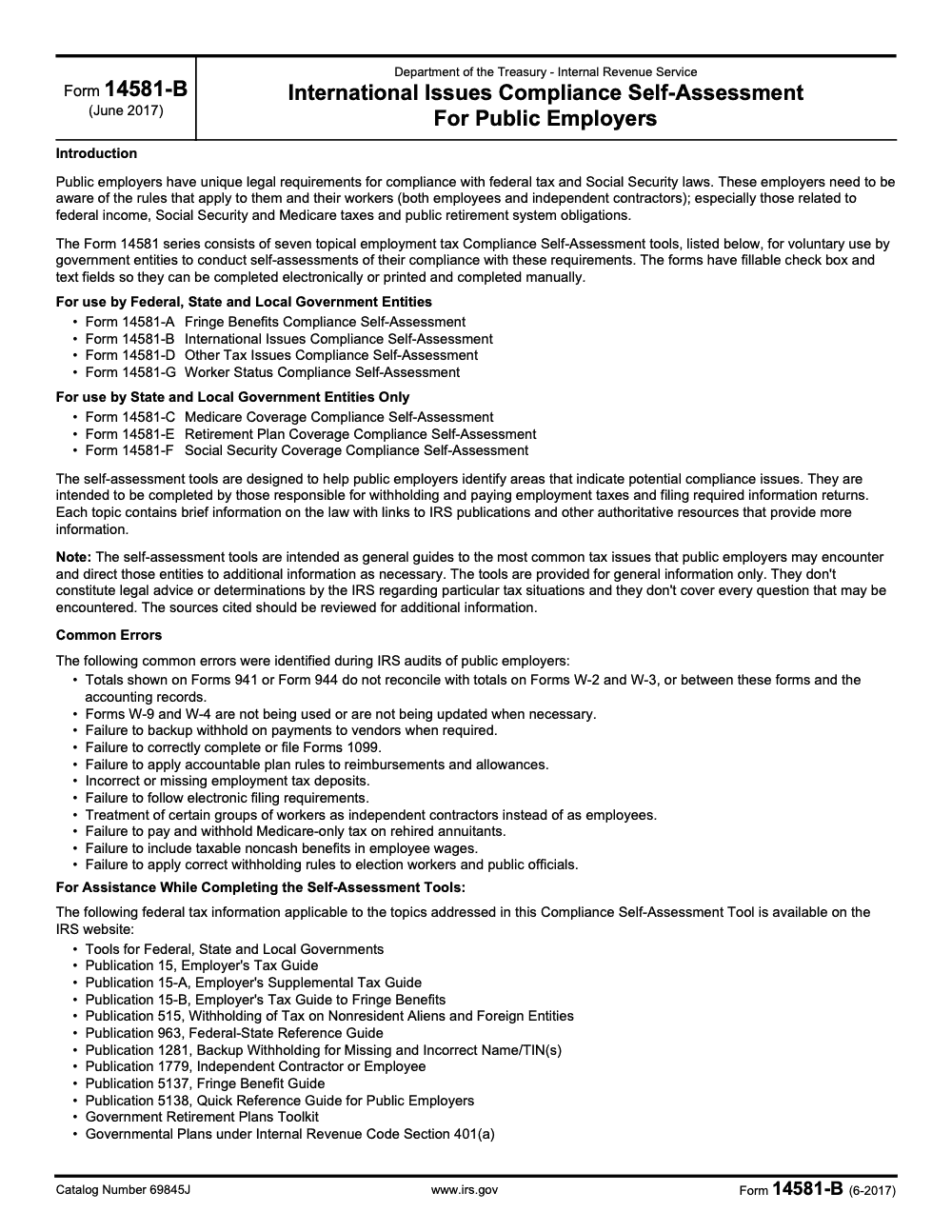
Form 14581-B is the IRS International Issues Compliance Self-Assessment for Public Employers (revision June 2017, catalog number 69845J) – a voluntary 3-page tool federal, state, and local government entities use to test their handling of payments to foreign persons. Default federal withholding on gross payments to nonresident alien vendors is 30% (per IRC §1441 and IRS Publication 515), reduced only when the recipient files Form 8233 to claim a current treaty rate from IRS Publication 901. NRA payments are reported on Form 1042-S, with Form 1042 as the annual summary withholding return – see our taxation services for execution support.
Most public employers do not think of themselves as withholding agents until a vendor payment goes wrong. A county AP workflow that has no checkpoint for "is this payee a U.S. person" can send money to a nonresident on a Form 1099-NEC, skip the default 30% withholding under IRC §1441, and leave the entity personally on the hook for the tax plus interest. Form 14581-B exists to catch that before it happens.
It is the IRS International Issues Compliance Self-Assessment for Public Employers, a voluntary three-page tool that tests how you handle payments to foreign persons. The questions push you toward the resources you actually need, including Publication 515 and the treaty rates in Publication 901, and toward the documentation, W-8s, Form 8233 treaty claims, and 1042-S reporting, that has to support each answer.
Key Takeaways
- Form 14581-B is a voluntary IRS compliance self-assessment, not a required filing with a due date.
- It focuses on international issues for public employers, mainly withholding, documentation, and reporting tied to foreign persons.
- The current version is Form 14581-B (June 2017) and it’s 3 pages.
- It points you toward the IRS resources you actually need, including Publication 515, and asks practical yes/no questions you can support with evidence.
- Your goal is simple: finish the assessment, keep your proof, and fix what’s weak, especially around W-8s, treaty claims, and 1042-S reporting.
What Is IRS Form 14581-B (and what it is not)
IRS Form 14581-B is titled “International Issues Compliance Self-Assessment for Public Employers.” It’s part of the IRS Form 14581 series of compliance tools designed to help government entities run an internal checkup of common employment tax and related compliance risks.
What it is
Think of it as a structured checklist that asks, “Did we pay foreign persons, and if so, did we handle withholding and reporting correctly?”
It covers areas like:
- payments to foreign persons that may be subject to withholding
- documentation you should have on file (W-8 series forms, Form 8233, visa documentation in certain cases)
- whether you properly handled reporting such as Form 1042-S and Form 1042 when required
What it is not
It is not:
- a tax return
- a form with a filing deadline
- a mandatory submission “only if you’re on a list”
The IRS describes the Form 14581 tools as being for voluntary use by government entities.
If someone told you Form 14581-B is “required for the 2023 tax year,” pause. The form itself is not written as a year-specific filing requirement. It’s a general-purpose self-assessment that can be used any time you want to test your controls.
Who Should Use Form 14581-B
The IRS positions these tools for public employers and government entities, including federal, state, and local employers.
You’ll get the most value from Form 14581-B if your organization has even a small chance of:
- hiring or paying resident aliens or nonresident aliens
- paying contractors or vendors who may be foreign persons
- dealing with treaty claims, exemptions, or reduced withholding rates
- issuing payments that could create 1042-S reporting needs
If you’re a CPA firm supporting public employers, this tool is also a clean way to standardize how your team collects documentation and proves “we checked.”
The point isn’t to panic and assume you did something wrong. The point is to stop guessing and start documenting.
Is Form 14581-B Mandatory, and is there a due date?
No due date exists for Form 14581-B because it’s not a form you file. It’s a self-assessment tool.
That said, self-assessments still matter. If you ever get questioned on withholding, classifications, or reporting, your ability to show a consistent process and clean documentation can make the whole situation less painful.
A quick compliance mindset shift (this is where most teams get stuck)
Most organizations don’t struggle because they “don’t care.” They struggle because delivery is messy. Work gets done late, documentation lives in inboxes, and review turns into a bottleneck.
Form 14581-B is helpful because it forces a delivery habit: assign an owner, answer the question, attach the support, fix gaps.
Where to Get the Correct Form (and how to avoid bad copies)
Your safest move is to download Form 14581-B directly from the IRS website. The IRS lists Form 14581-B under its compliance self-assessment tools and in its forms library.
What you should verify before you start
- You’re using Form 14581-B (June 2017)
- It’s the fillable PDF (so fields and checkboxes work)
- You store the completed version in a secure location with access control
The form itself also includes a reminder that the tools are general guides and not legal advice or formal IRS determinations for your specific facts.
Form 14581-B Step-by-Step (what to do, what to save)
If you want this to be useful, don’t treat it like a casual worksheet. Treat it like a mini-audit file.
Here’s a practical way to complete it that won’t waste your time later.
Step 1, Decide who owns the answers
Pick an owner who can pull records across payroll and AP. In public employers, that’s usually someone in payroll, finance, or treasury, sometimes with HR involved.
You also want a reviewer. Not a “rubber stamp” reviewer, someone who checks that answers match the evidence.
What to save:
- the name of the preparer and reviewer
- completion date
- where support files live (folder path or document management reference)
Step 2, Start with Question 1 (payments to foreign persons)
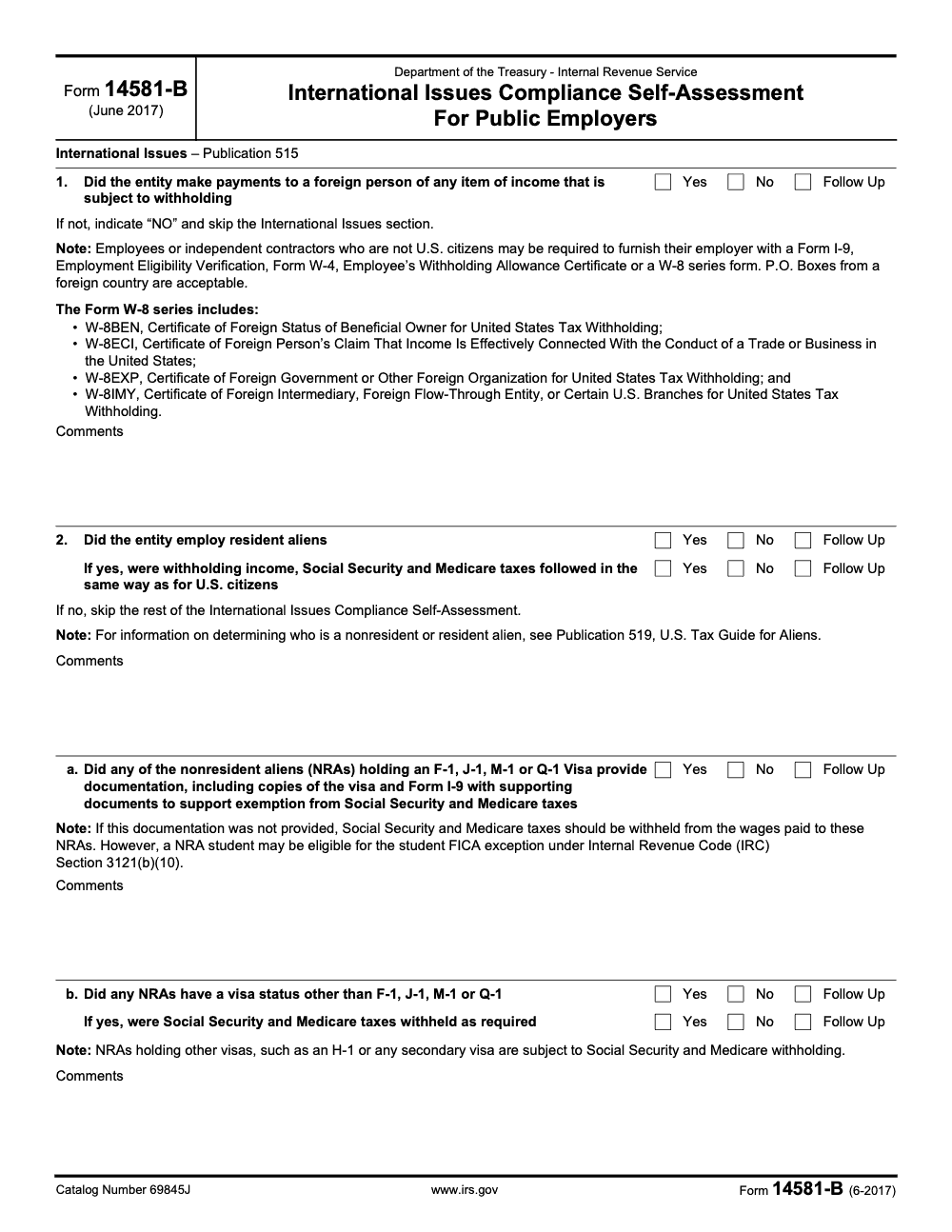
Form 14581-B begins by asking if the entity made payments to a foreign person of any item of income subject to withholding. If the answer is no, the form tells you to indicate no and skip the section.
This is where teams often answer “no” too fast.
Before you say no, do a quick sweep:
- vendor master list for foreign addresses
- payments with wires to foreign banks
- payments flagged as international services
- contractors paid for remote work
- any scholarship, stipend, grant, or honorarium paid to non-U.S. persons
What to save:
- your vendor list filter results
- a short memo that says what you checked and what you found
Step 3, Confirm how you treat resident aliens
The form asks whether you employ resident aliens, and if yes, whether you followed withholding and FICA rules in the same way as for U.S. citizens.
This part is less about “international tax strategy” and more about consistent payroll operations.
What to save:
- payroll system settings or policy notes
- a sample pay stub or payroll register slice (redacted)
- hiring/onboarding checklist items that show how you collect required tax forms
Step 4, Nonresident aliens, visa categories, and FICA
Form 14581-B specifically calls out NRAs holding F-1, J-1, M-1, or Q-1 visas and asks whether documentation supports an exemption from Social Security and Medicare taxes. Visa class alone is not enough: without the visa copies and Form I-9 support on file, FICA must be withheld. NRAs on H-1 or other secondary visas are subject to FICA regardless.
If you’ve ever had a visiting scholar, intern, or short-term program participant, this is where mistakes happen.
The form’s goal is not for you to become an immigration expert overnight. It’s for you to confirm you have the right documentation and followed the related tax rules.
What to save:
- copy of visa documentation and Form I-9 support (handled securely)
- your internal checklist for NRA onboarding
- a note showing who reviewed the exemption decision
Step 5, Federal income tax withholding and treaty claims
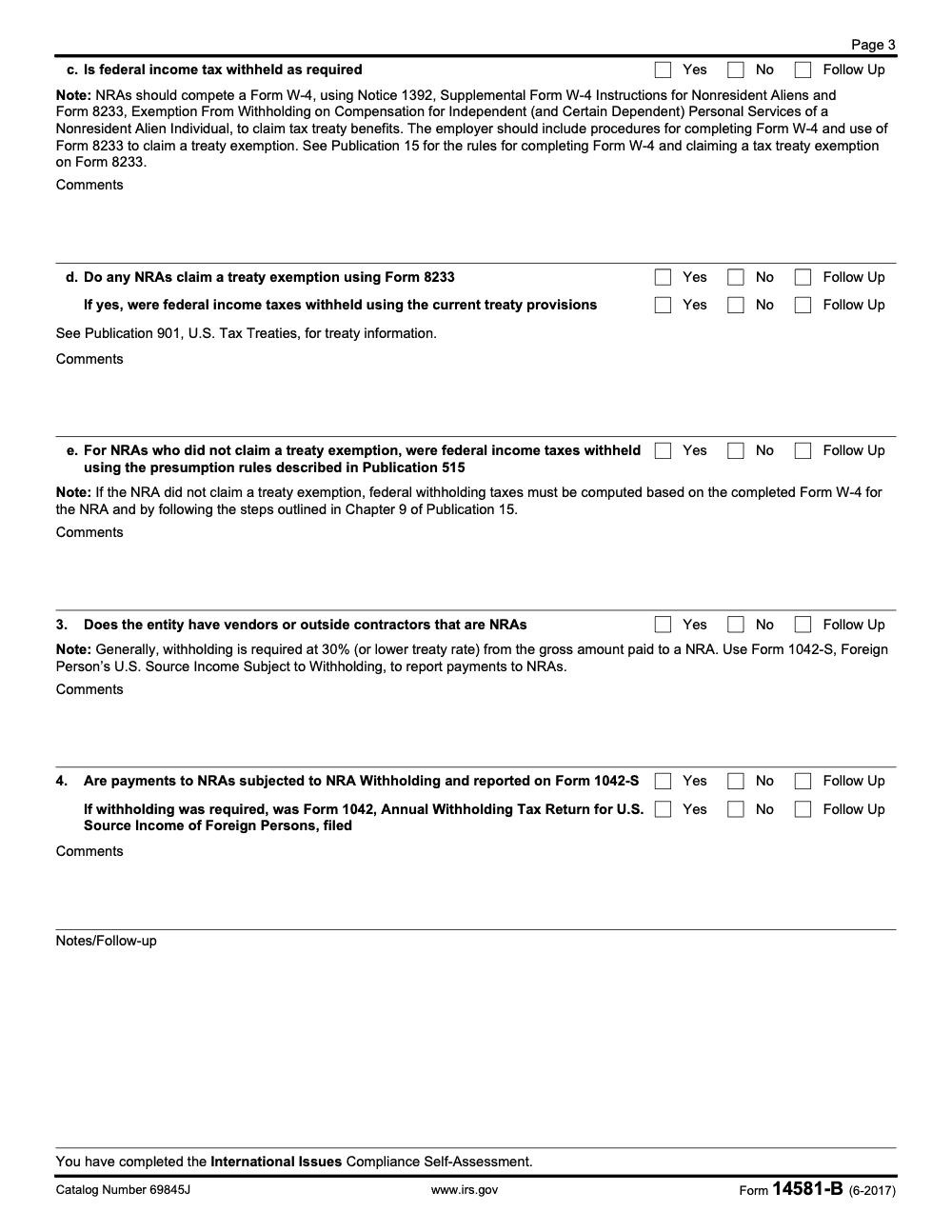
The form addresses federal income tax withholding for NRAs and mentions using Notice 1392 and Form 8233 when claiming treaty benefits. Treaty exemption is not automatic: the NRA has to file Form 8233 and you have to confirm the current treaty rate against Publication 901, since treaty provisions can change.
Treaty claims are one of those areas where good intentions still produce bad outcomes if the paperwork is missing or stale.
What to save:
- Form 8233s on file
- how you confirmed you used current treaty provisions
- a reconciliation between the treaty claim population and your payroll records
Step 6, Vendors and contractors who are NRAs
Form 14581-B asks if you have vendors or outside contractors that are NRAs and notes that withholding is generally required at 30% (or lower treaty rate), with reporting on Form 1042-S. The 30% rate applies to non-wage payments only; NRA wages use the special computation in Chapter 9 of Publication 15 with a Notice 1392-adjusted Form W-4.
If your AP team hires contractors outside the U.S., or if you pay foreign performers, speakers, consultants, or service providers, pay attention here.
What to save:
- W-8 series forms on file (as applicable)
- your AP withholding decision logic
- a list of payments reviewed and how you classified them
Step 7, 1042-S and 1042 filing confirmation
The form asks whether payments to NRAs were subjected to NRA withholding and reported on Form 1042-S, and if withholding was required, whether Form 1042 was filed. These are distinct filings: Form 1042-S is the per-recipient information return, and Form 1042 is the annual summary withholding tax return, so both are typically required.
This is where you want your evidence to be clean, not “we think so.”
What to save:
- filed copies or filing confirmations
- workpapers showing payment totals tie out to reporting
- sign-off notes for review
Common Mistakes Form 14581-B Helps You Catch
From audits and remediations I have sat through, the same handful of misses keep showing up on public-employer files. Form 14581-B earns its keep by surfacing these before they become assessments.
What to Do After You Finish the Self-Assessment
Once you’ve completed the form, don’t let it die in a folder.
Do three things:
- List the gaps. Anything you answered “No” or “Follow Up,” write down what needs to change.
- Assign an accountable owner. Not “payroll team,” a person.
- Set a deadline you control. Pick a date that fits your reporting calendar, not a vague “later.”
If your organization works with a CPA firm, this is also where a good firm can turn your answers into a tighter process. If you’re the firm, this is where delivery discipline matters. Clean workpapers and consistent review beat heroic last-minute efforts every time.
How CPA Firms Use Form 14581-B Without Creating More Busywork
If you’re supporting public employers, you already know the trap. You do good work, but the work shows up late, documentation is scattered, and partner review becomes a traffic jam.
Form 14581-B can be a light framework that keeps your engagements consistent.
Turn the form into a repeatable client checklist
Instead of treating the PDF as a one-off, pull its themes into your client workflow:
- “Foreign person payments” intake questions during onboarding
- W-8 and treaty documentation request list
- payroll and AP tie-outs before year-end
- 1042-S and 1042 support package standards
You’re not trying to “complete a form.” You’re trying to protect the file.
Build review protection into the process
Here’s what usually burns firms:
- preparers do the work
- reviewers ask for missing support
- prep does rework
- deadlines slip
A better pattern is to require the support before review begins. The Form 14581-B questions make it obvious what “support” means, and what a reviewer will ask for later.
If it can’t be supported, it’s not done.
Where Accountably fits (only if you need execution support)
If your firm is growing and your team is buried in production, the gap isn’t “finding clients.” It’s delivering consistently without burning people out.
This is one of the areas where Accountably can help in a practical way. When you need standardized workpapers, consistent documentation, and reliable turnaround for compliance-heavy workflows, we can support the execution layer so your senior team stays focused on review and client strategy.
That’s not about pushing work offshore and hoping for the best. It’s about building a controlled delivery system with clear SOPs and review checkpoints, especially for repeatable compliance work.
Conclusion
Form 14581-B is short, but it’s not “fluff.” In three pages, it forces the questions that most public employers and the CPA firms supporting them can’t afford to ignore, who you paid, whether they were foreign persons, what you withheld, what you filed, and whether you can prove it.
If you complete it thoughtfully and keep the support, you buy yourself something rare in compliance work, calm. Not because everything is perfect, but because you know exactly what’s true and what needs fixing.
Reusable Checklists
Three checklists you can lift straight into a firm SOP or a public-employer playbook. Each item is a step you can paste into your engagement standards or a controller's binder.
NRA payment intake
- Confirm the payee is a foreign person (Pub 519 substantial presence test if unclear)
- Collect the correct Form W-8 (W-8BEN, W-8ECI, W-8EXP, or W-8IMY) before any payment
- Tag the vendor record as foreign in AP for downstream 1042-S reporting
- Confirm no treaty claim, or obtain Form 8233 with the verified Publication 901 rate
- Set the withholding rate – 30% on gross or the verified treaty rate
- Foreign P.O. box address is acceptable on the worker's tax records
- Document who reviewed the determination, with date and source citations
NRA employee documentation
- Form I-9 on file with supporting documents
- Visa copy on file (F-1, J-1, M-1, or Q-1 if claiming the visa-based FICA exemption)
- Form W-4 completed under the Notice 1392 special instructions, not the standard instructions
- Separate review of the IRC §3121(b)(10) student FICA exception if applicable
- If FICA documentation is missing, default to withholding Social Security and Medicare
- Confirm the worker is on a primary visa qualifying for exemption (H-1 and most others do not qualify)
- Residency status (resident vs nonresident) re-tested each tax year
Form 1042 / 1042-S filing packet
- One Form 1042-S issued to each NRA recipient of U.S. source income
- One Form 1042 filed annually as the summary withholding tax return
- Withholding deposits tied out to Form 1042 totals
- Form 941 (or 944) totals reconcile to Forms W-2 and W-3 and to the GL
- Treaty rate citations attached for any reduced-withholding payments
- Form W-9 collected and on file for U.S. payees, with backup withholding triggers documented
- Workpapers signed off by preparer and reviewer before close
Keep 14581-B Season From Stalling
Form 14581-B looks short, but the international-issues compliance cycle behind it is anything but. Public employers run payments to foreign vendors, exchange visitors, and contractors through the same workflows as their domestic workforce, and the audit-error list in the form's introduction calls out eleven recurring patterns the IRS sees – worker misclassification, missing backup withholding, broken Form 941-to-W-2/W-3 reconciliations, and incorrect or missing Forms 1099 among them (per the Form 14581-B introduction). Each one is a self-inflicted exposure when the workflow is not standardized.
The fix is not more diligence on filing day. It is a few small structural changes that move the diligence upstream into vendor and employee onboarding, so by the time Form 1042 and Form 1042-S are due, the support already exists in the file.
- Tag every vendor and employee record with U.S.-person or foreign-person status at setup, and route foreign records through a Form W-8 collection workflow before any payment.
- Maintain a treaty-claim packet for each NRA on Form 8233, with the current Publication 901 rate cited and the verification date stamped.
- Run a quarterly tie-out: Forms 941 (or 944) totals to Forms W-2 and W-3 and to the GL, with a documented exception list for any variance.
- Maintain two NRA pay codes – wages (Publication 15 Chapter 9 method with Notice 1392-adjusted W-4) and non-wage payments (30% or treaty rate, Form 1042-S reporting).
- Build a January handoff packet that bundles Form 1042 totals, every Form 1042-S, treaty documentation, and deposit history into a single reviewable file.
This is the structural delivery work our taxation services team is built around – standard workpapers, a documented review chain, and the quiet confidence that comes from knowing the support is already in the file when a question lands.
FAQs
No. Form 14581-B is a voluntary compliance self-assessment tool for public employers. It’s designed to help you identify potential compliance issues, not to be submitted as a required filing.
No. The IRS lists Form 14581-B for use by federal, state, and local government entities as part of the self-assessment tools for public employers.
It focuses on international-related compliance areas, including payments to foreign persons subject to withholding, documentation such as W-8 forms, treaty claims (Form 8233 is referenced), and whether reporting like Form 1042-S and filing like Form 1042 applies based on your facts.
Complete it with evidence. Save the workpapers that prove how you answered each question, keep copies of relevant forms on file, and document who prepared and reviewed the assessment. The form itself stresses that it’s a general guide and points you to IRS resources for deeper detail.
Download it from the IRS page that lists the compliance self-assessment tools for government employers, or through the IRS forms library. This reduces the risk of using an altered or outdated copy.
Other forms this guide names
- Form 1042: Annual Withholding Tax Return for Foreign Persons 2025
- Form 8233: How to Reduce 30% U.S. Withholding With a Tax Treaty
- Form W-4: Step-by-Step Guide to Accurate Withholding
- Form W-3: What It Is, Filing Deadline, W-3c Corrections
- Form W‑2: Deadlines, E‑File Rules, Boxes, and W‑2c Corrections
- Form 944: Eligibility & Due Dates
About this guide
Accountably helps US CPA, EA, and accounting firms hire trained accountants and tax preparers in India.
About us Reviewed byJugal Thacker, CPAFounder and CEO at Accountably
A Washington-licensed CPA with 7+ years inside US firms – PwC, a real-estate tax practice, then a full-service firm, rising from reviewer to manager to advisory. This article was reviewed against current IRS guidance for the 2025 tax year and updated for filers preparing late returns, amendments, and 2026 estimates.
View profile →How we research, review, and update this guide
Every Accountably guide is researched against primary IRS sources, reviewed by a U.S. CPA, and refreshed as guidance evolves. Read our Editorial Guidelines to see how we source, fact-check, and update our content.