Summarize this article with AI
In Brief
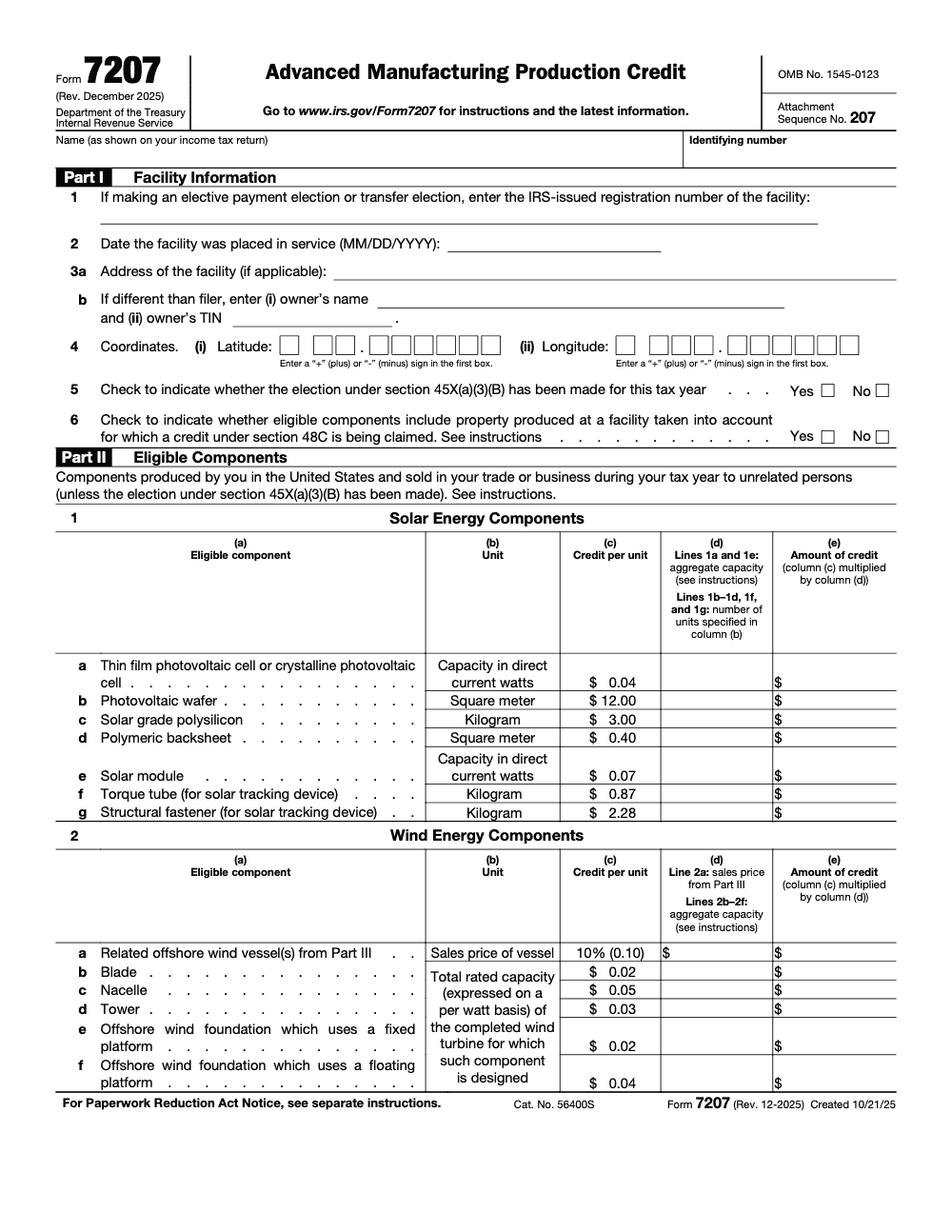
Form 7207 reports the Section 45X Advanced Manufacturing Production Credit for eligible components produced in the United States and sold during the tax year to unrelated persons, filed as an attachment to the income tax return under Attachment Sequence No. 207 (Form 7207, Rev. December 2025). The total from Part II, line 8a flows to Form 3800, Part III, line 1b as a general business credit. Under OBBBA (Public Law 119-21, July 2025), wind components on Lines 2a through 2f cut off after December 31, 2027, while solar, inverter, battery, and electrode components keep the 2030 through 2032 phasedown.
Producing solar, battery, inverter, wind, or critical mineral components in the United States and selling them to unrelated buyers is what opens the door to the Section 45X credit, and Form 7207 is where you compute and claim it. The total from Part II flows to Form 3800 as a general business credit, so an error here ripples through the whole return.
File a separate Form 7207 for each facility, attach it under Attachment Sequence No. 207, and include the facility coordinates on Line 4, checking Line 5 if you elect to treat related-party sales as unrelated. Two timing rules drive a lot of the planning. The base phase-down still applies to most eligible components sold after 2029, running 75% in 2030, 50% in 2031, 25% in 2032, and 0% after 2032. And the One Big Beautiful Bill Act signed July 4, 2025 terminates wind components after December 31, 2027, so working from outdated instructions is how teams get tripped up.
Key Takeaways
- You use Form 7207 to compute and claim the Section 45X credit for eligible components you produce in the United States and sell during the tax year. File a separate Form 7207 for each facility.
- In Part I, include the facility’s address, technical description, and the facility coordinates on Line 4. If you elect to treat related‑party sales as unrelated, check Line 5. If any production used Section 48C property placed in service after August 16, 2022, you must exclude it and address Line 6.
- Pre‑filing registration is required before you make a Section 6417 elective payment or a Section 6418 transfer election, not to simply claim the 45X credit on a return. You will reference the registration number when you file.
- The base phase‑down still applies to most eligible components sold after 2029, 75% in 2030, 50% in 2031, 25% in 2032, and 0% after 2032, with applicable critical minerals historically exempt from that original schedule (note that under OBBBA signed July 2025, applicable critical minerals other than metallurgical coal now phase out at 75% in 2031, 50% in 2032, 25% in 2033, and 0% after December 31, 2033, so they are no longer permanent).
- New for 2025, the “One Big Beautiful Bill Act” signed July 4, 2025 changes several 45X rules. Wind components terminate after December 31, 2027 and additional restrictions apply to integrated components and foreign entity involvement (this 2027 cutoff is more aggressive than the original IRA 2030-2032 phasedown that still governs solar, inverter, battery, and electrode active material components). Build your 2026 and 2027 wind plans with this cutoff in mind.
Purpose and Scope of Form 7207
Form 7207 is the IRS mechanism to compute and report your 45X Advanced Manufacturing Production Credit. You complete one form per manufacturing facility, document where and how the eligible components were produced, and report the volumes sold in the tax year. The credit is available only for eligible components produced in the United States, including U.S. territories and specified continental shelf areas, then sold to an unrelated person, unless you qualify under the integration rule or you make the related‑party election.
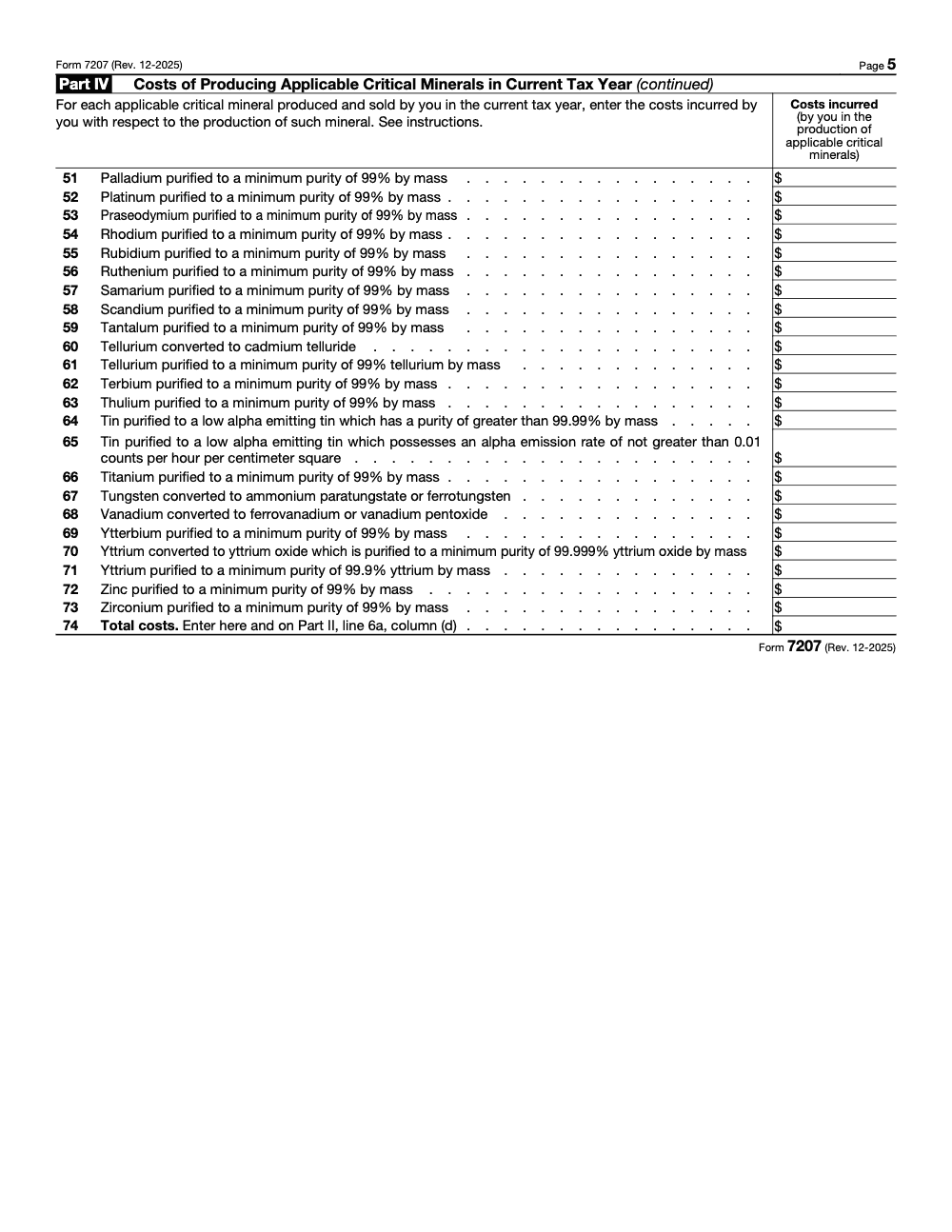
On the face of the form, Part I captures facility information and key certifications, including coordinates on Line 4, the related‑party election on Line 5, and the 48C exclusion on Line 6. In later parts, you compute the credit by component category using the prescribed units and rates, then carry the amount to Form 3800. Keep in mind, Parts III and IV are reserved for offshore wind vessels and applicable critical elements, so do not be surprised when you see them in the instructions.
Who Can File and When a Sale Counts
You file Form 7207 if you produced eligible components at a U.S. facility and sold them during the tax year to an unrelated person. A sale can still qualify if your component is integrated into another eligible component that is later sold to an unrelated party. For related‑party sales inside a group, you can elect to treat that sale as if made to an unrelated person, but you must disclose the election on Part I, Line 5 and maintain support. The related‑person standard follows the single‑employer common control rules under Section 52(b).
Your credit is tied to the year of sale, not the year of production. For example, an offshore wind vessel started before 2023 but completed and sold after 2022 may generate a credit in the year of sale, if all other requirements are met. Proof of U.S. production is required.
Where Pre‑Filing Registration Fits
There is a common point of confusion. You do not need pre‑filing registration just to claim 45X on a tax return. You must complete pre‑filing registration only if you plan to monetize the credit through either, Section 6417 elective payment or Section 6418 transfer. Registration is completed through the IRS IRA/CHIPS portal and must be done before you file the return on which you make the election. Keep your registration number with your facility files.
What changed for 2025
Congress enacted the One Big Beautiful Bill Act on July 4, 2025. For 45X, the law accelerates the end date for wind components to sales after December 31, 2027, introduces limits on integrated components starting with tax years beginning after 2026, and adds foreign entity of concern restrictions. Expect more IRS guidance to harmonize the Form 7207 instructions with these changes. Plan your documentation and contracts accordingly.
The What, How, and Wow of Form 7207
- What, Form 7207 is how you compute and report the 45X credit by facility, component type, and unit of measure.
- How, complete Part I for each facility, then compute component‑level outputs, apply statutory rates, and carry the credit to Form 3800. If you opt for elective pay or a transfer, finish IRS pre‑filing registration first and attach the registration number.
- Wow, clean records and disciplined review can turn a compliance chore into real liquidity without month‑end chaos.
The Form’s Core Structure
- Part I, Facility information, coordinates, owner information if different, technical description, related‑party election box, and Section 48C exclusion box.
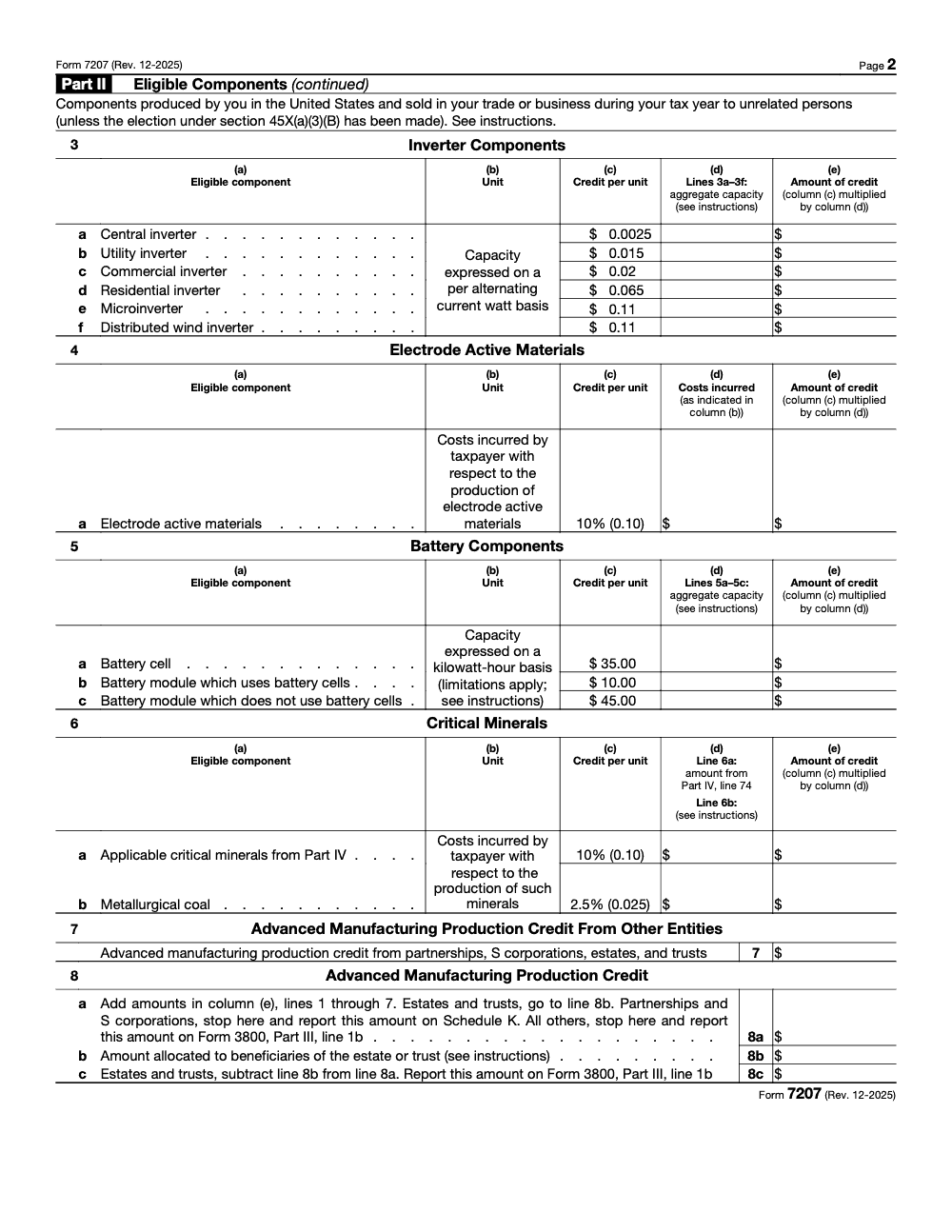
- Part II, Lines for solar, wind, inverters, battery components, electrode active materials, and applicable critical minerals, each with the prescribed units.
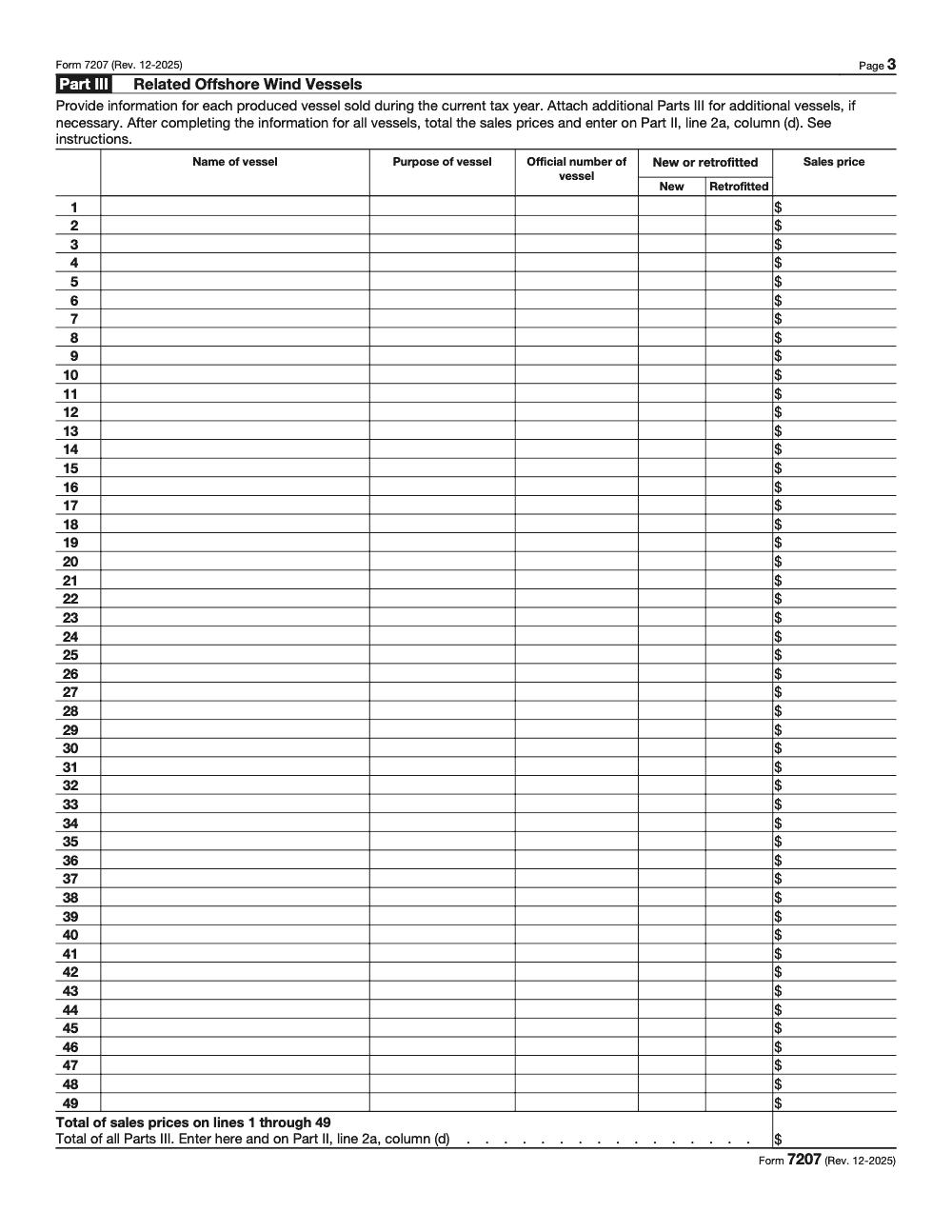
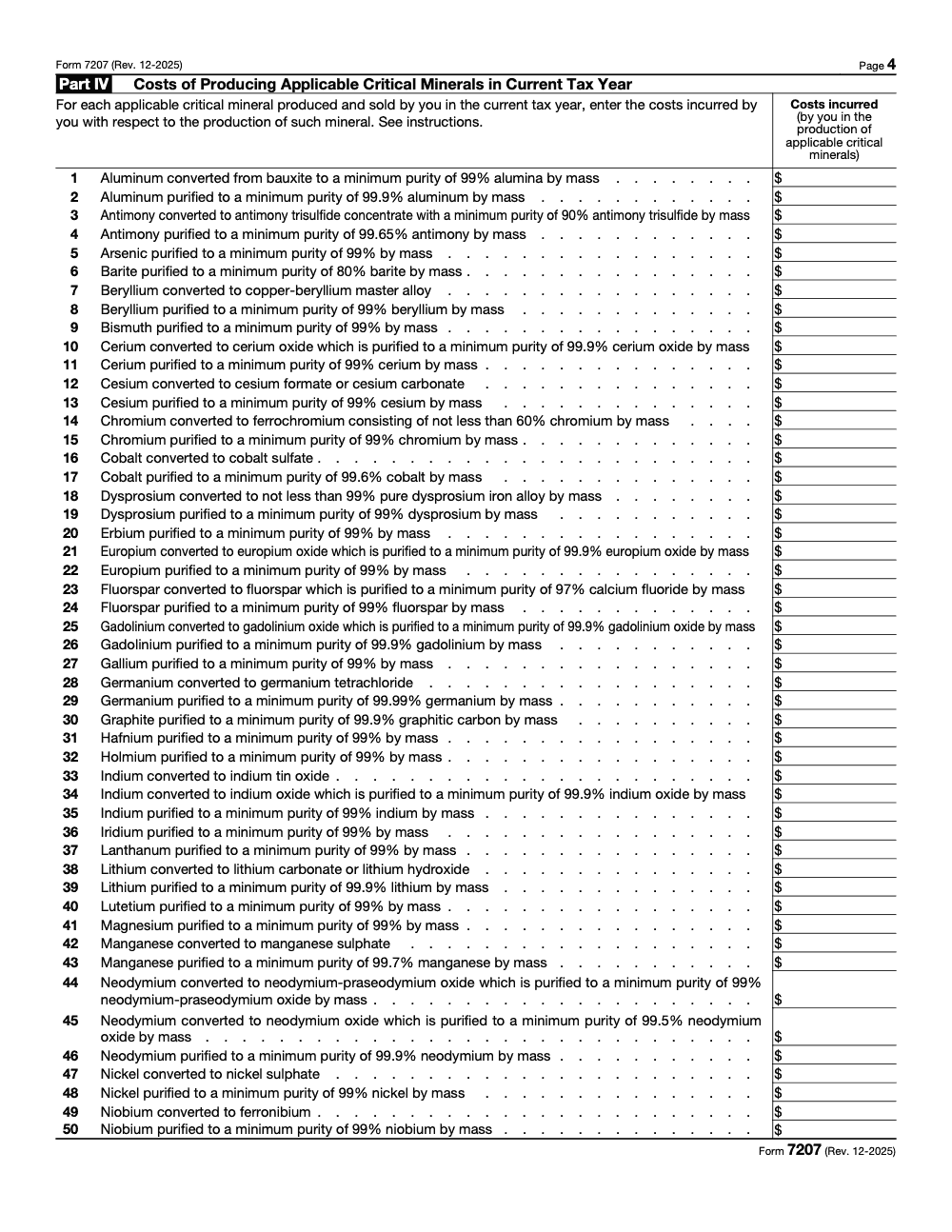
- Parts III and IV, reporting for offshore wind vessels and applicable critical elements.
You must file a separate Form 7207 for each production site. The IRS calls this out plainly, and reviewers will ask for separate workpapers by facility, not a single combined spreadsheet.
Eligibility and Filing Requirements
You are eligible if you, produce an eligible 45X component in the United States, including territories and continental shelf areas, sell it during the year, and meet the unrelated‑party rule, the integration rule, or the related‑party election. You must also exclude any production that used Section 48C awarded property placed in service after August 16, 2022. Document all of this by facility because the IRS requires separate calculations and details for each site.
- U.S. production is a must, the statute and regulations require production within the United States or its possessions (substantial transformation must occur in the U.S.; importing subassemblies and performing only final assembly domestically does not satisfy the production requirement).
- Related persons are defined by the common control rules in Section 52(b). If you elect to treat a sale to a related person as unrelated, disclose it on Line 5 and keep strong support.
- Do not mix 48C with 45X at the same facility for eligible components, the instructions require you to exclude those outputs and maintain proof of exclusion.
Required Registrations
- Pre‑filing registration is required only if you will make a 6417 elective payment or a 6418 credit transfer. Complete it before you file the return that makes the election, then include the registration number with your forms.
- Practical timing, allow processing time and create a folder by facility that includes, registration confirmation, facility map, coordinates, and the final technical description you will copy into Part I.
Pre‑Filing Documentation That Stands Up in Review
In my experience, the easiest 45X reviews are the ones where your files make the story obvious. Build the packet before year end and you will avoid the scramble.
- Facility profile, name, address, FEIN if different, coordinates, and a clear technical description that matches your production lines.
- Production logs tied to SKUs or work orders, including rated capacities and units that match IRS definitions, for example, cells and modules by counts and watts, inverters by AC kW category, battery cells and modules by their specified bases.
- Sales evidence, invoices, bill of lading or delivery confirmations, and a buyer relationship memo showing unrelated status, or the related‑party election support with intercompany agreements and pricing workups.
- 48C exclusion proof, award documentation and a schedule showing how you carved out any 48C production from your 45X claim.
Map Records to the Form
- Part I, facility facts, coordinates on Line 4, related‑party election on Line 5, 48C exclusion on Line 6.
- Part II, component categories, use the form’s units and aggregation rules, for example counts times watts for solar modules or AC nameplate kW for inverters.
- Carryover to Form 3800, and, if you make 6417 or 6418 elections, attach the pre‑filing registration number in the return package.
Aim for a two‑page “read me” per facility that links each line on the form to a document in your packet. Your reviewer will thank you, and your credit will move faster.
Elective Payment vs Credit Transfer, Picking the Right Monetization Path
You have two ways to turn Form 7207 amounts into cash. You can make an elective payment under Section 6417 or you can transfer the credit under Section 6418. The right choice depends on your tax position, filing calendar, and how fast you need liquidity.
Section 6417 Elective Payment, When a Credit Becomes a Refund
With elective payment, you treat your 45X amount as if it were a tax payment on your return. If it exceeds your liability, the excess is refundable (without the Section 6417 election the 45X credit is not refundable by default; it remains a non-refundable general business credit limited by your Section 38 tax liability). To keep this smooth, start with pre‑filing registration, then wire your documentation into a clean package, Form 7207 by facility, Form 3800 for the general business credit, your registration acknowledgment, and your return. Elections can span multiple years depending on your status, so map a three to five year plan for consistency, bank covenants, and cash forecasts.
Practical tips that help in review:
- Keep a copy of your portal registration confirmation in each facility’s binder.
- Match the facility registration number to the exact coordinates you report on Line 4.
- Tie the elective pay amount to a one‑page bridge that reconciles Part II totals to Form 3800.
Section 6418 Credit Transfer, Selling the Credit for Cash
Credit transfer lets you sell your 45X credit to an unrelated buyer for cash. You will still complete Form 7207 and Form 3800, but you execute a transfer election and assignment agreement and you include pre‑filing registration evidence with your return. Buyers will ask for diligence, so expect to share redacted invoices, production logs, and a memo explaining the related‑party election if you used it.
What to line up before you shop the credit:
- A draft data room, facility profiles, aggregation worksheets, and contract templates.
- A timeline, target signing date, and contingencies for audit questions.
- A clear policy on confidentiality and who can see client names in invoices.
If cash timing is tight, model both paths side by side. Elective pay depends on refund timing, while transfers depend on market demand and your ability to close an assignment before you file.
A Simple Decision Ladder
- If you are comfortable waiting on refund timing and prefer direct control, elective payment is often cleaner.
- If your taxable status or structure limits elective pay, or you want cash before filing, a transfer can fit better.
- If your documentation is light, fix that first. Both paths require clear, audit‑ready files.
Facility Reporting and Registration, A Step‑by‑Step Checklist
Each Form 7207 stands on its own, so build per‑facility discipline. This is where many claims slow down, not because the math is hard, but because the basics are missing.
- Create a facility cover sheet with name, address, FEIN if different, and the exact coordinates you will place on Line 4.
- Write a short technical description, what you produce, which lines do what, and how units are measured.
- List the eligible component SKUs and the unit basis that matches the form, counts times watts for solar modules, AC kW for inverters, count or energy basis for battery cells and modules, and weights or counts for wind where eligible.
- Build a monthly production and sales log. Credits arise on sale, so mark ship dates and invoice numbers.
- If you will use elective payment or transfer, complete pre‑filing registration and keep the acknowledgment with this facility’s packet.
- Decide whether you need the related‑party election for any intra‑group sales. If yes, prepare support and check Line 5.
- Review Section 48C awards. If any post August 16, 2022 property produced the items, exclude those outputs and check Line 6.
- Prepare a one‑page reconciliation from logs to the totals you will put into Part II.
Small teams often skip the cover sheet and jump straight to spreadsheets. Reviewers then spend hours asking basic questions and your filing drifts. A two‑page cover sheet avoids that.
Qualified Sales and the Related‑Party Election
A qualified sale means the eligible component was produced in the United States, then sold to an unrelated person. If your component is integrated into another 45X component that is later sold to an unrelated buyer, it can still qualify. If you sell to a related person under common control, you may elect to treat that sale as unrelated, but you must disclose the election on Part I, Line 5 and keep strong support that an arm’s length amount was recorded or that a downstream sale occurred.
What to Keep in Your Related‑Party File
- Intercompany agreements that set commercial terms and responsibilities.
- Pricing memos, cost builds, and a note describing how prices align with arm’s length practice.
- Evidence of a downstream sale to an unrelated party and a calendar that aligns production, transfer, and sale dates.
- A facility‑level schedule showing which lines used the election and how you prevented double counting.
Treat the related‑party election like a loan covenant. Make it explicit, make it provable, and make it consistent across all facilities that use it.
Component Categories and Reporting Specifics You Cannot Afford to Get Wrong
When reviewers push back on Form 7207, it is usually not about the statute. It is about units. If your unit basis does not match the IRS line instructions, the math breaks, and your credit looks inflated. The fix is simple. Pick the right bucket, use the right unit, then show your math.
Solar, Cells, Modules, Wafers, Polysilicon, Backsheets
- Photovoltaic cells and modules, report by counts multiplied by rated watts. Keep a sheet that lists every SKU, its nameplate watts, and the test method you use to confirm nameplate.
- Wafers, report only wafers at or above the required surface area threshold. Keep drawings or supplier spec sheets that show dimensions.
- Polysilicon and backsheets, report on the lines that match the component class and the unit basis shown in the instructions, for example kilograms or counts.
Practical tip, match your warehouse item master to the Form 7207 categories, then freeze the mapping for the year. If you add a new module SKU midyear, update the mapping file the same day.
Inverters, Match the AC Story
Inverters often stumble because the plant team thinks in DC while the form asks for AC capacity and type. Build a one‑pager that shows each inverter type and the AC kW that ties to the label. Report by the prescribed inverter category, then sum AC kW across units. If your product spans multiple categories, split the counts and document the logic.
Batteries, Cells, Modules, Packs, and Electrode‑Active Materials
Battery reporting succeeds when you decide two things up front, the unit basis per line, and the evidence you will keep. For cells and modules, stick to the required basis and keep test records for energy and capacity ratings. If you produce electrode‑active materials, document the production step that created the material, since reviewers will ask how you distinguished it from upstream feedstock.
Wind Components, Dates Matter
If you still produce wind components, treat dates like a bright line. Build a clean calendar that shows production, shipment, and sale. Link each wind component to a copy of the invoice and ship confirmation. Keep a simple certification that confirms U.S. production for each part number.
The fastest way to resolve a component dispute is a single PDF per component class that shows, the unit basis used, the SKU list, the label or spec that proves the unit, and the monthly summary that ties to your totals.
Critical Minerals and Integration Rules
If you deal in applicable critical minerals or integrated components, keep a process memo that explains your production step, your U.S. location, and how you confirmed eligibility. For integration, confirm the downstream sale date and the identity of the unrelated buyer. Flag any related‑party transfers that relied on the related‑party election and keep the support with that facility’s file.
Unit Mapping Quick Sheet
| Component class | Reported unit basis | What to prepare so review is easy |
| Solar cells and modules | Counts × watts | SKU list with nameplate watts, test records, monthly counts, and a tie‑out sheet |
| Solar wafers | Counts at or above the size threshold | Drawings or specs with area math, counts by month |
| Polysilicon | Weight | Batch logs that show net weight and shipment records |
| Polymeric backsheets | Counts | Production logs with counts and cut sizes |
| Inverters | AC kW by type | Label photos, AC kW table, category split sheets, monthly totals |
| Battery cells, modules, packs | Required count or energy basis | Test records, energy ratings by SKU, lot traceability to invoices |
| Electrode‑active materials | Weight or other prescribed basis | Process memo that explains the production step, batch sheets |
| Wind components | Counts or weight per line | U.S. production certification, invoices, shipping confirmations |
| Critical minerals | Required basis per instruction | Origin support, refining step description, and sale evidence |
Phase‑Out and Timing, Avoid Last‑Minute Surprises
Credits arise on sale, not on the day you finish a production run. Your calendar should track when each unit leaves your control, who bought it, and whether that buyer is unrelated. After 2029, apply the phase‑down percentage by the year of sale, then compute the credit for that year’s volumes. If your ERP does not lock invoice dates, export a monthly invoice register and save a snapshot on the first business day after month end. That snapshot becomes your audit‑ready ledger.
A Simple Example You Can Copy
- Your facility sells 1,000 modules in March 2030. Each module is rated at 450 W. Your unit basis is counts times watts, so 1,000 × 450 W.
- Apply the statutory dollar rate per watt, compute the raw credit, then apply the 2030 percentage.
- Tie the final amount to Form 7207 for that facility and carry it to Form 3800.
Keep the math in a single spreadsheet per facility, one tab per component class, with a summary tab that matches the form exactly. Reviewers love it because they can check one number and trust the rest.
Filing Workflow and The Pitfalls That Trip Teams Every Year
Even strong teams miss the same handful of items. Most misses come from rushing Part I, mixing units, or forgetting the 48C carve‑out. Use this workflow to keep your claim tidy and defensible.
A 30‑Day Filing Sprint Plan
Week 1, Prep
- Lock the facility list and confirm you have separate files for each site.
- Pull coordinates, address, FEIN if different, and write a clean two‑paragraph technical description.
- Finish the component‑to‑unit mapping table and freeze it.
Week 2, Evidence
- Export monthly production and sales, then tie those to invoices and ship confirmations.
- Build a buyer relationship memo that flags related‑party links under the common control rules.
- If you will make the related‑party election, draft the intercompany memo and flag Line 5.
Week 3, Controls
- Review Section 48C awards and prepare the exclusion schedule.
- If you plan elective payment or a transfer, check that your pre‑filing registration is done and the acknowledgment is saved to this facility’s folder.
- Run a peer review across facilities to confirm that no counts appear twice.
Week 4, Finalize
- Complete Form 7207 for each facility and tie each number to a specific tab in your workbook.
- Prepare Form 3800, then run a single reconciliation that shows how Form 7207 totals flow to the return.
- Have one person who did not build the numbers read every line out loud against the workpapers.
If you feel rushed, pause and finish Part I perfectly. Most IRS questions start there. A clean Part I sets the tone for a clean review.
Internal Controls That Protect Your Review Time
- SOPs for unit measurement, who records watts, who confirms AC kW, who signs off wafer size.
- A versioned file naming scheme, year‑month‑facility‑component‑v1.xlsx, with a change log.
- A two‑layer review, preparer to senior, then a final reviewer who signs off before the return is assembled.
- An issues list that tracks open questions and decisions, especially for integration and related‑party sales.
Common Errors and How to Fix Them
| Error you might see | Why it happens | How to fix it fast |
| Wrong unit basis for inverters | Plant tracks DC, form wants AC by type | Add a label‑photo table and convert to AC kW by category |
| Double counting integrated components | Counted subcomponent and finished good | Pick one line per item, document the integration rule, and remove the duplicate |
| 48C outputs included | Team reused a plant total | Build a simple exclusion tab by asset ID and subtract before you compute the credit |
| Weak related‑party files | Memo missing or no downstream proof | Add intercompany contracts, pricing memo, and downstream invoice extracts |
| Missing coordinates on Line 4 | No one owned Part I | Assign one owner per facility and add a pre‑filing checklist |
| Sale date unclear | ERP restated invoice date | Save a monthly invoice register snapshot and reconcile to shipping data |
Review Protection With Accountably’s Discipline, Short and Practical
If your internal team is underwater during quarter close, you can still file a clean Form 7207. This is where a disciplined offshore delivery system helps. At Accountably, we plug trained teams into your workflow, then run your documentation and workpaper prep with SOPs, structured naming, and multi‑layer quality checks. You keep control of your templates and systems. We reduce review loops by handing you a ready‑to‑sign packet for each facility, including the coordinates page, the unit mapping table, and the clean reconciliation to Form 3800. It is staffing, but not resume farming, trained preparers backed by the structure that protects your time.
- SOP‑driven workpapers that mirror your Form 7207 and Form 3800 lines.
- Structured file names and version control so nothing goes missing.
- Preparer, senior, and quality checks that cut partner time in review.
- Continuity plans so deadlines are met even if a team member is out.
You stay in your systems, we work inside them, and you decide how much of the prep we handle. Short term or seasonal spikes are fine, but long‑term stability is where the real payoff shows up.
A Quick Checklist You Can Copy Into Your Binder
- Facility cover sheet with name, address, FEIN if different, coordinates, and a two‑paragraph technical description
- Component to unit mapping table that mirrors the form
- Monthly production and sales logs tied to invoices and shipping confirmations
- Buyer relationship memo with related‑party flags and the election plan if needed
- 48C exclusion schedule with support
- Pre‑filing registration acknowledgment if you will make a 6417 or 6418 election
- One‑page reconciliation from the component tabs to Form 7207 and Form 3800
- Sign‑off page, preparer, senior, and final reviewer
Conclusion and Next Steps
You now have a clear playbook for Form 7207, from the facility‑by‑facility mindset to the nuts and bolts of units, elections, exclusions, and review. If you remember only a few items, make Part I perfect, keep unit mapping tight, exclude 48C outputs, and decide your monetization path early so registration does not delay cash. When you assemble a simple, repeatable packet for each facility, your reviewer stops hunting and starts approving. That is how credits become real liquidity without burning out your team.
If you want help standardizing the prep and compressing review time, we can set up a short working session to see where Accountably’s SOP‑driven model fits your process. If you prefer to do it yourself, copy the checklist above into your binder, assign owners, and calendar the steps. Either way, reconcile every figure to source records before you sign. Your future self, and your refund, will thank you.
Common Mistakes We See Every Season
After several production cycles supporting 45X filings, the same errors keep landing on our review desk. Most stem from treating Form 7207 like a year-end credit grab rather than a facility-by-facility, sale-by-sale audit trail.
Reusable Checklists
These checklists are written to drop straight into a firm SOP binder or a controller's review folder. Each one maps to a Form 7207 milestone that slows teams down when it is not standardized.
Per-Facility Packet for Form 7207 Part I
- IRS-issued facility registration number captured for Part I, Line 1 when an elective payment or transfer election is in scope.
- Place-in-service date confirmed in MM/DD/YYYY format for Line 2.
- Facility address verified for Line 3a, and owner name plus TIN documented for Line 3b if different from filer.
- Latitude and longitude captured in signed format with + or - prefix for Line 4.
- Section 45X(a)(3)(B) related-party election decision documented for Line 5 with contract support.
- Section 48C disclosure checkbox answered honestly on Line 6 with the exclusion schedule attached.
- Attachment Sequence No. 207 confirmed and packet aligned to the income tax return identifying information.
Component Unit Mapping Before Part II Totaling
- Solar cells and modules (Lines 1a, 1e) measured in DC watts of capacity, not AC.
- Inverters (Lines 3a through 3f) measured in AC watts of capacity at the correct product subcategory.
- Wind components (Lines 2b through 2f) tied to the total rated capacity of the completed wind turbine in watts.
- Battery cells, modules-with-cells, and modules-without-cells (Lines 5a through 5c) measured in kilowatt-hours at $35, $10, and $45 per kWh respectively.
- Electrode active materials and applicable critical minerals (Lines 4a, 6a) totaled at 10% of production cost.
- Metallurgical coal (Line 6b) totaled separately at 2.5% of production cost with a pre-2030 sunset flagged.
- Part IV line 74 total reconciled to Part II, Line 6a column (d) before sign-off.
Monetization Path Decision and Pre-Filing Registration
- Decide between credit carryforward, Section 6417 elective payment, or Section 6418 transfer at least one quarter before filing.
- If electing payment or transfer, complete IRS pre-filing facility registration and store the acknowledgment in the workpaper file.
- Confirm the entity type so the Part II routing is correct: line 7 for pass-through credit, lines 8b and 8c for estates and trusts, line 8a for all other filers.
- Reconcile Part II line 8a to Form 3800, Part III, line 1b for non-pass-through filers.
- For Part III, identify each related offshore wind vessel as New or Retrofitted with name, purpose, and official number, and attach additional Parts III when more than 49 vessels are involved.
Keep 7207 Season From Stalling
Form 7207 season does not run on a payroll or 1040 calendar. Each facility files its own packet, each component line has its own basis (DC watts for solar cells, AC watts for inverters, kilowatt-hours for batteries, percentage of cost for critical minerals and electrode materials), and the credit landscape shifted again in July 2025 when OBBBA (Public Law 119-21, One Big Beautiful Bill Act) accelerated wind to a hard 2027 cutoff and added a 2031 through 2033 phase-out for applicable critical minerals.
The fix is treating 45X like a structured manufacturing audit, not a year-end credit pull. Build the facility packet during production, lock unit definitions before the first qualifying sale of the tax year, decide the monetization path early enough for IRS pre-filing registration, and reconcile Part IV's 73 critical mineral specifications against the inventory system before the math hits Part II, line 8a.
- Standardize a per-facility packet covering Part I, Lines 1 through 6: registration number, place-in-service date, signed latitude and longitude, owner TIN if different from filer, related-party election decision, and 48C disclosure.
- Map each component line to its basis in the inventory system: DC watts for solar cells and modules, AC watts for inverters, watts of completed turbine capacity for wind components, kilowatt-hours for battery cells and modules, and percentage of production cost for electrode materials, applicable critical minerals, and metallurgical coal.
- Run a 48C exclusion reconciliation before each filing window so components produced at a 48C facility never roll into the 45X totals on Part II.
- Decide on the Section 45X(a)(3)(B) related-party election (Part I, Line 5) at the contract stage, not at filing, so qualifying sales are not silently disqualified.
- Complete IRS pre-filing registration whenever a Section 6417 elective payment or Section 6418 transfer is planned, and store the acknowledgment in the workpaper file.
When the facility packet, unit basis, and monetization path are set at the start of the year, Form 7207 stops being a March surprise and turns into a clean carryforward or cash position. See how our tax outsourcing model compresses Form 7207 review time without giving up control of the credit.
FAQs
File a separate Form 7207 for each facility that produced and sold eligible components during the year. Keep a distinct packet per facility to match.
No. Pre‑filing registration is required when you plan to make a Section 6417 elective payment or a Section 6418 transfer. Keep the registration acknowledgment in your files if you use either path.
Show that the item was produced in the United States, including territories and specified shelf areas, and that it was sold during the year to an unrelated person. If the buyer is related, disclose the related‑party election on Part I, Line 5 and keep arm’s length support or proof of a downstream sale to an unrelated buyer.
You must exclude production from property that received a 48C award placed in service after August 16, 2022. Keep a schedule that shows exactly what you excluded and why.
You can still qualify if the integrated item is later sold to an unrelated buyer. Keep a clear integration memo and the downstream invoice support.
Keep facility profiles, coordinates, technical descriptions, production and sales logs, unit mapping tables, invoices, shipping confirmations, related‑party memos, and 48C exclusion schedules. Retain them based on your standard tax document policy, and long enough to cover statute periods and credit carryforward windows.
Other forms this guide names
- Form 3800: How to Claim the General Business Credit in 2025
About this guide
Accountably helps US CPA, EA, and accounting firms hire trained accountants and tax preparers in India.
About us Reviewed byJugal Thacker, CPAFounder and CEO at Accountably
A Washington-licensed CPA with 7+ years inside US firms – PwC, a real-estate tax practice, then a full-service firm, rising from reviewer to manager to advisory. This article was reviewed against current IRS guidance for the 2025 tax year and updated for filers preparing late returns, amendments, and 2026 estimates.
View profile →How we research, review, and update this guide
Every Accountably guide is researched against primary IRS sources, reviewed by a U.S. CPA, and refreshed as guidance evolves. Read our Editorial Guidelines to see how we source, fact-check, and update our content.