Summarize this article with AI
In Brief
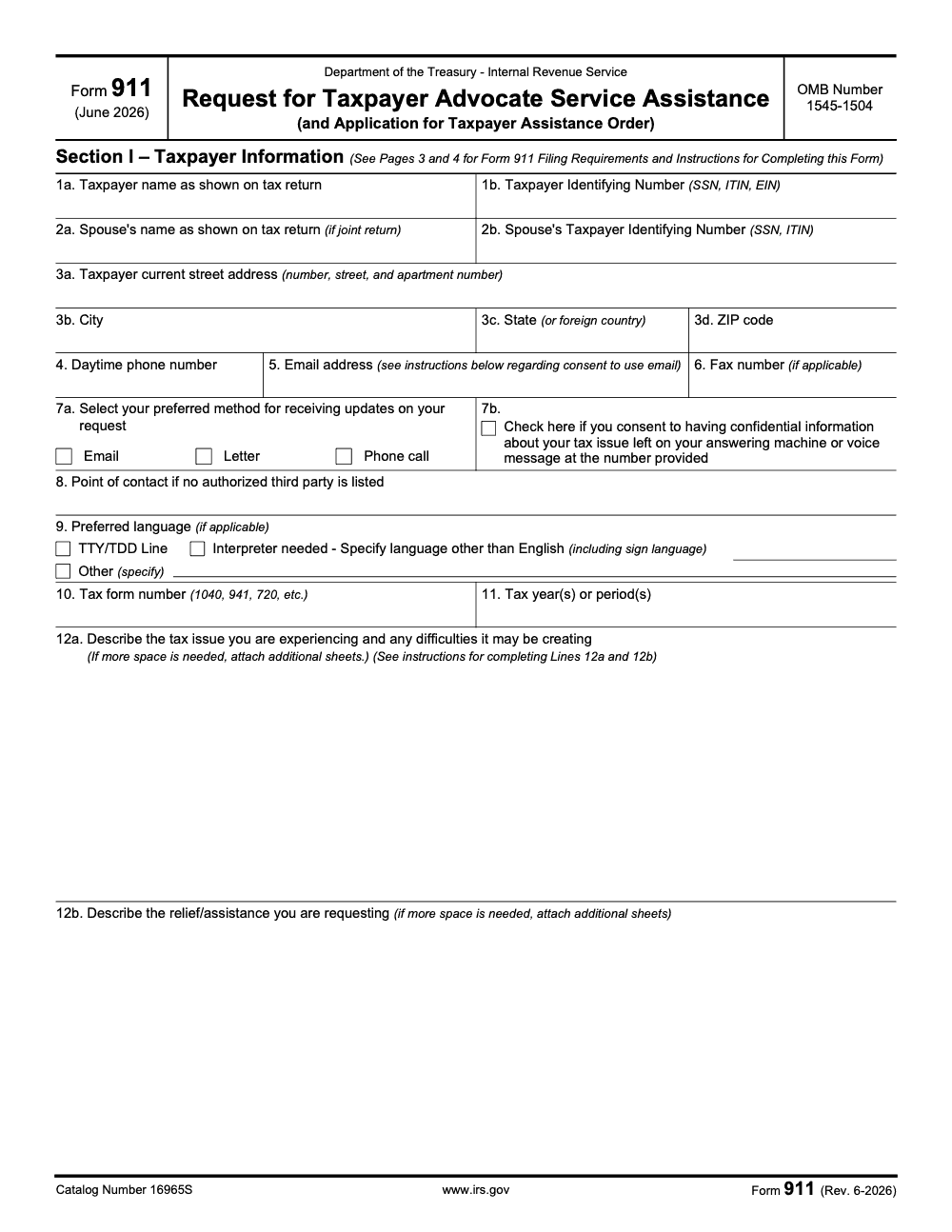
Form 911 is the Request for Taxpayer Advocate Service Assistance (Rev. 8-2025), the form you file when an IRS action or delay causes economic harm or an IRS process has stalled well past normal timelines. Describe the issue on Line 12a and the specific relief you want on Line 12b. TAS assistance is free, the IRS estimates about 30 minutes to complete the form (per the Form 911 instructions), and if 30 days pass with no contact you should call 877-777-4778. See our tax preparation services if you want a team to assemble the file.
By the time a levy hits or a refund has been stuck well past every normal timeline, the client is not asking about process anymore, they are asking how to make it stop. Form 911, the Request for Taxpayer Advocate Service Assistance, is the form you file when an IRS action or delay causes economic harm or a process has simply stalled. You describe the problem on Line 12a and the specific relief you want on Line 12b.
TAS is independent inside the IRS. It can coordinate with operating units and request a hold on collection, but it does not give legal advice and cannot reverse a Tax Court or Appeals decision. The service is free, and if 30 days pass with no contact, that is your signal to follow up, not to wait.
Key Takeaways
- Use Form 911 when IRS actions or delays cause, or are likely to cause, economic harm, for example levy, wage garnishment, loss of housing, utility shutoff, or when an IRS process is not working and the delay extends more than 30 days past normal processing.
- TAS is independent inside the IRS, it can coordinate with IRS functions and request holds on collection, but it does not give legal advice and it cannot reverse tax court or Appeals decisions. If you need representation, contact a CPA, EA, tax attorney, or a Low Income Taxpayer Clinic.
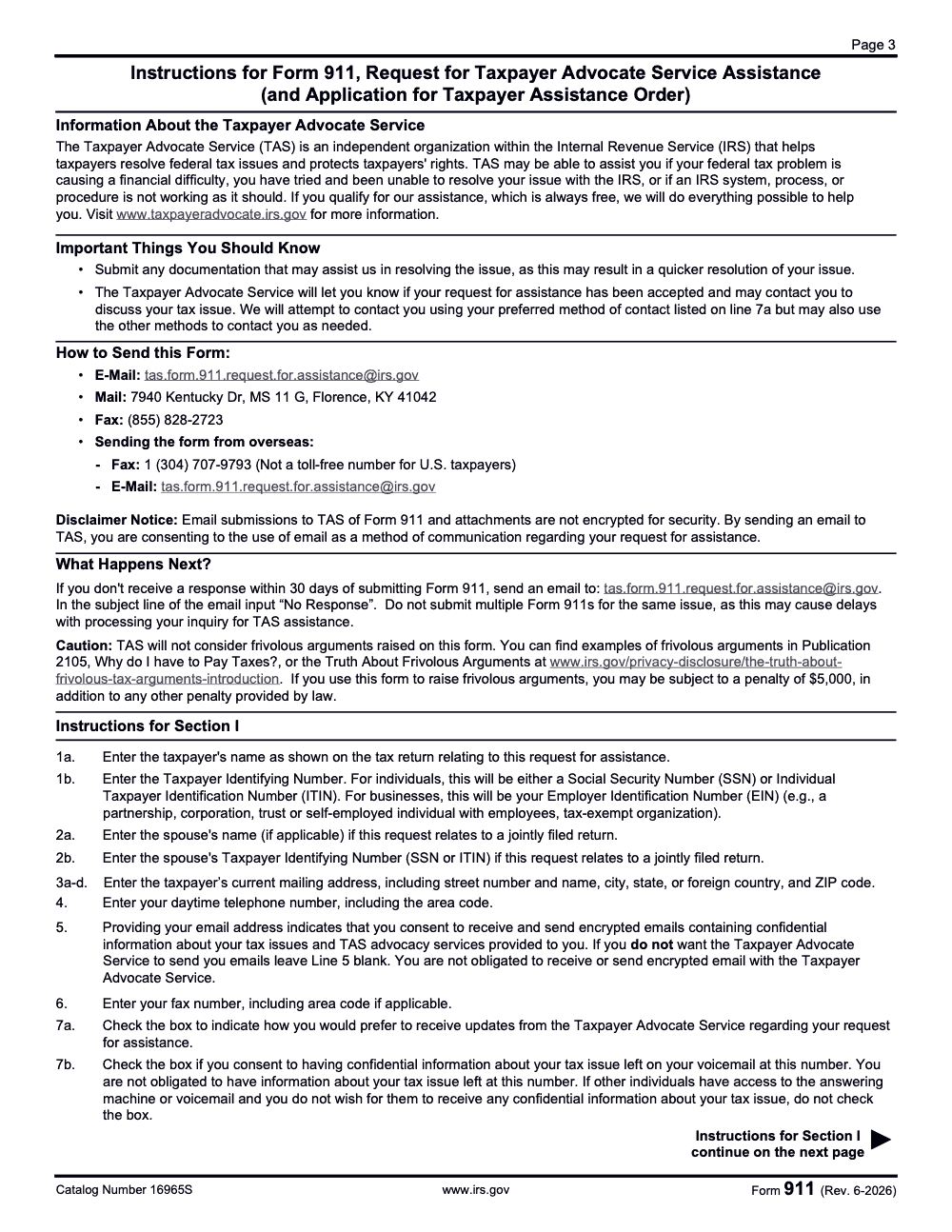
- Submit Form 911 by email, fax, or mail. Current intake: email tas.form.911.request.for.assistance@irs.gov, fax 855‑828‑2723, mail Taxpayer Advocate Service, 7940 Kentucky Dr., Stop MS 11‑G, Florence, KY 41042.
- If you do not hear back within 30 days, call the TAS office that received your form or the national line at 877‑777‑4778. Many taxpayers hear sooner, plan follow up around the 30‑day guidance.
- For fast relief on lien or levy issues, consider CAP or CDP. CAP aims for swift Appeals review of collection actions, while a timely CDP request, Form 12153, generally pauses collection and preserves court review.
What Form 911 is, and how TAS helps
Form 911 is your request for TAS assistance when normal contacts have failed and you face economic harm or a systemic breakdown. Economic harm means essentials are at risk, housing, food, utilities, transportation, or your income dropped sharply because of a levy. Systemic issues include long delays beyond normal timelines, multiple interim letters with no progress, missed promised dates, or procedures that did not work as intended. Make your facts obvious, dates, notice numbers, timeframes, and the specific relief you need.
Once TAS accepts your case, a case advocate becomes your point person. They coordinate with the IRS function, can request a hold on collection while your plan is set, and track milestones with you. TAS is independent, however it is not your lawyer. TAS will not draft a Tax Court petition and generally steps back once you have petitioned. If you need legal advice or representation, hire a qualified professional or contact a Low Income Taxpayer Clinic.
Quick tip, answer unknown numbers for a couple of weeks after you file. TAS often calls before mailing a letter, and missed calls can stretch timelines.
When you should use Form 911
Use Form 911 the moment IRS actions or delays threaten essentials, or when normal channels have failed and you are well past expected timelines. Classic triggers include a wage levy that makes rent impossible, a bank levy that wiped out your funds, an eviction risk tied to IRS action, or a return that has sat far beyond normal processing, usually more than 30 days, with missed promised dates. You can file even if you have not exhausted every call when harm is immediate. Otherwise, try normal paths first, then elevate with Form 911 and attach proof so TAS can act quickly.
Situations that do not qualify
Do not use Form 911 to get legal advice, to ask TAS to prepare returns, or to overturn an Appeals or court decision. TAS is federal only, it will not handle state tax issues. If you need court review on a collection matter, a timely CDP request is the correct path, not Form 911.
Disclosure, this guide is for general information. It is not legal, tax, or accounting advice. For legal strategy, speak with your tax professional or an attorney.
Understand TAS criteria, economic harm and systemic issues
TAS uses two acceptance gateways. Knowing which one fits your facts makes your submission clearer and faster to process.
- Economic harm, your basic living costs are at risk because of an IRS action or a long delay. Examples, eviction risk, utility shutoff, loss of transportation to work, or a levy that chops your take‑home pay so much that you cannot cover essentials. If the answer is yes to these questions, TAS may be able to help.
- Systemic issue, an IRS process failed. You are more than 30 days past normal processing, the IRS missed a promised date, or you received repeated interim letters with no real movement. Show exactly how long you have been waiting beyond published norms.
Micro‑story, a sole proprietor’s refund sat for months with three interim letters and no action. We filed Form 911, listed the letters and dates in bullets, attached identity proof, and TAS prodded the IRS function to resolve the freeze. This is a clean systemic‑issue example.
How to document harm in minutes
Make it easy for a case advocate to see the problem in one pass.
- Identify the IRS action and date, for example CP504 dated July 10 or LT11 dated August 2.
- Connect it to the harm, wage levy cut take‑home by 42 percent, utilities past due 327, rent due November1.
- List your attempts, calls on July 25 and August 19, a promised response by September 5 that never came.
- Ask for narrow relief, place a 30‑day collection hold, release wage levy while I submit Form 433 and an installment proposal.
If you are past the 30‑day delay threshold without a crisis, you can still qualify under systemic issues. Be specific about delay length, missed promises, and which unit has the file.
Pick the right path, TAS vs CAP vs CDP
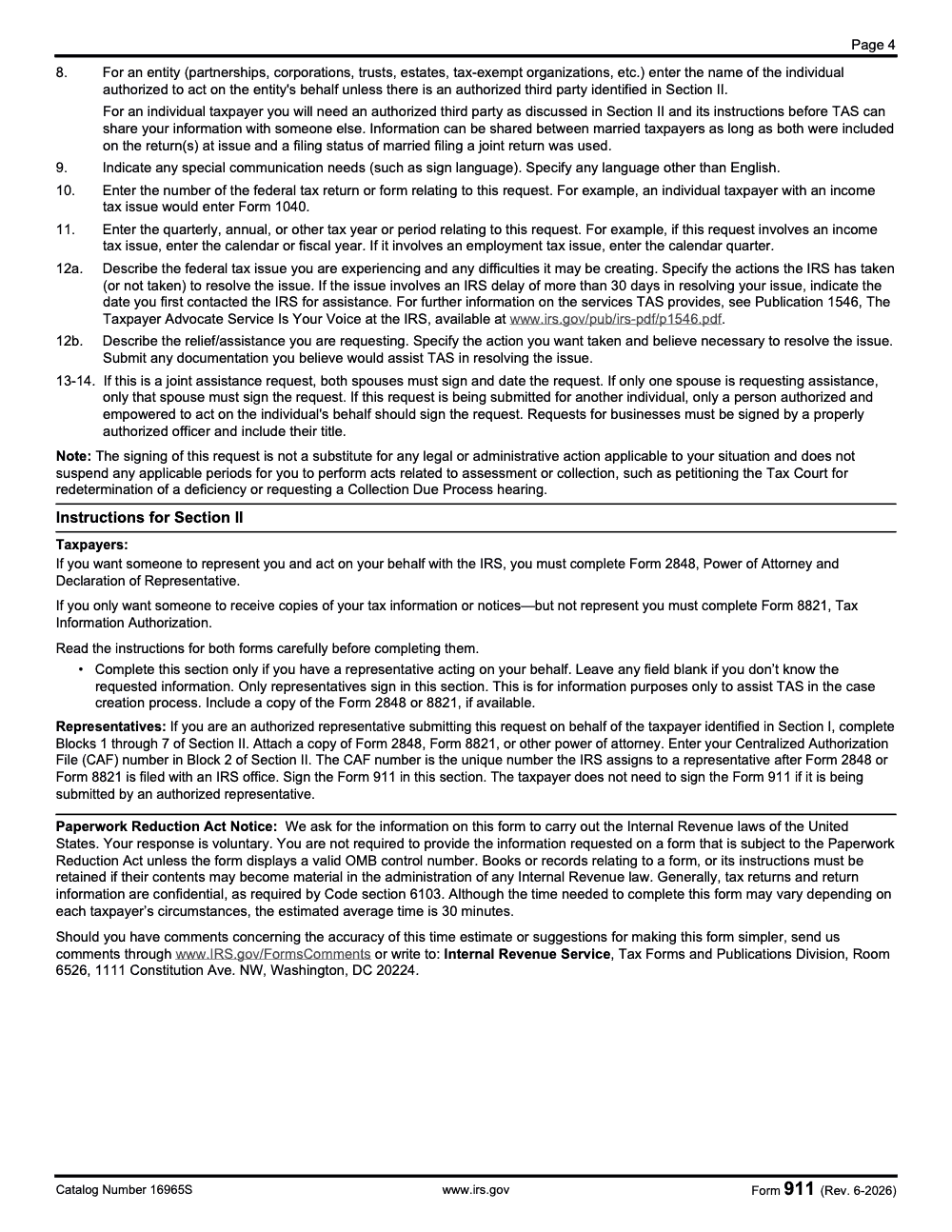
Form 911 is powerful for coordination and for pausing collections while a plan is set, but signing it does not suspend any statutory deadlines, such as the time to petition the Tax Court for a redetermination of a deficiency or to request a Collection Due Process hearing, so you must meet those dates independently. Sometimes a formal appeal is the faster or more protective option.
- CAP, Collection Appeals Program, is built for quick Appeals review of lien, levy, seizure, or certain installment agreement actions. The IRM confirms there is no Tax Court review of a CAP decision. CAP can be used before or after a collection action, and it is often fast. Use it when speed on a discrete collection action matters most.
- CDP, Collection Due Process, preserves rights. File Form 12153 by the date on your notice, a timely CDP request generally pauses collection while Appeals reviews your case and preserves the right to petition Tax Court if you disagree with the determination. If you miss the deadline, you can request an Equivalent Hearing within one year, however you lose Tax Court review.
If a levy is about to hit, CAP or a timely CDP request can be faster than waiting for TAS intake. You can still file Form 911 if you meet TAS criteria. The right choice depends on urgency, need for court rights, and the exact collection action you are fighting.
When TAS is the best first move
Choose Form 911 first when you need cross‑unit coordination, when harm stems from a stalled process, when you need a collection hold while proposing a plan, or when multiple IRS functions are involved. TAS is built to cut through fractured workflows and hold dates accountable.
Common mistakes that slow TAS intake
Most stalls I see at TAS intake have nothing to do with the merits of the case, they trace back to a short list of avoidable errors on the form itself. Clear these before you submit and you save days of back and forth.
How to complete Form 911, step by step
You will sign under penalty of perjury, so accuracy matters. Work section by section, then add attachments that tell the story clearly.
- taxpayer details
- Full legal name, SSN or EIN, spouse details for joint cases, address, and best phone number.
- For businesses, include the responsible party on the account.
- Ensure your address matches what the IRS has, it helps mail reach you.
- Line 12a, describe the problem
- Identify the form and tax period, 1040 for 2023, 941 for Q2 2025, or similar.
- State the IRS actions and dates, for example CP504 on July 10, ACS calls on July 25 and August 19, promised response by September 5 that never came.
- Quantify harm or delay, pay cut of 42 percent due to levy, eviction notice dated October 28, unprocessed refund 90 days past normal time.
- Line 12b, state the relief you want
- Ask for narrow, practical relief, stop levy, place a 30‑day hold, expedite processing, correct a misapplied payment, or release a lien if documentation supports it.
- If proposing an installment agreement or currently not collectible status, note the monthly amount or the hardship basis, and reference an attached Form 433.
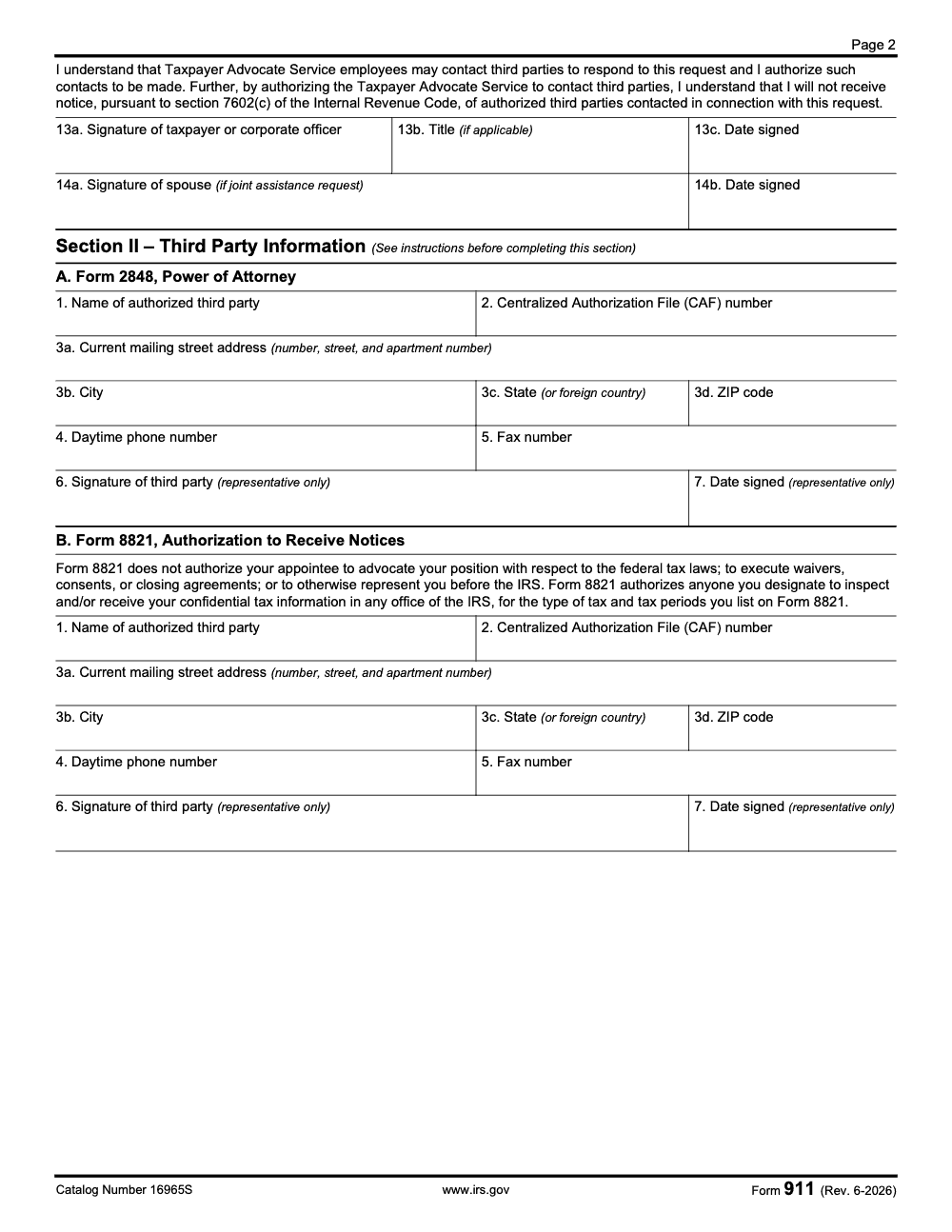
- Sign and date
- You sign and date, both spouses sign for joint issues.
- If represented, complete Section II and attach a signed Form 2848 or 8821 (use Form 2848 if you want the representative to advocate and act on your behalf, since Form 8821 only authorizes someone to inspect and receive your tax information, not to represent you).
- Attach documents
- Notices, transcripts, proof of harm, for example pay stubs showing levy, eviction or disconnect notices, a short call log with dates and names.
TAS emphasizes complete forms for faster intake. Clear facts and focused relief shorten back and forth and help a case advocate act quickly.
One‑page prep table you can copy
| Section | What to enter | Evidence to attach | Reviewer tip |
| I | Names, SSN or EIN, spouse if joint, address, phones | Prior IRS notice with matching address | Check for address consistency |
| 12a | Form, period, action, dates, harm or delay | Notices, letters, call notes | Use bullets with dates for skimming |
| 12b | Specific relief and short rationale | Budget snapshot, 433, bank proof | Ask for time‑boxed relief |
| Rep auth | Section II and Form 2848 or 8821 | Signed POA, CAF number | Confirm fax permissions if used |
Sample 12a and 12b language
Example 12a, the problem 1040, TY 2023. Wage levy started 9‑20 after CP504 issued 7‑10. I called ACS 7‑25 and 8‑19, was told to expect a response by 9‑5, none received. Levy reduced take‑home by 42 percent. Rent due 11‑1, utilities past due 327.
Example 12b, the relief Request a 30‑day collection hold and release of wage levy while I submit Form 433‑A and an installment proposal of 200 per month. If needed, assign field to verify income and expenses.
Where and how to submit Form 911
Pick the channel that fits your speed and privacy needs. TAS accepts email, fax, and mail. Email is quickest, however it is not encrypted, TAS will respond by phone or letter, not by email. If you prefer more privacy, use fax or mail to the Kentucky intake address.
| Method | How to send | Speed | Privacy | Notes |
| tas.form.911.request.for.assistance@irs.gov | Fast | Lowest | TAS will not reply by email. Expect a call or letter. | |
| Fax | 855‑828‑2723 | Fast | Better | Keep a fax confirmation sheet for your records. |
| TAS, 7940 Kentucky Dr., Stop MS 11‑G, Florence, KY 41042 | Slower | Better | Use tracking to confirm delivery. | |
| Time zones outside CONUS | Puerto Rico or Hawaii TAS offices | Varies | Better | TAS lists dedicated PR and HI fax numbers and addresses for certain GMT ranges. |
If 30 days pass with no contact, call 877‑777‑4778 or your local TAS office and reference your submission date. Do not file a second Form 911 for the same issue, since duplicate submissions for the same matter can delay processing.
Security tip, if you email due to urgency, consider redacting full SSNs on nonessential attachments, then provide full documents to your case advocate through a secure channel once assigned. TAS explicitly warns that email submissions are not encrypted.
What to expect after you file Form 911
Plan around a 30‑day follow‑up window. TAS indicates you should hear back within 30 days about your case. In many files, the first contact comes sooner by phone. If TAS cannot reach you by phone, they will mail a letter with next steps, and will leave confidential information about your tax issue on your voicemail only if you checked the Line 7b consent box on Form 911. Keep your voicemail available and your mailing address current.
- Initial contact, phone first, letter if they miss you.
- If 30 days pass with no contact, call 877‑777‑4778 or your local TAS office to check status.
- Accepted cases are assigned to a case advocate who coordinates with the IRS function and updates you on timelines.
If your situation is urgent
Tell TAS if you face eviction, utility shutoff, or a levy that threatens essentials. TAS can request immediate action, including a collection hold. If a collection action is already moving, you may need a formal appeal in parallel.
- CAP, built for speed on lien, levy, seizure, or certain installment agreement actions. There is no Tax Court review for CAP decisions, however Appeals aims to resolve these quickly. Use it when a discrete collection action needs an immediate decision.
- CDP, file Form 12153 by the deadline on your notice. A timely CDP request generally pauses collection while Appeals reviews the case and preserves the right to petition Tax Court after the determination. If late, you can request an Equivalent Hearing within one year, but you lose court review.
Alternatives to Form 911 and how they interact
| Option | Best for | Speed target | What you get | Court review |
| TAS, Form 911 | Economic harm or systemic delay, cross‑unit coordination | Follow up at 30 days if no contact | Case advocate, coordination, potential collection holds | No court review via TAS. |
| CAP | Fast review of a collection action | Typically faster than letters alone, designed for quick Appeals action | Appeals decision on the action, often within days | No Tax Court review of CAP decisions. |
| CDP, Form 12153 | Stop collection and preserve rights | Must file by the notice deadline | Appeals hearing, levy generally paused | Yes, you can petition Tax Court after the determination. |
Important, if you withdraw a timely CDP to switch to CAP, you usually give up Tax Court review and some related protections. Withdrawals remove the hold on levy and stop the extension of the collection statute. Read the withdrawal letter carefully before you sign.
For firm leaders and busy tax teams
If you run a CPA, EA, or bookkeeping firm, a repeatable Form 911 workflow protects clients and reduces partner time in review. Build an intake checklist, standard examples for Lines 12a and 12b by issue type, and a decision tree for TAS vs CAP vs CDP. Keep transcripts, notices, and proof of harm in a consistent folder structure so a case advocate can see the story at a glance. That discipline trims days off intake.
Accountably appears here only where it helps your workflow, not as a pitch. If your firm uses Accountably’s SOP‑driven workpaper structure, standardized naming, and layered review, the supporting documents TAS expects, notices, dates, call logs, and proposed relief, are already organized. That means less scramble, faster TAS acceptance, and less partner time stuck in review. Use whatever system you prefer, the point is consistency and visibility.
Final checklist before you hit send
- You meet TAS criteria, economic harm or a systemic delay more than 30 days past normal processing or a missed promised date.
- Line 12a lists form, period, actions, dates, and the clear harm or delay.
- Line 12b asks for focused relief, hold, release levy, expedite processing, correct account, or similar.
- Notices, transcripts, and proof of harm are attached, plus a short contact timeline.
- You chose the right channel, email for speed, fax or mail for privacy, and you set a 30‑day follow‑up reminder.
Short resources and freshness note
- Submit a request for assistance, current email, fax, and Kentucky address, and the email security notice, verified October 27, 2025.
- TAS contact page, 30‑day follow‑up guidance and national line, 877‑777‑4778.
- Appeals and CDP basics, Form 12153 requirement and right to petition Tax Court after a timely CDP determination. Page reviewed in 2025.
- CAP program scope and no Tax Court review for CAP decisions.
Reusable Checklists
These are copy-paste ready for your firm SOPs or your own prep folder. Work top to bottom before you submit, and keep the boxes checked as a record of what you reviewed.
Form 911 intake packet
- Confirm the facts fit TAS criteria, economic harm or an IRS delay more than 30 days past normal processing.
- Enter the taxpayer name and TIN on Lines 1a and 1b, and the spouse on Lines 2a and 2b for a joint request.
- Match the address on Lines 3a-3e to the address the IRS has on file.
- Put the underlying return on Line 10 (1040, 941, 720) and the tax year or quarter on Line 11.
- Decide Line 7a (encrypted email) and Line 7b (voicemail) consent on purpose, not by default.
- Gather notices, transcripts, pay stubs, and a short call log before you draft Line 12a.
Drafting Lines 12a and 12b
- State the IRS action and its date, for example CP504 issued 7-10.
- Quantify the harm or the delay, such as a levy cutting take-home by 42 percent or a refund 90 days past normal time.
- Include the date you first contacted the IRS whenever the delay exceeds 30 days.
- Ask for one or two specific remedies on Line 12b, a 30-day hold, a levy release, or expedited processing.
- Reference any attached Form 433-A or installment proposal by name.
- Confirm signatures, both spouses on Lines 14 and 15 for a joint request, or Section II if a representative is filing.
Submit and follow up
- Choose the channel, email for speed, or fax 855-828-2723 or mail for privacy.
- Save a fax confirmation sheet or mail tracking receipt for your file.
- Do not send a duplicate Form 911 for the same issue.
- Set a calendar reminder for the 30-day follow-up window.
- If no contact by day 30, call 877-777-4778 or the local TAS office and cite your submission date.
- Keep independent deadlines, such as a CDP or Tax Court date, on the calendar regardless of TAS status.
Keep 911 Season From Stalling
Form 911 work clusters at the worst possible times, right after filing season when refund freezes pile up, and through the collection cycle when CP504 and LT11 notices land on clients at once. The IRS estimates the form itself takes about 30 minutes to complete (per the Form 911 instructions), but that figure hides the real labor of assembling notices, transcripts, call logs, and proof of harm into a file a case advocate can read in one pass.
The fix is not heroics during the crunch, it is a repeatable intake system that is ready before any single request turns urgent. When the supporting documents are already organized and Lines 12a and 12b follow a standard pattern by issue type, acceptance moves faster and senior reviewers spend less time untangling files.
- Keep a standard Line 12a template by issue type, levy, refund freeze, or misapplied payment, so actions and dates are never missed.
- Pre-build Line 12b relief language, collection hold, levy release, and expedited processing, mapped to common fact patterns.
- Maintain one folder structure for notices, transcripts, and call logs so proof of harm is a single click away.
- Track the 30-day follow-up window alongside any parallel CDP or CAP deadlines on a shared calendar.
- Standardize representative authorization, Section II plus a signed Form 2848 with the CAF number, before deadline pressure hits.
This is the structured, documented execution Accountably builds into every engagement, SOP-driven workpapers, standardized naming, and layered review, so the file is ready when the deadline is not. If production capacity is your ceiling, our tax preparation services keep the intake disciplined while your team stays focused on strategy and the client conversation.
FAQs
Form 911 is the request you file when IRS actions or delays are causing, or are likely to cause, economic harm, or when an IRS process is not functioning and you are well past normal timelines. TAS is independent inside the IRS, and a case advocate can coordinate with the operating unit and request collection holds when appropriate.
Yes, when your facts fit TAS criteria. Expect a phone call or letter, often before the 30‑day follow‑up window. If 30 days pass with no contact, call 877‑777‑4778 or your local TAS office and confirm your contact details.
No. TAS does not provide legal advice and does not prepare Tax Court petitions. Once you petition, your case generally moves to IRS Counsel or the Department of Justice. Hire a qualified professional or contact a Low Income Taxpayer Clinic if you need representation.
Email is accepted for speed, however TAS warns that email submissions are not encrypted. TAS will not reply by email, expect a phone call or a letter. If privacy is a concern, use fax or mail.
If a levy is imminent or already in place, consider CAP for a fast Appeals decision on the specific action, or file a timely CDP request with Form 12153 to generally pause collection and preserve Tax Court rights. You can also file Form 911 if you meet TAS criteria, the best choice depends on urgency and whether you need court review.
Other forms this guide names
- Form 12153: CDP Hearing, How to Stop an IRS Levy
- Form 2848: Guide to Line 3, Filing, and Rules
- Form 1040: Filing Guide for 2025 Returns (AGI, Deductions, Deadlines)
- Form 8821: Tax Information Authorization
- Form 941: Employer's Quarterly Tax Return Guide 2025
- Form 433-A: IRS Collection Information Statement Guide
About this guide
Accountably helps US CPA, EA, and accounting firms hire trained accountants and tax preparers in India.
About us Reviewed byJugal Thacker, CPAFounder and CEO at Accountably
A Washington-licensed CPA with 7+ years inside US firms – PwC, a real-estate tax practice, then a full-service firm, rising from reviewer to manager to advisory. This article was reviewed against current IRS guidance for the 2025 tax year and updated for filers preparing late returns, amendments, and 2026 estimates.
View profile →How we research, review, and update this guide
Every Accountably guide is researched against primary IRS sources, reviewed by a U.S. CPA, and refreshed as guidance evolves. Read our Editorial Guidelines to see how we source, fact-check, and update our content.