Summarize this article with AI
In Brief
Form 1098-Q is the QLAC information return – the contract issuer (insurance company) files Copy A with the IRS and furnishes Copy B to the participant. The cumulative premium cap is $200,000 across all QLACs held by a single individual (per Form 1098-Q Rev. April 2025 instructions and SECURE 2.0 Act §202, which retired the prior 25%-of-balance test). Reporting starts with the first premium year and ends in the earlier of the participant's death or attainment of age 85; the participant keeps Copy B for their RMD and contribution-tracking records and does not attach it to Form 1040.
The first Form 1098-Q I ever reviewed arrived in a manila folder, slid across the desk by a retired couple whose broker had called it "an IRS form" without saying what to do with it. The answer was nothing on the return. They had bought a qualifying longevity annuity contract inside a traditional IRA, and the carrier was doing exactly what the rules require: filing with the IRS, furnishing Copy B to the participant, and updating cumulative premiums and the December 31 fair market value each year.
That reporting starts in the first premium year and runs until the earlier of death or age 85, and the number that governs the whole arrangement is the $200,000 cumulative premium cap across all of one person's QLACs, a figure SECURE 2.0 settled after retiring the old percentage-of-balance test. The statement is due to the participant by January 31, and the penalty tiers behind a late or wrong filing run $60, $130, and $340 per form, rising to $680 for intentional disregard.

Key Takeaways
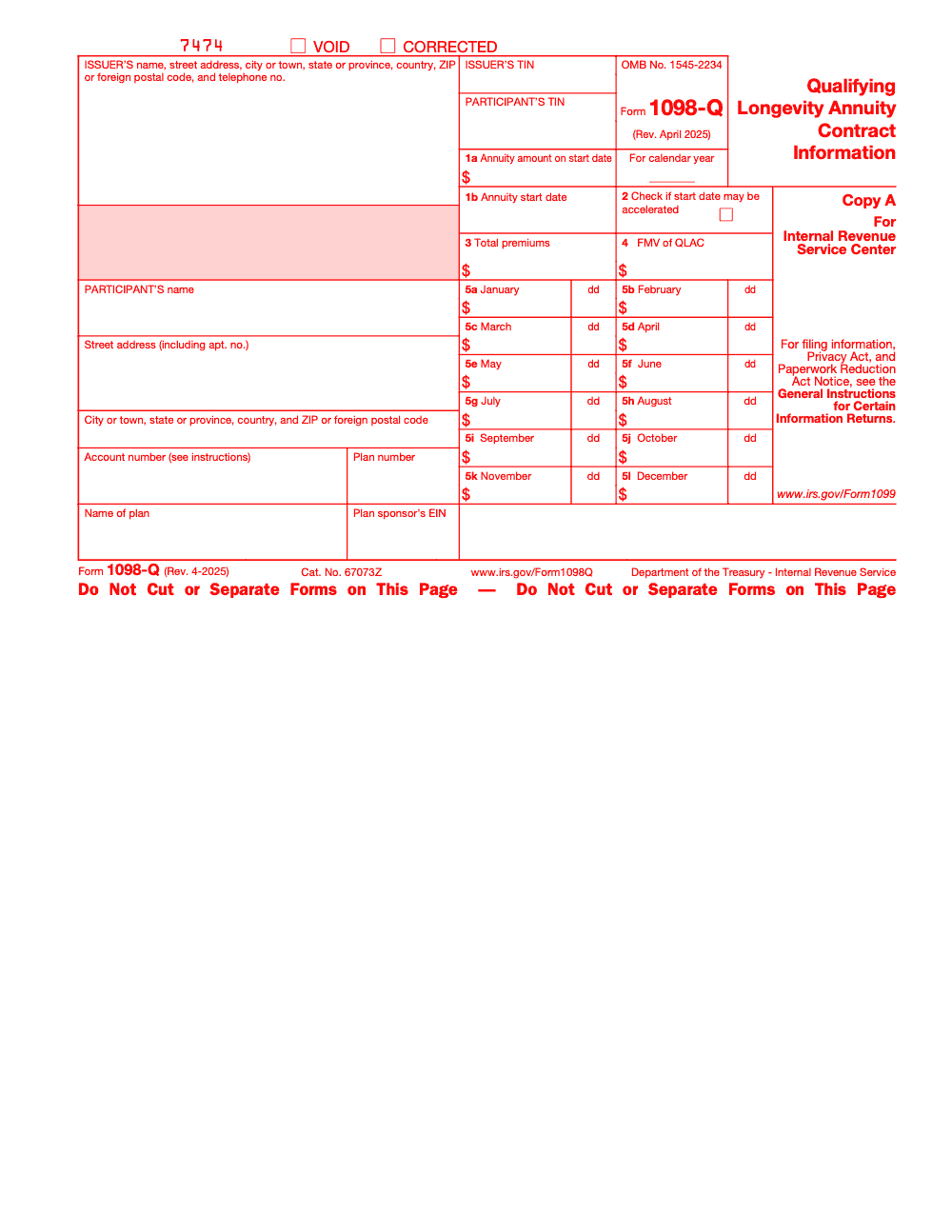
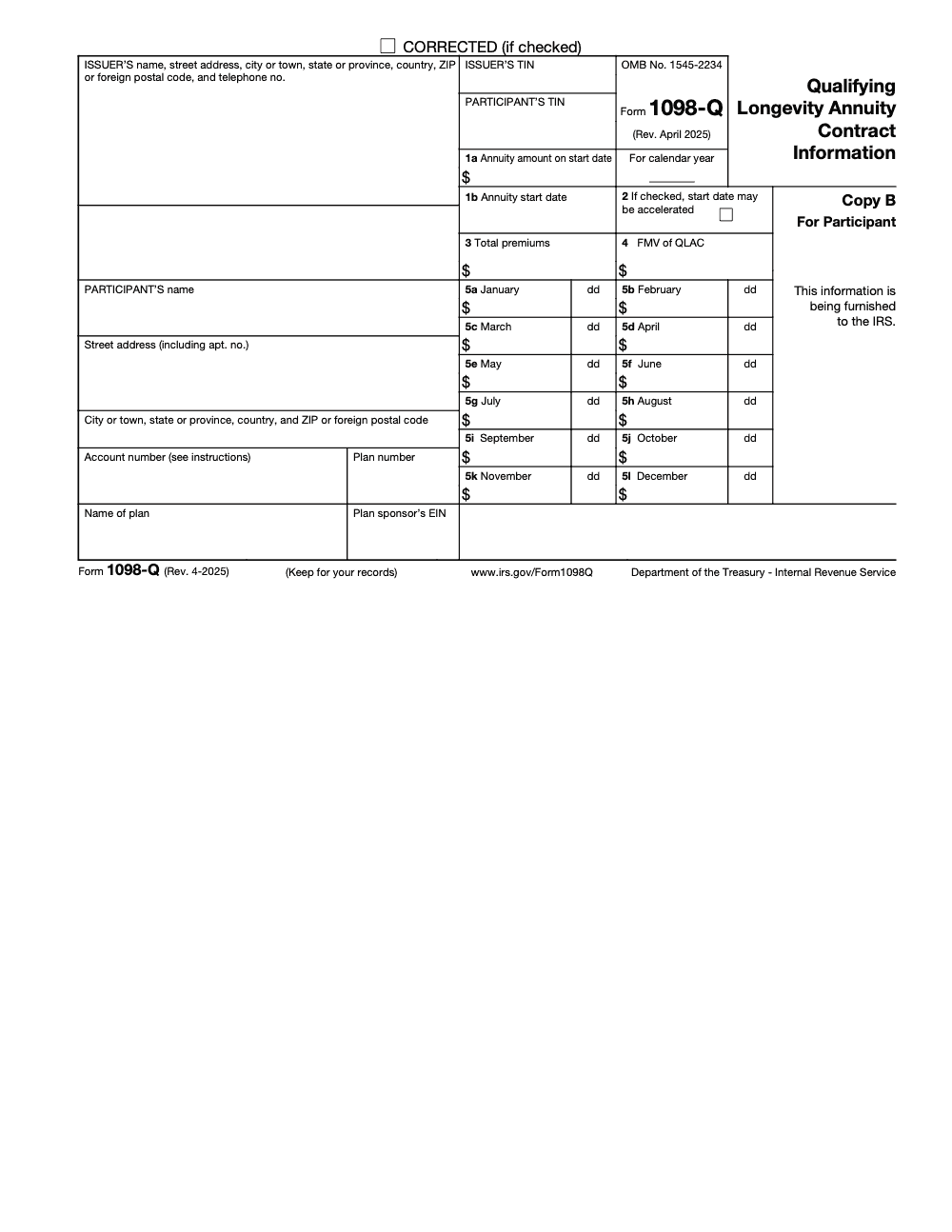
- Form 1098‑Q reports the purchase and annual status of a QLAC, including the annuity start date, the annuity amount at that date, cumulative premiums, December 31 FMV, and a month‑by‑month premium schedule.
- You must furnish the participant statement by January 31 and file with the IRS each year, beginning with the first premium year and continuing until death or age 85.
- For 2025, the QLAC premium cap is $200,000 per Form 1098-Q Rev. April 2025 instructions, subject to future inflation adjustment (verify the current indexing increment for your filing year). SECURE 2.0 Act §202 retired the prior 25%-of-balance test for contracts purchased or premiums paid after December 29, 2022.
- If you file 10 or more information returns in aggregate, you must e‑file. IRIS and FIRE both support the 1098 series.
- Penalties are tiered under IRC 6721 and 6722. For 2025 returns filed in 2026, common per‑form tiers are $60, $130, and $340, with $680 for intentional disregard.
What Is Form 1098‑Q
Form 1098‑Q is the IRS return an insurer files when a contract is intended to be a QLAC funded from qualified plans or IRAs other than Roth IRAs. Filing begins in the first premium year and continues annually through the earlier of the year the participant dies or attains age 85. This annual reporting helps confirm that QLAC value is excluded from the RMD base prior to annuitization.
The Boxes That Matter Most
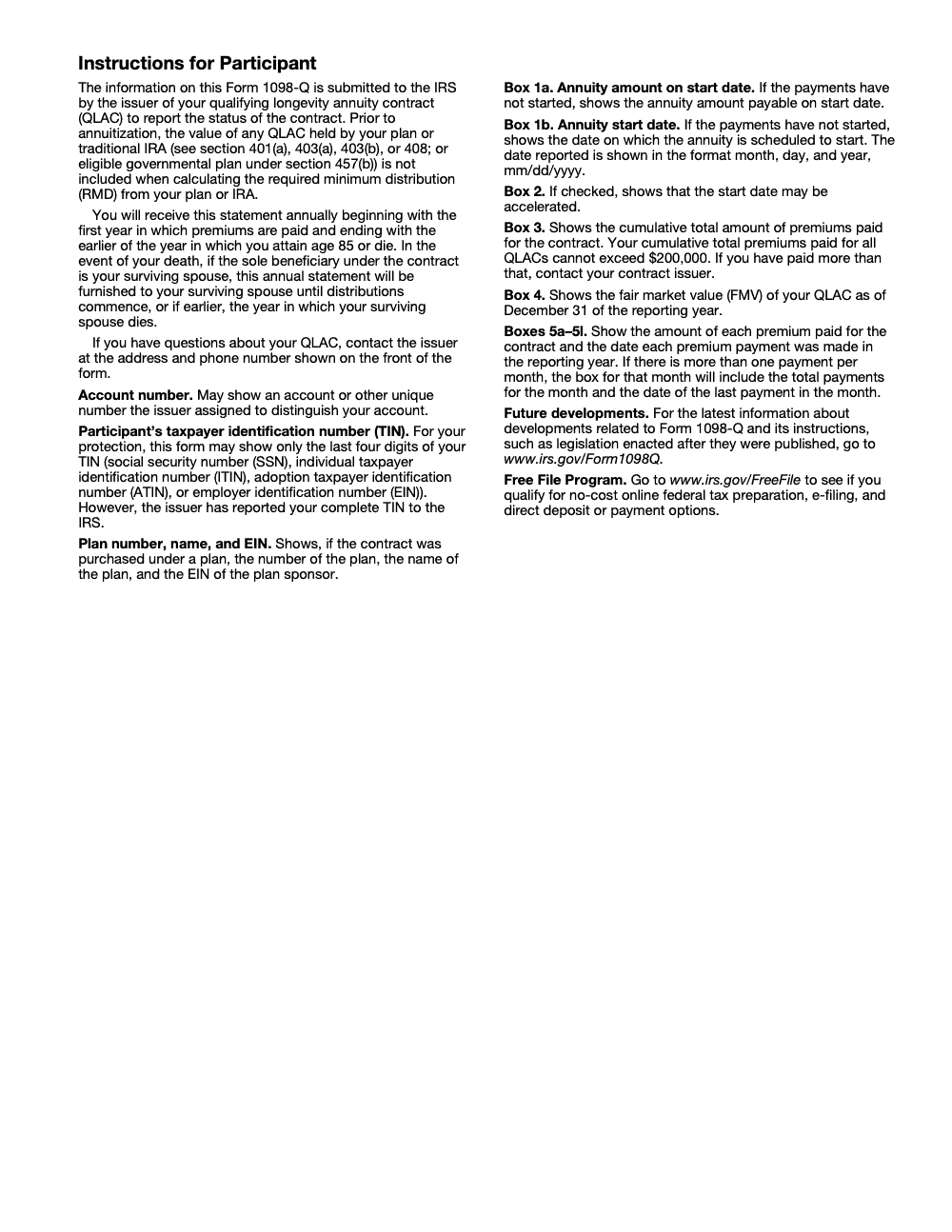
- Box 1a, Annuity Amount on Start Date, shows the periodic payment due at the scheduled start if payments have not yet begun.
- Box 1b, Annuity Start Date, lists when payments are set to start (filled only while payments have not yet begun; the box is left blank once annuity payments are underway).
- Box 2, check if the start date may be accelerated.
- Box 3, Total Premiums, is the cumulative amount through year end.
- Box 4, FMV of QLAC, is the December 31 value.
- Boxes 5a–5l, Monthly Premiums and Dates, capture each current-year premium with its date; they tie directly to Box 3 only in year one. In later years, prior-year Box 3 plus the sum of current-year Boxes 5a–5l should equal current Box 3, since Box 3 is cumulative since inception.
Quick win, reconcile Boxes 5a–5l to Box 3 first. If they do not tie, reviews drag and deadlines slip.
Who Must File Form 1098‑Q
If you issue a contract intended to be a QLAC under sections 401(a), 403(a), 403(b), 408 other than Roth IRA, or an eligible governmental 457(b) plan, you must file Form 1098‑Q and furnish the participant statement each year. The duty starts in the first premium year and ends in the earlier of the year of death or attainment of age 85. If the employee dies and the sole beneficiary is the spouse, furnishing continues to the spouse until their distributions begin, or until the spouse dies.
Practical Implications For Issuers
- The insurer files, not the plan.
- Use distinct account numbers when a participant holds multiple QLACs with you.
- You may truncate a participant’s TIN on Copy B, never on Copy A filed with the IRS.
Deadlines, Formats, And The 10‑Return Rule
Here are the key timing rules for the calendar year following the premium year.
| Action | Due date | Notes |
| Furnish Copy B to participant | January 31 | Truncate TIN allowed on participant copy only. |
| File Copy A, paper | February 28 | Next business day if weekend or holiday. |
| File Copy A, electronic | March 31 | Next business day if weekend or holiday. |
| E‑file mandate | 10 or more information returns in aggregate | IRIS and FIRE support the 1098 series. |
Snapshot, furnish by January 31, paper file by February 28, e‑file by March 31. If you file 10 or more information returns, you must e‑file.
How SECURE 2.0 Changed The QLAC Limits
The new regime is now integrated into the current instructions. For 2025, the QLAC premium cap is $200,000. Beginning with calendar years starting on or after January 1, 2025, the cap is indexed for inflation; verify the current rounding increment against the latest Form 1098-Q instructions for your filing year. If you added premiums after December 29, 2022, those additions follow the new cap, provided earlier premiums met prior rules.
Why this matters, Box 3 must reflect a total that respects the cap for the year. Overfunding risks failure of QLAC status unless the excess is treated correctly under the rules.
RMD Treatment
Before payouts begin, the QLAC value is excluded from the RMD base. Once annuity payments commence, the exclusion ends and the QLAC distributions themselves count toward the participant's RMD. This is one of the key reasons the form exists, it gives administrators and taxpayers the data to apply the exclusion correctly. Final 401(a)(9) regulations apply starting with distribution calendar years beginning January 1, 2025.
Box‑By‑Box Prep, With Reviewer Notes
You can finish Form 1098‑Q preparation quickly if you collect the right fields up front and run two simple tie‑outs.
Identification And Plan Fields
- Issuer name, address, TIN, and a phone line that reaches a knowledgeable person.
- Participant name, address, and TIN, observing truncation rules for participant statements.
- If purchased under a plan, include plan name, plan number, and plan sponsor EIN.
Core QLAC Entries
- Box 1a, periodic annuity amount payable at the start date.
- Box 1b, scheduled annuity start date.
- Box 2, check if the start date may be accelerated.
- Box 3, cumulative premiums through year end.
- Box 4, December 31 FMV.
- Boxes 5a–5l, each month’s premium and payment date.
Reviewer Notes That Prevent Rework
- Reconcile current-year Boxes 5a–5l to the prior-year Box 3 carry-forward; current Box 3 should equal prior-year Box 3 plus the sum of Boxes 5a–5l (Box 3 is cumulative since inception, so the two only tie directly in year one).
- Confirm Box 3 does not exceed the year’s cap, $200,000 for 2025.
- Verify the scheduled start date meets the latest permissible start, the first day of the month after the 85th birthday.
- Assign a unique account number when a participant holds multiple QLACs with you.
E‑File Workflow That Actually Sticks
Electronic filing is straightforward once your data is clean and your account access is set. The two common failure points are formatting and waiting too long to test.
Three‑Step E‑File Plan
- Prepare complete data, issuer EIN, participant TIN, account numbers, plan identifiers if applicable, and proper box formats. Validate before you transmit.
- Transmit through IRIS or FIRE. Both support the 1098 series in processing year 2025.
- Monitor acknowledgements and cure rejections quickly. If March 31 is close, push same‑day corrections to avoid moving into a higher penalty tier.
Remember, the e‑file mandate applies once your total information returns reach 10 or more across types.
Penalties In 2025, Plain Language
Information return penalties share the same tiered structure across most forms. For 2025 returns filed in 2026, common per‑form amounts are $60 if corrected within 30 days, $130 if corrected by August 1, and $340 after August 1 or not filed, with a $680 penalty for intentional disregard and different annual maximums by filer size.
Penalty Snapshot Table
| Scenario | Per‑form penalty | Notes |
| Correct within 30 days | $60 | Lower annual cap applies. |
| Correct after 30 days, by Aug 1 | $130 | Higher cap applies. |
| After Aug 1 or never | $340 | Highest standard tier. |
| Intentional disregard | $680+ | No maximum, special rules apply. |
These per‑form amounts apply to 2025 returns filed in 2026 under Rev. Proc. 2024-40. Annual maximums vary by filer size, so always confirm the table for your filing year.
A Real‑World Example You Can Model
Maria buys a QLAC from her IRA in March 2025 for $50,000, then adds $50,000 in November 2025. On the 1098‑Q for 2025, you will show $100,000 in Box 3, list $50,000 in Boxes 5c and 5k with their dates, record the planned start date in Box 1b, and enter the periodic annuity amount for Box 1a if payments have not started. Box 4 displays the December 31 FMV. Since her total is below the 2025 cap of $200,000, there is no limit issue. If the contract allows acceleration, check Box 2.
If your monthly entries do not roll to Box 3, reviewers will flag it, you will spend extra hours, and March 31 will creep up fast. Build that tie‑out into prep.
Operations Playbook, From First Premium To Furnishing
Here is the practical flow I use with issuers so this filing never turns into a fire drill.
Intake And Setup
- Tag the contract as intended to be a QLAC at issuance.
- Capture participant TIN, address, date of birth, and plan identifiers if relevant.
- Enter the scheduled annuity start date and confirm it meets the age‑85 latest start requirement.
During The Year
- Log each premium with the exact receipt date.
- Reconcile a year‑to‑date premium total monthly.
- Track the December 31 FMV for Box 4.
Year‑End Close And Statement Prep
- Confirm Box 3 is within the year’s cap, $200,000 for 2025.
- Verify Box 1a and Box 1b agree with contract terms.
- Tie current-year Boxes 5a–5l to current-year cash received; tie current Box 3 to prior-year Box 3 plus the sum of Boxes 5a–5l, since Box 3 is cumulative since contract inception.
- Assign unique account numbers when a participant holds multiple QLACs.
Furnish And File
- Furnish Copy B by January 31.
- File Copy A by February 28 on paper or by March 31 electronically, shifting to the next business day when a date falls on a weekend or federal holiday.
- If you file 10 or more information returns across types, e‑file is mandatory. Choose IRIS or FIRE and test your access well before March.
Controls That Keep You Out Of Penalty Trouble
- Box‑level validation rules for dates, positive amounts, and formats.
- A premium limit check by participant across all contracts.
- A monthly to annual premium reconciliation with sign‑off.
- TIN truncation rules applied to participant statements only, never to IRS files.
- A deadline calendar with assigned owners for January 31, February 28, and March 31 tasks.
- An exception log for over‑funding and corrections, including procedures to return excess to the non‑QLAC portion when applicable.
Small process wins usually save more time than new tools. A simple tie‑out and a named owner for each date beat last‑minute heroics every time.
Quick Compliance Table
| Topic | 2025 rule | Source |
| QLAC premium cap | $200,000 per Form 1098-Q Rev. April 2025 instructions, subject to future inflation adjustment (verify current indexing increment) | |
| Latest regs effective | Distribution calendar years starting 01‑01‑2025 | |
| Furnish deadline | January 31 | |
| IRS filing deadline, paper | February 28 | |
| IRS filing deadline, e‑file | March 31 | |
| E‑file threshold | 10 or more information returns in aggregate | |
| E‑file systems | IRIS and FIRE support the 1098 series |
Troubleshooting Common Issues
Box 3 Does Not Match Monthly Totals
Root cause is usually a missing month or a date keyed outside the calendar year. Run a month‑end tie‑out and a December 31 cutoff check before review.
Missing Account Numbers For Multiple Contracts
Assign a distinct account number per QLAC when a participant has more than one contract. It speeds participant support and reduces matching errors.
Annuitization Date Incorrect
Validate Box 1b against the contract and confirm it meets the age‑85 latest start rule. If acceleration is allowed, check Box 2.
E‑File Rejection Near March 31
Fix formatting errors, retransmit the same day, and keep proof. Once you hit 10 or more information returns in aggregate, paper is no longer an option without a waiver.
Where Accountably Fits, Briefly
Most 1098‑Q problems are not technical, they are capacity problems. When a firm runs lean during peak season, trained offshore staff plus multi‑layer review prevent the bottlenecks, missed January 31 mailings, and last‑minute e‑file scrambles. The approach is simple: place preparers inside your systems, keep monthly premium posting clean, standardize workpapers for Boxes 1a–5l, run the cap and tie‑out checks early, and file on time. Use us when you want capacity with control and keep ownership of your process and quality.
Real‑World Checklist You Can Paste Into Your SOP
- Confirm QLAC intent at issuance and capture participant and plan identifiers.
- Record each premium with exact payment dates and reconcile monthly.
- Validate the scheduled start date and the age‑85 rule.
- Compute December 31 FMV and confirm Box 3 is within the year’s cap, $200,000 for 2025.
- Prepare and furnish Copy B by January 31.
- E‑file via IRIS or FIRE by March 31, or paper file by February 28 if eligible and under the threshold. If you file 10+ information returns in aggregate, e‑file is required.
- Monitor acknowledgements, correct errors promptly, and retain delivery evidence.
Compliance And Trust Signals
- The April 2025 instructions reflect SECURE 2.0 changes and indexing mechanics for the cap. Update your SOPs if they still reference the 25% rule.
- The e‑file threshold is now 10 returns in aggregate across types. Plan IRIS or FIRE access and testing early.
- Penalty tiers for 2025 returns filed in 2026 are $60, $130, and $340 per form, with a $680 intentional disregard amount and different annual maximums by filer size. Confirm the table for your filing year.
Key Terms, Made Simple
- QLAC, a Qualifying Longevity Annuity Contract purchased from an insurer under qualified arrangements that meets specific requirements, including a latest permissible start by the first day of the month after age 85.
- Annuity Start Date, the scheduled date the QLAC begins paying, reported in Box 1b.
- FMV, fair market value as of December 31, reported in Box 4.
- IRIS, the Information Returns Intake System that supports e‑filing of the 1098 series.
- FIRE, the Filing Information Returns Electronically system that continues to accept the 1098 series via approved software.
Quick Answers For Stakeholders
For Finance Leaders
Ask for a Box 3 limit check and a Boxes 5a–5l tie‑out report as part of monthly close. This keeps year‑end surprises off your plate.
For Compliance
Confirm your SOP references the April 2025 instructions and the 10‑return e‑file mandate. Add a control that reviews TIN truncation on participant statements versus IRS files.
For IT
Validate your file generator outputs acceptable formats for IRIS or FIRE and test acknowledgements early, not on March 30.
Wrap‑Up
When 1098‑Q goes smoothly, nobody notices. When it does not, everyone does. Keep your process simple, track premiums monthly, tie the totals to Box 3, confirm the start date and the annuity amount, and hit January 31 and March 31 without drama. With the April 2025 instructions now in force and the e‑file threshold set at 10 returns, you have clear guardrails and modern systems to help you deliver on time.
This guide is general information. For your facts and year, follow the current IRS instructions and information return guidance, and keep documentation for every deadline and correction.
Common Mistakes We See Every Season
The same handful of misreads on Form 1098-Q surface every year, and almost all of them trace back to the form being mistaken for a participant filing or to pre-SECURE 2.0 rules still living inside templates. These are the patterns we flag during issuer review and participant intake.
Reusable Checklists
Each checklist is copy-paste ready – drop it into your SOP, intake template, or workpaper index. Items track in the page, so a reviewer can tick through them without losing place.
QLAC premium cap tracking (per individual)
- Identify every QLAC the individual owns across all plans and IRAs, not just the contract you issued.
- Sum cumulative premiums (Box 3 on each contract's most recent Form 1098-Q) and confirm the total is at or below $200,000.
- Flag any new premium that would push cumulative total premiums above the $200,000 cap before the payment is accepted.
- Document the prior 25%-of-balance test as retired (SECURE 2.0 Act §202, effective December 29, 2022) so it does not creep back into review notes.
- Re-check the cap against the most current Form 1098-Q revision each January; the $200,000 figure is subject to future inflation adjustment.
Issuer year-end Form 1098-Q prep
- Pull December 31 fair market value for Box 4 on every active QLAC and reconcile to the policy administration system.
- Verify Boxes 1a and 1b are populated only when annuity payments have not yet started and the start date is in mm/dd/yyyy format.
- Confirm Box 2 reflects whether the contract permits acceleration of the annuity start date, not whether acceleration has occurred.
- Tie Box 3 (cumulative) to prior-year Box 3 plus the sum of current-year Boxes 5a through 5l.
- Confirm reporting cutoff: the year the participant attains age 85 or dies IS reported; stop generating forms only for years after that final year (subject to the sole-beneficiary spouse continuation rule).
- Split copy distribution: full TIN on IRS Copy A, truncated last-four TIN on participant Copy B.
- Order official scannable Copy A from IRS.gov/EmployerForms for paper filings, or queue the run for IRIS or FIRE if aggregate information returns will hit 10.
Participant review on receipt of Copy B
- File Copy B in the QLAC records folder; do not attach it to Form 1040.
- Confirm the participant's TIN, name, and address are correct on Copy B; report errors back to the issuer for a corrected return.
- Compare Box 3 (cumulative premiums) against the participant's contract file to confirm no missed payment entries.
- If the participant is approaching RMD age, exclude the QLAC's fair market value from the prior-year-end account balance used to compute RMD until annuity payments commence.
- Update the QLAC tracker with the December 31 FMV and the scheduled annuity start date for future planning.
Keep 1098-Q Season From Stalling
Form 1098-Q is a low-volume, high-precision filing for most QLAC issuers and plan-sponsor TPAs. One contract generates one form per calendar year, but every form carries twelve monthly premium boxes (5a through 5l), a cumulative-since-inception total, a December 31 fair market value, and a separate Copy A and Copy B distribution path. Add the post-2024 e-file mandate – ten or more information returns in aggregate triggers required electronic filing per Treasury Reg §301.6011-2 (T.D. 9972) – and even a small QLAC book pulls a full year of operational discipline.
The fix is not more time; it is a calendared, box-mapped reporting SOP that closes each contract's reporting year the same way: cumulative premiums verified, December 31 FMV pulled, beneficiary status reconfirmed, and copy distribution split between the IRS Copy A track and the participant Copy B track.
- Lock a December 31 freeze date for fair market value entries in Box 4 and reconcile every contract before any Copy A or Copy B is generated.
- Run a Box 3 cumulative versus Boxes 5a-5l current-year reconciliation on every contract; the delta must equal prior-year Box 3, no exceptions.
- Maintain two template tracks – full TIN for IRS Copy A and last-four-digit truncation for participant Copy B – and QA the first batch of each filing year before scaling.
- Verify reporting cutoff against the participant's age and beneficiary status: reporting ends in the earlier of the year of death or attainment of age 85, and continues to a surviving spouse only when that spouse is the contract's sole beneficiary.
- Route paper filings through ordered scannable Copy A from IRS.gov/EmployerForms; route e-filings through IRIS or FIRE before aggregate information returns cross the 10-return threshold.
That is the discipline Accountably's tax delivery teams build into issuer and plan-sponsor workflows: documented box-by-box prep, reconciliation gates before furnishing, and a single owner per reporting year, so the next December 31 does not start from scratch.
FAQs
No. Participants keep it for records. Actual taxable annuity payments, when they begin, are reported on Form 1099‑R.
The issuer of the contract, generally the insurance company, must file with the IRS and furnish the participant statement annually, starting with the first premium year and ending in the earlier of the year of death or attainment of age 85.
Form 1098‑Q shows QLAC information, including premiums, start date, and FMV. Form 1099‑R reports distributions when annuity payments begin.
Yes. Before annuity payments start, QLAC value is excluded from the RMD base, subject to the final 401(a)(9) rules that apply beginning January 1, 2025 distribution years. Once payments begin, the exclusion ends and the QLAC distributions themselves count as RMDs.
Other forms this guide names
- Form 1098: How to Read It and Claim Mortgage Interest
- Form 1099‑R: Box 7 Codes, Rollovers, 2025 Filing Guide
- Form 1040: Filing Guide for 2025 Returns (AGI, Deductions, Deadlines)
About this guide
Accountably helps US CPA, EA, and accounting firms hire trained accountants and tax preparers in India.
About us Reviewed byJugal Thacker, CPAFounder and CEO at Accountably
A Washington-licensed CPA with 7+ years inside US firms – PwC, a real-estate tax practice, then a full-service firm, rising from reviewer to manager to advisory. This article was reviewed against current IRS guidance for the 2025 tax year and updated for filers preparing late returns, amendments, and 2026 estimates.
View profile →How we research, review, and update this guide
Every Accountably guide is researched against primary IRS sources, reviewed by a U.S. CPA, and refreshed as guidance evolves. Read our Editorial Guidelines to see how we source, fact-check, and update our content.