Summarize this article with AI
In Brief
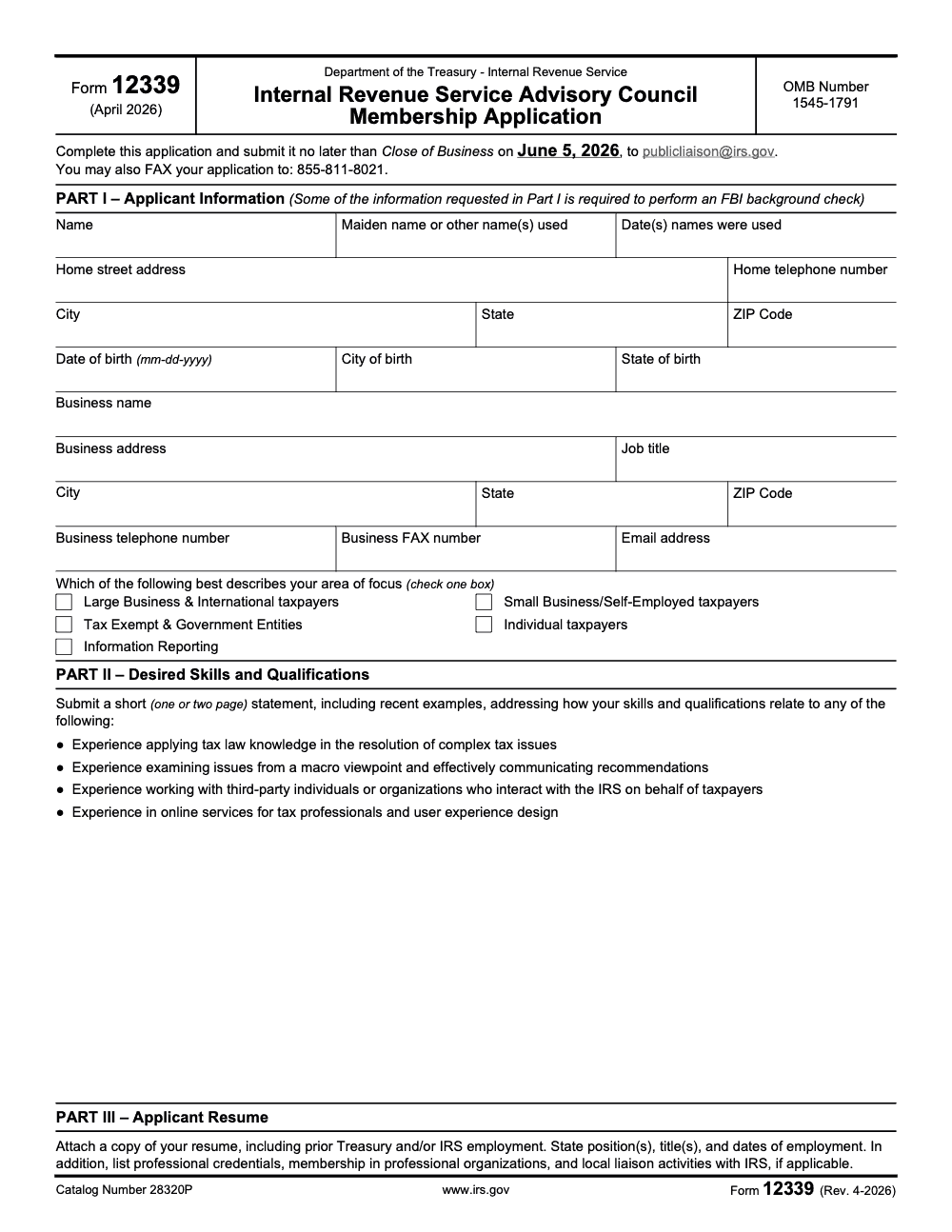
Form 12339 is the IRS Advisory Council (IRSAC) membership application – an administrative form, not a tax return, so it reports no income and computes no tax. The current revision is April 2026 (Rev. 4-2026, OMB 1545-1791), and for the 2026 cycle completed applications are due by Close of Business on June 5, 2026, sent to publicliaison@irs.gov or fax 855-811-8021, not the Washington, DC address printed in the Privacy Act notice. After you submit, the IRS emails Form 14767 (Consent to Disclose Tax Compliance Check), which you must return to complete the application (per the Form 12339 instructions).
The strongest IRS Advisory Council applications never start with the form. They start with a clean evidence file, a results-focused resume, verifiable credentials, and a short statement mapping real outcomes to a single IRSAC focus area, all assembled well before the cutoff.
Form 12339 is the IRSAC membership application, an administrative form that reports no income and computes no tax. The current revision is April 2026 (Rev. 4-2026, OMB 1545-1791), and for the 2026 cycle the completed application is due by Close of Business on June 5, 2026, sent to publicliaison@irs.gov or fax 855-811-8021. Submit, and the IRS emails Form 14767 next, so plan for that handoff rather than scrambling for it.
Key Takeaways
- Form 12339 is the IRS Advisory Council application that presents your qualifications, experience, and interest in serving. The current PDF shows revision April 2026 (Rev. 4-2026) and directs submissions to publicliaison@irs.gov, with a 2026 cycle deadline of Close of Business on June 5, 2026. Always confirm the current year’s form and deadline.
- Strong candidates are seasoned tax professionals who write clearly, bring measurable results, and represent diverse taxpayer perspectives. IRSAC is a formal advisory body that supports the Commissioner on tax administration issues.
- Use a results‑focused resume, verifiable credentials, and concise statements tied to IRS priorities. Keep conflict disclosures complete and timely.
- Electronic signatures are acceptable on many IRS documents if the form owner permits them. When you sign electronically, follow IRM 10.10.1 requirements and keep an audit trail.
- Expect multi‑month timelines. IRS announced 18 new IRSAC members for 2025, which shows the process is active and competitive. Plan your materials early.
What Form 12339 Does
Form 12339 is how you introduce your expertise to the Internal Revenue Service Advisory Council, IRSAC; it is an administrative application, not a tax return, so it reports no income and computes no tax. Think of it as a compact evidence file. You show what you know, where you have served, and how your judgment could help taxpayers at scale. The form collects core identity details, your focus area, a short statement on skills, a resume, prior council service, and consent for a tax compliance check. In the current PDF (Rev. 4-2026), submissions route to publicliaison@irs.gov or fax 855-811-8021, and for the 2026 cycle the deadline is Close of Business on June 5, 2026. Always verify the current cycle’s deadline before you hit send, and note the IRS uses a Close of Business cutoff, not midnight like ordinary federal filing deadlines.
Your job is to make review easy, your impact obvious, and your documentation airtight.
Why You, Why Now
If you have years of hands‑on tax work, policy insight, or advocacy for underserved filers, your perspective matters. IRSAC exists to give IRS leadership practical input from the field, spanning individual, small business, large corporate, information reporting, and exempt entities. The Council provides an organized forum to discuss improvements to service and compliance, then publishes an annual report. Your experience can influence the pain points you see every filing season.
The Bar Is High, and That Is Good
IRSAC seats are limited and selection is competitive. In January 2025 the IRS named 18 new members, again underscoring that reviewers look for balance, depth, and clear contributions. If you aim to be in that cohort in a future year, your application needs to show measurable outcomes, a clean compliance record, and the ability to collaborate in a public forum.
Who Should Apply
You should apply if you are a CPA, EA, tax attorney, corporate tax leader, LITC leader, policy researcher, or similar professional with several years of relevant experience. You add the most value if you can connect front‑line realities to system‑level recommendations. Show that you understand taxpayer burdens, digital access gaps, multilingual needs, and the trade‑offs inside compliance operations. The IRS seeks a cross‑section of the tax community so the Council reflects different segments and geographies.
- You have a record of service and ethics.
- You can write and speak clearly under time pressure.
- You are ready to participate in meetings and subcommittee work.
What To Prepare Before You Start
Before you type a single character, gather three things:
- A current resume or CV that lists roles, dates, and outcomes, not just duties.
- Clean copies of licenses or certifications, for example CPA, EA, JD, plus any relevant continuing education.
- A one to two page statement that maps your skills to IRSAC focus areas, for example complex issue resolution, examining issues from a macro viewpoint and communicating recommendations, online services for tax pros, or third‑party interactions with the IRS. The current form explicitly asks you to address these areas with recent examples.
If your firm runs on structured workflows, this prep will feel familiar. If not, this is a good moment to borrow the discipline you use for client engagements. At Accountably, we see the same pattern year after year. Teams win when they standardize files, name documents clearly, and keep version control tight. Mentioning Accountably lightly here, our preference is process before speed, because that is what survives scrutiny.
How the Form Is Structured
Use this quick map so you do not miss anything:
- Part I, Applicant Information, identity and contact details, including items used for FBI checks.
- Part II, Desired Skills and Qualifications, a short statement, one or two pages, with recent examples.
- Part III, Resume, include IRS or Treasury service, credentials, and liaison activities.
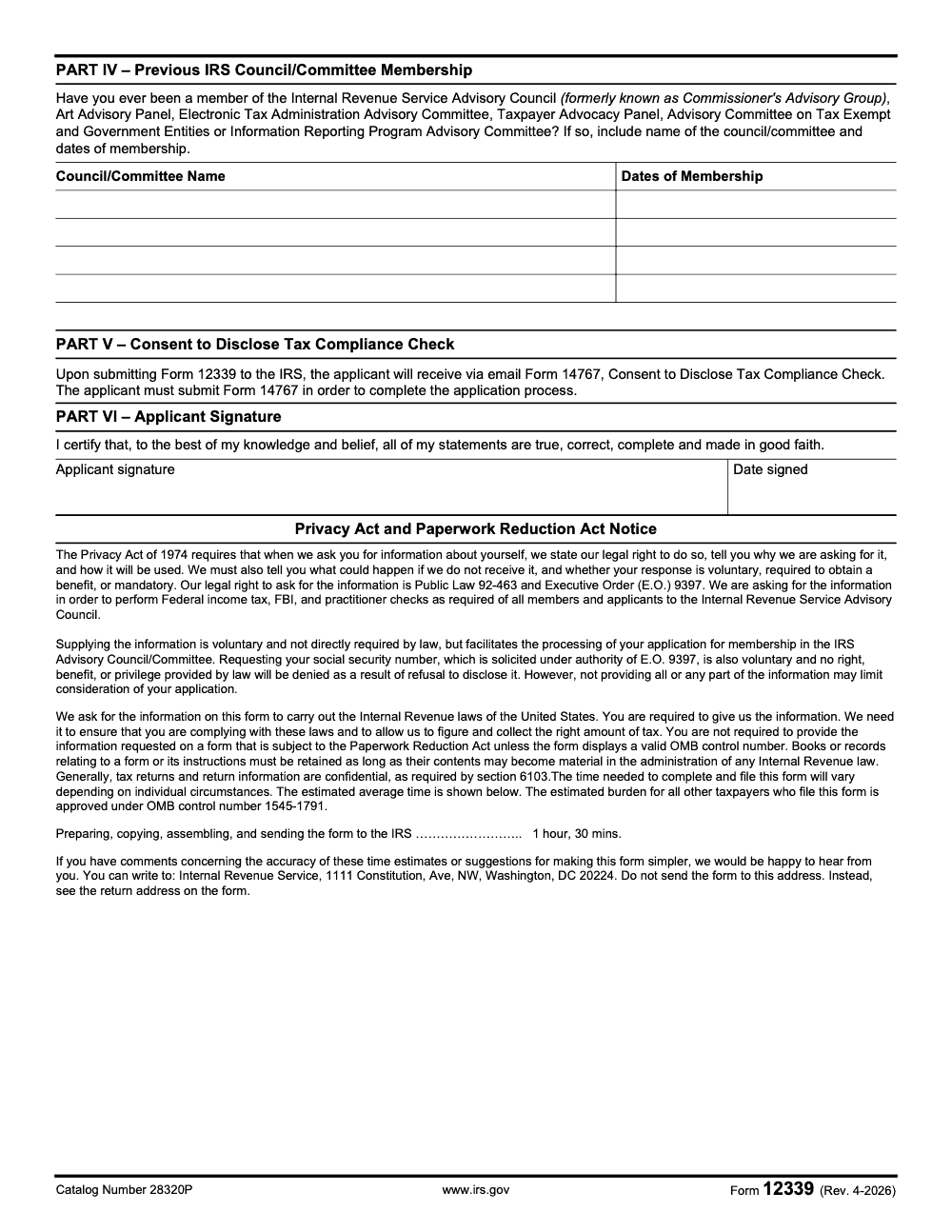
- Part IV, Previous Council Membership, list dates and committees.
- Part V, Consent to Disclose Tax Compliance Check, you will receive Form 14767 after you submit, and you must submit Form 14767 to complete the application, it is a required step, not an optional follow-up.
- Part VI, Signature, sign and date. If you sign electronically, follow IRM 10.10.1 standards for a legally binding e‑signature.
In short, show who you are, what you have done, where you served, and that your record stands up to a tax check. Keep everything consistent with your resume and your public profile.
Eligibility and Applicant Qualifications
To be competitive, pair domain expertise with public‑service impact. Reviewers look for deep experience in tax administration, accounting, law, information reporting, or exempt organizations, along with the ability to translate client or community issues into practical recommendations. Show that you can weigh trade‑offs for different taxpayer segments and that you know how IRS operations work in practice. The IRS builds a balanced Council, so perspectives that broaden discussion are valuable.
Common Strength Signals Reviewers Notice
- Measurable outcomes, for example error rate reductions, faster cycle times, or improved outreach.
- Experience with underserved communities, multilingual work, or digital access initiatives.
- Clear ethics record and conflict awareness, shown through complete disclosures and sound judgment.
Required Documents and Supporting Materials
Build a secure, complete portfolio that is easy to verify:
- Resume or CV with roles, dates, and quantified results.
- 2 to 3 recommendation letters from supervisors, board members, or public‑interest partners.
- Copies of active licenses or certifications, for example CPA, EA, JD, and recent CPE.
- Evidence of public service, for example LITC leadership, VITA programs, testimony, research, or board work.
- Any prior council or advisory committee service, with dates.
- Be ready to complete the separate tax compliance consent, Form 14767, which the IRS sends after submission.
Document your qualifications with specifics, then protect those files like client data.
Step‑by‑Step, Completing Form 12339
| Section | Action | Evidence Required |
| Part I | Enter identity and contact info exactly as it appears on government IDs | Consistent spelling, current phone and email |
| Part II | Write a one to two page statement with recent examples tied to IRSAC skills | Dates, results, populations served |
| Part III | Attach resume with roles, credentials, liaison activities | Verifiable licenses, CPE, publications |
| Part IV | List prior committee service with dates | Names of committees, service periods |
| Part V | Watch for Form 14767 and complete promptly | Signed consent for tax compliance check |
| Part VI | Sign and date, keep an audit trail if e‑signed | Signature image or platform certificate |
When you draft your statement, think What, How, Wow. What you did, how you did it, and what changed because of it. Use plain language. Keep it specific. Map each example to an IRSAC focus area from the form.
Final Pre‑Submission Checks
- Cross‑check names, dates, and titles across your statement, resume, and licenses.
- Confirm you removed unneeded SSNs and sensitive data where not required.
- Save a single, labeled package so reviewers can find documents quickly.
Submission Methods and eSignature Options
The current Form 12339 PDF shows submission by email to publicliaison@irs.gov, with a 2026 cycle deadline of Close of Business on June 5, 2026. The address and date can change, so always download the latest form before you submit. If you fax, use a reliable line and keep the confirmation page.
If you sign electronically, follow the IRS’s e‑signature standards. IRM 10.10.1 permits several signature types, including typed names, scanned signatures, signatures entered on a pad or screen, and signatures applied via trusted third‑party platforms, when allowed for the document. Keep an audit trail that ties the signer to the signed record, for example time stamps and authentication. The IRS also publishes a public overview page on e‑signatures that lists acceptable methods.
Practical e‑Signature Workflow
- Use a platform that records signer identity, time stamps, and document integrity.
- Export the signed PDF and the certificate or audit log.
- Store both with your submission packet in a secure folder.
| Step | Action | Outcome |
| 1 | Upload the current Form 12339 PDF | Ready to complete |
| 2 | Add fields for name, contact, and your statement as an attachment | Fewer edits later |
| 3 | Apply your e‑signature and date, per IRM standards | Legally valid signature record |
| 4 | Package resume, letters, and licenses, then email to the current address on the form | Complete submission with traceability |
Note, the IRS continues to allow electronic or digital signatures on many paper‑filed forms and to accept encrypted email in certain interactions. While this guidance focuses on taxpayer compliance activities, the IRM’s core signature requirements still help you pick a trustworthy method and maintain evidence.
Where Accountably Fits, Briefly
Most application delays come from messy files, missing evidence, or lax access controls. If your firm needs help building disciplined document workflows, our team at Accountably designs SOC 2 aligned controls, role‑based access, and standardized file structures so your package is consistent and easy to review. We keep this minimal here because the star of your application is your record, not our process.
Timeline and What To Expect
Plan for a multi‑month process. After you submit, you may receive an acknowledgment within days. Initial processing can take several weeks, and total selection windows often extend across a season as the IRS assesses experience mix and council needs. In January 2025, IRS announced 18 new members and noted the Council would submit its public report in November 2025, which illustrates the year‑round cadence. Use that as a sense check, then align your expectations to the current cycle.
If reviewers need more detail, they may request interviews, clarifications, or background checks. Respond promptly to keep your file moving.
A Simple Tracking Plan
- Keep a dated copy of your email submission and any fax confirmations.
- Save e‑signature certificates and platform audit logs.
- Record every follow‑up request with the date you replied.
Tips To Strengthen Your Application
- Show 10 or more years of relevant experience, then quantify what changed because of your work, for example cycle time, accuracy, outreach volume, or taxpayer savings.
- Explain how you engage stakeholders, for example small businesses, LITCs, VITA sites, or industry groups.
- Include 2 to 3 recommendation letters that cite specific outcomes, not general praise.
- Map your examples to IRSAC focus areas listed on the current form, for example complex issue resolution or online services for tax pros.
Highlight Relevant Expertise
Use concise, verifiable statements. Name the project, your role, the dates, and the result. If you improved notice clarity for 1.2 million filers, say so and attach evidence. If you led a multilingual outreach program across four counties, list the languages and attendance. Tie each result to taxpayer service or voluntary compliance.
Showcase Public Service
Document leadership with dates, bodies, and what was adopted. Summarize testimony, publications, or board work that led to measurable changes. If you chair a VITA program or run an LITC, include volume, error‑rate improvements, and partnerships.
Provide Strong References
Pick referees who observed your work directly. Share a one‑page brief so they can cite specifics aligned to IRSAC’s mission. Verify each phone number and email to avoid vetting delays.
Security, Tracking, and Managing Your Application Online
Treat your packet like client data. Use platforms that enforce HTTPS with TLS, role‑based access, and detailed access logs. Require passwords on shared links, set link expirations, and maintain version control to prevent conflicting edits. Archive confirmation IDs, signed certificates, and audit records so you can prove who signed, what was sent, and when it was received. The IRM defines acceptable e‑signature forms and stresses authentication and record integrity, so mirror those expectations in your workflow.
Precision, completeness, and consistency win reviews, and clean audit trails calm nerves.
Conclusion
You have the track record, now make it easy to see. Gather clean evidence, write a tight statement tied to IRSAC’s focus areas, sign with a method that leaves an audit trail, and follow the most current PDF for addresses and dates. If you want help tightening document control and submission discipline, our team at Accountably can set up the structure so you focus on telling your story. Then apply early, answer requests quickly, and give reviewers a packet they can trust.
Common Mistakes We See Every Season
Most Form 12339 problems are not about your qualifications. They come from misreading the administrative mechanics of the application, and the same handful surface every cycle.
Reusable Checklists
These checklists are copy-paste ready for your application SOP or a firm's candidate-support file. Confirm each item against the current Form 12339 revision before you start a new cycle.
Pre-submission package
- Download the current Form 12339 PDF and confirm the revision (April 2026, Rev. 4-2026) and OMB number 1545-1791.
- Enter Part I identity and contact details exactly as they appear on government ID, using the mm-dd-yyyy date-of-birth format.
- Select exactly one of the five areas of focus.
- Draft the Part II statement at one to two pages, addressing the four listed qualification topics with recent, dated examples.
- Attach the Part III resume listing any Treasury or IRS service, credentials, memberships, and IRS liaison activities.
- Complete Part IV, recording any prior IRSAC or Commissioner's Advisory Group service with dates.
- Sign and date Part VI; if signing electronically, keep an audit trail that ties the signer to the record.
Submission and deadline
- Confirm the current cycle deadline and treat it as Close of Business, not midnight (June 5, 2026 for the 2026 cycle).
- Submit only to publicliaison@irs.gov or fax 855-811-8021, never the Washington, DC comments address.
- Send at least one full business day early.
- Save the email timestamp or fax confirmation page as proof of timely receipt.
- Plan the IRS average estimate of 1 hour 30 minutes for preparing and sending the form, and start earlier if your evidence file is not assembled.
Post-submission follow-up
- Watch for the IRS email containing Form 14767, the Consent to Disclose Tax Compliance Check.
- Return Form 14767 promptly; the application is incomplete without it.
- Keep copies of everything submitted in a secure, version-controlled folder.
- Log any IRS request for clarification, interview, or background check with the date you responded.
- Retain records as long as their contents may be material under any Internal Revenue law.
Keep 12339 Season From Stalling
Form 12339 does not move on the orderly cadence of a quarterly return. The cycle compresses into a short window that closes at Close of Business on June 5, 2026, and the IRS estimates the average applicant spends about 1 hour 30 minutes preparing, copying, assembling, and sending the form (per the Form 12339 paperwork burden estimate). That estimate covers the keystrokes, not the weeks it takes to gather verifiable credentials, write a focused Part II statement, and reconcile dates across a resume.
The applications that stall are rarely weak on merit. They stall on document control: a statement that drifts across two focus areas, a Part IV entry that double-counts Commissioner's Advisory Group service, or a packet that misses the follow-up Form 14767. The fix is to treat the application like a reviewable engagement file with a clear owner and a checklist.
- Lock the single area of focus first, then build every Part II example to support that one lane.
- Standardize file names for the resume, credentials, and statement so reviewers, and the FBI background check, can verify quickly.
- Track the Form 14767 follow-up as a required step, not an optional email.
- Calendar the Close of Business cutoff a full business day ahead and store the email or fax confirmation with the packet.
The same discipline we bring to U.S. tax execution applies here: structured files, defined review steps, and version control so nothing is missing when it matters. Build the package once, review it like a client deliverable, and the deadline stops being the thing that decides your application.
FAQs
As of the 2026 application cycle, the posted PDF shows revision April 2026 (Rev. 4-2026) and directs submissions to publicliaison@irs.gov or fax 855-811-8021, with a deadline of Close of Business on June 5, 2026. Download the newest PDF each cycle and follow the address and date printed on that version.
IRSAC advises the IRS Commissioner on tax administration issues and publishes a public annual report. Members represent a cross‑section of the tax community to improve service and compliance.
Seats are limited and balanced across experience areas. For 2025, the IRS appointed 18 new members. Use quantifiable results and a clean compliance record to stand out.
The IRS authorizes several e‑signature methods when permitted for a document. If you sign electronically, use a method that authenticates the signer and preserves the record, and keep an audit trail with time stamps.
Form 2439 reports undistributed long‑term capital gains from a regulated investment company. You include the gains on your return and may claim a credit for tax the RIC paid. See the form instructions for specifics.
A summons is enforceable by a federal court. Ignoring it can lead to an order to comply, fines, or jail for contempt. Talk with counsel quickly to understand options.
Form 14039 reports identity theft to the IRS and triggers account protections, including potential IP PIN issuance. Processing can take months in complex cases. Response time varies with case volume and document requests.
Other forms this guide names
- Form 2439: Report Undistributed Capital Gains, Claim the Credit
About this guide
Accountably helps US CPA, EA, and accounting firms hire trained accountants and tax preparers in India.
About us Reviewed byJugal Thacker, CPAFounder and CEO at Accountably
A Washington-licensed CPA with 7+ years inside US firms – PwC, a real-estate tax practice, then a full-service firm, rising from reviewer to manager to advisory. This article was reviewed against current IRS guidance for the 2025 tax year and updated for filers preparing late returns, amendments, and 2026 estimates.
View profile →How we research, review, and update this guide
Every Accountably guide is researched against primary IRS sources, reviewed by a U.S. CPA, and refreshed as guidance evolves. Read our Editorial Guidelines to see how we source, fact-check, and update our content.