Summarize this article with AI
In Brief
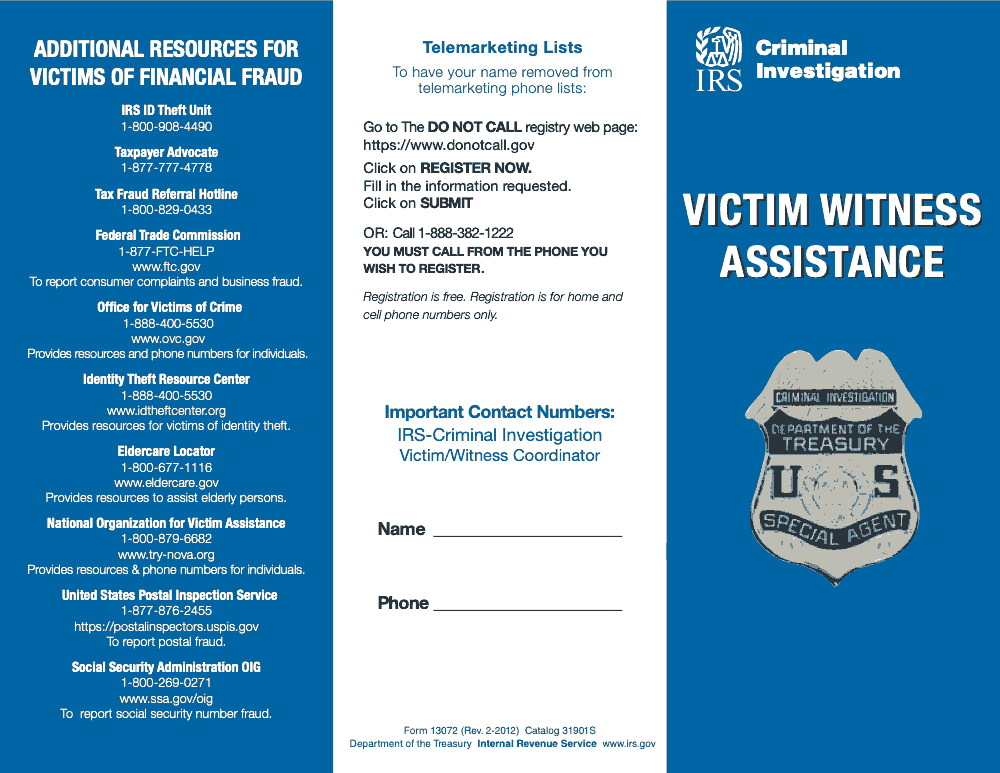
Form 13072 is the IRS-Criminal Investigation Victim Witness Assistance brochure, not a tax return or filing form. Issued by IRS-Criminal Investigation under the Department of the Treasury (Rev. 2-2012, Catalog Number 31901S), it explains the eight federal rights crime victims hold under the Crime Victims' Rights Act and lists victim support resources, as published in Form 13072. If a fraud or theft loss affects an actual return, our tax preparation team can help, and the IRS Forms library covers the returns you do file.
Most calls about Form 13072 do not come from someone filing anything. They come from a client who was just handed this brochure by an IRS-Criminal Investigation Victim/Witness Coordinator and wants to know what it means for their taxes. The honest answer is that it is not a tax form at all.
Form 13072 is the IRS-Criminal Investigation Victim Witness Assistance brochure (Rev. 2-2012, Catalog Number 31901S). It lists the eight federal rights crime victims hold under the Crime Victims' Rights Act and points to support resources, with a fillable block on the back for the coordinator's name and phone. The one spot it touches a return is documenting a financial loss, where some losses may be deductible depending on the facts.
Key Takeaways
- Form 13072 is the IRS-Criminal Investigation Victim Witness Assistance brochure (Rev. 2-2012, Catalog Number 31901S), an informational handout for crime victims and witnesses, not a tax return or filing form. It has no line items, no thresholds, and no filing deadlines, and it is never filed with the IRS.
- It explains the eight federal rights crime victims hold under the Crime Victims' Rights Act, and it records the IRS-Criminal Investigation Victim/Witness Coordinator's name and phone in a fillable block on the back of the brochure.
- IRS-Criminal Investigation (IRS-CI) is a Federal law enforcement agency that investigates criminal violations of the Internal Revenue Code, not the civil examination or collections function. If you are threatened or harassed for cooperating with an investigation, contact your Victim/Witness Coordinator immediately.
- Crime victim compensation for medical costs, lost wages, and funeral or burial expenses from violent crime comes from state programs, only for amounts not covered by insurance or other benefits. The coordinator can refer you to your state program to check eligibility.
- The one place this brochure touches a return is documenting a financial loss. Save every record tied to the loss, because some losses may be deductible depending on your facts and current law. Confirm deductibility with a qualified tax advisor or the IRS before claiming anything. To report suspected tax fraud, the brochure lists the IRS Tax Fraud Referral Hotline at 1‑800‑829‑0433.
What Form 13072 Actually Is
Form 13072 has a single identity: it is the IRS-Criminal Investigation Victim Witness Assistance brochure (Rev. 2-2012, Catalog Number 31901S), an informational handout for crime victims and witnesses. It carries no line items, no thresholds, and no filing deadlines, and it is never filed with the IRS.
Who Receives It and Why
IRS-Criminal Investigation distributes this brochure to people who are victims or witnesses in one of its investigations. As the brochure puts it, IRS-CI is concerned about the problems often experienced by victims and witnesses of crime, and it acknowledges that you may feel anger, confusion, frustration, or fear as a result of your experience.
The brochure exists to explain your rights under Federal law, point you to support services, and tell you who to contact during the investigation. The assigned IRS-Criminal Investigation Victim/Witness Coordinator records a name and phone number in a fillable block on the back of the brochure, so you always have a single point of contact.
What IRS-Criminal Investigation Actually Does
IRS-Criminal Investigation is a Federal law enforcement agency that investigates criminal violations of the Internal Revenue Code and related financial crimes, then refers cases for prosecution. It is not the civil examination or collections function, so a balance due or an audit moves through different IRS channels, not through the Victim/Witness Coordinator named on the brochure.
If your property was stolen, IRS-CI says it hopes to recover it as part of the investigation and, if it does, will notify you and make every effort to see that it is returned. At the same time, the agency needs your cooperation throughout the investigation, even while these support resources are available to you.
The Eight Federal Victim Rights It Lists
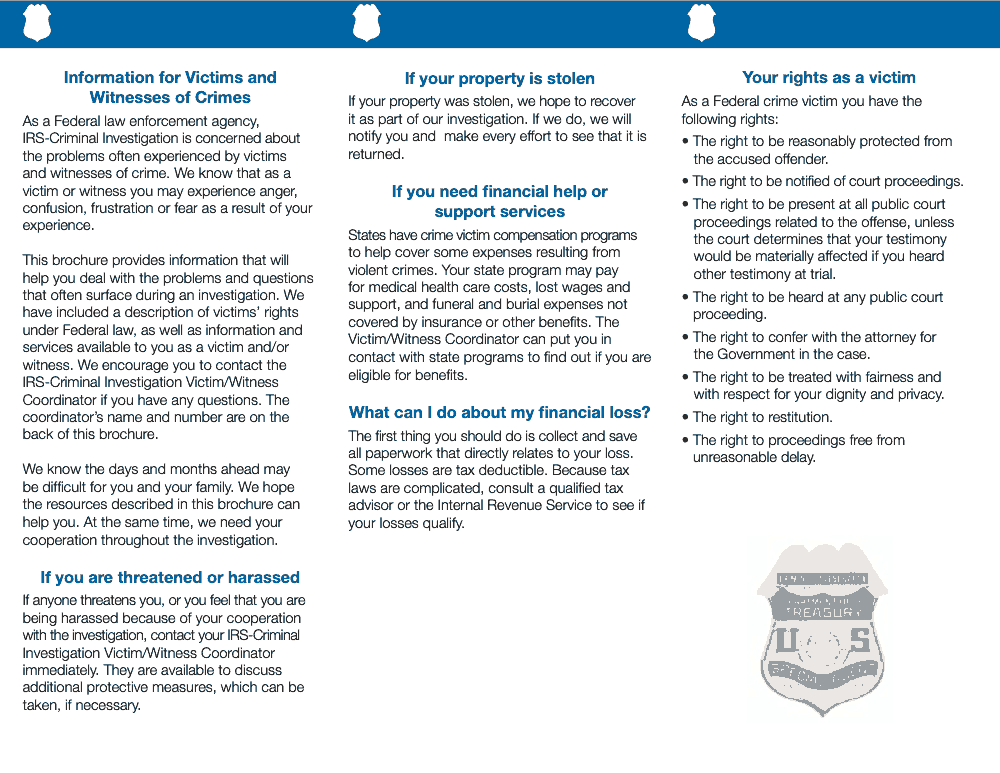
The heart of the brochure is the list of rights crime victims hold under Federal law, reflecting the Crime Victims' Rights Act. It enumerates eight rights:
| Right | What it means |
| Protection | The right to be reasonably protected from the accused offender. |
| Notice | The right to be notified of court proceedings. |
| Presence | The right to be present at all public court proceedings related to the offense, unless the court determines your testimony would be materially affected if you heard other testimony at trial. |
| To be heard | The right to be heard at any public court proceeding. |
| To confer | The right to confer with the attorney for the Government in the case. |
| Fairness | The right to be treated with fairness and with respect for your dignity and privacy. |
| Restitution | The right to restitution, which is a court-ordered payment from the offender, not a federal compensation fund. |
| Timely proceedings | The right to proceedings free from unreasonable delay. |
Note that the right to be present is conditional, not absolute. A court may exclude you if it determines your testimony would be materially affected by hearing other testimony first.
Why This Matters To You
- If you were just handed this brochure, the fastest way to avoid stress is to know what it is: an informational handout about your rights and resources, not a form you fill out or file.
- If you are a crime victim with a financial loss, the brochure is your prompt to start saving documentation, because some losses may be deductible depending on your facts and current law.
- If you advise clients, recognizing Form 13072 for what it is keeps a victim or witness matter from getting tangled up with the actual return work.
Our team's experience, after many cycles of cleanups, is simple. Treat the brochure and the return as two separate jobs. The brochure handles rights, referrals, and the coordinator contact; your file handles the tax treatment of any loss. That separation saves headaches later, especially when a reviewer has to sign off fast.
What To Do When Form 13072 Reaches You
When this brochure lands in a client's hands, or your own, here is how to move through it without confusion.
Step 1, Find Your Victim/Witness Coordinator
- Look at the back of the brochure. The IRS-Criminal Investigation Victim/Witness Coordinator's name and phone number are recorded in a fillable contact block for your specific investigation.
- Log that contact as your single point of contact for questions about the matter.
Step 2, Know When to Call Immediately
If anyone threatens you, or you feel you are being harassed because of your cooperation with the investigation, contact your Victim/Witness Coordinator immediately. They are available to discuss additional protective measures that can be taken if necessary.
Step 3, Ask About State Compensation
States operate crime victim compensation programs that may help cover some expenses from violent crimes. These programs may pay for medical health care costs, lost wages and support, and funeral and burial expenses that are not covered by insurance or other benefits. The Victim/Witness Coordinator can put you in contact with your state program to find out if you are eligible for benefits.
Step 4, Keep Cooperating
- Use the support resources the brochure lists while the investigation proceeds.
- Stay responsive to the coordinator and the attorney for the Government, because IRS-CI needs your cooperation throughout the investigation.
Common pitfalls we see
- Treating the brochure as a form to fill out and file. It is not.
- Assuming the IRS pays compensation. Compensation comes from state programs, and only for amounts not otherwise reimbursed.
- Assuming every listed resource is a federal agency. The Identity Theft Resource Center, for example, is a nonprofit referral, not a government body.
Documenting a Financial Loss the Right Way
This is the one place the brochure intersects with tax work. The brochure advises that the first thing you should do is collect and save all paperwork that directly relates to your loss, because some losses are tax deductible.
Preserve everything tied to the loss
- Save statements, invoices, receipts, police reports, and any correspondence about the loss. Organize originals by date and label each document clearly.
- Separate any amounts already reimbursed by insurance or other benefits, since those reduce what may be claimed.
Do not assume the deduction is automatic
The brochure makes no promise that fraud or theft losses are deductible. It says only that some losses are deductible and, because tax laws are complicated, you should consult a qualified tax advisor or the IRS to see if your losses qualify. Current law limits personal casualty and theft loss deductions, so the result depends on your facts.
A clean documentation checklist
- Confirm the loss amount and the date it occurred.
- Gather supporting documents and a clear summary of what happened.
- Note any insurance or other reimbursement received.
- Bring the full file to a qualified preparer before any return is started.
Why this discipline matters
Loss documentation is easy to lose track of in the middle of a stressful investigation. Building the file early means that if a deduction does qualify, you can substantiate it cleanly, and if it does not, you have not wasted review time chasing records after the fact.
Support Resources the Brochure Lists
The back of Form 13072 lists contact channels for victims and witnesses, including additional resources for victims of financial fraud. Some are government lines, and some are nonprofit organizations the IRS refers you to but does not operate.
| Resource | Phone | Use it for |
| IRS Identity Theft Unit | 1-800-908-4490 | Suspected tax-related identity theft |
| IRS Tax Fraud Referral Hotline | 1-800-829-0433 | Reporting suspected tax fraud |
| Taxpayer Advocate | 1-877-777-4778 | Help resolving IRS problems |
| Federal Trade Commission | 1-877-FTC-HELP | Consumer complaints and business fraud |
| Social Security Administration OIG | 1-800-269-0271 | Reporting Social Security number fraud (www.ssa.gov/oig) |
| U.S. Postal Inspection Service | 1-877-876-2455 | Reporting postal fraud |
| Office for Victims of Crime | 1-888-400-5530 | Resources and phone numbers for individuals |
| Identity Theft Resource Center (nonprofit) | 1-888-400-5530 | Resources for identity theft victims |
| Eldercare Locator | 1-800-677-1116 | Resources to assist elderly persons |
| National Organization for Victim Assistance | 1-800-879-6682 | Resources and phone numbers for individuals |
The brochure also points to the National Do Not Call registry to cut down on unwanted calls. Registration is free and covers home and cell phone numbers only. To register by phone, you must call 1-888-382-1222 from the exact phone you want listed, or register a different number at donotcall.gov.
Fixing Common Issues Fast
Most snags with Form 13072 come from misunderstanding what it is. Here is a quick triage you can use and share with your staff.
When someone treats it as a return
- Confirmed it is the IRS-CI Victim Witness Assistance brochure, not a filing form. Route any real tax question to the returns the client actually files.
- If they ask about a deduction for a loss, point them to the documentation steps above and a qualified advisor, not to a line on the brochure.
When a victim needs compensation help
- Send compensation questions to the Victim/Witness Coordinator's referral, not into your tax workflow. Compensation comes from state programs.
- Separate amounts already covered by insurance or other benefits, since state programs only cover what is not otherwise reimbursed.
Step‑By‑Step Guides You Can Copy Into SOPs
Received-the-brochure quick SOP
- Record the Victim/Witness Coordinator name and phone from the back of the brochure as the single point of contact.
- Call the coordinator immediately if the client is threatened or harassed for cooperating.
- Ask the coordinator about a referral to the state crime victim compensation program.
Loss-documentation quick SOP
- Collect every record tied to the loss, including statements, invoices, and police reports.
- Note any insurance or other reimbursement already received.
- Hold any deduction until a qualified tax advisor or the IRS confirms the loss qualifies, then bring the file to the preparer.
File Hygiene That Protects Reviewers and Speeds Approvals
Clean inputs lead to clean reviews. A few habits we teach new staff:
- Use descriptive file names and version control so reviewers are never guessing. Keep the latest file on top.
- Write short, factual descriptions, not narratives. Avoid free‑text unless instructions require it.
- Standardize where documents live. A predictable folder path beats a hero who “knows where everything is.”
Think of your submission like a labeled folder you hand to a busy reviewer. If they can find each component in seconds, you win.
Where Accountably fits
If your firm supports government forms at scale, structure matters. Teams need SOPs, standard workpapers, and clear version control, not heroics. That is how we build offshore delivery units, with layered reviews and predictable turnarounds that protect partner time and keep submissions clean. Mentioning it once here is enough. The rest of this page stays focused on your immediate task.
Compliance, Security, and Trust
When you work with a victim or witness matter, you carry the weight of someone's safety, finances, and privacy. Treat that responsibility with care:
- Keep personal identifiers out of any public or unsecured channel while the matter is active. Move specifics to secure, authenticated channels.
- Use the official numbers printed on the brochure when you call. Scammers spoof government names, so confirm which contacts are government lines and which are nonprofit referrals.
- For suspected tax fraud, use the IRS Tax Fraud Referral Hotline at 1-800-829-0433 that the brochure lists. For suspected tax-related identity theft, use the IRS Identity Theft Unit at 1-800-908-4490.
The What‑How‑Wow Summary
- What, Form 13072 is the IRS-Criminal Investigation Victim Witness Assistance brochure (Rev. 2-2012). It is an informational handout that explains crime victims' eight federal rights and lists support resources. It is not a tax return and is never filed with the IRS.
- How, log the Victim/Witness Coordinator contact from the back of the brochure, keep cooperating with the investigation, ask the coordinator about state compensation, and document any financial loss carefully before claiming a deduction.
- Wow, separating the brochure's job (rights and referrals) from the return's job (tax treatment of a loss) prevents days of back‑and‑forth. You get faster approvals and fewer edits, which protects your time and your client's trust.
Sample SOP Templates You Can Paste Into Your Playbook
Victim/witness intake template
- Matter title: Form 13072 brochure received, [client name]
- Single point of contact: IRS-CI Victim/Witness Coordinator name and phone from the back of the brochure
- Immediate-call trigger: Any threat or harassment for cooperating with the investigation
- State compensation: Ask the coordinator for a referral and check eligibility
- Privacy: Keep client identifiers out of shared or public channels while the matter is active
Financial-loss documentation template
- Matter title: Loss documentation for [client name]
- Records on hand: Statements, invoices, receipts, police reports
- Reimbursement: Amounts already covered by insurance or other benefits
- Deduction status: Hold until a qualified tax advisor or the IRS confirms it qualifies
- Handoff: Full file delivered to the preparer before the return is started
Final Notes and Next Steps
- Read Form 13072 as the IRS-Criminal Investigation Victim Witness Assistance brochure, an informational handout rather than a form you file.
- Use the Victim/Witness Coordinator on the back of the brochure as your single point of contact.
- Keep sensitive data out of public spaces while the matter is active.
- Document any financial loss carefully, and confirm deductibility with a qualified advisor or the IRS before claiming it.
Common Mistakes We See Every Season
The mistakes I see with Form 13072 are almost all about what people assume it is, not how anyone completes it. Here are the ones that cause the most confusion.
Reusable Checklists
These are copy-paste ready for your client-facing SOP when a Form 13072 brochure turns up in a client's hands.
If you received Form 13072
- Confirm the IRS-Criminal Investigation Victim/Witness Coordinator name and phone recorded on the back of the brochure.
- Contact that coordinator immediately if you are threatened or harassed for cooperating with the investigation.
- Keep cooperating with the investigation while you use the listed support resources.
- Review the eight federal victim rights the brochure lists under the Crime Victims' Rights Act.
- Ask the coordinator about a referral to your state crime victim compensation program.
- If property was stolen, confirm how the coordinator returns recovered property.
Documenting a financial loss
- Collect every record tied to the loss, including statements, invoices, and police reports.
- Organize originals by date and label each document clearly.
- Separate any amounts already reimbursed by insurance or other benefits.
- Hold any deduction until a qualified tax advisor or the IRS confirms it qualifies.
- Bring the full file to your preparer before the return is started.
Protecting against follow-on fraud
- Register home and cell numbers free at 1-888-382-1222, calling from each line you want listed.
- Report suspected tax fraud to the IRS Tax Fraud Referral Hotline at 1-800-829-0433.
- Contact the IRS Identity Theft Unit at 1-800-908-4490 if you suspect tax-related identity theft.
- Keep sensitive identifiers out of any public or unsecured channel.
Keep 13072 Season From Stalling
Form 13072 rarely arrives on its own. It lands attached to a client who was a victim or witness in an IRS-Criminal Investigation matter and now has a financial loss to sort out. The brochure (Rev. 2-2012) explains eight federal victim rights, but it says nothing about how that loss flows through a return, which is where the work backs up.
The fix is to separate the two jobs cleanly. The brochure handles rights and referrals; your file handles the tax treatment. When each moves on its own track, neither stalls waiting on the other.
- Log the IRS-Criminal Investigation Victim/Witness Coordinator contact from the back of the brochure as your single point of contact.
- Build the loss file early: records, amounts already reimbursed, and police reports in one place.
- Hold any deduction until a qualified advisor or the IRS confirms the loss qualifies.
- Send state compensation questions to the coordinator's referral, not into your tax workflow.
- Keep client identifiers out of shared or public channels while the matter is active.
When a victim or witness situation collides with a real return, our tax preparation team keeps the documentation disciplined and the review moving, so the tax side never becomes the bottleneck.
FAQs
No. Form 13072 is the IRS-Criminal Investigation Victim Witness Assistance brochure (Rev. 2-2012, Catalog Number 31901S). It is an informational handout for crime victims and witnesses. It has no line items, no thresholds, and no filing deadlines, and it is never filed with the IRS.
Form 13072 lists the IRS Tax Fraud Referral Hotline at 1‑800‑829‑0433 for reporting suspected tax fraud. If you suspect tax-related identity theft, the brochure also lists the IRS Identity Theft Unit at 1‑800‑908‑4490. Use the official numbers printed on the brochure, since scammers spoof government names.
No. Form 13072 explains that crime victim compensation comes from state programs, not from IRS-Criminal Investigation. State programs may cover medical care costs, lost wages and support, and funeral and burial expenses from violent crimes that are not covered by insurance or other benefits. The IRS-CI Victim/Witness Coordinator can refer you to your state program to check eligibility.
Registration is free and covers home and cell phone numbers only. To register by phone, call 1‑888‑382‑1222 from the exact line you want listed, or use donotcall.gov to register a different number. Business numbers are not eligible.
About this guide
Accountably helps US CPA, EA, and accounting firms hire trained accountants and tax preparers in India.
About us Reviewed byJugal Thacker, CPAFounder and CEO at Accountably
A Washington-licensed CPA with 7+ years inside US firms – PwC, a real-estate tax practice, then a full-service firm, rising from reviewer to manager to advisory. This article was reviewed against current IRS guidance for the 2025 tax year and updated for filers preparing late returns, amendments, and 2026 estimates.
View profile →How we research, review, and update this guide
Every Accountably guide is researched against primary IRS sources, reviewed by a U.S. CPA, and refreshed as guidance evolves. Read our Editorial Guidelines to see how we source, fact-check, and update our content.