Summarize this article with AI
In Brief
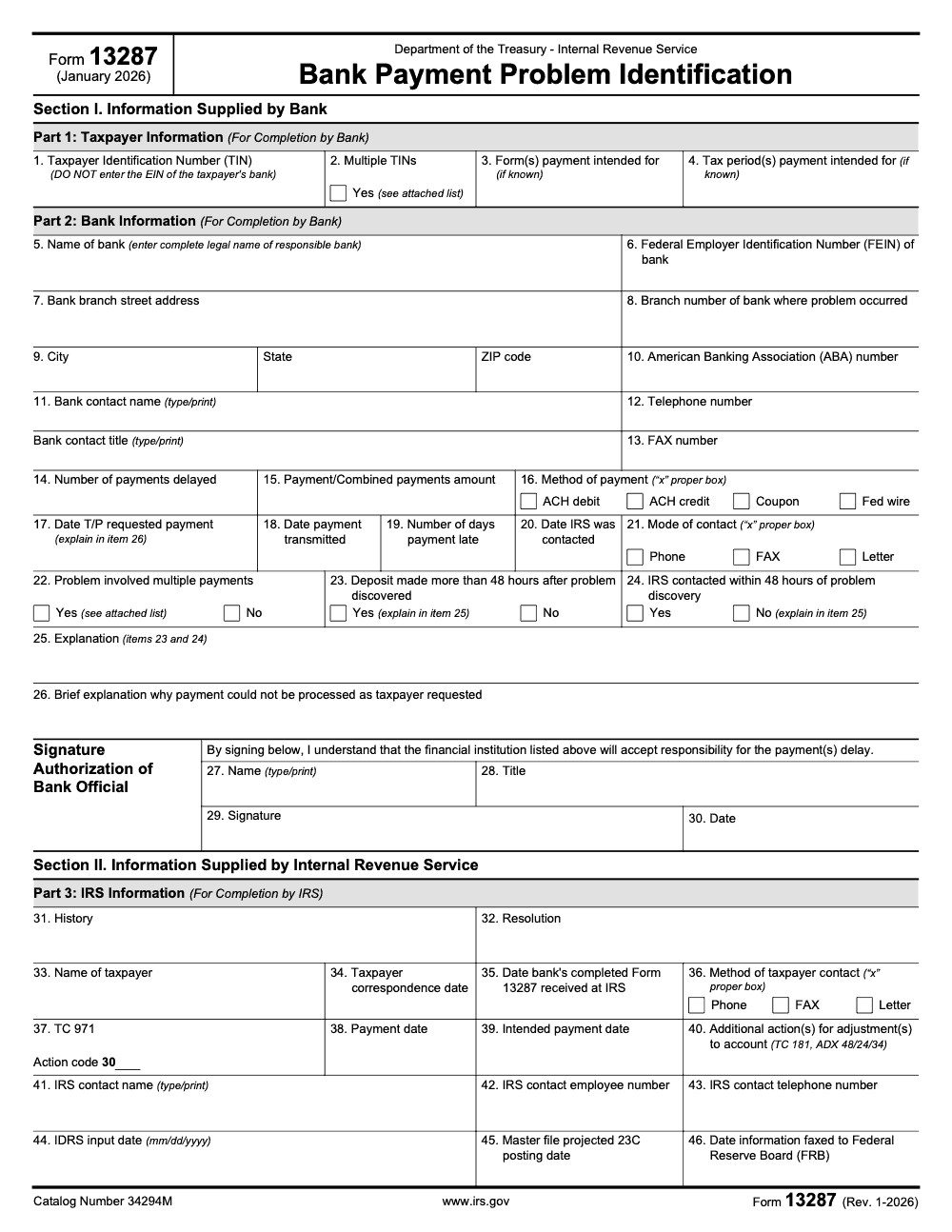
Form 13287, the Bank Payment Problem Identification form, is used when a bank delays forwarding a timely-received Federal Tax Deposit to the U.S. Treasury – FTD penalty relief flows from the bank's signed acceptance of responsibility on Item 29, not from filing the form itself (per IRS Form 13287 instructions, Rev. 1-2026). Items 1-30 are completed by the bank (taxpayer TIN on Item 1, bank ABA on Item 10, payment count on Item 14), Items 31-46 are completed by the IRS, and any deposit made or IRS contact delayed more than 48 hours after the bank discovers the problem must be explained in Item 25.
A bank receives your federal tax deposit on time, sits on it, and forwards it to Treasury late. The penalty notice still lands on your client, and the instinct is to file something to fix it. Form 13287, the Bank Payment Problem Identification form, exists for exactly that gap, but it does not work the way most people assume.
Relief here does not flow from filing the form. It flows from the bank signing Item 29 to accept responsibility for the delay. The bank completes Items 1 through 30, the IRS completes Items 31 through 46, and the form asks whether you contacted the IRS within 48 hours of spotting the problem, so the clock starts the moment you notice. The current revision is January 2026.
Key Takeaways
- Form 13287 is a two‑page IRS PDF used when a bank delay caused a late Federal Tax Deposit that the bank received timely and with proper instructions, often on Form 941 accounts. The bank completes and signs it, not the taxpayer.
- The current revision is January 2026 (Rev. 1-2026) and it remains available on IRS.gov, which is the safest place to download the form.
- The IRS uses Form 13287 alongside internal transaction codes to correct accounts and, where appropriate, remove the penalty tied to the delay.
- Timing matters. The form asks when the IRS was contacted and whether that happened within 48 hours of discovering the problem, so act quickly.
- This is not attached to your tax return. Treat it as a targeted penalty relief tool in your payroll and treasury playbook.
What Form 13287 Is, And Who Actually Uses It
Think of Form 13287 as a three‑party signal: the taxpayer alerts the IRS that a timely deposit got delayed, the IRS requests bank confirmation using this form, and the bank signs to accept responsibility. The result, when all facts line up, is removal of the penalty portion linked only to the delay. The Internal Revenue Manual calls out Form 13287 by name and explains how the IRS applies it with action codes and adjustments, especially on Form 941 employment tax accounts.
Key point, you, as the business or firm, do not sign this form. A responsible bank official must complete and sign Section I, then the IRS completes Section II as part of its account correction process. The form captures critical details like the payment method, ABA number, the number of days late, an explanation of the issue, and the bank official’s authorization to accept responsibility.
Is The January 2026 PDF Still Valid In 2026
Yes. The IRS still hosts the two‑page PDF on its website, and the IRS forms index lists Form 13287 with a January 2026 revision date (Rev. 1-2026). If you are hunting for a safe download, go to IRS.gov and use the official PDF. Third‑party fillers can be handy for typing, however always validate that your copy matches the two‑page IRS layout, including the instruction page.
Quick Snapshot
| What | Why it exists | Who completes it | Where it lives | Attach to a return |
| Form 13287, Bank Payment Problem Identification | To document a bank‑caused delay in a Federal Tax Deposit and enable penalty relief | A bank official signs and accepts responsibility, IRS completes Section II | Official two‑page PDF on IRS.gov | No, used with penalty relief workflow, not with a filed return |
Note for firm owners and controllers, if payroll tax deposits are your world, build a fast path to this form. The difference between a clean reversal and a long, expensive back‑and‑forth often comes down to how quickly your team triggers the bank confirmation and how cleanly you document the timeline.
When To Use Form 13287, And How The Process Usually Flows
You reach for Form 13287 when all three of these are true:
- You instructed a federal tax deposit on time and with correct details.
- The payment reached Treasury late due to a bank error or transmission delay.
- The bank is willing to accept responsibility in writing.
The IRS manual explains that a completed Form 13287 supports internal adjustments, including specific transaction codes that document the issue, and on some accounts systemically reverse the FTD penalty amount tied to the delay. In practice, this shows up most often on quarterly employment tax deposits for Form 941.
Who Does What
- Taxpayer or firm, identify the delay, call the IRS quickly, and request guidance.
- IRS agent, faxes or shares Form 13287 to the bank, or instructs you to route it, then finishes Section II once the bank signs.
- Bank, completes Section I, explains the failure, and an authorized officer signs to accept responsibility.
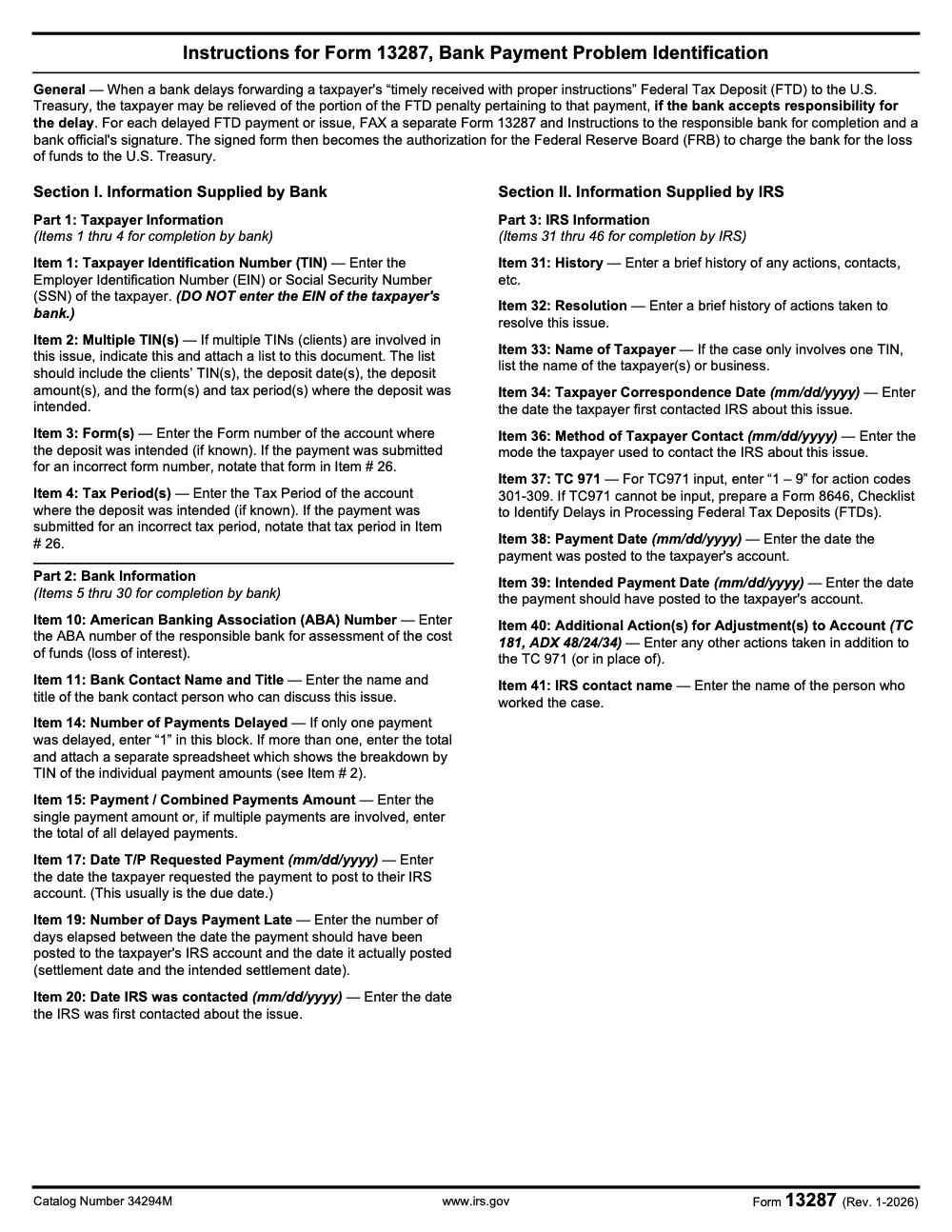
This flow is built into the form. Section I is labeled Information Supplied by Bank, Section II is Information Supplied by Internal Revenue Service, and the instruction page clarifies the purpose, the timelines, and the fields.
Timing Matters, Watch The 48‑Hour Questions
Two checkboxes ask whether the deposit was made more than 48 hours after the problem was discovered, and whether the IRS was contacted within 48 hours of discovery (these are two separate measurements, and if either window was missed the bank must explain the delay in Item 25). Those answers help the IRS evaluate the facts and decide how to resolve the penalty. If your payroll process finds a delay, call the IRS right away, then trigger the bank’s completion of the form the same day.
Inside The Form, What Each Part Captures
The bank provides the taxpayer TIN, intended form and period, full bank identity, ABA number, contact details, payment method, number of days late, and a brief plain‑language explanation of what went wrong. An authorized officer signs to accept responsibility for the delay, and that signature is what becomes the Federal Reserve Board's authorization to charge the bank for the loss of funds to Treasury. The IRS later records how the case was resolved, intended versus actual payment dates, and the internal adjustments it applied.
Field Highlights You Should Know
| Field | What it asks | Practical tip |
| 1–4 | Taxpayer TIN, intended form and period | Match to payroll records, do not use the bank’s EIN in place of the taxpayer TIN |
| 10 | ABA number | The IRS uses this to assess loss of funds to the bank, make sure the responsible bank is identified correctly |
| 14–19 | Counts, amounts, days late | Recreate the exact timeline, use EFTPS timestamps, Fed wire confirmations, or bank logs |
| 23–24 | 48‑hour questions | Document when the issue was discovered, when you called the IRS, and when the deposit posted |
| 26 | Why payment could not be processed as requested | Encourage the bank to use clear, factual phrasing, no vague statements |
| 27–30 | Bank officer identity and signature | Secure a real officer signature, avoid internal routing delays |
Everything you need to interpret the fields appears on page 2 of the IRS PDF. If your team works from a PDF filler, keep page 2 visible while you type to avoid mistakes.
How To Kick Off The Process As A CPA Firm Or Controller
Here is a simple, repeatable method we use when a client flags a bank‑caused delay:
- Confirm it was a bank issue, not a data entry error. Pull the EFTPS receipt, bank confirmation, and payroll system logs.
- Call the IRS to report the delay, capture the call date and name, and ask about next steps.
- Ask the bank to complete and sign Form 13287 the same day. Give them the IRS PDF and a one‑page summary of facts and dates.
- Track completion, then confirm the IRS received the signed form, and monitor the account for the penalty reversal.
The Internal Revenue Manual shows how IRS staff use Form 13287 with Transaction Code 971 action codes 301 through 309 (the form pre-prints the '30' prefix on Item 37, so IRS staff enter only the trailing digit 1 through 9 to complete the action code), and explains when a penalty on a 941 account will reverse systemically and when it must be adjusted manually. Your part is the clean timeline and a bank signature that accepts responsibility.
Pro tip, keep a standard playbook that lists the bank contacts and preferred escalation path, so you are not chasing signatures on a deadline. That is the difference between a ten‑minute fix and a week of email.
Where To Download Form 13287 Safely
Download directly from IRS.gov to avoid altered templates. The official PDF is two pages, with January 2026 (Rev. 1-2026) shown at the top, and includes a full instruction page. If you temporarily use a third‑party filler to type and route for signature, verify the exported PDF matches the IRS layout exactly before you send it to the IRS.
The IRS forms index also lists Form 13287 by title, revision date, and availability, which is useful if you need to validate that the form is still active for your compliance file. Screenshot or save the index entry with a current “Page Last Reviewed” date for your workpapers.
Quick Download Checklist
- Use the IRS PDF, two pages total, with page 2 instructions.
- Confirm the title reads Bank Payment Problem Identification and the revision shows January 2026 (Rev. 1-2026).
- Keep page 2 with your records, it is part of the form.
Completion And Routing, A Practical Checklist
- Build a clear facts timeline, include the intended payment date, actual posting date, and discovery date.
- Call the IRS and note the date, time, and employee name.
- Send the IRS PDF to the bank with your facts summary.
- Ask the bank officer to complete Section I and sign.
- Confirm IRS receipt, then watch the account for the penalty adjustment.
Sample Bank Request Email
Subject, Request for Form 13287 signature, federal tax deposit delay
We instructed a federal tax deposit on [date] for [amount]. The payment posted on [date], which was [X] days late due to a bank transmission delay. The IRS asked that the responsible bank complete and sign Form 13287, Bank Payment Problem Identification. I attached the IRS PDF and a one‑page facts timeline. Please complete Section I and have an authorized officer sign today, then return the signed copy to us for the IRS. Thank you for your quick help.
Common Mistakes That Slow Penalty Relief
Most Form 13287 cases stall in the same handful of spots. Each one is fixable if the bank-completed Items 1-30 land clean on the first pass (per IRS Form 13287 instructions, Rev. 1-2026).
Recordkeeping, What To Keep And For How Long
Keep the signed Form 13287, your facts timeline, EFTPS receipts, bank confirmations, and any IRS call notes with the payroll tax workpapers for that quarter. Since penalty resolution relates to employment tax accounts, retain the package for the same duration you keep your Form 941 records. The IRS manual guidance ties Form 13287 to internal adjustments on Form 941 accounts, so keep everything that proves timeliness and responsibility.
Simple File Structure
- 01 Timeline and call log
- 02 Bank evidence, EFTPS receipts, wire confirmations
- 03 Signed Form 13287 PDF
- 04 IRS correspondence and adjustment proof
A Note For Firms Using Distributed Teams
If your payroll and CAS work moves across onshore and offshore staff, standardize this playbook. A clear SOP that spells out who calls the IRS, who contacts the bank, where the PDF lives, and how to name files, prevents review bottlenecks and missed windows. At Accountably, we build these kinds of SOPs into our delivery architecture so firms get speed without losing control. Use any approach you like, just make sure it is documented and visible to your team.
Reusable Checklists
These checklists are copy-paste ready for firm SOPs. Drop them into your FTD remediation playbook so any staff member can drive a Form 13287 case from discovery to bank signature without re-litigating the steps.
FTD delay discovery checklist
- Confirm the FTD was timely received by the bank with proper instructions – Form 13287 relief only applies to bank-caused delays.
- Capture the intended posting date (Item 17 / Item 39) and the actual posting date (Item 38) from the IRS account transcript.
- Start the 48-hour clock on Item 23 (deposit-after-discovery) and the 48-hour clock on Item 24 (IRS-contact-after-discovery) the moment the delay is confirmed.
- Identify the responsible branch and pull its ABA, FEIN, branch number, and street address for Items 6 through 10.
- Decide single-payment vs multi-payment scope; if multi-payment, draft the per-TIN spreadsheet for Item 14.
- Flag whether the original payment was sent to the wrong form number or tax period (this lands in the Item 26 narrative, not Items 3-4).
- Log the case in your tracker with the IDRS input target date (Item 44) and the projected 23C posting date (Item 45) as the close-out milestones.
Bank packet checklist (Items 1-30)
- Item 1 carries the taxpayer's TIN (EIN or SSN) – never the bank's FEIN.
- Item 2 marks Yes only if multiple TINs are involved; if Yes, attach the per-client list with TIN, deposit date, amount, and intended form / tax period.
- Items 3 and 4 carry the form number and tax period the payment was intended for, not the misapplied ones.
- Item 10 carries the responsible branch's ABA – not the parent holding company's ABA.
- Item 14 carries the count of delayed payments; if more than one, attach the spreadsheet, and Item 15 carries the combined total.
- Item 16 has one of the four method-of-payment boxes checked (ACH debit, ACH credit, Coupon, or Fed wire).
- If Item 23 is Yes or Item 24 is No, Item 25 carries the written explanation before the form leaves the bank.
- Item 29 has the bank official's signature and Item 30 has the signature date in mm/dd/yyyy format.
Post-fax tracking checklist
- Confirm IRS receipt of the bank-completed form and log the Item 35 date.
- Track the TC 971 input on Item 37 (single digit 1-9 after the pre-filled 30, producing action codes 301-309).
- If TC 971 cannot be input, confirm the IRS prepared Form 8646 in lieu of the TC 971 step – Form 8646 substitutes for the TC entry, not for Form 13287 itself.
- Match Item 38 (actual posting date) and Item 39 (intended posting date) against the account transcript; Item 19 days-late should reconcile.
- Capture Item 46 (date Form 13287 information was faxed to the Federal Reserve Board) as the case-close marker before archiving the file.
Keep 13287 Season From Stalling
Form 13287 does not run on a tax-season calendar. It runs on incidents. Each bank-caused FTD delay opens a fresh case, and per IRS Form 13287 instructions (Rev. 1-2026) penalty relief only flows once the bank signs Item 29 accepting responsibility. Every day the bank-completed Items 1-30 sit unsent is another day the FTD penalty stays parked on the client's account.
The fix is mechanical, not heroic. Treat each delayed FTD as its own case file, lock the bank packet to the 48-hour clocks on Items 23 and 24, and route the signed form so the IRS-completed Items 31-46 (the TC 971 entry, IDRS input, and Federal Reserve Board notification) can land without rework.
- Open a single case file per delayed FTD and start the 48-hour clocks on Item 23 (deposit-after-discovery) and Item 24 (IRS-contact-after-discovery) on day one.
- Pre-fill the bank packet so Item 1 carries the taxpayer's TIN, Item 6 carries the bank's FEIN, and Item 10 carries the branch ABA, not the parent holding company's.
- For multi-payment cases that share an issue, write the per-TIN spreadsheet attachment first, then pre-fill Item 14 with the count and Item 15 with the combined total.
- If the original payment was sent to the wrong form number or tax period, keep the intended figures on Items 3 and 4 and document the misapplied figures in the Item 26 narrative.
- Time the fax so the Item 30 signature date holds inside the IRS 48-hour expectation, and log the Item 46 fax-to-FRB date as the case-close marker.
Accountably runs FTD bank-delay casework inside our tax execution service. Trained U.S.-led offshore teams open the case, drive the bank-side completion, and hand the IRS-completed packet to senior reviewers ready for the TC 971 input, so client penalty relief lands without burning your senior bench on phone calls to branch managers.
FAQs
No. Form 13287 is not a return attachment. It documents a bank‑caused delay for the IRS so the related penalty can be corrected. The bank signs Section I, the IRS completes Section II, and the form lives with your payroll and penalty‑relief workpapers.
That is where you will see it most often. The IRS manual describes how Form 13287 works with specific transaction codes on Form 941 accounts, and when a penalty reverses systemically versus manually. Other accounts can be involved, however the classic use case is 941 deposits.
An authorized bank officer must sign to accept responsibility for the delay. The signature block sits in Section I. The IRS uses that authorization to pursue cost of funds with the bank and to adjust the taxpayer’s account.
Use the IRS copy, which includes the January 2026 revision (Rev. 1-2026) and the page 2 instructions. Keep both pages together.
Immediately. The form asks if you contacted the IRS within 48 hours of discovery and whether the deposit was made within 48 hours after the problem was discovered. Those answers matter, so call the IRS as soon as you confirm the facts, then route the form to the bank for signature.
Other forms this guide names
- Form 941: Employer's Quarterly Tax Return Guide 2025
About this guide
Accountably helps US CPA, EA, and accounting firms hire trained accountants and tax preparers in India.
About us Reviewed byJugal Thacker, CPAFounder and CEO at Accountably
A Washington-licensed CPA with 7+ years inside US firms – PwC, a real-estate tax practice, then a full-service firm, rising from reviewer to manager to advisory. This article was reviewed against current IRS guidance for the 2025 tax year and updated for filers preparing late returns, amendments, and 2026 estimates.
View profile →How we research, review, and update this guide
Every Accountably guide is researched against primary IRS sources, reviewed by a U.S. CPA, and refreshed as guidance evolves. Read our Editorial Guidelines to see how we source, fact-check, and update our content.