Summarize this article with AI
In Brief
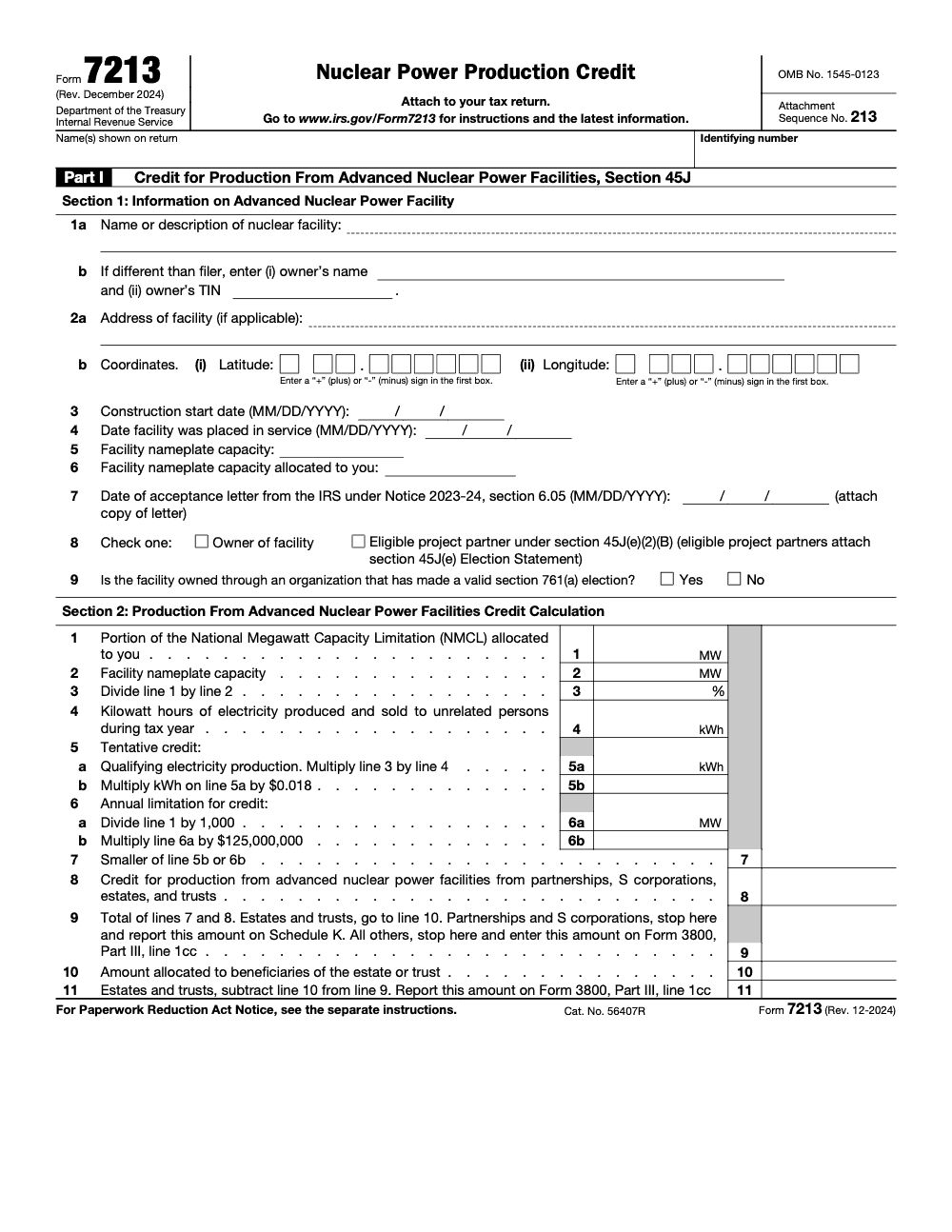
Form 7213 computes the Nuclear Power Production Credit. Part I covers the section 45J advanced nuclear facilities credit at $0.018 per kWh, capped at $125,000,000 per 1,000 MW of allocated National Megawatt Capacity Limitation each year. Part II covers the section 45U zero-emission nuclear credit at a $0.003 per kWh base rate (subject to the IRS annual inflation adjustment) for facilities placed in service before August 16, 2022. The computed credit flows through to Form 3800, Part III line 1cc for §45J and line 1u for §45U, per the Form 7213 instructions (Rev. December 2024).
Two nuclear credits live on one form, and the part you pick changes the whole calculation. Part I handles the section 45J advanced nuclear credit at $0.018 per kWh, capped at $125,000,000 per 1,000 MW of allocated National Megawatt Capacity Limitation each year. Part II handles the section 45U zero-emission credit at a base rate of 0.3 cents per kWh for facilities placed in service before August 16, 2022.
The attachments are where Form 7213 packets stall. For a 45J claim, the IRS acceptance letter that shows your allocated share of the NMCL has to be in the file, and unutilized NMCL gets applied for within 30 days after the facility is placed in service. For a 45U claim, confirm the in-service date, include the NRC permit or license number, and run the inflation-adjusted base rate with any reduction amount. File a separate form for each facility or undivided ownership share, and the computed credit lands on Form 3800.
Key Takeaways
- Form 7213 has two parts, Part I for the section 45J advanced nuclear credit, Part II for the section 45U zero‑emission nuclear credit. Use the December 2024 revision for tax years beginning in 2024 and later, until a newer version appears.
- File a separate Form 7213 for each facility or undivided ownership share. Pass‑through recipients usually claim on Form 3800 instead of filing Form 7213.
- For 45J, attach the IRS acceptance letter that shows your allocated share of the National Megawatt Capacity Limitation, known as NMCL. Apply for unutilized NMCL within 30 days after the facility is placed in service under Notice 2023‑24.
- For 45U, confirm the facility was placed in service before August 16, 2022, include the NRC permit or license number, and apply the inflation‑adjusted base rate of 0.3 cents per kWh with any reduction amount.
- If you plan to use elective payment or transfer for 45U, complete IRS pre‑filing registration and get a registration number before you file.
What Form 7213 actually does
Form 7213 is the IRS form for nuclear power production credits. Part I computes the 45J credit on electricity from advanced nuclear power facilities, paid at 1.8 cents per kWh, subject to your facility’s allocated share of the NMCL and the annual statutory cap. Part II computes the 45U credit for qualified non‑advanced nuclear facilities, paid at an inflation‑adjusted 0.3 cents per kWh, reduced by the statute’s reduction amount.
Here is the practical split you will use while preparing returns.
- Use Part I if the reactor qualifies as an advanced nuclear power facility and you have an IRS acceptance letter allocating NMCL (note: under IRC §45J(d), construction of the facility must have begun before January 1, 2014, so post‑2013 advanced reactors do not qualify even if they later receive NMCL).
- Use Part II if the facility is not advanced under 45J and was placed in service before August 16, 2022 (facilities placed in service on or after that date fall under the §45Y / §48E technology‑neutral regime, not §45U).
Why this matters for your timeline
You do not want to discover a missing attachment during partner review week. 45J claims stall without the IRS acceptance letter, and 45U claims stall without the NRC license or permit number. If you intend to elect direct pay as an applicable entity or transfer the 45U credit, you also need pre‑filing registration numbers in hand before filing. The IRS instructions make that sequence explicit, so plan your prep checklist around those items.
The short version of the rules you will cite to your CFO
- Separate form per facility, and per undivided share if you have one.
- 45J needs the IRS acceptance letter tied to the unutilized 6,000 MW NMCL pool, and a copy of that letter must be attached to Form 7213 every year you claim the credit, not only in the first year.
- 45U needs the NRC license number and confirmation the unit was placed in service before August 16, 2022.
- Elective payment and transfers for 45U require pre‑filing registration each year before you file.
Who this guide is for
If you are a tax director at a utility, a controller for a nuclear generating station, or a partner at a CPA firm that supports energy clients, this is for you. I will walk you through what to enter, which docs to attach, how to avoid the common snags in Part I and Part II, and how to organize records so a future exam is easier than you fear. Where helpful, I will point to workflow steps that reduce back‑and‑forth between preparer and reviewer.
Note on independence, this article was prepared by our team using IRS primary sources and was fact‑checked as of November 19, 2025. For any 2026 changes, check the latest Form 7213 page and instructions.
Form 7213, in plain English
Form 7213 is built to collect your facility details, your production and sales numbers, and the required proof for 45J or 45U. The IRS says to use the December 2024 revision for tax years beginning after 2023, and to file a separate form for each facility. If your only credit is from a partnership or S corporation, you typically do not file Form 7213, you claim your share on Form 3800.
Who must file
- Direct owners file 7213 for each facility they own, including estates or trusts that are the direct taxpayer.
- Pass‑through recipients usually do not file 7213, they pick up the credit on Form 3800 from the Schedule K‑1 detail.
- Partnerships and S corporations that directly own a facility file 7213 for the entity, then pass credits to owners.
When and where to file
You attach Form 7213 to your federal income tax return for the year the qualifying electricity was produced and sold. The correct revision matters. The IRS updates the page if forms or instructions change, so check the current revision before you finalize returns.
Pre‑filing registration, only when it applies
Pre‑filing registration is required if you plan to use elective payment under section 6417 or transfer under section 6418 for the 45U credit. Register each facility and get a registration number before filing. The instructions direct you to the IRS registration tool and remind you to do this every year you elect. This requirement does not apply to 45J, except that 45J has its own transfer rules for qualified public entities under section 45J(e).
Quick checklist, if you will elect direct pay as an applicable entity or transfer 45U, block time two to four weeks before filing to complete pre‑filing registration and collect the confirmation.
What to attach, by credit
- 45J, attach the IRS acceptance letter that shows your facility limitation allocation from the unutilized NMCL. Your application for NMCL must be filed within 30 days after the reactor is placed in service, and allocations are made in placed‑in‑service order until the 6,000 MW pool is exhausted.
- 45U, include the NRC permit or license number for the qualified facility, and keep documentation that the unit entered service before August 16, 2022.
45J vs 45U at a glance
Comparison table
| Attribute | 45J Advanced Nuclear | 45U Zero‑Emission Nuclear |
| Facility type | Advanced nuclear power facility | Non‑advanced qualified nuclear facility |
| Placed‑in‑service rule | Construction begun before January 1, 2014 (per IRC §45J(d)) | Before August 16, 2022 |
| Base credit rate | 1.8¢/kWh, fixed | 0.3¢/kWh, annually inflation‑adjusted |
| Credit period | 8 years from placed‑in‑service date | Tax years beginning after 2023 and before 2033 |
| Key attachment | IRS acceptance letter with NMCL allocation | NRC license or permit number |
| Capacity limit | Subject to NMCL, total national cap 6,000 MW | No NMCL cap, but subject to reduction amount |
| Special rules | Annual cap based on allocation, transfer by qualified public entities to eligible project partners | Elective payment for applicable entities, transfer to buyers with pre‑filing registration |
Sources, see the IRS instructions and Notice 2023‑24 for 45J, and the IRS 45U page for timeframe and rate.
A quick word on workflow
If you run a CPA firm or an energy tax team, most delays I see come from two things, missing acceptance letters for 45J and late pre‑filing registrations for 45U. A tight prep checklist that calls these out early will save you days during review week. If you are short on in‑house capacity, a disciplined external team that works in your templates and checklists can keep production steady without creating review chaos. On Accountably’s side, we typically map the 7213 inputs to your naming conventions and secure the attachments before we move to computation, which cuts reviewer time. Use help like that only where it adds control and speed, not noise.
Part I, claiming the section 45J advanced nuclear credit
Facility details to enter
- Facility name or a clear technical description, the full address, and exact coordinates.
- Owner status, and whether any election under section 45J(e) applies for transfers by qualified public entities to eligible project partners.
- Nameplate capacity and, if you hold an undivided share, the capacity tied to your share.
- The date on the IRS acceptance letter and the allocated facility limitation in MW. Attach the letter.
How the 45J credit is computed
- Report qualifying kWh sold to unrelated persons during the year.
- Multiply by 1.8 cents per kWh to get the tentative credit.
- Apply your credit percentage, your allocated MW divided by the facility’s nameplate MW.
- Apply the annual cap, the allowable credit cannot exceed the ratio of your allocated MW to 1,000, multiplied by 125,000,000.
Pro tip, many teams forget to apply the annual cap check after the allocation percentage. Build it into your worksheet once and reuse it.
The NMCL allocation you must secure
Notice 2023‑24 explains how the IRS allocates unutilized NMCL, up to 6,000 MW in total. Applications are due within 30 days after the facility is placed in service. The IRS allocates first to any units in service by December 31, 2020 that lacked full allocation, then to later units in placed‑in‑service order. Each reactor at a multi‑reactor site is a separate facility for allocation.
Ownership and pass‑through treatment
If multiple taxpayers hold direct undivided interests, each owner files separately and is treated as owning a separate qualified facility for 45J purposes. Partnerships and S corporations compute at the entity level, then pass the credit to owners. Qualified public entities can transfer 45J credits to eligible project partners using the election procedures in Notice 2023‑24 and must furnish an election statement each year.
Common 45J mistakes I see
- Missing or mismatched acceptance letters, for example, facility names or coordinates that do not match the application.
- Late NMCL applications, remember the 30‑day window after placed‑in‑service.
- Treating a multi‑reactor site as a single facility in the allocation math.
- Skipping the annual cap check after applying the allocation ratio.
Step‑by‑step, Part I
- Gather the acceptance letter, nameplate capacity, and placed‑in‑service date. Verify that coordinates match.
- Confirm sales to unrelated persons and reconcile kWh to meter data.
- Compute tentative credit, apply allocation percentage, then apply the annual cap.
- Attach the acceptance letter and, if applicable, the annual election statement for transfers by a qualified public entity.
Review tip, build a one‑page “Part I packet” with the acceptance letter, a map or screenshot showing coordinates, and a short reconciliation of kWh to the general ledger. Your reviewer will thank you.
Part II, claiming the section 45U zero‑emission nuclear credit
Eligibility snapshot
A qualified nuclear power facility is any nuclear facility you own that produces electricity, is not advanced under 45J, and was placed in service before August 16, 2022. Part II applies to tax years beginning after December 31, 2023 and before January 1, 2033. Attach the NRC permit or license number.
The math you will actually run
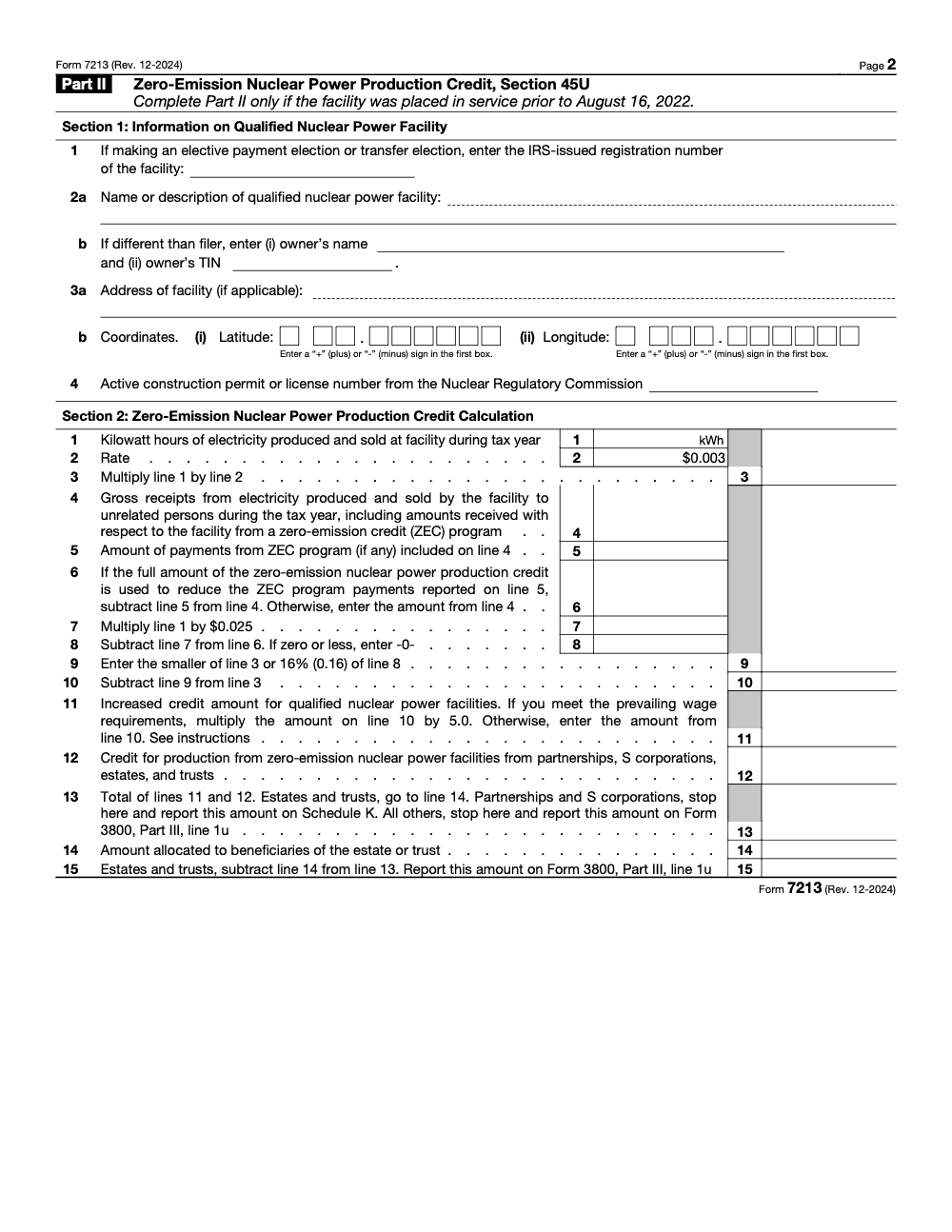
- Enter kWh produced and sold at the facility during the tax year. Do not carry the Part I line 4 "unrelated persons" wording across – Part II line 1 reads "sold at facility," a broader scope.
- Multiply by 0.3 cents per kWh, then adjust for inflation as provided in the instructions for the year.
- Subtract the reduction amount. The instructions define this using gross receipts and a per‑kWh threshold that is inflation adjusted.
- If you satisfy prevailing wage requirements for alteration or repair work, multiply the base credit on line 10 by 5.0 on line 11 per the instructions and attach the required wage documentation (the 5× multiplier is not automatic – without prevailing wage compliance, line 11 simply equals the base amount on line 10).
Keep it clean, separate facility‑by‑facility workpapers, then sum only after each facility’s line‑by‑line review clears.
Elective payment and transfers for 45U
Applicable entities, for example certain tax‑exempt or governmental entities, can elect to treat the 45U credit as a payment against income tax, which can produce a refund. Eligible taxpayers can also transfer 45U credits for cash to unrelated buyers. Both paths require pre‑filing registration for each facility and year. Follow the registration steps before filing and include the registration number on Part II.
Documentation you will keep handy
- NRC license or permit number and placed‑in‑service evidence.
- Meter data for kWh produced and sold, and utility settlements that tie to gross receipts.
- Any ZEC program payments and how they factor into gross receipts or exclusions as defined in the instructions (Part II line 5 is subtracted from line 4 on line 6 only if the full §45U credit actually reduces those ZEC payments; otherwise line 6 equals line 4 and the phase‑out runs on the full gross receipts, ZEC included).
- Prevailing wage records if you claim the increased credit amount.
A short filing day checklist
- Confirm the correct revision of Form 7213 is loaded in your binder.
- For 45J, acceptance letter present and consistent with coordinates and facility name.
- For 45U, NRC license number entered, and eligibility confirmed for the placed‑in‑service date.
- If using elective payment or transfer for 45U, pre‑filing registration numbers are on the form and support is attached.
What trips teams up, and how to avoid it
- Filing one form for multiple reactors at a site. Treat each reactor as a separate facility for 45J allocation and keep that discipline in your records.
- Forgetting that 45U begins for tax years after 2023, so 2024 is the first common filing season.
- Overlooking ZEC payments when computing gross receipts and the reduction amount. The instructions define what is included, what is excluded, and how reductions apply.
If your team is at capacity, consider routing data gathering and workpaper standardization to a trained support pod that works inside your systems and naming conventions. The point is to protect review time, not to add a handoff.
Records, penalties, and exam readiness
Records to keep
Keep filed Forms 7213, facility identifiers, acceptance letters, and license numbers in a single binder. Retain meter data, generation logs, sales contracts, and utility settlement reports for the full credit period, then for at least three years after the return due date or filing date, whichever is later. The instructions also include a Paperwork Reduction Act notice and remind you to keep books and records as long as they may matter for tax administration.
Penalties to avoid
If you skip required attachments or cannot support kWh sold to unrelated persons, the IRS can disallow the credit and assess accuracy‑related penalties. Stay strict about matching facility coordinates, names, and ownership shares to your attachments. Build a shelf of standard proofs so every reviewer sees the same package.
Closing thoughts and an optional assist
If you have your attachments, your kWh tie‑outs, and your checklists in order, Form 7213 becomes a routine filing, not a fire drill. If delivery pressure is your real blocker, not the rules, a disciplined support team that works in your software and templates can keep work moving without slowing your reviewers. When our team at Accountably helps firms on tight deadlines, we usually begin by standardizing workpapers for 7213 Parts I and II, then we plug into your review cadence so partners spend time on strategy, not chasing missing documents. Use outside help sparingly, when it improves speed, visibility, and control.
The goal is simple, file on time with the right proof, protect review time, and keep your audit file clean.
Small disclaimer, this article reflects IRS guidance as of November 19, 2025, including the December 2024 revision of Form 7213. Always confirm the latest form and instructions on the IRS website before you file.
Resources you will check during prep, Form 7213 instructions and About Form 7213 for the latest revision, the IRS 45U page for current base rate and dates, and Notice 2023‑24 for 45J allocation rules and deadlines.
Common Mistakes We See Every Season
Six recurring patterns we see on Form 7213 cleanups every season. Each one looks small on its own, but any single one can drop a credit below audit-defensible footing or land it on the wrong Form 3800 line.
Reusable Checklists
Two checklists we keep at the front of every Form 7213 engagement file in our tax outsourcing practice. Both are copy-paste ready for a firm SOP, and the checkbox state persists on this page so the same checklist can be reused across filings.
Pre-file packet (both §45J and §45U)
- Filer's legal name and identifying number (SSN or EIN) confirmed at the top of Form 7213.
- Facility name or description and physical address logged on the correct Section 1 line (Part I line 1a/2a for §45J; Part II line 2a/3a for §45U).
- Facility coordinates entered on Part I line 2b or Part II line 3b with the '+' or '-' sign in the first box of each coordinate field.
- If the facility owner is different from the filer, owner's name and TIN entered (Part I line 1b for §45J; Part II line 2b for §45U).
- Construction start date on Part I line 3 confirmed against the §45J pre-January-1-2014 statutory requirement under IRC §45J(d).
- Placed-in-service date on Part I line 4 and the §45U pre-August-16-2022 cutoff for Part II eligibility cross-checked.
- NRC active construction permit or license number entered on Part II, Section 1 line 4 if a §45U credit is being claimed.
- For §45U elective payment or transfer elections, the IRS-issued facility registration number entered on Part II, Section 1 line 1.
- Section 45J(e) Election Statement attached if the filer checks 'eligible project partner' on Part I, Section 1 line 8.
- Section 761(a) election question on Part I, Section 1 line 9 answered Yes/No based on the operating-organization documentation.
- Copy of the Notice 2023-24, section 6.05 acceptance letter attached to the return for the current filing year (re-attached annually, per the Form 7213 instructions).
§45J credit calculation (Part I, Section 2)
- Line 1: portion of NMCL allocated to the filer (in MW), pulled from the IRS acceptance letter under Notice 2023-24, section 6.05.
- Line 2: total facility nameplate capacity in MW, reconciled to the operations record.
- Line 3: allocation percentage computed as line 1 ÷ line 2.
- Line 4: kWh produced and sold to unrelated persons during the tax year, reconciled to meter logs and offtake invoices.
- Line 5a: qualifying electricity production computed as line 3 × line 4.
- Line 5b: tentative credit computed as line 5a × $0.018.
- Line 6a: NMCL converted to thousand-MW units using the 1,000 divisor.
- Line 6b: annual dollar limitation computed as line 6a × $125,000,000.
- Line 7: smaller of line 5b or line 6b entered (cap test, re-run every year).
- Line 8: §45J credit passed through from partnerships, S corporations, estates, and trusts added.
- Line 9: total of lines 7 and 8 routed to Form 3800, Part III, line 1cc (or Schedule K for pass-throughs).
- For estates and trusts, line 10 (amount allocated to beneficiaries) completed and the residual on line 11 routed to Form 3800.
§45U credit and phase-out (Part II, Section 2)
- Line 1: kWh produced and sold at the facility during the tax year (note: not restricted to unrelated persons; do not carry the Part I line 4 wording across).
- Line 2: inflation-adjusted per-kWh rate confirmed against the current IRS inflation adjustment notice for the tax year (statutory base is $0.003).
- Line 3: tentative §45U credit computed as line 1 × line 2.
- Line 4: gross receipts from electricity produced and sold to unrelated persons, including amounts received from a ZEC program.
- Line 5: ZEC program payments included on line 4 isolated for the line 6 conditional test.
- Line 6: if the §45U credit reduces the ZEC payments, enter line 4 minus line 5; otherwise enter line 4 in full.
- Line 7: gross receipts phase-out threshold computed using the $0.025 per-kWh multiplier (subject to annual inflation adjustment).
- Line 8: excess gross receipts = line 6 minus line 7; enter -0- if zero or less.
- Line 9: phase-out reduction = smaller of (a) line 3 or (b) 16% of line 8.
- Line 10: base §45U credit = line 3 minus line 9.
- Line 11: 5.0 prevailing wage multiplier applied only if prevailing wage documentation is on file; otherwise line 11 equals line 10.
- Line 12: §45U credit passed through from partnerships, S corporations, estates, and trusts added.
- Line 13: total of lines 11 and 12 routed to Form 3800, Part III, line 1u (or Schedule K for pass-throughs).
- For estates and trusts, line 14 (amount allocated to beneficiaries) completed and the residual on line 15 routed to Form 3800.
Keep 7213 Season From Stalling
Form 7213 sits inside a long compliance tail rather than a tight filing window. The §45J credit depends on an IRS acceptance letter issued under Notice 2023-24, section 6.05, and that letter has to be attached every single year the credit is claimed, per the Form 7213 instructions (Rev. December 2024). The §45U credit, limited to qualified nuclear power facilities placed in service before August 16, 2022, layers a gross receipts phase-out at the $0.025 per kWh threshold and a 5x prevailing wage multiplier on top of a $0.003 per kWh base rate that the IRS adjusts for inflation each year. Any one of those moving pieces can drop a credit out of audit-defensible territory before the return is signed.
The fix is to treat Form 7213 as an operational packet, not a year-end deliverable. The metered kWh data, the NMCL allocation, the NRC permit number, and the wage records all live in different systems. The work is to pull them into one trail that the preparer, the reviewer, and an IRS examiner can walk in the same order.
- Reconcile kWh sold to unrelated persons on Part I, Section 2 line 4 against meter logs and offtake invoices before the preparer touches line 5b. Sales to related parties do not enter the §45J base.
- Recompute the annual dollar limitation each year on Part I, Section 2 line 6b as (NMCL ÷ 1,000) × $125,000,000, then take the smaller of line 5b and line 6b. That comparison has to be re-run every filing, not carried forward from a prior year.
- For §45U, work the phase-out cleanly. Part II, Section 2 line 6 nets ZEC program payments out of gross receipts only if the credit is actually used to reduce those payments; otherwise line 6 equals line 4 in full and the 16% phase-out runs against the higher base.
- Hold the 5.0 prevailing wage multiplier on Part II, Section 2 line 11 until the wage documentation is on file. Apprenticeship is waived under §45U(d)(2), but prevailing wage compliance is the gate to the 5x rate, so the base credit on line 10 stands alone without it.
- Map both credits to Form 3800 at the start of the engagement: §45J to Part III line 1cc and §45U to Part III line 1u. Partnerships and S corporations stop at line 9 (Part I) or line 13 (Part II) and report on Schedule K, not Form 3800 themselves.
That sequencing is what we build into our tax outsourcing engagements on energy and utility filings: tracked source data, locked computation rules, and a documented chain from the operations team to the signed return so the preparer is never the bottleneck.
FAQs
It is the form to claim the nuclear production credits, Part I for 45J advanced nuclear and Part II for 45U zero‑emission nuclear, with one form per facility and the right attachment for each part.
Usually no, you report your share on Form 3800, while the partnership files Form 7213. Estates or trusts that are direct owners file Form 7213 and allocate credit to beneficiaries as applicable.
It is the lesser of a per‑kWh product based on the 0.3 cent base and the amount equal to 16 percent of the excess of gross receipts over a per‑kWh threshold, both inflation adjusted as the instructions specify.
Yes, but only under section 45J(e) by qualified public entities to eligible project partners, following the election procedures in Notice 2023‑24 and attaching the required election statement.
Yes, 45U is eligible for elective payment by applicable entities and for transfer to an unrelated buyer for cash, both requiring pre‑filing registration before filing.
Other forms this guide names
- Form 3800: How to Claim the General Business Credit in 2025
Summarize this article with AI
About this guide
Accountably helps US CPA, EA, and accounting firms hire trained accountants and tax preparers in India.
About us Reviewed byJugal Thacker, CPAFounder and CEO at Accountably
A Washington-licensed CPA with 7+ years inside US firms – PwC, a real-estate tax practice, then a full-service firm, rising from reviewer to manager to advisory. This article was reviewed against current IRS guidance for the 2025 tax year and updated for filers preparing late returns, amendments, and 2026 estimates.
View profile →How we research, review, and update this guide
Every Accountably guide is researched against primary IRS sources, reviewed by a U.S. CPA, and refreshed as guidance evolves. Read our Editorial Guidelines to see how we source, fact-check, and update our content.