Summarize this article with AI
In Brief
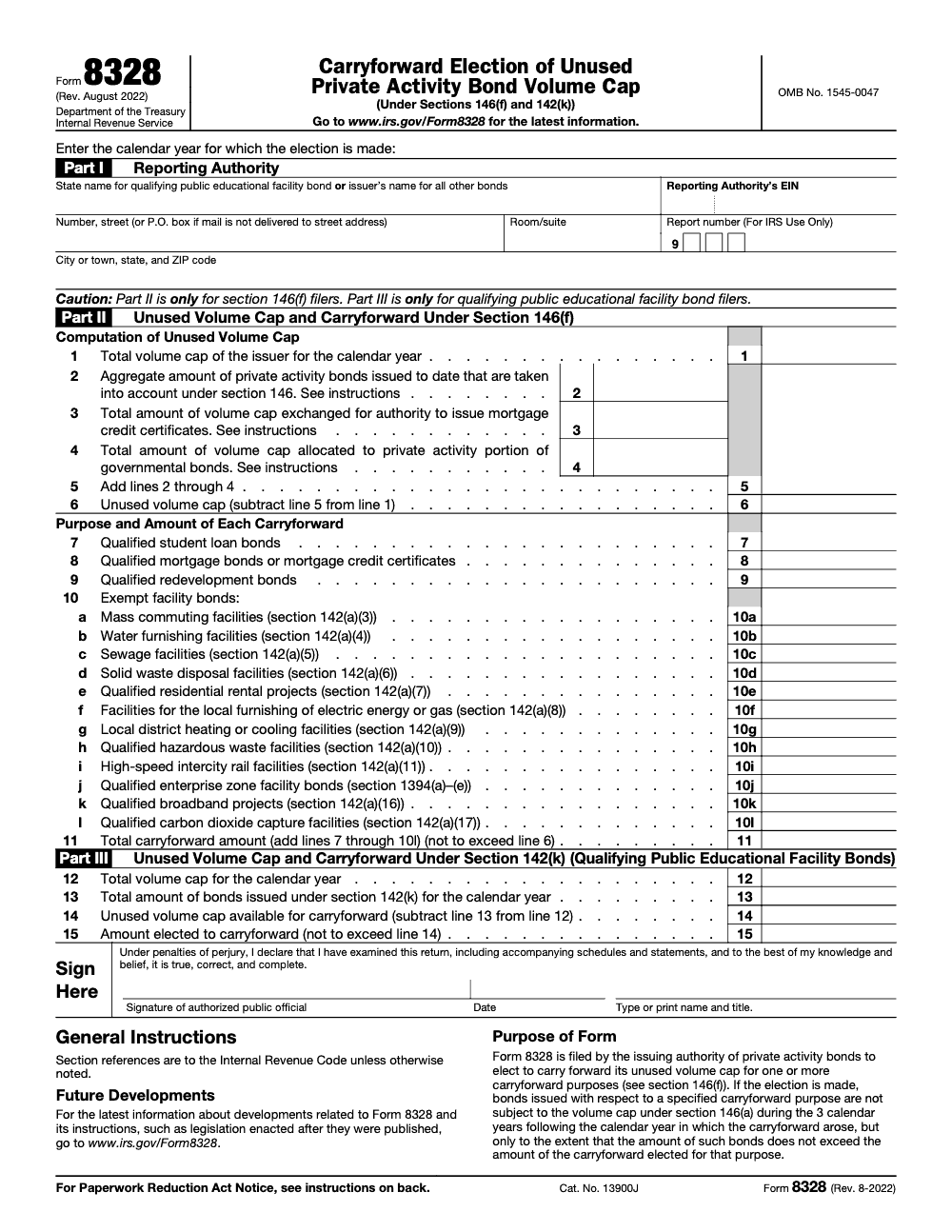
Form 8328 is the IRS election an issuing authority files to carry forward unused private activity bond volume cap under IRC section 146(f). The election is due the earlier of February 15 of the calendar year after the excess arises (February 15, 2026 for 2025 cap) or the date of issue of bonds issued pursuant to the carryforward election (per Form 8328 instructions, Rev. August 2022). The carryforward is valid for 3 calendar years, line 11 must not exceed unused volume cap on line 6, and Form 8328 is paper-only filed to the IRS Service Center in Ogden, UT. See related IRS form guides for adjacent bond compliance steps.
An issuing authority sits on private activity bond volume cap it did not use this year and assumes there is plenty of runway to decide what to do with it. The decision is the election on Form 8328, and the window to file it closes faster than most people plan for.
Form 8328 carries forward that unused volume cap under IRC section 146(f), and the carryforward stays valid for 3 calendar years. The deadline is the earlier of February 15 of the year after the excess arises, February 15, 2026 for 2025 cap, or the date you issue bonds under the election. The election names a purpose category and is binding, line 11 cannot exceed the unused cap on line 6, and many states add their own milestones, such as a September 15 date in Colorado, before the federal February 15 deadline arrives.
Key Takeaways
- Use IRS Form 8328 to elect a carryforward of your unused private activity bond volume cap and preserve it for future eligible projects for up to three calendar years under IRC §146(f).
- The deadline is the earlier of February 15 following the year the excess arises, or the date you issue bonds under that carryforward, so treat February 15 as a hard stop for each allocation vintage.
- The election must identify the purpose category and is binding, you cannot reassign it later to a different purpose.
- 2025 state ceilings use the greater of 130 per resident or 388,780,000 as the small‑state minimum, so confirm your cap math with the latest IRS inflation table.
- Many states add their own milestones. In Colorado, for example, September 15 is the decisive date to issue, assign, carry forward, or relinquish, then the federal Form 8328 is due by February 15.
- If you miss the IRS deadline, limited relief exists, Rev. Proc. 2005‑30 offers a six‑month automatic extension if you meet its conditions and mail to Ogden with the required legend on the form.
What Form 8328 Actually Does
Form 8328 is the IRS mechanism that turns leftover volume cap from last calendar year into usable authority for specific, qualified private activity bond purposes over the next three years. You report the calendar year the excess arose, the exact dollar amount, and the purpose, then you make a binding election. Once you choose the purpose, you cannot later flip that carryforward to something else.
The timing is where most teams stumble. The IRS treats the due date as the earlier of February 15 following the year of the excess or the date you issue bonds using that carryforward. Practically, you put February 15 on the wall for each vintage of unused cap and work backward from there.
Why it matters in 2025, the national ceiling moved up again. States calculate their cap as the greater of 130 times resident population or 388,780,000, which means more cap in many jurisdictions and a larger risk surface if you mis‑track usage or miss the filing window.
Who Files, And When You Are On The Hook
If you are the governmental issuer that holds the allocation for the year in question, you file the carryforward. If you formally assigned cap to another issuer and they accepted it, the assignee becomes responsible for both state notices and the federal Form 8328 for that unused portion. The key is simple, the entity that actually holds the cap on December 31 is the one that must elect the carryforward if any amount remains unused.
State overlays can move the goalposts earlier. Colorado is a clean example. By September 15, you must either issue, assign, elect to carry forward with a state notice, or relinquish back to the statewide balance. Then, by February 15 of the following year, the federal Form 8328 must be filed, and once filed, you cannot reassign that amount. Many states follow a similar cadence, but the rules are not uniform, so confirm your state’s handbook.
What You Gain If You Get This Right
Three very practical wins tend to show up when teams institutionalize the carryforward process.
- You buy time to line up deal‑readiness. The three‑year window lets you match issuance to permitting, pricing, and closings, instead of forcing a year‑end scramble.
- You protect affordable housing and infrastructure pipelines from arbitrary lapses, which can be huge in a year like 2025 with higher state ceilings.
- You reduce IRS headaches. Clean carryforward elections simplify downstream Form 8038 reporting because you can attach the applicable 8328 when you finally issue.
A Simple Way To Think About The Timeline
- January 1 to December 31, track allocations, issuances, assignments, relinquishments, and prior carryforwards.
- By mid‑January, finalize the year‑end ledger of used versus unused cap and tie it to Forms 8038 already filed for issued deals.
- Before February 15, file Form 8328 for any unused amount you want to preserve, earlier if you will issue under that carryforward in January or early February.
- If you discover you missed the date, immediately evaluate relief under Rev. Proc. 2005‑30, which can provide a six‑month extension if you meet the conditions and include the required “FILED PURSUANT TO REV. PROC. 2005‑30” notation.
Overview Of Private Activity Bonds And Volume Cap
Private activity bonds fund projects with private participation that still deliver public value, like affordable housing or infrastructure. To keep that tax advantage, issuers must operate within the federal private activity bond volume cap set by the Internal Revenue Code. Each state receives an annual ceiling, then allocates cap to issuers who must either use it or file a carryforward election. If you do not elect, the unused portion lapses and you lose it for good.
For calendar year 2025, the IRS set state ceilings at the greater of 130 per resident or 388,780,000. That increase is helpful, but it also raises the stakes, because larger allocations mean larger losses if deadlines slip. Confirm your own state’s figures and allocations, then line up Form 8328 filings for anything left over after year end.
Who Must File And Who Is Eligible
You file Form 8328 if you are the governmental issuer that actually holds the cap at year end. If you formally assigned cap and the assignee accepted it, the assignee becomes the filer for that portion. The statute is clear, the carryforward election is made by the issuing authority, it identifies the purpose, and once made, the election is irrevocable (typos or math errors cannot be fixed by filing an amended Form 8328 either, only a Voluntary Closing Agreement Program (VCAP) request under Notice 2008-31 can correct such errors). That is why you should confirm who is on title for the cap before February 15.
When there is unused cap for the calendar year, and you intend to preserve it for permitted purposes, you are eligible to elect a carryforward. Your documentation should back into a specific unused amount after considering issuances, assignments, and any relinquishments. If you handle pooled or multi‑agency programs, designate a lead filer and document authority so the right entity signs the election.
State Coordination Matters
Several states add intermediate milestones. Colorado is a practical example many teams reference. By September 15, an issuer must either issue, assign, carry forward with a state notice, or relinquish to the statewide balance. Then, file the federal Form 8328 by February 15 of the following year for any amount you are preserving. Treat September 15 as the state trigger and February 15 as the federal lock.
When You Should File And The Key Deadlines
Under long‑standing IRS guidance, the due date for the carryforward election is the earlier of February 15 of the year after the excess arose, or the date you issue bonds using that carryforward. In plain terms, if you plan to issue under the carryforward in January, file Form 8328 before you close. Otherwise, get the election in by February 15 without fail.
Here is a clean way to work the calendar. In early January, finalize your unused cap by reconciling the internal ledger to Forms 8038 already filed for issued deals, then confirm any assignments or relinquishments. By the end of January, circulate the draft Form 8328 with supporting schedules. File well before February 15, and keep proof of filing with your audit file. If your state has a September 15 notice cut‑off, align your internal memo trail to both dates.
What You Need On Your Desk Before You Draft The Form
You will move faster if you gather everything once. At a minimum, have the issuer’s legal name, mailing address, and EIN, the calendar year of the unused allocation, and the exact dollar amount you are carrying forward. Pull the calculation that shows how the unused cap arose by program, tie those figures to closings and par amounts, and reconcile to Forms 8038 or 8038‑G. Add any assignments, state notices, and related governing resolutions. When you sign, the authorized official certifies accuracy, so your backup should be complete and indexed.
Why Purpose Selection Is A Big Deal
The Code requires you to identify the carryforward purpose, for example an exempt facility category under section 142, qualified mortgage bonds or mortgage credit certificates, student loan bonds, or redevelopment bonds. Choose carefully because that purpose is fixed and you cannot reassign the carryforward later. Use a short internal memo to explain the choice and to align future issuances with the election.
Step‑By‑Step Guide To Completing Form 8328
- Part I, identify the issuer. Enter the exact legal name, mailing address, and EIN for the governmental issuer that holds the cap. List a responsible contact with phone, so the IRS can reach the right person if needed. Small mistakes here can misroute correspondence.
- Part II, show the math. State the original allocation year, your total cap, the amount used, and any prior carryforwards actually deployed. The result should match your unused balance for that calendar year. Double‑check the ledger against Forms 8038 already filed and closing documents.
- Part II, lines 7 through 10l, is where the section 146(f) carryforward election is actually made. Allocate the unused volume cap from line 6 across the elected carryforward purposes on lines 7 through 10l, and confirm the line 11 total does not exceed line 6. Part III is only for a state filing a section 142(k) election for qualified public educational facility bonds (line 15, not to exceed line 14); if that does not apply, leave Part III blank.
- Attach support and sign. Include the allocation breakdown, relevant resolutions, and a short reconciliation worksheet. Have an authorized official sign and date. Route a second‑person review before you file to catch typos and number transpositions.
When you finally issue bonds that use this carryforward, attach a copy of the relevant Form 8328 to your Form 8038 filing, as the instructions require. Doing this eliminates back‑and‑forth later.
Filing Methods, Proof, And E‑File Status
Most issuers still file Form 8328 on paper. The IRS product page lists the current revision and provides the downloadable PDF. As of the page reviewed July 30, 2025, there is no Modernized e‑File option listed for Form 8328, so plan on mailing to the address in the instructions and keep dated proof.
| Option | Compliance considerations |
| Use the IRS address in the current instructions, include all attachments, and retain certified mail or tracking receipts. | |
| IRS online | If the IRS ever enables online submission, confirm eligibility on the 8328 product page, then archive the electronic acknowledgement. |
| E‑file providers | Verify whether your provider supports 8328 transmission and attachments. If not, fall back to paper and keep proof. |
| Professional software | Confirm that your software exports a clean PDF of Form 8328, your carryforward schedules, and a signature block. |
| Recordkeeping | Archive the signed form, attachments, and proof of timely filing in your permanent file. |
What If You Discover An Error After You File
If the wrong entity filed instead of the issuing authority, see Rev. Proc. 2003‑46 for correction procedures. If you simply filed late, evaluate whether you qualify for the six‑month automatic extension in Rev. Proc. 2005‑30, which allows a late election if you meet specific conditions and print the required legend at the top of the form. If neither applies, speak with bond counsel about a private letter ruling request.
A Practical Checklist You Can Reuse
- Reconcile used versus unused cap for the calendar year, with a one‑page summary.
- Confirm the holder of the cap, issuer versus assignee, and attach assignments.
- Identify the carryforward purpose and draft a short justification memo.
- Fill Parts I, II, and III, then attach schedules and resolutions.
- Obtain the authorized public official's signature and date (a paid preparer or third-party agent cannot sign, it must be a public official responsible for carrying forward unused volume cap), then file before February 15.
- Save proof of mailing and add the form to your permanent index.
- When you issue under the carryforward, attach the 8328 to Form 8038.
Calculating Unused Volume Cap Accurately
You will avoid most headaches by treating the math as an auditable schedule, not a quick spreadsheet. Start with your annual allocation, population‑based ceiling plus any reassigned amounts, then subtract only private activity bonds that actually consume cap. Exclude governmental purpose bonds and non‑incremental refundings. Line by line, tie every reduction to a closing statement, a par amount, and a corresponding Form 8038.
Determine The Annual Allocation
- Pull the state’s 2025 ceiling using the IRS inflation table, then pull your local allocation letter or state ledger.
- Adjust for mid‑year assignments in or out and for any relinquishments.
- Subtract issued PAB amounts that count against cap, by category and date.
- Consider prior‑year carryforwards that you actually used during the year.
- The difference is your preliminary unused cap for that calendar year.
Track Issuances By Category
A simple monthly ledger works best. For each PAB issue, record the par amount, the issuance date, and the cap consumed. Note whether the cap came from a direct allocation, an assignment, or a carryforward. Apply an oldest‑first rule when you draw down prior carryforwards, then update balances right after each closing. At year end, your totals should match the state ledger and your internal allocations, making your 8328 figure easy to defend.
Reconcile Carryforwards Precisely
Once the issuance ledger is clean, finish the carryforward math. Start with the unused cap, adjust for prior carryforwards used, reflect any refunded or canceled issues, and verify that each adjustment is backed by documents. Prepare a one‑page roll‑forward that shows opening balance, additions, usage, and ending balance by vintage year. When you file the 8038 for a deal that uses the carryforward, attach the matching 8328 to close the loop.
Risk Controls That Keep You Out Of Trouble
- Calendar the state’s mid‑September milestone and the IRS February 15 deadline for each vintage. Put both dates on a single tracker with owner names.
- Require a second‑person review of Part II math and the purpose designation before the signer sees it.
- Store a signed PDF, a versioned schedule workbook, and your mailing proof in a permanent, indexed folder.
- Add a closing checklist item to attach the relevant 8328 to Form 8038 when you issue under the carryforward.
Tip, name your files by vintage and purpose, for example “2024‑Carryforward‑8328‑ExemptFacility‑Signed.pdf.” It makes future issuances faster and review painless.
Carryforward Rules, Limits, And Eligible Projects
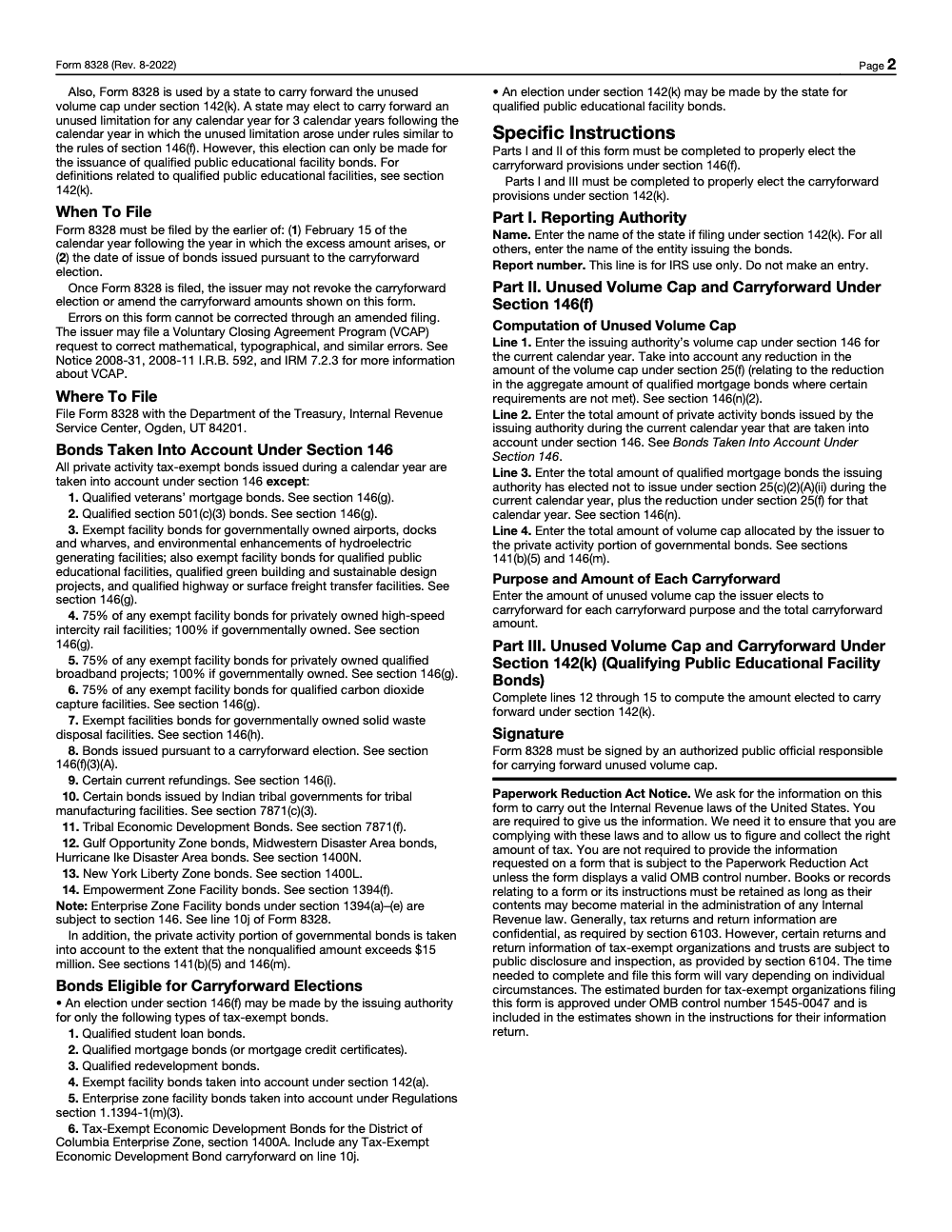
The law allows you to carry forward unused cap for up to three calendar years, and it must be used for the purpose you elect, up to the specific dollar amount you elected for that purpose on the form. Carryforwards are spent using the oldest vintage first, which is why tracking by year matters. Acceptable purposes include exempt facility bonds taken into account under section 142(a), qualified mortgage bonds or mortgage credit certificates, qualified student loan bonds, qualified redevelopment bonds, enterprise zone facility bonds taken into account under Regulations section 1.1394-1(m)(3), and Tax-Exempt Economic Development Bonds for the District of Columbia Enterprise Zone under section 1400A. Once you choose, you cannot reassign that purpose later.
If your state has an intermediate notice requirement, satisfy that requirement first, then complete the federal election. Missing the state date can push your allocation into a statewide balance before you even reach the IRS filing window. Colorado’s September 15 rule is a clear example, and many states follow a similar pattern with their own dates and forms.
Assignments, Relinquishments, And Team Coordination
You may keep the cap, assign it, or relinquish it to the statewide pool, depending on program design and project timing. If you assign to another issuer and they accept it, they become responsible for any carryforward election for that portion. Document the assignment fully, including dates and amounts, and update your ledger the same day. If you relinquish, expect the state to reallocate competitively by year end, so communicate early with sponsors who may be affected.
Common Errors And How To Avoid Them
- Late filings, the classic problem. If you miss February 15, evaluate Rev. Proc. 2005‑30 for a six‑month automatic extension if you meet the conditions and include the required legend. If you do not qualify, talk to counsel about a ruling.
- Wrong filer, where an allocating authority or the wrong entity files. See Rev. Proc. 2003‑46 for corrections that move the election to the actual issuing authority.
- Purpose miscues, choosing a category that does not match your pipeline. Add an internal sign‑off to confirm eligibility under section 142 or other categories before you lock the purpose.
Late Filing Risks, Explained
A late Form 8328 can permanently forfeit the carryforward. The IRS due date is the earlier of February 15 after the excess arises or the date you issue bonds that use that carryforward. If you discover the miss quickly, the six‑month relief window in Rev. Proc. 2005‑30 can save you, but only if you meet all conditions and act before the IRS contacts you. Build a calendar that alerts you 60 and 30 days before February 15, then file early in February to remove doubt.
Incomplete Form Details That Trigger Problems
Unsigned, undated, or misaddressed forms create avoidable delays. Mismatched issuer names or EINs create correspondence loops that burn weeks. The best fix is a pre‑submission checklist and a second‑person review of the header fields. Tie the carryforward amount to your ledger and to Forms 8038 already filed, and include the one‑page reconciliation. When the 8038 instructions ask you to attach the carryforward election for an issue using that cap, do it.
Recordkeeping And Documentation That Stand Up In Review
Think of your carryforward file as a permanent record, not a seasonal task. Keep the signed Form 8328, your computation schedules, governing body actions, assignments, and proofs of mailing. Index by vintage year, and retain the records for as long as their contents may become material in the administration of any Internal Revenue law. When you issue under that carryforward, add the final Form 8038 with the election attached to complete the story. This one folder is often the difference between a quick inquiry and a protracted exam.
Compliance Risks And What Examiners Look For
Examiners check eligibility, math that supports the unused amount, the timeliness of the election, and consistency with Forms 8038. They also confirm that your use matches the elected purpose and that oldest‑first consumption is respected. If your state has an intermediate notice date, have the letter or email handy. If you lean on the 2005‑30 relief, include the required legend and keep your timeline documentation in the file.
Strategic Benefits For Housing, Infrastructure, And Development
The carryforward election is not just a compliance step, it is a planning lever. Preserving cap lets you time issuance to project readiness and interest rates, especially for multifamily housing that needs more than a single year’s allocation. For complex infrastructure, carryforward gives you a way to aggregate authority and avoid forced December closings that create execution risk. If you run a public pipeline, this election is how you protect momentum when vendors or permits slip.
File Form 8328 on time, and you buy yourself three years of breathing room to issue when your project is truly ready.
Resources You Can Trust
- About Form 8328, current revision and product page, check here first for the latest PDF and any updates.
- Form 8038 instructions, includes the requirement to attach a copy of Form 8328 when you issue under a carryforward.
- IRC section 146, the legal backbone for volume cap, carryforward purpose, and irrevocability.
- IRS 2025 inflation adjustments for state ceilings, the numbers you need for this year’s cap math.
- Example state rule, Colorado’s September 15 framework for use, assignment, carryforward, or relinquishment.
Professional Advisory And Operational Help
- Bond counsel or municipal finance attorneys, confirm purpose eligibility and the legal effect of the election.
- CPAs and public finance specialists, tie cap math to 8038 reporting and build the schedules.
- Issuer operations partners, if your team is stretched during peak season, a disciplined partner can help with documentation and filing cadence so you do not miss a carryforward window. On the operations side, Accountably works with finance teams to standardize workpapers, set filing checklists, and protect deadlines without adding internal burnout.
Conclusion
Form 8328 is how you protect scarce private activity bond capacity and keep your pipeline moving. Close your books quickly in January, confirm who holds the cap, choose the right purpose, and file well before February 15. Keep a permanent folder, attach the election to Form 8038 when you issue, and align state notices with the federal deadline. If the calendar gets tight, ask counsel about relief under Rev. Proc. 2005‑30. Do the simple things right and you will preserve millions in financing capacity for housing, infrastructure, and development.
Common Mistakes We See Every Season
From my side of the desk, these are the recurring 8328 traps I see across state and local issuing authorities. Most cost a year of cap, not a typo penalty, so the prevention is worth more than the cleanup.
Reusable Checklists
Copy these into your issuing-authority SOP folder. They mirror the workflow my team runs ahead of every February 15 cycle and any pre-deadline bond issue.
Pre-file volume cap reconciliation
- Pull the calendar-year volume cap under IRC section 146 and apply any section 25(f) reduction before entering line 1.
- Total all private activity bonds issued during the year that are counted under section 146 for line 2.
- Add mortgage credit certificate amounts elected under section 25(c)(2)(A)(ii) plus the section 25(f) reduction for line 3.
- Enter the volume cap allocated to the private activity portion of governmental bonds (per sections 141(b)(5) and 146(m)) on line 4.
- Add lines 2, 3, and 4 to compute line 5, then subtract from line 1 for unused cap on line 6.
- Confirm the eligible carryforward categories on lines 7 through 10l, and that the line 11 total does not exceed line 6.
- Verify the calendar year is entered at the top of the form and the report number field is left blank.
Bond exclusion determination
- Confirm whether the bond falls in any of the 14 excluded categories under section 146 (veterans mortgage, 501(c)(3), governmentally owned airport/dock/wharf, public educational facility, green building, highway/freight transfer, governmentally owned solid waste, certain current refundings, tribal manufacturing, Tribal Economic Development, Gulf Opportunity Zone, Midwestern Disaster, Hurricane Ike, New York Liberty Zone).
- For airports, docks, wharves, and environmental enhancements of hydroelectric facilities, confirm governmental ownership before excluding under section 146(g).
- For Enterprise Zone Facility bonds, classify as section 1394(a)-(e) (subject to cap, line 10j) versus section 1394(f) Empowerment Zone bonds (excluded).
- For high-speed intercity rail and broadband projects, apply 75 percent exclusion only if privately owned, 100 percent if governmentally owned.
- For qualified carbon dioxide capture facilities, apply 75 percent exclusion regardless of ownership.
- For governmental bonds with a private activity portion, count only the portion of the nonqualified amount that exceeds the $15 million threshold under sections 141(b)(5) and 146(m).
Filing, signature, and evidence packet
- Confirm Parts I and II are completed for a section 146(f) carryforward, or Parts I and III for a state section 142(k) carryforward (the two paths are mutually exclusive).
- Have the authorized public official responsible for carrying forward unused volume cap sign under penalties of perjury.
- Mail the original to the Department of the Treasury, Internal Revenue Service Center, Ogden, UT 84201, certified mail with return receipt. There is no electronic filing option for Form 8328.
- If bonds are being issued pursuant to the carryforward election, file Form 8328 on or before the bond issue date, not February 15.
- Retain a complete copy of the filed form, mailing proof, and supporting workpapers. Books and records related to the form must be kept for as long as their contents may become material in administering any Internal Revenue law.
- Calendar the 3 calendar years following the carryforward year to track which carryforward purposes remain available and when each expires.
Keep 8328 Season From Stalling
The 8328 cycle is short and unforgiving. State and local issuing authorities have only a few weeks between closing the prior year's volume cap math and the February 15 election deadline, and any bond issue executed under the carryforward shortens that runway further (per Form 8328 instructions, Rev. August 2022). When the workpaper is rushed, the cost is not a penalty, it is a full year of lost cap.
The fix is treating Form 8328 as a year-end closing task, not a January scramble. The volume cap calculation, the line 2 issuance total, and the carryforward purpose allocations each need a controlled hand-off between bond counsel, the issuing authority, and the reviewer before signature.
- Anchor the year-end close to a fixed line 6 calculation. Lock line 1 (volume cap with the section 25(f) reduction), lines 2 through 4 (issuance totals), and line 5 before opening Part II so the unused cap on line 6 is final.
- Build a category map for lines 7 through 10l before allocating carryforward dollars. The map decides which carryforward purpose each dollar lands on, and the assignment is binding for the 3 calendar years that follow.
- Cap line 11 against line 6 as a hard rule in the workpaper. Any overshoot invalidates the election, and the only correction path is a VCAP closing agreement under Notice 2008-31, 2008-11 I.R.B. 592.
- Run the bond issuance calendar against the February 15 deadline weekly through January. If any issue under the carryforward closes before February 15, the controlling deadline moves to that bond issue date.
- Route Part III (section 142(k)) filings through the state authority only. Local issuers cannot sign Part III, and a misrouted form does not start the carryforward clock.
This is the kind of structured execution our offshore tax delivery teams are built to support, with documented SOPs, multi-layer review, and turnaround SLAs that fit a February 15 hard stop without burning a senior reviewer's week on math reconciliation.
FAQs
Refundings often do not consume new cap to the extent they replace outstanding principal, but you still need clean 8038 reporting and arbitrage documentation. When a reissuance occurs, recheck qualified use and proceed tracking, then confirm whether any part of the transaction touches your carryforward balance.
Update the IRS contact information and keep governing documents that show successor authority. Maintain continuity by keeping the signed election, proof of timely filing, and a memo explaining leadership or name changes in the same indexed folder.
You need a single issuing authority to act as filer. If multiple agencies are involved, use intergovernmental agreements to document roles, then have the proper issuer make the election and control the record.
Possibly. Rev. Proc. 2005‑30 provides a six‑month automatic extension if you meet all requirements, file before the IRS contacts you, and include the required legend on the form you submit. If you do not qualify, discuss a ruling request with counsel immediately.
As of July 30, 2025, the IRS product page for Form 8328 lists the PDF and does not indicate an e‑file pathway. Plan on paper filing and keep dated proof of mailing.
About this guide
Accountably helps US CPA, EA, and accounting firms hire trained accountants and tax preparers in India.
About us Reviewed byJugal Thacker, CPAFounder and CEO at Accountably
A Washington-licensed CPA with 7+ years inside US firms – PwC, a real-estate tax practice, then a full-service firm, rising from reviewer to manager to advisory. This article was reviewed against current IRS guidance for the 2025 tax year and updated for filers preparing late returns, amendments, and 2026 estimates.
View profile →How we research, review, and update this guide
Every Accountably guide is researched against primary IRS sources, reviewed by a U.S. CPA, and refreshed as guidance evolves. Read our Editorial Guidelines to see how we source, fact-check, and update our content.