Summarize this article with AI
In Brief
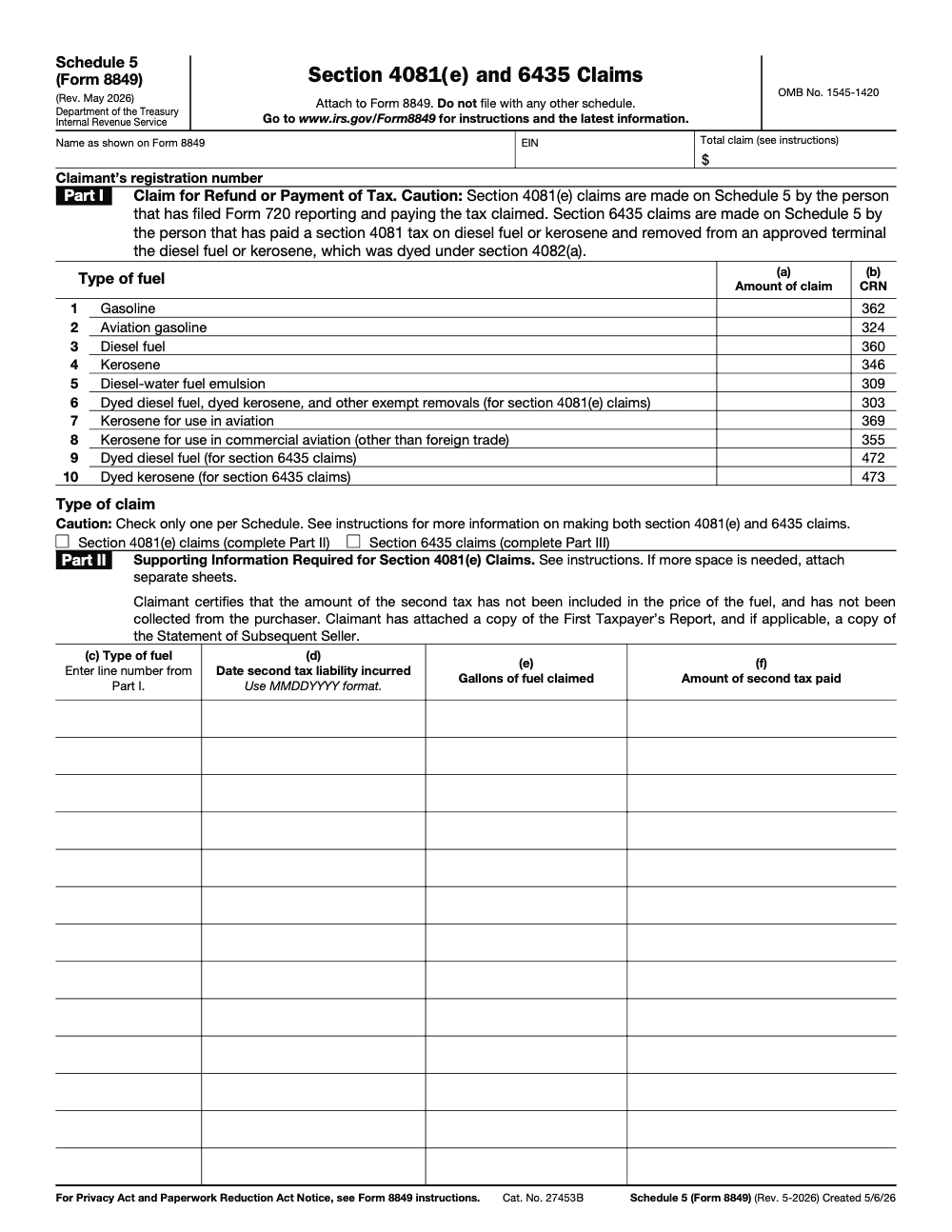
Schedule 5 (Form 8849) is how you reclaim a duplicate §4081 excise tax on taxable fuel after the original tax was already reported and paid on Form 720 (according to the Schedule 5 instructions, Rev. May 2026). Part I carries ten fuel-type lines tied to specific Credit Reference Numbers, from gasoline (CRN 362) to dyed kerosene (CRN 473), and a single Schedule 5 covers one claim type only: a §4081(e) second-tax refund or a §6435 dyed-fuel credit, never both.
Schedule 5 exists for one narrow moment: a second §4081 excise tax was paid on the same taxable fuel after a prior §4081 tax was already reported and paid on Form 720. Only the person who reported and paid that second tax can file the claim, which is where most would-be filers fall out.
The single box you check decides the whole filing. One Schedule 5 covers one claim type only, a §4081(e) second-tax refund or a §6435 dyed-fuel credit, never both, and Part I runs ten fuel-type lines from gasoline at CRN 362 to dyed kerosene at CRN 473. You generally have 3 years from when the second-tax return was filed or 2 years from when it was paid, whichever is later, and e-filed claims typically process in about 45 days.
Key Takeaways
- Schedule 5 (Form 8849) is used to claim a refund when a second IRC §4081 excise tax was paid on the same taxable fuel and a prior §4081 tax was also paid and reported.
- Only the person who reported and paid the second tax to the government (on Form 720) is eligible to file the Schedule 5 claim.
- Your claim must include required attachments, including a First Taxpayer’s Report and, when applicable, a Statement of Subsequent Seller.
- You generally must file within 3 years from when the return for the second tax was filed, or 2 years from when the second tax was paid, whichever is later.
- You can e-file Form 8849 including Schedule 5 through an IRS-approved transmitter, and the IRS says most non-Schedule 2/3/8 claims (including Schedule 5) are processed within about 45 days after acceptance.
What Is Form 8849 Schedule 5 (Section 4081(e))?
Schedule 5 is the IRS’s refund mechanism for “second tax” situations under IRC §4081(e). In other words, the same gallons of taxable fuel got hit with a second federal excise tax, even though a prior §4081 tax on that fuel was already paid and reported.
This is not the schedule you use for off-highway use, farming use, export claims, or other nontaxable use cases. Schedule 5 is narrowly focused on duplicate taxation under §4081.
What fuels does Schedule 5 cover?
The schedule is built around common taxable fuel categories and related claim lines, like gasoline, diesel fuel, kerosene, aviation gasoline, and certain special categories listed on the form.
Practical takeaway: before you touch the form, confirm your scenario is truly a §4081(e) second tax situation, not a different excise refund type that belongs on another schedule.
Who Can File Schedule 5 (and Who Cannot)?
This part trips people up, especially when multiple parties touched the fuel.
Schedule 5 is not “whoever feels the pain” from the duplicate tax. It’s tied to who actually reported and paid the second tax to the IRS.
The IRS eligibility rule in one sentence
The person who reported on Form 720 and paid the second tax to the government on the same fuel is the only person eligible to make the claim.
So if you are a downstream purchaser who paid more because the tax was priced into the fuel, you might be financially impacted, but that does not automatically mean you’re the eligible claimant for Schedule 5.
You also have to certify a pricing and collection point
Schedule 5 includes a certification that the amount of the second tax has not been included in the fuel price and has not been collected from the purchaser. That certification is a substantive eligibility requirement, not a formality: if you already recovered any part of the second tax from the buyer, whether built into the price or billed separately, that portion is not refundable to you.
That’s the IRS basically saying, “We don’t want the tax refunded twice through the supply chain.”
A quick reality check, is this really a Schedule 5 situation?
Before you build the package, ask yourself:
- Did a prior §4081 tax on the fuel get paid and reported?
- Did you later pay and report a second §4081 tax on the same gallons?
- Can you prove it with the specific documents the IRS calls for (we’ll cover those next)?
If you can’t confidently answer “yes” to all three, pause and confirm the correct schedule before you file. The fastest way to lose time is filing the right story on the wrong schedule.
Schedule 5 vs Other Form 8849 Schedules (Choose the Right Lane)
Form 8849 is a container. The schedule you attach is what tells the IRS what you’re actually claiming.
Here’s the clean way to think about it:
- Schedule 5 is for duplicate §4081 taxation (second tax paid on fuel where a prior §4081 tax was already paid and reported).
- Other schedules cover nontaxable uses, vendor claims, alternative fuels, and “everything else.”
Important filing rule, Schedule 5 must be separate
If you’re filing Schedule 5, do not bundle it with other schedules on the same Form 8849. The Form 8849 instructions are clear that Schedules 2, 3, 5, and 8 cannot be filed with any other schedules on Form 8849 and must be filed separately.
That sounds small, but it matters. Mixing schedules can slow processing or trigger a rejection.
Quick comparison table (save this)
| Your situation | Likely schedule |
| Second §4081 tax paid on the same gallons, prior §4081 tax also paid and reported | Schedule 5 |
| Fuel used in a nontaxable way by the ultimate purchaser (off-highway, farming, etc.) | Schedule 1 |
| You’re a registered ultimate vendor claiming for sales to exempt users | Schedule 2 |
| Fuel mixtures or alternative fuel credit type claims | Schedule 3 |
| Excise refunds not reportable on Schedules 1, 2, 3, 5, or 8 | Schedule 6 |
If you’re advising clients, this is where good intake questions pay off. Half of “denied claims” are really “wrong schedule” or “missing required attachments.”
Required Documents for Schedule 5 (What the IRS Actually Wants)
Schedule 5 is one of those forms where the attachments are not optional.
The two core attachments
For each claim, the Schedule 5 instructions require you to attach:
- A copy of the First Taxpayer’s Report related to the fuel covered by each claim
- If you bought the fuel from someone other than the first taxpayer, a copy of the Statement of Subsequent Seller you received for that fuel
Schedule 5 also notes that these documents must contain the information shown in Model Certificates A and B in Appendix B of Pub. 510.
Practical takeaway: if your team does not already have a habit of collecting and storing these documents at the time of the transaction, Schedule 5 becomes a scramble later.
Supporting records that make your claim easier to defend
Even though the schedule highlights the two required documents above, real-world refund claims go smoother when your backup records line up cleanly, for example:
- Form 720 workpapers showing where the second tax was reported and paid
- EFTPS payment confirmations (or other payment records) tying the tax payment to the period
- Invoices, bills of lading, terminal records, and movement documentation tying the gallons to the transaction chain
Why this matters: Schedule 5 requires you to enter gallons and the second tax amount tied to a specific second-tax event. If your gallons cannot be traced, you’re asking the IRS to “trust you,” and that’s not the game here.
Where to File (Paper) and Why E-File Is Usually Cleaner
Paper filing address
For Schedules 2, 3, 5, and 8, the Form 8849 instructions list the mailing address as: Internal Revenue Service, P.O. Box 312, Covington, KY 41012-0312.
Also note the caution: private delivery services designated by the IRS can’t deliver to P.O. boxes, so if you use a private carrier you may need a different approach per IRS guidance.
E-file is allowed (and often reduces dumb errors)
The IRS allows optional electronic filing for Form 8849, including Schedules 1, 2, 3, 5, 6, and 8, through an IRS-approved Modernized e-File provider/transmitter.
The IRS also states you’ll generally pay the provider’s service fee to transmit electronically.
From a quality-control standpoint, e-file tends to reduce preventable issues like missing fields, messy handwriting, or basic data entry mistakes.
Schedule 5 Deadlines and Timing (What “On Time” Really Means)
A lot of online summaries talk about “file next quarter” rules for Form 8849. That’s not what Schedule 5 itself centers on.
Schedule 5’s own instructions focus on the statute of limitations style deadline:
Generally, the claim must be filed within 3 years from when the return for the second tax was filed, or 2 years from when the second tax was paid to the government, whichever is later.
My practical advice on timing (even if you have time)
Even if you are within the 3-year or 2-year window, filing sooner is usually safer because:
- your transaction documentation is easier to locate
- your staff remembers the fact pattern
- the chain of custody for the gallons is clearer
- you can fix gaps before they become “we can’t prove it”
Also, Schedule 5’s example describes filing the claim after the second tax return is filed.
Processing Time (E-Filed vs Paper)
The IRS states that refunds for e-filed Form 8849 with Schedules 2, 3, or 8 are processed within 20 days after acceptance, and all other Form 8849 schedules are processed within 45 days of acceptance, which includes Schedule 5.
That is not a guarantee for every claim, especially if your package is incomplete, but it’s a helpful expectation-setting point for clients and internal cash planning.
How to Complete Form 8849 Schedule 5 Step by Step
Let’s make this simple. Schedule 5 is only two pages, but it’s dense because it assumes you already understand the excise tax chain and the documents.
Step 1, confirm you are the eligible claimant
Before you fill anything out, confirm you are the person who:
- reported the second tax on Form 720, and
- paid that second tax to the government, and
- are claiming a refund because a prior §4081 tax on that same fuel was already paid and reported
If that’s not you, stop. You’re likely not the eligible claimant for Schedule 5.
Step 2, complete Form 8849 (top-level form)
Fill in your name, EIN (or SSN if applicable), address, and other required fields.
Also remember the “separate filing” rule: Schedule 5 should be filed on a separate Form 8849 and not combined with other schedules.
Step 3, Schedule 5 Part I, choose the fuel line and enter the amount
In Part I, you select the fuel type line that fits your claim and enter the amount of refund tied to that fuel line.
Schedule 5 uses CRNs and fuel categories on the form itself. Your job here is to:
- pick the correct line for the fuel type
- ensure the dollars you enter are supportable by your “second tax paid” records
- keep your totals consistent with what you’ll list in Part II
Step 4, Schedule 5 Part II, list the supporting details
Part II asks you to list the details that tie the refund to the second tax event, including:
- the fuel line number (from Part I), entered as the numeric line number and not the fuel name
- the date the second tax liability was incurred (MMDDYYYY format, entered as 8 digits with no slashes or dashes, for example 05062026 for May 6, 2026)
- the gallons of fuel claimed
- the amount of second tax paid
This is where most avoidable errors happen. A “right dollars, wrong date” claim can still become a headache if it does not tie cleanly to your Form 720 and your supporting documents.
Step 5, attach the required documents (do not skip)
Attach the required items:
- First Taxpayer’s Report for the fuel covered by each claim
- Statement of Subsequent Seller if you bought from someone other than the first taxpayer
Schedule 5 also reminds you these documents must match the content requirements shown in Pub. 510’s model certificates.
Step 6, finalize totals and file correctly
- Add up the amounts in Part I and enter the total refund.
- Attach Schedule 5 to Form 8849.
- If mailing, follow the Form 8849 “Where To File” instructions for Schedule 5.
- Schedule 5 instructions also say to write “Section 4081(e) Claim” on the envelope when mailing.
Common Form 8849 Schedule 5 Mistakes (and How You Avoid Them)
Most Schedule 5 issues are not “bad intent.” They’re messy execution.
Here are the mistakes I see most often, plus the fix.
Mistake 1, filing Schedule 5 when you are not the eligible claimant
Schedule 5 is not a “whoever lost money” claim. It’s tied to who reported and paid the second tax.
Fix: Confirm you are the person who filed Form 720 and paid the second tax to the government. Schedule 5’s instructions say that is the only eligible claimant.
Mistake 2, missing the First Taxpayer’s Report or the Statement of Subsequent Seller
These are not “nice to have.” Schedule 5 explicitly calls for them, and filing without them on the assumption that the IRS will request them later often gets the claim denied or delayed.
Fix: Build a standard internal checklist. If your team touches fuel excise work regularly, store these documents at the time of the transaction, not months later when you’re building the refund claim.
Mistake 3, gallons and dates that cannot be traced back to the second tax event
Part II requires the date the second tax liability was incurred and the gallons claimed.
Fix: Tie every line item back to the underlying movement/terminal records and your Form 720 reporting support. If you cannot prove the chain, reduce the claim to the portion you can prove.
Mistake 4, combining Schedule 5 with other schedules on one Form 8849
Form 8849’s instructions say Schedules 2, 3, 5, and 8 cannot be filed with any other schedules on Form 8849.
Fix: File Schedule 5 with its own Form 8849 package.
Mistake 5, treating “deadline” as a vague concept
Schedule 5 gives a clear general filing window, based on the timing of the second tax return filing or payment.
Fix: Put the statute-based deadline into your calendar when the second tax is paid and reported, then aim to file well before it.
Quick Schedule 5 Filing Checklist (Copy and Paste)
Before you file, confirm you have:
- A clear §4081(e) fact pattern (second tax paid on the same gallons, prior tax also paid and reported)
- Confirmation you are the eligible claimant (you reported and paid the second tax on Form 720)
- Completed Form 8849 with Schedule 5 only (not bundled with other schedules)
- Schedule 5 Part I completed for the correct fuel line(s)
- Schedule 5 Part II completed with correct date, gallons, and second tax paid
- First Taxpayer’s Report attached
- Statement of Subsequent Seller attached when required
- Filing method chosen (paper to the Schedule 5 address, or e-file through an approved transmitter)
Conclusion
Schedule 5 is not complicated because it’s long. It’s complicated because it’s strict about who can claim, what has to be attached, and how well you can prove the second tax event.
If you take one thing from this guide, make it this: a great Schedule 5 claim is a documentation package, not a form. The form is just the cover sheet.
If you’re a CPA firm or tax team handling these claims at scale, and your bottleneck is workpaper prep, documentation consistency, or review cycles, Accountably can support the back-office execution so your internal team stays in control without getting buried.
Common Mistakes We See Every Season
The Schedule 5 claims I see denied or kicked back share a theme. The numbers are fine, but the package is built wrong, so the refund stalls in review. Here are the patterns worth scanning for before anything leaves your office.
Reusable Checklists
Drop these into your firm’s SOP library. Each item is written so a preparer or reviewer can check it off as the Schedule 5 package comes together.
Eligibility and claim-type screen
- Confirm a duplicate §4081 tax event: a second tax paid on the same gallons that already carried a reported §4081 tax.
- Confirm the claimant is the entity that reported and paid the tax on Form 720, not a downstream buyer or reseller.
- Decide the claim type: a §4081(e) second-tax refund or a §6435 dyed-fuel credit, never both on one schedule.
- Confirm the claimant’s IRS registration number is on hand for the header.
- Verify Schedule 5 will be filed on its own Form 8849, not bundled with another schedule.
§4081(e) second-tax claim packet
- Check the §4081(e) box and complete Part I on the correct fuel line (for example gasoline line 1, CRN 362, or diesel line 3, CRN 360).
- Use line 6 (CRN 303) for dyed diesel, dyed kerosene, and other exempt removals under §4081(e).
- Complete Part II in full: fuel type by Part I line number, date the second tax was incurred in MMDDYYYY, gallons claimed, and amount of second tax paid.
- Attach the First Taxpayer’s Report.
- Attach the Statement of Subsequent Seller if the fuel was purchased from someone other than the first taxpayer.
- Certify the second tax was not passed through to the purchaser, per the Schedule 5 instructions.
- Confirm the header name matches the parent Form 8849 exactly.
§6435 dyed-fuel claim packet
- Check the §6435 box and use line 9 (dyed diesel, CRN 472) or line 10 (dyed kerosene, CRN 473) in Part I.
- Confirm you paid the §4081 tax and then removed the fuel, dyed under §4082(a), from an approved terminal.
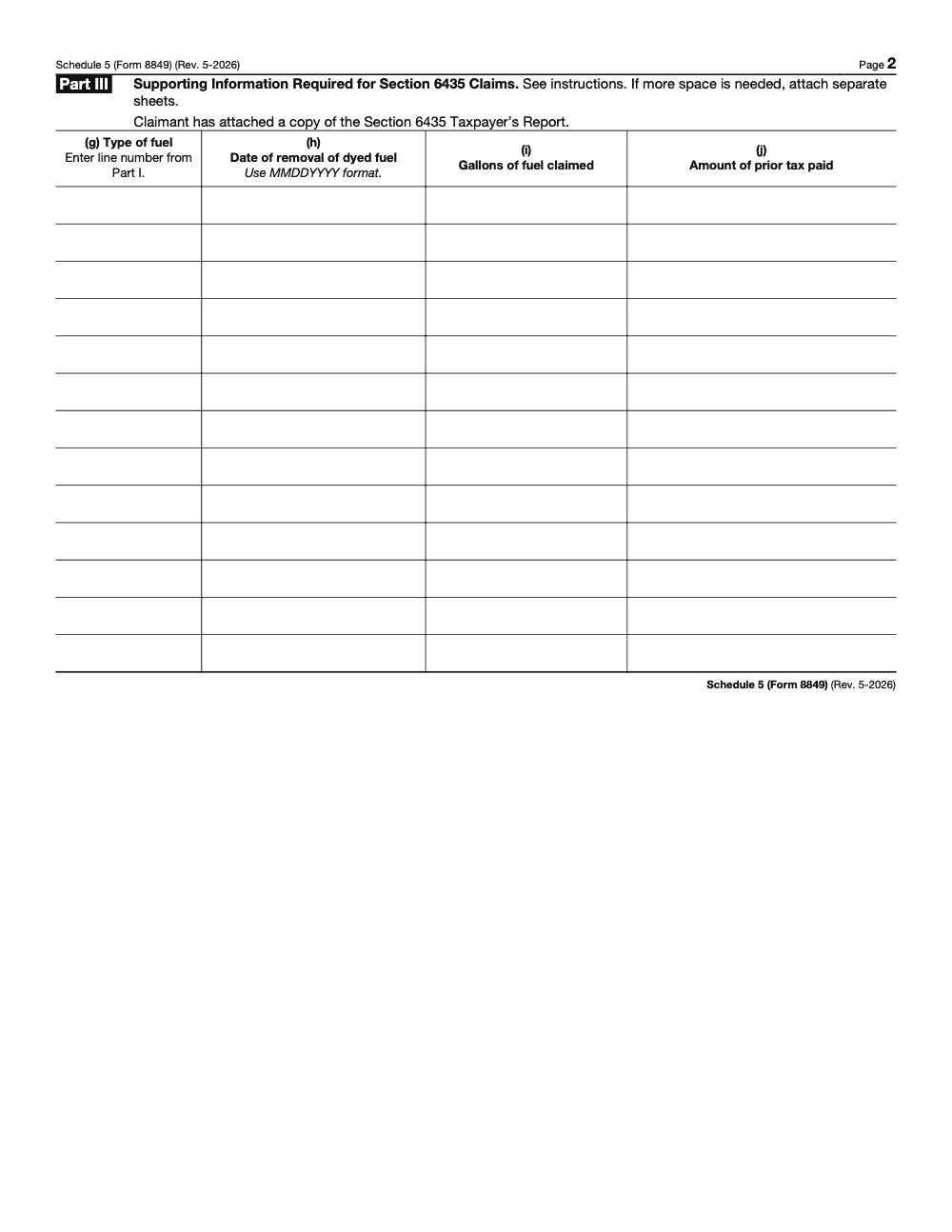
- Complete Part III in full: fuel type by Part I line number, date of removal in MMDDYYYY, gallons claimed, and amount of prior tax paid.
- Attach the Section 6435 Taxpayer’s Report.
- Attach separate sheets if Part III runs out of room.
- Confirm the claimant’s registration number and EIN are entered in the header.
Keep 8849 Schedule 5 Season From Stalling
Schedule 5 work clusters around fuel excise cycles, and the claims rarely stall on volume. They stall on proof. The Schedule 5 instructions (Rev. May 2026) spread ten Credit Reference Numbers across two separate statutes, §4081(e) and §6435, and IRS Publication 510 layers the report and certification requirements behind each one. Get a single attachment or a single CRN wrong and a clean refund turns into a months-long review thread.
The teams that keep these claims moving treat every Schedule 5 as a documentation package assembled the same way each time, rather than a form filled in at the deadline. Consistency in how the claim is built is what shortens review, not speed at the keyboard.
- Lock the claim-type decision first, so the §4081(e) second-tax and §6435 dyed-fuel packages move on separate tracks with one claim-type box each.
- Map each fuel to its CRN before data entry, so dyed diesel lands on line 9 (CRN 472) rather than line 6 (CRN 303).
- Standardize Part II and Part III entry: fuel type by line number, dates in MMDDYYYY, gallons, and tax paid, with the matching taxpayer report indexed to the claim.
- Build a tickler for the claim window so packages are assembled ahead of the deadline, not against the clock.
- Run a two-step review that checks the certification and attachments, then matches the claimant’s registration number and name to the parent Form 8849.
This is the kind of repeatable, review-heavy production that scales badly when it is squeezed between client deadlines. Accountably builds the structured workpaper prep and multi-layer review behind claims like these, so your tax execution stays consistent without pulling senior reviewers off higher-value work.
FAQs
Schedule 5 is used to claim a refund of a second §4081 excise tax paid on taxable fuel when a prior §4081 tax on that same fuel was also paid and reported. It is specifically for Section 4081(e) situations, not general fuel credits or nontaxable use claims.
The eligible claimant is the person who reported the second tax on Form 720 and paid it to the government on the same fuel. If you did not pay and report the second tax, you generally are not the claimant for Schedule 5.
Schedule 5 requires a First Taxpayer’s Report for each claim and, if applicable, a Statement of Subsequent Seller when the fuel was purchased from someone other than the first taxpayer. These documents must contain the information shown in the model certificates referenced in Pub. 510.
Schedule 5 states you generally must file within 3 years from when the return for the second tax was filed, or 2 years from when the second tax was paid, whichever is later. If you are close to the edge of that window, get professional advice and file with clean proof.
Yes. The IRS allows optional e-filing of Form 8849 and includes Schedule 5 among the schedules accepted through IRS-approved transmitters/providers. The IRS also notes you’ll typically pay the provider’s service fee for online submission.
Other forms this guide names
- Form 720: Deadlines, Deposits, and PCORI, 2025 Guide
About this guide
Accountably helps US CPA, EA, and accounting firms hire trained accountants and tax preparers in India.
About us Reviewed byJugal Thacker, CPAFounder and CEO at Accountably
A Washington-licensed CPA with 7+ years inside US firms – PwC, a real-estate tax practice, then a full-service firm, rising from reviewer to manager to advisory. This article was reviewed against current IRS guidance for the 2025 tax year and updated for filers preparing late returns, amendments, and 2026 estimates.
View profile →How we research, review, and update this guide
Every Accountably guide is researched against primary IRS sources, reviewed by a U.S. CPA, and refreshed as guidance evolves. Read our Editorial Guidelines to see how we source, fact-check, and update our content.