Summarize this article with AI
In Brief
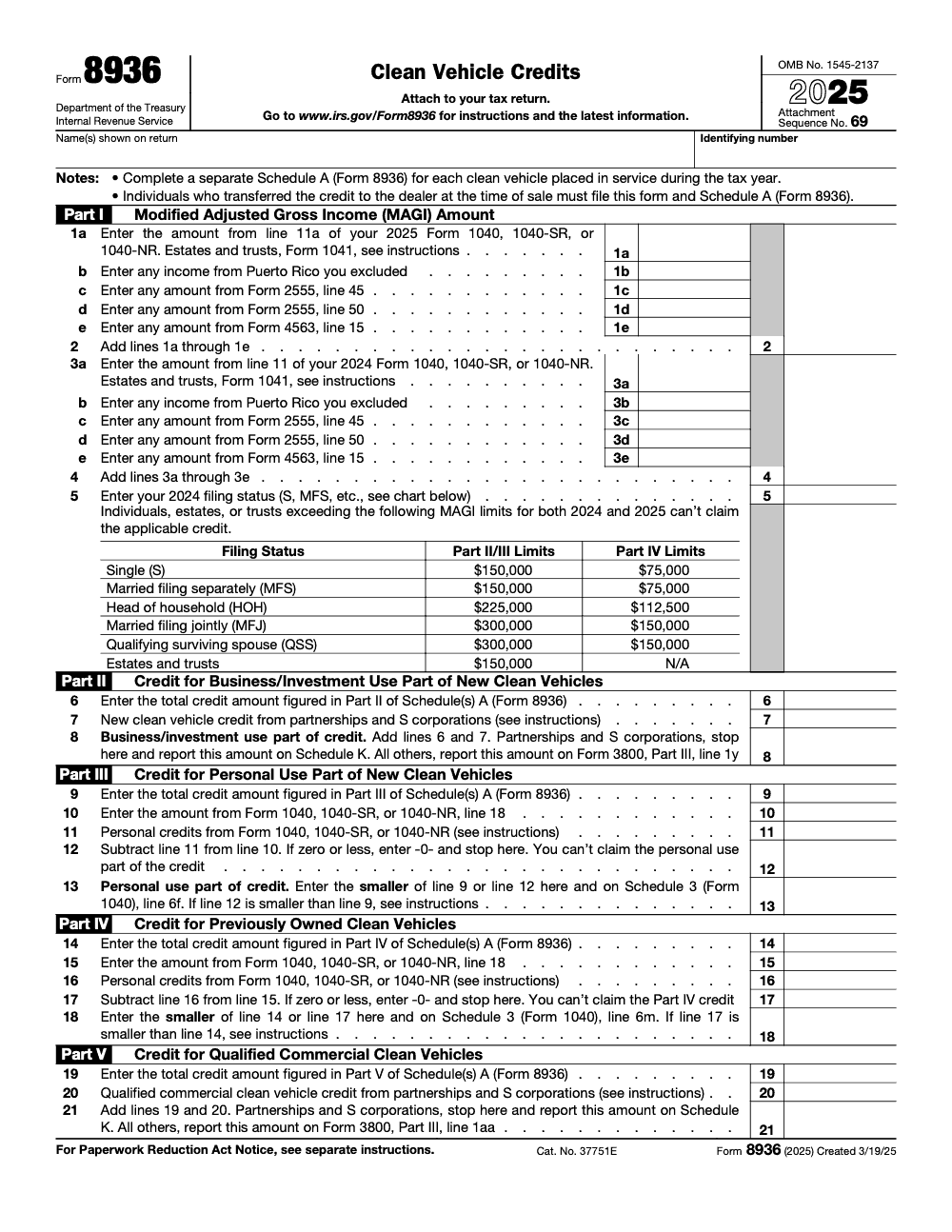
Form 8936 claims the New Clean Vehicle Credit (up to $7,500 under IRC §30D), the Previously Owned Clean Vehicle Credit (lesser of 30% of sales price or $4,000 under IRC §25E), and the Qualified Commercial Clean Vehicle Credit under IRC §45W – each figured on a separate Schedule A by VIN for every vehicle placed in service. Under the One Big Beautiful Bill Act (Public Law 119-21), no clean vehicle credit is allowed for vehicles acquired after September 30, 2025; the personal-use new credit flows to Schedule 3 (Form 1040) line 6f, the previously owned credit to line 6m, and the business and commercial portions to Form 3800 lines 1y and 1aa. See our U.S. tax preparation services for per-VIN workbook support.
The dealer ran the point-of-sale transfer and the seller report is in the folder, but if the buyer's MAGI is over the limit in both years, $300,000 for joint filers, the credit has to be repaid as recapture on Schedule 2 (Form 1040), line 1b. The test can use current-year or prior-year MAGI, whichever is lower, so both years belong in the file.
Form 8936 claims the New Clean Vehicle Credit of up to $7,500 under §30D, the Previously Owned Clean Vehicle Credit, and the Qualified Commercial Clean Vehicle Credit, each figured on a separate Schedule A by VIN. Under the One Big Beautiful Bill Act, no clean vehicle credit is allowed for vehicles acquired after September 30, 2025, and MSRP caps run $55,000 for most cars and $80,000 for vans, SUVs, and pickups.
Key Takeaways
- You use Form 8936 to claim the New Clean Vehicle Credit and the Previously Owned Clean Vehicle Credit. You must complete a separate Schedule A (Form 8936) for each vehicle and include the VIN.
- Under current IRS guidance, these credits are not available for vehicles acquired after September 30, 2025. If you acquired by that date, you may still claim when the vehicle is placed in service later, as long as a binding contract and payment were made by September 30, 2025.
- Price and income caps still apply. MSRP caps are 55,000 for most cars and 80,000 for vans, SUVs, and pickups. MAGI limits are 300,000 MFJ, 225,000 HOH, 150,000 others for new vehicles. Used credit limits are lower.
- For vehicles placed in service on or after April 18, 2023, the credit is split into two parts, 3,750 for battery components and 3,750 for critical minerals. In 2025, FEOC rules also apply to critical minerals, which can disqualify a vehicle.
- Time of sale reporting by the dealer through IRS Energy Credits Online is required. If a sale is not reported, the buyer cannot claim the credit, even if all other rules are met.
What Form 8936 is and when it applies
Form 8936 calculates the clean vehicle credit for qualified new and used clean vehicles. For each vehicle, you attach a separate Schedule A, include the VIN, the placed in service date, and the data needed to figure the allowable amount. The form also supports the older qualified plug in formula for vehicles placed in service before April 18, 2023.
You will see two different frameworks on the form. First, a legacy battery capacity based calculation for vehicles placed in service before April 18, 2023. Second, the current two part test for vehicles placed in service on or after April 18, 2023 that considers battery components and critical minerals. Used clean vehicles have their own computation, the lesser of $4,000 or 30 percent of the sale price, with a $25,000 sale price cap (the $25,000 figure is an absolute eligibility cutoff on the sales price, not a credit cap; vehicles selling above $25,000 are wholly ineligible for the Part IV credit).
2025 changes you must know
- Program end date for acquisitions. Under current IRS pages, the New, Used, and Commercial clean vehicle credits are not available for vehicles acquired after September 30, 2025 (the OBBBA, P.L. 119-21, July 2025, accelerated this cutoff; these credits were originally scheduled to run through 2032 under the Inflation Reduction Act, so older articles citing a 2032 sunset are out of date). If you acquired the vehicle by that date with a binding contract and payment, then you can still claim once you take possession, even if delivery occurs later. Keep proof of the contract and payment in your file.
- Point of sale reporting. Starting in 2024, only sales reported through the Energy Credits Online portal count as qualified sales. The dealer’s submission, paired with the seller report you receive, is required whether or not you transfer the credit at the point of sale.
- FEOC rules. In 2024, vehicles could not include battery components from a foreign entity of concern. In 2025, that restriction extends to critical minerals too. Many filers see this show up as models that qualified last year but do not this year. Always verify a specific VIN against the current list.
Who can claim and basic eligibility
You must buy the vehicle for your own use, not for resale, and use it primarily in the United States. New clean vehicles must have final assembly in North America, meet the battery rules, and meet VIN, MSRP, and buyer income limits. Buyers should confirm final assembly on the window sticker, on FuelEconomy.gov, or by running the VIN through NHTSA’s decoder.
Used clean vehicles follow separate rules. The model year must be at least two years older than the purchase year, the sale price must be $25,000 or less, and you cannot have claimed a used clean vehicle credit in the prior three years (this is a rolling 3-year lookback measured from the purchase date of the current vehicle, not a calendar-year reset). You must buy from a licensed dealer that submits the time of sale report.
Quick rule of thumb, if you cannot produce a clean seller report and a successful time of sale submission, you will not get the credit on your return.
Educational only, not tax advice. For complex facts, consult your tax advisor. Rules cited as of November 10, 2025.
Income, price caps, and final assembly
Your filing status and the vehicle’s price decide eligibility before you even compute the credit. Keep this table handy.
Income and price limits at a glance
| Item | Thresholds and notes |
| New vehicle MAGI limit | 300,000 MFJ or qualifying surviving spouse, 225,000 HOH, 150,000 others. You can use current year or prior year MAGI, whichever is lower. MAGI here means AGI plus excluded Puerto Rico income, plus Form 2555 lines 45 and 50 (foreign earned income and housing exclusion), plus Form 4563 line 15 (American Samoa exclusion). It is not raw AGI. |
| Used vehicle MAGI limit | 150,000 MFJ, 112,500 HOH, 75,000 others. |
| MSRP cap, new vehicles | 80,000 for vans, SUVs, pickups, 55,000 for other vehicles. Check the specific trim’s MSRP label. |
| Used vehicle sale price cap | 25,000 maximum sale price, dealer sale only. |
| Final assembly | Must occur in North America. Confirm with FuelEconomy.gov and the VIN decoder. |
VIN, final assembly, and how to confirm quickly
- Ask the dealer for the VIN before signing. Check final assembly in North America on the window sticker or FuelEconomy.gov, then confirm with the NHTSA VIN decoder for that exact vehicle. Print to PDF and keep it with your tax file.
- For used vehicles, confirm the model year gap of at least two years and verify it is the first transfer to a qualified buyer since August 16, 2022. A seller report and successful time of sale submission are required.
Leases, company cars, and who actually claims
- If you lease, you usually do not claim Form 8936. The lessor claims under commercial rules and may pass value to you through the lease price. Ask for a written lease disclosure.
- Partnerships and S corporations that buy vehicles need to consider partner or shareholder MAGI when the credit flows through to individuals. Track this early to avoid surprises at filing time.
How the two part test works in 2025
From April 18, 2023 onward, new clean vehicles are measured against two independent requirements. Each part is worth 3,750.
- Battery components requirement. A minimum percentage of battery components must be manufactured or assembled in North America. Vehicles with any battery component from a foreign entity of concern do not qualify for any credit. In 2024 and 2025, the applicable battery component percentage target is 60 percent.
- Critical minerals requirement. A minimum percentage of critical minerals must be sourced from the United States or free trade partners, or be recycled in North America. In 2025, the applicable percentage target is 60 percent and FEOC restrictions now apply to critical minerals too.
Why this matters to you, a model that qualified last year may not qualify this year because of FEOC rules or because a specific trim or battery pack changed suppliers. Always check the VIN at the time of sale.
Used clean vehicle credit, the quick filter
You may claim up to $4,000, limited to 30 percent of the sale price, if all used vehicle rules are met. That includes buying from a licensed dealer, meeting the sale price cap, meeting MAGI thresholds, and receiving a valid seller report with a successful IRS submission. If the time of sale report is missing, the credit is not allowed.
Case example
You buy a 2022 compact EV on August 20, 2025 for 22,000 from a licensed dealer. Your 2024 MAGI is 109,000 HOH, your 2025 MAGI is 114,000. You can use the lower year. Your credit is the lesser of 4,000 or 30 percent of the sale price, which is 22,000 times 30 percent equals 6,600, capped at 4,000. Keep the seller report and the successful submission confirmation with your return, then file Form 8936 with Schedule A for that vehicle.
How to calculate and file Form 8936
Pick the correct framework
- Vehicles placed in service before or on April 17, 2023 use the legacy formula, 2,500 base plus 417 for meeting 7 kWh and 417 per kWh above 5, up to 7,500.
- Vehicles placed in service on or after April 18, 2023 follow the two part test, 3,750 for battery components and 3,750 for critical minerals, with FEOC restrictions in 2024 and 2025 as noted earlier.
- Used clean vehicles use the 30 percent up to 4,000 computation.
Step by step, filling the form
- Complete a separate Schedule A (Form 8936) for each vehicle. Enter the VIN, placed in service date, and vehicle details. Keep this one vehicle per Schedule A habit for clean workpapers and fast reviews.
- If you did a point of sale transfer, still file Form 8936 and Schedule A to report the transfer and confirm eligibility. The seller must have submitted a time of sale report.
- For personal use claims you attach Form 8936 to your Form 1040. For business use, coordinate with Form 3800 if the vehicle is used in a trade or business.
- Attach supporting documents to your records, not to the e file. Keep them for at least three years.
Point of sale transfer, what it changes
- If you transfer the credit to a registered dealer, you receive the value at purchase as cash or as a down payment item, even if your tax liability is zero. You still file Form 8936 with Schedule A to report the transfer.
- Dealers are not required to verify your income, but they must disclose the MAGI limits and collect your attestation. If your final MAGI exceeds the limit, you must repay the credit on your return (the repayment appears as recapture on Schedule 2 (Form 1040), line 1b for new vehicles or line 1c for previously owned vehicles).
- The dealer must be registered and must submit the time of sale report through the portal. If that report was not submitted, the credit is not allowed.
Nonrefundable rules and carryforwards
- If you do not transfer the credit and you claim it on Schedule 3 for personal use, it cannot reduce your tax below zero, and there is no carryforward of the unused amount. For business use that runs through Form 3800, different carryforward rules can apply.
- The clean vehicle credits themselves are nonrefundable. The transfer mechanism was designed to solve low liability situations at the point of sale.
Acquired by September 30, 2025, delivered later
Under current IRS pages, you may still claim the credit if you acquired the vehicle by September 30, 2025 with a binding contract and payment, even if delivery and placed in service happen later. Retain the contract and payment proof, and make sure the dealer submits the time of sale report at delivery.
Documentation checklist you should keep
- Seller report and confirmation of successful IRS submission
- VIN, window sticker, and FuelEconomy.gov printouts showing final assembly in North America
- Bill of sale, proof of payment, and if applicable, the binding contract dated on or before September 30, 2025
- Buyer income attestation, dealer disclosure of MAGI limits, and any credit transfer documents
- Battery capacity and any manufacturer qualification documents, including model certification or periodic report references
- For used vehicles, proof that sale price was $25,000 or less and that it is the first qualifying transfer since August 16, 2022
Common pitfalls and how we avoid them
- VIN typos. Cross check VIN on the seller report, window sticker, and your return. One character can void the claim.
- Missing time of sale report. If the dealer did not submit through the portal, the claim will fail. Verify submission before you leave the lot.
- Wrong MSRP bucket. An “Other” body style is capped at 55,000, while SUV or pickup caps are 80,000. Confirm the official classification for that trim.
- Income surprise. If you transferred the credit and later exceed MAGI limits, you owe it back. Plan with safe estimates before you sign.
Quick scenario, transfer with later delivery
You sign a binding contract and pay 1,000 on September 28, 2025. The vehicle arrives in November. The dealer submits the time of sale report on delivery and you get the credit value as a down payment offset. You still file Form 8936 with Schedule A to report the transfer. Keep the contract and payment proof with your records.
For firms, a simple way to standardize Form 8936 at scale
If your team files dozens of these, build a tight workflow. Use a single SOP, a structured workpaper that mirrors Schedule A, and a brief pre filing checklist for dealer reporting, VIN checks, and eligibility caps. Accountably supports firms that want disciplined, repeatable delivery, including standardized workpapers, multi layer reviews, and clear turnaround SLAs for busy season. Mention us only if you need structured help on Form 8936 files during peak volume.
Final word
Form 8936 is a paperwork test. If you slow down, check VIN and final assembly, confirm income and price caps, and secure the seller report, you will file cleanly and on time. Keep records for at least three years, and if a detail feels off, pause and review it before you submit.
This article is for education, not legal or tax advice. Confirm facts against the latest IRS pages and your client’s facts before filing. Rules cited as of November 10, 2025.
Common Mistakes We See Every Season
Most Form 8936 errors trace back to the same handful of intake gaps. Here is the punch list our preparers screen against before any Schedule A is opened, per the 2025 Form 8936 and Schedule A (Form 8936) instructions.
Reusable Checklists
The checklists below are copy-paste ready for firm SOPs and client-intake packets. Each one mirrors the order we work Form 8936 in a real season, with line citations so a reviewer can spot a missing step on first scan.
Pre-fill eligibility screen (run before any Schedule A is started)
- Confirm acquisition date is on or before September 30, 2025 (OBBBA cutoff under Public Law 119-21 for §30D, §25E, and §45W).
- For binding-contract acquisitions, retain the contract and payment proof dated on or before September 30, 2025; the placed-in-service date can fall later.
- Pull 2024 MAGI from Form 1040 line 11 and 2025 MAGI from Form 1040 line 11a; apply the lower of the two against the limit ($300,000 MFJ or QSS, $225,000 HOH, $150,000 others for the new credit; $150,000 MFJ or QSS, $112,500 HOH, $75,000 others for the previously owned credit).
- Add back excluded Puerto Rico income, Form 2555 line 45, Form 2555 line 50, and Form 4563 line 15 to AGI before treating the result as MAGI.
- For previously owned vehicles, confirm sales price is at or below $25,000 (Schedule A Part IV line 13e); above $25,000, the vehicle is ineligible regardless of other facts.
- For previously owned vehicles, confirm no §25E credit has been claimed in the rolling 3-year period ending on the current purchase date (Schedule A Part IV line 13d).
- Confirm the dealer submitted a time-of-sale report through IRS Energy Credits Online; without that submission, the credit is not allowed even if every other test passes.
- Confirm the filer cannot be claimed as a dependent on another taxpayer's return (a hard disqualifier for the previously owned credit, regardless of whether the other return actually claims them).
Per-VIN Schedule A (Form 8936) workbook
- One Schedule A per vehicle; never aggregate two VINs on a single Schedule A.
- Enter model year, make, and model on lines 1a, 1b, and 1c.
- Enter VIN on line 2; cross-check against the bill of sale, the window sticker, and the seller report.
- Enter placed-in-service date on line 3 in MM/DD/YYYY format.
- If a point-of-sale transfer occurred, mark line 4a Yes and enter the transferred amount from the seller's report.
- For new vehicles in business use, compute the tentative credit on line 9 and apply the business or investment use percentage on line 10; the remainder flows to Part III as personal use.
- For previously owned vehicles, run sales price × 30% on line 15, then take the lesser of that or $4,000 on line 16.
- For commercial clean vehicles, reduce basis by any Section 179 expense on line 20 before applying 15% (plug-in hybrid) or 30% (pure EV) on line 22, then cap at $7,500 (light) or $40,000 (GVWR of 14,000 pounds or more) on line 25, and take the smaller of line 24 or line 25 on line 26.
Routing and recapture review
- Route Part II business or investment-use new clean vehicle credit (Form 8936 line 8) to Form 3800, Part III, line 1y as part of the General Business Credit.
- Route Part III personal-use new clean vehicle credit (Form 8936 line 13) to Schedule 3 (Form 1040) line 6f.
- Route Part IV previously owned credit (Form 8936 line 18) to Schedule 3 (Form 1040) line 6m.
- Route Part V commercial credit (Form 8936 line 21) to Form 3800, Part III, line 1aa.
- If the vehicle was resold within 30 days of placed-in-service, or if the lower-of-two-years MAGI test fails, route any dealer-transferred amount to Schedule 2 (Form 1040) line 1b (new) or line 1c (previously owned) as recapture.
- For partnership or S corporation pass-throughs, pick up the credit on Form 8936 line 7 (new) or line 20 (commercial) from the K-1, not directly on Form 3800.
- For an elective payment election on a qualified commercial clean vehicle, confirm the IRS-issued registration number is entered on Schedule A line 18a before the return is submitted.
- Confirm Parts III and IV credits are capped by remaining tax on Form 1040 line 18 less other personal credits already taken; neither part is refundable, and unused amounts do not carry forward to next year.
Keep 8936 Season From Stalling
Form 8936 is one of the few credits where a single missed check – a VIN that fails final assembly, a joint MAGI above $300,000 in both 2024 and 2025, or a sales price north of $25,000 on a previously owned vehicle – wipes out the entire credit and triggers Schedule 2 (Form 1040) recapture on any dealer-transferred amount. The OBBBA acquisition cutoff (September 30, 2025) under Public Law 119-21 compresses the season further: every 2025 return needs an acquisition-date verification before anything else flows, per the IRS One Big Beautiful Bill Act tax provisions guidance, and Schedule A (Form 8936) was re-revised on August 21, 2025 to add the cutoff language on lines 5, 6, and 7.
The fix is not more hours. The fix is moving the eligibility tests upstream of preparation so disqualifying facts surface during intake, not during review. A short pre-fill packet, a Schedule A workbook keyed to VIN, and a routing rule that splits Part II to Form 3800 line 1y and Part III to Schedule 3 line 6f catches most season-killers before they cost a reviewer's day.
- Verify the OBBBA acquisition date (on or before September 30, 2025) before starting Schedule A lines 5, 6, or 7 – vehicles acquired October 1, 2025 or later do not qualify under §30D, §25E, or §45W.
- Apply the lower-of-two-years MAGI test against both 2024 (Form 1040 line 11) and 2025 (Form 1040 line 11a); a high-income 2025 with a qualifying 2024 still passes, per the Schedule A (Form 8936) instructions.
- Pull MAGI add-backs from Form 2555 lines 45 and 50 (foreign earned income and housing) and Form 4563 line 15 (American Samoa) before totaling Form 8936 line 2 and line 4 – AGI alone fails the test.
- Confirm sales price is at or below $25,000 on previously owned vehicles before running Schedule A Part IV line 15 (sales price × 30%), then take the lesser of that or $4,000 on line 16.
- Reconcile any dealer point-of-sale transferred amount on Schedule A line 4a; if MAGI fails or the buyer resold within 30 days of placed-in-service, route the transferred amount to Schedule 2 (Form 1040) line 1b (new) or line 1c (previously owned) as recapture.
This is what Accountably's U.S. tax preparation delivery is built for: an upstream eligibility screen, a per-VIN Schedule A workbook, and a preparer-to-reviewer routing that keeps the file out of recapture territory.
FAQs
Form 8936 is how you claim the New Clean Vehicle Credit and the Previously Owned Clean Vehicle Credit. You complete a separate Schedule A for each vehicle, include the VIN, and attach it to your return for the year the vehicle is placed in service.
Yes, but only if you acquired the vehicle by September 30, 2025 with a binding contract and payment, then placed it in service later. If you acquired after that date, current IRS pages say the credit is not available.
If you transfer the credit to a registered dealer, you receive the value at purchase and do not need tax liability. If you do not transfer, the personal use credit is nonrefundable and cannot be carried forward.
Normally no. The lessor claims benefits under commercial rules and may reflect that value in your lease terms. Ask the dealer for a written disclosure of any incentive applied.
Keep the seller report and submission confirmation, the VIN materials, proof of payment, binding contract if relevant, and your income attestation documents. Store them with your return for at least three years.
Form 8936 family
- Form 8936 Schedule A: Clean Vehicle Credit Guide
Other forms this guide names
Summarize this article with AI
About this guide
Accountably helps US CPA, EA, and accounting firms hire trained accountants and tax preparers in India.
About us Reviewed byJugal Thacker, CPAFounder and CEO at Accountably
A Washington-licensed CPA with 7+ years inside US firms – PwC, a real-estate tax practice, then a full-service firm, rising from reviewer to manager to advisory. This article was reviewed against current IRS guidance for the 2025 tax year and updated for filers preparing late returns, amendments, and 2026 estimates.
View profile →How we research, review, and update this guide
Every Accountably guide is researched against primary IRS sources, reviewed by a U.S. CPA, and refreshed as guidance evolves. Read our Editorial Guidelines to see how we source, fact-check, and update our content.