Summarize this article with AI
In Brief
Form 8937 is the issuer's report of organizational actions affecting the basis of specified securities – stock splits, spin-offs, mergers, non-dividend distributions, and returns of capital that change a holder's cost basis (per IRS Form 8937, Rev. December 2017). File within 45 days of the action or by January 15 of the following calendar year, whichever is earlier, or post the same information on the issuer's primary public website and keep it accessible for 10 years as an alternative (per Treas. Reg. §1.6045B-1). For production help, see our tax outsourcing services.
A company does a stock split or a spin-off, the deal team moves on, and the basis-reporting clock has already started without anyone watching it. That clock is Form 8937. It is the issuer's report of organizational actions that change a holder's cost basis, and the deadline is the earlier of 45 days after the action or January 15 of the following year.
You have two ways to satisfy it. File the form with the IRS and furnish statements to holders, or post the same information on the issuer's own primary public website and keep it accessible for 10 years. Third-party hosting and press-release wires do not count as the website option. If the exact numbers are not ready, you may use reasonable assumptions and then file a corrected report within 45 days of determining the final basis effects.
Key Takeaways
- You must report organizational actions that affect shareholders’ tax basis under IRC §6045B, and you must do it by the earlier of 45 days after the action or January 15 of the following year.
- You may either file Form 8937 with the IRS and furnish statements to holders, or you may post the same information on the issuer's own primary public website (third-party hosting, press-release wires, and IR services do not qualify) and keep it accessible for ten years.
- If you cannot determine exact numbers in time, you may use reasonable assumptions, then you must file a corrected report within 45 days after you determine the final basis effects.
- Issuers that miss, furnish late, or file incorrect information can face penalties under IRC §§6721 and 6722, with tiered amounts that escalate with delay and are indexed for inflation.
- Brokers rely on your Form 8937 to update cost basis, but they report sales on Form 1099‑B, not you, so be precise in your basis methodology and timing.
What Form 8937 is and who must file
Form 8937, Report of Organizational Actions Affecting Basis of Securities, is the issuer disclosure that explains how a corporate action changes U.S. holders’ tax basis. It is required for any issuer of a specified security, including stock and certain debt, when an organizational action affects basis for at least one non‑exempt U.S. holder. If you are classified as a corporation for U.S. federal income tax purposes, this applies to you, including many non‑U.S. issuers with U.S. investors.
The timing rule is crisp. File no later than the earlier of 45 days after the action or January 15 of the following year. You may file or post early if the quantitative effect on basis is determinable. If you are required to furnish statements to holders, you do so by January 15.
Issuers can satisfy the rules without mailing if they publicly post a completed, signed Form 8937 or equivalent statement on their primary website and keep it accessible for ten years. That public‑posting option, if executed correctly, replaces filing with the IRS and furnishing to holders.
Remember, Form 8937 exists to help investors get basis right. When you publish clear methodology and numbers on time, you protect your holders and reduce corrections later.
Which actions trigger Form 8937
You file when an organizational action changes basis. Common triggers include spin‑offs, stock splits and reverse splits, recapitalizations, redomiciliations, conversions, reorganizations under §368, acquisitions for stock, distributions treated as return of capital, and certain exchanges or modifications of specified debt that reset basis. If exact per‑share impacts are not ready by the due date, disclose your reasonable assumptions and update later.
Practical examples you will recognize
- Spin‑off distributes new shares of a subsidiary. You allocate old basis across the old and new securities using relative fair market values as of the measurement date.
- Reverse split, for example 1‑for‑10. Total basis stays the same, basis per share scales up by the split ratio.
- Return of capital distribution. Basis per share decreases by the portion not treated as dividend.
- Redomiciliation or conversion, such as preferred converting to common. Basis carries over and may be reallocated across the new units or classes.
These mechanics are familiar, but the disclosure details matter. Describe your calculation inputs, valuation dates, and Code sections so brokers and holders can apply your numbers consistently.
Why teams slip on 8937
In my experience, teams do not stumble on the tax law, they stumble on delivery. The action date is not always captured in a central checklist, workpapers are inconsistent, reviews bounce between people, and no one owns the ten‑year posting requirement. That is a delivery problem, not a technical one. If your internal capacity is tight, build a clear 45‑day map on day zero, then assign a single owner for posting or filing and holder notifications.
Deadlines and timing rules you can count on
Here is the operational heartbeat that keeps you compliant.
File or publicly post by the earlier of 45 days after the organizational action or January 15 of the following year. Furnish holder statements by January 15, and issue corrections within 45 days after you determine different numbers.
- Track the action date the day the board approves and the transaction becomes effective, then start the 45‑day timer.
- If numbers are not final, document reasonable assumptions and file or post on schedule, then calendar the correction window.
- For redemptions, the regulations treat the redemption as occurring on the last day a holder may redeem, which affects your clock.
- Successor or acquiring entities step into the filing obligation if the issuer fails, and penalties can apply to both.
Your two reporting options, and when to use each
- Option A, file with the IRS, and furnish statements to holders by January 15.
- Option B, post on the issuer's own primary public website (third-party hosting does not qualify) in a readily accessible location by the same deadline, keep it available for ten years, and that satisfies both IRS filing and furnishing. The posted form must be signed, an electronic signature is fine if the signatory is identified in the jurat.
Choose Option A if you prefer traditional submission flows or your website operations are complex. Choose Option B if you want administrative efficiency and a single source of truth for brokers and investors, but make sure the posting lives on your own primary public website (not a third-party host or press-release wire) and you can guarantee uninterrupted access for the full ten‑year period, including after a merger or domain change.
Real‑world posting examples help. Public companies and funds commonly maintain Form 8937 archives in Investor Relations or Tax Information sections, for example Rocket Companies and fund complexes like BNY Investments and BlackRock. These pages show dated entries with direct PDF downloads and persist year over year.
What to include on Form 8937
Think of the form as a concise technical recipe, clear enough that any broker or holder can recompute the result.
- Issuer identity and contact. Legal name, EIN, address, and a human contact with email and phone.
- Security identifiers. CUSIP or similar, class of security, and ticker if applicable.
- Action details. The type of organizational action and the action date or record date.
- Basis effect. The quantitative effect on basis, stated per share or as a percentage of old basis, the calculation method, valuation dates and inputs, the applicable Code section, the reportable tax year, and whether loss is recognized.
- Holder statement language. Indicate that the information is being reported to the IRS if you are furnishing statements rather than posting.
- Signature and date. Electronic signature is acceptable for public postings when the signer is clearly identified.
A simple structure for your narrative attachment
- What happened. Describe the transaction in plain language that matches your SEC or corporate communications.
- How basis changes. Provide the formula you used, the valuation dates and sources, and a short example.
- What holders should do. State whether fractional shares were cashed out, whether any cash boot is taxable, and how to treat odd‑lot adjustments if any.
- Where to find more. Link to your permanent archive page for future corrections and related actions.
When exact numbers are not ready
Use reasonable assumptions to meet the deadline, then file a corrected form within 45 days after you determine final numbers. Always explain your assumptions so the market understands what might change, then follow through with the correction on time.
Penalties, corrections, and how to stay out of trouble
Late, missing, or incorrect reports can trigger penalties under IRC §§6721 and 6722. The regime is tiered, lower if corrected within 30 days, higher after 30 days, and highest after August 1, with amounts indexed annually. Intentional disregard is much more severe. You can seek reasonable cause relief when you acted without willful neglect and corrected promptly, which is why contemporaneous documentation matters.
Practical guardrails that work:
- Start a written 45‑day plan the day the action is approved.
- Document reasonable assumptions you relied on for any interim filing.
- Schedule the correction deadline the same day you file or post the initial form.
- Track penalty thresholds annually so you can escalate internally if a deadline is at risk.
How actions change tax basis, with quick reference
| Action type | Basis effect |
| Tax‑free merger or spin‑off | Allocate original basis among the new securities using relative fair market values as of the chosen valuation date. Generally no gain recognition in tax‑free reorganizations. |
| Reverse stock split | Basis per share increases by the split ratio, total basis stays the same before any cash in lieu. |
| Return of capital | Reduce basis per share by the portion treated as a return of capital rather than a dividend. |
When you publish your form, show the allocation method, the valuation date, and sample math. If you needed to estimate, disclose that clearly and follow with a corrected filing once final.
Form 8937 vs. Form 1099‑B
Issuers file the 8937 to explain how a corporate action affects basis. Brokers issue 1099‑B to report sales proceeds and, for covered securities, adjusted basis at sale. Your 8937 data informs broker basis, and a later correction can lead to corrected 1099‑B reporting. Keep your methodology clean and explicit to reduce downstream mismatches.
Non‑U.S. issuers, still in scope
If you are treated as a corporation for U.S. tax purposes and at least one non‑exempt U.S. holder is affected, the same timing, content, and posting rules apply. The regulations define the required contents, timing, exceptions for exempt recipients, and the website‑posting alternative with the ten‑year access requirement.
Where companies post, with real examples you can model
Many issuers maintain simple Form 8937 hubs. Look at Rocket Companies’ Investor Relations page, which lists transactions with direct PDF links, or BNY Investments’ tax center and BlackRock’s organizational actions archive. The pattern is consistent, a dated index, PDF per action, and continuity over many years.
A quick note for accounting firm leaders
If your internal team is buried in production, Form 8937 can slip because process, not tax knowledge, is the blocker. You need standardized workpapers, clear review lanes, and visible SLAs to hit the 45‑day and January 15 milestones. This is where a disciplined offshore delivery system, when integrated with your templates and security controls, can protect timelines without sacrificing quality or control. That is how Accountably works with firms that cannot risk delays, by bringing SOP‑driven execution, multi‑layer reviews, and continuity plans that keep filings and public postings on schedule.
Your compliance timeline and workflow
Map the entire path on day one.
Timeline steps that prevent surprises
- Record the action date and start the 45‑day clock.
- Pick Option A, filing with the IRS and furnishing holders, or Option B, public posting for ten years.
- Draft the form and narrative attachment. Document assumptions if numbers are not final.
- File or post by the earlier of 45 days or January 15 of the next year, furnish holders if you did not post.
- Calendar the correction window, 45 days after any later determination, and update the posting or furnish corrected statements.
- Archive proofs, internal approvals, and web snapshots for audit support.
How investors use your Form 8937
- Identify the action that changed basis.
- Apply the issuer’s per‑share method or percentages to reallocate basis across old and new securities.
- If a corrected form appears later, use the corrected numbers going forward and reconcile prior estimates.
- Keep the PDF with tax records so gain or loss on sale is computed correctly.
Conclusion
When Form 8937 is on your radar the day a transaction is approved, it becomes a simple delivery exercise. Capture the action date, pick your reporting path, publish clear math, and schedule corrections. Your investors get clean basis, your brokers get aligned numbers, and your audit trail stands up.
If your firm is stretched thin and deadlines make you nervous, consider tightening your delivery system. At Accountably, we integrate trained offshore teams into your workflow, inside your systems and templates, to keep SOPs, workpapers, and review lanes moving so Form 8937s are filed or posted on time, every time, with security and accountability built in.
This page is general information, not tax advice. For your facts and transactions, speak with your tax counsel. For the latest IRS materials, see the IRS Form 8937 page and the regulations under §1.6045B‑1.
Common Mistakes We See Every Season
Form 8937 errors repeat in the same handful of patterns. Each one costs time, triggers §6721 information-return penalties, and forces a corrected filing that should never have been needed in the first place.
Reusable Checklists
These checklists are copy-paste ready for your firm's 8937 SOP. Adapt the kebab-case anchors if you already use a different naming convention internally.
Pre-filing readiness scan
- Confirm the action is a covered organizational action (split, spin-off, merger, return of capital, non-cash distribution). Ordinary taxable cash dividends do not trigger 8937.
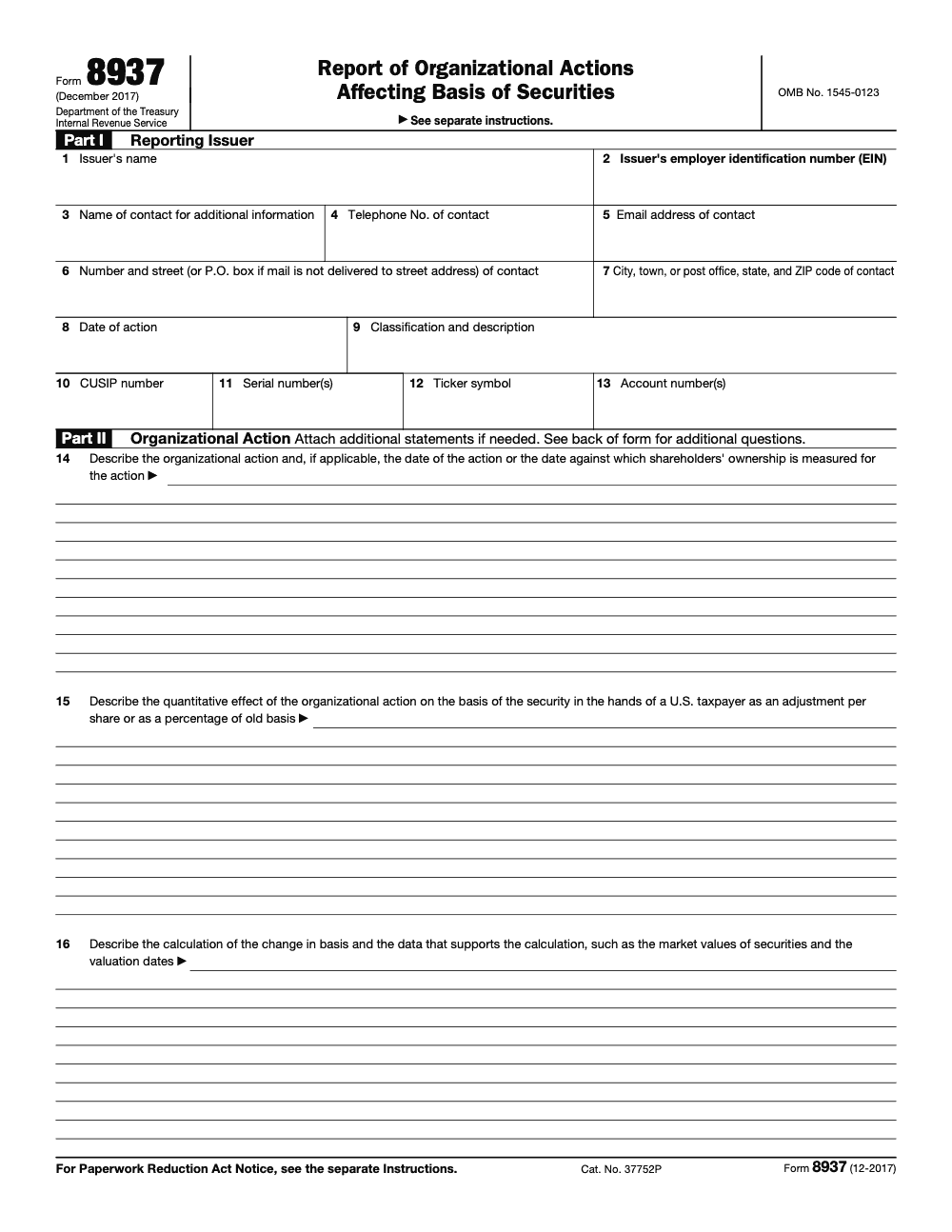
- Pull issuer name, EIN, contact name, phone, email, and address for Lines 1-7.
- Capture date of action, CUSIP, serial numbers, ticker, and account numbers for Lines 8-13.
- Draft the Line 14 description of the action and the date against which holder ownership is measured.
- State the Line 15 basis adjustment as a per-share dollar amount or as a percentage of old basis, never as an issuer-level aggregate.
- Document the Line 16 calculation, including market values and valuation dates that support the math.
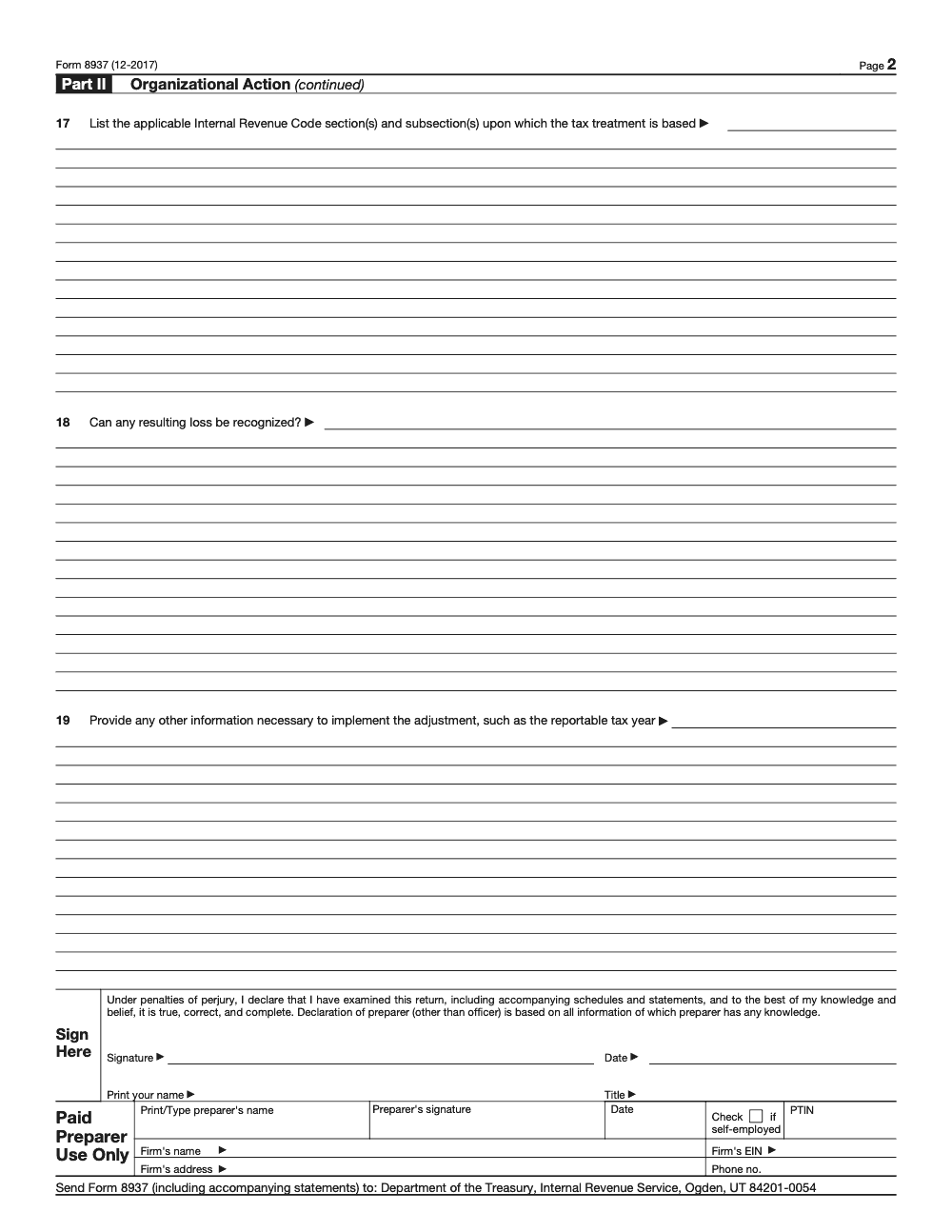
- Cite the Line 17 IRC section AND subsection (e.g., §368(a)(1)(B), §301(c)(2), §355(a)).
- Answer Line 18 with the loss-recognition position and the statutory basis (e.g., §354 non-recognition).
- Specify the reportable tax year on Line 19.
- Calculate both deadlines (45 days from action date, January 15 of the following year) and lock the earlier one.
Public-website posting handoff
- Confirm posting lives on the issuer's primary public website, not a third-party IR vendor or press wire.
- Use a readily accessible format (PDF or indexed HTML), not a paywalled or login-gated page.
- Add the posting URL to the corporate-actions log with the 10-year retention end date pre-populated.
- Date-stamp the file copy and save a PDF snapshot in secure records.
- Notify the broker community through standard channels so 1099-B basis reporting picks the change up cleanly.
- Add a quarterly link-check task so the URL does not 404 anytime during the 10-year window.
- Document the posting decision in the file (why public website was chosen over IRS filing and holder statements).
Holder statement and correction packet
- Draft the holder statement using the same Line 1-19 content sent to the IRS.
- Mail by January 15 of the year following the action year; the statement deadline runs whether you filed early or not.
- Mark each file copy with date sent, mailing service, and tracking number.
- For corrections, file a corrected Form 8937 marked CORRECTED within 30 days to capture the §6721 tier-1 ($60 per return) penalty band.
- If the correction lands after 30 days but on or before August 1, plan for the §6721 tier-2 ($130 per return) penalty.
- If the correction lands after August 1, prepare the reasonable-cause memo to support relief from the tier-3 ($330 per return) penalty.
- Avoid intentional-disregard exposure ($660 per return minimum, no annual cap under §6721(e)) by documenting every step of the discovery and correction.
Keep 8937 Season From Stalling
8937 work is unpredictable because the trigger is a board-level corporate action, not a calendar date. The Form 8937 instructions (Rev. December 2017) put the filing obligation on the issuer within 45 days of the action or by January 15 of the year after the calendar year of the action, whichever is earlier. That window is short when issuer counsel, treasury, and investor relations are each holding a piece of the basis math.
The fix is operational, not technical. When the basis calculation, IRC subsection citation, and holder communication move on a shared workflow rather than serial handoffs, the 45-day window stops feeling tight and the public-website alternative becomes a deliberate choice rather than a backup plan.
- Build a corporate-actions trigger log that pings tax the day a covered action signs, so the 45-day timer starts inside one system rather than three.
- Pre-stage the Line 1-13 issuer block in a saved template so only the action-specific fields need fresh drafting under deadline pressure.
- Lock the Line 14-17 narrative with treasury before legal sign-off, not after, so subsection-level IRC cites are pinned before the document moves.
- Choose the public-website posting URL up front so the 10-year retention calendar starts on a clean record rather than being reconstructed later.
- Run the holder statement and the IRS filing on parallel tracks; both can fail independently and both are required unless the public-website alternative is in place.
We run that documentation discipline – corporate-actions tracking, Line 14-19 narrative drafting, holder-statement mailing, and 10-year posting retention – through our tax outsourcing services, with structured workpapers and a multi-layer review before anything leaves the firm.
FAQs
It is the issuer’s report of organizational actions that change the tax basis of a specified security, with the method and numbers investors and brokers need to adjust basis. You either file and furnish, or you post publicly for ten years.
Penalties under IRC §§6721 and 6722 apply separately for filing and furnishing failures, with tiered amounts that increase the later you correct and special rules for intentional disregard. Document reasonable cause and correct quickly to mitigate exposure.
Form 8937 provides issuer‑level basis methodology after actions like spin‑offs or reverse splits. Form 1099‑B is a broker form that reports sales proceeds and, for covered securities, basis at the time of sale. Brokers use your 8937 to get basis right.
Yes, if the entity is treated as a corporation for U.S. tax purposes and at least one non‑exempt U.S. holder is affected, the same §6045B rules and deadlines apply.
Investor Relations sites often host archives. For instance, Rocket Companies and BNY Investments each maintain pages with dated Form 8937 PDFs that remain accessible for many years.
Other forms this guide names
- Form 1099-B: Report Broker & Barter Proceeds
About this guide
Accountably helps US CPA, EA, and accounting firms hire trained accountants and tax preparers in India.
About us Reviewed byJugal Thacker, CPAFounder and CEO at Accountably
A Washington-licensed CPA with 7+ years inside US firms – PwC, a real-estate tax practice, then a full-service firm, rising from reviewer to manager to advisory. This article was reviewed against current IRS guidance for the 2025 tax year and updated for filers preparing late returns, amendments, and 2026 estimates.
View profile →How we research, review, and update this guide
Every Accountably guide is researched against primary IRS sources, reviewed by a U.S. CPA, and refreshed as guidance evolves. Read our Editorial Guidelines to see how we source, fact-check, and update our content.