Summarize this article with AI
In Brief
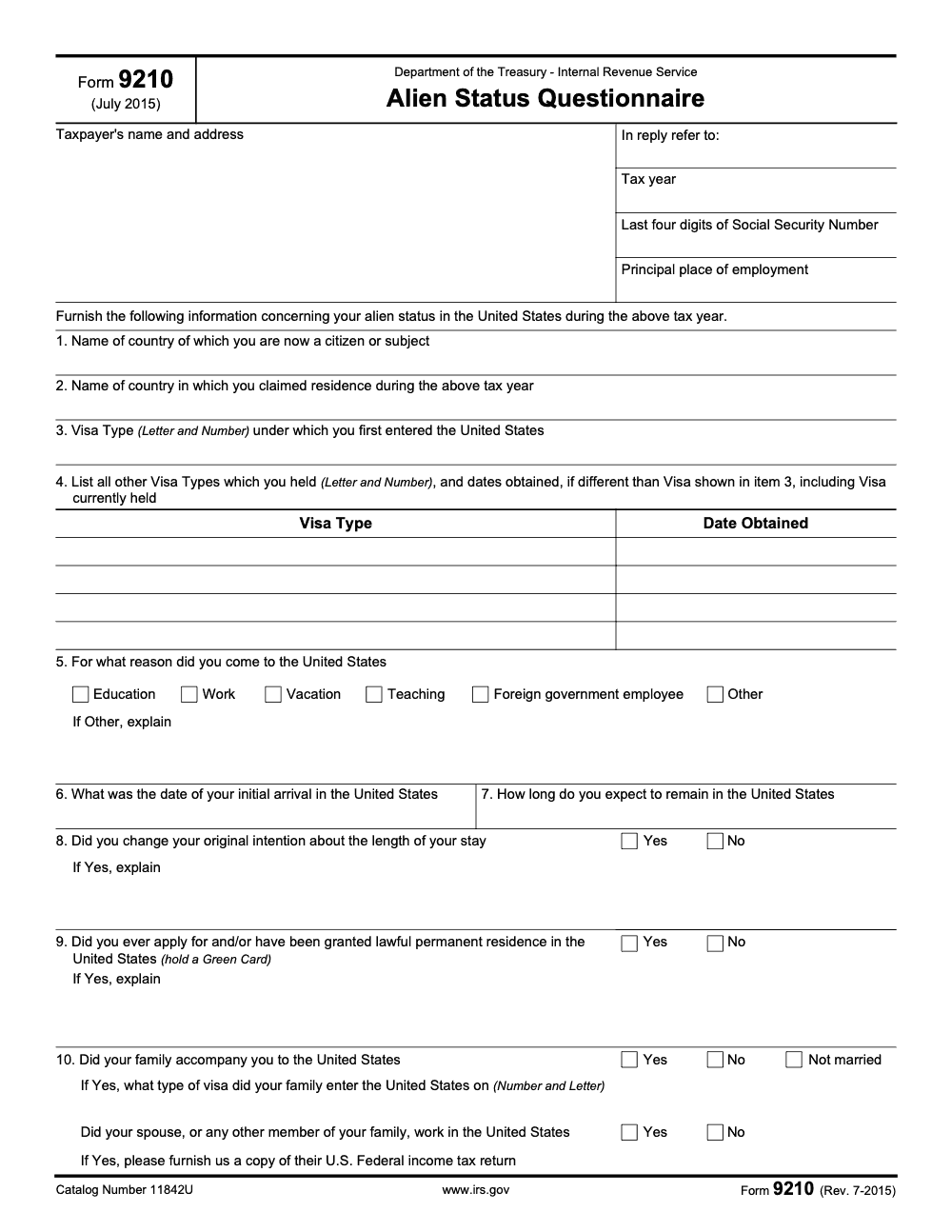
Form 9210 is the IRS Alien Status Questionnaire (Rev. July 2015, Cat. No. 11842U) – a two-page, 15-question form the IRS sends to verify an alien individual’s visa, employment, and travel facts for one specific tax year, not a return you attach to Form 1040-NR. It requests only the last four digits of your SSN, must be signed under penalty of perjury, and is returned to the office named in the “In reply refer to:” block, per the Form 9210 instructions (Rev. 7-2015).
A letter arrives from the IRS asking an alien individual to account for visa history, time in the country, employment, and travel for one specific tax year. Many people assume it attaches to a Form 1040-NR. It does not. Form 9210 is the Alien Status Questionnaire, a separate two-page form you complete only when the IRS asks, and you return it to the office named in the notice.
Most of the delay on these comes from the answers, not the questions. The form requests only the last four digits of the SSN and must be signed under penalty of perjury, and it focuses on practical facts like visa type, arrival date, employment, and a travel timeline. Missing dates, inconsistent details, and vague explanations are what trigger the follow-up letters, so clean documentation does most of the work.
Key Takeaways
- Form 9210 is an IRS “Alien Status Questionnaire” used to collect facts about your visa history, time in the U.S., employment, and travel during a specific tax year.
- You usually complete it only when the IRS asks, and you should follow the instructions in the IRS notice for where and how to return it.
- The form focuses on practical facts such as visa type, initial arrival date, employment, foreign tax return filing, and a travel timeline.
- Clean documentation and clear timelines matter. Most delays come from missing dates, inconsistent details, or vague explanations.
- If you are dealing with an ITIN separately, remember that ITIN applications have their own strict documentation rules, including the requirement for originals or certified copies and that notarized copies generally are not acceptable.
- An ITIN is not immigration status and not work authorization, even if it helps you comply with U.S. tax filing requirements.
What Is Form 9210 and Who Is It For?
Form 9210 is a two-page IRS questionnaire titled “Alien Status Questionnaire.” The current IRS PDF is labeled Form 9210 (Rev. 7-2015), and there is no annual reissue, so the July 2015 revision is still the version to use for the 2025 tax year.
The form asks you to “furnish information concerning your alien status” for the tax year shown on the form. In plain English, the IRS is trying to understand the facts that influence how you should be treated for U.S. tax purposes, such as:
- What country you are a citizen of and what country you claimed residence in
- What visa type you entered under and what other visa types you held
- Why you came to the U.S.
- When you first arrived, how long you expected to stay, and whether your plans changed
- Whether you applied for lawful permanent residence (a green card), which counts as a “Yes” even if the application is still pending or was denied
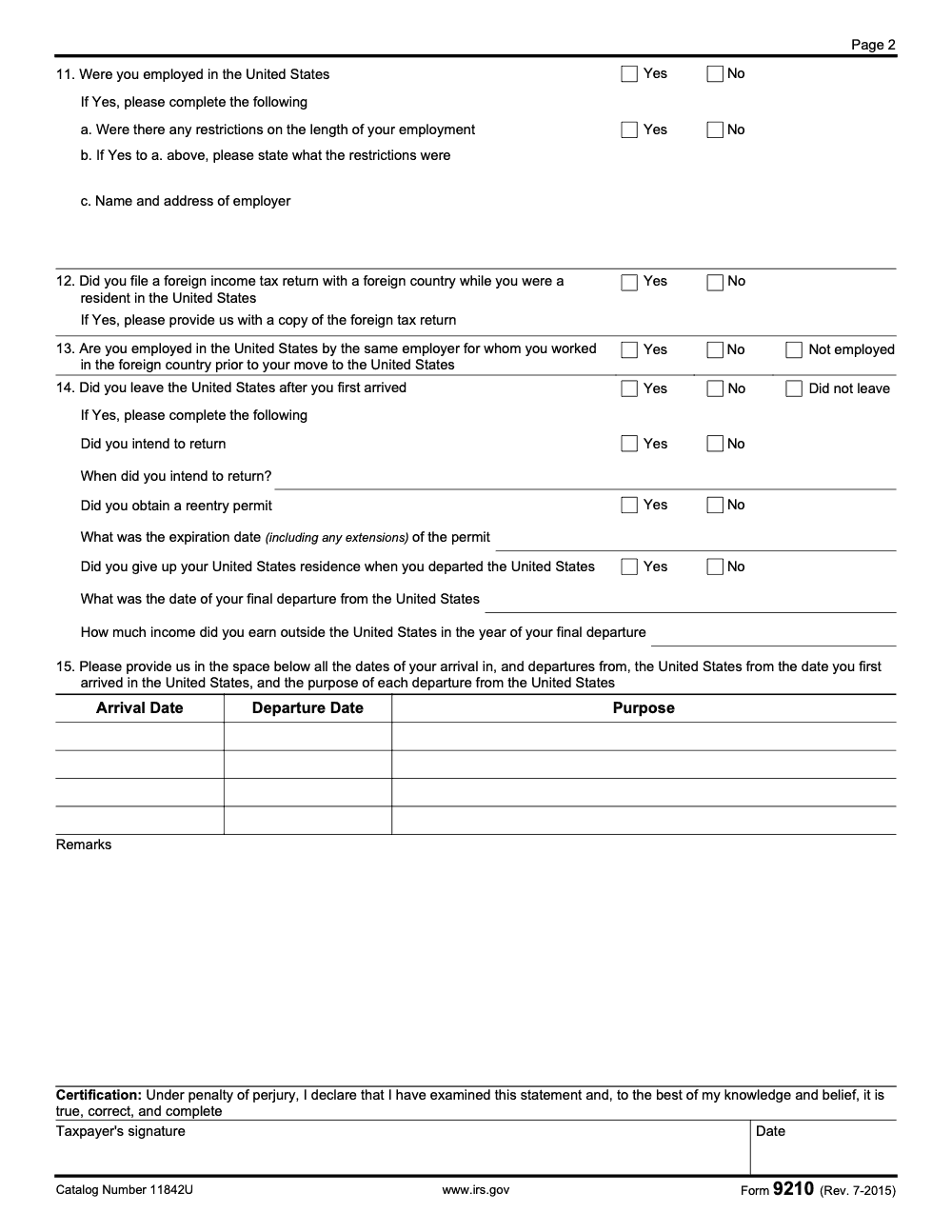
- Whether you worked in the U.S., for whom, and whether there were restrictions
- Whether you filed a foreign income tax return while resident in the U.S.
- Whether you left the U.S. after arriving, your intent to return, and your travel dates
- A detailed list of arrival and departure dates and the purpose of each trip
Who typically gets Form 9210?
The IRS may request Form 9210 when your tax residency facts, travel history, or visa situation matter for a determination they are making about your return. That can come up in international tax situations, treaty questions, or residency classification issues.
If you are a U.S. citizen, this specific “alien status” questionnaire is generally not the tool the IRS uses for you. The form is built around visa and alien status facts.
Why This Form Causes Delays (and How to Avoid That)
A lot of IRS delays are not about “wrong answers.” They are about unclear answers.
In our experience working around tax operations and documentation workflows, the pattern is simple. If your timeline is messy, your response becomes a guessing game for the person reviewing it. Guessing leads to follow-up letters. Follow-up letters lead to weeks of delay.
Here’s what the IRS reviewer needs from you, even if they do not say it this way:
- A consistent story across dates, visa types, and travel
- Specific answers, not vague ones
- A travel timeline that matches what you stated elsewhere on your return (or what you told another agency)
Are You “Eligible” to Use Form 9210?
This is one of the most confusing parts. It’s not a “benefit” form you choose to file. If the IRS asked you to complete Form 9210, that request is what matters. The practical eligibility test is simple.
The three real-world eligibility checks
- The IRS asked for it. If you did not receive a request, you generally should not be mailing Form 9210 to the IRS randomly.
- The tax year matches your situation. Form 9210 is tied to a specific tax year shown at the top, so your answers should describe that historical year, not your status today.
- You can support your answers. Even though Form 9210 itself is mostly Q and A, you should be ready to back up travel dates and status facts if the IRS asks for proof.
Documents and Details to Gather Before You Start
Form 9210 is short, but it pulls information from multiple parts of your life. Before you type a single word, take 20 minutes and gather your timeline. You will feel more in control, and your answers will be cleaner.
What you should have in front of you
- Your IRS notice, especially anything that includes a response deadline, fax number, mailing address, or reference codes
- Your passport biographical page and any pages with U.S. entry stamps, if applicable
- Your visa records and approval notices, especially if you changed status
- Your travel history, ideally with exact arrival and departure dates
- Employer information for the relevant tax year, including location and any restrictions tied to your employment authorization
- Copies of relevant tax filings, including any foreign tax return you filed during the period the IRS is asking about (the form directly asks this question)
Tip: If you are missing travel dates, start with your calendar, flight receipts, and email confirmations. Build a simple spreadsheet. “Close enough” dates are how you end up in the follow-up-letter loop.
If your situation includes an ITIN application
Form 9210 is separate from the ITIN process, but many people run into both in the same season of life.
If you are applying for an ITIN, the IRS rules are strict. Your supporting documents must be originals or certified copies from the issuing agency, and notarized copies generally are not acceptable.
Also, remember this if you are worried about what an ITIN “means” about your immigration status.
- An ITIN does not provide legal immigration status or work authorization.
How to Complete Form 9210 Step by Step (with plain-English guidance)
The IRS PDF is fillable, and it’s only two pages. The hard part is not the typing, it’s answering clearly.
Step 1, Confirm the header information and the tax year
At the top, Form 9210 includes:
- Taxpayer name and address
- “In reply refer to”
- Tax year
- Last four digits of your Social Security Number (the form asks for only the last four, not your full nine-digit SSN)
- Principal place of employment
If something is wrong here, do not just “fix it” without thinking. If you received the form pre-filled from the IRS, follow the notice instructions, and consider calling the number on the IRS letter to confirm what they want corrected.
Step 2, Answer visa and intent questions like you’re building a timeline
Questions 3 and 4 ask for your visa type and any other visa types you held, including dates obtained. Give the full visa designation with both the letter and the number, for example F-1, J-1, or H-1B, not just the letter.
Questions 6 through 9 ask about:
- Initial arrival date
- Expected length of stay
- Whether you changed your intention
- Whether you applied for lawful permanent residence
What to write when your plans changed
If you answer “Yes” to changing your intention, the IRS will want a short explanation. Keep it factual.
Examples of clear wording:
- “I originally entered on an F-1 visa for a two-year program. In [month/year], I accepted OPT employment and extended my stay.”
- “I entered for work on [visa type]. In [month/year], my employer began a green card process, and my expected stay became indefinite.”
Step 3, Handle family and employment questions without oversharing
The form asks if your family accompanied you, their visa type, and whether any family member worked.
Answer what the form asks. Do not attach extra personal narratives unless the IRS notice specifically requests more.
If the form requests a copy of a spouse’s or family member’s U.S. federal income tax return, that request appears directly on the form. If you are uncomfortable sharing sensitive documents, talk with a tax professional about the correct way to comply.
Step 4, Employment history matters more than people expect
Form 9210 asks:
- Were you employed in the U.S.?
- Were there restrictions on the length of employment?
- Employer name and address
This is one of the highest-risk sections for “inconsistent story” problems, especially if you have multiple employers, changed status, or had gaps.
If you had multiple employers, you can attach a separate page listing each employer, dates, and addresses. Keep it clean and readable.
Step 5, Foreign tax return question, answer carefully
Form 9210 asks whether you filed a foreign income tax return with a foreign country while resident in the U.S., and requests a copy if yes.
If you filed one, be prepared to provide it. If you did not, do not guess.
Step 6, Travel history, this is where people get stuck
The form asks you to list all arrival and departure dates from your first arrival, plus the purpose of each departure.
This is where your spreadsheet pays off.
A simple approach that works:
- List each trip in date order
- Use consistent purpose labels, such as “vacation,” “family visit,” “work conference,” “school break”
- If you are unsure of a date, do the work to verify it before submitting
Step 7, Sign and date, then make a full copy for yourself
The form includes a certification under penalty of perjury and requires your signature and date.
Before you send it, make a complete copy of:
- The completed Form 9210
- Any attachments
- The IRS notice you are responding to
- Proof of mailing or fax confirmation
Where and How to Submit Form 9210
Send it exactly where the IRS told you to send it. Form 9210 is built as a reply document, and IRS questionnaires like this are commonly tied to a specific unit, notice, or examiner.
Filing location options
- If the IRS notice gives a mailing address, use that address.
- If the notice gives a fax number, use that fax number and keep the confirmation page.
- Do not send Form 9210 to a random “general IRS address” you found online, misrouting can turn a simple response into months of delay.
Submission checklist
- Completed Form 9210, signed and dated
- Any attachments requested by the IRS notice
- Your identifying reference info on every page, if the notice recommends it
- Proof of delivery or fax transmission
How Long the Review Takes and What to Expect
The IRS does not publish a single “Form 9210 processing time” the way it does for some major programs. In real life, timing depends on:
- How complex your travel and status history is
- Whether the IRS needs follow-up documents
- The IRS workload for that unit during that period
If you respond quickly, with a clean travel timeline and consistent facts, you improve your odds of avoiding a second round of questions.
Common Form 9210 Mistakes That Trigger Follow-Up Letters
You do not need perfect English. You do need clear facts.
Mistake 1, Visa type mismatch
If your visa type on Form 9210 does not match other IRS filings or supporting records, expect questions. The form asks for your initial visa type and any other visa types held, including dates, and you must include the visa you currently hold if it differs from the one you first entered on.
Mistake 2, Travel dates that do not add up
If you list travel dates that conflict with your “time in the U.S.” story, it can affect residency determinations. The form explicitly asks for a full arrival and departure log.
Mistake 3, Vague explanations for changed intent
“Plans changed” is not enough. A short factual reason and a month/year is usually plenty.
Mistake 4, Forgetting the signature
It sounds obvious, but it happens. The IRS certification section requires you to sign and date, and an unsigned questionnaire can be treated as not filed, so your answers carry no weight until you sign.
How Form 9210 Can Affect Your Tax Benefits (high level)
Form 9210 is basically the IRS saying, “We need the underlying facts.”
Those facts can influence:
- Whether you are treated as a resident alien or nonresident alien for U.S. tax purposes
- Whether travel days and residency connections support certain international positions
- Whether your situation matches what was reported elsewhere
If you are claiming international benefits such as the foreign earned income exclusion, the IRS has separate forms and rules for that claim, for example, Form 2555, and residency concepts matter.
Form 9210 vs Form W-7, SS-5, and other ID-related forms
Here’s a quick comparison so you do not mix up the purpose.
| Form | What it’s for | Who handles it |
| Form 9210 | IRS questionnaire to collect facts about alien status, travel, employment, and residency-related details for a specific tax year | IRS |
| Form W-7 | Application for an ITIN, requires strict supporting documentation rules | IRS ITIN Operation |
| Form SS-5 | Application for a Social Security Number | Social Security Administration |
When to Get Help (and who to ask)
If any of these are true, get support:
- You have multiple visa types and status changes across the year
- You cannot confidently reconstruct travel dates
- The IRS request is tied to a larger exam or dispute
- You are worried your tax residency position is wrong
A qualified tax professional can help you respond cleanly without adding risk.
A quick word for tax teams and firm owners
If you run a firm, this is exactly the kind of “small, annoying, detail-heavy” work that can clog delivery, especially when it hits during peak season. That’s why strong documentation habits and repeatable checklists matter. It’s the same idea we talk about at Accountably, structure prevents rework, and rework is what burns teams out.
Conclusion
Form 9210 feels intimidating because it’s unfamiliar, not because it’s long. Once you treat it like what it is, a timeline questionnaire, you can answer it cleanly, attach anything the IRS specifically requests, and avoid the “letter ping-pong” that drags on for weeks.
If you want the safest next step, do this today. Build your travel timeline, confirm visa types and dates, and respond exactly to the IRS notice instructions.
Common Mistakes We See Every Season
Form 9210 trips people up in the same places every season, and almost all of it is detail-level, not conceptual. Here are the errors my team flags most, with the line each one lives on.
Reusable Checklists
These are copy-paste ready for a firm SOP or a personal filing folder. Work them top to bottom and the questionnaire goes back clean the first time.
Before you answer: build the file
- Confirm the tax year printed in the header block; every answer from Question 2 on describes that year, not today.
- Pull your passport and visa stamps, plus the I-94 record of each U.S. entry and exit.
- List every visa you have held, with the letter, number, and date obtained for each.
- Locate the name and full address of any U.S. employer for Question 11.
- If you filed a foreign income tax return while a U.S. resident, pull a copy for Question 12.
- If a spouse or family member worked in the U.S., pull a copy of their U.S. federal income tax return.
- Reconstruct every arrival and departure since your first U.S. arrival, with the purpose of each trip.
Before you sign: line-by-line review
- The header shows only the last four digits of your SSN.
- Question 1 reflects current citizenship; Questions 2 through 15 reflect the header tax year.
- Each visa in Questions 3 and 4 shows both letter and number (for example F-1, J-1, or H-1B).
- Question 9 reads “Yes” if you ever applied for a Green Card, with the status explained.
- Every “Other” or “If Yes, explain” prompt has a written explanation, moved to Remarks if the line runs short.
- Question 14, if “Yes,” answers every departure follow-up point.
Submit and keep a record
- Sign and date the certification on Page 2 under penalty of perjury.
- Attach the foreign return for Question 12 and any working family member’s U.S. return for the Question 10 follow-up.
- Return the package to the office shown in the “In reply refer to:” block, not with an annual tax return.
- Keep a full copy of the signed questionnaire and every attachment for your records.
Keep 9210 Season From Stalling
Form 9210 does not arrive on a calendar. It shows up when an IRS examiner or compliance unit opens an inquiry into a taxpayer’s alien-status position, and the clock starts the day the notice is dated. For a tax team the pressure is not volume, it is reconstruction: a two-page, 15-question questionnaire (per the Form 9210 instructions, Rev. 7-2015) can hang a stack of follow-up data points off a single “Yes” on Question 14, plus a travel history that may stretch back years.
The fix is to treat each 9210 like a small engagement with its own evidence file, not a fill-in-the-blank chore. When the visa timeline, the employment record, and the trip history are assembled and cross-checked before anyone writes an answer, the questionnaire goes back once and the residency determination keeps moving.
- Build one source of truth for the visa timeline so Questions 3 and 4 carry matching letters, numbers, and dates.
- Reconcile the Question 15 arrival and departure table against passport stamps and I-94 records before it is typed.
- Flag every “Yes” on Questions 10, 12, and 14 as an attachment or follow-up trigger so nothing ships incomplete.
- Confirm only the last four SSN digits sit in the header and the certification is signed before the file leaves your desk.
That discipline is what sits behind our tax preparation and review service: structured workpapers, a documented review pass, and a defined turnaround, so correspondence like Form 9210 gets answered accurately the first time without pulling a senior reviewer off higher-value work.
FAQs
Form 9210 is an IRS “Alien Status Questionnaire” that collects details about your visa type, time in the U.S., employment, and travel history for a specific tax year. You usually complete it because the IRS requested it as part of reviewing or verifying your tax situation.
Typically, no. Form 9210 is set up as a response document, it includes “In reply refer to” and a tax year, which signals it’s often tied to an IRS request. Follow the IRS notice instructions for how to submit it.
No. An ITIN is used for U.S. tax administration purposes, and it does not grant legal immigration status or work authorization. If you are applying for an ITIN, follow the IRS documentation rules carefully.
The IRS generally requires original documents or certified copies from the issuing agency, and the documents must prove identity and foreign status. The IRS lists acceptable document options, including that a passport can be a stand-alone document in many cases.
Other forms this guide names
- Form W-7: ITIN Application Guide, Requirements & Documents
About this guide
Accountably helps US CPA, EA, and accounting firms hire trained accountants and tax preparers in India.
About us Reviewed byJugal Thacker, CPAFounder and CEO at Accountably
A Washington-licensed CPA with 7+ years inside US firms – PwC, a real-estate tax practice, then a full-service firm, rising from reviewer to manager to advisory. This article was reviewed against current IRS guidance for the 2025 tax year and updated for filers preparing late returns, amendments, and 2026 estimates.
View profile →How we research, review, and update this guide
Every Accountably guide is researched against primary IRS sources, reviewed by a U.S. CPA, and refreshed as guidance evolves. Read our Editorial Guidelines to see how we source, fact-check, and update our content.