Summarize this article with AI
In Brief
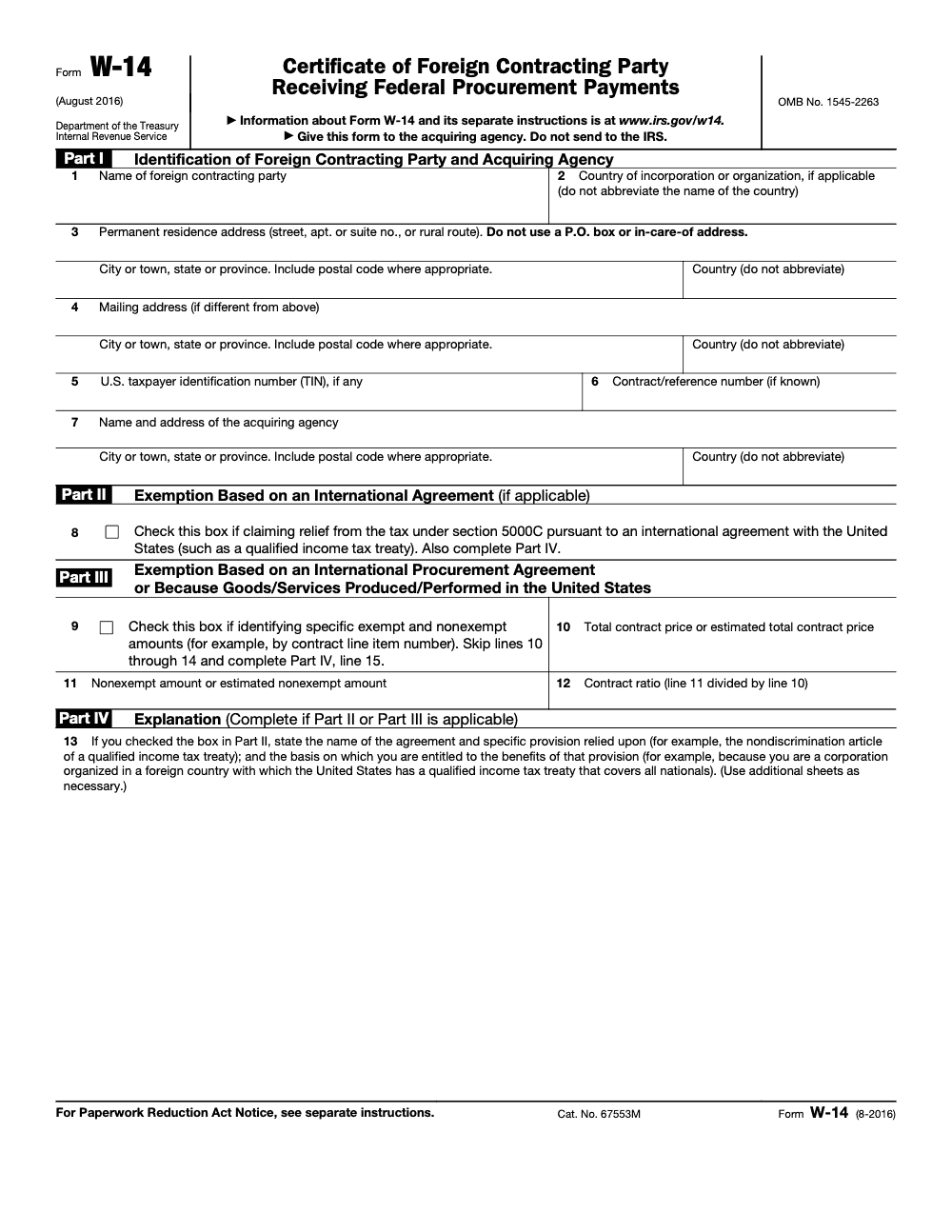
Form W-14 is the Certificate of Foreign Contracting Party Receiving Federal Procurement Payments (August 2016 revision, OMB 1545-2263). A foreign contracting party gives it to the acquiring U.S. agency, not the IRS, to claim relief from the 2 percent Section 5000C tax on federal procurement payments. Check the Part II box on line 8 for a treaty-based exemption, or use Part III lines 10 through 12 to report the contract ratio when only part of the award is nonexempt, then support it in Part IV (per the IRS Instructions for Form W-14).
A foreign manufacturer wins a federal award, the first invoice is already in the system, and no one has handed the contracting officer a certificate. So the agency does the only thing it can and withholds the 2 percent under Section 5000C. Now you are clawing cash back instead of preventing the deduction, and the W-14 calls that go sideways almost always turn on that timing, not on a hard treaty question.
Form W-14 is the Certificate of Foreign Contracting Party Receiving Federal Procurement Payments, and it goes to the acquiring U.S. agency, not the IRS, ideally with your offer. Claim a full treaty exemption on the Part II box at line 8, or use Part III lines 10 through 12 to report the contract ratio when only part of the award is nonexempt, and update within 30 days if facts change.
Key Takeaways
- The 2 percent tax under section 5000C applies to specified federal procurement payments to foreign persons, and agencies generally collect it by withholding. You use Form W-14 to establish your foreign contracting status and to claim any exemption.
- Deliver Form W-14 to the acquiring agency, not the IRS, as early as possible, ideally with your offer, and no later than the contract execution date. Update within 30 days if facts change.
- Claim a full exemption in Part II if a qualified treaty’s nondiscrimination article covers section 5000C for your situation, see the IRS list of qualified treaties.
- Use Part III when only part of the contract is nonexempt. Enter the total price on line 10, the nonexempt amount on line 11, and compute line 12 as the contract ratio used for withholding.
- As of January 14, 2026, the IRS “About Form W-14” page shows no recent developments and links to the current form and instructions. Always check that page before filing.
What Form W-14 Is, In Plain English
Form W-14 is your certificate to the U.S. government that says two things. First, you are a foreign contracting party on this specific contract. Second, you either are not subject to the 2 percent tax or only part of your contract is subject to it, and here is the legal reason with numbers to back it up. You hand it to the acquiring agency, for example the department or component that signed your contract, not to the IRS.
Section 5000C has been in place for contracts entered into on or after January 2, 2011, and the final regulations have applied since November 16, 2016. That scope and timing still stand in 2026.
When the 2 percent applies, it is calculated on the gross amount of specified federal procurement payments that are not exempt. Agencies withhold that amount under chapter 3 unless your W-14 shows a valid exemption or allocation.
Who Actually Needs To Provide Form W-14
If you are a foreign person that will receive specified procurement payments under a U.S. government contract, the acquiring agency can request a W-14, even if you are not claiming an exemption. If you are claiming an exemption, you must provide it, and you must replace it within 30 days if anything important changes, for example a shift in where the work is performed. If you are a U.S. person, you do not use W-14, you use Form W-9 when the agency asks.
Certain situations are carved out in the regulations. Simplified acquisitions below the threshold, certain emergency acquisitions, specified foreign humanitarian assistance, some personal service contracts under set amounts, and payments that are not for goods or services can be outside the tax. Always confirm the specific regulatory text for your fact pattern.
Prime, Sub, Or Both
Most withholding decisions trace back to the prime contract. Payments to a subcontractor are generally outside section 5000C, however there is an anti abuse rule that can pull a foreign subcontractor in under certain structures. If you are a sub on a sensitive program, coordinate early with the prime and the contracting officer.
When To Submit During The Contract Lifecycle
Send your W-14 with your offer if you can, and definitely no later than contract execution. That timing lets the contracting officer validate the exemption and set the right withholding from day one. If a key detail changes, for example you move a portion of services from a GPA country to a non agreement country, send a revised certificate within 30 days. Keep proof of delivery in your contract file.
2026 Checkpoint
The IRS “About Form W-14” page was last reviewed on January 17, 2025 and shows no recent developments. The instructions page remains the 08 2016 revision with appendices listing qualified treaties. Check those pages before you certify, since treaty status and procurement agreements can change.
W-14 Versus W-9, And When Not To File
- Use W-14 if you are a foreign contracting party on a covered federal procurement and you want the agency to apply an exemption or allocation.
- Use W-9 if you are a U.S. person.
- Do not submit W-14 for excluded scenarios in the regulations, or for payments that are not for goods or services, such as a land purchase.
Quick Comparison Table
| Form | Audience | Purpose | Where It Goes |
| W-14 | Foreign contracting party | Establish status, claim treaty or allocation relief from the 2 percent tax | Acquiring agency |
| W-9 | U.S. person | Provide TIN and backup withholding certification | Acquiring agency or payer |
In our experience helping accounting firms and government contractors in 2024 and 2025, the fastest approvals came from teams that attached a one page Part IV explanation with clear citations and a simple allocation schedule if Part III applied. That small step cut review time and avoided back and forth with the agency.
How To Complete Form W-14, Line By Line
You do not need fancy software to get this right. You need clean facts, one owner, and a short checklist. Here is a practical walk through you can keep by your keyboard.
Part I, Identification And Contract Details
- Line 1, legal name. Use the legal name of the foreign contracting party on the award, not a branch or trade name. Match your SAM record if you have one.
- Line 2, country of organization. Spell out the full country name.
- Line 3, permanent address. Use your address in the country of organization. Never use a P.O. box or an in-care-of address here; if your mailing address differs and is a P.O. box, put it on line 4 instead.
- Line 4, mailing address. Use this if different, and make sure it matches how the agency sends notices.
- Line 5, U.S. TIN or EIN, if you have one or if required under the instructions. If you need an EIN, apply early so payments do not stall, but line 5 reads if any, so the absence of a U.S. TIN does not by itself make the certificate invalid.
- Line 6, contract or reference number. Tie the certificate to a single award. If you have multiple task orders, add the base contract number and, if helpful, the active task order.
- Line 7, acquiring agency name and address. Match the contracting activity on the award. Small mismatches slow reviews.
Tip, assign a version number in your filename, for example W-14_Contract1234_v2_signed.pdf. Reviews go faster when everyone can see what changed.
Part I Pitfalls To Avoid
- Using a subsidiary when the parent is the actual party to the contract.
- Entering a U.S. branch address as the permanent address for a non U.S. entity.
- Leaving off a contract number you already have, which forces the contracting officer to guess; line 6 is only requested if known, so a not-yet-assigned number may be left blank.
- Forgetting to sign in Part V. Unsigned forms are treated as not provided.
Part II, Claim A Treaty Nondiscrimination Exemption
Part II is for a full exemption when a qualified income tax treaty’s nondiscrimination article applies to section 5000C for your case. In practice, you check the Part II box, you name the treaty country, and you cite the article. Then you support it in Part IV with a short, clear explanation.
If you are new to this, think about it this way. You are telling the agency, a comparable U.S. person would not pay this 2 percent on the same procurement, so the treaty says you should not either. Keep it factual and specific to your payment.
What To Include In Your Part II Explanation
- Treaty country and specific nondiscrimination article.
- A one sentence statement of why that article covers section 5000C in your fact pattern.
- A reference to the contract, the goods or services, and why the treatment should match a U.S. person.
- A closing line that you will update within 30 days if facts change.
Example Part IV paragraph for a Part II claim We rely on the United States, Country X income tax treaty, Article 24, Nondiscrimination. Under Article 24, the United States will not impose a more burdensome taxation requirement on a resident of Country X than on a U.S. person in the same circumstances. The payments under Contract ABC123 are for [description], which would not be subject to a comparable 2 percent tax if paid to a U.S. person. We certify this exemption under penalties of perjury and will provide an updated certificate within 30 days of any change in facts.
When Part II Is Not The Right Tool
Do not force a treaty answer when your facts fit Part III better. If part of your contract is exempt because the goods are produced in the United States or the services are performed in the United States, or the contract is covered by an international procurement agreement, you can apportion in Part III. That is often faster for mixed performance.
Part III, Use Allocation When Only Part Is Subject To The 2 Percent
Part III is your calculator for mixed contracts. You report the total contract price on line 10, the nonexempt amount on line 11, then you compute the contract ratio on line 12 as line 11 divided by line 10, that is the nonexempt amount over the total price, never exempt over total. The agency will apply the 2 percent to that ratio of each specified payment.
What Counts As Nonexempt In Line 11
- Goods produced outside the United States and outside an agreement country.
- Services performed outside the United States in a non agreement country.
- Any portion not covered by a listed procurement agreement.
Use a reasonable allocation method and keep support. Many teams use CLIN level schedules, statements of work, or country of performance summaries. Keep it simple enough that a reviewer can follow it in two minutes.
Documentation Table You Can Reuse
| Item | Keep On File | Why It Helps |
| CLIN to country map | One page table | Shows how you computed line 11 |
| Bills of lading or production certs | Copies | Proves U.S. production for exempt items |
| Labor location statements | By prime and key subs | Proves where services are performed |
| Procurement agreement cite | One line in Part IV | Shows legal basis if you rely on an agreement |
| Calculation sheet | Spreadsheet printout | Matches numbers to lines 10 to 12 |
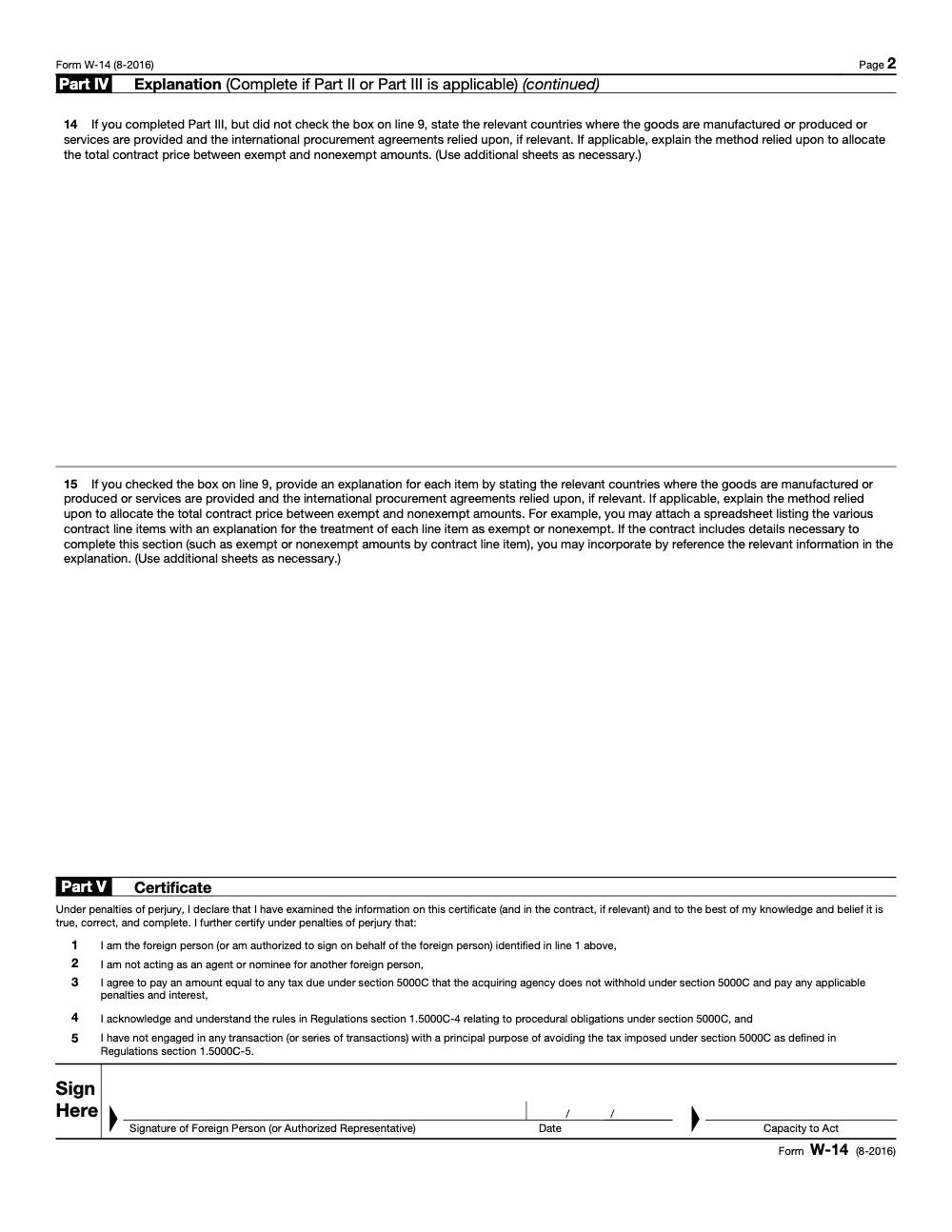
Sign And Certify, Part V
An authorized signatory must sign Part V under penalties of perjury, so a knowingly false certificate carries perjury liability rather than a routine paperwork correction. Use a real name and title, complete the Capacity to Act field whenever an authorized representative signs rather than the foreign person directly (leaving it blank makes the certificate facially incomplete), add the date, and include contact details that someone actually monitors. If you route the PDF through an e signature tool, make sure the final file shows a clear signature block and is not locked from agency viewing.
If you operate through a U.S. subsidiary and a foreign parent, confirm which entity is the contracting party before you sign. A signature mismatch is one of the most common reasons an agency asks for a resubmission. Keep a short memo in your file that explains who signed and why they had authority. That memo will save you time later if personnel change.
A Worked Example For Part III Allocation
Numbers calm everyone down during review. Here is a simple walk through you can mirror in your file.
- Contract ABC123 total price is $12,000,000, enter this on line 10.
- Goods worth $4,200,000 are produced in a non agreement country, and $1,800,000 of services are performed there too. Your nonexempt amount is $6,000,000, enter this on line 11.
- Compute the contract ratio on line 12, $6,000,000 ÷ $12,000,000 = 0.50. The agency applies the 2 percent to 50 percent of each specified payment. On a $1,000,000 invoice, the withholding would be $10,000. Keep your supporting schedule with CLINs or work locations so the contracting officer can follow the math. The instructions permit a reasonable allocation method and the regulations define the contract ratio the same way.
Hybrid Or Cost Reimbursement Contracts
For cost reimbursement or hybrid contracts, use your best estimate at award, then true up when actuals are known. If the nonexempt share changes, send a revised certificate within 30 days and attach an updated allocation sheet. The regulations let you allocate by proportionate costs or country of performance, just document the approach.
Documentation, File Discipline, And Review Speed
A clean Part IV explanation and a short attachment often cut review time in half. Aim for a two minute read.
Your Reusable Part IV Package
- One paragraph legal basis, treaty nondiscrimination or procurement agreement name and date, or U.S. production or services facts.
- One page allocation table that ties lines 10 through 12 to CLINs or labor locations.
- Two or three exhibits, for example a bill of lading, a manufacturing certificate, or a labor location statement from a key subcontractor.
- A one line promise to update within 30 days if facts change.
The IRS instructions ask you to give the W-14 to the acquiring agency before you earn or receive payments, ideally at offer, and to provide a revised certificate within 30 days when circumstances change. Include that timing language in your cover note so reviewers see you understand the rule.
Common Mistakes And Fast Fixes
Across W-14 reviews, the same handful of errors send certificates back from the contracting officer. Here are the ones I flag most, with the fix you can paste straight into a review note.
Key Exceptions And Threshold Notes For 2026
Form W-14 is not used in several situations spelled out in the regulations, for example payments that are not for goods or services, certain emergency acquisitions, specified foreign humanitarian assistance, and simplified acquisitions below the threshold. Be careful here, because thresholds moved on October 1, 2025, the Simplified Acquisition Threshold increased to $350,000 under FAR 2.101. If your contract is under that level and otherwise meets the rule, the exception may apply. Always confirm the exact FAR threshold your award cites.
Quick Reference, What Triggers Withholding
- Payment is for goods or services under a covered contract.
- The payee is a foreign contracting party.
- The goods or services are nonexempt, for example made or performed in a non agreement country. When those are true and no valid W-14 is on file, the acquiring agency must withhold 2 percent.
Submission Checklist You Can Copy
- Prepare Part I with exact legal name, country, addresses, TIN if required, contract number, and acquiring agency.
- Choose Part II or Part III based on facts, not preference.
- Build a one paragraph Part IV, then attach the one page allocation and two or three exhibits.
- Sign Part V with an authorized signatory and a reachable email.
- Send to the contracting officer before award if possible, no later than execution, and keep proof of delivery.
- Calendar a 30 day ticker for any fact change, for example a shift in country of performance. The instructions make the 30 day update rule explicit.
Where To Submit And How To Get Help
You submit Form W-14 to the acquiring agency, not to the IRS. Think of the W-14 as a contract file document that drives the agency’s withholding settings. If you need a U.S. EIN for line 5, apply with Form SS 4 early so payment setup does not stall. For official guidance, use the IRS W-14 instructions and the “About Form W-14” page, then check the regulations for definitions, allocation rules, and examples.
Quick Table
| Need | What To Do | Source |
| Where to send | Submit to the acquiring agency contracting office | IRS instructions |
| When to send | With your offer if possible, no later than contract execution | IRS instructions |
| Updates | Send a revised certificate within 30 days of a change | IRS instructions |
| Definitions and examples | Check 26 CFR 1.5000C 1 through 1.5000C 7 | Regulations |
| Thresholds | Confirm FAR 2.101, SAT currently $350,000 effective Oct 1, 2025 | Acquisition.gov |
A Short Note On Process Control
If your accounting or tax team is already stretched, assign one owner for W-14 and give them a one page SOP with templates for Part IV and the allocation table. In our work with firms, the biggest gains came from simple habits, a shared checklist, versioned filenames, and a 30 day change ticker.
Where Accountably Can Help, If You Need It
Some firms ask for help building discipline around documentation, review notes, and deadline accountability. Accountably integrates trained offshore teams into your systems to standardize workpapers, apply SOPs, and keep version control tight, which helps W-14 packages move through agency review faster without risking quality or security. Use this only if it supports your internal process, not as a substitute for correct legal analysis.
Final Notes And A Plain Language Disclaimer
- The 2 percent rule sits in section 5000C. The regulations define who is covered, the contract ratio, and how agencies withhold. Start there, then match the facts of your contract.
- Thresholds matter. The Simplified Acquisition Threshold increased to $350,000 on October 1, 2025, so confirm what your award cites.
- This guide is for general education. Always confirm with the current IRS instructions and your contracting officer, and consider formal advice for complex structures or treaty positions.
Reusable Checklists
These checklists are copy-paste ready for a firm SOP. Drop them into your engagement workpapers and tick items off as you build each W-14 package.
Part I prep packet
- Enter the legal name of the foreign contracting party on line 1, matching the award rather than a branch or trade name.
- Spell out the full country of organization on line 2, with no abbreviations.
- Use a street, suite, or rural-route permanent address on line 3, never a P.O. box or in-care-of address.
- Add a separate mailing address on line 4 only if it differs from line 3.
- Provide a U.S. TIN on line 5 if the party has one; line 5 reads if any, so leave it blank when there is none.
- Enter the contract or reference number on line 6 if it is known.
- Record the acquiring agency name and address on line 7.
Exemption path and Part IV
- Choose the treaty exemption in Part II or the allocation in Part III based on the facts, not preference.
- For a treaty claim, check the line 8 box and name the agreement and specific provision on line 13.
- For the ratio method, leave line 9 unchecked, enter the total price on line 10 and the nonexempt amount on line 11, then compute line 12 as line 11 divided by line 10.
- For the ratio method, complete the line 14 narrative identifying the countries of production and the allocation method.
- For the per-item method, check line 9, skip lines 10 through 14, and explain each contract line item on line 15.
- Attach a one-page allocation schedule, or incorporate the contract by reference where line 15 allows it.
Sign, certify, and deliver
- Confirm all five Part V certifications are true, including the agreement to pay any Section 5000C tax the agency does not withhold.
- Have an authorized signatory sign Part V under penalties of perjury.
- Complete the Capacity to Act field whenever a representative signs rather than the foreign person directly.
- Add the signature date and a contact address someone monitors.
- Deliver the certificate to the acquiring agency, not the IRS, and keep proof of delivery.
- Confirm you are using the August 2016 revision of Form W-14 before sending.
Keep W14 Season From Stalling
W-14 work does not arrive on a tidy April calendar. It lands whenever a foreign contracting party wins a federal award, and the clock starts at the offer, not the first invoice. When the certificate is late or incomplete, the acquiring agency has no choice but to default to withholding 2 percent under Section 5000C, and the team ends up clawing cash back instead of preventing the deduction. The Form W-14 itself, the August 2016 revision under OMB control number 1545-2263, runs fifteen numbered lines and a five-point Part V certificate across two pages, so a single missed field can stall the whole award.
The fix is not more horsepower at the deadline, it is a repeatable package built before the award closes. When Part I identification, the Part II or Part III exemption choice, and the Part IV explanation are standardized, agency review stops being a negotiation and becomes a checklist.
- Lock a Part I template so the line 1 legal name, line 2 full country name, and line 3 street address never trigger a resubmission.
- Bake the line 12 contract ratio, line 11 over line 10, into a reviewed worksheet so it is never inverted.
- Keep a Part IV library of line 13 treaty citations, line 14 allocation narratives, and line 15 per-item explanations ready to adapt per award.
- Run a two-layer review on Part V so the signature, date, and Capacity to Act field are complete and all five certifications hold before the certificate leaves.
- Calendar the certificate to reach the acquiring agency before payment, with versioned filenames and proof of delivery in the contract file.
This is the kind of structured, repeatable execution we build for clients every day. Accountably integrates trained offshore teams into your workflow to standardize these workpapers, hold the review line, and keep version control tight, so W-14 packages clear agency review without burning senior hours. See how our tax execution services keep procurement filings moving.
FAQs
With the agency. You give W-14 to the acquiring U.S. government department or agency, not to the IRS. The agency relies on your certificate to decide how much to withhold under section 5000C.
Generally no, because section 5000C applies to payments under the federal contract, typically at the prime level. That said, the regulations include an anti abuse rule, so coordinate early if a foreign subcontractor performs in a non agreement country.
If there is no valid W-14 on file and the payment is nonexempt, the acquiring agency must withhold 2 percent. You can still correct with a proper certificate, but it is easier to submit on time and avoid cleanup.
No. W-14 handles section 5000C for federal procurement payments. W-9 is for U.S. persons, and W-8 series forms address other withholding regimes for non U.S. persons. Follow the request from your agency or payer.
Estimate the nonexempt portion at award using a reasonable allocation method, for example by country of performance or proportionate costs, divide by the total estimated price, then true up with a revised W-14 when actuals are known. Keep your support and send updates within 30 days when facts change.
For section 5000C, goods are treated as made where they are substantially transformed or assembled into the final product, and services are treated as performed where the individuals are physically located while working. That definition is specific to this tax.
Other forms this guide names
- Form W-9: Guide & Instructions
About this guide
Accountably helps US CPA, EA, and accounting firms hire trained accountants and tax preparers in India.
About us Reviewed byJugal Thacker, CPAFounder and CEO at Accountably
A Washington-licensed CPA with 7+ years inside US firms – PwC, a real-estate tax practice, then a full-service firm, rising from reviewer to manager to advisory. This article was reviewed against current IRS guidance for the 2025 tax year and updated for filers preparing late returns, amendments, and 2026 estimates.
View profile →How we research, review, and update this guide
Every Accountably guide is researched against primary IRS sources, reviewed by a U.S. CPA, and refreshed as guidance evolves. Read our Editorial Guidelines to see how we source, fact-check, and update our content.