Summarize this article with AI
In Brief
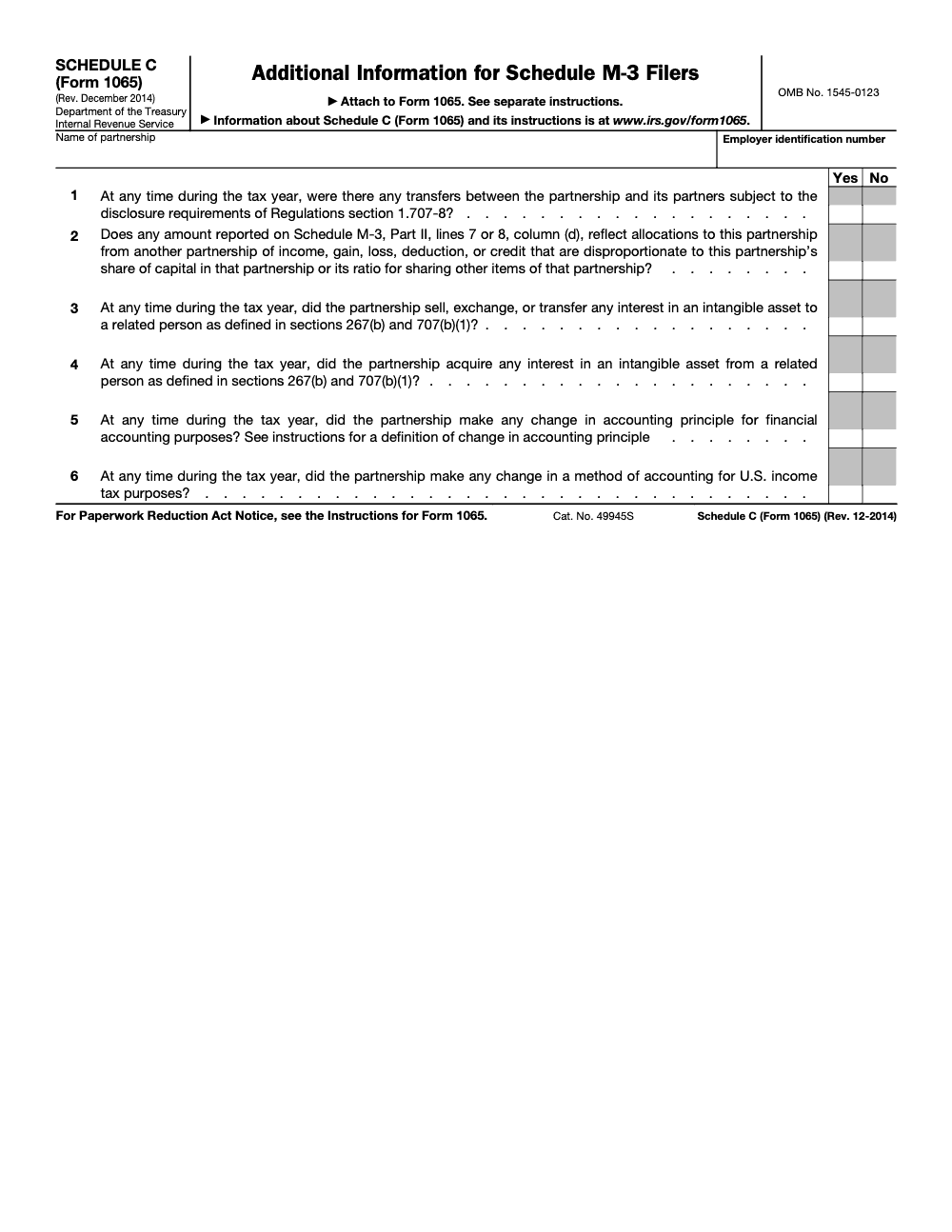
Schedule C (Form 1065), Rev. December 2014, is the ‘Additional Information for Schedule M-3 Filers’ schedule attached to Form 1065 whenever a partnership files Schedule M-3, with six yes/no questions covering Treas. Reg. §1.707-8 partner-partnership transfers (line 1), disproportionate Schedule M-3 allocations referenced from Part II, lines 7 or 8, column (d) (line 2), intangible-asset transactions with related persons under IRC §§267(b) and 707(b)(1) (lines 3 and 4), and accounting changes (financial on line 5, tax method on line 6). The December 2014 revision remains the operative version for 2025 returns, per the IRS About Schedule C (Form 1065) page.
Answer the related-person questions on lines 3 and 4 by checking only for family ties and you will eventually meet the cleanup. Those lines ask whether the partnership sold or bought an intangible to or from a related person under IRC sections 267(b) and 707(b)(1), and that net sweeps in commonly controlled entities, not just relatives. It is the quiet driver of rework on this schedule.
Schedule C rides along only when the partnership files Schedule M-3, which generally means $10 million or more in total assets at year-end. The form is six yes/no questions, but each one needs evidence built at intake rather than reconstructed in review: the Reg. 1.707-8 transfer memo, the related-person map, and the Form 3115 confirmation for any accounting-method change on line 6.
Key Takeaways
- Schedule C (Form 1065) collects additional information from partnerships that file Schedule M-3 – it asks six yes/no questions about specific partner-partnership transactions, related-person intangible transfers, and accounting changes.
- Who must file: Any partnership required to file Schedule M-3 must also complete Schedule C. This generally means partnerships with $10 million or more in total assets at year-end, and certain other large or publicly traded partnerships.
- Lines 1 and 2 tie back to disclosure and reconciliation: line 1 flags partner-partnership transfers within the Treas. Reg. §1.707-8 disclosure rules, and line 2 flags disproportionate allocations referenced from Schedule M-3, Part II, lines 7 or 8, column (d).
- Lines 3 through 6 cover related-person and accounting changes: lines 3 and 4 ask about selling or acquiring an intangible asset to or from a related person under IRC §§267(b) and 707(b)(1); line 5 asks about a change in accounting principle for financial-accounting purposes; line 6 asks about a change in method of accounting for U.S. tax purposes.
- Deadline: Schedule C is filed with the Form 1065 on the 15th day of the third month after the partnership’s year-end (March 15 for calendar-year partnerships), with a 6-month extension available.
- Quick SOP rule: Build the supporting evidence at intake – the Reg. §1.707-8 transfer memo, the §§267(b)/707(b)(1) related-person map, and the Form 3115 confirmation for any line 6 method change – so the six answers can be verified at review.
What Schedule C Is and When It Is Required
Schedule C – Additional Information for Schedule M-3 Filers – is a one-page supplement to Form 1065 that collects disclosure information from partnerships that are large enough to file Schedule M-3. (Note: this is unrelated to Schedule C of Form 1040, the profit-or-loss form used by sole proprietors – the two schedules share a name and nothing else.) Think of it as a targeted disclosure sheet: it asks six yes/no questions about partner-partnership transfers subject to Treas. Reg. §1.707-8, disproportionate allocations referenced from Schedule M-3, related-person intangible transactions under IRC §§267(b) and 707(b)(1), and changes in accounting principle or method.
The IRS introduced Schedule M-3 (and its companion Schedule C) to get a clearer picture of book-to-tax differences in large entities. Before Schedule M-3, partnerships filed Schedule M-1, a simpler two-line reconciliation that gave the IRS limited visibility into the composition of timing and permanent differences. Schedule M-3 expanded that reconciliation substantially – and Schedule C flags specific transactions the IRS wants surfaced alongside M-3’s detail.
Schedule C is required when Schedule M-3 is required. The Schedule M-3 threshold for Form 1065 filers is generally total assets of $10 million or more as reported on Schedule L. A partnership that voluntarily files Schedule M-3 instead of Schedule M-1 also triggers the Schedule C requirement. Certain publicly traded partnerships (PTPs) may have different or additional obligations.
Schedule C vs. Schedule M-1 vs. Schedule M-3
These three schedules address book-to-tax reconciliation but at different levels of detail. Understanding when each applies is essential to correctly scoping a partnership return engagement.
| Schedule | Who Files | Purpose | Schedule C Required? |
|---|---|---|---|
| Schedule M-1 | Partnerships with <$10M total assets; Schedule M-3 not filed | Simple book-to-tax reconciliation (income, deductions) | No |
| Schedule M-2 | All partnerships (accompanies M-1 or M-3) | Analysis of partners’ capital accounts during the year | No |
| Schedule M-3 | Partnerships with ≥$10M total assets OR voluntary election | Detailed income (loss) book-to-tax reconciliation by category | Yes |
| Schedule C | Same as Schedule M-3 filers | Six yes/no disclosures: §1.707-8 transfers, disproportionate M-3 allocations, related-person intangible transfers, accounting changes | N/A (Schedule C is itself the additional schedule) |
A partnership that crosses the $10 million asset threshold for the first time in a year must file Schedule M-3 and Schedule C for that year. There is no grace period or phase-in. If you are scoping a new client’s return and their prior-year total assets were under $10 million, verify the current year’s Schedule L balance before assuming the simpler M-1 schedule applies.
How to Complete Schedule C, Question by Question
Schedule C is organized as six yes/no disclosure questions rather than a line-by-line calculation. Each line keys to a specific statutory trigger or to a Schedule M-3 entry, so the answer cannot be verified without the underlying memo or party map.
Line 1 – Transfers Subject to Treas. Reg. §1.707-8
Line 1 asks whether, at any time during the tax year, there were any transfers between the partnership and its partners subject to the disclosure requirements of Regulations section 1.707-8. This is keyed specifically to the disguised-sale and related disclosure rules, not all partner-partnership traffic. From my side of the desk, I document the §1.707-8 analysis at intake so line 1 has a paper trail attached to the workpaper, and I mark “No” with a supporting memo when the transfer is outside the disclosure rules.
Line 2 – Disproportionate Allocations from Another Partnership
Line 2 asks whether any amount reported on Schedule M-3, Part II, lines 7 or 8, column (d) reflects allocations to this partnership from another partnership that are disproportionate to this partnership’s share of capital or its ratio for sharing other items. Tie this line directly to those M-3 values, and keep a tier-by-tier breakdown alongside the answer.
Lines 3 and 4 – Related-Person Intangible Transactions
Line 3 asks whether the partnership sold, exchanged, or transferred any interest in an intangible asset to a related person as defined in sections 267(b) and 707(b)(1). Line 4 asks the same question for intangible interests acquired from a related person. Run the full §267(b) and §707(b)(1) ownership map against the partner roster up front – these statutes sweep in controlled entities, related corporations, and fiduciary relationships, not just family – and reuse the same party map for both lines.
Lines 5 and 6 – Accounting Changes
Line 5 asks whether the partnership made any change in accounting principle for financial-accounting (GAAP) purposes. Line 6 asks whether it made any change in a method of accounting for U.S. income tax purposes. These are independent questions: line 5 is supported by the book audit memo, while line 6 is supported by the tax memo or Form 3115. A “Yes” on line 6 does not replace the change-in-method approval process, which generally requires Commissioner consent through Form 3115.
Related-Person Intangible Transfers on Lines 3 and 4
Lines 3 and 4 are where most Schedule C review time goes, because the related-person test under IRC §§267(b) and 707(b)(1) is broader than people expect. Line 3 captures intangible interests the partnership sold, exchanged, or transferred to a related person; line 4 captures intangible interests it acquired from a related person.
The definition of “related person” sweeps in controlled entities, commonly controlled partnerships and corporations, and fiduciary relationships – not just spouses, parents, and children. Limiting the analysis to family misses the most common partnership scenarios: entity-to-entity transfers and common-control acquisitions.
The practical move is to build a single §267(b) and §707(b)(1) ownership map against the partner roster at intake, attach it to the Schedule C workpaper, and reuse the same map for both lines. That way a reviewer can validate the “Yes” or “No” on each line without reopening the file.
Line 2 and Its Cross-Reference to Schedule M-3
Line 2 is the one Schedule C question that does not stand on its own – it points directly back into Schedule M-3. It asks whether any amount reported on Schedule M-3, Part II, lines 7 or 8, column (d) reflects allocations to this partnership from another partnership that are disproportionate to this partnership’s share of capital in that partnership or its ratio for sharing other items.
In tiered structures, this is the line that catches disproportionate flow-through from a lower-tier partnership. Because the answer is driven by the M-3 entries, you cannot reliably mark line 2 until Schedule M-3, Part II, lines 7 and 8, column (d) are final.
Practical Note on Line 2
Pull the current Schedule M-3, Part II, lines 7 and 8, column (d) values before answering line 2, and keep a one-page tier-by-tier breakdown saved alongside the answer. If amounts change during review, re-check line 2 last so the disclosure stays consistent with the final M-3. This is an area where I have seen material inconsistencies in returns prepared without careful coordination between the M-3 preparer and whoever completes Schedule C.
Deadlines, Penalties, and Filing Requirements
| Item | Detail |
|---|---|
| Form 1065 due date (calendar year) | March 15 (15th day of 3rd month after year-end) |
| Extension available | Yes – Form 7004, automatic 6-month extension to September 15 |
| Schedule C filing | Filed with Form 1065; no separate due date |
| Schedule M-3 filing | Same – attached to Form 1065 |
| Late filing penalty | $235 per partner per month (2025), up to 12 months |
| Failure to include Schedule M-3 or C when required | May result in an incomplete return penalty; IRS may request the schedule |
| E-file requirement | Partnerships with more than 100 partners must e-file Form 1065 |
| Amended return | File an amended Form 1065 (check “Amended Return” box) with corrected Schedule C |
The late filing penalty for partnership returns is partnership-level – it is assessed per partner per month, not as a flat amount. A 10-partner partnership filing one month late faces $2,350 in penalties. That said, first-time abatement and reasonable cause arguments are available. Maintain documentation of any circumstances that caused a late filing.
Common Mistakes That Slow Things Down
Schedule C reads like a yes/no checklist, but each line carries a specific statutory trigger. The patterns below are the ones we catch every season during review of M-3 partnership returns.
Practical Checklists You Can Reuse
These checklists map directly to the six Schedule C questions and the Schedule M-3 entries they reference. Paste them into your firm SOP or partnership-tax intake packet.
Pre-Schedule C Review Packet
- Confirm the partnership meets the Schedule M-3 filing condition before adding Schedule C to the return packet.
- Header: enter the partnership’s legal name and EIN exactly as they appear on Form 1065.
- Pull the current Schedule M-3, Part II, lines 7 and 8, column (d) values for the line 2 cross-check.
- List every partner-partnership transfer during the year and tag each as in or out of Treas. Reg. §1.707-8 scope.
- List every intangible-asset transaction during the year and tag each party against IRC §§267(b) and 707(b)(1).
- Attach the GAAP change-in-principle memo (if any) for line 5 support.
- Attach the Form 3115 filing confirmation (if any) for line 6 support.
- Label the cover sheet ‘Schedule C (Form 1065), Rev. December 2014’ so reviewers do not chase a non-existent 2025 revision.
Six-Question Walkthrough
- Line 1: Were any partner-partnership transfers subject to Treas. Reg. §1.707-8 during the year? Yes or No, with memo.
- Line 2: Do amounts on Schedule M-3, Part II, lines 7 or 8, column (d) reflect disproportionate allocations from another partnership? Yes or No, with tier-by-tier breakdown.
- Line 3: Was any intangible-asset interest sold, exchanged, or transferred to a related person under IRC §§267(b) and 707(b)(1)? Yes or No, with party map.
- Line 4: Was any intangible-asset interest acquired from a related person under IRC §§267(b) and 707(b)(1)? Yes or No, with party map.
- Line 5: Was there a change in accounting principle for financial-accounting (GAAP) purposes? Yes or No, with audit memo if Yes.
- Line 6: Was there a change in a method of accounting for U.S. tax purposes? Yes or No, with Form 3115 reference if Yes.
Line 6 Form 3115 Confirmation
- Identify the change in method of accounting (cash to accrual, change in inventory method, change in depreciation method, etc.).
- Confirm whether the change is automatic or non-automatic under the current Rev. Proc., per the Instructions for Form 1065.
- Confirm Form 3115 was filed with the IRS and a copy attached to the partnership return.
- Stash the Form 3115 filing confirmation in the same workpaper folder as the Schedule C answer.
- Note the §481(a) adjustment, if any, and confirm flow-through to Schedule M-3.
Keep 1065-SC Season From Stalling
Schedule C looks like a six-line checkbox at the back of the return, but each line cross-references either a Schedule M-3 entry or a statute (Treas. Reg. §1.707-8, IRC §§267(b) and 707(b)(1)). That makes the schedule deceptively review-heavy during partnership season, because the answers cannot be verified without the underlying memos, party maps, and Form 3115 attachments. The December 2014 revision is still the operative version for 2025 returns (per the IRS About Schedule C (Form 1065) page), so practitioners keep applying the same workflow against ever-larger partnership stacks.
The fix is structural, not heroic. Build the evidence at intake so the schedule fills itself at review, and standardize where each piece of support lives so a second-pair reviewer can validate without reopening the file.
- Document the Treas. Reg. §1.707-8 transfer analysis at intake, not at review. Line 1 then has a paper trail attached to the workpaper.
- Run the full IRC §§267(b) and 707(b)(1) related-person test against the partner roster up front, and reuse the same party map for lines 3 and 4.
- Tie line 2 directly to Schedule M-3, Part II, lines 7 and 8, column (d) values, with a one-page tier breakdown saved alongside.
- Separate line 5 (book GAAP change) and line 6 (tax method change) into two independent tickmarks with two independent evidence trails: the audit memo supports line 5; the Form 3115 supports line 6.
- Label every Schedule C cover sheet ‘Schedule C (Form 1065), Rev. December 2014’ so reviewers stop searching for a 2025 revision that does not exist.
This is the production posture our U.S. tax preparation team applies on every M-3 partnership engagement: intake-first evidence, fixed cross-references to Schedule M-3 entries, and a single naming convention that survives reviewer handoffs. Schedule C stops being a season bottleneck once the evidence is built before the question is asked.
FAQs
Schedule C, titled “Additional Information for Schedule M-3 Filers,” is a supplemental schedule required from partnerships that also file Schedule M-3. It asks six yes/no questions covering partner-partnership transfers subject to Treas. Reg. §1.707-8, disproportionate allocations referenced from Schedule M-3, related-person intangible transactions under IRC §§267(b) and 707(b)(1), and changes in accounting principle or method.
Partnerships that are required to file Schedule M-3 must also complete Schedule C. The Schedule M-3 requirement generally applies to partnerships with total assets of $10 million or more on Schedule L at year-end, and to any partnership that voluntarily files Schedule M-3 instead of Schedule M-1.
Schedule C asks six yes/no questions: (1) partner-partnership transfers subject to Treas. Reg. §1.707-8; (2) whether amounts on Schedule M-3, Part II, lines 7 or 8, column (d) reflect disproportionate allocations from another partnership; (3) selling, exchanging, or transferring an intangible asset to a related person under IRC §§267(b) and 707(b)(1); (4) acquiring an intangible asset from a related person; (5) a change in accounting principle for financial-accounting purposes; and (6) a change in method of accounting for U.S. tax purposes.
Generally no. Partnerships under the $10 million threshold file Schedule M-1 instead of Schedule M-3 and are not required to file Schedule C. However, if a small partnership voluntarily elects to file Schedule M-3, it must also complete Schedule C.
Schedule M-1 is a simplified two-line reconciliation of book income to taxable income, used by smaller partnerships. Schedule M-3 is a detailed, multi-part reconciliation that breaks down each category of book-to-tax difference by line item. Schedule M-3 is required for larger partnerships and provides significantly more visibility into permanent and temporary differences. Schedule C accompanies M-3; there is no corresponding additional schedule for M-1 filers.
Other forms this guide names
About this guide
Accountably helps US CPA, EA, and accounting firms hire trained accountants and tax preparers in India.
About us Reviewed byJugal Thacker, CPAFounder and CEO at Accountably
A Washington-licensed CPA with 7+ years inside US firms – PwC, a real-estate tax practice, then a full-service firm, rising from reviewer to manager to advisory. This article was reviewed against current IRS guidance for the 2025 tax year and updated for filers preparing late returns, amendments, and 2026 estimates.
View profile →How we research, review, and update this guide
Every Accountably guide is researched against primary IRS sources, reviewed by a U.S. CPA, and refreshed as guidance evolves. Read our Editorial Guidelines to see how we source, fact-check, and update our content.