Summarize this article with AI
In Brief
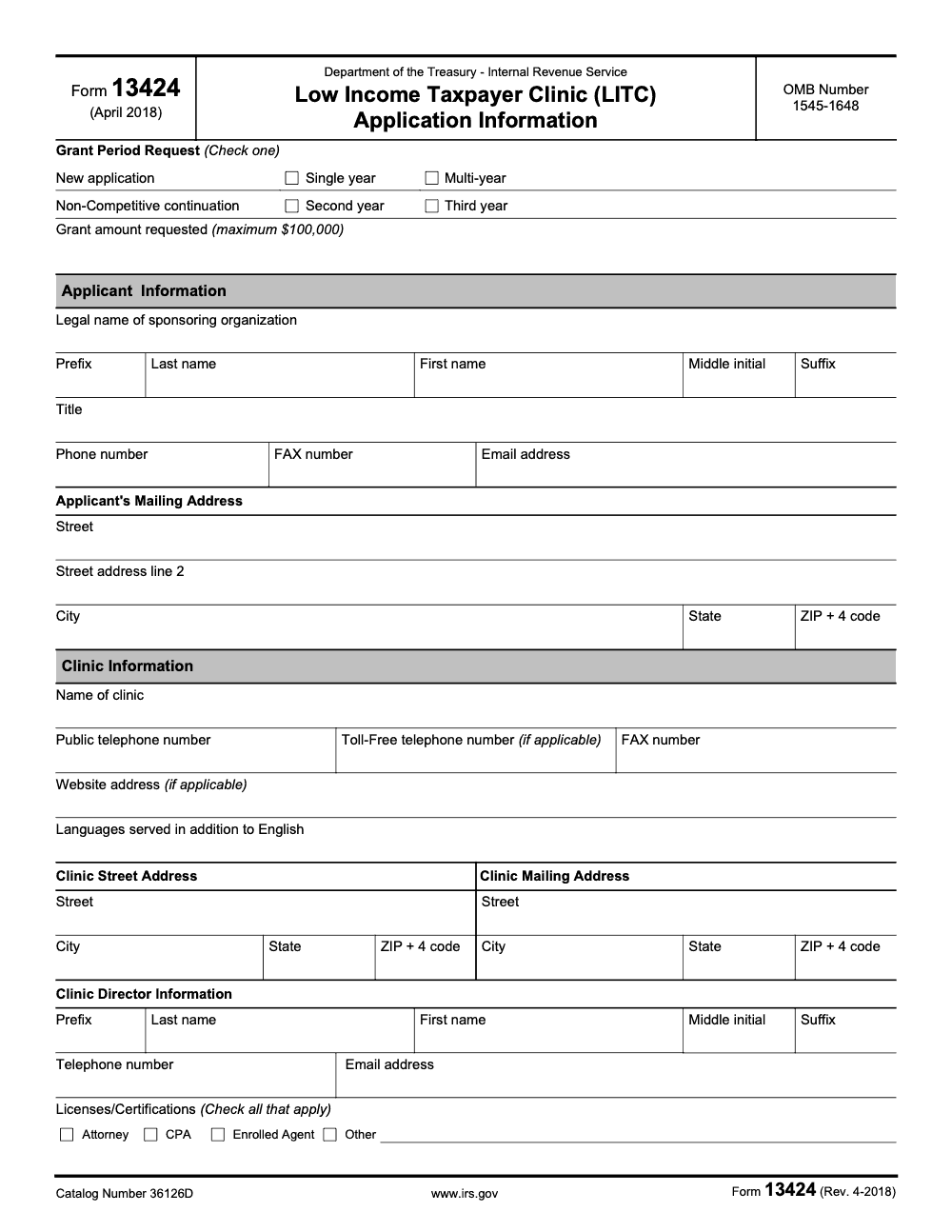
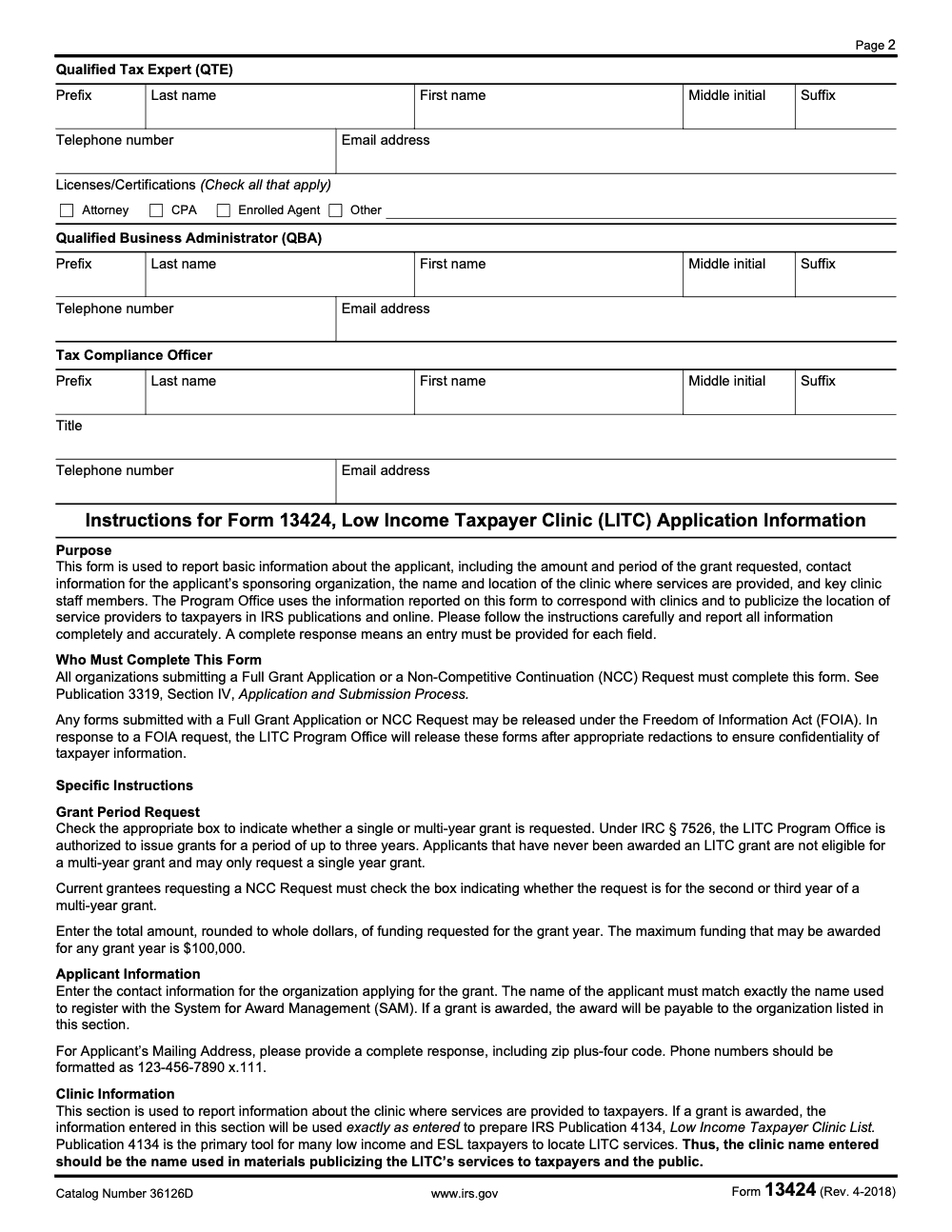
Form 13424 is the Low Income Taxpayer Clinic (LITC) Application Information form, current revision April 2018 (Catalog 36126D, OMB 1545-1648). Every organization submitting a Full Grant Application or Non-Competitive Continuation (NCC) request must complete it (per IRS Publication 3319, Section IV). The grant amount requested is capped at $100,000 per grant year, rounded to whole dollars, and authorized for up to three years under IRC § 7526 – first-time applicants are limited to a single-year request.
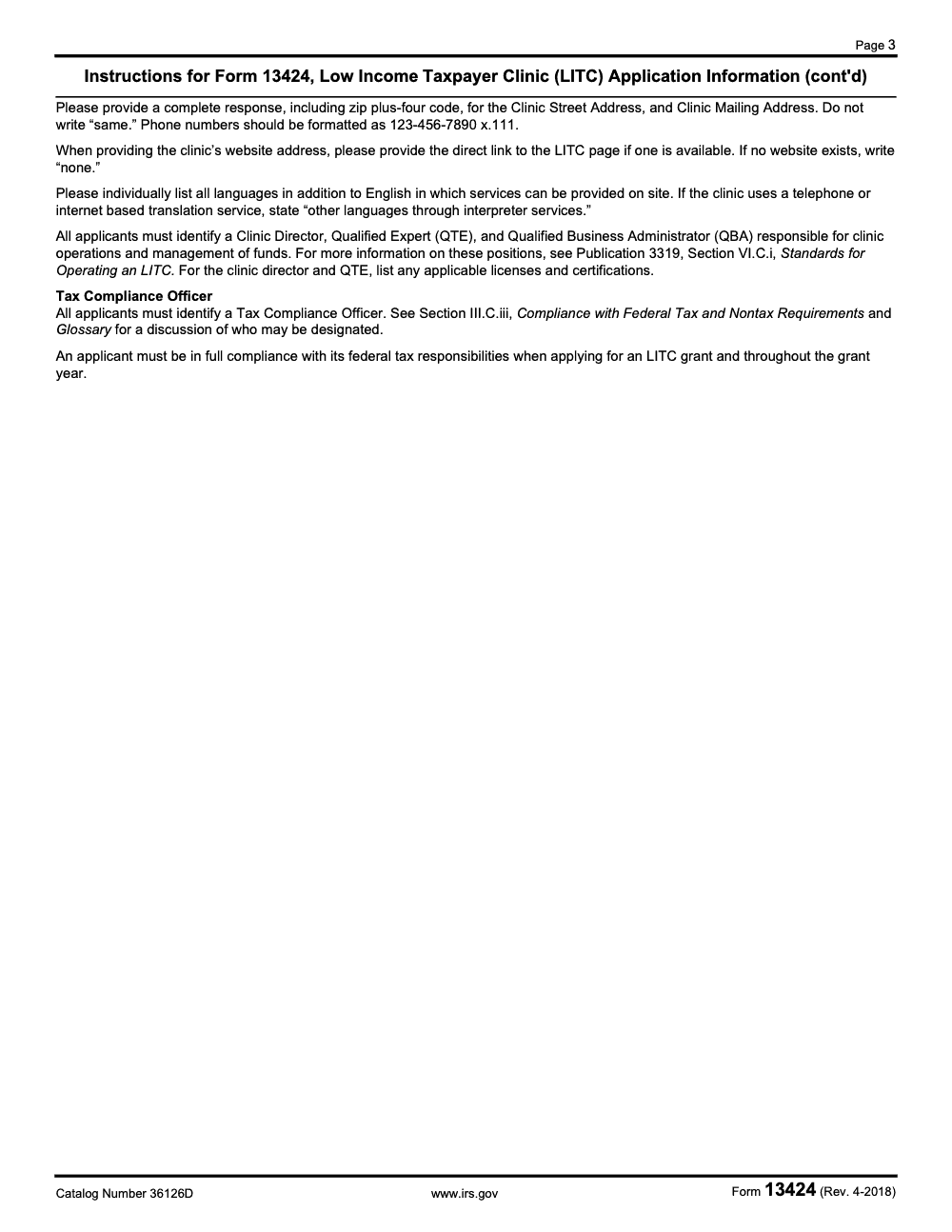
A returning grantee once nearly typed the word same into the Clinic Mailing Address fields because the street and mailing addresses matched. The instructions prohibit that shortcut, and the fix took seconds, but it would have bounced the package. That is the personality of Form 13424, the LITC Application Information form, where small entries decide whether a complete application moves.
Every organization submitting a Full Grant Application or Non-Competitive Continuation completes this form as one piece of a larger package alongside SF-424, the budget, and the narrative. The current revision is April 2018, the requested grant amount is capped at $100,000 per grant year, and an award can run up to three years under IRC § 7526. Keep Publication 3319 open while you work.
Key Takeaways
- IRS Form 13424 is not the “eligibility checklist.” In the LITC grant package, Form 13424 is the “Application Information” form you submit as part of a complete application.
- A complete new LITC application typically includes SF-424, Form 13424, Form 13424-J (budget), Form 13424-M (narrative), plus required attachments.
- For the 2026 grant year, the IRS published that the application window opened May 15, 2025 and closed July 14, 2025 at 11:59 p.m. ET. That deadline has already passed, so you should confirm the current cycle before you plan your internal timeline.
- Submission is handled electronically and Publication 3319 states applications must be submitted through the LITC Grants Portal.
- Your application is evaluated on real-world factors like who you’ll serve, your service area, program quality, and other funding sources, and LITC grants require dollar-for-dollar matching funds.
What Is IRS Form 13424 (and What It’s Used For)?
IRS Form 13424 is the LITC “Application Information” form. It’s one of the required components of an LITC grant application package (along with the budget and narrative forms).
Think of Form 13424 as the form that helps the program office quickly understand the basics of who you are, how to contact you, and how the IRS should treat your application at an administrative level. It is not the place where you “prove” your full program plan, that’s what your narrative and budget support.
What Form 13424 Is Not
If you’ve heard Form 13424 described as an “eligibility checklist,” that’s a common mix-up. In the 2026 LITC package, Publication 3319 specifically lists Form 13424 as “Low Income Taxpayer Clinic (LITC) Application Information.”
Who This Form Is For (Eligible Applicant Types)
LITC grants are generally aimed at organizations that will provide representation and/or ESL education for qualifying taxpayers. The public opportunity listing for the 2026 cycle spells out eligible applicant categories such as:
- Nonprofits with 501(c)(3) status (non-higher education)
- Public and state institutions of higher education
- Private institutions of higher education
If your organization is a nonprofit legal aid provider, a university clinic, or a law school program, you’re exactly the kind of applicant this process is built for.
Deadlines and Submission, What’s True for the Current Cycle
Here’s the part most teams wish they’d pinned to the top of the project plan earlier.
The most recently published deadline (2026 grant year) has already passed
Publication 3319 for the 2026 grant year states the application period opened May 15, 2025 and closed July 14, 2025 at 11:59 p.m. ET. The IRS also summarized that same deadline publicly in an IRS newswire bulletin.
That window has since closed, so treat those dates as a reference point for how the program runs, not as your current deadline.
Where you submit (this matters)
For the 2026 cycle, Publication 3319 states applications must be submitted electronically through the LITC Grants Portal. The TAS LITC Grants page also notes you’ll need ID.me access to use the portal.
If you take nothing else from this section, take this: confirm the current Publication 3319 and the live portal instructions before you start building your internal timeline. The program updates annually.
What You Should Gather Before You Start Form 13424 (So You Don’t Get Stuck Mid-Application)
If your team is small, the fastest way to reduce stress is simple: front-load the admin and proof documents. Do the “paper chase” first, then fill out forms.
Based on the 2026 Publication 3319 package requirements, here’s what you want ready before you sit down to complete Form 13424 and its companion forms:
- Your organization identity basics
- Legal name, address, EIN, leadership contact details (the legal name you list must match exactly the name registered with the System for Award Management (SAM) – using a DBA or abbreviated name can delay grant payment, since the award is made out to the listed entity)
- Your required application forms
- SF-424 (Application for Federal Assistance)
- IRS Form 13424 (Application Information)
- IRS Form 13424-J (Detailed Budget Worksheet and Narrative Explanations)
- IRS Form 13424-M (LITC Application Narrative)
- Your required attachments
- Tax-exempt determination letter (if applicable)
- Proof of academic accreditation (if applicable)
- Most recent audited financial statement, or an explanation plus unaudited statement if you don’t have an audit
- Indirect cost rate agreement (if applicable)
- Documentation showing your designated TCO is authorized to receive tax information (Publication 3319 gives examples such as organizational documents or Form 2848)
A quick note on the “TCO authorization” item
This is one of those requirements that can quietly turn into a bottleneck. Publication 3319 references confidentiality rules and the need to ensure the right person is authorized.
Practical tip: don’t treat this as a “we’ll handle it later” task. If you need internal legal review, leadership sign-off, or board documentation, start early.
The Complete Package, at a Glance
Here’s a simple table you can use as your internal checklist. It matches what Publication 3319 describes as a complete submission for new applications and continuation requests.
| Item | New Grant Application | Continuation Request |
| SF-424 | ✅ | ✅ |
| IRS Form 13424 (Application Information) | ✅ | ✅ |
| IRS Form 13424-J (Budget Worksheet + Narrative Explanations) | ✅ | ✅ |
| IRS Form 13424-M (Application Narrative) | ✅ | ✅ (with specific update-focused content) |
| Audited financial statement (or alternative explanation) | ✅ | ✅ |
| Tax-exempt determination letter (if applicable) | ✅ | Not listed as required for continuation in the same way |
| Proof of academic accreditation (if applicable) | ✅ | Not listed as required for continuation in the same way |
| TCO authorization documentation | ✅ | ✅ |
| Indirect cost rate agreement (if applicable) | ✅ | ✅ |
Publication 3319 outlines these package components for both new applications and continuation requests.
How to Complete Form 13424 (Step-by-Step, in Plain English)
You’ll complete Form 13424 inside the official application system, but the mental model is the same either way.
Step 1: Treat Form 13424 like “your application’s cover sheet”
Your narrative (Form 13424-M) tells your story. Your budget (Form 13424-J) shows you can run the program responsibly. Form 13424 is where you make sure the IRS can process the application correctly.
Before you fill anything in, decide who owns final review. One person should be responsible for catching:
- wrong contact info
- inconsistent organization names across forms
- mismatched budget totals
- missing attachment uploads
This sounds basic, but it’s a common reason teams end up reworking the package at the last second.
Step 2: Confirm your program type and scope early
LITC work generally centers on:
- representation of low-income taxpayers in controversies with the IRS
- ESL education about rights and responsibilities
Publication 3319 and the opportunity listing describe these focus areas as core to the program.
Make sure your internal team agrees on your emphasis (representation, ESL education, or both), because it affects how your narrative and goals read.
Step 3: Build the “attachment trail” like you would for an audit
If you’ve ever prepared an audit binder, use that same instinct here:
- consistent naming
- clear versions
- one shared source of truth
- no mystery PDFs with names like “FINAL_final2.pdf”
You are not being graded on your file naming, but messy attachments slow reviewers down and increase the risk of follow-up questions.
How LITC Applications Are Evaluated (What Reviewers Actually Care About)
The strongest LITC applications usually feel grounded. Not flashy, not over-written, just clear and real.
Publication 3319 includes criteria drawn from the program’s statutory framework, such as:
- How many taxpayers you expect to serve, including ESL populations in your area
- Whether other LITCs already serve the same population, and what gap you fill
- Program quality, including qualifications and past record (if any)
- Other funding sources available to you, including grants and institutional resources
Matching funds are not optional
The program includes a dollar-for-dollar matching requirement for grant funds.
In plain terms, you should plan to explain, cleanly and credibly:
- where the match comes from
- whether it’s cash, in-kind, or staff time
- how you track it (so reporting later doesn’t become a fire drill)
What Happens After You Submit
Two things can be true at once:
- You did solid work.
- The wait still feels stressful.
For the 2026 cycle, Publication 3319 stated that qualified applicants would be notified of award decisions by November 2025, and that award recipients are required to attend the annual conference in December 2025.
Even if your current cycle differs, it’s still helpful to plan your internal calendar around the reality that:
- you may get follow-up questions
- you may need fast turnaround on clarifications
- award timing may affect staffing plans for the upcoming year
A Practical Operations Note (Especially if Your Team Is Small)
This is where the “delivery ceiling” shows up.
A lot of organizations don’t lose points because their program is weak. They lose time because their internal workflow is fragile. Review gets stuck with one person. Documentation lives in five inboxes. Nothing is standardized, so every year feels like starting over.
If you want one simple upgrade, it’s this: build an SOP for your LITC grant package. Not a 40-page document, just a repeatable checklist and file structure that makes the next cycle easier.
And yes, on Accountably.com, it’s fair to say this out loud: operational discipline is what keeps work from breaking when deadlines hit. That’s the same reason firms bring in structured support partners like Accountably for repeatable, deadline-driven accounting work, because capacity without process gets messy fast.
Conclusion
If you’re applying for LITC funding, Form 13424 is one of the key building blocks, but it’s rarely the only thing standing between you and a clean submission. The real win is getting your full package tight, consistent, and easy for reviewers to follow.
Use the most current Publication 3319, confirm the active deadline for your cycle, gather your attachments early, then complete Form 13424 with the same mindset you’d bring to a high-stakes filing: accurate, documented, and calm.
Common Mistakes We See Every Season
We see the same handful of Form 13424 errors trip up otherwise strong applications every cycle. Most are not knowledge gaps, they are workflow gaps that show up because the form looks deceptively simple.
Reusable Checklists
These are the three checklists my team copies into a fresh LITC engagement file. Mark each item complete inside the page, or paste the list straight into your firm SOP, your call.
Pre-submission package
- Active SAM registration confirmed; legal name copied character for character into the Applicant Information block.
- Current Publication 3319 (active grant cycle) reviewed and bookmarked.
- Form 13424 (Rev. 4-2018), Form 13424-J, Form 13424-M, and SF-424 downloaded into the engagement folder.
- Clinic Street Address and Clinic Mailing Address verified with USPS ZIP+4 lookup; no field left as “same.”
- Phone numbers reformatted to 123-456-7890 x.111 on every applicable field.
- Website Address pointed to the LITC-specific page, or “none” entered if no site exists.
- On-site languages listed individually; “other languages through interpreter services” added only if applicable.
- Clinic Director, Qualified Tax Expert, Qualified Business Administrator, and Tax Compliance Officer named with current licenses on file.
Grant period and amount cross-check
- Grant Period row matches the application type (New vs Non-Competitive Continuation; Single vs Multi-year).
- First-time applicants confirmed as Single year only, per Publication 3319 eligibility.
- NCC requests confirmed as Second year or Third year, never both.
- Requested amount rounded to whole dollars.
- Requested amount at or below the $100,000 per-grant-year cap under IRC § 7526.
- Form 13424 amount reconciled line by line to the Form 13424-J budget total.
- Match funding sourced, documented, and dated.
- Federal tax compliance status verified for the applicant entity for the current and upcoming grant year.
FOIA and verbatim-publication review
- Every field has an entry (no blanks, no “same,” no “various”).
- Clinic name reflects how services are publicized to taxpayers, not the formal corporate legal name.
- Clinic name, addresses, and contact data prepared for verbatim republication in IRS Publication 4134.
- No client-taxpayer information included anywhere on Form 13424.
- Licenses (Attorney, CPA, Enrolled Agent, Other) checked only for the Clinic Director and Qualified Tax Expert rows.
- Internal sign-off from the Tax Compliance Officer captured before portal upload.
- Final signed PDF saved to the engagement folder for audit trail.
- LITC Grants Portal confirmation receipt archived with the file.
Keep 13424 Season From Stalling
LITC applicants rarely lose grant funding because Form 13424 is hard. They lose it because the package around it is rushed. Per IRS Publication 3319, one annual window governs each cycle, Form 13424 has to reconcile to Form 13424-J to the dollar, and the clinic information you type lands verbatim in IRS Publication 4134, the primary tool low-income and ESL taxpayers use to find LITC services. Any one of those mismatches can delay an award decision or trigger follow-up questions that eat senior review time you do not have.
The fix is not more hours in the final week before the deadline. It is a workflow that lets a small clinic or grant team move through the same package the same way every cycle, with the names, addresses, licenses, and grant math already locked before anyone opens the LITC Grants Portal.
- Pre-build a Form 13424 source-of-truth sheet that locks the SAM legal name, ZIP+4 addresses, phone format (123-456-7890 x.111), and the clinic name used to publicize services; reuse the same values across Form 13424, SF-424, and the Publication 4134 listing.
- Treat the four Grant Period checkboxes as a gate: confirm first-time applicants are marked Single year only, Non-Competitive Continuation requests are marked Second year or Third year (never both), and the requested amount sits at or below the $100,000 per-year cap rounded to whole dollars.
- Maintain a key-staff roster for the Clinic Director, Qualified Tax Expert, Qualified Business Administrator, and Tax Compliance Officer, with licenses checked only on the Director and QTE rows (the QBA and Tax Compliance Officer rows have no license boxes by design).
- Run a two-pass review on every verbatim field: clinic name, addresses, website, and on-site languages all reprint into Publication 4134 exactly as typed, so each field gets a preparer pass and a senior pass before the portal upload.
- Confirm federal tax compliance for the applicant entity at submission and calendar a mid-grant-year re-check, since Publication 3319 requires full compliance throughout the entire grant year, not just on the application date.
That kind of structure is the same operating discipline behind any deadline-driven engagement. When your team needs scalable production capacity around the moving parts of a Form 13424 package without burning senior review hours, our U.S.-led tax and compliance support handles the workflow so in-house staff stays focused on program work.
FAQs
No. Publication 3319 lists Form 13424 as one piece of a complete package, alongside SF-424, Form 13424-J (budget), Form 13424-M (narrative), plus required attachments.
SF-424 is the federal Application for Federal Assistance form required across many grant programs. Publication 3319 lists it as part of a complete LITC application submission.
For the 2026 grant year package, Publication 3319 states applications must be submitted electronically through the LITC Grants Portal, and TAS notes access via ID.me.
Publication 3319 stated the window closed July 14, 2025 at 11:59 p.m. ET for the 2026 grant year.
It means for every grant dollar you receive, you must provide an equivalent amount in matching support, consistent with the program’s matching requirement language.
Other forms this guide names
- Form 13424-J: LITC Budget Worksheet & Narrative Guide
- Form 13424-M: LITC Application Narrative Guide, Rev. 6-2025
About this guide
Accountably helps US CPA, EA, and accounting firms hire trained accountants and tax preparers in India.
About us Reviewed byJugal Thacker, CPAFounder and CEO at Accountably
A Washington-licensed CPA with 7+ years inside US firms – PwC, a real-estate tax practice, then a full-service firm, rising from reviewer to manager to advisory. This article was reviewed against current IRS guidance for the 2025 tax year and updated for filers preparing late returns, amendments, and 2026 estimates.
View profile →How we research, review, and update this guide
Every Accountably guide is researched against primary IRS sources, reviewed by a U.S. CPA, and refreshed as guidance evolves. Read our Editorial Guidelines to see how we source, fact-check, and update our content.