Summarize this article with AI
In Brief
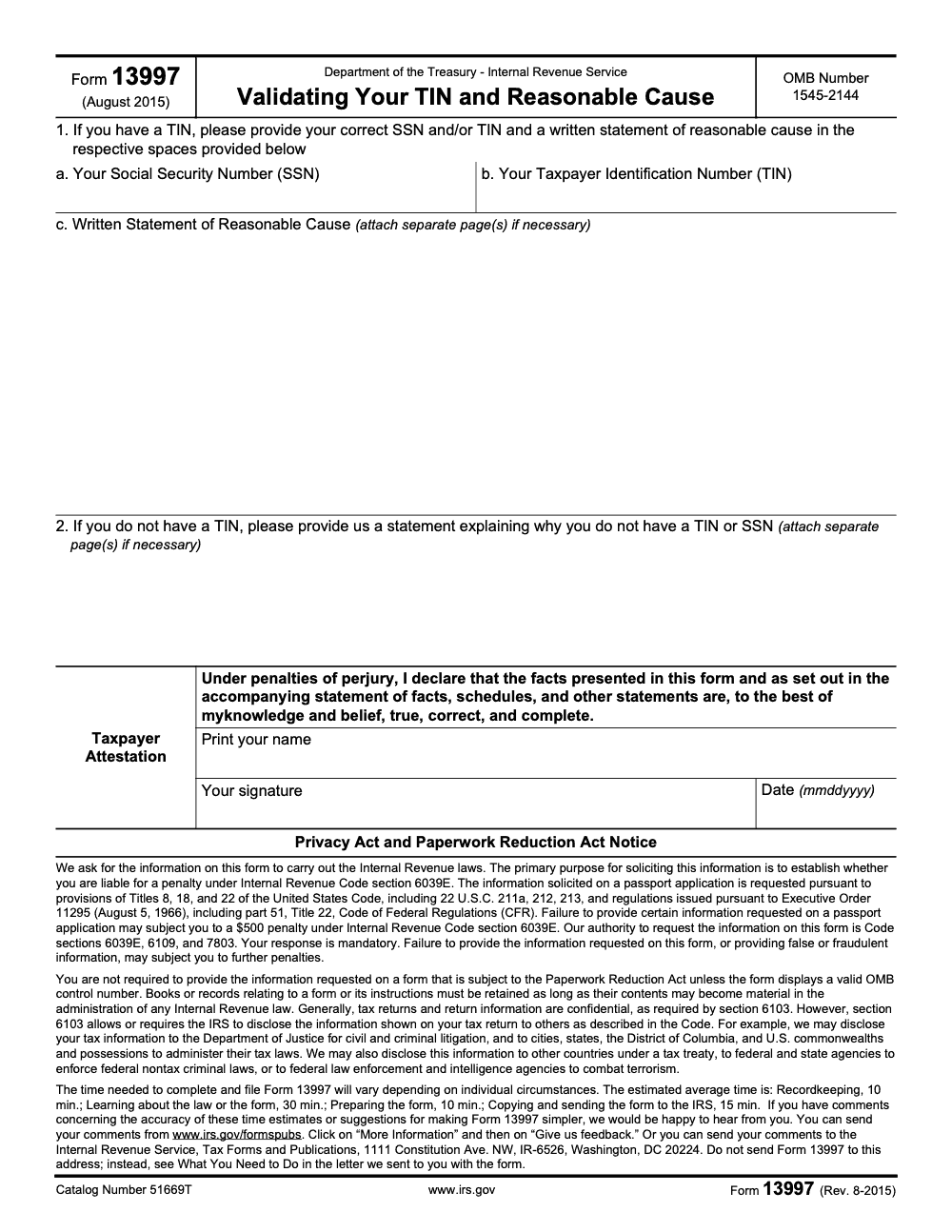
Form 13997 is the IRS reply form for Validating Your TIN and Reasonable Cause – sent with Letter 4318 to address a $500 penalty under IRC §6039E for missing information on a U.S. passport application (per Form 13997, Rev. 8-2015). Enter SSN on line 1a or TIN on line 1b, write the reasonable-cause statement on line 1c, sign in mmddyyyy format under penalties of perjury, and mail it to the address shown in your IRS letter, never the IR-6526 comments address printed on the form itself.
Form 13997 tends to arrive a few weeks after someone renews a U.S. passport, stapled behind Letter 4318, with IRC §6039E cited in one paragraph and a $500 penalty in the next. In most files the taxpayer was not hiding anything. They simply left their SSN off a box on the State Department application, and now the IRS wants a signed reasonable-cause statement explaining the miss.
The form is short, so the outcome turns on a handful of details. Enter the SSN on line 1a or the TIN on line 1b, write the reasonable-cause statement on line 1c, and sign in mmddyyyy format under penalties of perjury. The single biggest trap is the address: the form itself tells you not to use the generic comments address printed on it and to mail it back to the address in your Letter 4318. Handle those right and the §6039E penalty usually does not stick.
Key Takeaways
- Form 13997 rides along with IRS Letter 4318 to validate a taxpayer identification number and, if needed, present a reasonable cause statement under IRC §6039E.
- The penalty tied to §6039E is generally $500 per application, unless reasonable cause applies. The IRS gives a notice and a window to respond before assessing it, and the response itself is mandatory – failure to respond, or providing false information, may bring further penalties on top of the $500.
- You must follow Letter 4318’s return instructions, address, and deadline. Form 13997 itself says do not send it to a generic address and directs you back to the letter.
- Form 13997 requires a signature. The latest official supporting statement says this form is not filed electronically, so plan to return it as the letter instructs, usually by mail or fax.
- Keep copies of everything. Tax return information is confidential under IRC §6103 – though §6103 itself authorizes the IRS to share information in specified situations (DOJ litigation, state and local tax administration, tax-treaty exchanges, federal nontax criminal enforcement, and counterterrorism) – and the form displays OMB control number 1545‑2144.
What Form 13997 is and why you received Letter 4318
Form 13997 is a one‑page IRS form titled “Validating Your TIN and Reasonable Cause.” The IRS uses it when someone who applied for a U.S. passport or for lawful permanent residence did not provide all §6039E information, especially a valid SSN or other TIN. Letter 4318 explains the issue and asks the individual to complete and return Form 13997.
Under IRC §6039E, certain passport or permanent resident applicants must give specific identifying information, including their TIN if issued. If the information is missing or incorrect, the IRS can assess a penalty unless the person shows reasonable cause. Form 13997 is the IRS’s way to gather the missing TIN details and any reasonable cause statement.
How the law and the timeline work
The regulations provide a response window after the IRS notifies you of a potential penalty. Generally, passport applicants have 60 days from the date of the notice to respond, or 90 days if the notice is addressed to someone outside the United States. If you show the failure was due to reasonable cause and not willful neglect, the IRS should not assess the penalty.
The penalty amount tied to §6039E is $500 per application. IRS internal guidance confirms the amount and clarifies that only one $500 penalty can be asserted per application.
Letter 4318 is the controlling document
Form 13997 itself tells you not to mail it to a generic address. Instead, follow the “What You Need to Do” section in the letter that came with it. That is your routing, your deadline, and your checklist for supporting documents. The IRS’s OMB filing for this form also notes that it is sent as a specialized attachment to Letter 4318.
Quick note on different passport issues
Do not confuse Letter 4318 and Form 13997 with the separate passport debt certification process for seriously delinquent tax debt, which involves CP508C notices and different rules. That program is unrelated to §6039E TIN validation. If you are curious, the IRS posts yearly thresholds and procedures for debt certification separately.
What to do first
- Read Letter 4318 end to end and mark the due date. If the taxpayer is outside the U.S., note the 90‑day window.
- Download the official Form 13997 PDF and skim the attestation and privacy notice so you understand what you are certifying.
- Start a small file, digital or paper. Put the letter, the filled form, supporting proof, and your mailing or fax confirmation in one place. This saves review time later.
Treat the response like a mini case file. Clear form, clean support, and proof of transmission are what protect you if the IRS asks questions later.
Step‑by‑step, how to complete Form 13997
You can complete Form 13997 in a single sitting if you gather the right details first. The form asks for the correct SSN or TIN if one exists, a concise reasonable cause statement if information was missing or incorrect, and your signature.
Gather these documents before you write
- Identification and name history, for example passport, birth certificate, marriage certificate, court order, or other name‑change evidence.
- Application records, for example U.S. passport or permanent residence application receipts, State Department or USCIS notices, appointment confirmations, and any tracking emails.
- TIN evidence, for example Social Security card, SSA letter, or ITIN records if applicable.
- Any correspondence that shows attempts to obtain or correct a TIN, for example SSA visit receipts, call logs, or confirmation numbers.
You will use these to match facts and dates in your reasonable cause statement and to avoid conflicts across documents.
Write a concise reasonable cause statement
Reasonable cause generally means you exercised ordinary care but could not comply due to circumstances outside your control. Focus on dates, actions you took, who you spoke with, and the documents you relied on. Show that you corrected the problem quickly once you learned about it. The regulation allows the IRS to waive the penalty when the facts support reasonable cause.
Here is a simple structure you can adapt:
Reasonable cause summary
- On [date], I submitted a [passport or LPR] application.
- At that time, I [did not have a TIN / listed an incorrect TIN] because [specific reason].
- Between [date] and [date], I took these steps: [SSA appointment, W‑7 filing, correction request, calls, emails, receipts].
- I obtained or corrected my TIN on [date].
- I am attaching [list of documents] to support these facts.
- As soon as I received your notice dated [date], I completed Form 13997 and corrected the record.
Keep it factual and brief. One page is usually enough, with attachments for proof.
Fill the form accurately
- Enter the correct SSN or other TIN if you have one. If you do not have a TIN, state that clearly and explain why in the space provided.
- Paste or type your reasonable cause statement, or attach a separate page if needed.
- Sign and date the attestation. The signature is required and is made under penalties of perjury, so false statements can subject you to additional penalties beyond the §6039E $500.
How to submit the form
- Follow Letter 4318. It controls the address, any fax number, and the due date. The form itself warns you not to mail it to a generic address.
- Plan for paper or fax. The official supporting statement confirms Form 13997 is not filed electronically because a signature is required.
- Keep proof. Use certified mail with return receipt, a reputable courier with tracking, or a fax confirmation sheet.
Common mistakes that slow things down
- Missing signature or date on the attestation.
- Names that do not match the passport or USCIS application records.
- A reasonable cause story with no dates or proof.
- Mailing to the wrong address instead of the address on Letter 4318.
One‑page reference
| Item | What the IRS expects | Where this comes from |
| TIN status | Provide a valid SSN or other TIN if issued, or explain why none exists | Form 13997 fields 1–2; §6039E requirements |
| Reasonable cause | Facts showing the failure was not willful and you acted promptly | 26 CFR §301.6039E‑1(c); IRS notice timeline |
| Signature | Signed attestation under penalties of perjury | Form 13997 attestation |
| Deadline | Generally 60 days to respond, 90 days if addressed outside the U.S. | 26 CFR §301.6039E‑1(c) |
| Where to send | Exactly as directed by Letter 4318 | Form 13997 footer and OMB supporting statement |
| Privacy | Return information is confidential under §6103 | Form 13997 Privacy Act/PRA notice |
Sources for the points above are the official form, the regulation, and the OMB supporting statement.
After you send it, what to expect
The IRS will review what you submitted, verify any TIN you provided, and decide whether to assert or waive the §6039E penalty based on your explanation and supporting documents. That review process is described in the agency’s supporting materials for this form. Keep your proof of mailing or fax transmission until you have written confirmation or the matter is otherwise resolved.
If you missed the deadline
Act now. Complete Form 13997, attach your reasonable cause statement, and send it per Letter 4318. The regulation allows the IRS to consider all surrounding circumstances when deciding whether a penalty should apply, and late but complete responses can still help you avoid or reverse an assessment.
Special cases you might see
- No TIN yet. Explain why, show proof of your SSA or ITIN application, and include any appointment or receipt numbers. Then supplement once you receive the number. The form specifically accommodates this scenario.
- Name changes. Attach court orders or other records so your names align with your passport or USCIS file.
- Outside the U.S. The response window is generally 90 days when the IRS’s notice is addressed to an applicant outside the United States.
For CPA and EA firms, make this repeatable
If your team handles Letter 4318 cases for clients, build a short, disciplined workflow:
- Intake checklist tied to §6039E and the 60 or 90 day clock.
- Standard reasonable cause templates with date prompts and evidence slots.
- Proof of mailing or fax procedures.
- A one‑page reviewer guide to keep names, addresses, and TINs consistent with passport or USCIS records.
If you want to shift preparation time off your in‑house staff during peak season, Accountably can fold this workflow into a controlled offshore delivery model, including SOPs, standardized workpapers, and review protection, without giving up quality or security. Use it when you need capacity and predictable turnaround, not resumes. Use your judgment on when that adds value for your firm.
Wrap‑up and next steps
- Read your Letter 4318 and calendar the due date.
- Download and complete Form 13997, attach your reasonable cause statement, sign, and send it exactly as directed in the letter. Keep proof.
- If you are late, still respond with a full, well‑documented explanation. The regulation allows the IRS to consider reasonable cause.
Common Mistakes We See Every Season
Form 13997 looks routine, but Letter 4318 files have a predictable cluster of mistakes that turn a reasonable-cause response into a denied response. Here are the six we see most often, and the fix we paste into our SOPs.
Reusable Checklists
These checklists are copy-paste ready for firm SOPs. Drop them into your workpaper template, your client intake form, or your Letter 4318 response folder.
Letter 4318 intake packet
- Scan the IRS Letter 4318 and Form 13997 together; save as a single PDF in the client matter file.
- Confirm the letter date, the response deadline, and the specific filing address printed in the "What You Need to Do" section.
- Verify the taxpayer's current SSN or TIN against IRS records before drafting.
- Note whether the taxpayer has a TIN (line 1a/1b path) or has no TIN (line 2 path).
- Open a §6039E penalty exposure note for the $500 amount in the engagement file.
- Calendar the response deadline plus a 7-day buffer for review.
- Capture the State Department passport-application reference number if the client kept it.
Reasonable-cause statement drafting
- Open Form 13997 line 1c (or line 2 if no TIN).
- Lead with the original passport application date and what was missing.
- State the factual reason the TIN was not provided; keep editorial out.
- Identify the corrective action and the date the taxpayer became aware of the gap.
- Name the penalty statute (IRC §6039E) and amount ($500) in the statement.
- Re-read the statement against the perjury attestation above the signature block.
- Print, sign, and date in mmddyyyy format on the signature line.
- Attach extra pages numbered "Page X of Y" if the line 1c box is too small.
Mailing and follow-up
- Confirm the filing address from the Letter 4318, not the IR-6526 comments address printed on the form.
- Send certified mail with return receipt; staple the receipt into the matter file.
- Photocopy the signed form, the IRS letter, and any attachments before mailing.
- Diary a 60-day follow-up to confirm acknowledgement or §6039E penalty abatement.
- Save the IRS reply (acknowledgement or notice) to the client file when it arrives.
- Update the engagement exposure note: penalty resolved, abated, or pending.
Keep 13997 Season From Stalling
Form 13997 does not have a season the way Form 1040 or Form 941 does. It has a trigger: a Letter 4318 lands in a client's mailbox and the IRC §6039E $500 penalty clock starts. The IRS estimates the response burden at 65 minutes total, broken into 10 minutes recordkeeping, 30 minutes learning the rule, 10 minutes preparing, and 15 minutes copying and sending, per the Form 13997, Rev. 8-2015 Paperwork Reduction Act notice. The real cost is the back-and-forth that happens when the response is mailed to the wrong address or filed without a reasonable-cause statement, because the IRS does not pause Letter 4318 while you fix it.
What slows these files down is rarely the form itself. It is the moment a Letter 4318 arrives mid-quarter, mid-1040 push, or mid-payroll cycle and the 13997 is treated as administrative. By the time someone looks at it, the response window has shrunk and the line 1c statement reads like it was drafted at 11 PM. Treating Letter 4318 as a small delivery workflow with its own SOP keeps the response calm and the §6039E penalty path clean.
- Open a standing "Letter 4318 / Form 13997" folder in your document system with the intake checklist above, so the file structure exists the moment a letter arrives.
- Pre-draft a reasonable-cause template that names the IRC §6039E penalty and the $500 amount, then leaves clear fields for the original passport application date and the corrective action.
- Train front-desk and bookkeeping staff to flag any IRS letter with "Letter 4318" or "Form 13997" on the cover page so it routes to a reviewer the same day, not the same week.
- Mail the response to the address printed in the "What You Need to Do" section of the Letter 4318, never the IR-6526 comments address printed on the form, per Form 13997, Rev. 8-2015.
- Diary the 60-day acknowledgement check on the calendar of whoever drafted the response, so an unresolved file surfaces before the §6039E penalty assesses.
That kind of disciplined intake-to-mailing workflow is exactly what our U.S. tax delivery teams run for clients every week. Letter 4318 files get the same review structure as a quarterly 941 or a complex 1040 amendment, which means the §6039E penalty gets addressed once, on the first response, and stays addressed.
FAQs
Letter 4318 is the IRS’s notice that explains your potential §6039E issue, the possible $500 penalty, and how to resolve it by completing and returning Form 13997. It also sets your due date and where to send the response.
No. The current supporting statement says Form 13997 is not filed electronically because it requires a signature. Follow the return instructions in your letter, usually mail or fax.
Facts showing you used ordinary care and tried to comply, but circumstances outside your control prevented it. Provide dates, steps you took, who you contacted, and proof. The regulation allows the IRS to waive the penalty when reasonable cause exists.
No. That is a separate program for seriously delinquent tax debt and uses different notices, for example CP508C/CP508R. It does not resolve a §6039E TIN information issue.
The form’s Paperwork Reduction Act notice estimates about an hour on average, including gathering records, learning what is required, preparing the form, and copying and sending it. Your time may vary.
Other forms this guide names
About this guide
Accountably helps US CPA, EA, and accounting firms hire trained accountants and tax preparers in India.
About us Reviewed byJugal Thacker, CPAFounder and CEO at Accountably
A Washington-licensed CPA with 7+ years inside US firms – PwC, a real-estate tax practice, then a full-service firm, rising from reviewer to manager to advisory. This article was reviewed against current IRS guidance for the 2025 tax year and updated for filers preparing late returns, amendments, and 2026 estimates.
View profile →How we research, review, and update this guide
Every Accountably guide is researched against primary IRS sources, reviewed by a U.S. CPA, and refreshed as guidance evolves. Read our Editorial Guidelines to see how we source, fact-check, and update our content.