Summarize this article with AI
In Brief
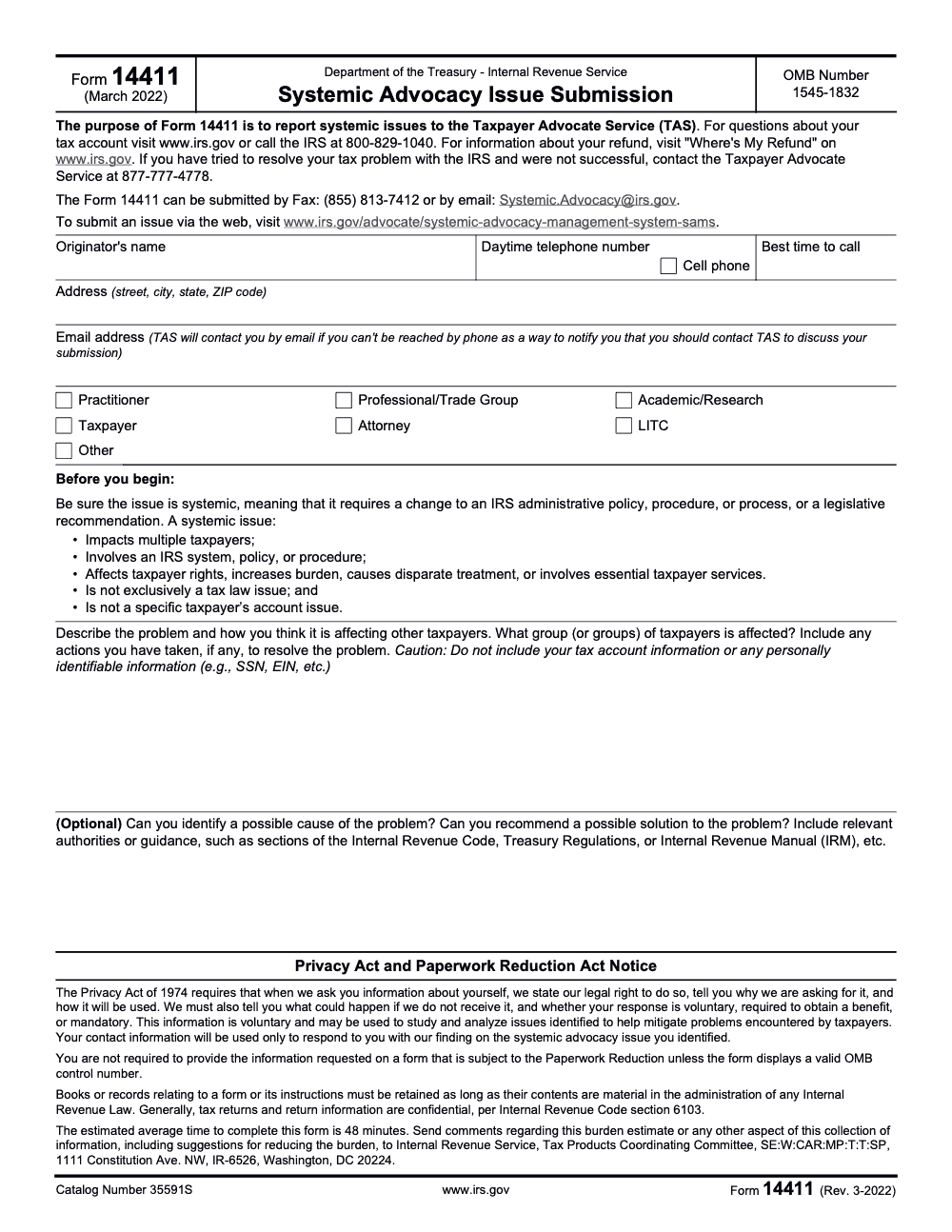
Form 14411, the Systemic Advocacy Issue Submission (Rev. 3-2022), reports IRS-wide policy, procedure, or process problems affecting multiple taxpayers to the Taxpayer Advocate Service – not a single account dispute. It is voluntary, carries no filing deadline, and goes to TAS by fax at (855) 813-7412, by email to Systemic.Advocacy@irs.gov, or through the SAMS portal on IRS.gov (per the Form 14411 instructions, OMB No. 1545-1832). For one taxpayer’s own case, use Form 911 or call the IRS at 800-829-1040.
Most people reach for Form 14411 thinking it will fix their own account, and that is the wrong tool. Form 14411 is the Systemic Advocacy Issue Submission, meant for IRS-wide policy, procedure, or process problems that hit many taxpayers at once. For one taxpayer's own case, the form is Form 911. Mixing the two just sends your problem to the wrong queue.
There is no deadline and anyone can file, so the question is really when a pattern is worth reporting. A useful rule: when the same IRS error lands on two or more unrelated clients in the same period, log it centrally, and treat three occurrences as a systemic pattern worth submitting to the Taxpayer Advocate Service by fax, email, or the SAMS portal.
Key Takeaways
- Form 14411 is used to report systemic IRS problems – issues affecting multiple taxpayers due to IRS policies, procedures, or practices rather than individual case errors – to the Taxpayer Advocate Service’s Office of Systemic Advocacy.
- Who files: Anyone – taxpayers, practitioners, organizations, or members of the public – who identifies a pattern of IRS behavior or process that is causing harm to a broad group of taxpayers.
- No deadline: Submit whenever you identify a systemic issue; earlier submissions give TAS more time to evaluate and act before the problem compounds.
- Key distinction: Form 14411 is not for individual case problems – use Form 911 (Request for Taxpayer Advocate Service Assistance) for individual cases. Form 14411 is for IRS-wide problems.
- SOP tip: When you see the same IRS error affect two or more unrelated clients in the same period, document it in a centralized log; three occurrences is typically a systemic pattern worth submitting.
What Form 14411 Is and When to Use It
Form 14411, “Systemic Advocacy Issue Submission Form,” is used to bring systemic IRS problems to the attention of the Taxpayer Advocate Service’s Systemic Advocacy Management System (SAMS). Systemic advocacy is TAS’s function of identifying and addressing broad IRS practices that harm multiple taxpayers at once, as opposed to helping individual taxpayers resolve their specific cases. For an individual account problem, the right channel is the IRS at 800-829-1040, or the Taxpayer Advocate Service at 877-777-4778 if you have already tried to resolve it through normal IRS channels without success.
The Taxpayer Advocate Service was created by Congress to be an independent voice within the IRS for taxpayer rights. TAS’s systemic advocacy work leads to formal recommendations to the IRS Commissioner, changes to IRS guidance and procedures, and in some cases legislative recommendations. Form 14411 is how practitioners and taxpayers feed information into this process.
What Qualifies as a Systemic Issue
A systemic issue is a problem rooted in IRS policy, procedure, or practice that affects a broad group of taxpayers – not just one person or one case. It must stem from how the IRS administers the law and cannot be exclusively a tax-law issue – a disagreement with how Congress wrote a provision does not qualify unless it ties to an IRS administrative process or supports a legislative recommendation. Examples include: IRS notices that are poorly designed and routinely misunderstood, processing delays affecting an entire class of filers, incorrect IRS mathematical computations applied consistently across a return type, identity theft protocols that create unnecessary hardship for victims, and IRS website or online account failures affecting large numbers of users.
Form 14411 vs. Form 911
This distinction matters in practice. If your client is experiencing hardship because of a specific IRS action or inaction in their individual case – a frozen refund, a missing return, a collection action while in compliance – the right tool is Form 911, which triggers a TAS case assignment. Form 14411 is for when you see the same type of IRS failure affecting multiple clients or categories of taxpayers, and you want TAS to address the underlying cause rather than just individual cases.
How to Complete Form 14411
Form 14411 is a narrative form that asks you to describe the systemic issue clearly and concisely. The quality of the description determines whether TAS opens a systemic advocacy project.
| Section | What to Include | Practitioner Tips |
|---|---|---|
| Submitter Information | Name, organization (if applicable), address, phone, email | TAS may contact you for follow-up information; provide a direct phone number; the form requires originator contact fields, so completing them lets TAS follow up |
| Issue Description | Clear, specific description of the systemic problem: what the IRS is doing (or not doing), why it is wrong or harmful, and what law, regulation, or procedure is implicated | Be specific – “IRS is sending notices with incorrect math on EITC recapture” is far more useful than “IRS notices are confusing.” Cite the specific notice number or IRM provision if known. |
| Who Is Affected | Describe the population of taxpayers affected – type, number (estimated), geographic scope if relevant | TAS prioritizes issues affecting larger groups; quantify impact where you can even if estimates are rough |
| Examples | Specific cases (anonymized) or data points illustrating the problem | Two or three concrete examples make the submission compelling; describe what happened, what IRS action caused it, and what harm resulted. Do not include any tax account information or personally identifiable information (e.g., SSN, EIN) in the narrative – the form explicitly cautions against it |
| Supporting Documentation | Copies of notices, IRS correspondence, screen shots of website errors, or other documentation illustrating the issue | Attach everything that directly supports the submission; TAS reviewers need evidence, not just assertions |
| Suggested Remedy | Optional but valuable – describe what IRS change would fix the problem | Practitioners often know exactly what procedural change would resolve a systemic issue; include your recommendation even if TAS may modify it |
Submission Method
Form 14411 can be submitted online through the SAMS portal on the TAS website, by fax to (855) 813-7412, or by email to Systemic.Advocacy@irs.gov. The online portal is the preferred and fastest method. Do not mail the completed form to the IR-6526 burden-comments address (1111 Constitution Ave. NW, Washington, DC) – that address only receives Paperwork Reduction Act comments, not Form 14411 submissions. After submission, TAS assigns a reference number you can use to follow up on the status of your systemic advocacy issue.
Deadlines, Penalties, and Filing Requirements
Form 14411 has no filing deadline and no associated penalties. It is a voluntary submission to TAS’s systemic advocacy function. Timing considerations are practical rather than regulatory.
| Consideration | Notes |
|---|---|
| Best time to submit | As soon as you identify a clear pattern; TAS can act faster if the issue is ongoing |
| TAS review timeline | TAS reviews all submissions but does not guarantee a response timeline; complex systemic issues may take months to evaluate |
| TAS case outcomes | TAS may open a systemic advocacy project, refer the issue to the relevant IRS function, issue a Taxpayer Advocate Directive, or determine no further action is warranted |
| Transparency | TAS publishes its Most Serious Problems report annually; issues raised through Form 14411 sometimes appear in this report |
How TAS Uses Systemic Advocacy Submissions
The Taxpayer Advocate Service reviews all Form 14411 submissions and uses them to inform its systemic advocacy priorities. TAS’s systemic advocacy function can result in several types of outcomes, each with a different scope of impact.
Taxpayer Advocate Directives
In cases where TAS identifies a clear violation of taxpayer rights or a significant systemic problem, the National Taxpayer Advocate can issue a Taxpayer Advocate Directive (TAD) requiring the IRS to take specific corrective action. TADs are relatively rare and reserved for significant issues, but they represent the strongest form of TAS systemic advocacy action. IRS operating divisions must either comply or appeal to the Deputy Commissioner.
IRS Guidance and Procedure Changes
Many systemic advocacy outcomes are less formal but still meaningful – TAS works with IRS operating divisions to update notices, revise processing procedures, or improve IRM guidance. These changes rarely result in public announcements, but practitioners who submitted Form 14411 on a specific issue sometimes notice the correction in subsequent IRS behavior.
Annual Report to Congress
The National Taxpayer Advocate’s Annual Report to Congress identifies the Most Serious Problems facing taxpayers, many of which originate from patterns identified in Form 14411 submissions. If you have submitted on an issue and it appears in a subsequent Annual Report, the submission contributed to that identification even if no individual acknowledgment was provided.
Common Mistakes That Slow Things Down
The same handful of errors send Form 14411 submissions to a dead end before TAS ever opens a systemic advocacy project. Here are the patterns I see most often, and how to keep your submission in the right queue.
Practical Checklists You Can Reuse
These checklists are copy-paste ready for your firm SOP, so a Form 14411 submission moves from spotted pattern to filed in one clean pass. Cite the Form 14411 instructions as your source of record for each step.
Systemic-issue qualification check
- Confirm the problem stems from an IRS policy, procedure, or process, not a single client error.
- Verify it affects multiple taxpayers rather than one account.
- Check that it touches taxpayer rights or creates undue burden.
- Rule out a pure tax-law disagreement with no administrative angle.
- Decide whether Form 911 fits better for any individual cases involved.
- Estimate how many taxpayers are affected and the geographic scope.
Submission packet prep
- Draft a specific issue description: what the IRS does or fails to do, and the resulting harm.
- Add two or three anonymized examples that illustrate the pattern.
- Strip every SSN, EIN, and account number from the narrative and exhibits.
- Attach supporting notices, correspondence, or screenshots of system errors.
- Add the optional cause and recommended fix, with IRC, Treasury Reg, or IRM cites if known.
- Complete the originator contact fields so TAS can follow up.
Submit and track
- Choose a channel: SAMS portal on IRS.gov, fax (855) 813-7412, or email Systemic.Advocacy@irs.gov.
- Do not mail the form to the IR-6526 burden-comments address.
- Budget the IRS-estimated 48 minutes of completion time when you schedule the work (per the Form 14411 Paperwork Reduction Act notice).
- Save the SAMS reference number for follow-up.
- Log the submission in your firm tracker with the issue and date.
- Watch the National Taxpayer Advocate annual report for related findings.
Keep 14411 Season From Stalling
Form 14411 has no filing season and no deadline, which is exactly why it stalls. Systemic IRS failures usually surface during the busiest filing windows, when one notice error or a stuck online account shows up across several clients at once, and that is the moment no one has time to spare. The IRS estimates 48 minutes to complete a single submission (per the Form 14411 Paperwork Reduction Act notice), so a voluntary filing with no due date quietly drops to the bottom of the list.
The fix is to treat systemic-issue capture as a standing process, not a heroic end-of-season effort. When the pattern is logged as it happens and the narrative is drafted from a template, the actual submission takes minutes instead of an afternoon.
- Keep a shared log of repeat IRS errors across unrelated clients, with the notice number and date for each occurrence.
- Pre-draft the issue-description block so it names the IRS process, the affected group, and the harm in plain terms.
- Build an anonymization step that strips every SSN and EIN before examples enter the narrative.
- Standardize the channel on the SAMS portal so reference numbers are captured and tracked.
- Assign a reviewer to confirm the issue is systemic, not an individual case better suited to Form 911.
That documentation discipline is the same muscle that keeps every other return moving. Our tax delivery teams build the logs, templates, and review steps that turn a scattered observation into a clean, submittable record, so spotting a systemic issue never competes with the work in front of you.
FAQs
Form 911 (Request for Taxpayer Advocate Service Assistance) is used when an individual taxpayer is experiencing economic hardship or an IRS action that is causing specific harm in their case. TAS opens a case and assigns a caseworker. Form 14411 is for systemic issues – IRS procedures or practices affecting multiple taxpayers – and is handled by TAS’s Office of Systemic Advocacy rather than the case advocacy function.
TAS may contact you for additional information, but it does not guarantee a response to every submission. If you provided contact information, TAS can reach out if they need clarification, and any contact information you provide is used only to respond to you with TAS’s finding on the systemic advocacy issue you identified. TAS does not publish individual submission outcomes, but significant systemic issues may appear in the National Taxpayer Advocate’s annual reports.
Appropriate issues include: IRS notices with consistent errors, processing delays affecting entire categories of filers, IRS online systems failures, IRS math errors applied systematically, identity theft procedures that create undue hardship, and any IRS policy that you believe violates taxpayer rights. Single-client issues should go through Form 911 instead.
Yes. Tax professionals frequently file Form 14411 based on patterns they observe across multiple clients. You should anonymize client information when providing examples, but describing the pattern based on your professional experience is exactly the kind of submission TAS values. Professional associations and advocacy organizations also submit Form 14411 referrals on behalf of their members.
About this guide
Accountably helps US CPA, EA, and accounting firms hire trained accountants and tax preparers in India.
About us Reviewed byJugal Thacker, CPAFounder and CEO at Accountably
A Washington-licensed CPA with 7+ years inside US firms – PwC, a real-estate tax practice, then a full-service firm, rising from reviewer to manager to advisory. This article was reviewed against current IRS guidance for the 2025 tax year and updated for filers preparing late returns, amendments, and 2026 estimates.
View profile →How we research, review, and update this guide
Every Accountably guide is researched against primary IRS sources, reviewed by a U.S. CPA, and refreshed as guidance evolves. Read our Editorial Guidelines to see how we source, fact-check, and update our content.