Summarize this article with AI
In Brief
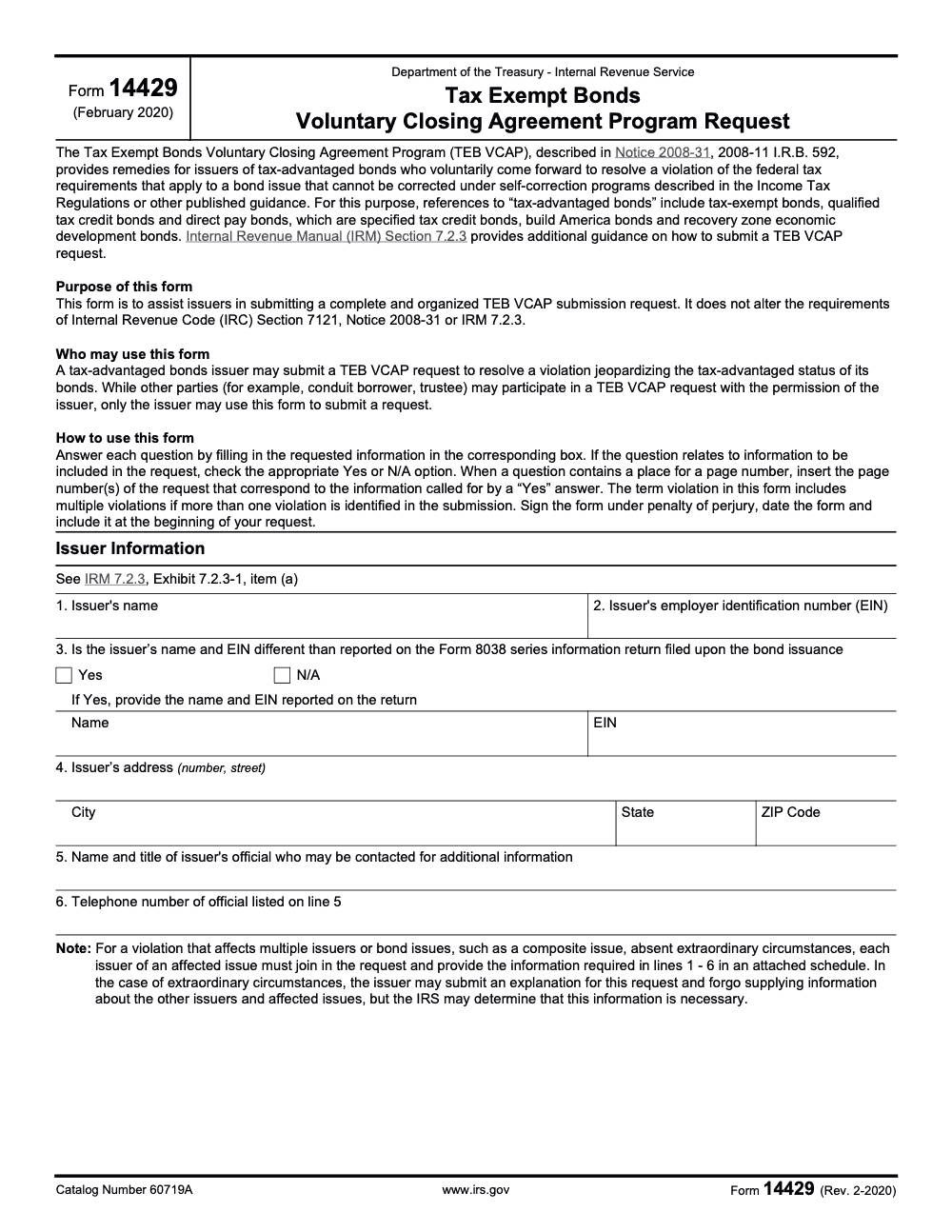
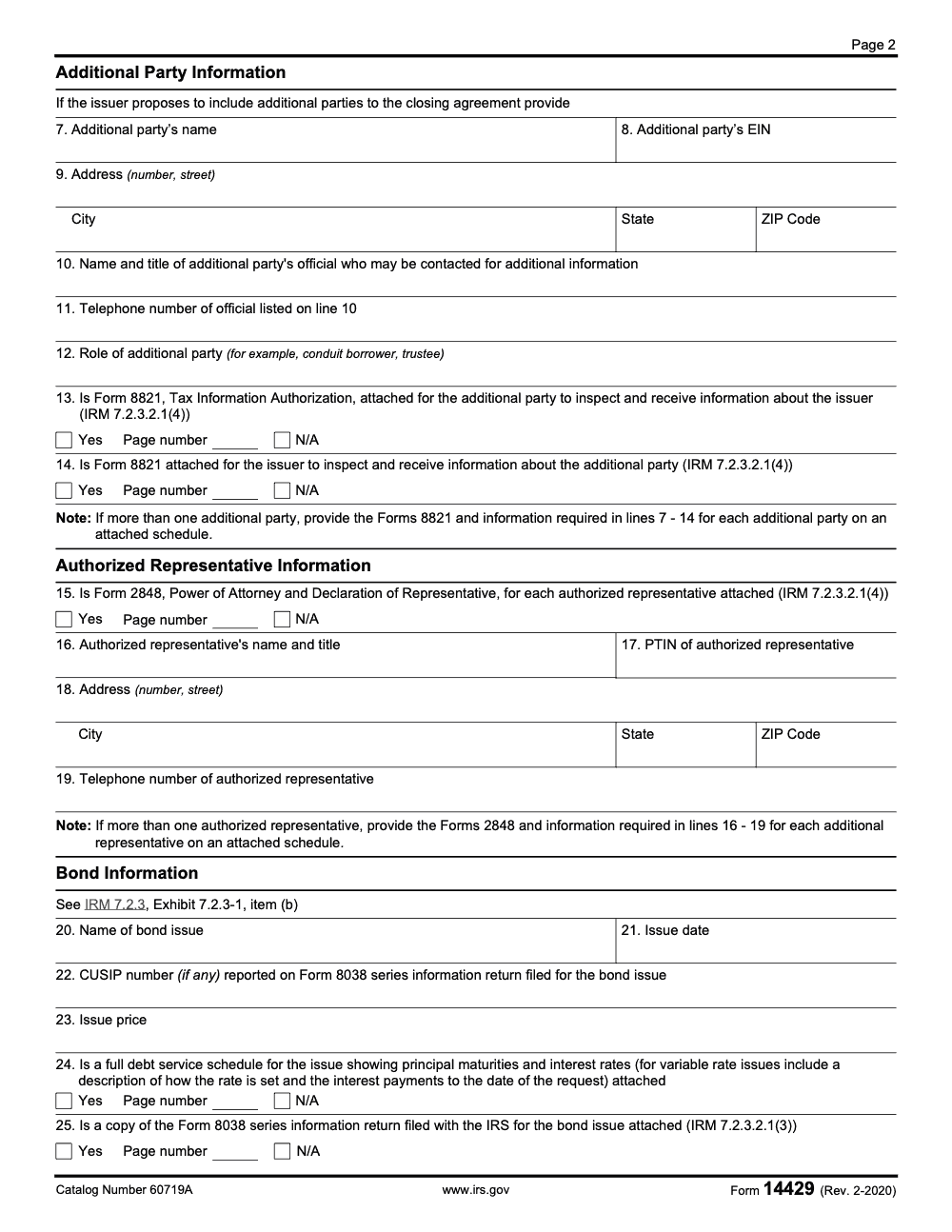
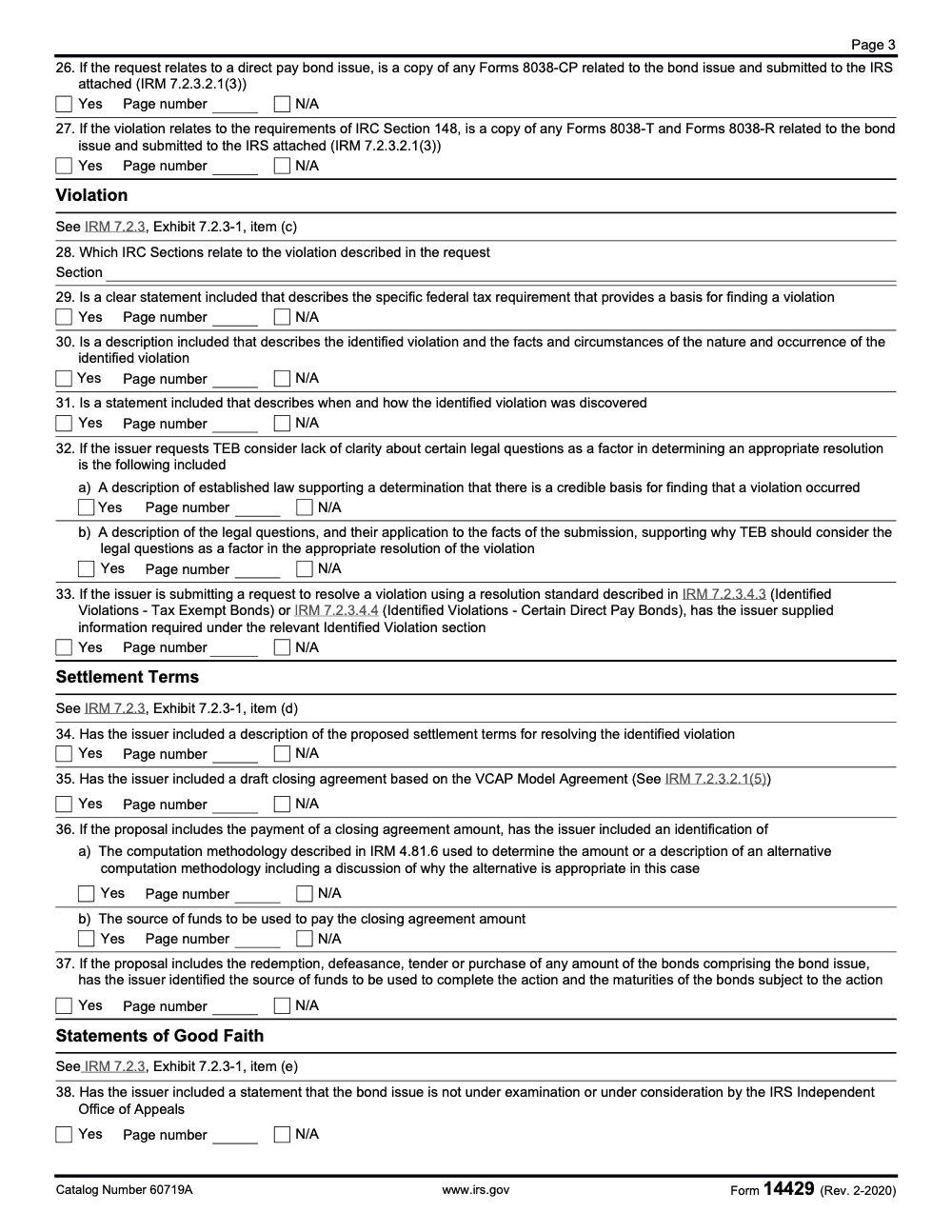
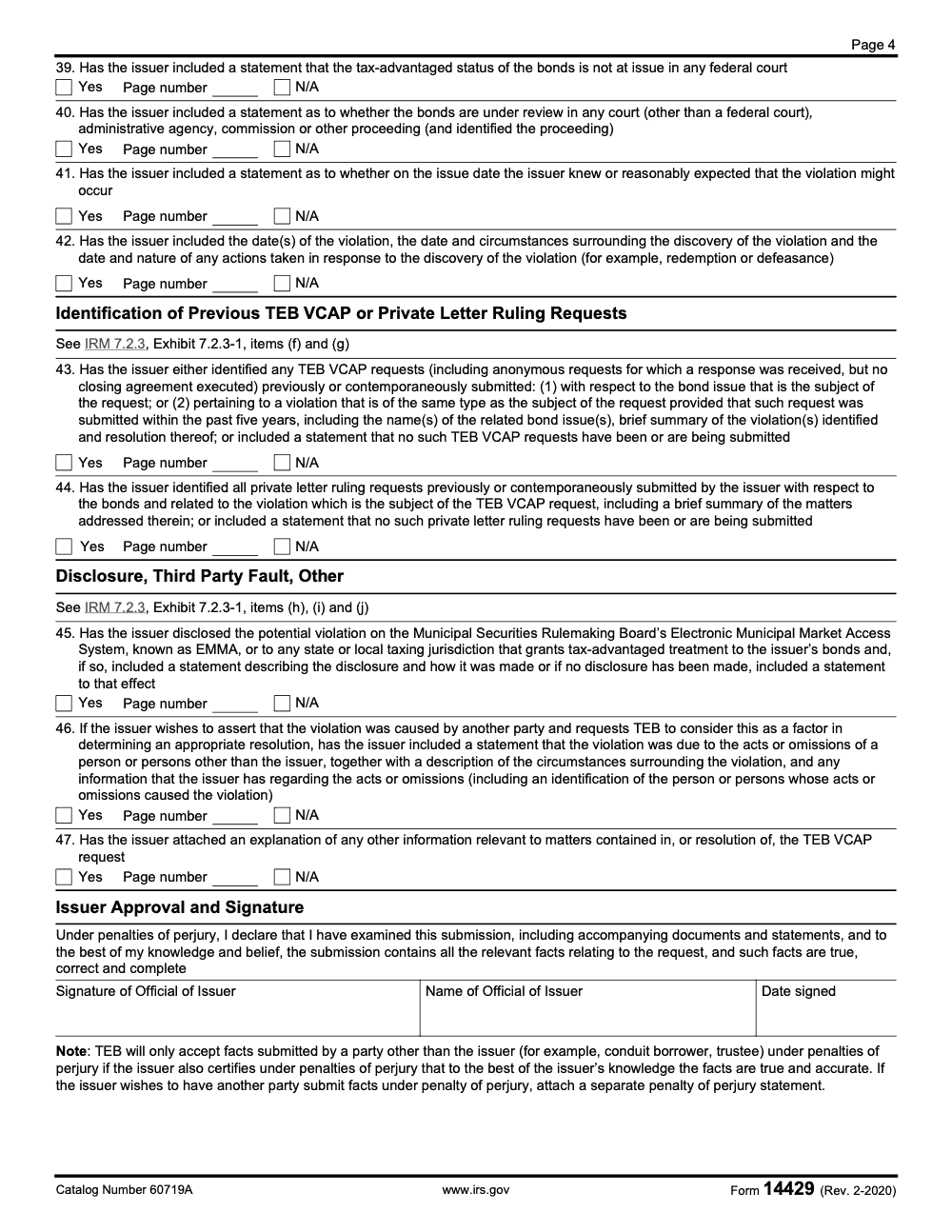
Form 14429 is the Tax Exempt Bonds Voluntary Closing Agreement Program (TEB VCAP) request – filed only by the issuer of tax-advantaged bonds to disclose a non-self-correctable violation and propose a closing agreement under IRC §7121 (per IRS Notice 2008-31, 2008-11 I.R.B. 592). The current Rev. 2-2020 version runs 4 pages and 47 numbered lines; line 35 requires a draft closing agreement based on the VCAP Model Agreement (IRM 7.2.3.2.1(5)), and line 43 requires a 5-year lookback of prior VCAP requests for the same type of violation. See our taxation services or the IRS Forms library for related guidance.
An issuer of tax-advantaged bonds discovers a violation that cannot be self-corrected, and the instinct is to wait and hope the IRS never asks. Form 14429 is the better move: it requests entry into the Tax Exempt Bonds Voluntary Closing Agreement Program so the issuer can disclose the problem, document the cure, and propose a closing agreement under IRC §7121 before an examiner finds it.
The current Rev. 2-2020 version runs four pages, and two lines carry the weight. Line 35 requires a draft closing agreement built on the VCAP Model Agreement, and line 43 requires a five-year lookback of prior VCAP requests. The form tracks the procedures in Internal Revenue Manual 7.2.3, and requests go to TEB by secure email or to the Ogden FAST address listed in the IRM. Only the issuer of the bonds can file it.
Key Takeaways
- Form 14429 is how you request TEB VCAP, the IRS program that lets issuers voluntarily resolve material, non‑willful violations on tax‑advantaged bonds through a closing agreement (VCAP only covers violations that cannot be corrected under self‑correction programs in the Income Tax Regulations or other published guidance, so confirm no self‑correction path applies first).
- The form and its checklist align with IRS Internal Revenue Manual 7.2.3, which also describes required items, case intake, and closing procedures.
- The form’s current revision is Rev. 2‑2020, confirmed on the IRS PDF, and it is still listed on IRS tax‑exempt bond forms pages reviewed in June and July 2025.
- You submit a signed Form 14429 with a fact‑specific narrative, proposed corrections, support like bond transcripts and legal opinions, a model closing agreement, and required statements under penalties of perjury.
- TEB accepts requests by secure email to TEBVCAP@irs.gov or by mail to the Ogden, Utah FAST M/S 114 address listed in the IRM, subject to any superceding address on irs.gov.
What Form 14429 Does For You
Form 14429 is the door you open before the IRS knocks.
At a practical level, Form 14429 helps you do three things well.
- You disclose a material, non‑willful compliance failure early, on your terms.
- You propose a clear corrective plan with documents that prove your fix will work.
- You request a negotiated closing agreement that preserves tax‑advantaged treatment and gives bondholders certainty.
Unlike a private letter ruling, a VCAP closing agreement is about resolving the past, not blessing future facts. It is cooperative, time bound, and designed to encourage due diligence without dragging you through a full exam.
Why Teams File Before The IRS Finds It
When you discover a problem first, you control the record. TEB’s intake group checks for an ongoing audit, and if your issue is already under exam, VCAP is not available. That is why speed matters. The IRM shows exactly how intake reviews your file, what is required to perfect a submission, and how they correspond if something is missing.
Filing early can also help with penalty outcomes. You demonstrate good faith, you document the cure, and you invite a resolution that fits the facts, including any payment, redemption, or yield actions, all memorialized in the agreement.
What You Include, At A Glance
Here is the quick reference I use when helping a team assemble their package.
| Item | What TEB Expects | Why It Matters |
| Signed Form 14429 | Current Rev. 2‑2020, completed and signed under penalties of perjury | Opens the case in the right program. |
| Form 8038 copy | Filed for the issue, plus 8038‑CP, 8038‑T, 8038‑R if relevant | Links your submission to IRS records. |
| Compliance narrative | Facts, dates, amounts, discovery, and scope | Gives TEB a reliable timeline. |
| Proposed correction | Method, timeline, funding source, and effects | Shows a workable cure, not just intent. |
| Model closing agreement | Draft based on VCAP model language | Required, speeds negotiation. |
| Support docs | Bond transcript, trustee reports, computations, opinions | Substantiates the fix and the math. |
| Good‑faith statements | No IRS exam, litigation status, discovery details | Confirms eligibility and posture. |
A word on version control
IRS pages for tax‑exempt bonds confirm Form 14429 is still the right vehicle in 2025. Always download it from irs.gov, not a third‑party mirror, and keep a PDF copy of the exact revision you filed in your records.
Who Should Use Form 14429
You should file if you are the issuer of tax‑advantaged bonds, you have identified a non‑willful, material violation, and the bonds are not under IRS examination, under consideration by the IRS Independent Office of Appeals, or at issue in any federal court (any one of those three forecloses VCAP relief). Other parties, like a conduit borrower or trustee, can participate, but the issuer is the one who files and signs. Anonymous requests have special procedures, which the IRM outlines, but those do not use the form in the same way.
- You protect bondholder confidence.
- You pause the uncertainty that drains staff time.
- You replace doubt with a plan, evidence, and a draft agreement.
Typical issues VCAP can resolve
- Excess arbitrage earnings, late or missed rebate or yield reduction
- Private business use over the limits, remedial actions needed
- Proceeds allocations or reimbursements that missed timing rules
- Documentation gaps that affect tax representations
These are classic examples from real issuer files, and they are the kinds of matters the IRM’s identified violation standards discuss for tax‑exempt and certain direct pay bonds.
How The VCAP Process Flows
Think in three stages, request, review, resolution.
- Request You email your submission to TEBVCAP@irs.gov or mail it to the Ogden FAST address. Your package includes the signed form, the narrative, key exhibits, a model agreement, and required statements. Intake checks for completeness and for any existing examination. If something is missing, they send a letter with a short due date to perfect the file.
- Review A specialist is assigned. They confirm the facts, analyze your proposed cure, and discuss any adjustments. You may be asked for clarifications or an updated draft agreement. This is collaborative and time bound.
- Resolution You finalize the closing agreement, sign, and make any required payment through EFTPS. The specialist returns fully executed copies, or closes the case by letter if an agreement is not needed. The IRM describes the transmittal letters and closing steps.
What, How, Wow
- What, Form 14429 is the entry ticket to VCAP.
- How, you submit a complete, documented story with a working fix and a draft agreement.
- Wow, you convert a scary unknown into a written, final IRS resolution that protects tax exemption and lets your team get back to service.
Example Narrative, The Right Level Of Detail
Keep it factual, dated, and tied to documents.
- Issue, City Public Facilities Revenue Bonds, Series 2020A, issued 07,01,2020, original principal 85,000,000, CUSIP 123456AB1.
- Problem, arbitrage earnings of 412,785 accrued in the project fund between 10,01,2021 and 09,30,2023, missed timely rebate under section 148(f).
- Discovery, internal audit on 11,06,2023, confirmed by trustee reports.
- Interim actions, segregated excess earnings 11,15,2023, computed rebate 11,17,2023, wired payment 11,27,2023, obtained counsel opinion 12,01,2023.
- Proposed resolution, include computations, source of funds, and a draft closing agreement that documents the cure and any monitoring commitments.
This is the structure TEB expects, and it maps neatly to the questions on the form, including bond identifiers, discovery date, violation period, and corrective steps.
Benefits You Can Actually Feel
- Certainty, a binding agreement that preserves tax‑advantaged status
- Control, your narrative, your evidence, your timeline
- Focus, less partner or director time in back‑and‑forth review, more time on strategy
- Credibility, a record that shows diligence to auditors, rating agencies, and boards
When you file before IRS discovery, the tone of the resolution is almost always better than when you wait for an exam letter. The IRM also reminds specialists to tailor agreements to facts, which is your chance to present something practical and fair.
Step‑By‑Step, Completing Form 14429
Step 1, Get the right form
Download the current PDF directly from irs.gov, confirm the revision line shows “Form 14429, Rev. 2‑2020,” save an unedited copy, then work from a duplicate. This keeps your evidence trail clean and avoids stale versions found on third‑party sites.
- Use a PDF tool that preserves fillable fields.
- Lock the final signed version in your records system.
- Store the catalog number and revision date in your index, it helps later.
Step 2, Read what the IRS will look for
Open the TEB VCAP program page and IRM 7.2.3. Note the required items, the need for a model closing agreement, and the specific statements under penalties of perjury. Flag the intake email and mail stop in your checklist.
- Confirm you are not under exam, VCAP is not available if you are.
- List every attachment the IRM calls out, including the signed Form 8038 for the issue.
- Note the short response window if intake asks for missing items.
Step 3, Gather everything before you type
Collect issuer identifiers, the bond’s issue name and date, CUSIPs if available, and the Form 8038 copy. Pull trustee statements, rebate or yield calculations, any 8038‑T or 8038‑R for section 148 issues, counsel opinions, board minutes, and borrower communications if a conduit is involved. Have your discovery memo and timeline ready, then reconcile dates to each exhibit.
Aim for a file that an outsider could pick up and understand in 15 minutes.
What To Write In Each Core Section
- Issuer Information, legal name, EIN, address, contact, and a note if different from the name on the original Form 8038. Include authorized representative details and attach Form 2848 if you want counsel to speak for you (each authorized representative needs a separate Form 2848, with lines 16–19 information for each additional representative on an attached schedule).
- Bond Information, issue name, date, issue price, debt service schedule, and a copy of the Form 8038. Add 8038‑CP for direct pay bonds, 8038‑T or 8038‑R for section 148 matters.
- Violation, cite the Code section, state the rule you missed, describe facts, discovery date, and scope. If there is legal uncertainty, describe it and why it should influence resolution terms.
- Settlement Terms, spell out your cure, include a draft agreement that mirrors the IRS model, explain the computation method for any payment and the source of funds, and list any redemptions or defeasance actions with maturities.
- Good‑Faith Statements, confirm you are not under IRS exam or litigation on the issue, and list discovery and actions taken so far.
Submission mechanics
Email the package to TEBVCAP@irs.gov, or mail to the IRM’s Ogden FAST address, watching irs.gov for any posted superseding address. Include contact info for the signer so TEB can reach you quickly, and keep proof of transmission with a contents list.
Documentation That Speeds Review
Think like a reviewer. They want to trace facts to documents, dates to ledgers, and calculations to methods.
- Bond transcript, final official statement, indenture, tax certificate
- Trustee statements and investment records that tie to the violation period
- Arbitrage yield, rebate, or yield reduction calculations with workpapers
- Board resolutions approving corrective steps and funding sources
- Legal opinion that explains why the fix restores compliance
- Any EMMA or investor notices, if you made disclosure, as the form asks whether you did so
The February 2020 form includes a question about public disclosure. The IRM also states that, for older versions, a disclosure question could be disregarded, but the current revision prints it as Question 45, so answer it clearly, either way.
A worked example, section 148 issue
- Facts, earnings above yield accrued in the project fund in four year‑end cycles, 12,31,2021, 06,30,2022, 12,31,2022, 06,30,2023.
- Discovery, internal audit 11,06,2023, confirmed by trustee data.
- Actions taken, segregated earnings 11,15,2023, computed rebate 11,17,2023, wired by 11,27,2023, counsel opinion dated 12,01,2023.
- Proposed settlement, close with payment already made and monitoring commitments, no redemption needed, include method under IRM 4.81.6 references for computation and source of funds statement in the draft agreement.
Turnaround, Communication, And Closing
Intake sends a perfection letter if they need more, usually with 21 business days to respond. Once assigned, the specialist will share edits or ask for clarifications, then circulate a final agreement for signature. After signatures and any EFTPS payment, TEB returns fully executed copies and closes the case, documenting the record in RCCMS.
The fastest files are the ones that read like a clean audit binder.
Common pitfalls to avoid
- Vague timelines, fix this with a dated chronology that matches exhibits
- Missing Form 8038 copy, include it every time, along with 8038‑CP, 8038‑T, or 8038‑R when applicable
- No model closing agreement, include it with your proposed terms
- Unclear source of funds for any payment or redemption
- Submitting while under exam, VCAP is not available then
Where Accountably Fits, Only If You Need It
Some issuer teams are at capacity. If you prefer to keep strategy in house and have a disciplined partner assemble the binder, reconcile computations, and format the draft agreement and index, Accountably can help. We are a U.S.‑led offshore operations partner that builds documented workflows, version‑controlled workpapers, and multi‑layer review so your counsel and finance leadership can focus on decisions, not assembly. Use us only where it adds control and speed, and always keep your bond counsel in the lead.
- SOP‑driven document prep
- Structured workpapers that cut review time
- Secure, role‑based access and zero local storage policies
Mentioning us here is appropriate because documentation discipline makes or breaks a fast VCAP file.
Compliance Note
This guide is for education, not legal advice. Form 14429 and VCAP submissions should be coordinated with your bond counsel, disclosure counsel, and advisors. Always confirm current IRS instructions and addresses on the day you file.
Common Mistakes We See Every Season
Most TEB VCAP submissions stumble on the same handful of details every cycle – authority, scope, and attachment math. Here are the patterns my team flags most often when reviewing draft Form 14429 packages.
Reusable Checklists
These three checklists are written to drop straight into your firm SOP for any TEB VCAP engagement. Each item maps to a specific line, attachment, or IRM citation on Form 14429.
Pre-Submission Packet Audit
- Issuer perjury block signed and placed at the beginning of the package.
- Issuer name and EIN on lines 1-2 reconciled against the Form 8038 series return; any mismatch explained at line 3.
- Two Forms 8821 attached per additional party (lines 13 and 14) and one Form 2848 per representative (line 15).
- Form 8038 series return copy attached and page-cited at line 25.
- Forms 8038-CP attached only if direct pay bonds (line 26); Forms 8038-T and 8038-R attached only for IRC §148 arbitrage violations (line 27).
- Full debt service schedule attached at line 24, including variable-rate methodology and historical interest payments if applicable.
- Draft closing agreement based on the IRM 7.2.3.2.1(5) Model Agreement attached and cited at line 35.
Violation Narrative Build
- List each IRC section that frames the violation at line 28.
- Plain-language statement of the federal tax requirement at issue at line 29.
- Description of facts, nature, and timing of the violation at line 30.
- Discovery statement covering when, how, and by whom at line 31.
- If invoking legal ambiguity as a resolution factor, complete line 32(a) and 32(b); otherwise mark N/A.
- If using an Identified Violation resolution standard, complete line 33 under IRM 7.2.3.4.3 (tax exempt bonds) or IRM 7.2.3.4.4 (certain direct pay bonds).
- Reconcile violation date, discovery date, and remedial action date on line 42 against the line 30 description.
Statements of Good Faith Sweep
- Affirm the bond issue is not under examination or IRS Independent Office of Appeals consideration at line 38.
- Affirm tax-advantaged status is not at issue in any federal court at line 39.
- Disclose any non-federal court, administrative agency, commission, or other proceeding at line 40.
- State whether the issuer knew or reasonably expected the violation on the issue date at line 41.
- Complete the 5-year lookback of prior or contemporaneous VCAP requests at line 43, including anonymous submissions with non-final responses.
- Disclose related private letter ruling requests at line 44, or affirm none exist.
- State EMMA disclosure and any state or local taxing jurisdiction disclosure at line 45, even when no disclosure was made.
- If asserting third-party fault, identify the responsible party and circumstances at line 46; otherwise mark N/A.
Keep 14429 Season From Stalling
TEB VCAP packages stall in review for the same reason most compliance projects stall – the work is gated by a small number of attachments that the IRS reviewer needs in a specific order. Form 14429 in its current Rev. 2-2020 form runs 4 pages and 47 numbered lines across 8 named sections (per IRS Form 14429, Rev. February 2020), and a single missing Form 8821 direction or a non-Model closing agreement at line 35 can push the case off the next reviewer cycle.
The fix is not faster drafting. It is a tighter intake checklist and an attachment ledger that mirrors the IRM 7.2.3 exhibit structure, so the same package clears review on the first pass instead of cycling through clarification requests.
- Pre-build an attachment ledger that maps each Yes / page-number response on lines 13, 14, 15, 24-27, 29-37, and 38-46 to a tabbed exhibit before the issuer signs.
- Lock the line 35 draft to the IRM 7.2.3.2.1(5) Model Agreement template; track any deviation in a side memo, not in the agreement itself.
- For IRC §148 arbitrage violations, assemble the Forms 8038-T and 8038-R attachments at line 27 before drafting the closing-agreement computation under IRM 4.81.6 at line 36(a).
- Run the 5-year lookback at line 43 against issuer, current counsel, and predecessor counsel files – including anonymous TEB VCAP requests that received a non-final response.
- Reconcile violation date, discovery date, and remedial action date on line 42 against the line 30 violation narrative so timestamps match across the package.
That is what disciplined offshore preparation buys: the attachment ledger built, the line-cited exhibits indexed, the lookback documented, and the package handed back to bond counsel for signature in one clean pass. Our taxation services integrate this work into the engagement so the IRS review cycle is the only constraint left.
FAQs
Only the issuer files and signs. Other parties, like a conduit borrower or trustee, can be included as additional parties with proper authorizations, but the issuer is the applicant. Anonymous requests have their own process under the IRM.
Yes. The IRS PDF shows “Form 14429, Rev. 2‑2020,” and IRS TEB pages reviewed in June and July 2025 still list it as the operative form. Always download from irs.gov to avoid stale copies.
Email to TEBVCAP@irs.gov, or mail to the IRM’s Ogden FAST M/S 114 mail stop, unless the IRS site posts a superseding address, which would control. Include a complete contact block for quick follow up.
Yes. The TEB VCAP page states you must include a model agreement with your submission, and per IRM 7.2.3.2.1(5) your draft must be based on the VCAP Model Agreement template, not a custom‑drafted version. It speeds review and sets shared expectations for terms.
VCAP is generally unavailable if the issue is under examination or under consideration by the IRS Independent Office of Appeals. Intake checks audit and Appeals status as part of case set up and will return ineligible requests.
No. VCAP agreements resolve past violations for the bonds at issue. They are not private letter rulings and do not conclusively resolve future events.
Other forms this guide names
- Form 2848: Guide to Line 3, Filing, and Rules
- Form 8821: Tax Information Authorization
- Form 8038-R: Refund Claim Guide for Arbitrage Rebate
- Form 8038‑T: Complete Filing Checklist for Rebate and Penalties
About this guide
Accountably helps US CPA, EA, and accounting firms hire trained accountants and tax preparers in India.
About us Reviewed byJugal Thacker, CPAFounder and CEO at Accountably
A Washington-licensed CPA with 7+ years inside US firms – PwC, a real-estate tax practice, then a full-service firm, rising from reviewer to manager to advisory. This article was reviewed against current IRS guidance and the Rev. 2-2020 form for issuers and bond counsel preparing TEB VCAP submissions.
View profile →How we research, review, and update this guide
Every Accountably guide is researched against primary IRS sources, reviewed by a U.S. CPA, and refreshed as guidance evolves. Read our Editorial Guidelines to see how we source, fact-check, and update our content.