Summarize this article with AI
In Brief
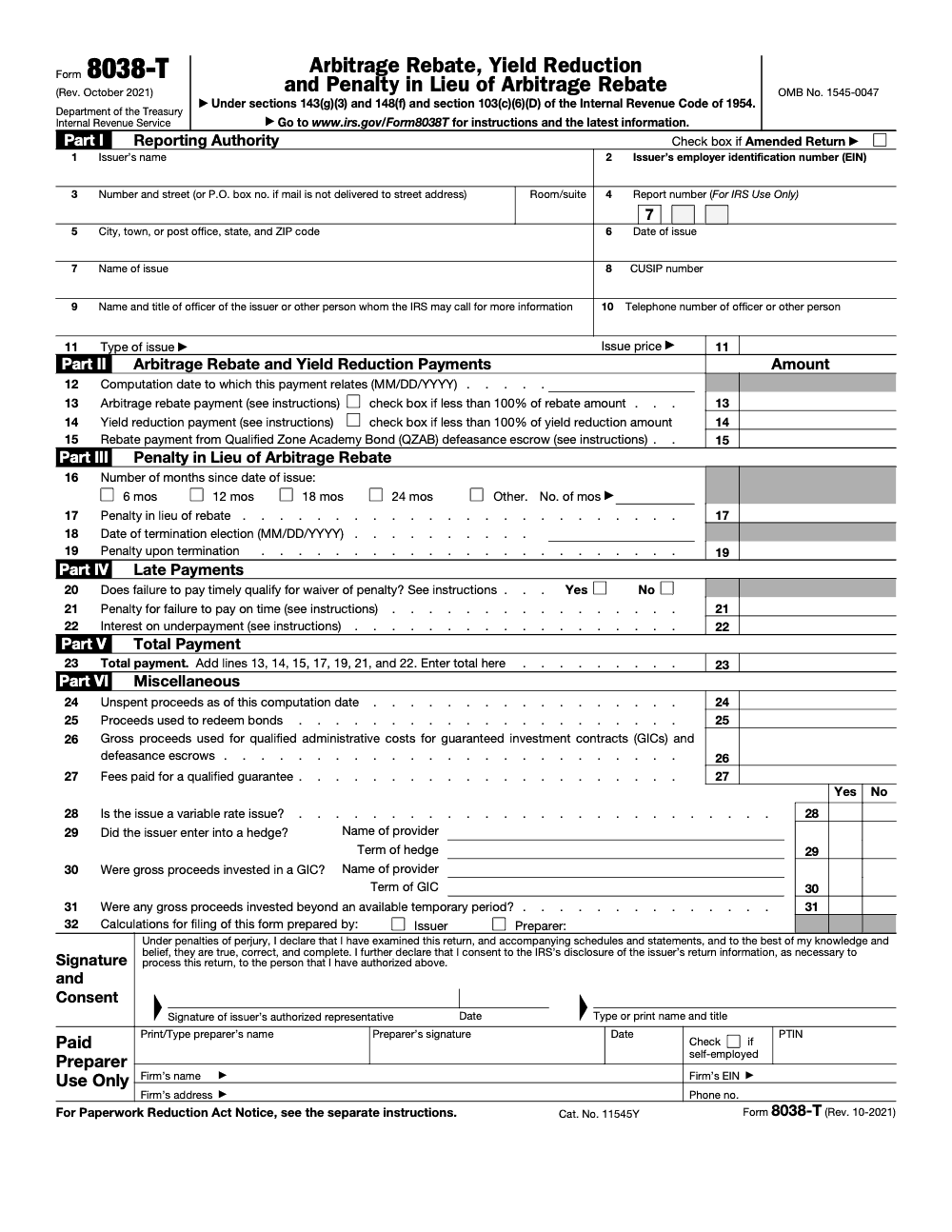
Form 8038-T is the IRS payment return for arbitrage rebate, yield reduction payments, and penalties in lieu of rebate on tax-exempt bond issues. Per the Form 8038-T instructions (October 2021 revision), the issuer files a separate return for each bond issue and each computation date, reports the payment on its dedicated line (13, 14, 15, 17, 19, 21, or 22), and totals them on Line 23 of Part V. See our tax compliance services when the calendar gets crowded.
Form 8038-T is where a bond issuer actually pays the IRS what it owes on arbitrage rebate, a yield reduction payment, or a penalty in lieu of rebate. It is not a cover sheet. The return pairs your certified calculation with the payment for one specific bond issue, and the line you use depends on what you are paying.
The structure forces discipline: a separate return for each bond issue and each computation date, with the payment totaled on Line 23 of Part V. Validate your spending exceptions first, because the 6-month, 18-month, and 2-year exceptions can wipe out rebate entirely before you pay anything. As of December 27, 2025, this one is paper filed by mail, so do not confuse it with Form 8038-CP, which does have an e-file path.
Key Takeaways
- You file Form 8038‑T to remit arbitrage rebate, yield reduction payments, or a penalty in lieu of rebate for a specific bond issue under IRC section 148. Payments are tied to five‑year computation dates, with a due date of 60 days after each computation date and within 60 days after the issue is discharged.
- Use a separate Form 8038‑T for each bond issue, and a separate return for each computation date (Line 12 ties a single payment to a single computation date, so multi‑date or multi‑issue payments require separate filings). The mailing address is currently, Department of the Treasury, Internal Revenue Service Center, Ogden, UT 84201‑0027. Keep proof of timely filing.
- The small‑issuer exception and the 6‑month, 18‑month, and 2‑year spending exceptions may eliminate rebate, so you should validate exceptions before you file or pay.
- As of December 27, 2025, Form 8038‑T is paper filed by mail, it is not e‑filed. Do not confuse it with Form 8038‑CP, which does have e‑file options through approved providers.
- Late or incorrect payments can trigger interest and corrective penalties under the arbitrage regulations. For governmental and qualified 501(c)(3) bonds, the failure‑to‑pay penalty is generally 50% of the unpaid rebate amount, plus interest, if not corrected under the rules.
What Form 8038‑T Does, And Why It Matters
Form 8038‑T is the payment return that ties your arbitrage calculation to the United States. On this form, you identify the issuer and the specific bond issue, confirm the issue price and the type of remittance, and certify the exact dollar amounts you are paying for arbitrage rebate, yield reduction, or a penalty in lieu of rebate. The IRS expects a separate filing for each bond issue, since the rules measure compliance on an issue‑by‑issue basis.
The most common miss is not the math, it is the clock and the paperwork trail that proves the math.
The timing rules are not flexible. In general, rebate payments are due in installments for computation dates that occur at least every five years, with each payment due within 60 days after the computation date. Your final payment arrives within 60 days after the bonds are discharged, for example at final maturity or upon full redemption. These dates anchor your calendar and your internal workflow, so build your schedules around them.
Who Must File, And When You Might Not
If you are the issuer of tax‑exempt bonds, or other bonds subject to section 148, and you owe arbitrage rebate or elect yield reduction payments or the penalty in lieu of rebating arbitrage, you file Form 8038‑T. You also use the form to remit penalties and interest related to a late payment under the arbitrage rules, and for certain QZAB defeasance escrow earnings when they apply.
Key exceptions that can eliminate rebate
- Small‑issuer exception, generally when a governmental issuer issues no more than 5 million in a calendar year, with modified thresholds that can increase the cap to 10 million after 1997 and 15 million after 2001 for certain school bonds, provided no more than 5 million finances non‑school purposes.
- Spending exceptions, which treat rebate as met when you spend proceeds within defined timeframes, including the 6‑month, 18‑month, and 2‑year construction exceptions. The two‑year exception coordinates with the penalty‑in‑lieu election if the schedule is missed.
When an exception fully applies, you may not owe rebate. Verify, document, and keep your exception file complete, since an exception claim is only as strong as the evidence you keep.
Filing Basics You Need On Your Desk
You complete Form 8038‑T with precise issuer and deal identifiers, then you calculate and state the amount owed for the current computation period. Mail the signed return and attachments to the IRS Ogden Service Center at the address listed below. Use approved private delivery services if needed for proof, but note that PDS cannot deliver to P.O. boxes, so follow the special street‑address directions on IRS.gov when you use a carrier. Keep a timestamped copy of everything.
Current mailing address Department of the Treasury Internal Revenue Service Center Ogden, UT 84201‑0027.
As of today’s date, December 27, 2025, there is no direct e‑file for Form 8038‑T. Some forms in the 8038 series have electronic options, most notably Form 8038‑CP via approved Modernized e‑File providers, but 8038‑T remains a paper‑filed payment return. Plan for mail time and proof of deposit.
The What‑How‑Wow Framework For 8038‑T
- What, You pay rebate, yield reduction, or penalty‑in‑lieu amounts for a specific bond issue using Form 8038‑T.
- How, You run bond‑year cash flow schedules, compute future values at the issue yield, document exceptions if applicable, and file within the precise IRS windows.
- Wow, You reduce stress and cost by structuring your workpapers, standardizing naming and version control, and aligning reviews so the signer only sees clean, final numbers with a clear trail.
A quick story from the field
In my experience, the teams that never sweat the five‑year clock always have a living binder per issue, digital or physical. It holds the 8038 initial filing, trust indenture, investment ledgers, exception tests, and the current arbitrage model with dates locked to each computation period. When the due date arrives, the signer reviews a clean summary and a one‑page certification memo. No scrambling, no guesswork.
Required Inputs And Documentation
Here is the checklist I use before anyone touches the form.
- Issuer identification, legal name, EIN, mailing address, contact person and phone.
- Issue details, issue name, issue date, CUSIP if available, issue price, bond type, and whether it is a refunding.
- Computation engine, the arbitrage model with the issue yield, nonpurpose investment cash flows, and all exception tests that apply to your proceeds.
- Payment details, the amount due for rebate, any yield reduction payment, or penalty in lieu, the method of payment, and the intended filing date that meets the 60‑day window.
- Attachments, investment earnings schedules and cash flow worksheets that support Regulations section 1.148‑3 computations, plus any election documentation.
Aim for a package that anyone on your team could defend in an exam room next year.
Step‑By‑Step, Completing Form 8038‑T
Part I, Identification
Enter the issuer and issue details exactly as they appeared on your initial 8038, 8038‑G, or 8038‑GC filing, updated for any changes, so the IRS can match your payment to the right issue.
Part II, Arbitrage rebate and yield reduction
- Report the arbitrage rebate amount due for the computation period on Line 13 (check the less‑than‑100% box on Line 13 if your payment is a partial settlement rather than the full computed rebate, since partial payments are also reportable).
- If you are making a yield reduction payment, include it on Line 14 of the same part, since these payments follow the same due dates as rebate (check the Line 14 less‑than‑100% indicator if you are remitting less than the full computed yield reduction amount).
Part III, Penalty in lieu of rebate
Use this when you made the irrevocable election tied to a construction issue and you did not meet the two‑year spending schedule. The penalty equals 1.5% of the available construction proceeds that fail the schedule. You can later terminate the election by paying 3% of unspent available construction proceeds multiplied by the number of years in the initial temporary period, along with yield restriction and related actions.
Part IV, Late payments
If you discovered a failure to pay on time, follow the correction framework. For governmental and qualified 501(c)(3) bonds, the failure‑to‑pay penalty is generally 50% of the unpaid rebate amount plus interest, if not corrected under the waiver rules (the Line 20 waiver can excuse the Line 21 penalty in qualifying cases, but the interest on the underpayment is reported separately on Line 22 and is not waived alongside the penalty). Attach your reasonable cause explanation when appropriate and compute interest at the underpayment rate beginning on the original due date.
When to file
- Rebate, pay within 60 days after each computation date, at least every five years, and within 60 days after discharge of the issue.
- Penalty in lieu, pay within 90 days after the end of the applicable spending period.
- Termination penalty, pay within 90 days of the relevant termination trigger described in section 148(f)(4)(C).
Filing Method, Address, And Proof
As of December 27, 2025, you mail Form 8038‑T to Ogden. The IRS lists the current address as, Department of the Treasury, Internal Revenue Service Center, Ogden, UT 84201‑0027. If you use a private carrier, follow the IRS’s special street‑address guidance for PDS filings. Keep tracking, proof of deposit, and a full copy of the signed package.
A quick note on e‑file, 8038‑T is not set up for direct electronic filing. Do not confuse it with 8038‑CP, which the IRS now processes electronically through approved providers. If you only file CP forms electronically, you still need to paper file 8038‑T. Plan your internal calendars around mail delivery and signature routing.
Calculations, Rebate, Yield Reduction, And Penalty Options
Determining rebate liability, your anchor points
You anchor the math to the bond yield and the timing rules. You compare the future value of actual nonpurpose investment earnings with the future value of what would have been earned at the bond yield, compounded to the computation date. That delta, net of permitted offsets, is your rebate. Each issue stands on its own, so keep separate models and bank trails by issue. File and pay within 60 days after each five‑year computation date, and within 60 days after discharge.
A simple rhythm that works in practice, identify the issue price and yield, set computation periods and bond years, compile all investment cash flows with dates, run the rebate schedules, test spending exceptions, then prepare a one‑page summary that ties every line on the form back to a named worksheet.
Yield reduction strategies, when they make sense
Sometimes you prefer to cap earnings to the issue yield rather than wait for a larger rebate bill. Yield reduction payments are computed under Regulations section 1.148‑5 and follow the same timing rules as rebate. If you adopt this path, model both outcomes, the pay‑now yield reduction and the pay‑later rebate, and choose the lower net present value after considering your administrative cost. Report yield reduction payments on the same return.
Penalty in lieu of rebate, the construction issue safety valve
For construction issues, you can make an irrevocable election to pay a penalty instead of rebate if the two‑year spending schedule is not met. That penalty is 1.5% of the available construction proceeds that miss the milestones. If you later choose to terminate the election, pay the 3% termination amount and complete the required actions like yield restriction and using proceeds to redeem bonds, then report it on Form 8038‑T. Timing matters, so follow the 90‑day windows in the instructions.
Common Errors, And How To Avoid Them
- Combining issues on one form, 8038‑T is issue‑specific. Use one return per issue.
- Missing the 60‑day clock after a computation date, anchor dates in your calendar at closing, not years later.
- Incomplete cash flows, every nonpurpose investment receipt and payment must be in the model with dates.
- Unsupported exceptions, keep dated evidence for the small‑issuer and spending exceptions.
- Confusing e‑file options, 8038‑CP is e‑filed through providers, but 8038‑T is mailed.
File Form 8038‑T correctly, one issue, right dates, full calculations, and documented exceptions.
Recordkeeping And Retention
Build an issue‑by‑issue file that includes the signed Form 8038‑T, the latest arbitrage calculation, the proof of payment, and investment statements and confirmations that tie to your cash‑flow model. Keep versioned worksheets with a visible change log, and preserve exception tests and certifications. A six‑year retention period after the final rebate payment is a common practice, and many issuers keep these files through final maturity plus a buffer year to be safe.
A practical folder structure I recommend
- Master issuer file, current contact details, policies, and delegations of authority.
- Issue dossier, initial 8038 or 8038‑G/GC, trust indenture, closing statement, and amendments.
- Investment ledger, monthly or quarterly statements, broker confirms, and escrow agreements.
- Rebate workpapers, the model, exception tests, and review sign‑offs.
- Payment proofs, check images, carrier tracking, and IRS receipt letters.
Recent Developments And Where To Get Help
For mail addresses and filing logistics, always confirm the IRS “Where to file” page before you send your package. For 8038‑T, the current Ogden address ends in ZIP 84201‑0027. For questions, TE/GE Customer Account Services answers routine questions at 877‑829‑5500. Bookmark both resources.
If you work with direct pay or tax credit bonds, remember that Form 8038‑CP now uses electronic filing via approved providers. That is a different return than 8038‑T, but it often appears on the same compliance calendar, which is why teams mix them up.
Comparison Table, Know Which 8038 Form To Use
| Form | Purpose | When it is used | Filing notes |
| 8038‑T | Pay arbitrage rebate, yield reduction, penalty in lieu, or related penalties and interest for a specific issue | At each five‑year computation date, at final discharge, within 90 days for penalty‑in‑lieu and termination events | Paper file to Ogden, UT 84201‑0027, no direct e‑file as of Dec 27, 2025 |
| 8038 | Information return for private activity bond issues | By the 15th day of the second calendar month after the close of the quarter of issuance | Mail to Ogden, see current instructions |
| 8038‑G | Information return for governmental bonds, issue price at least 100,000 | Same timing as 8038 | Mail to Ogden, see current instructions |
| 8038‑GC | Information return for small governmental issues, leases, installment sales | Same timing as 8038‑G, for issues under 100,000 | Mail to Ogden, see current instructions |
| 8038‑R | Request recovery of overpayments made with 8038‑T | When you qualify for a refund of amounts previously paid | See IRM and form instructions for scope |
| 8038‑CP | Request direct subsidy payments on qualified bonds | On the payment schedule for the bond | Electronic filing through approved providers is available |
References, About Form 8038 and instructions, About Form 8038‑G and instructions, 8038‑CP e‑file updates, IRM overview for 8038‑R.
Advanced Tips, Make Reviews Fast And Defensible
- Name files so reviewers can follow the trail, for example Issuer_SeriesYYYY_8038T_Calc_v03.xlsx and Issuer_SeriesYYYY_InvestmentLedger_Q1‑Q4.pdf.
- Lock dates in your model to bond years and computation periods, then use a single named cell for the issue yield so updates cascade.
- Attach a one‑page memo that explains which exceptions you tested, the result, and a short paragraph on methodology, for example Regulations section 1.148‑3 future‑value approach.
- Run a pre‑mortem, what would an IRS reviewer ask you to prove, and add those proofs now.
If you discover a timing miss
Use the late‑payment framework in the instructions. Many issuers can resolve non‑willful failures by promptly paying the rebate plus interest and, if required, the corrective penalty. Follow the documentation steps and keep your explanation letter clear and factual.
A Simple Workflow You Can Reuse Every Year
- At closing, create the issue binder and calendar the five‑year computation date, the 60‑day deadline, and anticipated final discharge date.
- Quarterly, reconcile nonpurpose investment activity to your ledger and update the arbitrage model.
- Six months before the computation date, run exception tests, draft the memo, and prepare a mock 8038‑T.
- Thirty days out, finalize the number, prepare the check request, assemble attachments, and route the signature.
- Mail with tracking, capture proof, and archive the signed package with bank proof of payment.
If your team can produce the full 8038‑T package in under one hour, your system is working.
For CPA And Advisory Firms, Avoid The Delivery Trap
If you support multiple issuers, the math is rarely the bottleneck. The bottleneck is producing consistent, review‑ready packages on time during seasonal spikes, while your partners are pulled into other reviews. We have seen teams solve this with disciplined SOPs, structured workpapers, and layered review. If your firm is building that discipline and wants help with standardized execution for repeatable filings like Form 8038‑T, Accountably can integrate trained offshore teams into your workflow so your partners stay focused on strategy instead of chasing documents. Use this only if it fits your model, it is about performance, not promises.
Compliance Notes And Resources
- Instructions for Form 8038‑T, purpose, exceptions, timing, penalties, and where to file.
- IRS “Where to file, Forms beginning with 8,” for the current Ogden mailing address and ZIP +4.
- About Form 8038 and About Form 8038‑G pages for accurate definitions and filing windows.
- TE/GE Customer Account Services, routine questions at 877‑829‑5500.
This article is for education, not tax or legal advice. Always confirm facts with the current IRS instructions and with bond counsel, especially when your facts touch spending exceptions, variable rate structures, or refundings.
Mini‑Checklist, Ready To File
- Issuer IDs and issue details match initial 8038, 8038‑G, or 8038‑GC.
- Arbitrage model and exception tests are final and signed off.
- Attach earnings schedules and computation summaries.
- Signature secured, check cut, package mailed to Ogden with tracking.
Common Mistakes We See Every Season
The recurring pattern with Form 8038-T is treating it like the one-time information return that sits at issuance, rather than the recurring payment return tied to each computation date. Most rework on these filings traces back to five specific gaps.
Reusable Checklists
These three checklists are built to drop into a firm SOP or an issuer finance team's bond compliance binder. Each step ties to a specific line item or disclosure Form 8038-T expects.
Pre-file packet for Form 8038-T
- Confirm issuer legal name and EIN match Lines 1 and 2 on the original Form 8038, 8038-G, or 8038-GC.
- Pull CUSIP, date of issue, name of issue, and issue price for Lines 6 through 11.
- Lock the computation date for Line 12 against the bond compliance calendar.
- Decide whether this filing reports rebate (Line 13), yield reduction (Line 14), QZAB escrow rebate (Line 15), or penalty in lieu (Lines 16 through 19).
- Confirm the IRS contact officer for Lines 9 and 10 and that the phone number is current.
- Mark Line 32 to show whether calculations were prepared by the issuer or by a preparer, and stage Paid Preparer block details if needed.
Part V payment math reconciliation
- Recompute Line 13 arbitrage rebate against the rebate model output and check the less-than-100% box if applicable.
- Recompute Line 14 yield reduction payment if a yield reduction election is in play and check the less-than-100% box if applicable.
- If on the penalty in lieu election, pick the correct bracket on Line 16 (6, 12, 18, 24, or Other) and enter Line 17.
- If terminating the penalty election, complete Lines 18 and 19; penalty upon termination is not zero.
- Sum Lines 13, 14, 15, 17, 19, 21, and 22 and confirm the total agrees with Line 23.
- Cut the check or wire for the Line 23 amount and tie the payment confirmation to the return in the file.
Part VI disclosure scan
- Pull unspent proceeds as of the computation date for Line 24.
- Pull proceeds used to redeem bonds for Line 25.
- Compute qualified administrative costs on GICs and defeasance escrows for Line 26.
- Pull guarantee fees paid for Line 27 and confirm variable-rate status on Line 28.
- For a Yes on Line 29 or Line 30, write the provider name and contract term on the line.
- Answer Line 31 on proceeds invested beyond an available temporary period, since this drives the yield reduction analysis.
Keep 8038-T Season From Stalling
Form 8038-T is event-driven, not seasonal. The trigger is a computation date on the bond issue, a final discharge, or another event tied to the issue, and the payment timing rules in the Form 8038-T instructions are unforgiving. When several issues hit a computation date in the same quarter, the rebate math, sign-off, and check-cut workflow all compress into the same week, and that is where filings slip.
The fix is to treat each issue as its own packet with locked inputs before the rebate model output lands. The day the model finalizes, the only open work should be plugging numbers into the form and routing the payment.
- Build a computation-date calendar that lists every outstanding issue, its date of issue, its next computation date, and its pay window per the Form 8038-T instructions.
- Lock the issuer IDs, CUSIP, and Line 11 type-of-issue and issue price into a per-issue template so model output drops straight into Lines 12 through 23.
- Pre-decide payment regime per issue (full rebate, partial rebate with the Line 13 box, yield reduction on Line 14, or penalty in lieu on Lines 16 through 19) so the model team knows what output you need.
- Run a two-pass review: preparer on Lines 1 through 23, second reviewer on Part VI disclosures (Lines 24 through 32), because Part VI is where omissions hide.
- Mail to Ogden with a delivery-confirmed service and store the proof against the issue's Line 12 computation date in the compliance binder.
Accountably's offshore tax teams run this packet workflow alongside the issuer's bond counsel and arbitrage rebate analyst, so the pay window stays a deadline rather than a fire drill. See our tax compliance services for how the engagement model fits a bond compliance calendar.
FAQs
Form 8038‑T is the IRS payment return you use to remit arbitrage rebate, yield reduction payments, or a penalty in lieu of rebate for a specific bond issue, and to report certain related penalties and interest. You file a separate form for each issue and follow the five‑year, final discharge, and 90‑day timing rules described in the instructions.
Form 8038 is the information return for tax‑exempt private activity bond issues. It is filed after issuance to provide required information under sections 141 through 150 and section 149(e).
There is no single universal form. For private activity bonds, use Form 8038, and for governmental bonds, use Form 8038‑G or 8038‑GC depending on issue size. For arbitrage rebate, yield reduction, or penalty‑in‑lieu payments, use Form 8038‑T.
Form 8038‑GC is the information return for small tax‑exempt governmental bond issues, leases, and installment sales, typically when the issue price is under 100,000. It is not used to report arbitrage rebate or yield reduction, those payments go on Form 8038‑T.
As of December 27, 2025, no. You mail Form 8038‑T to the Ogden Service Center. By contrast, Form 8038‑CP has electronic filing through approved providers. Always confirm the IRS site before you file.
Other forms this guide names
- Form 8038-G: Filing Guide, Due Dates, and Instructions
- Form 8038‑GC: Filing Guide, Deadlines, Consolidated Return
- Form 8038-R: Refund Claim Guide for Arbitrage Rebate
About this guide
Accountably helps US CPA, EA, and accounting firms hire trained accountants and tax preparers in India.
About us Reviewed byJugal Thacker, CPAFounder and CEO at Accountably
A Washington-licensed CPA with 7+ years inside US firms – PwC, a real-estate tax practice, then a full-service firm, rising from reviewer to manager to advisory. This article was reviewed against current IRS guidance for the 2025 tax year and updated for filers preparing late returns, amendments, and 2026 estimates.
View profile →How we research, review, and update this guide
Every Accountably guide is researched against primary IRS sources, reviewed by a U.S. CPA, and refreshed as guidance evolves. Read our Editorial Guidelines to see how we source, fact-check, and update our content.