Summarize this article with AI
In Brief
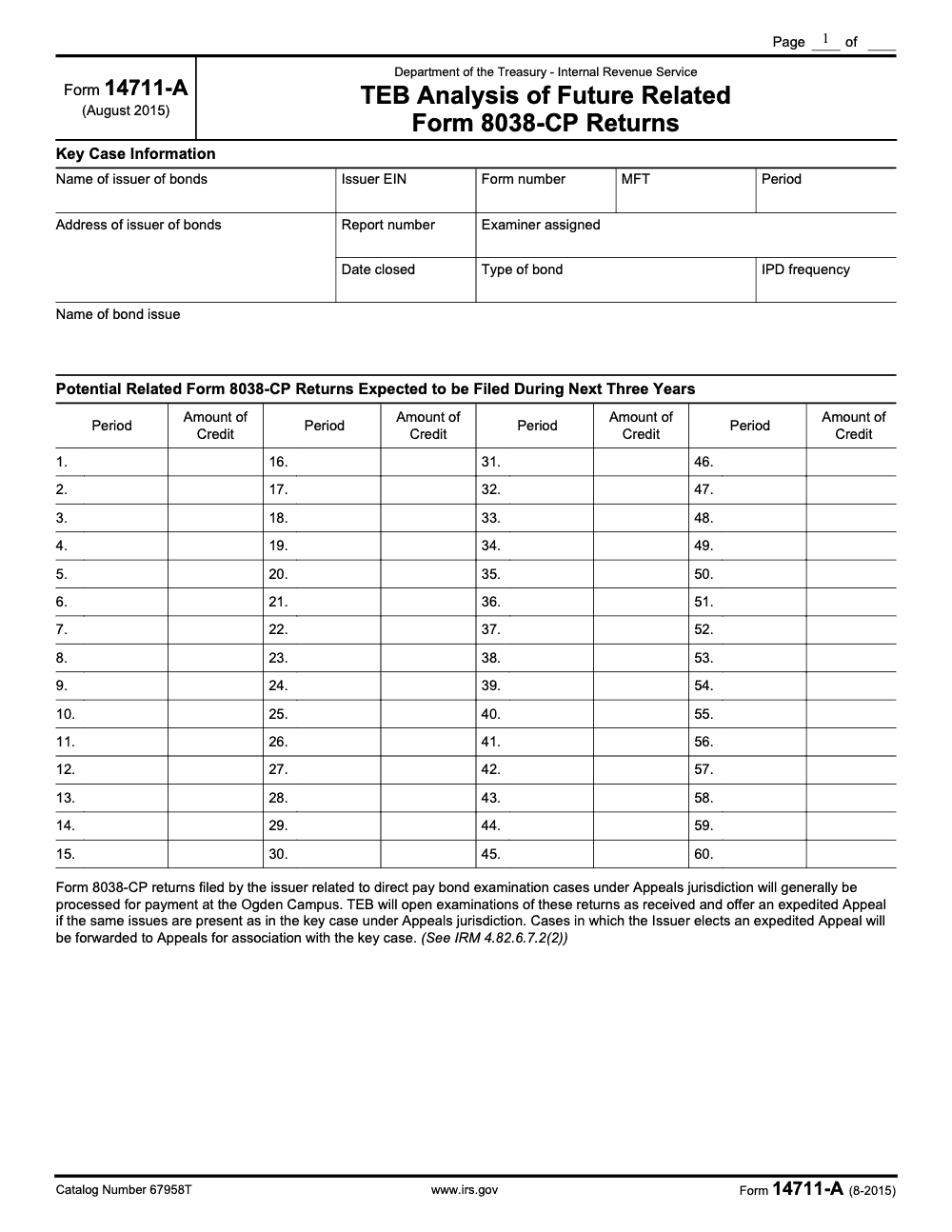
Form 14711-A is an internal IRS Tax Exempt Bonds (TEB) worksheet, not a return that bond issuers or other taxpayers file. TEB examiners use the August 2015 revision (Catalog 67958T) to project the related Form 8038-CP filings an issuer is expected to make over the next three years while a direct pay bond key case sits under Appeals jurisdiction. Related Form 8038-CP returns are generally processed for payment at the Ogden Campus, and the expedited-Appeal forwarding workflow is governed by IRM 4.82.6.7.2(2) (per the IRS Form 14711-A footnotes and the Internal Revenue Manual).
It would be easy to read "Form 14711-A" as something a bond issuer fills out and files. It is not. This is an internal IRS Tax Exempt Bonds worksheet that a TEB examiner completes during a key case, never a return submitted by the issuer, and reading it the other way sends teams looking for the wrong workflow.
Examiners use the August 2015 revision to project the Form 8038-CP filings an issuer is expected to make over the next three years while a direct pay bond case sits under Appeals jurisdiction. Those direct pay claims, for BABs, RZEDBs, QZABs, QSCBs, NCREBs, and QECBs, still run through Form 8038-CP. The worksheet itself lists each future period and the expected credit amount, with 60 Period and Amount of Credit slots arranged as four columns of fifteen rows.
Key Takeaways
- Form 14711‑A is the “look‑ahead” worksheet, TEB Analysis of Future Related Form 8038‑CP Returns. You use it to list the 8038‑CP claims you expect over the next three years for the direct pay bond issue under exam – the worksheet applies only to direct pay bond examination cases under Appeals jurisdiction, not to tax‑exempt bond exams generally. It is a planning tool, not a statute control form.
- The worksheet covers only direct pay bond examination cases under Appeals jurisdiction, where the issuer claims refundable credits on Form 8038‑CP. It is completed by a TEB examiner during a key case, not filed by the issuer.
- Direct Pay Bond claims, for BABs, RZEDBs, QZABs, QSCBs, NCREBs and QECBs, still run through Form 8038‑CP. Use the current IRS instructions for e‑file notes and attachment rules.
- The worksheet lists each future period and the expected credit amount for an anticipated 8038‑CP filing, with 60 Period / Amount of Credit slots arranged as four columns of fifteen rows.
- Treat 14711‑A as part of your delivery system. When you forecast future filings, you prevent review bottlenecks, prioritize consent‑needed cases, and avoid last‑minute paper chases for payee data or ACH details. TE/GE’s TEB program guidance frames the mission and process for these exams.
What Form 14711‑A actually is
Form 14711‑A is a one‑page internal worksheet issued by the IRS Tax‑Exempt Bonds (TEB) office and completed by TEB examiners – issuers and taxpayers do not prepare, sign, or file it. The title says exactly what it does, TEB Analysis of Future Related Form 8038‑CP Returns. In practice, you list each period in the coming three years – a rolling, forward‑looking window measured from the date the worksheet is prepared, not a fixed calendar window – when a related 8038‑CP claim is likely and estimate the credit amount. This gives your team a realistic runway to schedule reviews, request consents when needed, and set workload expectations with managers.
Think of 14711‑A as your flight plan. You are not flying yet, you are charting the route so there are no surprises mid‑air.
Keep the purpose narrow: Form 14711‑A forecasts the related 8038‑CP claims expected over the next three years for the bond issue under exam. It is a planning sheet that helps the examiner schedule reviews and anticipate volume, not a statute‑control or filing form. Used that way, the case feels calm instead of reactive.
Why this matters for your delivery and growth
If you run a CPA, EA, or municipal finance practice, your problem is rarely a lack of demand. The ceiling is delivery, especially during peak season or when multiple DPB cases hit at once. Without a forward view of 8038‑CP filings, partners end up trapped in review loops, statute dates creep up, and quality wobbles under time pressure. I have seen great teams lose days chasing a missing payee EIN or a delayed DSS while a consent deadline ticked down. That is avoidable.
Form 14711‑A restores predictability. When you chart the next twelve to thirty‑six months of claims tied to a bond, you can:
- Block review time before calendars fill up.
- Sequence the work for returns with less time remaining on the clock.
- Coordinate communication, so payee details and ACH info are confirmed before submission windows open.
- Set realistic credit-amount expectations, which helps issuers and designated payees manage their budgets.
Programs covered and current context
Direct Pay Bonds with refundable credits continue to use Form 8038‑CP for claim processing. The IRS instructions, last reviewed on January 14, 2025, cover BABs and the specified tax credit bonds that were eligible for direct pay elections, including RZEDBs, QZABs, QSCBs, NCREBs, and QECBs. If you are setting up 14711‑A today, use those instructions to make sure your attachment set and data formatting match current IRS expectations, including e‑file compatibility and Schedule A rules.
A practical note, refundable direct pay bond credits can be reduced by sequestration in some years. Confirm the current reduction rate against the IRS sequestration notice in effect for the payment date, and reflect it in your credit estimates so stakeholders are not surprised by the net received.
How 14711‑A fits the wider exam workflow
- Use 14711‑A to plan the next three years of related 8038‑CP filings and expected credit amounts. It is a forecasting sheet that keeps your team ahead of volume and timing.
- Pair that forecast with your own statute-control workpapers for the related returns you identified. Track statute dates, secure managerial approval where required, and document the controls separately from the projection sheet.
When you keep the two separate, 14711‑A sets the calendar while your statute workpapers protect it. That is the simplest way to keep delivery tight and reviews sane.
How to complete Form 14711‑A with confidence
Use this as your repeatable playbook. It keeps the work clean and your reviewers fast.
Gather the right inputs first
- Issuer identifiers, issuer EIN, issue date, issue price, IRS report number.
- Core schedules, the current Debt Service Schedule that shows principal and interest by payment date.
- DPB data, the most recent DPB Compliance Database extract that lists related or expected Form 8038‑CP returns, including payee EINs, claim dates, claimed amounts, and filing dates.
- Crosswalk, a simple index that ties each DSS payment date to a related or expected 8038‑CP claim.
Quick tip: Align file names and tabs so reviewers can jump between DSS, payee list, and the 14711‑A without hunting. Two clicks, not ten.
Fill out the worksheet
- Identify each upcoming interest payment date over the next three years.
- For each date, record the expected related 8038‑CP claim, the payee EIN, and the estimated refundable credit amount.
- Note any changes in designated payee status so you are not surprised by a different EIN on the filed return.
- Add a comment whenever you expect an amended claim, a reassignment, or a filing delay.
Keep paragraphs short and entries precise. Your goal is to make reviews fast and predictable.
Keep reviews friction‑free
- Use structured workpapers, standardized naming, and version control.
- Add an “internal completeness check” checklist, file present, dates validated, payee EIN matched, totals tied to the Debt Service Schedule, any applicable sequestration reduction noted.
- Save a PDF snapshot of each 14711‑A version and keep your editable workbook in the live folder so history and current state are both clear.
Submission timing and updates
Prepare Form 14711‑A when you open the Direct Pay Bonds examination. Then set calendar reminders to refresh the worksheet at least every six months. Accelerate that schedule if you see amended filings, correspondence that affects timing, or changes in payee information.
Bottom line, prepare on day one, then update every six months, faster if something material changes.
A practical cadence that works:
- Week 1, request the DSS and the DPB extract via secure email, include issuer EIN, issue date, issue price, and report number.
- Week 2, populate 14711‑A, tie it to DSS and the extract, and get a quick manager review.
- Ongoing, when you issue a Form 5701‑B or reach an adverse determination, update 14711‑A the same week and note any new related cases you need to open.
- Six‑month cycle, refresh DSS, pull a current extract, and re‑run your completeness checks.
Required approvals and signatures
Use your approval authority matrix so the right people sign at the right time. Routine planning and updates usually sit with the examiner and Group Manager. Escalate if your forecast implies multiple related 8038‑CP exams, sensitive procedures, or program‑level impacts. In those cases, get Program Manager or Director sign‑off and keep the signed page with the permanent file.
Acceptable signature methods
- Original signatures or secure electronic signatures are fine if you document the contact and store the transmission log.
- Faxed or scanned signatures are acceptable once you have documented the taxpayer contact and followed internal signature rules.
- Re‑approve whenever your evaluation changes, at least every six months, and keep name, title, and date clear on each version.
Documentation to include with your request
When you circulate or submit the worksheet, include the materials reviewers need to validate every entry without guesswork.
Include issuer EIN, bond details, IRS report number, and aligned attachments so everything ties out cleanly.
- Debt Service Schedule, complete, with payment dates and amounts. Flag dates that have related or expected 8038‑CP claims.
- DPB extract or Excel list, show payee EINs, claim dates, claimed amounts, and filing dates.
- Relevant correspondence, for example Form 5701‑B, no‑consideration letters, and amended filings.
- Cross‑references, show where each item appears in your folder structure and in the 14711‑A comments.
Processing timeline and notifications
Before you open the case file fully, build your timeline using Form 14711‑A so you know when claims are likely to hit and how that maps to review capacity. Then create simple notification triggers.
- Trigger 1, when you issue a Form 5701‑B, update 14711‑A within the week and list any affected related returns.
- Trigger 2, when an adverse determination is made, mirror that change in 14711‑A, identify related exams to open, and plan statute protection steps using your statute tools and statute worksheet.
- Trigger 3, set a 90‑day look‑ahead reminder for upcoming claim dates so you can confirm payee EINs and supporting schedules.
Simple workflow table
| Step | Owner | What you do | Proof of completion |
| Request DSS and DPB extract | Examiner | Send secure email with issuer EIN, issue date, issue price, report number | Email and receipt log |
| Build 14711‑A draft | Examiner | Populate three‑year forecast, link to DSS and extract | Saved workbook and PDF snapshot |
| Quick review | Group Manager | Spot check ties and comments | GM initials and date |
| Notifications set | Examiner | Calendar 90‑day and 6‑month reminders | Calendar entries |
| Six‑month refresh | Examiner | Pull current DSS and extract, re‑validate | Updated 14711‑A and checklist |
| Escalation, if needed | Program Manager or Director | Approve sensitive or multi‑case actions | Signed page, name, title, date |
Accountably note, optional, if you want help standardizing this workflow, our teams can operate inside your systems, QuickBooks, Thomson Reuters, CCH, Karbon, TaxDome, and maintain the same naming, checklist, and review logic so nothing slips during peak season. We keep references light because the focus is your process, not our promo.
Keeping the projection trail continuous and auditable
Form 14711‑A is a planning sheet, yet it plays a big role in keeping your registration trail continuous and auditable. Treat it as the anchor that ties issuer identifiers, the DSS, the payee EIN list, and every related filing together throughout the life of the examination.
- Validate DSS to payee alignment. Reconcile scheduled interest payments with identified payees and expected or filed 8038‑CP returns.
- Refresh when facts change. If a payee is reassigned, a payee EIN changes, or the DSS is updated, revise 14711‑A the same week.
- Preserve permanency. Keep the latest version and a snapshot history in the permanent file so your decisions are easy to follow later.
Spotting eligibility and payee status changes early
Use the worksheet to spot eligibility changes early. If an issuer switches to a designated payee, if an adverse bond qualification finding affects claim rights, or if duplicate claims appear, update 14711‑A immediately and document the who, the when, and the why.
Eligibility changes to capture
- Record the change, issuer EIN versus designated payee EIN, and the effective payment periods.
- Identify related 8038‑CP returns with at least 180 days remaining and plan consent or protection steps if needed.
- Reflect any adverse determinations, duplicate filings, or amended claims and attach the supporting correspondence.
Common mistakes to avoid
The same handful of misreads surface whenever an issuer-side team, bond counsel, or new TEB practitioner first encounters Form 14711-A. Naming them keeps your engagement scope honest and the workpapers defensible.
Contact information and support
Keep contacts visible on the first tab of your workbook, not buried in email chains. Record secure email addresses, phone numbers, and escalation paths for your DPBCRC contact, TEB technical contact, your Group Manager, and any coordinator.
| Role | Primary method | Escalation path |
| DPBCRC | Secure email | Manager, Program Lead |
| TEB Technical | Secure email | Technical Advisor |
| Examiner | Secure email or phone | Group Manager |
| Coordinator | Secure email | Territory Manager |
Follow your secure transmission instructions whenever you share issuer EINs, issue dates, issue prices, and report numbers. Save the latest version of 14711‑A in the permanent file so anyone stepping into the case can orient in minutes.
Conclusion and next steps
You now have a practical way to make Form 14711‑A work for you, not against your calendar. Set it up on day one, tie it tightly to the DSS and your DPB extract, and refresh it at least every six months. Use it to schedule reviews, anticipate payee changes, and keep related 8038‑CP filings from becoming fire drills.
Treat planning as a deliverable. When you plan well, reviews are shorter, deadlines are met, and clients trust your process.
If your team is stretched thin during peak cycles and you want help standardizing workpapers, reviews, and updates inside your own systems, Accountably can provide trained offshore teams that plug into your templates and tools, maintain your naming and review logic, and keep the updates on schedule. No resume farming, just disciplined execution that reduces review time and revision cycles.
Reusable Checklists
Three checklists that paste straight into a firm SOP for direct pay bond engagements where Form 14711-A is in play. Strip what you do not need; add detail per client. Each list is independent.
Key Case header intake (12 fields)
- Confirm issuer legal name as printed on the bond documents and on the existing TEB file.
- Capture issuer address and EIN exactly as filed; cross-check against the bond issue official statement.
- Record the form number, MFT, period, and report number associated with the key case.
- Note the examiner assigned and the date the key case was closed at the examination level.
- Document the type of bond and the IPD frequency the issue follows.
- Confirm the bond issue name matches the issue identifier used on prior 8038-CP filings.
- PDF-archive the completed 14711-A header for your engagement file.
Rolling three-year 8038-CP projection workbook
- Anchor the projection window to the date the examiner completes (or most recently updates) Form 14711-A.
- List every anticipated Form 8038-CP filing across the next three years with Period and Amount of Credit columns.
- Reserve enough rows for up to 60 period-and-credit pairs (the worksheet allows four columns of 15 rows each).
- Tag each anticipated filing as 'same issues as key case' or 'distinct issues' for the Appeals election decision.
- Reconcile the projection against the issuer's debt service schedule to catch missing or duplicate periods.
- Refresh the workbook after every material status change in the key case.
- Log the re-anchor date in a change history tab so the projection trail stays auditable.
Expedited-Appeal election decision packet
- Confirm the related 8038-CP examination presents the same issues as the key case under Appeals (per IRM 4.82.6.7.2(2)).
- Verify the issuer has affirmatively elected expedited Appeal for the related case in writing.
- Document any deviation from the expected Ogden Campus payment processing on the relevant tab.
- Attach the related case notice of examination and the issuer's election letter to the decision packet.
- Calendar the response window for TEB's expedited-Appeal forwarding and the Appeals docketing acknowledgement.
- Brief the engagement partner before sending the election; capture the decision rationale in the workbook narrative tab.
- If the issuer declines expedited Appeal, document the choice and track the related case on its own examination calendar.
Keep 14711-A Season From Stalling
Direct pay bond examinations rarely stall because of effort. They stall because related Form 8038-CP filings keep arriving on a rolling three-year horizon while the key case sits at Appeals, and nobody on the issuer side owns the projection schedule. The IRS Tax Exempt Bonds function tracks that schedule on Form 14711-A (August 2015 revision, Catalog 67958T); issuer-side teams who want a clean record need a parallel workbook of their own, or the planning conversation defaults to whatever the examiner most recently noted.
The fix is to treat the projection as production work, not a sidebar. Build a single workbook that mirrors the 12 Key Case Information header fields, lists the rolling three-year 8038-CP claim schedule across up to 60 period-and-credit row pairs, and tags each related return as 'same issues' or 'distinct issues' so the expedited-Appeal election (per IRM 4.82.6.7.2(2)) becomes a documented decision rather than a hallway call.
- Mirror every Key Case Information field on the cover tab (issuer name, EIN, MFT, report number, type of bond, IPD frequency, bond issue name) so updates flow in one place.
- Lock the projection horizon to a rolling three years from the date the worksheet is prepared, not a fixed calendar window; re-anchor after each material status change in the key case.
- Tag each anticipated 8038-CP filing with its issue-overlap status so expedited-Appeal eligibility is decided once and re-validated on receipt.
- Cross-check related 8038-CP returns against the expected Ogden Campus payment-processing path so refund-credit timing does not surprise the issuer's cash forecast.
- Keep your statute-control workpapers synced to the same workbook so the consent and update trail stays auditable across the exam life cycle.
None of this is glamorous, but disciplined projection workbooks are what keep direct pay bond exams from drifting between status calls. If your team needs help building or maintaining the workpapers that sit alongside a TEB examination, our trained offshore tax delivery teams can standardize the templates, run the reconciliations, and keep the rolling three-year view current inside your existing systems.
FAQs
Form 14711-A, titled “TEB Analysis of Future Related Form 8038-CP Returns,” is an internal IRS Tax Exempt Bonds (TEB) worksheet. Examiners use it to record the related Form 8038-CP returns an issuer is expected to file during the next three years. The current revision is the August 2015 version (catalog number 67958T); it is not a form taxpayers file.
The worksheet has 60 Period / Amount of Credit row pairs, laid out as four columns of fifteen rows each. Each pair records a future payment period and the expected credit amount for an anticipated Form 8038-CP filing, giving the examiner a single view of the rolling three-year horizon.
Per the note on the form, Form 8038-CP returns filed by the issuer related to direct pay bond examination cases under Appeals jurisdiction are generally processed for payment at the Ogden Campus. The expedited-Appeal forwarding procedure is governed by IRM 4.82.6.7.2(2), which the worksheet cross-references.
About this guide
Accountably helps US CPA, EA, and accounting firms hire trained accountants and tax preparers in India.
About us Reviewed byJugal Thacker, CPAFounder and CEO at Accountably
A Washington-licensed CPA with 7+ years inside US firms – PwC, a real-estate tax practice, then a full-service firm, rising from reviewer to manager to advisory. This article was reviewed against current IRS guidance for the 2025 tax year and updated for filers preparing late returns, amendments, and 2026 estimates.
View profile →How we research, review, and update this guide
Every Accountably guide is researched against primary IRS sources, reviewed by a U.S. CPA, and refreshed as guidance evolves. Read our Editorial Guidelines to see how we source, fact-check, and update our content.