Summarize this article with AI
In Brief
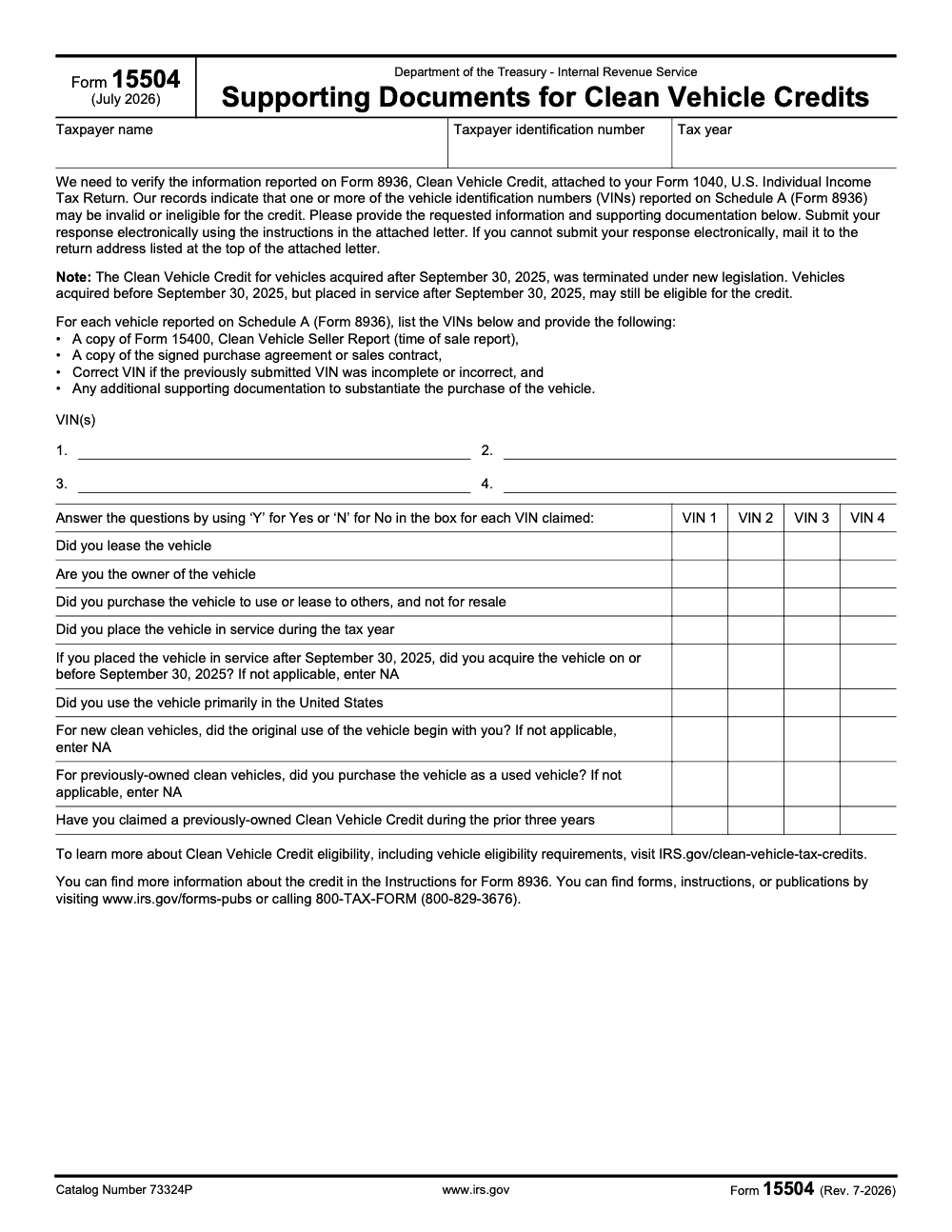
Form 15504 (Rev. 11-2024) is the IRS verification response form for the Clean Vehicle Credit claimed on Form 8936. It is filed only after the IRS mails a verification letter, never proactively with the original return (per Instructions for Form 8936, as published on IRS.gov). The form holds up to 4 VINs and 6 yes/no eligibility questions per VIN; mail your response and the sales contract for every VIN to the address printed on the IRS letter, not to your original Form 1040 service center.
A bought-it, claimed-it, moved-on clean vehicle credit can sit quiet for months, then a letter from the IRS lands questioning the VINs on your Form 8936. Form 15504 (Rev. 11-2024) is how you answer that letter, and it is filed only in reply, never proactively with the original return.
The form holds up to 4 VINs and asks six yes-or-no eligibility questions for each one, answered with a single 'Y' or 'N' in the box. You attach the sales contract for every VIN, add the manufacturer's or distributor's certification for any foreign-manufactured vehicle, and mail it to the address printed on the IRS letter rather than to the service center where your Form 1040 went.
Key Takeaways
- Form 15504 (Rev. 11-2024), Supporting Documents for Clean Vehicle Credits, is the IRS verification response form filed only in reply to an IRS letter questioning VIN(s) claimed on Form 8936.
- The form captures taxpayer name, taxpayer identification number, tax year, up to 4 VINs from the original Form 8936 claim, and six yes/no eligibility answers per VIN.
- Responses use the single letter 'Y' for Yes or 'N' for No in each per-VIN answer box, per the IRS instructions on the form itself.
- The form covers both the post-IRA Clean Vehicle Credit and the older Qualified Plug-in Electric Vehicle Credit, renamed by the Inflation Reduction Act on August 16, 2022.
- Foreign-manufactured vehicles require the manufacturer's or domestic distributor's certification in addition to the sales contract; U.S.-manufactured vehicles need the sales contract only.
What Form 15504 Actually Does
Form 15504 is the IRS verification response document for a Clean Vehicle Credit claim. The taxpayer fills it out only after receiving an IRS letter stating that one or more VINs on Form 8936 is ineligible or invalid. Its role is to gather the evidence the IRS needs to confirm or reverse the credit that was already claimed on the original Form 1040 return.
Here is how it plays out in practice.
- The taxpayer lists every VIN previously claimed on Form 8936, up to 4 per Form 15504.
- The taxpayer assembles the valid sales contract for each VIN, plus the manufacturer's or domestic distributor's certification for any foreign-manufactured vehicle.
- The taxpayer answers the six yes/no eligibility questions per VIN using single-letter 'Y' or 'N' responses, per the IRS form instructions.
- The taxpayer enters the applicable tax year, taxpayer name, and taxpayer identification number in the header fields at the top of the form.
- The taxpayer mails the completed form and supporting documents to the return address printed at the top of the IRS verification letter, not to the original Form 1040 service center.
When to Use Form 15504
Use Form 15504 only when the IRS mails a verification letter questioning the VIN(s) claimed on Form 8936 for the Clean Vehicle Credit. It is never filed proactively with the original Form 1040 return. The form is a reactive verification response, not a credit-claim form, and filing it does not by itself claim or restore the credit.
The Rev. 11-2024 version is year-neutral and covers both the post-IRA Clean Vehicle Credit and the older Qualified Plug-in Electric Vehicle Credit, so use the same form for any open tax year under verification.
What Form 15504 Does Not Do
Form 15504 does not claim the Clean Vehicle Credit. The credit must already have been claimed on Form 8936 attached to the original Form 1040; Form 15504 only supplies the supporting evidence the IRS requests when it questions the original claim. If a taxpayer never claimed the credit on Form 8936, filing Form 15504 does not retroactively create one. The form also does not restate the substantive credit rules in detail; the IRS notes that more information about the underlying credit lives in the Instructions for Form 8936.
A Quick Map of the Form 15504 Response
What goes in the header
- Taxpayer name
- Taxpayer identification number
- Tax year under verification (the form is year-neutral; the taxpayer writes the year)
What goes in the body
- Up to 4 VINs previously claimed on Form 8936
- Six yes/no eligibility answers per VIN, using single-letter 'Y' or 'N'
- The valid sales contract for each VIN, plus manufacturer or domestic distributor certification for any foreign-manufactured vehicle
Where the response goes
- Mailed to the return address printed at the top of the IRS verification letter
- Not mailed to the IRS service center that processed the original Form 1040
- One additional Form 15504 prepared for each group of 4 more VINs if more vehicles are under verification
A brief brand note for context. On Accountably's side, our work lives on disciplined delivery. When firms ask us to help package Clean Vehicle Credit verification responses, we apply the same habits that protect client work, for example SOP-driven execution, structured workpapers, multi-layer reviews, turnaround SLAs, and security controls. Mentioning this here is not a pitch; it is a reminder that strong delivery mechanics make the response packet faster to build and easier to defend.
The Six Eligibility Questions, Explained Simply
Form 15504 asks the same six yes/no eligibility questions for each VIN claimed on Form 8936. Each answer must be a single letter 'Y' for Yes or 'N' for No in the response box for that VIN, per the IRS instructions printed on the form. A disqualifying answer on any of these questions usually invalidates the consumer Clean Vehicle Credit for that vehicle.
The Six Verification Questions
| # | Question on Form 15504 | Why the IRS asks | Disqualifying answer |
| 1 | Did you lease the vehicle | For a leased vehicle the credit goes to the lessor under the commercial branch, not the consumer driver | Y (lessees cannot claim the consumer credit on Form 8936) |
| 2 | Are you the owner of the vehicle | Ownership is a baseline eligibility test for the consumer credit | N |
| 3 | Did you purchase the vehicle to use or lease to others, and not to resale | Purchase must be for the taxpayer's own use or to lease to others, not for resale | N (dealers and resellers cannot claim the consumer credit) |
| 4 | Did you place the vehicle in service during the tax year | The credit attaches to the year the vehicle was placed in service, not the contract or payment year | N |
| 5 | Did the original use of the vehicle begin with you | The consumer credit on Form 8936 requires original use to begin with the taxpayer (new vehicle only) | N (pre-owned EVs fall under the separate Previously-Owned Clean Vehicle Credit) |
| 6 | Did you use the vehicle primarily in the United States | The test is primary use in the U.S., not just U.S. registration | N |
The IRS uses the pattern of Y and N answers across the six questions to decide whether the credit claimed on Form 8936 should stand or be reversed. Mis-certifying an answer (for example, marking ownership Y on a leased vehicle) does not save the credit; it just shifts the issue from credit denial to a potential accuracy problem.
Lease vs Own, The Trap Most Consumers Hit
Lessees often think they can claim the consumer Clean Vehicle Credit on Form 8936. For a leased vehicle the credit goes to the lessor under the commercial branch of the credit, not to the consumer driver. A 'Y' on the lease question combined with 'N' on the ownership question is the IRS's signal that the consumer credit was claimed in error. The lessee may have negotiated a lease-payment benefit that reflects the credit, but the consumer credit itself is not available to the lessee.
Placed-in-Service vs Contract Year, What Changes
The placed-in-service question catches taxpayers who claimed the credit in the year they signed the purchase contract instead of the year the vehicle was placed in service. The IRS verifies service-year alignment, not contract-signing-year. Use the dealer report (or vehicle pickup date) to confirm the placed-in-service year for each VIN before answering this question.
Manufacturer Phase-Out, A Separate Check
Form 15504 itself warns that the manufacturer of the vehicle may have already reached its phased-out reduction limit, in which case the credit is reduced or unavailable even if all six eligibility answers are favorable. For vehicles placed in service on or before August 16, 2022, verify each manufacturer's allowable credit at www.irs.gov/qpievc before assuming the full credit amount.
Why The Six Questions Matter To The IRS
- The IRS uses the six answers to decide whether the credit claim on Form 8936 should stand or be reversed.
- The answers are checked against the IRS's own VIN records, the dealer report, and, for foreign-manufactured vehicles, the manufacturer or distributor certification.
- A single disqualifying answer (for example, 'Y' on lease, or 'N' on placed-in-service) is enough to deny the credit for that VIN.
- Consistent, accurate answers backed by the sales contract close the verification quickly; inconsistent or unsupported answers extend the IRS correspondence cycle.
How To Keep Your Response Credible
- Answer each of the six questions per VIN with a single 'Y' or 'N', exactly as the IRS instructions on the form direct.
- Back every favorable answer with the matching document: the sales contract, the dealer report for the placed-in-service date, and the manufacturer or distributor certification for foreign-manufactured vehicles.
- Keep the answer pattern consistent with the evidence. A 'Y' on ownership must match a sales contract in the taxpayer's name, not a lease agreement.
- Date and label every document so a reviewer can tie it to the VIN and the tax year under verification.
A good rule of thumb, if your response cannot survive a read-through by someone outside the engagement, it is not ready. The completed form plus its exhibits should let an IRS examiner reconstruct each eligibility decision and reach the same conclusion.
Plan Your Form 15504 Response
Gather What You Need First
Preparation drives a clean verification response. List every VIN previously claimed on Form 8936 (up to 4 per Form 15504), pull the IRS verification letter and copy the response address from the top, and gather the valid sales contract for each VIN. For any foreign-manufactured vehicle, also pull the manufacturer's or domestic distributor's certification. Write the taxpayer name, taxpayer identification number, and the tax year under verification into the header fields before answering any of the six eligibility questions.
Add these practical artifacts to your packet.
- The dealer report or pickup document that fixes the placed-in-service date for each VIN
- Proof that original use began with the taxpayer (for the consumer credit, the vehicle must be new)
- Evidence that primary use is in the United States, not just U.S. registration
- A copy of the verification letter, so the response address and any electronic upload code stay with the file
Map Each Question To Its Evidence
For each VIN, line up the six questions with the document that proves the answer.
- Lease versus own, confirm against the sales contract; a leased vehicle's credit belongs to the lessor, not the consumer driver.
- Owner of the vehicle, confirm the sales contract is in the taxpayer's name.
- Purchased to use, not to resell, confirm the purchase was for the taxpayer's own use or to lease to others.
- Placed in service during the tax year, confirm the date from the dealer report, not the contract-signing date.
- Original use began with the taxpayer, confirm the vehicle is new; used EVs fall under the separate Previously-Owned Clean Vehicle Credit.
- Primarily used in the United States, confirm actual primary use, since more than half the vehicle's use must occur in the U.S.
Record the supporting document next to each answer so a reviewer can follow the logic without guessing. Your future self will thank you.
No Assessor or Certification Fields On The Form
Form 15504 itself has no assessor or certification fields; the header captures only taxpayer name, taxpayer identification number, and tax year. The work of qualifying a credit claim happens on the original Form 8936, where the taxpayer (or the tax preparer signing the return) attests to eligibility. For Form 15504, the focus is evidence: keep the sales contract, the manufacturer or domestic distributor certification for foreign-manufactured vehicles, the dealer report showing the placed-in-service date, and proof of primary U.S. use in the same packet as the completed form.
Evidence Quality, Review It Carefully
Evaluate each document for provenance, completeness, relevance, and reliability. Cross reference every exhibit to a VIN and to the question it supports. Record reviewer, date, and the response answer it backs. Summarize your conclusion in a few lines so anyone can follow your logic. This is not padding, it is your audit trail if the IRS pushes back.
A Ready to Use Checklist
- The IRS verification letter, with the response address copied from the top
- Header fields completed: taxpayer name, taxpayer identification number, and the tax year under verification
- Every VIN previously claimed on Form 8936, up to 4 per form
- The valid sales contract for each VIN
- Manufacturer or domestic distributor certification for any foreign-manufactured VIN
- Six 'Y' or 'N' answers per VIN, each tied to its supporting document
- The phase-out check at www.irs.gov/qpievc for any vehicle placed in service on or before August 16, 2022
Where Accountably Fits, Briefly and Practically
If you want help with the mechanics, our team at Accountably applies the same delivery discipline we use for complex client work to your Clean Vehicle Credit verification packets. That looks like SOP driven execution, structured workpapers with naming rules, multi layer reviews that protect partner time, turnaround SLAs, and secure, role based access. You keep your tools and templates. We help you make the response consistent, traceable, and ready for scrutiny, which lowers review friction and closes IRS correspondence faster.
Staying Current On The Credit Rules
Know Which Rule Set Applies
The Inflation Reduction Act renamed the Qualified Plug-in Electric Vehicle Credit to the Clean Vehicle Credit on August 16, 2022, and it did more than change the name. Vehicles placed in service on or before that date follow the older rules; vehicles placed in service after it follow the new Clean Vehicle Credit rules, with stricter battery sourcing, MSRP caps, and buyer income limits. Confirm the placed-in-service date for each VIN so you apply the right rule set when you verify eligibility.
Check The Phase-Out Before Assuming The Full Credit
For vehicles placed in service on or before August 16, 2022, a manufacturer may already have reached its phase-out reduction limit, which reduces or eliminates the credit even when all six eligibility answers are favorable. Verify each manufacturer's allowable credit at www.irs.gov/qpievc before assuming the full amount, and keep the result with the file.
Use The Right Reference
Form 15504 does not restate the substantive credit rules in detail. The IRS directs taxpayers to the Instructions for Form 8936 for the underlying eligibility rules. When a question turns on a rule rather than a document, cite the Form 8936 instructions in your workpaper so the reviewer can find the basis quickly.
A Short History You Can Share With Non Specialists
- Before August 16, 2022, the credit was the Qualified Plug-in Electric Vehicle Credit, with a per-manufacturer phase-out after 200,000 cumulative U.S. sales.
- On August 16, 2022, the Inflation Reduction Act (Public Law 117-169) renamed it the Clean Vehicle Credit and restructured eligibility.
- The new rules added battery component and critical mineral sourcing requirements, MSRP caps, buyer income limits, and a North American final-assembly requirement for post-IRA vehicles.
- Form 15504 (Rev. 11-2024) covers both names of the credit, so it is used for any open year under verification.
- Today, the IRS works verification queues across both the pre-IRA and post-IRA versions of the credit.
Translate legacy talk. When a client says “I claimed the EV credit,” confirm the placed-in-service date first, then decide whether the older Qualified Plug-in Electric Vehicle Credit rules or the current Clean Vehicle Credit rules govern the verification.
Common Pitfalls and How To Avoid Them
- Filing Form 15504 proactively. Fix it by remembering the form is only a response to an IRS verification letter, never an attachment to the original return.
- Sending only the sales contract for a foreign-manufactured vehicle. Fix it by adding the manufacturer or distributor certification to that VIN's packet.
- Mailing to the original 1040 service center. Fix it by copying the response address from the top of the IRS letter.
- Claiming the credit in the contract year. Fix it by taking the placed-in-service date from the dealer report and amending the prior return if needed.
- Writing full words in the answer boxes. Fix it by using single-letter 'Y' or 'N' responses per VIN, as the form instructs.
The Payoff
When you treat Form 15504 as a standard verification workflow, not a one-off scramble, you get faster IRS responses and fewer denied credits. The taxpayer keeps the credit they earned, the preparer closes the correspondence quickly, and the evidence and the answers live together, organized and easy to defend.
Documents To Plan Into Every VIN Packet
Each VIN needs its own evidence set. Build only what the vehicle's facts require, then keep it with the completed form.
Per-VIN Document Table
| Document | Why you include it | When it is required |
| Valid sales contract | Establishes purchase, ownership, and the price for each VIN | Every VIN listed on Form 15504 |
| Manufacturer or domestic distributor certification | Confirms the vehicle qualifies; the form requires it in addition to the sales contract | Foreign-manufactured vehicles only |
| Dealer report or pickup document | Fixes the placed-in-service date the credit attaches to | Every VIN, to answer the placed-in-service question |
| Phase-out check from www.irs.gov/qpievc | Confirms the manufacturer had not hit its phase-out limit | Vehicles placed in service on or before August 16, 2022 |
Foreign-Manufactured Vehicles, A Two-Document Rule
For a foreign-manufactured vehicle the sales contract alone is not enough. The form says to submit the sales contract and, for a foreign-manufactured vehicle, also the manufacturer's or domestic distributor's certification. Treat the certification as an additional document, not a substitute, and tag each VIN as U.S.-manufactured or foreign-manufactured early so the certification is never the bottleneck.
Placed-in-Service Evidence, Without Guesswork
The credit attaches to the year the vehicle was placed in service, which can differ from the contract or payment date. Use the dealer report or pickup document to fix the placed-in-service date for each VIN, and confirm the credit was claimed in that year on the original Form 8936. If it was claimed in the wrong year, amend the prior return before sending the verification response.
Evidence Mapping That Survives Scrutiny
For each VIN, link every answer to a specific, dated document. Examples include the sales contract, the manufacturer or distributor certification, the dealer report, and the phase-out check. Add a short note that explains why each document supports the answer. When the examiner can reconstruct your reasoning, the verification closes faster.
Operational Tips That Make Reviews Faster
- Use a standardized file naming scheme with the VIN, document type, and date.
- Keep a single tracker that shows each verification's response deadline, mailing date, and destination address.
- Build a per-VIN evidence folder the day the original Form 8936 is filed, so the response is half-ready before any IRS letter arrives.
- Have a reviewer scan every 'Y' or 'N' answer column against the supporting documents before mailing.
One more practical note. When firms ask Accountably for help running Clean Vehicle Credit verification packets, we do not change their tax software. We wrap the work with SOPs, structured workpapers, layered reviews, and turnaround SLAs. The outcome is simple, stable production, review protection, and traceable decisions, so verification letters stop sitting in a queue.
Sources Behind Your Response
Make your conclusions easy to verify. Tie each answer to the authoritative source that backs it.
- The Instructions for Form 8936, for the underlying Clean Vehicle Credit eligibility rules
- The IRS phase-out page at www.irs.gov/qpievc, for manufacturer credit amounts on pre-August 16, 2022 vehicles
- The sales contract and, for foreign-manufactured vehicles, the manufacturer or distributor certification
- The dealer report or pickup document, for the placed-in-service date
- The IRS verification letter itself, for the response address and any electronic upload instructions
Cross reference each document to its VIN and the question it supports. This makes the response repeatable and keeps any IRS follow-up short.
Conclusion and Next Step
A good Form 15504 response is not busywork, it is clarity. You list the VINs, answer the six questions with single-letter responses, and back each answer with the right document. The taxpayer keeps a credit they earned, and the IRS closes the verification quickly. If you want momentum, build a per-VIN evidence template, wire in the six-question worksheet, and pull the response address straight from the IRS letter every time.
If you need a hand with the mechanics, our team at Accountably can help you wrap your verification work with SOPs, structured workpapers, layered reviews, and turnaround SLAs, all inside your own tools and templates. The goal is simple, production stability, review protection, and responses that hold up under IRS scrutiny.
Common Mistakes We See Every Season
The same handful of errors show up on almost every Form 15504 packet that lands on my desk for review. They are rarely complicated, but each one delays the verification close and can quietly cost the client the credit if the IRS pushes back hard.
Reusable Checklists
The following lists are written to drop straight into a firm SOP or a client packet. Use them as the verification-letter response template for any open Clean Vehicle Credit year.
Clean Vehicle Credit verification packet
- Pull the IRS verification letter and record the response address printed at the top.
- List every VIN previously claimed on Form 8936, up to 4 per Form 15504; prepare a second Form 15504 if more VINs are under verification.
- Collect the original sales contract for each VIN.
- For any foreign-manufactured VIN, add the manufacturer or domestic distributor certification to that VIN's packet.
- Confirm the placed-in-service date for each VIN against the dealer report.
- Verify each manufacturer's allowable credit for pre-August 16, 2022 vehicles against the IRS phase-out page (www.irs.gov/qpievc).
- Write the tax year under verification into the Form 15504 header before completing any answer boxes.
Six-question eligibility scan
- Confirm the taxpayer is the owner of every VIN listed, using a single Y or N in the response box per IRS form instructions.
- Confirm the vehicle was not purchased for resale; dealers and resellers cannot claim the consumer credit.
- Confirm the vehicle was placed in service during the tax year being verified, not the contract or payment year.
- Confirm original use began with the taxpayer; the consumer credit on Form 8936 does not cover used EVs, which fall under the separate Previously-Owned Clean Vehicle Credit.
- Confirm primary use is in the United States, not just U.S. registration.
- Confirm the vehicle was not leased; if it was, the lessor (not the consumer) holds the claim.
Mailing and recordkeeping
- Photocopy the completed Form 15504 plus every supporting document before mailing.
- Send the packet to the address on the IRS verification letter, never to the original 1040 service center.
- Use certified mail with return receipt and staple the receipt to the client file.
- Log the mailing date and expected IRS response window in the firm's open-correspondence tracker.
- Hold the verification packet with the rest of the open-year evidence for the statute period.
Keep 15504 Season From Stalling
Clean Vehicle Credit verifications are not a calendar season the way Form 941 deposits or April 15 returns are; they arrive in unpredictable waves whenever the IRS audits a manufacturer's claimed VIN range or a taxpayer's eligibility flag. Since the Inflation Reduction Act (Public Law 117-169) renamed and restructured the credit on August 16, 2022, the IRS has been working through verification queues across both the pre-IRA Qualified Plug-in Electric Vehicle Credit and the post-IRA Clean Vehicle Credit (per the IRS Clean Vehicle Credits manufacturer phase-out page, as published on IRS.gov).
The firms that close these verifications cleanly are not the ones with the largest staff. They are the ones whose response packets are templated, whose evidence is pre-built per VIN at the time of the original claim, and whose mailing addresses are pulled straight from the IRS letter rather than from memory.
- Build a per-VIN evidence folder the day the original Form 8936 is filed, so half the verification response is ready before any IRS letter arrives.
- Standardize the six Form 15504 verification answers as a one-page worksheet with the Y or N response convention printed at the top.
- Tag every VIN as U.S.-manufactured or foreign-manufactured at the time of claim, so the manufacturer or distributor certification is never the bottleneck during a verification response.
- Maintain a master phase-out reference for pre-August 16, 2022 vehicles against IRS phase-out data (www.irs.gov/qpievc) and a separate sourcing-and-MSRP reference for post-IRA Clean Vehicle Credit claims.
- Route every IRS verification letter into a single open-correspondence tracker on day one to lock the response calendar and the destination address.
If response capacity is the bottleneck rather than knowledge of the rules, our U.S. tax delivery team at Accountably can run the per-VIN evidence packet, the Form 15504 draft, and the certified-mail step inside your existing workflow, so verification letters stop sitting in a queue waiting for a free hour.
FAQs
Form 15504 is filed only after the IRS sends a verification letter questioning the VIN(s) claimed on Form 8936 for the Clean Vehicle Credit. It is never filed proactively with the original Form 1040 return. The taxpayer who claimed the credit on Form 8936 is the one who completes and mails Form 15504 in response.
Submit the valid sales contract for every VIN listed on Form 15504. For any foreign-manufactured vehicle, also include the manufacturer's or domestic distributor's certification for that vehicle. The certification is additional to the sales contract, not a substitute. Mail the packet to the return address on the IRS verification letter.
Form 15504 accommodates up to 4 VINs on a single form. If more vehicles are under verification, prepare an additional Form 15504 for each group of up to 4 more VINs.
Use the single letter 'Y' for Yes or 'N' for No in the response box for each VIN, per the IRS instructions printed on the form. Writing out full words or using checkmarks is not the format the IRS instructs.
Mail Form 15504 and all supporting documents to the return address printed at the top of the IRS verification letter that prompted the response. Do not send the packet to the IRS service center that processed the original Form 1040; verification correspondence is routed through specific units, not standard return-processing centers.
Other forms this guide names
About this guide
Accountably helps US CPA, EA, and accounting firms hire trained accountants and tax preparers in India.
About us Reviewed byJugal Thacker, CPAFounder and CEO at Accountably
A Washington-licensed CPA with 7+ years inside US firms – PwC, a real-estate tax practice, then a full-service firm, rising from reviewer to manager to advisory. This article was reviewed against current IRS guidance for the 2025 tax year and updated for filers preparing late returns, amendments, and 2026 estimates.
View profile →How we research, review, and update this guide
Every Accountably guide is researched against primary IRS sources, reviewed by a U.S. CPA, and refreshed as guidance evolves. Read our Editorial Guidelines to see how we source, fact-check, and update our content.