Summarize this article with AI
In Brief
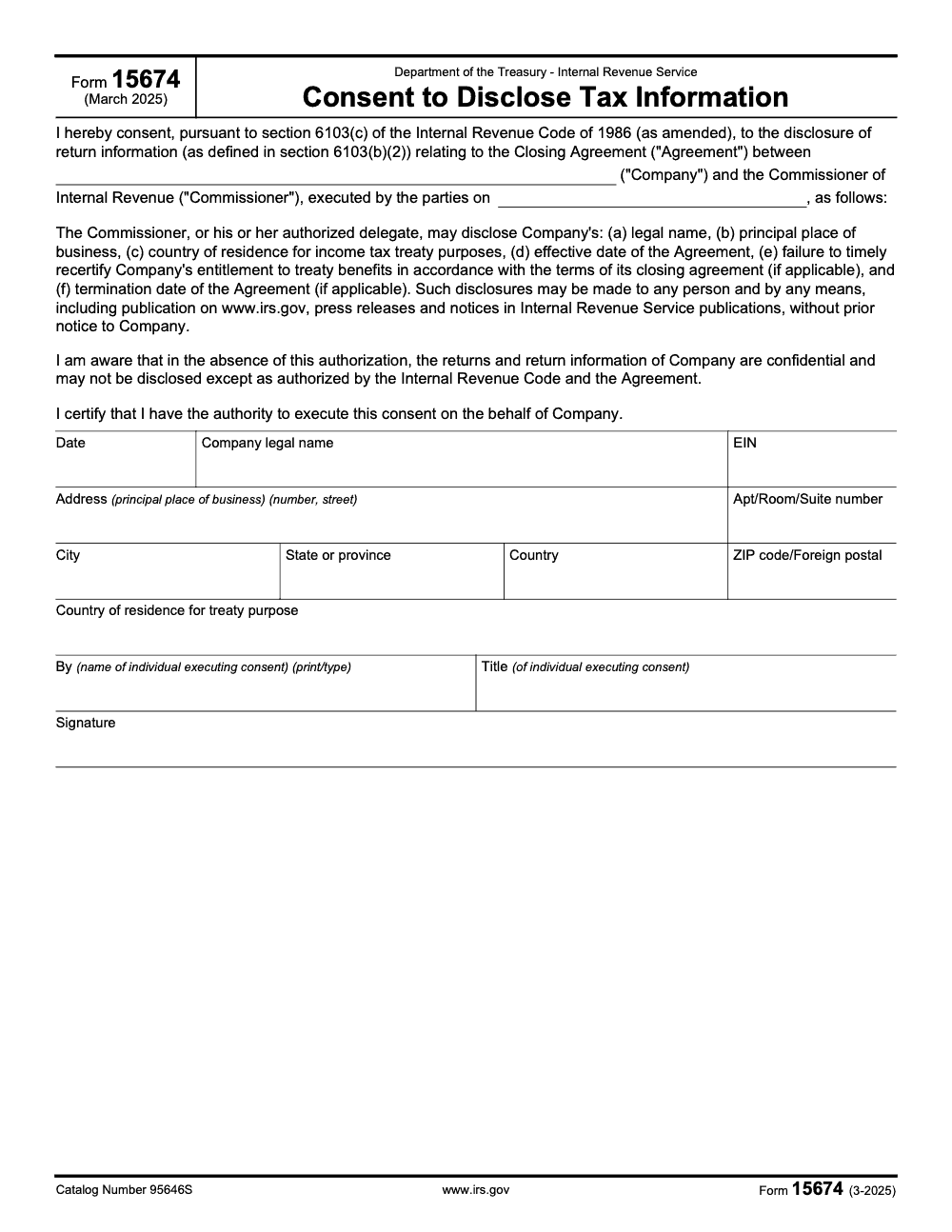
Form 15674, Consent to Disclose Tax Information, is a one-page IRS consent (Rev. March 2025, Catalog No. 95646S). By signing, a Company consents under IRC Section 6103(c) to let the Commissioner, or an authorized delegate, disclose six specific items about a particular Closing Agreement: legal name, principal place of business, treaty country of residence, the Agreement's effective date, any failure to timely recertify treaty benefits (if applicable), and the Agreement's termination date (if applicable). Everything else stays confidential. See the FAQ.
Sign Form 15674 and you let the IRS publish certain facts about your Closing Agreement to anyone, including on its website, in press releases, and in IRS publications, with no prior notice to you. That single consequence is what separates this consent from a routine authorization, and it is why only an individual with authority to bind the Company should sign.
Signed under IRC Section 6103(c), this single-page consent (Rev. March 2025, Catalog No. 95646S) releases six specific items: legal name, principal place of business, treaty country of residence, the Agreement's effective date, any failure to timely recertify, and the termination date. Everything outside those six items stays confidential.
Key Takeaways
- Form 15674, Consent to Disclose Tax Information, is a single-page IRS consent (Rev. March 2025, Catalog No. 95646S). It is signed under IRC Section 6103(c).
- By signing, a Company consents to let the Commissioner, or an authorized delegate, disclose return information relating to one identified Closing Agreement between the Company and the Commissioner.
- The consent covers six specific items: (a) legal name, (b) principal place of business, (c) country of residence for income tax treaty purposes, (d) the Agreement's effective date, (e) failure to timely recertify treaty benefits (if applicable), and (f) the Agreement's termination date (if applicable).
- Disclosures may be made to any person and by any means, including publication on www.irs.gov, press releases, and IRS publications, without prior notice to the Company.
- Only an individual with authority to bind the Company should sign, and they certify that authority on the form. Information outside the six items stays confidential under IRC Section 6103.
What Form 15674 Does, In Plain Language
Form 15674 is a consent. By signing it, a Company tells the IRS: you may disclose certain information about my Closing Agreement that would otherwise be confidential. The form's own language says the signer consents, pursuant to IRC Section 6103(c), to the disclosure of return information (as defined in Section 6103(b)(2)) relating to the Closing Agreement between the Company and the Commissioner of Internal Revenue.
That is the whole job of the form. It does not file a return, claim a benefit, or appoint anyone to act for the Company. It opens a narrow window through which the IRS may publish six listed facts about the Agreement. Absent this consent, that same information stays confidential under the Internal Revenue Code.
This article focuses on practical steps, the exact items in scope, and the documentation habits that keep the form clean. For legal interpretation of your specific Agreement, consult counsel.
Why This Matters To You
- The disclosures the form authorizes are public. They may be published on www.irs.gov, in press releases, and in IRS publications, so understand the six items before you sign.
- The consent is scoped to one identified Closing Agreement, not to all of the Company's return information. Confirm you are signing for the right Agreement.
- An unauthorized signature does not bind the Company and can render the consent invalid, so authority to sign is not a formality. The signer certifies it on the form.
Statutory Authority Behind the Consent
The consent rests on IRC Section 6103, the rule that makes returns and return information confidential. Section 6103(c) lets a taxpayer authorize disclosure that would otherwise be barred, and that is the hook Form 15674 uses. The form's own clause cites the Internal Revenue Code of 1986 (as amended).
The definition of "return information" the form relies on comes from IRC Section 6103(b)(2). So two cross-references do the work: 6103(c) supplies the authority to consent, and 6103(b)(2) defines what category of information the consent reaches.
Quick Reference Map
| Element | Where it comes from |
| Authority to consent to disclosure | IRC Section 6103(c) |
| Definition of "return information" | IRC Section 6103(b)(2) |
| Code referenced in the consent clause | Internal Revenue Code of 1986 (as amended) |
| Scope of the consent | One identified Closing Agreement |
| Items disclosable | Six categories, (a) through (f) |
| Confidentiality baseline | Everything else under IRC Section 6103 |
Sources: Form 15674 (Rev. March 2025); Internal Revenue Code Section 6103.
Who Signs Form 15674
The Company that is party to the Closing Agreement signs Form 15674, and it is signed by an individual with authority to bind that Company. The form contains a certification that the signer has the authority to execute the consent on the Company's behalf, so this is not a clerical signature.
In practice the consenting entity is often a non-U.S. company operating under a U.S. income tax treaty closing agreement, which is why the form carries foreign-address fields and a separate country-of-residence-for-treaty-purpose field. An officer or authorized representative should sign, not an unauthorized employee, because an unauthorized signature does not bind the Company and may invalidate the consent.
When You Use It, At A Glance
Form 15674 is not a recurring, calendar-driven filing. It is executed in connection with a specific Closing Agreement between the Company and the Commissioner. You complete it when the parties want the IRS to be able to disclose the listed facts about that Agreement.
- Confirm the underlying Closing Agreement is the one the consent should reference before signing.
- Read the six disclosable items so you understand exactly what the IRS may publish.
- Verify the signer's authority to bind the Company, since the form carries a certification of that authority.
A Note on Timing
The form captures two dates that are easy to confuse. One is the date the underlying Closing Agreement was executed by the parties, which appears in the consent paragraph. The other is the date the consent itself is signed, captured in the signature block's Date field. They are conceptually distinct and may fall on different calendar days.
Treat the consent like any binding document. Confirm the facts, preserve a signed copy, and be ready to explain who signed and on what authority.
Company Information You Must Get Right
The identification block asks for the Company's details, and accuracy here matters because some of these same items are what the IRS may later disclose. Capture the Company legal name and EIN exactly as they appear on the Agreement and the Company's records.
The address block is built for both domestic and foreign signers. It includes Address (principal place of business), Apt/Room/Suite number, City, State or province, Country, and ZIP code/Foreign postal. A separate Country of residence for treaty purpose field records the treaty residence, which may differ from where the principal place of business sits.
- Match the Company legal name and EIN to the underlying Agreement.
- Use the foreign-address fields where the Company is non-U.S.; do not force a domestic format.
- Record the treaty country of residence separately from the principal place of business.
The Six Disclosable Items, Without Guesswork
Under the consent, the Commissioner or an authorized delegate may disclose the Company's: (a) legal name; (b) principal place of business; (c) country of residence for income tax treaty purposes; (d) effective date of the Agreement; (e) failure to timely recertify the Company's entitlement to treaty benefits in accordance with the terms of its closing agreement, if applicable; and (f) termination date of the Agreement, if applicable.
That list is the boundary. The consent is not open-ended. Items outside these six categories remain confidential under IRC Section 6103. Read each item against your Agreement so you know exactly what the IRS could make public.
Quick Self-Check
- Do the legal name, principal place of business, and treaty country of residence on the form match the Agreement?
- Does the Agreement include a treaty-benefit recertification obligation, which makes item (e) relevant?
- Could the Agreement be terminated, which makes item (f) relevant? If neither applies, those "if applicable" items simply do not arise.
Conditional Items: Recertification and Termination
Two of the six items are tagged "if applicable," and that label is doing real work. Item (e), a failure to timely recertify the Company's entitlement to treaty benefits, applies only when the underlying Closing Agreement actually contains a recertification obligation. If your Agreement has no such requirement, item (e) does not arise.
Item (f), the termination date of the Agreement, applies only if the Agreement is later terminated. Both items are conditional disclosure categories, so their availability depends on the actual terms and lifecycle of the Agreement, not on a default assumption that every consent includes them.
Read the Agreement, then decide whether items (e) and (f) are even in play. Do not treat them as automatic.
How the Commissioner May Disclose the Information
Once the consent is executed, the disclosures it authorizes are broad in audience and channel. The form states that such disclosures may be made to any person and by any means, including publication on www.irs.gov, press releases, and notices in IRS publications, without prior notice to the Company.
Two practical consequences follow. First, there is no audience restriction, so do not assume disclosure will be limited to a particular counterparty or to your own designees. Second, there is no advance-notice requirement, so the Company will not be warned before each specific disclosure.
Who Actually Makes the Disclosure
The form authorizes disclosure by the Commissioner or his or her authorized delegate. In other words, the Commissioner does not have to act personally. Any IRS official acting under delegated authority may carry out a disclosure within the six enumerated categories. The consent operates as a standing authorization for those items.
The Two Dates the Form Captures
Form 15674 records two dates, and entering the same value in both is a common error. The consent paragraph captures the date the underlying Closing Agreement was executed by the parties. The signature block captures the date the consent itself is signed, in its Date field.
These are conceptually distinct events. The Agreement may have been executed earlier, with the consent provided separately on or after that execution. They can land on the same calendar day, but they do not have to.
Enter the Agreement execution date in the consent paragraph and the consent signing date in the signature-block Date field. Confirm which is which before you finalize.
Confidentiality Outside the Consent
The form is explicit that, absent this authorization, the returns and return information of the Company are confidential and may not be disclosed except as authorized by the Internal Revenue Code and the Agreement. The consent is an opt-in, not a waiver of all confidentiality.
So the six enumerated items are the only information this form unlocks. Anything outside them stays protected by IRC Section 6103. That framing is worth repeating to a nervous signer: you are not handing the IRS a blanket pass over the Company's tax data.
What Stays Protected
- Any return information outside items (a) through (f) remains confidential under IRC Section 6103.
- The consent does not let a third party access the Company's records or act on its behalf.
- It is tied to one Closing Agreement, not to all of the Company's dealings with the IRS.
Documentation Habits That Save You Time
Think of this as your file for the consent. Keep it simple and complete.
- A copy of the underlying Closing Agreement the consent references, so the right Agreement is on record.
- Evidence of the signer's authority to bind the Company, since the form certifies that authority.
- A note on whether items (e) and (f) apply, based on the Agreement's recertification and termination terms.
- Both relevant dates: when the Agreement was executed by the parties and when the consent was signed.
- The fully completed identification block, including EIN, principal place of business, and treaty country of residence.
If a reviewer can confirm scope, signer authority, and the two dates in a few minutes, you have done it right.
Completing and Submitting the Form
Form 15674 is a single page with roughly a dozen fillable fields plus two inline blanks in the consent paragraph (the Company name and the Agreement execution date). Work through it in order so nothing is missed.
- Fill the two inline blanks in the consent paragraph: the Company name and the date the Agreement was executed by the parties.
- Complete the identification block: Date, Company legal name, EIN, and the full address fields, including foreign-address lines where the Company is non-U.S.
- Enter the Country of residence for treaty purpose, then have the authorized signer complete the By (name), Title, and Signature fields.
Submit the completed consent through the IRS channel handling your Closing Agreement. Keep a signed copy with the Agreement in your files.
Common Errors We See, And Quick Fixes
- Treating it like Form 8821 or 2848. Form 15674 is a narrow IRC Section 6103(c) consent tied to one Closing Agreement, not a general authorization or power of attorney.
- Assuming private disclosure. The consent permits disclosure to any person and by any means, including www.irs.gov and press releases. Confirm the signer understands this.
- An unauthorized signer. Only someone with authority to bind the Company should sign, and the form certifies that authority.
- One date for both fields. Enter the Agreement execution date in the consent paragraph and the consent signing date in the signature block.
- Forcing a domestic address. Use the foreign-address fields and the treaty country-of-residence field for non-U.S. companies.
Control Checklist
| Control | What to check | Why it matters |
| Scope | Correct Closing Agreement referenced | Consent is limited to one Agreement |
| Items | The six categories (a) through (f) | Only these may be disclosed |
| Conditional items | Whether (e) and (f) apply | Both are "if applicable" |
| Signer | Authority to bind the Company | Validity of the consent |
| Dates | Agreement execution vs. consent signing | Two distinct dates |
Sources: Form 15674 (Rev. March 2025); Internal Revenue Code Section 6103.
How It Differs From 8821 and 2848
Practitioners reach for the wrong form because the names sound related. Here is the clean distinction:
- Form 8821, Tax Information Authorization, lets a designated person receive a taxpayer's confidential information broadly. Form 15674 only authorizes the IRS to disclose six listed items about one Closing Agreement.
- Form 2848, Power of Attorney, lets a representative act on the taxpayer's behalf. Form 15674 grants no authority to act for the Company; it is a consent to disclosure, nothing more.
The Practical Takeaway
If your goal is to let someone receive information or act for the Company, Form 15674 is the wrong tool. Use it only when the IRS needs the Company's consent to disclose the enumerated facts about a specific Closing Agreement.
Light Touch On Brand
This guide lives on Accountably.com's Form 15674 page. Our team focuses on disciplined delivery in regulated workflows, so the emphasis here is structure you can trust. If you need help building internal checklists for consents and Closing Agreement files, we can share templates. No pitches, just process.
Conclusion
Form 15674 looks simple, and it is, but its consequences are not trivial. Confirm the right Closing Agreement, read the six disclosable items, decide whether the conditional items apply, and have an authorized person sign. Capture both dates correctly. Get those few things right and the consent does exactly what it should, no more and no less.
The form is short. The discipline is in understanding scope before you sign.
Common Mistakes We See Every Season
Small errors on a consent create outsized problems, because the form touches confidentiality. These are the ones we flag most often.
Reusable Checklists
Copy these into your workpapers. They mirror the form's actual structure.
Before signing Form 15674
- Identify the specific Closing Agreement the consent references.
- Read the six disclosable items, (a) through (f), against that Agreement.
- Decide whether the conditional items (e) recertification failure and (f) termination date apply.
- Confirm the signer has authority to bind the Company.
- Make sure the signer understands the disclosures may be public and given without notice.
Completing the identification block
- Fill the two inline blanks: Company name and the Agreement execution date.
- Enter Company legal name and EIN exactly as on the Agreement.
- Complete the address fields, using foreign-address lines where the Company is non-U.S.
- Record the Country of residence for treaty purpose separately from the address.
- Complete By (name), Title, Signature, and the signature-block Date.
Keep 15674 From Stalling Your Closing Agreement
When a Closing Agreement is in motion, a consent that is wrong or unsigned holds things up. Form 15674 is a single page (Rev. March 2025), but it gates the IRS's ability to disclose the agreed facts, so getting it right keeps the broader matter moving.
From our side of the desk, the friction is almost never the page itself. It is scope confusion, an unauthorized signer, or a mismatched date. Build a short internal SOP that confirms the right Agreement, the six items, signer authority, and the two dates, and the consent stops being a bottleneck. If your team handles these alongside other IRS forms and reviews, Accountably is an offshore accounting and tax staffing company built for CPA, EA, and accounting firms that brings documented SOPs and multi-layer review to exactly this kind of detail work.
FAQs
Form 15674, Consent to Disclose Tax Information, is a single-page IRS consent (Rev. March 2025, Catalog No. 95646S). By signing it, a Company consents under IRC Section 6103(c) to let the Commissioner, or an authorized delegate, disclose specified return information relating to a particular Closing Agreement between the Company and the Commissioner.
Six enumerated categories: (a) legal name, (b) principal place of business, (c) country of residence for income tax treaty purposes, (d) the effective date of the Agreement, (e) any failure to timely recertify entitlement to treaty benefits in accordance with the closing agreement (if applicable), and (f) the termination date of the Agreement (if applicable). Information outside these six items stays confidential under IRC Section 6103.
No. Form 15674 is a narrowly scoped IRC Section 6103(c) consent tied to one identified Closing Agreement, not a general tax information authorization like Form 8821 or a power of attorney like Form 2848. It does not let a third party act for the Company; it only authorizes the IRS to disclose the six listed items.
The Commissioner or an authorized delegate may make the disclosures. They may be made to any person and by any means, including publication on www.irs.gov, press releases, and notices in IRS publications, without prior notice to the Company.
An individual with authority to bind the Company. The signer certifies on the form that they have authority to execute the consent on the Company's behalf, so an officer or authorized representative should sign, not an unauthorized employee.
Yes. The address block includes State or province, Country, and ZIP code or foreign postal fields, plus a separate Country of residence for treaty purpose field. The form is commonly used by non-U.S. companies operating under U.S. income tax treaty closing agreements.
Other forms this guide names
About this guide
Accountably helps US CPA, EA, and accounting firms hire trained accountants and tax preparers in India.
About us Reviewed byJugal Thacker, CPAFounder and CEO at Accountably
A Washington-licensed CPA with 7+ years inside US firms – PwC, a real-estate tax practice, then a full-service firm, rising from reviewer to manager to advisory. This article was reviewed against the current Form 15674 (Rev. March 2025) and IRC Section 6103 for the 2025 tax year.
View profile →How we research, review, and update this guide
Every Accountably guide is researched against primary IRS sources, reviewed by a U.S. CPA, and refreshed as guidance evolves. Read our Editorial Guidelines to see how we source, fact-check, and update our content.