Summarize this article with AI
In Brief
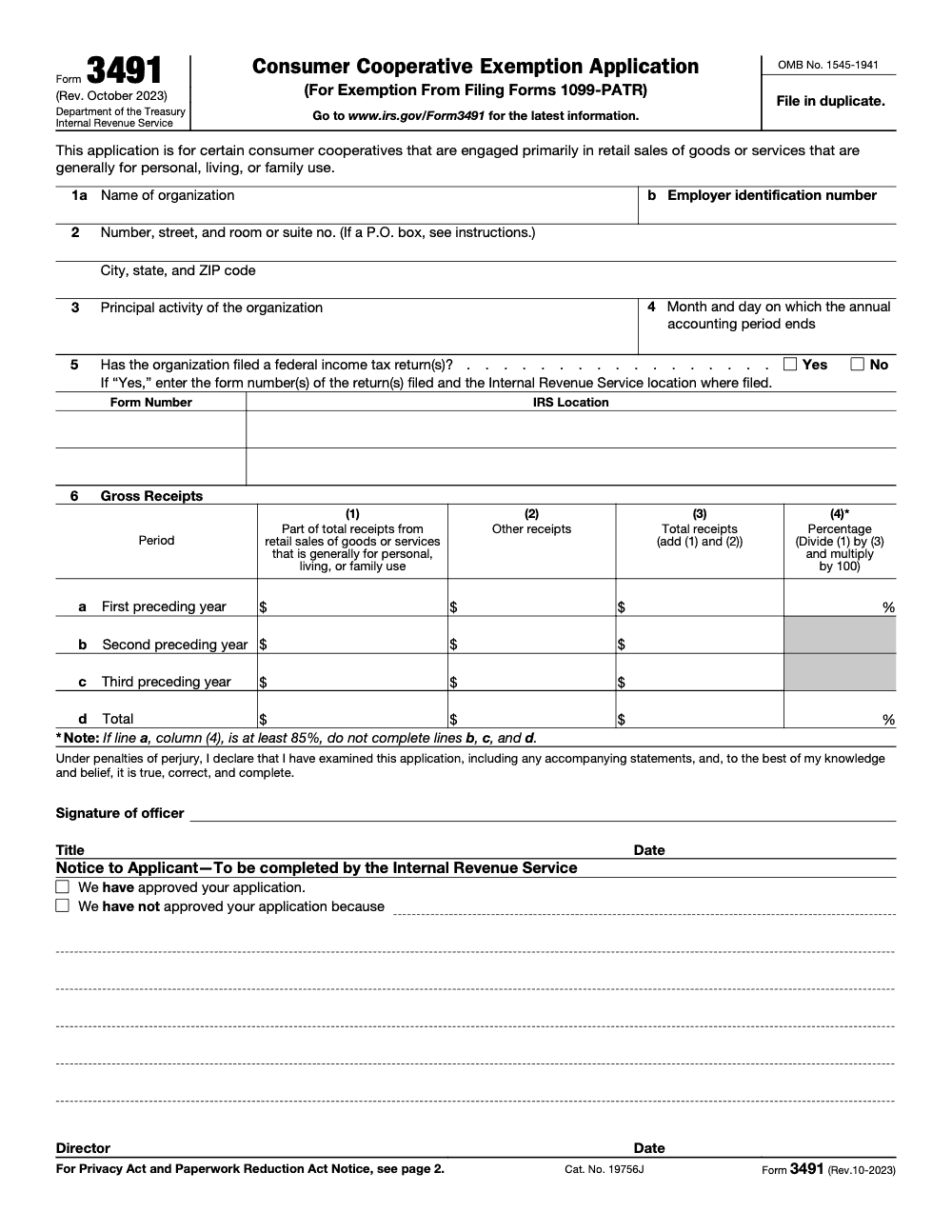
Form 3491 is the Consumer Cooperative Exemption Application – a qualifying consumer co-op uses it to ask the IRS for relief from filing Form 1099-PATR on patronage distributions of $10 or more per recipient (per IRC Section 6044(c) and Treasury Regulation 1.6044-4). Per the October 2023 revision (as published on IRS.gov), the exemption requires at least 85% of gross receipts from qualifying retail sales (one preceding tax year OR the trailing three tax years combined), and two copies of the application must be mailed to Mail Stop 4-G08.151, Philadelphia, PA 19255-0633.
A consumer co-op has been mailing 1099-PATR forms for years, a new treasurer asks why, and someone finally splits the receipts by category and sees that more than 85% of gross receipts have always come from household retail sales. Form 3491 is the application that would have stopped the mailing, and it has been sitting unfiled the whole time.
Form 1099-PATR normally reports patronage distributions of $10 or more per recipient, and Form 3491 asks the IRS for relief from filing it. The relief is not self-claimed: you file 2 copies of the current October 2023 revision and wait for an affirmative determination, and the exemption ends automatically once qualifying retail sales fall below 70%.
Key Takeaways
- Form 3491 is the Consumer Cooperative Exemption Application. A qualifying consumer co-op uses it to request exemption from filing Form 1099-PATR, under Internal Revenue Code section 6044(c).
- Form 1099-PATR is normally required to report patronage distributions of $10 or more to a recipient during the calendar year. Form 3491 seeks relief from that information-reporting requirement, not from federal income tax.
- To qualify, at least 85% of gross receipts must be from qualifying retail sales (goods or services generally for personal, living, or family use), measured over either the preceding tax year or the preceding 3 tax years in aggregate.
- The exemption is not self-claimed. The co-op must file Form 3491 and receive an affirmative determination from the IRS before it can stop filing Form 1099-PATR. See Regulations section 1.6044-4.
- Once granted, the exemption terminates automatically for payments made after the close of the first tax year in which qualifying retail sales drop below 70%, so test the ratio annually.
- File 2 copies of the current revision (Rev. October 2023) to the Department of the Treasury, Mail Stop 4-G08.151, Philadelphia, PA 19255-0633.
What Form 3491 actually does
Form 3491 is the Consumer Cooperative Exemption Application. It lets a qualifying co-op ask for relief from reporting patronage distributions on Form 1099‑PATR (this is only an exemption from that information‑reporting requirement, not from federal income tax on the cooperative itself). The authority lives in Internal Revenue Code section 6044 and its regulations. In plain terms, if your co-op is primarily a retail, consumer‑facing operation, you can apply so you do not have to issue 1099‑PATR forms while you keep meeting the retail‑sale tests (the exemption is not self‑claimed – a co-op cannot simply stop filing 1099‑PATR until the IRS affirmatively grants the determination under section 6044(c)).
The regulation sets the bar this way, you apply, the Service determines whether you are primarily engaged in selling at retail goods or services generally for personal, living, or family use. The test is measured by gross receipts, not by number of transactions.
Who should apply, and who should pause
If you are a consumer cooperative whose prior‑year gross receipts, or three‑year aggregate, are at least 85% from qualifying retail sales, Form 3491 is worth filing. That includes groceries, farm and home supply, outdoor gear, energy efficiency services, and similar retail models with household‑use purchasing patterns. If your mix has drifted toward commercial or wholesale transactions, pause until the numbers are back on side, then apply with support that clearly shows how you meet the retail standard.
A few sanity checks before you send anything, does your sales mix reflect personal, living, or family use in fact, do your ledgers separate qualifying retail from nonqualifying revenue, and are dual‑use items classified using an approach consistent with the regulation. An item commonly purchased wholesale for business may still qualify when you sell it at retail for household use. Document the pattern, not just the item.
The retail‑sale test in clear language
Here is the heart of the rule. You qualify when at least 85% of gross receipts are from sales at retail that are generally for personal, living, or family use. You can meet this using the immediately preceding taxable year or the preceding three years in the aggregate. The regulation expressly allows items that could be bought for business to count if, when used for business, they are generally purchased at wholesale, and your co-op sold them at retail. That is the government’s way of saying dual‑use items can be qualifying if household‑use retail buying is the norm.
Once approved, the determination applies beginning with payments made during the calendar year of approval. It automatically stops being effective for payments made after the close of your first taxable year in which the qualifying portion of receipts drops below 70%. Keep testing annually so you do not get surprised.
What‑How‑Wow, your fast roadmap
- What, Form 3491 is an application for exemption from Form 1099‑PATR reporting for qualifying consumer co-ops. It sits under IRC § 6044 and 26 CFR § 1.6044‑4.
- How, build a receipts schedule that proves the 85% gate, complete the form, sign, file two copies to the current IRS address, and retain the IRS response letter in your records. Then monitor the 70% continuation test each year.
- Wow, a small set of routines, monthly mix tracking, clear dual‑use rules, and a clean workpaper pack, can permanently reduce January reporting anxiety, and keep you eligible without drama.
Expected subtopics you came for
What counts as qualifying retail
Qualifying retail means sales of goods or services at retail, generally for personal, living, or family use. Think household‑use patterns. If a product is sometimes business and sometimes household, the regulation tells you to treat it as household when sold at retail, because business buyers would usually buy it wholesale. That carveout keeps consumer co-ops from losing eligibility just because a few items have dual use. Document your rationale in your workpapers each period.
Where you file today, not in 1962
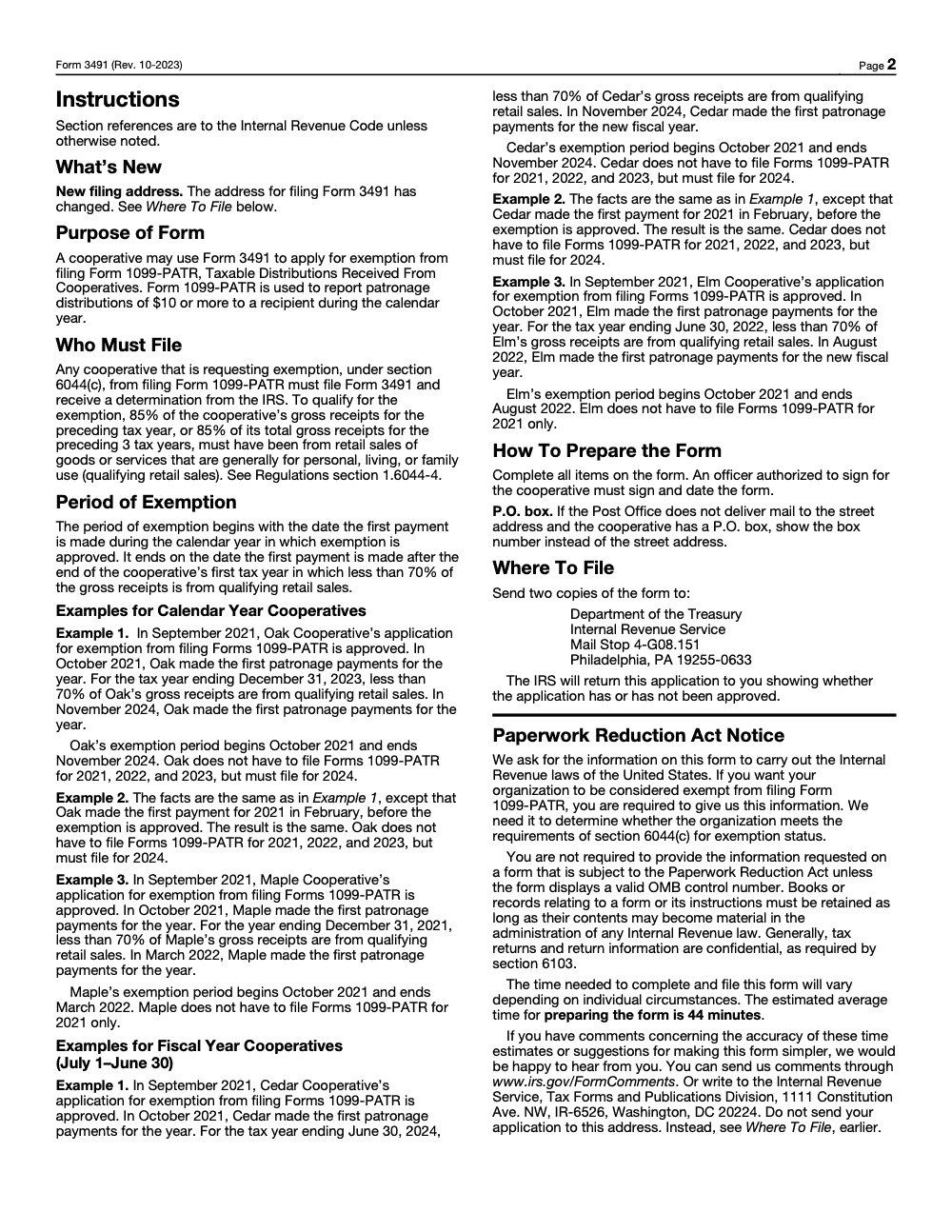
You may see older language about filing “with the district director.” That term remains in the regulation, but the IRS reorganized long ago. The current Form 3491 instructions tell you to send two copies to the IRS in Philadelphia, and the IRS has posted the address update with the same destination. Use the address printed in the latest PDF and keep a proof of mailing.
Eligibility tests you must pass and keep passing
The 85% qualification test
You clear the gate if either of these is true, at least 85% of gross receipts in the preceding taxable year were from qualifying retail sales, or at least 85% of aggregate gross receipts over the preceding three taxable years were from qualifying retail sales. Build your schedule by gross receipts, not by transaction counts. Reconcile to your trial balance and sales subledgers, then store the workpapers with your application copy.
Quick reference, qualification versus continuation
| Measure | Threshold | Period tested | What it controls |
| Initial qualification | 85% | Prior year or 3‑year aggregate | Whether IRS grants the exemption |
| Annual continuation | 70% | Each taxable year after approval | Whether exemption keeps applying |
Source rules, 26 CFR § 1.6044‑4, and Form 3491 instructions.
The 70% continuation rule, with practical timing
Approval is not set‑and‑forget. Your exemption applies starting with payments made during the calendar year of approval. It automatically stops being effective for payments made after the close of your first taxable year in which qualifying retail receipts fall below 70%. The official instructions include timing examples for both calendar‑year and fiscal‑year co-ops, which are useful to sanity check your payment dates.
Plain English timing tip, note when you actually make the first patronage payment in a year, that date is how the start and end of your exemption period are tested in the form instructions’ examples.
Dual‑use items without the headache
Many co-ops sell products that can be used personally or for business. The regulation specifically addresses this. If the item, when bought for business, is generally purchased at wholesale, your retail sales of that item are treated as consumer‑type for the test. Summarize that logic once in your policy, then reference it in your monthly classification notes so reviewers do not re‑argue it every quarter.
How to file Form 3491, step by step
Build a clean receipts schedule
- Pull the prior‑year, and if needed, the prior three‑year, gross receipts by category.
- Mark each category as qualifying retail or other, based on the regulation’s definitions and your dual‑use policy.
- Reconcile totals to your financials and POS exports.
- Add a short memo, one paragraph per category, that explains your treatment in plain language. This becomes your reviewer’s map.
Complete the form, and sign
Form 3491 is short, two pages. You will identify the co-op, list prior returns and campus where filed, and present a small table that totals qualifying retail receipts, other receipts, and the percentage. An authorized officer must sign under penalties of perjury (a bookkeeper, preparer, or other non‑officer cannot sign in the officer's place – the signer must have authority to bind the cooperative). Keep a copy of everything you send.
Where to file, and how many copies
Send two copies of Form 3491 to the current IRS address listed in the instructions, as of the October 2023 revision, that address is, Department of the Treasury, Internal Revenue Service, Mail Stop 4‑G08.151, Philadelphia, PA 19255‑0633. The IRS will mail back its determination showing approval or non‑approval, retain that letter with your permanent records. Check the IRS Form 3491 page for any future address update before you mail.
Can you e‑file this
At this time, Form 3491 is not an e‑file form. The form instructions tell you to mail two copies, and the IRS’s internal manual references Philadelphia handling. If you are ever in doubt, follow the current Form 3491 PDF and IRS page, they are the controlling sources for address and method.
When relief starts and ends
Relief begins with payments made during the calendar year in which your exemption is approved (payments made earlier in that same calendar year, before the IRS grants approval, are also covered – see Example 2 in the form instructions). It ends after the first taxable year in which the qualifying retail share dips below 70%, and the termination applies to payments made after that year. This is automatic, there is no separate revocation letter. Set a year‑end checkpoint to test the continuation rule before any early‑year patronage payments go out.
Documentation and controls that make approval easy
Your minimum workpaper pack
- A one‑page policy on what your co-op treats as qualifying retail, including dual‑use logic and examples.
- Prior‑year gross receipts summary, and if needed, a three‑year aggregate schedule, with ties to the GL and POS.
- A category‑level memo explaining why each category is qualifying or not, written so a new reviewer can follow it.
- A brief seasonal analysis, for example, garden center peaks spring to early summer, with no impact on the annual ratio.
- A signed Form 3491 and a proof of mailing, certified mail or similar.
- On approval, the IRS determination letter, saved with your permanent records.
If the IRS later questions penalties for missing 1099‑PATR filings, an approved Form 3491 letter is the first item you present. The IRS manual tells personnel to abate information return penalties when an approved exemption is documented.
Keep the exemption, keep it simple
Ongoing habits that protect your 70%
- Run a monthly retail mix report that splits qualifying versus other receipts, keep a rolling twelve‑month view.
- Watch dual‑use categories, for example, tools or small appliances, and note why the sales pattern is consumer‑type.
- Train cash office and accounting staff on category mapping so new SKUs do not drift into the wrong bucket.
- Do an annual receipt review before you authorize any patronage payments for the new year.
- Communicate with members, membership policies and pricing can influence what shows up as household‑use purchases.
These are light lifts, and they make your re‑test at year end quick and boring, which is the goal.
Common mistakes to avoid
- Treating the test as a count of tickets or items instead of gross receipts. The regulation is clear, it is by gross receipts.
- Waiting to classify dual‑use items until year end. Decide the rules now, then apply them monthly.
- Mailing to the wrong address. Use the most recent Form 3491 instructions for the Philadelphia address.
- Forgetting that relief ends automatically after a sub‑70% year. Put the continuation test on your compliance calendar.
A short, practical filing checklist
- Confirm you meet the 85% test, prior year or three‑year aggregate.
- Prepare the receipts schedule, dual‑use notes, and a one‑page policy.
- Complete and sign Form 3491, file in duplicate to the Philadelphia address in the latest PDF.
- Calendar a continuation test at year end to confirm you remain above 70%.
- Store the IRS determination letter in your permanent files and train staff on your classification rules.
Where Accountably fits, if you want help
If you are short on reviewer time or you need tighter documentation, our team can template your gross‑receipts schedules, standardize dual‑use classifications, and build simple monthly dashboards that keep you above the 70% line without last‑minute scrambles. We work inside your systems and workpapers, which makes the Form 3491 packet easy to review and approve. Use us lightly for setup, or lean on us during peak season while you focus on members and operations.
Compliance note and sources
Tax rules change, so check the IRS Form 3491 page for the latest revision and address before you mail. As of February 19, 2025, the IRS page confirms Form 3491 is the application for exemption from Form 1099‑PATR filings, and the current PDF shows the Philadelphia filing address and “file in duplicate” instruction. The governing law is IRC § 6044 and 26 CFR § 1.6044‑4.
One small historical footnote, the regulation still uses the term “district director,” which dates to a pre‑reorganization IRS structure. Today, follow the filing address in the current Form 3491 instructions.
Final word
If you mostly serve households, Form 3491 can take a big annual task off your list. Prove the 85% gate, mail a clean form with supporting workpapers, and keep your eye on the 70% each year. That is it. If you want a second set of eyes to set up the schedules and policies once, we are here to help, and we will work within your workflow so the process stays yours.
Common Mistakes We See Every Season
The Form 3491 errors we clean up most often are not math errors. They are routing errors, signature errors, and a misread of the asymmetry between the 85% qualifying gate and the 70% continuation gate.
Reusable Checklists
The checklists below are copy-paste ready for your firm SOP. Each one maps to one of the three Form 3491 lifecycle moments: getting in, mailing the packet, and staying in.
Pre-application qualification check
- Confirm the cooperative is consumer-facing (sales primarily for personal, living, or family use).
- Pull gross receipts by category for the most recent tax year and calculate line 6a column (4).
- If line 6a column (4) is at least 85%, skip the three-year rows and document the calculation.
- If under 85% for the preceding year, calculate the trailing three tax years combined and check the 85% test there.
- Confirm the principal activity for line 3 (one-line description that matches the receipts mix).
- Note the annual accounting period end date for line 4.
- Capture EIN, mailing address, and any prior federal tax return form numbers and IRS locations for line 5.
Duplicate-filing mailing packet
- Print two original copies of Form 3491 (Rev. October 2023), not photocopies of a single signed sheet.
- Confirm an authorized officer has signed both copies under penalties of perjury.
- Verify the mailing address reads: Department of the Treasury, Internal Revenue Service, Mail Stop 4-G08.151, Philadelphia, PA 19255-0633.
- Attach the qualifying-sales workpaper that supports line 6a (one page is fine).
- Send by certified mail with return receipt; staple the green card to the office copy when it comes back.
- Calendar a 90-day follow-up date in case the stamped approval copy has not returned.
- File the returned approval copy in a dedicated IRS exemption folder separate from the annual tax workpapers.
Annual 70% continuation review
- At year-end close, recalculate qualifying retail receipts as a percentage of total gross receipts for the tax year just closed.
- Compare against the 70% continuation threshold and document the result in the exemption folder.
- If above 70%, file a one-page memo confirming the exemption stands for the coming calendar year.
- If below 70%, calendar the date of the first patronage payment in the next tax year as the exemption end date.
- If below 70%, restart 1099-PATR preparation for payments made after that first post-failure date.
- Update the board file so future officers know the exemption status without re-running the math.
Keep 3491 Season From Stalling
Form 3491 work does not carry the calendar pressure of a 1040 deadline or a 941 deposit, but it stalls the same way: the application sits on a desk for months because no one owns the qualifying-sales calculation and no one wants to pull the receipts apart by category. The IRS estimated 44-minute prep time (per Form 3491 instructions, Rev. October 2023) is realistic only when the workpaper underneath the form is ready. Without that, a one-hour task becomes a six-month back-and-forth that delays the determination letter into the next reporting cycle.
The fix is to treat Form 3491 like any other production workflow: one owner, one source of truth for the qualifying-sales ratio, and a documented mailing packet so the application clears the office on the first attempt.
- Build the line 6 gross-receipts workpaper before drafting the form itself, with receipts split into qualifying retail versus non-qualifying.
- Set a hard rule that line 6a column (4) is calculated first; if it clears 85%, leave lines 6b through 6d blank rather than guessing at three-year data.
- Lock the duplicate-copy rule into the mailing SOP, with a second signed original kept on file as evidence the application was filed correctly.
- Calendar the annual 70% continuation check the same week the tax year closes, so the exemption status is settled before the next 1099-PATR cycle begins.
- Route every Form 3491 file through one reviewer who confirms the Philadelphia Mail Stop 4-G08.151 address has not changed in a later revision.
That is the production pattern Accountably's tax execution team sets up for consumer cooperatives that want the exemption handled once, documented once, and reviewed once a year without burning a quarter of staff time on the same calculation.
FAQs
It is the Consumer Cooperative Exemption Application. You use it to ask the IRS to exempt your co-op from filing Form 1099‑PATR, as allowed by IRC § 6044 and its regulations.
The IRS reviews your application under 26 CFR § 1.6044‑4 using the 85% retail‑receipt test for initial qualification. If approved, you keep the exemption only while you meet the 70% continuation test each year.
No. The current instructions tell you to mail two copies to the IRS in Philadelphia. Keep your proof of mailing and the approval letter.
No. Dividends on a cooperative’s capital stock, if any, are reported on Form 1099‑DIV. Form 3491 relates to patronage distributions reported on 1099‑PATR.
Your exemption ends automatically for payments made after the close of the first taxable year with less than 70% qualifying receipts. You would resume filing 1099‑PATR for later payments.
Form 3491 carries OMB control number 1545‑1941, shown on the form itself.
About this guide
Accountably helps US CPA, EA, and accounting firms hire trained accountants and tax preparers in India.
About us Reviewed byJugal Thacker, CPAFounder and CEO at Accountably
A Washington-licensed CPA with 7+ years inside US firms – PwC, a real-estate tax practice, then a full-service firm, rising from reviewer to manager to advisory. This article was reviewed against current IRS guidance for the 2025 tax year and updated for filers preparing late returns, amendments, and 2026 estimates.
View profile →How we research, review, and update this guide
Every Accountably guide is researched against primary IRS sources, reviewed by a U.S. CPA, and refreshed as guidance evolves. Read our Editorial Guidelines to see how we source, fact-check, and update our content.