Summarize this article with AI
In Brief
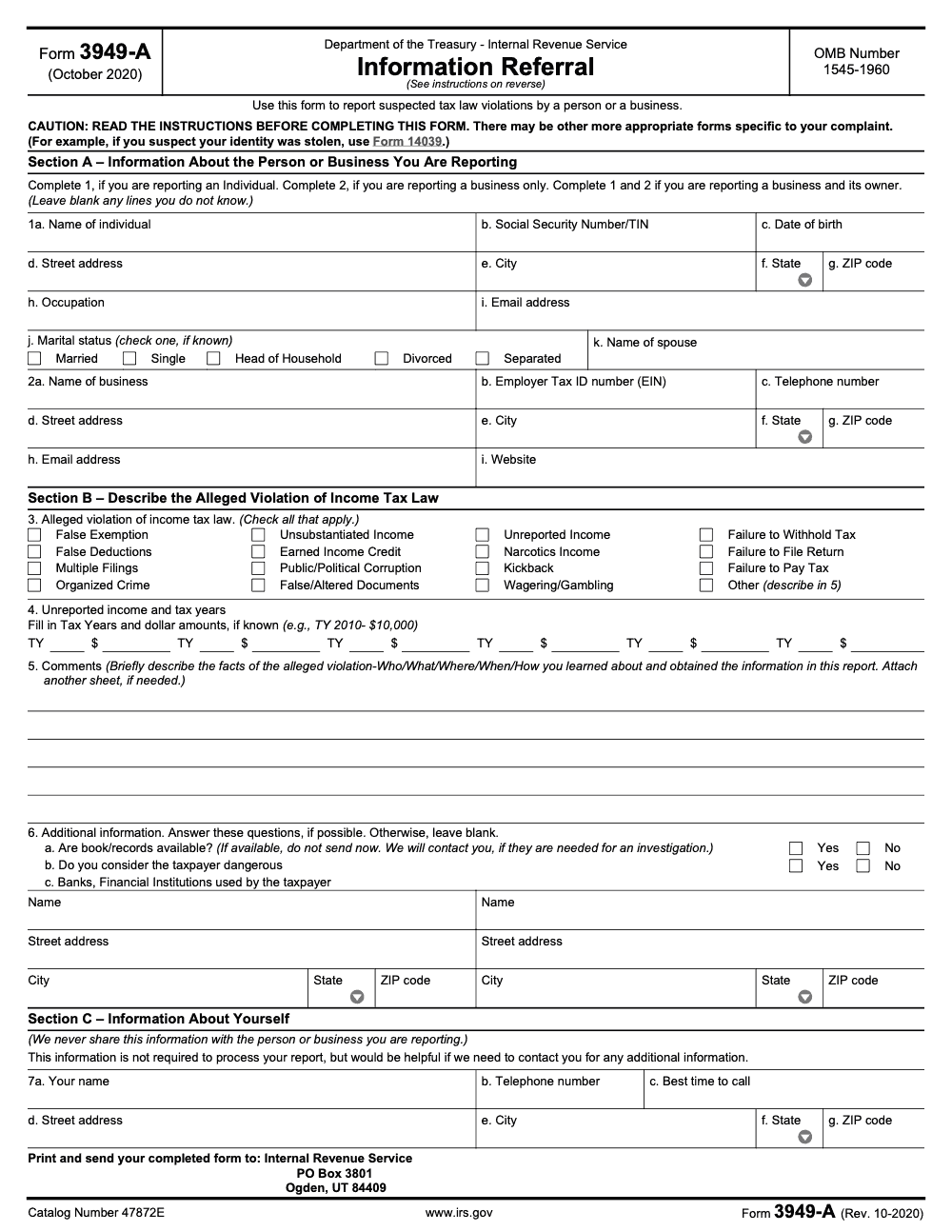
Form 3949‑A (Rev. October 2020) is the IRS Information Referral form used to report alleged tax law violations by an individual, a business, or both. Section A captures subject details, Section B lists 15 violation categories on line 3 (check every box that applies), and Section C is optional, which permits anonymous filing. The completed form must be printed and mailed to Internal Revenue Service, PO Box 3801, Ogden, UT 84409 (per the Form 3949‑A instructions on IRS.gov, no e-file or fax submission channel exists).
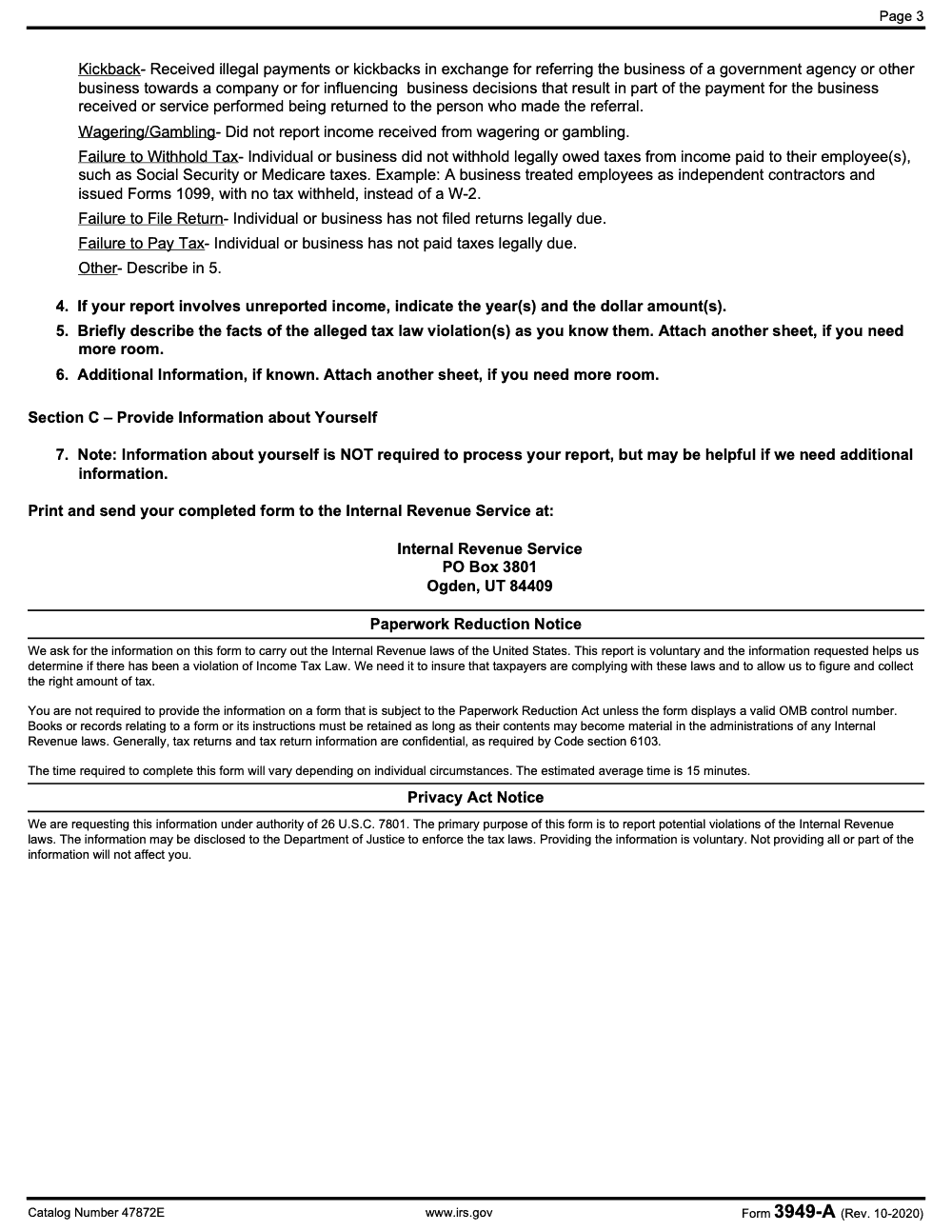
Most people who want to report tax fraud assume a phone tip will do the job, then learn the hard way that the IRS routes alleged tax law violations through a printed, mailed form. Form 3949-A is the Information Referral, and there is no e-file, fax, or email channel for it. The current form shows the mailing address as Internal Revenue Service, PO Box 3801, Ogden, UT 84409.
The other common mistake is picking Form 3949-A for the wrong problem. It is meant for serious, intentional violations like unreported income, false deductions, or payroll tax abuse, not identity theft, preparer misconduct, or whistleblower award claims, each of which has its own form. Section C is optional, so anonymous tips are allowed, though specific identifiers and documents raise the odds the IRS can act.
Key Takeaways
- Form 3949‑A must be printed and mailed to the IRS. Per the Form 3949‑A instructions, no e-file, fax, or email submission channel exists for this form.
- If you choose paper, the current form shows the mailing address as, Internal Revenue Service, PO Box 3801, Ogden, UT 84409. Always check the latest form before mailing.
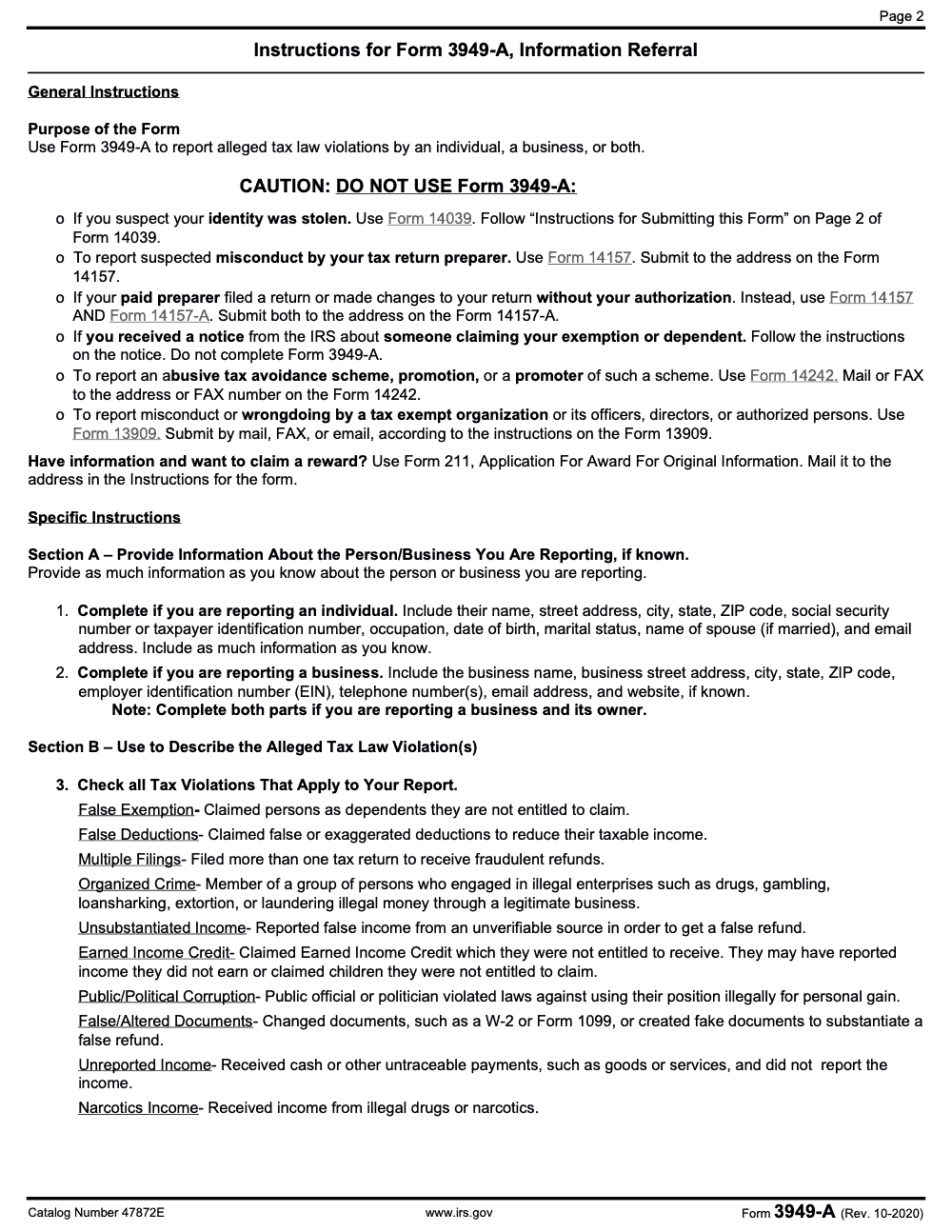
- Use Form 3949‑A to report serious, intentional violations like unreported income, false deductions, fabricated documents, or payroll tax abuses. Abusive tax avoidance schemes, promotions, and promoters route to Form 14242, not Form 3949‑A.
- Do not use Form 3949‑A for identity theft, preparer misconduct, or whistleblower awards. Use Form 14039 for identity theft, Forms 14157 and 14157‑A for tax preparer issues, and Form 211 for award claims.
- Anonymous tips are allowed. Section C on the paper form is optional, however specific identifiers and documents increase the chance the IRS can act.
What Is Form 3949‑A?
Form 3949‑A, often called “Information Referral,” is how you report suspected federal tax violations by an individual, a business, or both. You provide who, what, where, when, why, and how, along with any copies of documents that back up your account. Per the Form 3949‑A instructions, the form must be printed and mailed; no e-file, fax, or email submission channel exists. Organize your facts clearly before printing.
Typical issues that fit this form include unreported income, false deductions or credits, fabricated or altered documents, failure to file, failure to pay or withhold, and organized evasion patterns. Abusive tax avoidance schemes and shelters route to Form 14242, not Form 3949‑A. The online IRS page lists these categories plainly, which can help you check your facts against what the Service considers within scope.
When Not To Use Form 3949‑A
- Identity theft, for example, someone filed a return in your name, belongs on Form 14039, which can be submitted online or by paper.
- Preparer misconduct or fraud needs Forms 14157 and, when applicable, 14157‑A (when both forms apply, submit them together to the address shown on Form 14157‑A, not Form 14157). The IRS accepts these online, by fax, or by mail, and posts the Return Preparer Office mailing address.
- Seeking a whistleblower award, use Form 211. As of December 19, 2025, the IRS also allows secure online submission for Form 211, and it still accepts mail.
Why Firms And Families Ask About This Form
In our work with accounting teams, we see two common scenarios. First, a firm encounters a client who has credible proof that a competitor or ex‑partner is hiding income. Second, a separated parent suspects hidden wages or sham deductions that distort child support calculations. In both cases, emotions run high. Your best move is to slow down, separate facts from feelings, and build a clean, specific record. That disciplined approach is exactly what the IRS intake screeners look for.
A Straight Answer On Anonymity
You can leave your own information blank on Section C of the form to file anonymously. The IRS does not notify the subject about who reported them. That said, names, addresses, Taxpayer Identification Numbers if known, exact tax years, and good documentation make a real difference in whether your tip gets elevated.
The What‑How‑Wow Framework For Form 3949‑A
- What, Form 3949‑A is the IRS pathway to report serious tax noncompliance with a concise 5‑W narrative and supporting records.
- How, organize identifiers, specify tax years and estimated unpaid tax by year, indicate on line 6a whether records are available (do not mail them with the form), and print and mail the form to Internal Revenue Service, PO Box 3801, Ogden, UT 84409.
- Wow, you improve your odds when you quantify amounts, map a clear timeline, and show how the IRS can independently verify your facts, for example, through bank statements, false 1099s, or payroll records that tie back to returns. Screening teams prioritize tips that are specific, corroborated, and within IRS jurisdiction.
When To Use Form 3949‑A
Use this form when you can describe deliberate, material noncompliance with facts, not hunches. Think cash sales never recorded, false W‑2s or 1099s, sham expenses, improper credits, or a pattern of failing to file or pay. If all you have is a billing argument, a divorce dispute, or a gut feeling, pause and gather proof first. The IRS lists the specific categories it considers within scope, which is a helpful cross‑check before you file.
Serious Tax Violations, What Counts
- Unreported income, for example, cash receipts omitted from books.
- False deductions or credits that do not match source records.
- Fabricated or altered documents, for example, inflated W‑2s or 1099s.
- Failure to file or failure to withhold payroll taxes.
- Organized or repeated schemes that show intent.
Your job is to tie people, entities, and years to specific amounts or patterns. If you do not know the exact dollars, write “Unknown,” then show how you estimated scope or where the IRS can verify it.
Strong Supporting Evidence
Evidence is the difference between a tip that moves forward and one that stalls. Aim for:
- Precise identifiers, full legal name, complete address, and SSN or EIN if known.
- Tax years, list each year involved and the related amounts if known.
- Documents, copies only, never originals, like bank statements, invoices, altered W‑2s or 1099s, payroll reports, contracts, or emails that corroborate your claim.
- Witnesses and record locations, where ledgers, systems, or third‑party files can confirm your facts.
- A short 5‑W narrative that shows intent, not mere error.
“Specific, corroborated, and verifiable” is what screening teams prioritize. Keep your narrative short, factual, and easy to route.
Legitimate Reasons For Filing, With What To Provide
| Issue | What you should provide |
| Unreported income | Years affected, estimated amounts, examples of omitted deposits, and where the deposits appear, for example, bank statements |
| False deductions or credits | The expense or credit type, dates, supporting records that contradict the claim |
| False or altered documents | Copies of questionable W‑2 or 1099, the payer or preparer name, and how you know the item is false |
| Abusive schemes or shelters | Structure, parties, jurisdictions, and any promoter details |
| Payroll abuses | Employer name, EIN, pay periods, unpaid tax estimates, and payroll records that show under‑withholding |
The IRS’s “About Form 3949‑A” page outlines these categories, so it is a good reference as you prepare your file.
Using Form 3949‑A For Child Support Situations
If hidden income or sham deductions are distorting child support, Form 3949‑A can be appropriate when the underlying behavior is federal tax fraud, not a custody dispute. Focus on facts that the IRS can verify.
- Describe off‑the‑books cash work, fake deductions, or improper dependent claims.
- List tax years, names, addresses, and, if known, SSN or EIN.
- Attach copies of pay stubs, bank records, or employer messages that show real income or dependents claimed improperly, copies only.
- If identity theft is involved, use Form 14039 instead of Form 3949‑A.
Keep family law remedies on a separate track with your local child support agency. Form 3949‑A deals with federal tax noncompliance, and it should stand on its own merits.
Required Information And Documentation
You will improve your submission by assembling four buckets of information:
- Who, full legal names, addresses, and TINs if known, for the person, business, or both.
- When, the tax years and, if possible, relevant dates for transactions or filings.
- What, a short 5‑W account of the alleged misconduct, written like meeting minutes.
- How much, estimated unpaid tax by year, and how you arrived at the numbers.
Complete both the individual and business sections if you are reporting a company and its owner. If you want IRS follow‑up, provide your contact details. If you prefer anonymity, leave Section C blank, the IRS keeps tipster information confidential, and it does not share it with the subject.
Step‑By‑Step, Filling Out Form 3949‑A
Follow this simple sequence to keep your file clean and review‑ready:
- Confirm identifiers
- Gather the legal name, complete address, and SSN or EIN if known for the person or business you are reporting.
- Complete Section A
- Identify whether you are reporting an individual, a business, or both, then fill in what you know.
- Check the violation boxes in Section B
- Mark every relevant issue, unreported income, false deductions, false documents, failure to file, failure to pay, payroll issues, or other.
- List years and dollars
- In Part 4, list each tax year and estimated unpaid tax. If you cannot estimate a number, write “Unknown,” then explain where the IRS can verify amounts.
- Write a tight Part 5 narrative
- Stick to the 5‑W format. Keep it factual and short. Avoid opinions and adjectives.
- Attach copies, not originals
- Label exhibits by year, for example, “Exhibit A, 2023 bank deposits,” and keep a complete copy for yourself. For the full books and records themselves, however, line 6a of the form instructs reporters not to send those with the initial submission; just indicate they are available, and the IRS will contact you if records are needed for an investigation.
- Print and mail the form
- Print and mail the completed form to the address on the current form. As of the latest PDF, the address is PO Box 3801, Ogden, UT 84409. Per the Form 3949‑A instructions, no e-file, fax, or email submission channel exists.
5‑W Narrative Template You Can Copy
| Prompt | Your entry, 2 to 3 sentences each |
| Who | Full name of the person or business, plus any related entities or key individuals |
| What | The behavior you observed, for example, omitting cash sales, filing false 1099s, or claiming fake dependents |
| When | The tax years and specific dates if known, for example, monthly cash skims from March 2023 through October 2024 |
| Where | Where the activity occurred, for example, business location, bank, or payroll platform |
| Why and how | Why you believe it was intentional, and how the IRS can verify it, for example, bank statements do not match reported receipts |
Tip, if you have a lot of exhibits, add a one‑page index at the front. Screeners love clarity.
Quick Checklist Before You Submit
- Specific names and addresses match IDs or records you can reference.
- Each year listed shows an amount, or “Unknown” with a note on verification.
- Exhibits have clear labels and redactions where appropriate.
- The 5‑W narrative reads like minutes, not a story.
- You saved a complete copy of the packet.
Proper Submission Methods In 2025
Per the Form 3949‑A instructions, there is only one way to submit: by mail. There is no e-file, fax, or email submission channel.
- Print the current form and send it to the address shown on the form. The October 2020 PDF lists, Internal Revenue Service, PO Box 3801, Ogden, UT 84409. Use a secure mailing method and keep a copy.
If you are reporting fraudulent or abusive e‑file activity, the IRS still directs you to use Form 3949‑A and send the information to the address shown on the form, while following the data fields the Service requests for e‑file fraud submissions.
Common Misroutes And The Right Forms
- Identity theft victims should use Form 14039, which can be submitted online or by paper, not Form 3949‑A.
- Complaints about a paid tax return preparer, use Form 14157 and, when your return was altered without consent, add Form 14157‑A (mail both forms together to the address shown on Form 14157‑A, not Form 14157). The IRS accepts these online, by fax, or by mail to the Return Preparer Office.
- Seeking a whistleblower award, file Form 211. As of December 19, 2025, you can submit Form 211 online, or by mail if you prefer.
What Happens After You File
Once your submission arrives, intake specialists screen it for specificity, identifiers, timeliness, and evidence. Their goal, confirm there is a federal tax issue within IRS jurisdiction, then route it to the right unit for civil exam or criminal investigation if warranted. Per the Form 3949‑A instructions, the form is paper-only, so a clean narrative and organized exhibits help once your packet lands at the Ogden intake desk.
Initial Screening Criteria, What They Look For
- Clear identifiers, full legal name, address, and TIN if known.
- Defined years and material amounts, or a method the IRS can verify.
- Evidence, copies of W‑2s, 1099s, bank records, payroll data, contracts, or correspondence.
- Scope fit, the allegation belongs with the IRS, not identity theft, not a preparer complaint routed elsewhere.
Screeners elevate suspected criminal activity, organized schemes, and large‑dollar cases. Nonspecific tips may be logged without action, which is why clarity and corroboration matter.
Investigation Decision Factors
You improve priority when you provide verifiable facts that tie to returns, deposits, or payroll. Link the players, the years, and the money. Show patterns and how the IRS can validate them independently. Keep dates current. If you are seeking an award, remember that Form 3949‑A does not create award eligibility. That runs through Form 211, which the IRS now accepts online and by mail.
Timelines And Updates
There is no fixed clock. Screening can take weeks or months, and complex schemes can take years to resolve. The IRS typically does not provide status updates on Form 3949‑A submissions, which protects your confidentiality. If you filed Form 211 instead, the Whistleblower Office will mail an acknowledgment letter with a claim number, and there is a formal process with milestones explained in Publication 5251.
Expect patience to be part of the process. Your preparation on the front end, specific facts and clean exhibits, is the part you can control.
For Firm Leaders, How To Help Clients Do This Right
If you lead a CPA, EA, or accounting firm, your role is not to make accusations, it is to help clients present facts that can be verified. Standardized workpapers, clear file naming, and a short narrative go a long way. This is where trained offshore staffing with layered review shines.
- Create a secure folder structure for exhibits by year.
- Use internal checklists to confirm identifiers and years are captured.
- Keep a simple index page that maps each claim point to an exhibit.
When a firm’s team is buried in production, messy evidence files often sink otherwise valid tips. If your practice needs help building repeatable documentation discipline, Accountably integrates trained offshore teams into your workflow with SOP‑driven execution, structured workpapers, and layered review. That way, your onshore reviewers spend less time untangling files and more time protecting client interests. Mentioning this here because it directly affects outcomes, not as a sales pitch.
Bonus Tools
One‑Page 5‑W Narrative Example
Who, Acme Services LLC, EIN XX‑XXXXXXX, owner Jane Smith, SSN XXX‑XX‑1234, 1200 Market St, Denver, CO 80202. What, Cash sales from countertop installs not recorded in books. When, March 2023 through October 2024, weekly pattern, higher in summer months. Where, Main location listed above, deposits into First Front Range Bank ending 4321. Why and how, Bank deposits exceed POS and ledger sales by about 25 percent monthly. Exhibits A‑H show monthly statements and POS reports.
Attachments Index Template
- Exhibit A, 2023 bank statements, First Front Range Bank, acct ending 4321
- Exhibit B, 2024 bank statements, same account
- Exhibit C, POS monthly sales summaries, 2023–2024
- Exhibit D, Email from owner to manager about cash jobs, April 12, 2024
Conclusion
You now have a clean, practical way to report suspected tax fraud that stands on its own, Form 3949‑A, a short 5‑W narrative, specific identifiers, and labeled exhibits. In 2025, you must print and mail the form to Internal Revenue Service, PO Box 3801, Ogden, UT 84409, and you should expect confidentiality with no status updates. Use the right form for the right issue, 14039 for identity theft, 14157 series for preparer misconduct, 211 for awards. When your goal is to help the IRS act quickly and fairly, clarity and corroboration are your best tools.
Common Mistakes We See Every Season
The same six patterns kill credible Form 3949-A referrals every season, and most start with picking the wrong form before the first line of Section A is filled in.
Reusable Checklists
These three checklists are copy-paste ready for firm SOPs and for individual filers handling a one-off referral. Run them in order: routing first, packet second, retention last.
Routing sanity check before reaching for Form 3949-A
- Rule out identity theft – use Form 14039 if the issue is unauthorized SSN or tax-account use.
- Rule out preparer misconduct – use Form 14157, plus Form 14157-A for unauthorized filing or alteration.
- Rule out abusive tax schemes, promotions, or promoters – use Form 14242 (mail or fax to the address or FAX number shown on Form 14242).
- Rule out tax-exempt organization wrongdoing – use Form 13909 (mail, fax, or email per its own instructions).
- For a duplicate exemption or dependent notice (such as CP87A), follow the instructions on the notice instead.
- Decide whether a Form 211 (Application For Award For Original Information) should accompany the referral if the reporter expects an award.
Pre-submission referral packet
- Confirm the alleged conduct fits one of the 15 line 3 categories or qualifies as 'Other'.
- Complete Section A line 1 (1a through 1k) for an individual subject; line 2 (2a through 2i) for a business; both for a business and its owner together.
- Enter every applicable tax year and dollar amount on line 4 in the format shown on the form (e.g., TY 2010- $10,000); six slots are available.
- Draft a tight line 5 narrative covering who, what, where, when, and how the information was learned.
- Answer line 6a (records available) and line 6b (dangerousness) if known; list up to two banks or financial institutions on line 6c.
- Decide whether to complete Section C (lines 7a through 7g) or leave it blank to file anonymously.
- Print the completed form on plain paper and mail to Internal Revenue Service, PO Box 3801, Ogden, UT 84409.
Internal documentation retention
- Save a scanned copy of the printed Form 3949-A in the secure client folder.
- Log the mail date, postage tracking number, and recipient address for the audit trail.
- File source records cited on line 6c in a sealed evidence folder; do not destroy while they may still be material in the administration of Internal Revenue laws.
- Note the IRC §6103 confidentiality rule and the disclosure-to-DOJ exception in the engagement memo.
- Confirm that no books, statements, or exhibits were mailed with the form.
- Calendar a 90-day follow-up note – the IRS does not send status updates on Form 3949-A referrals.
Keep 3949-A Season From Stalling
Form 3949-A does not file like a return. It files like a referral packet that lands on an intake desk in Ogden, where specialists triage identifiers, years, materiality, and the line 5 narrative against the 15 categories on Section B line 3. The clients who slow this work down are not the bad-faith ones; they are the well-meaning filers who expect a 5-minute tip to close the loop, leaving the firm to absorb the routing decision, the narrative drafting, and the retention discipline.
Per the Form 3949-A instructions, the IRS estimates 15 minutes to complete the form itself – but the practitioner work sits around it. The fix is workflow discipline at the front of the engagement, not bigger evidence packets at the back.
- Build a routing decision tree that checks Form 14039, Form 14157 and 14157-A, Form 14242, Form 13909, and Form 211 before defaulting to Form 3949-A.
- Standardize the line 5 narrative around the five W's (who, what, where, when, and how) with a strict word cap; exhibits enter the file only when line 6a is answered 'Yes'.
- Maintain a Section A field map so junior preparers know which fields are populated (lines 1a through 1k for individuals, 2a through 2i for businesses) and which can be left blank without penalty.
- Document the mailing log every time – print date, postage tracking number, and the PO Box 3801, Ogden, UT 84409 address – because the IRS will not confirm receipt.
- Capture the IRC §6103 confidentiality language in the engagement letter so the reporter understands Section C identifying information is never shared with the subject of the referral.
That delivery discipline is what we build into every tax engagement at Accountably. Our tax execution team carries the routing decision tree, the line 5 narrative templates, and the Section A field maps, so the form goes out clean the first time and the engagement does not stall waiting for a re-routing decision.
FAQs
Your tip enters an intake screen where specialists check identifiers, years, materiality, and documentation. Actionable tips route to civil or criminal units. The IRS does not provide status updates on these referrals, which preserves confidentiality.
Yes. You can withhold your contact information on the paper form, and the IRS keeps tipster details confidential. Keep in mind, strong identifiers and evidence increase the likelihood of action.
No. Per the Form 3949‑A instructions, the form must be printed and mailed to Internal Revenue Service, PO Box 3801, Ogden, UT 84409. There is no e-file, fax, or email submission channel.
Mail to the address shown on the current form. The latest PDF lists, Internal Revenue Service, PO Box 3801, Ogden, UT 84409. Use a secure mailing method and keep a copy.
Do not use Form 3949‑A for awards. File Form 211 with the IRS Whistleblower Office. In December 2025, the IRS launched a secure online option for Form 211, and it still accepts mail.
Use Form 14157, and if your return was altered without your consent, include Form 14157‑A. The IRS page lists online, fax, and mail options for these forms and provides the Return Preparer Office address.
Use Form 14039 for tax‑related identity theft. You can file that online or by paper, and the IRS explains the assistance process and next steps on its site.
Other forms this guide names
- Form 14157: Report Tax Preparer Misconduct, Step-by-Step
- Form 14157-A: Affidavit Report Tax Preparer Fraud to the IRS
- Form 14242: Report Abusive Tax Promotions Guide 2026
About this guide
Accountably helps US CPA, EA, and accounting firms hire trained accountants and tax preparers in India.
About us Reviewed byJugal Thacker, CPAFounder and CEO at Accountably
A Washington-licensed CPA with 7+ years inside US firms – PwC, a real-estate tax practice, then a full-service firm, rising from reviewer to manager to advisory. This article was reviewed against current IRS guidance for the 2025 tax year and updated for filers preparing late returns, amendments, and 2026 estimates.
View profile →How we research, review, and update this guide
Every Accountably guide is researched against primary IRS sources, reviewed by a U.S. CPA, and refreshed as guidance evolves. Read our Editorial Guidelines to see how we source, fact-check, and update our content.