Summarize this article with AI
In Brief
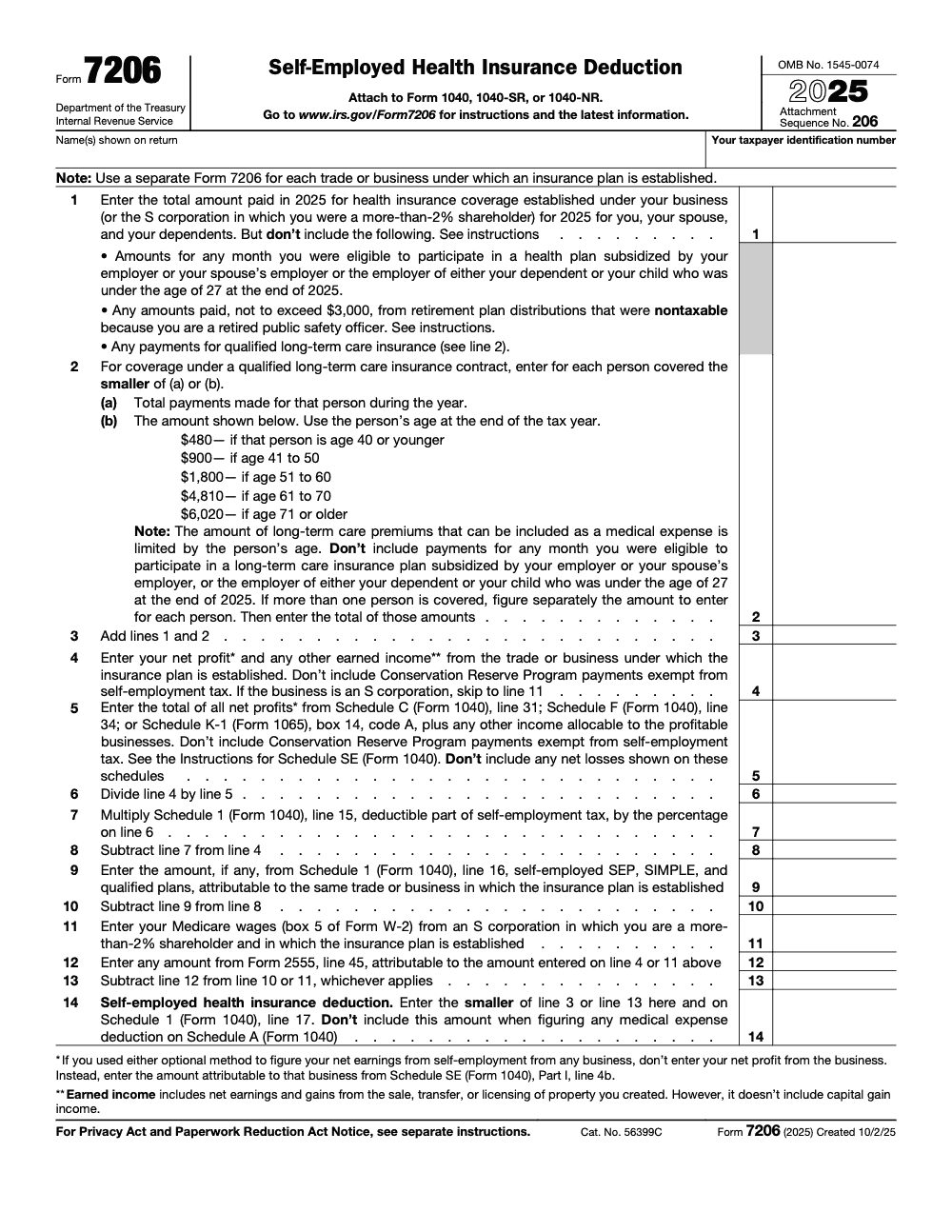
Form 7206 calculates the self-employed health insurance deduction for self-employed filers and more-than-2% S-corp shareholders, with the line 14 result posting to Schedule 1 (Form 1040) line 17 as an above-the-line adjustment to income. For 2025, qualified long-term care premiums are capped per person by age (per Rev. Proc. 2024-40): $480 at age 40 or under, $900 (41-50), $1,800 (51-60), $4,810 (61-70), and $6,020 at 71 and older. The underlying 1040-series return is due April 15, 2026, and Form 4868 extends filing to October 15, 2026.
A freelancer pulls her marketplace premium total, pays it in full, and assumes the whole amount drops onto her return as a self-employed health deduction. Form 7206 is where that assumption gets tested. Her spouse may have been eligible for an employer plan part of the year, which knocks those months off line 1, and her earned-income limit on line 13 may be tighter than the premiums she paid, so the final number on line 14 lands smaller than the spreadsheet she walked in with.
Form 7206 computes the self-employed health insurance deduction for self-employed filers and more-than-2% S-corp shareholders, with the line 14 result posting to Schedule 1 (Form 1040), line 17 as an above-the-line adjustment. Qualified long-term care premiums are capped by age for 2025: $480 at 40 or under, $900 from 41-50, $1,800 from 51-60, $4,810 from 61-70, and $6,020 at 71 and older. The eligibility tests, including the rule that disqualifies any month you or a child under 27 could have joined an employer plan, are where most of the work lives.
Key Takeaways
- Form 7206 standardizes how you compute the self‑employed health insurance deduction that flows to Schedule 1 (Form 1040), line 17, replacing the old Pub. 535 worksheet and continuing for 2025.
- File a separate Form 7206 for each trade or business that established a health plan, then combine allowable amounts on Schedule 1.
- The deduction reduces adjusted gross income on Schedule 1, line 17, and does not change your Schedule SE base.
- Eligible premiums include medical, dental, vision, and qualified long‑term care within age‑based caps. For 2025 the caps are 40 or younger 480, 41–50 900, 51–60 1,800, 61–70 4,810, 71+ 6,020.
- Exclude any month you, your spouse, a dependent, or a child under 27 were eligible for an employer plan, even if you did not enroll.
- More‑than‑2% S‑corp shareholders take the deduction when premiums are included in Form W‑2 Box 1, not Boxes 3 and 5.
What Form 7206 Is and Why It Matters
Form 7206 is the IRS form you use to figure and report your self‑employed health insurance deduction. It replaced the old worksheet from Pub. 535 and gives you a consistent way to calculate this deduction for 2023 and later years, including 2025. The total you compute on Form 7206 flows to Schedule 1 (Form 1040), line 17.
You can include premiums for yourself, your spouse, dependents, and children under age 27 at year‑end. That covers medical, dental, vision, and qualified long‑term care insurance, subject to the annual age‑based limits. If your plan came through the Marketplace and you had advance premium tax credits, the IRS points you to Pub. 974 for coordination, which is a good reminder to check subsidies before you finalize the number.
You need to file a separate Form 7206 for each health plan established under a different business. For example, if you run a consulting Schedule C and a separate rental activity that qualifies as a trade or business with its own plan, you complete one Form 7206 for each plan, then combine the allowable amounts on Schedule 1. This one‑form‑per‑business design is what keeps the math tied to the right income source.
Quick gut check, if you would have been eligible for any employer plan for even one day during a month, you cannot claim the self‑employed health insurance deduction for that month for the person who had that eligibility.
Another point many filers miss, this deduction does not change your self‑employment tax at all. It reduces AGI on Schedule 1, which affects many phaseouts and credits, but it does not flow into Schedule SE. The IRS repeats that in both the Form 7206 instructions and the Schedule 1 guidance.
Who Should File
You should complete Form 7206 if you are self‑employed with a net profit on Schedule C or F, a partner with self‑employment earnings reported on Schedule K‑1, you used an optional method on Schedule SE, or you are a more‑than‑2% S‑corp shareholder with premiums included in Form W‑2 Box 1. The plan must be established under your business, which can be in your name or the business name, depending on your entity type.
Self‑Employed Filers
If you report a net profit on Schedule C or F, you can generally include premiums paid for yourself, your spouse, dependents, and children under 27. Track eligibility by month. Any month you or a family member could join an employer plan is a non‑deductible month for that person. Add qualified long‑term care only up to the age‑based caps.
| Filer type | Key requirement | Deduction limiter |
| Schedule C or F | Net profit required, plan established under the business | Months with employer plan eligibility are out |
| Partner | K‑1 shows self‑employment earnings and premiums properly treated as guaranteed payments if the policy is in your name | Age‑based LTC caps apply |
| Optional SE method | Election on Schedule SE counts as SE income | Plan establishment rules still apply |
S‑Corp Shareholders, The 2% Rule
If you own more than 2% of an S corporation and the company pays or reimburses your health insurance, the premiums must be included in your Form W‑2, Box 1 (your S‑corp K‑1 pass‑through income does NOT count as earned income for this deduction – Form 7206 line 11 uses Medicare wages from W‑2 Box 5 instead, and you skip lines 4–10). They are not subject to Social Security and Medicare when properly structured, so they are not in Boxes 3 and 5. You then claim the deduction on your personal return using Form 7206, which carries to Schedule 1, line 17.
In practice, the policy can be in the S‑corp’s name or your name. If it is in your name and you paid it, the corporation needs to reimburse you and include the amount in Box 1. That is what makes the plan established under the business for this deduction.
Eligible Family Coverage, What Counts
Form 7206 lets you include premiums for yourself, your spouse, dependents, and children under age 27 at the end of the year, even if those children are not dependents on your return. The common trap is forgetting to remove any month anyone in that list could join an employer plan. Eligibility alone blocks the month, enrollment is not required. Apply this rule person by person, month by month.
Tip, create a 12‑column grid with each covered individual on a separate row. Mark any month with employer eligibility and keep those months out of the Form 7206 total.
Qualified long‑term care insurance can be included, but it has to meet the tax‑qualified definition. The contract must be guaranteed renewable, cover only qualified long‑term care services, have no cash value, and any refunds or dividends must reduce future premiums or increase benefits.
Employer Plans, Marketplace, and Special Cases
- Employer eligibility rules are strict. If you or your spouse were eligible for an employer plan for any part of a month, premiums for that person for that month are not allowed on Form 7206. The same rule applies to a dependent or a child under 27.
- If your coverage was purchased through a Marketplace and you received or are claiming the premium tax credit, follow the IRS coordination rules in Pub. 974 before you finalize Form 7206 (the deduction and the credit are interdependent, so Rev. Proc. 2014-41 requires an iterative calculation; software that fails to iterate triggers IRS notice mismatches).
- Medicare premiums you pay in your own name can count. Premiums paid directly by a retirement plan to an insurer for retired public safety officers do not count for this deduction.
Why Schedule SE Does Not Change
Your self‑employed health insurance deduction is an above‑the‑line adjustment on Schedule 1. It does not reduce net earnings from self‑employment and never feeds into Schedule SE. That is straight from the IRS. Expect your income tax to go down, but your self‑employment tax base to stay the same.
Including Qualified Long‑Term Care Premiums in 2025
After you remove employer‑eligible months, add qualified long‑term care (QLTC) premiums up to the annual age limits. For tax year 2025 the maximum includable amount per person is:
| Age at year end | 2025 QLTC cap |
| 40 or younger | 480 |
| 41–50 | 900 |
| 51–60 | 1,800 |
| 61–70 | 4,810 |
| 71 or older | 6,020 |
These limits come from Rev. Proc. 2024-40 § 3.28 and are printed on the Form 7206 line 2 table; they are the IRS inflation adjustment under IRC §213(d)(10) for tax years beginning in 2025.
On Form 7206 you enter the smaller of what you paid or the age cap for each covered person, then you combine those amounts with your other eligible medical, dental, and vision premiums for the business.
If your long‑term care premiums exceed the age‑based cap, do not assume the excess simply falls through to Schedule A. The same per‑person age‑based cap under IRC §213(d)(10) also limits LTC premiums on Schedule A, so amounts above the cap are generally not deductible there either, even if you itemize and clear the 7.5 percent of AGI threshold.
A Quick, Real‑World Example
Say you are 53 with a Schedule C profit, you paid 7,200 for family health coverage and 2,200 for your own long‑term care policy. You were eligible for your spouse’s employer plan in November and December, but not earlier in the year. You would:
- Remove November and December premiums for anyone eligible through the employer plan.
- Cap your QLTC at 1,800 for age 51–60, not the full 2,200.
- Add the allowed QLTC to the remaining eligible premiums and compute Form 7206 for that business.
This approach keeps the math clean and reviewable for anyone who needs to check your file later, including an IRS examiner.
How Form 7206 Flows To Your Return
Flows To Schedule 1
You compute the deduction on Form 7206 and carry the total to Schedule 1 (Form 1040), line 17. If you had multiple businesses with separate plans, you add up the allowable amounts from each Form 7206 and report the combined total on that line. This is an above‑the‑line deduction that reduces adjusted gross income.
No Impact On Schedule SE
This deduction does not reduce your self‑employment income for Schedule SE and will not lower self‑employment tax. Keep that in mind when you model cash tax effects or estimate quarterly payments.
S‑Corp Shareholders, A Final Checklist
If you are a more‑than‑2% shareholder:
- Make sure the S‑corp either paid the premiums or reimbursed you, and that the amount is in your Form W‑2 Box 1.
- Confirm it is not in Boxes 3 and 5 when the plan is set up for a class of employees.
- Include those Box 1 wages on your personal return, then compute the deduction on Form 7206.
Common Pitfalls We See In Reviews
- Treating months with employer eligibility as deductible months. The rule is eligibility, not enrollment.
- Forgetting to file a separate Form 7206 for each plan tied to a different business, then over‑deducting.
- Using the wrong long‑term care caps for the year. For 2025, use 480, 900, 1,800, 4,810, and 6,020.
- Assuming the deduction lowers self‑employment tax. It does not.
Filing Mechanics And Software Notes
Most professional tax suites now include Form 7206 and handle the carry to Schedule 1, line 17. If you use Marketplace coverage with premium tax credits, follow the Pub. 974 coordination steps before finalizing the deduction. If your stack includes a document request tool, add a one‑page checklist that collects policy documents, premium proof by month, and employer eligibility confirmations. It saves hours in review.
For CPA And EA Firms
If you run a firm, Form 7206 is a small form with big process impact. You need clean SOPs for month‑by‑month eligibility testing, standardized workpapers that tie to Form 7206 lines, and a review checklist that cross‑checks W‑2 Box 1 for S‑corp owners. At Accountably, we see partners lose time in review because teams do not flag employer eligibility or apply the right QLTC cap. Building a repeatable workflow fixes that. We help firms implement disciplined offshore delivery that keeps this work accurate, on time, and secure, without burying partners in review comments. Use us where it makes sense, and keep ownership of your standards and templates.
Goal for your next busy season, every Form 7206 package should pass review in one turn with zero changes to months, caps, or line mapping.
Step‑By‑Step, Your First 7206 In Under 15 Minutes
- Identify the business that established the plan and pull net profit or, for a more‑than‑2% S‑corp shareholder, W‑2 Box 5 Medicare wages for the line 11 earned‑income limit (W‑2 Box 1 inclusion is the separate requirement that the premium be added to wages).
- List covered individuals and mark any employer‑eligible months. Remove those months for those people.
- Total medical, dental, vision premiums for the allowed months.
- Add QLTC premiums up to the 2025 age caps, then combine with other premiums.
- Complete the form for each business plan, then carry the total to Schedule 1, line 17.
What, How, Wow Framework For Clarity
What
Form 7206 is the IRS’s standardized way to compute the self‑employed health insurance deduction that reduces AGI on Schedule 1, line 17. It replaced the old Pub. 535 worksheet and applies per business, per plan.
How
- Confirm the plan was established under your business.
- Track employer eligibility month by month for everyone covered.
- Include medical, dental, vision, and QLTC; the annual age‑based caps apply only to qualified long‑term care premiums, not to medical, dental, or vision.
- File a separate Form 7206 for each plan and add them on Schedule 1.
Wow
The wow is not a trick, it is discipline. Clients often overstate this deduction by missing employer‑eligible months or by using last year’s long‑term care caps. Tight paperwork beats guesswork, and that keeps returns clean if the IRS ever asks. The 2025 caps, 480, 900, 1,800, 4,810, 6,020, are not hard to remember, but they do change over time.
Compliance Notes You Should Know
- Form 7206 totals do not get mixed into Schedule A. Do not double count.
- If your plan was obtained through a Marketplace and you had premium tax credits, use Pub. 974 to coordinate before you finalize.
- If you are a retired public safety officer and your retirement plan paid premiums directly to the insurer, up to $3,000 of those nontaxable §402(l) distributions must be EXCLUDED from Form 7206 line 1 – they are already pre‑tax, so including them on Form 7206 would double‑count the same dollars.
Documentation You Will Want Handy
- Policy and billing statements, showing who is covered and for which months.
- Proof of payment, especially if the policy is in your name but reimbursed by an S‑corp or partnership.
- Employer eligibility confirmations for you, your spouse, and any child under 27 for the year.
- A one‑page summary workpaper that mirrors the lines on Form 7206.
For Firms, A Lightweight Delivery Playbook
- Create a Form 7206 SOP that defines who tests employer eligibility, who confirms W‑2 Box 1 for S‑corp owners, and who verifies long‑term care caps for the current year.
- Standardize naming and versioning for the 7206 workpaper set so reviewers can spot issues in minutes.
- Add a reviewer checklist, one page, that mirrors the form’s lines and has a monthly eligibility grid.
- Track 7206 exceptions in your practice management tool with due dates and notes, since these often block e‑file readiness.
Accountably supports firms that want capacity without chaos. We integrate trained offshore teams into your workflow, follow your templates, and work inside your systems so partners get fewer review comments and more on‑time files. If you need extra disciplined hands for 7206 season, we can help while you keep control. Use us where operations, not resumes, make the difference.
Originality And Trust
You deserve straight answers grounded in current IRS sources. For 2025, IRS guidance confirms that Form 7206 governs the self‑employed health insurance deduction reported on Schedule 1, line 17, and that it replaced the old worksheet. The S‑corp W‑2 treatment for more‑than‑2% shareholders remains the same. The 2025 long‑term care caps are published by the federal LTC program and track the IRS’s annual inflation adjustment.
Quick Checklist Before You File
- Do you have a separate Form 7206 for each business plan.
- Did you remove every employer‑eligible month for every covered person.
- Did you cap any long‑term care premiums using the 2025 limits.
- If you are an S‑corp owner, is the premium in Box 1, not Boxes 3 and 5, of your W‑2.
- Did you carry the final number to Schedule 1, line 17, and not to Schedule SE.
Conclusion
Form 7206 looks simple, yet it carries real weight for your return and your workflow. When you check employer eligibility, apply the right long‑term care caps, and tie each plan to the correct business, you protect AGI, keep reviews short, and avoid amendments. If you run a firm and want help turning this into a smooth, repeatable process, our team at Accountably can plug into your system and keep delivery tight while you focus on advisory.
Not tax advice. This article is general information for the 2025 filing season. Always confirm current IRS guidance for your facts and consult your tax advisor for personalized advice.
Common Mistakes We See Every Season
Most Form 7206 issues we catch in review trace back to the same set of misses: eligibility versus enrollment, the wrong long-term care cap, and S-corp owners reaching for the wrong wage figure.
Reusable Checklists
Copy these into your firm SOPs or your own filing workpapers; the line items mirror the Form 7206 sequence so reviewers can tick them off in order.
Pre-file employer-eligibility scan
- List every person covered under the plan: taxpayer, spouse, each dependent, and any child under age 27 at December 31, 2025.
- For each person, pull a 12-month grid and mark any month they were ELIGIBLE (not just enrolled) for a subsidized employer plan via their own, the taxpayer's, spouse's, dependent's, or under-27 child's employer.
- Drop disqualified months out of total premiums BEFORE totaling line 1.
- Document the eligibility source for each marked month (employer name, plan year, evidence held).
- Re-test if a covered person changed jobs mid-year or aged out of the under-27 rule on December 31, 2025.
- Apply the test separately to standard health premiums (line 1) and to any qualified long-term care premiums (line 2); per the Form 7206 instructions, the month-by-month rule covers both.
Long-term care per-person age-cap calculation (2025)
- Confirm each contract qualifies as a qualified long-term care insurance contract under IRC §7702B before including any premium on line 2.
- Record each covered person's age at December 31, 2025; the age cap is per person, not per family.
- Apply the 2025 caps per Rev. Proc. 2024-40: $480 (40 or younger), $900 (41 to 50), $1,800 (51 to 60), $4,810 (61 to 70), $6,020 (71 or older).
- For each person, take the smaller of premiums paid for that person or the age cap.
- Sum the per-person allowed amounts to fill line 2; do NOT pool premiums first and then apply one cap.
- Note in the workpaper that long-term care premium above the cap does NOT flow through to Schedule A in full, since IRC §213(d)(10) imposes the same per-person cap there.
More-than-2% S-corp shareholder packet
- Confirm the shareholder owned more than 2% of the S-corp at any point during the year, including IRC §318 family attribution (spouse, children, parents, grandchildren).
- Verify the S-corp paid or reimbursed the premium and added it to the shareholder's Form W-2 box 1 wages per IRS Notice 2008-1.
- Confirm the premium is NOT in W-2 boxes 3 and 5 when set up properly for the shareholder.
- On Form 7206, skip lines 4 through 10; enter W-2 box 5 Medicare wages on line 11 as the earned-income limit.
- Compute line 14 as the smaller of line 3 or line 13 and carry it to Schedule 1 line 17; do NOT use the K-1 pass-through amount on line 4.
- File one Form 7206 per S-corp; if the shareholder also runs a separate Schedule C plan, file a second Form 7206 for that business.
Keep 7206 Season From Stalling
Form 7206 reads like a single-page worksheet, but in practice it stacks a per-person eligibility test, a per-business earned-income limit, and a per-person long-term care cap on top of the rest of the 1040 workflow. The form has only existed as a standalone IRS document since tax year 2023, per the Form 7206 instructions, so software handling still varies and reviewer time per return runs higher than the page count suggests.
The fix is process, not heroics. Build the testing once, lock the 2025 numbers into the template, and let the next preparer reproduce the math without re-asking the client.
- Lock the 2025 long-term care caps per Rev. Proc. 2024-40 ($480 / $900 / $1,800 / $4,810 / $6,020) into the line 2 template at the start of busy season and refresh annually.
- Make the 12-month employer-eligibility grid a required attachment to the 7206 workpaper for every covered person, including any child under age 27 at year-end.
- For S-corp clients, route a payroll check before tax prep starts so W-2 box 1 already includes the premium per IRS Notice 2008-1; this prevents a January W-2 amendment.
- For marketplace clients with a Premium Tax Credit, follow the Rev. Proc. 2014-41 iterative method (or the IRS-approved alternative) to coordinate Form 7206 line 14 with Form 8962 before signoff.
- Apply a one-form-per-business rule: separate Schedule C activities with separate plans get separate Forms 7206, then combine allowable amounts on Schedule 1 line 17.
Accountably builds the workpaper discipline, the reviewer checklist, and the SOP cadence that keep 7206 packages moving in one review turn. If long-term care caps, eligibility grids, and S-corp payroll routing are eating reviewer hours, our U.S. tax delivery teams can absorb the production layer so seniors stay on review and signoff.
FAQs
You use it to figure the self‑employed health insurance deduction and report it on Schedule 1, line 17. It replaced the old Pub. 535 worksheet and applies per business and per plan.
No. It reduces AGI on Schedule 1 and does not change Schedule SE. Plan your estimates with that in mind.
Other forms this guide names
About this guide
Accountably helps US CPA, EA, and accounting firms hire trained accountants and tax preparers in India.
About us Reviewed byJugal Thacker, CPAFounder and CEO at Accountably
A Washington-licensed CPA with 7+ years inside US firms – PwC, a real-estate tax practice, then a full-service firm, rising from reviewer to manager to advisory. This article was reviewed against current IRS guidance for the 2025 tax year and updated for filers preparing late returns, amendments, and 2026 estimates.
View profile →How we research, review, and update this guide
Every Accountably guide is researched against primary IRS sources, reviewed by a U.S. CPA, and refreshed as guidance evolves. Read our Editorial Guidelines to see how we source, fact-check, and update our content.